




Abstract
Laminar natural convection with a pair of hot and cold tube in a closed cubic cavity is carried out. This configuration can be founded in performance of nuclear power plant containment passive residual heat removal system. The basic government aquations are sloved by means of finite volume method. The effect of Ra number (103–106), shape of tube and spatial position on local and mean heat transfer characteristics is studied. It is found that the Nu number increased when raising Ra number. The Nu number is higher when the shapes are circle and triangle. In adddition, it is founded that the heat transfer has a better effect when the cold tube locates above the hot tube among the five spatial positions. The results provides theoretical basis for performance of nuclear power plant containment passive residual heat removal system.
Introduction
In recent years, the natural convection in the closed cavity attracts the attention of engineers. The flow caused by the uneven temperature of the fluid is natural convection, independent of external forces such as pumps and fans. Natural convection in closed cavity is widely used in many fields,1–8 such as heat transfer in buildings, Nanofluid heat transfer enhancement and control and management of nuclear reactor.
The existence of single heated cylinder affects the convective heat transfer and flow fields in the closed cavity. Natural convection in a closed cavity is affected by many factors, such as Rayleigh number, heat source location, cavity shape, and heat source shape etc. Considerable studies have been devoted to the problems of the aspect.9–13 Hussain and Hussein 14 studied natural convection in a closed cubic cavity with a heated cylinder numerically. The effect of Ra number and vertical location of heat cylinder on Nusselt number was investigated. It was found that average and local Nusselt number increase with different vertical location with increasing Ra number. Saha et al. 15 studied natural convection inside a square open tilted cavity filled with air. A adiabatic cylinder is located in the center of the cavity, and the effect of Grashof number, diameter ratio and tilt angle was performed by numerical simulation. Hussein 16 investigated natural convection inside closed parallelogrammic cavity containing a heated cylinder by finite volume method. Distribution of streamlines and isotherms and average and local Nusselt number at different Ra number, vertical locations and inclination angle were showed. Molana et al. 17 carried out a numerical simulation of Fe3O4-H2O nanofluid natural convection in aporous cavity. He proposed a novel MFD (magnetic field dependent) viscosity model. In addition, The effects of Da numbers, Ha numbers, and Ra numbers, inclination angle and cavity aspect ratio on heat and flow fields were investigated by finite element method. The results showed that the increase of Ha number constrains the heat transfer rate. Further, the increase of aspect ratio gives a greater average Nusselt number. Tayebi et al. 18 studied natural convection inside elliptical cavity filled with nanofluid numerically. The elliptical heated cylinder is located in the center of the closed cavity. The effects of nanoparticles volumic concentration, Ra number and internal heat generation and absorption on thermohydrodynamic characteristic and entropy generation were carried out. Abdelmalek et al. 19 investigated convective heat transfer in a closed cavity filled with nanofluid with a wavy circular heated cylinder. They perused the influence of Ra numbers, shape of wavy circular heated cylinder and concentration of nanoparticles on heat transfer.
Gibanov and Sheremet 20 considered the effect of shapes of heat source on natural convection in a closed square cavity.
Rehman et al. 21 studied natural convective heat transfer in a trapezium cavity with a heated circular cylinder by Finite Element Method. The convective heat transfer effect of each wall and the influence of heated circular cylinder on heat transfer were investigated.
Xu et al. 22 investigated laminar steady-state natural convection in a triangular cavity with a circular heated cylinder. The effects of Ra number and aspect ratio on convective heat transfer were performed by means of isotherms, streamlines, average, and local Nusselt number.
Lee et al. 23 have analyzed convective heat transfer of three dimensional cavity with a spherical surface. It was founded that there exists a critical Ra number beyond which the Nusselt number decreases as the temperature difference increases. In addition, a novel equation for predicting Nusselt number was proposed.
Zhang et al. 24 carried out numerical simulation of steady-state natural convection in a cold outer square enclosure containing a hot inner elliptic cylinder by using the variational the square cavity, major axis of the inner cylinder, and Ra number on the flow field and temperature field are investigated. Authors concluded that the magnitude of major axis and Ra number have remarkable effects on the streamlines, temperature contours, vortex formation in the enclosure. The average Nusselt number on inner elliptic cylinder increases with increase of Ra number, but the distribution of these numbers are nearly independent on the variation of the tilted angle of the square enclosure.
Numerical investigations were carried out for natural and mixed convection within domains with stationary and rotating complex geometry by using an immersed-boundary method. Liao and Lin
25
investigated the parameters in the study included Ra number, axis ratio and inclination angle of the elliptic cross-section. Local and average heat transfer characteristics were fully studied around the surfaces of both inner cylinder and outer enclosure. Authors concluded that the growth of inclination angle (
The natural convection with a single heating tube in the closed cavity has been studied experimentally or numerically. However, there are many cavities containing multiple tubes in practical engineering.
Seo et al. 26 studied the case of four rectangular heated circular tubes in a closed cold cavity by numerical method, the influence of Ra number and spacing of heating tubes on natural convection in the cavity was investigated. Authors concluded that the stability of flow field and temperature field depends on Ra and spacing.
Ali Ashrafizadeh and Hosseinjani 27 carried out a numerical investigation to discuss natural convection in a square cavity with two rotating hot cylinder. The influences of rotation scenario, Ra and Ri numbers on Nusselt number were revealed, indicating that the rotation may significantly increase the heat transfer rate and there is instability in flows fields at high Ra numbers.
Daneshvar Garmroodi et al. 28 numerically studied MHD mixed convection of nanofluids in the presence of multiple rotating cylinders in different configurations. The better convective heat transfer was obtained when two cylinders are vertical arrangementc at low Hartmann numbers.
Park et al. 29 studied two dimensional natural convection in a square closed cavity with a hot elliptical cylinder and a hot circular cylinder by Immersed Boundary Method. They investigated the effects of position and inclination angle of elliptical cylinder at different Ra numbers.
When there are hot source and cold source in a closed cavity, the convective heat transfer in the closed cavity is changed. Vahabzadeh Bozorg and Siavashi 30 studied mixed comvection inside a closed cavity flilled with Cu-H2O nanofluid. There are a hot cylinder and a cold cylinder in the cavity. The convective heat transfer was investigated considering Ri number, Ra number, and nanofluid mole fraction.
In the passive residual heat removal system of nuclear power plant containment, some heat exchange tubes may appear damage or failure for long time so that the natural convection flow and heat transfer mechanism in the cooling water tank are changed. Most studies about natural convection have focused on the shape and spatial position of a single heat source. When there are hot and cold abnormity tube in a closed cavity, the discussions of its convective heat transfer are rare. In this paper, the influence of Ra number, shape, and spatial position on natural convection is considered comprehensively for the first time. The research in this paper provides theoretical basis for the design and layout of the cooling tube and heat tube of the passive residual heat removal system of nuclear power plant containment.
Computational model and numerical technique
The physical system considered in this paper is shown in Figure 1. The origin of the Cartesian coordinate located in the center of the cavity and the gravity is along the negative Y-direction. The height of cavity is H and the side length of tube is 0.2 H. Both the hot and cold tubes are positioned in the center of the cavity symmetrically. The distance between two tubes is 0.4 H and the distance between tubes and the walls of cavity is 0.2 H. Both the hot and cold tubes are maintained at constant temperature Th and Tc respectively, and the walls of cavity maintain at constant temperature T0, where

Computational domain and coordinate system.
The closed cavity is filled with air. Because the Ra number studied ranges from 103 to 106 in this paper, the flow in the cavity is considered as stable laminar flow 31 according to Table 1.
Criterion of flow state.

In the present study, the following assumptions are made according to the research questions:
The thermal conductivity of the walls of the cavity and the surfaces of the hot and cold tube is not considered.
The effect of radiation is not considered.
The temperature difference is small, the Boussinesq hypothesis is adopted for the working medium inside the cavity. All other physical parameters are constant, and it is assumed that there is no slip wall surface.
Figures 2 and 3 show different shapes of tubes and spatial positions respectively. In order to ensure the same heat transfer area of the tubes, the tubes have the consistent perimeter of cross section.

Four tubes of different shapes with the same section circumference.
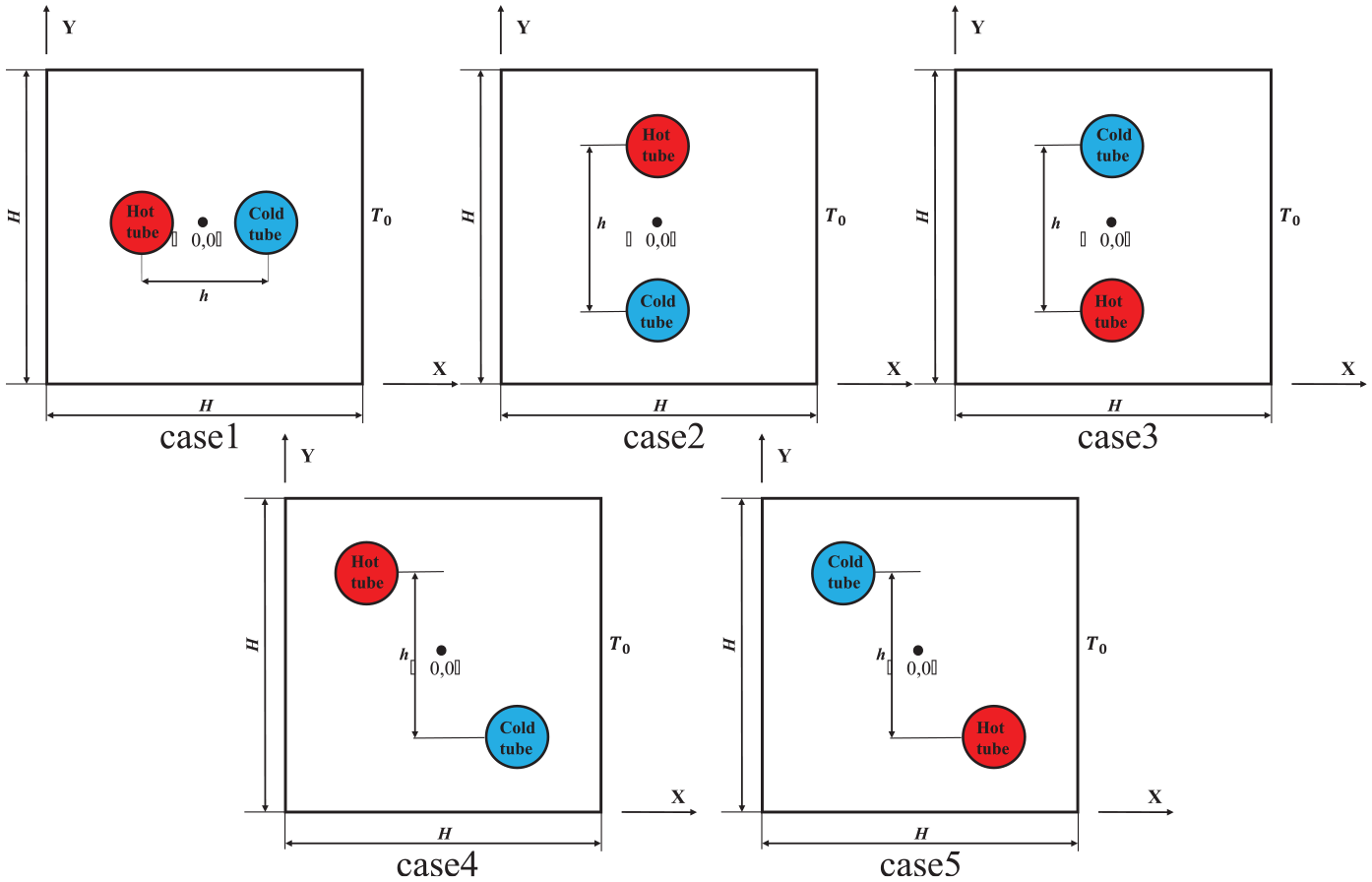
Schematic diagram of five different spatial positions.
The governing equations inside the closed cavity with hot and cold tubes are described by the Navier–Stokes and the energy equations, respectively. The governing equations are transformed into dimensionless forms under the following non-dimensional variables. 32 The dimensionless variables are defined as:


The dimensionless forms of the governing equations under steady state condition are defined in the following equations.
Continuous equation:

Momentum equation:


Energy equation:

Local Nusselt number and average Nusselt number are defined as:


In the present study, a steady simulation is performed by ANSYS FLUENT. The Pressure-Velocity coupling is handled by means of Coupled algorithm, and PRESTO! Scheme is adopted for the pressure interpolation. Second Order Upwind is adopted for momentum and energy equations.
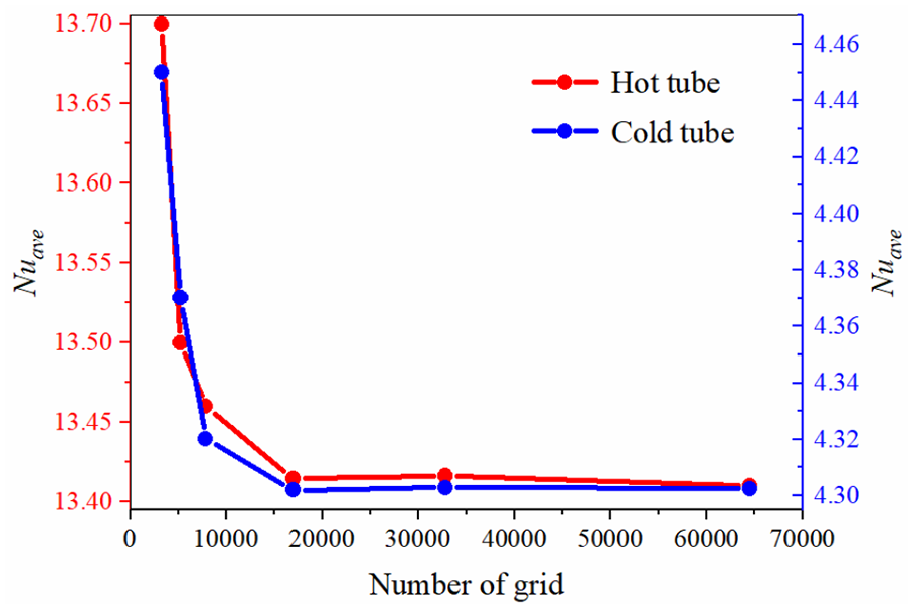
The computational mesh is shown in Figure 4. In addition, a grid independence test for the case of Ra = 106 was conducted in order to verify the accuracy of numerical calculation and choose the grid density, six uniform grids of 3256, 5234, 7869, 16,958, 32,814, and 64,529 are used for the grid- independence test. Figure 5 shows the distribution of average Nusselt number of hot tube and cold tube with different numbers of grid. It was found that when number of grids is 16,958, the simulation result could be approximately regarded as a grid-independent solution.

A grid distribution for Ra = 106.
Average Nusselt number of hot and cold tube with different numbers of grid.
To validate the rationality of the method in this paper, a natural convection problem in a cooling outer cavity with a heated inner cylinder located in the center was tested. The computational and experimental research studied by Kim et al. 33 and Warrington and Powe 34 were used for comparison. The average Nusselt number of hot and cold tubes were obtained as shown in Table 2. It can be found that the difference between present study and references is very small.
Comparsion of Nuave from the present study with those of previous numerical and experimental results.

Results and discussion
Effect of Ra on natural convection
Figure 6 shows the distribution of the isotherms and streamlines at different Ra numbers from 103 to 106. Due to the buoyant effects caused by the temperature difference, recirculating vortices are formed which are clearly displayed by the closed streamlines.

Distribution of isotherms and streamlines for different Ra numbers at 103–106 (contour values range from 0 to 1 with 20 levels).
When Ra = 103, heat transfer in the cavity is controlled by heat conduction. As a result, the distribution of the temperature and flow fields are symmetric about the vertical and horizontal centerlines respectively. The isotherms surround the tubes, and the whole streamlines contain a inner small vortex and a large outer vortex around the tubes.
The distribution of streamlines and isotherms at Ra = 104 is similar to that at Ra = 103, because the heat transfer in the cavity is also dominated by heat conduction. However, the distribution of streamlines and isotherms rotates clockwise around origin because of the weak convection.
With the increasing Ra, the streamlines and isotherms become more twisted because of the dominant convection heat transfer mode. When Ra = 105, the inner two vertices of streamlines become more stretched and merge into one vortex to match the area between two tubes. In addition, when Ra = 105, the interaction between the hot and cold tubes is strengthened, so that the air is drived to create two small vortices at the two corners in the cavity.
When Ra = 106, the heat transfer in the cavity is dominated by convection overwhelmingly. The isotherms become more densely packed near the tubes. The inner vertices of streamlines separate into two larger vertices, and the two small vortices at the two corners become larger.
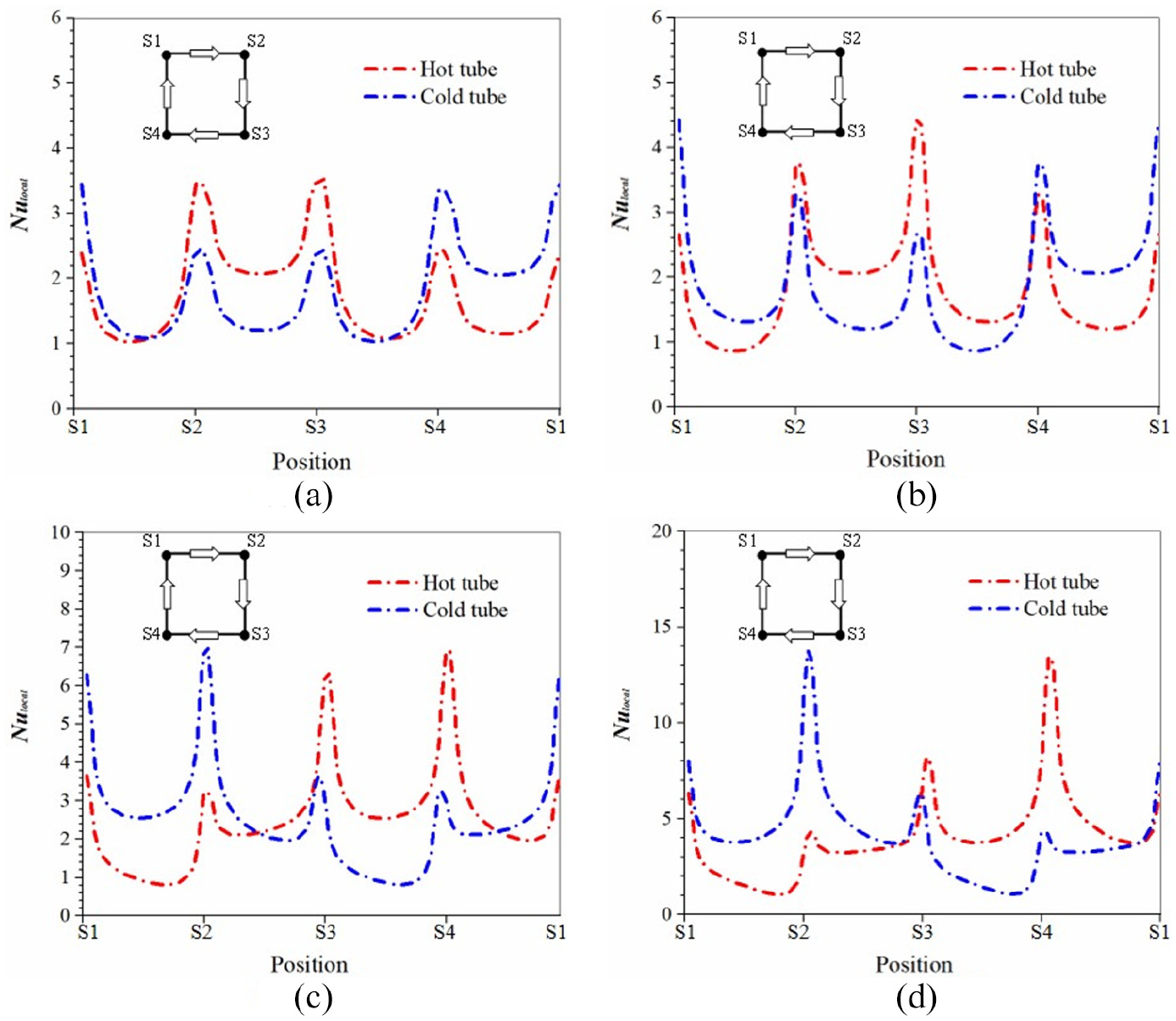
Figure 7 shows local Nusselt number of the tubes at different Ra numbers. Figure 8 shows local Nusselt number of the peak values of the tubes at different Ra numbers.
Distribution of Nulocal along the surface of the heating and cooling tube at different Ra numbers from 103 to 106: (a) Ra = 103, (b) Ra = 104, (c) Ra = 105, and (d) Ra = 106.

Distribution of Nulocal in the four corners of the square tube.
As is shown as Figure 7, the values of Nulocal along the tubes increase with increasing of Ra number. Nusquare has four local high peaks at the corner (S1–S4), the values of peaks are shown as in Figure 8.
When Ra = 103 and 104, Nusquare has local high peaks at the corner and local low peaks at the center of each side because of the effect of sharp corners on flow. Comparing hot tube with cold tube, the values of Nusquare along the top wall (S1S2) and bottom wall (S3S4) are similar except that at the sharp corners. The values of Nusquare along the hot right wall are larger than that along the cold right wall, because the promotion of convection is significant between the tubes. The values of Nusquare along the hot left wall are smaller than that along the cold left wall because of convection.
When Ra = 105 and 106, the effect of convection caused by the difference between two tubes on the flow-field and heat transfer in the cavity is larger than that caused by heat conduction. Thus Nusquare has larger local high peaks at the corner, but the local low peaks of Nusquare change a lot. For the hot tube, the positions at which Nusquare has local low peaks along the top and left walls move toward S2 and S1, respectively. While the positions at which Nusquare has local high peaks along the bottom and right walls move toward S3 and S2, respectively.
It can be found that Nusquare has very similar values along the hot right wall and cold left wall, (the hot left wall and cold right wall), (the hot top wall and cold bottom wall), (the hot left wall and cold right wall) at all Ra numbers, because the temperature difference between cavity and tubes performs the same way on these surfaces.
Effect of shapes of tube on natural convection
The thermal and flow fields are presented in the form of isotherms and streamlines. The distribution of isotherms and streamlines for different tube-shapes at Ra = 103–106 is shown as Figures 9 and 10.

Distribution of isotherms and streamlines for different Ra values at 103 (left column) and 104 (right column)(contour values range from 0 to 1 with 20 levels).

Distribution of isotherms and streamlines for different Ra values at 105 (left column) and 106 (right column)(contour values range from 0 to 1 with 20 levels).
The distribution of isotherms and streamlines for different tube-shapes at all Ra numbers is generally similar to Figure 6, because the tubes are much smaller than the cavity. However, the flow-structure of the area betweeen two tubes is slightly changed on account of the different tube-shapes. As a result, when the tube-shape changes, the distribution of the flow-field, and thermal-field has a slight change in the area between two tubes. When the tube-shapes are triangle and trapezoid, the isotherms become more densely between two tubes. There is more space above than below so the upper small inner vortex of steamlines slightly become larger than that at the bottom.
While the distribution of flow and thermal field is also maintained at good symmetry when tube-shape is circle, because the region between two circular tubes is symmetry.
Figure 11 shows the comparison of local Nusselt numbers for various tube-shapes tubes at Ra = 103. Because the distribution of isotherms and treamlines for four kinds of tube-shapes is different, the distribution of local Nusselt numbers along the surfaces of the different tubes is different. Nulocal has local high peaks at the corners each side, similar to Figure 7, because of the enhanced disturbance of the air flow around the sharp corner. Since the case of square tube has been mentioned in the previous section, it is not described in this section. When Ra = 103, the degree of convection in the cavity is much less than heat conduction, thus the main heat transfer mode in the cavity is heat conduction. Nutriangle has three local high peaks at corners T1, T2, and T3 while it has three local lower peaks near the centers of three sides. Nutrapezoid has four local high peaks at corners I1, I2, I3, and I4; it has four local lower peaks near the centers of four sides. For the hot tube, Nucircle has a local high peak at

Distribution of Nulocal along the hot tube (left column) and cooling tube (right column) for different tube shapes at Ra = 103.
Figure 12 shows the distribution of local Nusselt numbers for various tube-shapes tubes at Ra = 104. The effect of tube-shapes is the main factor in determining the distribution of local Nusselt numbers, similar to that when Ra = 103. When Ra = 104, the heat transfer in the cavity is still dominated by heat conduction. The positions at local high and low peaks of Nu are generally similar to those when Ra = 103; while the relative position and size of these local peaks change slightly, as shown in Figure 12. Particularly, for the hot tube, the position at which Nucircle has a local low peak moves to

Distribution of Nulocal along the hot tube (left column) and cooling tube (right column) for different tube shapes at Ra = 104.
The distribution of local Nusselt numbers for various tube-shapes tubes at Ra = 105 is shown as Figure 13. Because the structure of isotherms and streamlines at Ra = 105 is different from that at Ra = 103 and 104, the distribution of local Nusselt numbers for various tube-shapes tubes at Ra = 105 is different from that at Ra = 103 and 104. The gradient of local Nusselt numbers around the corners has a more dramatic rise because of the presence of the convection. The positions at local peaks of Nu change a lot because the main heat transfer mode in the cavity is convection. For the triangle hot tube, the position at local low peak of Nutriangle on the left and right wall move toward T2. Rather, for the triangle cold tube, the positions at local low peaks of Nutriangle on the left and right wall move away from T2. In addition, for the hot circle tube, the position at which Nucircle has a local low peak moves to

Distribution of Nulocal along the hot tube (left column) and cooling tube (right column) for different tube shapes at Ra = 105.
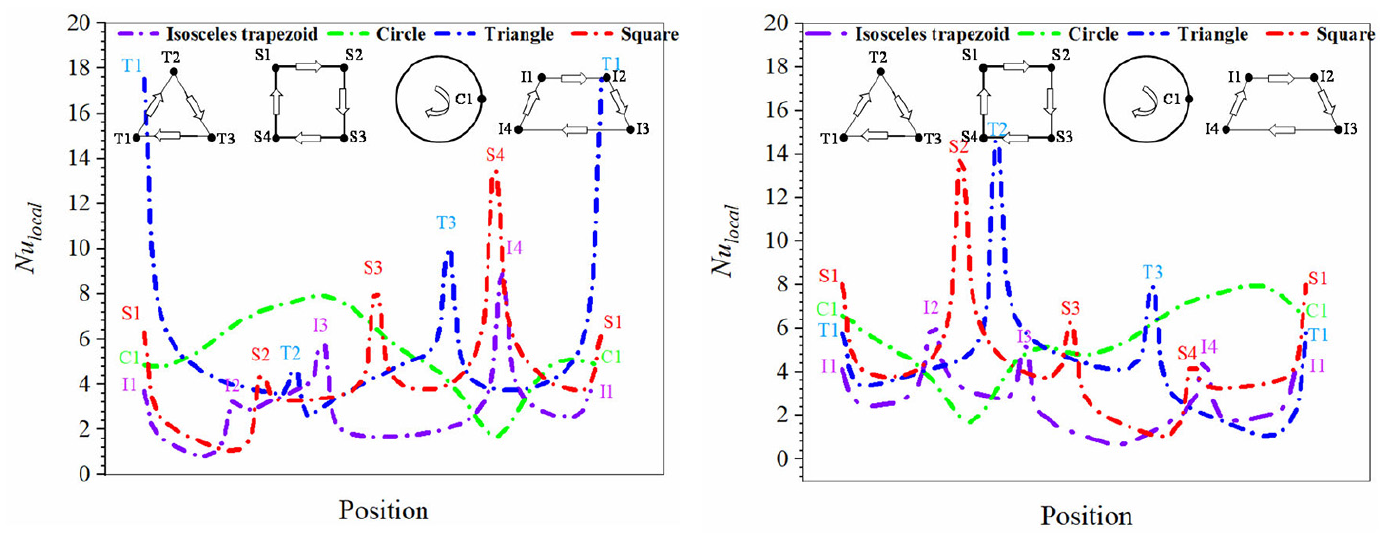
The distribution of local Nusselt numbers for various tube-shapes tubes at Ra = 106 is shown as Figure 14. The distribution of local Nusselt numbers at Ra = 106 is different from that at
Distribution of Nulocal along the heat tube (left column) and cooling tube (right column) for different tube shapes at Ra = 106.
In addition, as shown in Figures 11 to 14, the relative altitude of local Nusselt numbers changes because of the different tube-shapes. In general, the gradient of Nutriangle, Nutrapezoid, and Nusquare has drastic change near the corners, while the Nucircle has a moderate distribution around the whole tube because of the better flow-field structure.
In addition, as shown in Figures 11 to 14, the relative altitude of local Nusselt numbers changes because of the different tube-shapes. In general, the gradient of Nutriangle, Nutrapezoid, and Nusquare has drastic change near the corners, while the Nucircle has a moderate distribution around the whole tube because of the better flow-field structure.
Figure 15 shows the distribution of average Nusselt numbers for various tube-shapes tubes at Ra = 103–106. It can be found that Nucircle and Nutriangle has larger average Nusselt numbers than others, the average Nusselt number of Nutrapezoid is smallest; and all the values of the average Nusselt numbers increases with increasing of Ra. The circular and triangular tubes have fewer sharp corners, so the distribution of Nusselt number is more uniform. In terms of spatial distribution, the number of sharp corners are fewer, the interaction between heat tube and cold tube is more significant and the heat exchange effect is better. Therefore, the sharp corner of tube should be reduced as much as possible in engineering.
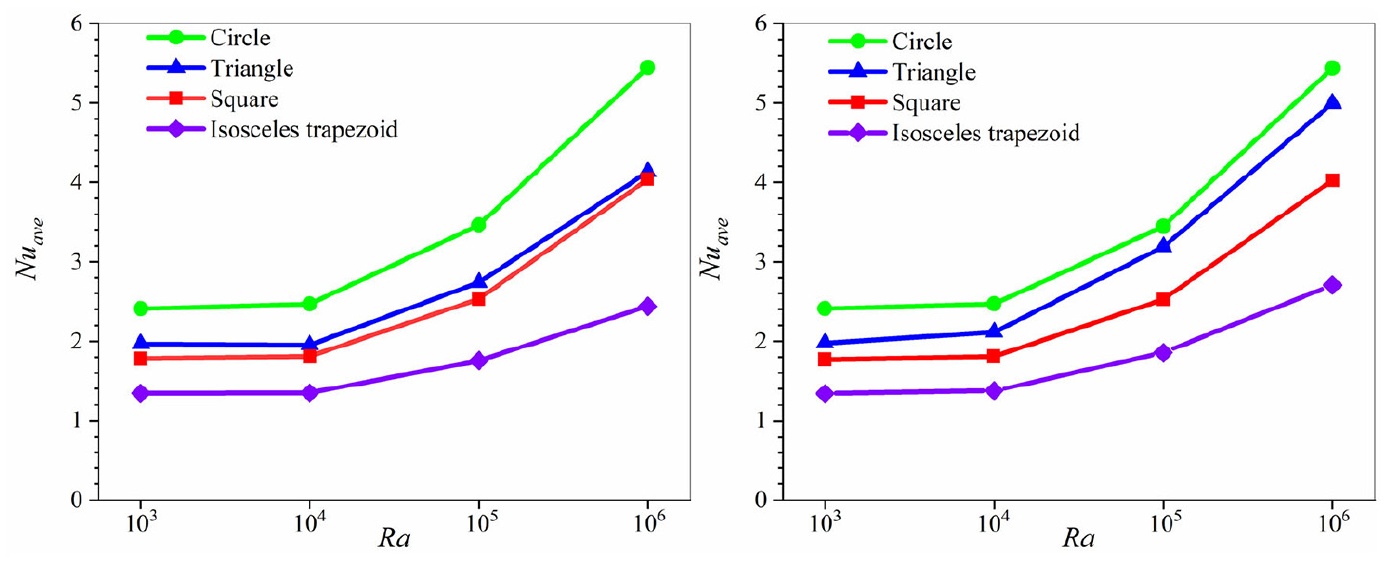
Distribution of Nuave along the hot tube (left column) and cooling tube (right column) for different tube shapes and Ra numbers.
Effect of spatial position on natural convection
From the previous study, we founded that circular and triangular tubes have a better heat transfer effect. The effect of different spatial positions is investigates in this section.
Figures 16 and 17 presents the distribution of isotherms and streamlines in the cavity for different spatial positions of the inner circular and triangular tubes at Ra = 103 and 106. As shown in Figure 16, when Ra = 103, heat transfer in the cavity is controlled by heat conduction, so the distribution of isotherms and streamlines in the cavity is symmetric. When case2, the distribution of the temperature and flow fields are symmetric about the vertical and horizontal centerlines (through the origin), the whole streamlines contain four vortices at the four corners in the cavity. When case3, the distribution of isotherms and streamlines is similar to that in case2, because the convection is much less than heat conduction. When case4 and case5, the distribution of the temperature and flow fields are symmetric about the origin.
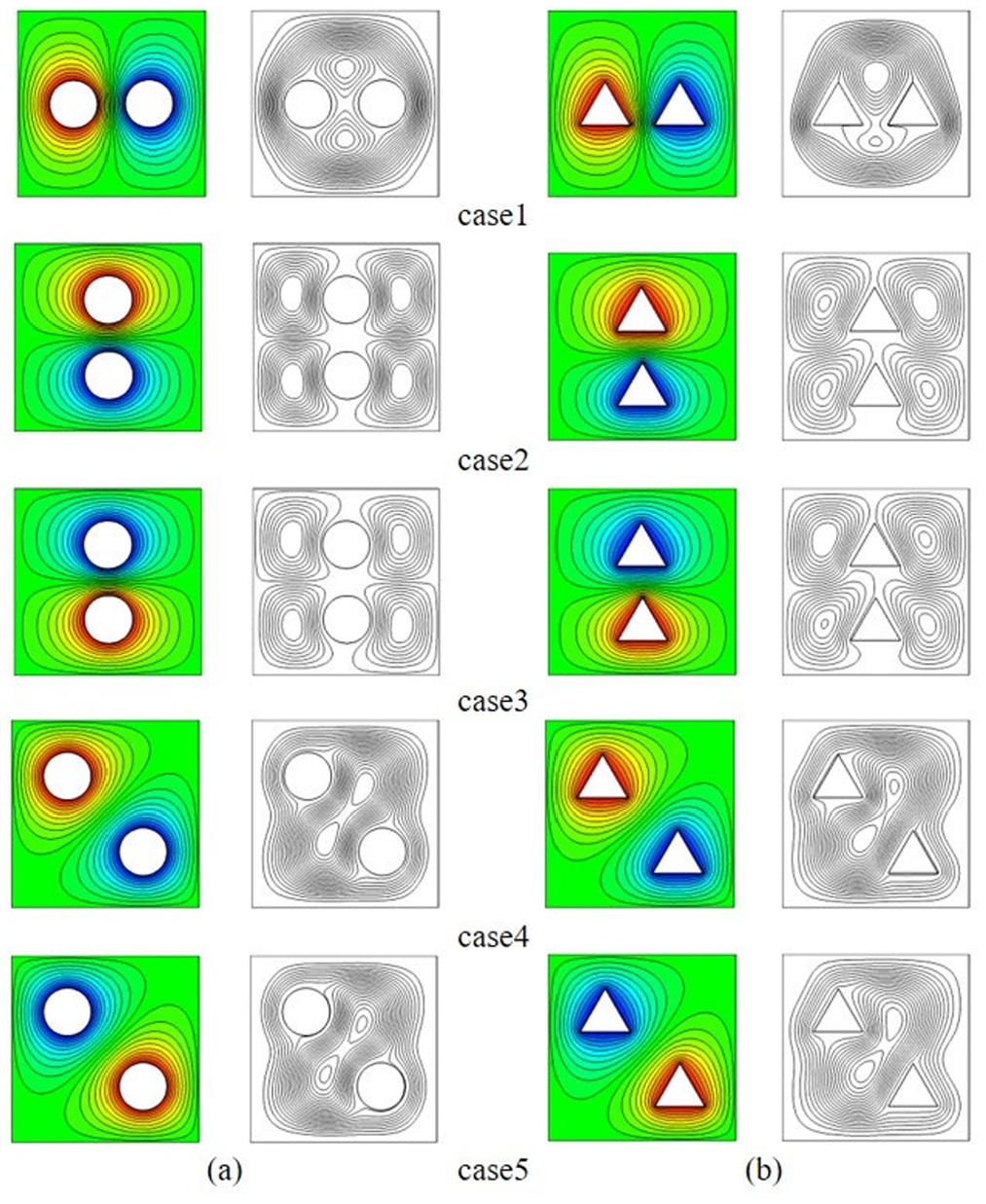
Distribution of isotherms and streamlines of circular (a) and triangular (b) tubes for different spatial positions at Ra = 103 (contour values range from 0 to 1 with 20 levels).

Distribution of isotherms and streamlines of circular (a) and triangular (b) tubes for different spatial positions at Ra = 106 (contour values range from 0 to 1 with 20 levels).
As shown in Figure 17, when Ra = 106, heat transfer in the cavity is controlled by convection, so that the distribution of isotherms and streamlines in the cavity changes a lot. When case2(a), the distribution of the isotherms are symmetric about the vertical and horizontal centerlines and the distribution of the streamlines is symmetric about the origin; when case2(b), the distribution of isotherms and streamlines is similar to case2(a), but the two small vertices are generated under the bottom tube, because the thermal plume rising from the bottom wall of the cavity is encumbered by the bottom wall of the cold tube. When case3, the distribution of the isotherms and streamlines are symmetric about the vertical centerline (through the origin). The thermal plume rising from the hot tube is encumbered by the cold tube, resulting in its incomplete development. When case4, the distribution of isotherms and streamlines is symmetric about the origin, similar to case2(b),the two small vertices are also generated under the bottom tube as shown in case4(b). When case5, the distribution of the isotherms and streamlines changes a lot, the isotherms around two tubes become more stretched and distorted because of the longer distance between both tubes and the effect of cold tube on hot tube; the streamlines contain a large vortex around two tubes, a small vortex between two tubes, and two vortices at the corners.
Figure 18 shows the distribution of local Nusselt numbers along the surface of hot and cold circular tubes for different spatial positions at Ra = 103. It can be seen that spatial positions have a significant influence on the distribution of local Nusselt numbers. The relative spatial positon of both tubes and the interaction of the both tubes are the main factors in determining the distribution of local Nusselt numbers. For the hot tube, when case2, Nucircle has two local high peaks at

Distribution of Nulocal along the heating tube (left column) and cooling tube (right column) for different spatial positions at Ra = 103.
Figure 19 shows the distribution of local Nusselt numbers along the surface of hot and cold triangular tube for different spatial positions at Ra = 103. The distributions of local Nusselt numbers for case1–case5 are similar because of the shape of tubes and heat conduction mode. While the bottom walls of hot tube (case2) and cold tube (case3) have larger local Nusselt numbers. The small distance and the large temperature difference between hot tube and cold tube, and the dominant heat transfer mode is heat-conduction, these take a combined influence on enhancing the fluid flow in this area.

Distribution of Nulocal along triangular heating tube (left column) and triangular cooling tube (right column) for different spatial positions at Ra = 106.
Figure 20 shows the distribution of local Nusselt numbers along the surface of hot and cold circular tube for different spatial positions at Ra = 106. It can be found that the distribution of local Nusselt numbers is different from that at Ra = 103 because of the enhanced convection. The distance between both tubes, the interaction of the both tubes, and the intensity of convection are the main factors in determining the distribution of local Nusselt numbers. The distributions of Nucircle for case2 and case4 are the same because the enhanced convection decrease the effect of distance between both tubes and the cold tube does not obstruct the thermal flow from the surface of hot tube. For the hot tube, the Nucircle for case2 and case4 has a local low peak at

Distribution of Nulocal along circular heating tube (left column) and circular cooling tube (right column) for different spatial positions at Ra = 106.
Figure 21 shows the distribution of local Nusselt numbers along the surface of hot and cold triangular tube for different spatial positions at Ra = 106. The distribution of local Nusselt number is similar to that at Ra = 103. While the left wall of hot tube (case5) and the bottom wall of cold tube (case3) have larger local Nusselt numbers.
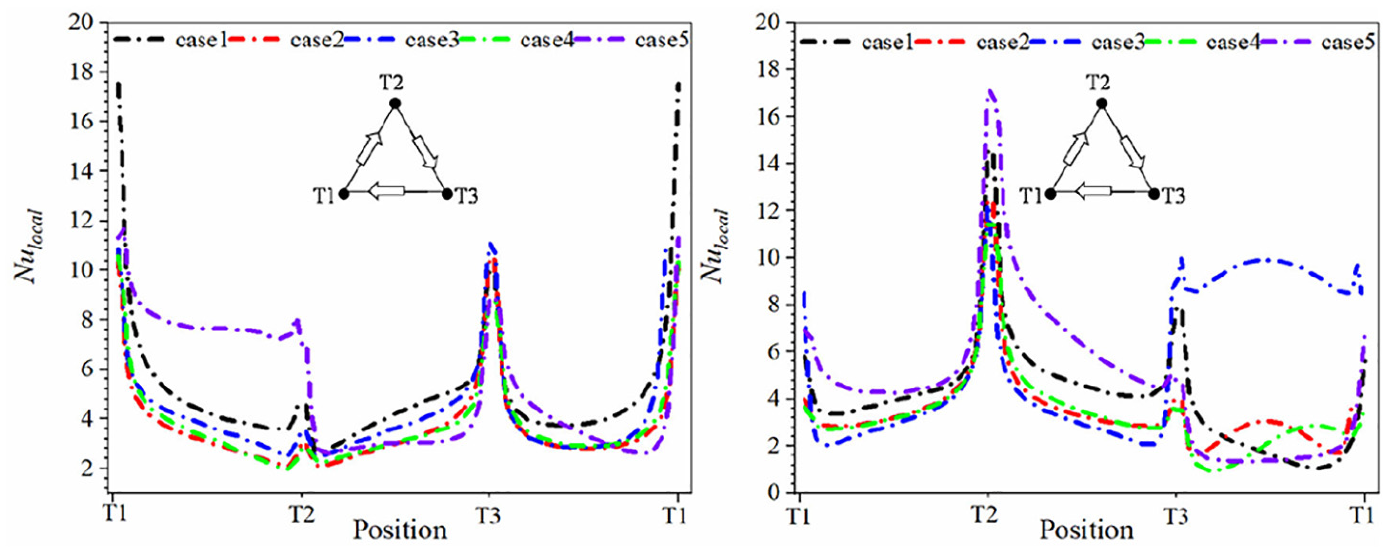
Distribution of Nulocal along triangular heating tube (left column) and triangular cooling tube (right column) for different spatial positions at Ra = 106.
Figure 22 shows the distribution of average Nusselt numbers along the hot tube (left column) and cold tube (right column) for different spatial positions.

Distribution of Nuave along the heating tube (left column) and cooling tube (right column) for different spatial positions.
When Ra = 103, the distribution of Nuave of hot and cold tube is uniform, because the main heat transfer mode in the cavity is heat conduction and the walls of cavity perform on both tubes in the same way. Nuave of circular tube are larger than that of triangular tube because of the effect of tube-shape.
When Ra = 106, for the hot tube, Nuave of circular tube are larger than that of triangular tube for all the cases. Nuave of circular tube has a maximum value in case5; Nuave of triangular tube has a maximum value in case5. For the cold tube, Nuave of circular tube has a maximum value in case5; Nuave of triangular tube has a maximum value in case4. It can concluded that it has a better heat transfer effect for circular tubes in case5.
Conclusion
In this paper, the two-dimensional natural convection heat transfer in a square cavity with a hot tube and a cold tube is studied by means of finite volume method. The physical model considered is a closed square cavity filled with air. The effects of Ra number, shape of tube, and spatial position on convective heat transfer are performed in form of isotherms, streamlines, average, and local Nusselt number. Based on the presented numerical results and analysis, following conclusions are summarized.
The Ra number ranges 103 from 106, as Ra number is increased, the heat transfer mode in the closed cavity converts from heat conduction to convection, and the isotherms and streamlines become asymmetric and more twisted. In addition, the average and local Nusselt number of the tubes increase with the increasing Ra number.
The natural convective heat transfer is investigated when the shapes of tube are square, circle, triangle, and isosceles trapezoid. The results indicates that the variation of the shape of the tube has less influence on the distribution of isotherms and streamlines in the cavity, and the effect of shape of tube on isotherms and streamlines is mainly reflected in the region between two tubes. However, the shapes of the tube has a noticeable influence on the distribution of the average and local Nusselt numbers. When Ra number and spatial position are constant, the average and local Nusselt numbers of circular and triangular tubes are larger, indicating that the heat transfer effect of circular and triangular tubes is better than others. In addition, local Nusselt number has a peak value in the sharp angle of the tubes, so circular tube has a uniform and smooth distribution of local Nusselt number.
The spatial position of hot and cold tubes has a significant effect on the distribution of isotherms, streamlines, average and, local Nusselt numbers. The plume heat flow rising from the hot tube is obstructed by the cold tube, resulting in its insufficient expansion. It is found that the best heat transfer effect appear in case5 (Oblique diagonal, the cold tube is higher than the heat tube).
The research in this paper provides theoretical basis for the design and layout of the cooling tube and heat tube of the passive residual heat removal system of nuclear power plant containment. In order to obtain a better convective heat transfer, the interaction between cavity with different shapes and internal heat and cold source can be considered in the future.
Footnotes
Appendix
Declaration of conflicting interests
The author(s) declared no potential conflicts of interest with respect to the research, authorship, and/or publication of this article.
Funding
The author(s) disclosed receipt of the following financial support for the research, authorship, and/or publication of this article: This research is supported by National Key Research and Development Program of China, Grant No. 2016YFC0802100.
