




Abstract
Industry and agriculture are two major industries for a country's economic development and also important areas for promoting sustainable development. At present, most countries in the world have started the process of industrialization, and green agriculture is also valued by all countries. So what will be the impact of industrialization on the development of low-carbon agriculture? Studying this problem has a good theoretical and practical significance. To this end, we take the example of China's 2000–2021 provincial samples to study the impact of industrialization on agricultural carbon productivity. The study found that industrialization has a nonlinear effect on agricultural carbon productivity, with a significant U-shaped feature, i.e. first deteriorating and then improving. And there is obvious heterogeneity in this feature. The balance area of grain production and marketing and the main grain selling area are better than the main grain-producing areas, and the eastern and central regions are better than the western region. At the same time, in this process of influence, the level of economic development and urbanization has played a good role mechanism, while the transport infrastructure has played a positive regulatory effect.
Introduction
In March 2023, the Intergovernmental Panel on Climate Change (IPCC) held the 58th plenary session and released the Comprehensive Report on the Sixth Assessment Report: Climate Change 2023. The report further clarified that greenhouse gas emissions from human activities are the cause of global warming. The global mean surface temperature increased by 1.1°C in 2011–2020 compared to 1850–1900. In the face of this serious situation, governments are actively taking measures to reduce carbon emissions, and agriculture can both absorb carbon dioxide and produce carbon dioxide emissions. In the Fourth Assessment Report of the IPCC, agriculture is the second largest contributor to carbon emissions. Therefore, how to reduce agricultural carbon emissions, improve agricultural carbon productivity, and develop low-carbon and green agriculture has become an important task for governments in all countries. China is the world's largest emitter of carbon dioxide, of which agricultural carbon emissions reach 17%, higher than the world average. 1 China is under enormous pressure to reduce agricultural carbon emissions. To this end, in October 2021, China issued the “Action Plan for Peaking Carbon Emissions before 2030,” which clearly proposed to “promote agricultural and rural emission reduction and carbon sequestration.” In May 2022, China promulgated the “Implementation Plan for Emission Reduction and Carbon Sequestration in Agriculture and Rural Areas,” which systematically laid out how to balance the development needs of agriculture to increase production and income and achieve the ecological goal of emission reduction and carbon sequestration. While the agricultural economy is growing rapidly, making every effort to promote carbon peaking and carbon neutrality in agriculture has become an urgent problem to be solved.
Before the industrial revolution, agriculture was the leading industry for economic growth and the basic industry for social survival. In the industrial society, with the deepening of the industrialization process, industrial production has gradually become the main component of social production. 2 The industrial sector has gradually become the leading sector of the social economy, and the dominance of the agricultural sector has gradually been replaced by the industrial sector. Industry has become an important sector for absorbing surplus agricultural labor force and also the main supplier of modern agricultural production factors. Modern agricultural production factors have played an important role in transforming traditional agriculture, improving agricultural labor productivity and promoting the development of agricultural production. The “Second Biennial Update Report on Climate Change in China” released in 2019 shows that in recent years, the sources of carbon emissions have gradually shifted from agriculture and animal husbandry each accounting for “half of the country” to agriculture, animal husbandry, and energy consumption accounting for “three parts of the world.” Energy consumption due to mechanization has become the most uncertain factor in achieving carbon neutrality in agriculture. This suggests that industrialization has a significant impact on the development of low-carbon agriculture. While reducing carbon emissions is key to the low-carbon transition and achieving peak carbon emissions, the world's population is still growing and more food is needed. Carbon productivity, which combines the dual goals of stabilizing atmospheric carbon dioxide levels and sustaining agricultural growth, is one measure of success in slowing the rate of climate change. However, there is no literature examining the impact of industrialization on agricultural carbon productivity.
Agriculture and industry are complementary. Agriculture is the foundation of a country, while industry is the foundation of development. Low-carbon development is the only path to sustainable human development. The purpose of this study is to provide new policy pathways for low-carbon development in agriculture. This article chooses China as a case study because China is the world's largest developing country, with rapid industrialization and a large population and agriculture, making it highly representative. The research results can provide useful guidance for the low-carbon development of agriculture in other developing countries and economies. Therefore, this article takes 31 provinces (autonomous regions, municipalities) in China (excluding Hong Kong, Macau, and Taiwan) as a sample and examines the impact of industrialization on agricultural carbon productivity from 2000 to 2021. The marginal contribution of this article is to explore four questions from the perspective of industrialization, focusing on theoretical analysis and empirical testing. First, what is the impact of industrialization on agricultural carbon productivity? Is it getting worse or better? Second, what is the heterogeneity of industrialization on agricultural carbon productivity? Third, through what mechanism of action does industrialization affect agricultural carbon productivity? Fourth, are there other factors that influence this process in the influence of industrialization on agricultural carbon productivity? These four questions have not been discussed in the existing literature, so they are also the innovation points of this paper.
Literature review
The existing literature has not yet examined the relationship between industrialization and agricultural carbon productivity, but scholars have conducted many studies on the influencing factors of agricultural carbon productivity and the effect of industrial carbon emissions. At the same time, scholars have also conducted related research on the coordinated development of industrialization and green agriculture. These documents can serve as a reference for studying the impact of industrialization on the agricultural carbon production rate in China.
Factors influencing the agricultural carbon production rate
Regarding the factors affecting the agricultural carbon production rate, the existing literature was reviewed from the following aspects. First is the impact of the development of the digital economy and the digital transformation of agriculture on agricultural carbon productivity. The digital economy can significantly increase agricultural carbon productivity through technological innovation, and the impact is greatest in eastern China and in the food production and marketing balance zone. 3 At the same time, the digital transformation of agriculture is also conducive to the improvement of agricultural carbon productivity, but the main transmission mechanism is the upgrading of agricultural industrial structure and agricultural scale. And it is influenced by the level of urbanization and rural human capital. 4 Second is the impact of agro-industrial agglomeration and agricultural specialization agglomeration on agricultural carbon productivity. Agricultural industrial agglomeration has no significant impact on local agricultural carbon productivity, but it has a significant inverted U-shaped impact on agricultural carbon productivity in surrounding areas, and financial decentralization will weaken this impact.5,6 However, agricultural specialization agglomeration improves agricultural carbon productivity through agricultural technology, and agricultural specialization agglomeration has different effects on agricultural carbon productivity under different technical levels. 7 Third is the impact of high-standard farmland construction on agricultural carbon productivity. In the process of promoting agricultural carbon productivity through high-standard farmland construction, agricultural scale operation, agricultural planting structure, and agricultural technology progress have played an effective intermediary effect. 8 Fourth is the impact of agricultural fiscal expenditure on agricultural carbon productivity. Agricultural technology innovation and scale operation efficiency are two effective channels for agricultural fiscal expenditure to improve agricultural carbon productivity. At the same time, the input of agricultural machinery and fertilizer are the two threshold variables for agricultural financial expenditure to improve agricultural carbon productivity. 9 In addition, urbanization, 10 the level of agricultural economic development, 11 land transfer, 12 agricultural green technology, 13 and agricultural insurance 14 are also important factors affecting agricultural carbon productivity.
The above study analyzed the influencing factors of agricultural carbon productivity from different perspectives, including factors directly related to agriculture such as digital transformation, agricultural structure, farmland construction, and agricultural fiscal expenditure. There are also factors beyond agriculture, such as the development of the digital economy and urbanization. Industrialization is not directly mentioned among these drivers. Although the threshold effects of agricultural machinery and fertilizer inputs were analyzed in the impact of agricultural fiscal expenditure on agricultural carbon productivity, these two factors are based on industrialization. However, the study only analyzed the indirect effects of these two factors and did not directly analyze the impact of overall industrialization on agricultural carbon productivity. Meanwhile, among the above factors, only agro-industrial agglomeration has an inverted U-shaped impact on the agricultural carbon production rate in the surrounding areas through spatial spillovers, while the other factors are all linear.
The impact of industrialization on carbon emissions
There are currently three main conclusions regarding the impact of industrialization on carbon emissions. First, industrialization will increase carbon emissions.15–17 The industrialization process requires the use of more energy than the agricultural sector, especially fossil fuels, to increase carbon emissions. 18 And R&D intensity, investment intensity, and R&D efficiency are the three main factors influencing carbon emissions from industrialization. 19 From the perspective of carbon absorption, industrialization requires the consumption of more natural resources, leading to a decrease in forest cover, 20 which reduces carbon absorption and worsens the environment. 21 Secondly, industrialization will reduce carbon emissions. 22 In the long term, industrialization significantly reduces carbon emissions, but in the short term, there is a nonsignificant relationship between industrialization and carbon emissions. 23 Because the improvement of industrialization promotes the formation of industrial agglomeration and improves energy efficiency, it helps to reduce carbon emissions. 24 At the same time, changes in industrial structure have a significant negative impact on carbon emissions, such as the linkage between manufacturing and service industries, i.e. the upgrading of industrial structure, which contributes to carbon emission reduction and sustainable development.25,26 Thirdly, there is a bidirectional causal relationship between industrialization and carbon emissions, 27 such as two-way Granger causality. 28
There are different conclusions about the carbon emissions from China's industrialization. Industrialization increases carbon emissions. Firstly, industrialization will increase carbon emissions. As China's industrialization is based on large-scale investment in carbon resources, the industrial sector has become the main source of carbon emissions in China, and the proportion may even reach 75%–80%.29,30 Secondly, the impact of industrialization on carbon emissions varies at different stages of industrialization. In the early stage of industrialization, economic development was the primary goal, environmental protection was neglected, and carbon emissions were serious. With the improvement of environmental protection awareness and the development of energy-saving and emission-reducing technologies, the driving role of industrialization in economic development has surpassed its carbon emissions, and the efficiency of carbon emissions has gradually improved.31,32 Industrial carbon emissions will gradually decrease with the increase in industrial output value, especially when the per capita industrial output value reaches 125,000 yuan, the effect will become more significant. 33
Industrialization is an important factor affecting carbon emissions, but there are different conclusions about the specific impact of industrialization on carbon emissions, which may be related to the development stage of industrialization. Overall, in the early stages of industrialization, carbon emissions will increase. In the later period, with the continuous improvement of the industrialization level, especially the influence of industrial agglomeration and technological progress, the carbon emission reduction effect of industrialization gradually appeared. China's reality has also confirmed this rule.
Industrialization and agricultural carbon productivity
Regarding industrialization and agricultural carbon productivity, there is no literature that directly examines the relationship between them. However, the indirect effect of industrialization on carbon productivity is analyzed in the relevant literature. For example, industrialization has played a positive regulatory role in the process of foreign direct investment affecting carbon productivity. 34 In addition, modern agricultural production factors include agricultural machinery, fertilizers, pesticides and seeds, and plastic films, and these factors are the main sources of agricultural carbon emissions. Therefore, industrialization is considered to be one of the main causes of significant agricultural land loss and environmental pollution. 35 Among them, industrially produced chemical fertilizers, agricultural machinery, and pesticides are the main sources of agricultural carbon emissions.36–38 However, with the improvement of the level of industrialization, especially industrial products with high technical content are used in agricultural production. These products, such as the use of robots and the application of digital technology, all contribute to reducing agricultural carbon emissions.39,40
From the above literature review, we can draw the following conclusions. First, agricultural carbon productivity has attracted the attention of many scholars, and the factors affecting agricultural carbon productivity have been studied from various aspects. However, the impact of industrialization on agricultural carbon productivity has not received enough attention, and there is no literature research on this topic. Second, many scholars have studied the impact of industrialization on carbon emissions, but they have not reached unanimous conclusions. And there are very few studies on whether industrialization affects agricultural carbon emissions. Therefore, our research on the impact of industrialization on agricultural carbon productivity can well complement the existing literature, further expand the influencing factors of agricultural carbon productivity, and enrich the mechanism of industrialization on agricultural sustainable development.
Mechanism of action and research hypothesis
The U-shaped effect of industrialization on agricultural carbon productivity
Classical development economics theory has pointed out that the relationship between industry and agriculture varies at different stages of industrialization. In the early stage of industrialization, agriculture supports industry, and when industrialization develops to a certain extent, industry in turn supports agriculture. From 2000 to 2021, the impact of China's industrialization on agricultural carbon productivity can be divided into two phases. The first phase is from 2000 to 2011. After China joined to the WTO in 2001, the economy was gradually brought into line with the international standards, and the three industries developed and adjusted comprehensively and rapidly. In 2002, China proposed to take reform as the internal driving force, take opening-up as the external driving force, and embark on a new path of industrialization. China began to move from the primary stage of industrialization to the intermediate stage of industrialization. At the same time, after joining the WTO, China encourages the development of agricultural machinery services, agricultural technology extension services, and agricultural public services in order to enhance the international competitiveness of the agricultural industry and increase farmers’ incomes. Industry provides equipment and technical support for agricultural development, and China's agriculture has embarked on the path of scale, standardization, and branding. In addition, the flow of agricultural labor into industry and services has accelerated, creating the conditions for scale and mechanization in agriculture. However, at this stage, China's agriculture is still in the primary stage of mechanization and scale. With the unbalanced development among regions, the coordinated development of industrialization and green agriculture is only at the primary stage, resulting in the negative impact of industrialization on agricultural carbon productivity. Entering the second phase, 2012–2021. Since 2012, the growth momentum of China's traditional industry has weakened, while the service sector has maintained a steady growth trend. In 2012, the growth rate of the service sector exceeded that of the industry for the first time. The reform of information technology has led to the mutual integration of industry, service industry, and agriculture, and the agricultural producer service industry has become the new engine of modern agriculture. With the deepening of agricultural informatization, specialization, scale and intensification, mobile internet, big data technology, consulting, training, express delivery, and other services have begun to move to rural areas. Science and technology, information, capital, and talents have been effectively implanted into the agricultural industry chain, and the formation of new business forms and new models of agriculture has been accelerated. At this stage, the service-oriented industrial production has accelerated the optimization of agricultural structure, the level of informatization and intelligence has been improved, and the coordination degree of industrialization and the green agricultural development have been greatly enhanced and thus improve agricultural production efficiency and carbon productivity. Therefore, we propose the first research hypothesis.
Hypothesis 1: Industrialization has a U-shaped effect on agricultural carbon productivity.
The mechanism of industrialization on agricultural carbon productivity
Mediating effects of economic development
Industrialization can bring great economic benefits. Through industrial production mode, mechanization, automation, and other efficient production mode can be realized, so as to greatly improve production efficiency and product quality, reduce production costs, and promote the development and growth of industrial enterprises. At the same time, the industrial economy can also drive the development of other economic industries, such as construction, logistics, and scientific and technological innovation. Industrialization can promote the national technological innovation, increase the added of products, increase export revenue and employment opportunities, and thus promote the national economic development. Through the development of industrialization, a country can realize the optimal allocation of resources and enhance the national economic strength and core competitiveness. The environmental Kuznets curve (EKC) hypothesis is the most widely used hypothesis for the impact of economic growth on carbon emissions. Grossman and Krueger (1991) were the first to verify the existence of the EKC, i.e. in the early stages of economic development, pollution increases with economic growth. 41 When economic growth reaches a certain level, pollution decreases with economic growth, and there is an inverted U-shaped relationship between environmental pollution and economic growth. There is an inverted U-shaped relationship between economic growth and carbon emissions. When economic growth exceeds a certain threshold, economic growth can reduce carbon emissions as economic development and technological progress promote energy transformation. Among these, renewable energy can mitigate the negative impact of economic growth on carbon emission reduction. Agriculture, as an important area of economic growth, also applies equally to EKC. To this end, we propose the second hypothesis.
Hypothesis 2: Industrialization increases agricultural carbon productivity by promoting economic growth.
Mediating effects of urbanization
Industrialization promotes urbanization through the employment conversion effect, agglomeration economic effect, and wealth accumulation effect. The development of industry can enable more rural residents to engage in nonagricultural industries with a higher degree of specialized division of labor and promote the urbanization of the population. At the same time, the development of the industrial economy will promote the concentration of labor, capital, and other factors, thus accelerating the process of urbanization. In addition, the wealth and technology brought about by industrialization provide the necessary support for the improving urban infrastructure conditions and breaking down the transportation constraints of urbanization development. Industrialization is the foundation and driving force of urbanization, and accelerating the process of industrialization can provide the impetus for the development of urbanization. With the structural transformation of the world economy, more and more rural people have been moving to cities and towns, and people have been gradually moving towards industrialization. Industrialization has brought great material returns to the world, and the efficient production mode has also helped to greatly improve the level of agricultural production and liberate the rural labor force. Urbanization has reduced the rural labor force, which will encourage agricultural production units to pay attention to scale and intensive operation, which is conducive to resource conservation, improving labor productivity, resource utilization rate, and green production efficiency and reducing agricultural carbon emissions. At the same time, the labor force that has migrated to urban areas has changed from agricultural producers to agricultural consumers, which has a higher demand for the safety and quality of agricultural products. Therefore, it will encourage farmers to adopt green and low-carbon agricultural technologies and reduce the input of pesticides and fertilizers, which can improve the green production efficiency of agriculture and reduce agricultural carbon emissions. Accordingly, we propose the third hypothesis.
Hypothesis 3: Industrialization improves agricultural carbon productivity by promoting urbanization.
Moderating effect of transport infrastructure
With the process of industrialization, the transport infrastructure and the transport industry have developed rapidly. The improvement of transportation infrastructure promotes the development of transportation industry, which will have a positive impact on both industrial output value and agricultural output value, thus affecting the carbon emission production of both. First is the impact of transport infrastructure on industrial carbon emissions. Perfect transport infrastructure can promote innovation and bring about agglomeration effect and economies of scale, thereby reducing production costs and improving industrial output and energy efficiency. On the other hand, the construction of land transport infrastructure mainly affects the carbon emission performance of the manufacturing industry through various influencing mechanisms such as forming scale effect, accelerating regional communication, realizing energy substitution, and eliminating backward production capacity. Second is the impact of transport infrastructure on agricultural carbon emissions. On the one hand, transport infrastructure can reduce the total cost of agricultural production inputs, which is conducive to improving agricultural productivity. On the other hand, it can speed up the circulation of agricultural products, reducing the sales cost of selling agricultural products and helping to improve the agricultural profit margins. Transport infrastructure can then have an impact on carbon emissions from agricultural production processes. In particular, transport can positively regulate the impact of agricultural productivity on carbon emissions. And transport infrastructure increases the regional transfer of agricultural production by affecting the mobility of agricultural labor and other agricultural inputs, a process that will help to reduce carbon emissions.
Hypothesis 4: In the process of industrialization affecting agricultural carbon productivity, transport infrastructure has a regulating effect.
Figure 1 shows the mechanism of industrialization on agricultural carbon productivity.

Influence mechanism.
Method and data
Measurement model
Main effect model
Based on the above theoretical analysis and research hypothesis, industrialization may have a U-shaped effect on agricultural carbon productivity, so we set up a main effect model, taking into account the unobservable individual differences between provinces and the interference of special years in the empirical results. Therefore, we examined the effect of industrialization on agricultural carbon productivity by constructing a panel data regression model. The main effect model was set as follows.

Mechanism effect model
Based on the previous theoretical analysis and research hypotheses, industrialization has the potential to affect agricultural carbon productivity by promoting economic development and advancing urbanization, i.e. the mechanism effect. To test whether industrialization can affect agricultural carbon productivity through economic development and urbanization, we constructed the following mechanism effect model to test.


Moderating effect model
Based on the theoretical analysis and research hypotheses mentioned above, there is a moderating effect of transport infrastructure on the impact of industrialization on agricultural carbon productivity. To further identify the regulatory effects of other factors in the process of industrialization affecting agricultural carbon productivity, we will examine the regulatory role of transport infrastructure. Following to the practice of Shi and Li (2020) and other scholars, we use the intersection of core explanatory variables and regulatory variables to construct a regulatory effect model,
43
as shown in equation (4).

Model variables
Interpreted variables
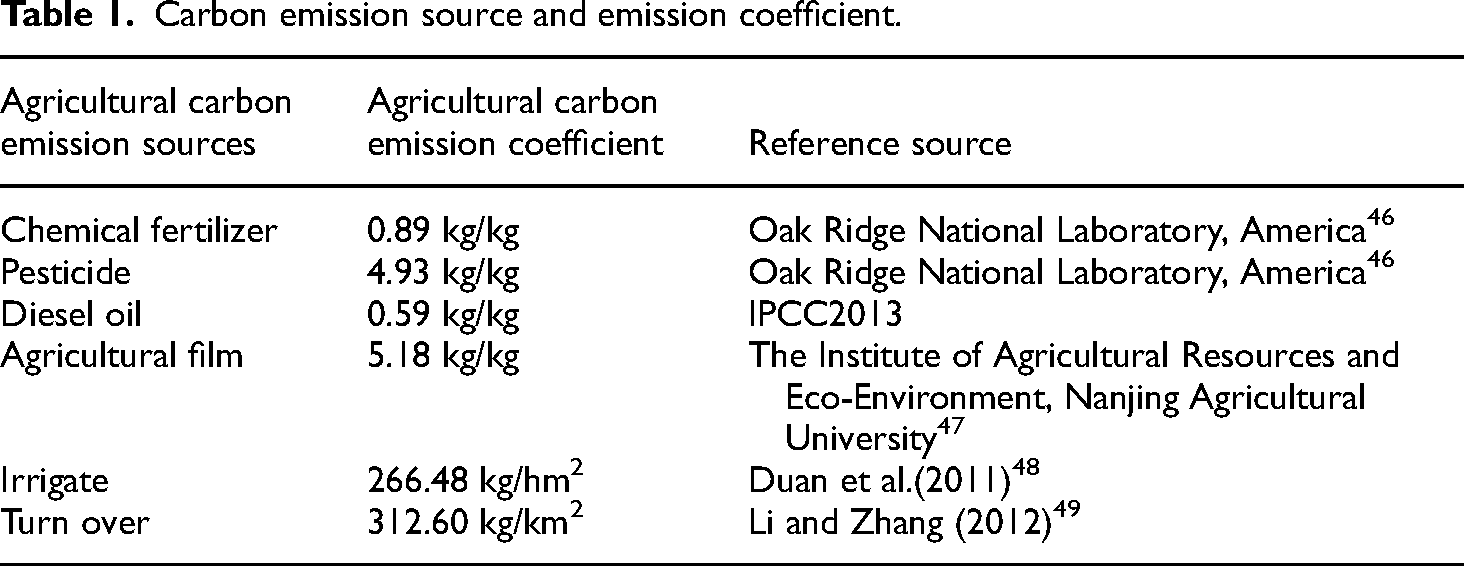
Agricultural carbon productivity (ACP). There are currently two ways of measuring agricultural carbon productivity, including the total factor productivity method and the single-factor productivity method. However, we chose to use the more common single-factor productivity measurement method as is used in the literature. According to Kaya and Yokobori (1999), agricultural carbon productivity is defined as the ratio of total agricultural output to total agricultural carbon dioxide emissions.
44
Agriculture is used here in the narrow sense of agriculture. Agricultural carbon productivity represents the output value of carbon emissions per agricultural unit and meets the development requirements of green, low-carbon, and sustainable agriculture. The calculation formula is as follows:


Carbon emission source and emission coefficient.
Core explanatory variables
Industrial level (indu). Industrialization is the use of mechanization means, with material data as raw material and with capital and labor as the factors of production, large-scale material production, and consumption of products, promoting human society from agricultural society to industrial society, characterized by machine production of the industrial sector in the GDP proportion of the rising development process. Much literature commonly uses the ratio of industrial output value to GDP to measure the level of industrialization.15,50 Therefore, this paper uses the ratio of provincial industrial output value to GDP to measure the level of industrialization.
Figure 2 shows the development of industrialization and agricultural carbon productivity in China from 2000 to 2021. First of all, the overall level of industrialization in China shows a slow rise and then a gradual decline trend, with the turning point around 2012. The reason for this phenomenon is that with the continuous growth of China's economic aggregate and the adjustment of industrial structure, the proportion of total industrial output value in GDP is constantly adjusted. But a decline in industrialization does not mean a decline in China's industrial output. In fact, China's industrial output value increased from 6618.22 billion yuan in 2000 to 368569.5 billion yuan in 2021, an increase of nearly six times. Second, the agricultural carbon productivity of agriculture has been growing, increasing 4.5 times from 0.2 in 2000 to 0.9 in 2021. Among these, agricultural carbon emissions increased by only 14% from 2000 to 2021, while agricultural output value increased by more than four times, indicating that China's carbon emissions per unit of agricultural output value have decreased significantly.

Evolution of industrialization and agricultural carbon productivity in China.
Control variables
With reference to existing studies and in combination with the subjects of the study, we selected the following control variables. Foreign direct investment (FDI) is measured by the share of FDI in GDP in each province. The level of marketization (MI) is measured by the marketization index of each province in China. The calculation method of the market index in China refers to the approach of Fan et al. (2003). 51 The level of agricultural mechanization (AML) is measured by the power of agricultural machinery (10,000 kilowatts) used per unit of sown area (one thousand hectares) in each province. Financial development (fin) is measured by the ratio of the sum of deposits and loans in each province to GDP at the end of each year. Regional innovation capacity (inno) is taken from the China Regional Innovation Capacity Evaluation Report over the years. This report was compiled by the China Science and Technology Development Strategy Research Group and the China Innovation and Entrepreneurship Management Research Center of the University of the Chinese Academy of Sciences. It has been published for 23 consecutive years and is an authoritative evaluation report on regional development in China.
Mechanistic variables
Level of economic development (pgdp). The level of economic development refers to the extent, speed, and level of economic development of a country. Measures of economic size can be divided into absolute and relative measures. Absolute size measures only the total GDP of a country or region over a given period of time, without discussing how much labor produces this level of GDP. The relative size index is concerned about the relationship between a country's population (or the number of workers) and its total GDP. The most commonly used relative size indicator is GDP per capita.
Level of urbanization (urb). The essence of the urbanization process is the process of the transformation of the rural population into the urban population. An important indicator of the level of urbanization is the urbanization rate, i.e. the share of the urban population in the total population of a region. Therefore, the urban population as a percentage of the total population at the end of each year is used to measure the level of urbanization in each province. 52
Moderator variable
Infrastructure infrastructure (infra). Transport infrastructure refers to the fixed engineering facilities that provide transport services for residents’ travel and social product transport, which is an important basis and precursor for a country's national economic development. Among the various transport infrastructures, railways and roads are the most important, accounting for the majority of the transport share. According to China's Ministry of Transport, by 2022, rail and road will account for 83% of the freight volume. Therefore, this paper selects the sum of railway and road kilometers and takes the logarithm as an alternative variable of transport infrastructure.
To make the names, abbreviations, and measures of each variable clearer, we use a tabular description, as shown in Table 2.
Main variables and measurement methods.

Data sources
Due to the difficulties in obtaining data, this paper uses panel data from 31 provinces (autonomous regions and municipalities) (excluding Hong Kong, Macao, and Taiwan) from 2000 to 2021. The relevant data are from the China Statistical Yearbook, China Rural Statistical Yearbook, and the statistical yearbooks of each province over the years, and some of the missing values are supplemented by the average method. In order to eliminate the impact of price changes, this paper takes 2000 as the base period and uses the CPI of each province to deflate all monetary data in the article. Descriptive statistics for each variable are shown in Table 3.
Descriptive statistics.

Variance factor and unit root test
In order to ensure the availability of data and the feasibility of the research, it is necessary to test for multicollinearity between different variables before conducting empirical analysis. The variance inflation factor (VIF) is a numerical value that characterizes the degree of complex collinearity between observations of independent variables. To this end, this chapter uses the variance inflation factor method to test whether there is a multicollinearity problem between variables. Table 4 shows the variance inflation factors of the main variables. From the values in the table, it can be seen that the VIF values of the main variables are all less than 10. According to the rule of thumb, the probability of severe multicollinearity between variables is low.
Variance inflation factor.

Based on the above variance inflation factor test results, a panel unit root test is carried out on all variables. In this chapter, interprovincial balanced panel data are used to conduct regression analysis. In order to avoid pseudo-regression phenomenon, before using sample data for regression analysis, it is necessary to test whether each sample data is stable, that is, stationarity test. Data stationarity is mainly tested by the unit root test method. If there is a unit root in the data series, it means that the data is a nonstationary time series. On the contrary, if there is no unit root, it means that the data is stationary. The LLC (Lagrange multiplier test for a unit root) method is used in this paper, and the results are shown in Table 5. The results show that ACP and fin are two variables with unit roots, i.e. nonstationary data.
Panel unit root test results.

Note: The original hypothesis of unit root test H0: there is a unit root. If the original hypothesis H0 is rejected then the data series is stable. Within parentheses are P-values. *** and ** represent 1% and 5% level of upper outstanding. Both constant terms and trend terms are included in the test form.
If we want to carry out measurement test on these variables, we need to carry out a cointegration test. Before the cointegration test, it is determined whether these variables have single integers of the same order. If the single integers of the same order are satisfied, it is necessary to carry out the cointegration test. An econometric regression model constructed from the variables involved only makes sense when there is a cointegration of these variables. The first-order difference of two nonstationary variables is subjected to unit root test using LLC. The statistical values and P-values of the two variables are (−4.6678, 0.0000) and (−5.7852, 0.0000), respectively, and the results of the first-order difference unit root test of the two variables reject the original null. Both are stationary sequences and are first-order single-integer variables. On this basis, the cointegration test is conducted to investigate the long-run equilibrium relationship of all variables. The results of the cointegration test are shown in Table 6, and the test results are all significant at the 1% level. Therefore, it can be assumed that there is a long-term cointegration relationship between the explained variables, the core explanatory variables, and the control variables, and the econometric model can be estimated.
Coordinate test results.

Note: *** represents the 1% significance levels, respectively.
Results of the study
Main effect test results
In this paper, stepwise regression was used to examine the direct effect of industrialization on the agricultural carbon production rate, based on the fixed effect panel model. In Table 7, in column (1), no control variables were included, and in column (2), control variables were included and the estimation results of the province fixed effect were used. In column (3), no control variables were included and in column (4), control variables were included, and the estimation results of bidirectional fixed effects of province and time were used. The results showed that the regression coefficient of the four estimation methods was significantly negative for the primary term of industrialization, while the regression coefficient of the industrial quadratic term was significantly positive. This result confirms that industrialization first aggravates the agricultural carbon production rate and then improves the agricultural carbon production rate, i.e. both have U-shaped characteristics, verifying hypothesis 1. Under the two-way fixed effect model, the influence coefficient of industrialization on the agricultural carbon production rate was −0.3568, significant at the 1% level. However, the effect coefficient of the quadratic term of industrialization on the agricultural carbon production rate was 2.6061, which was significant at the 1% level. At the same time, comparing columns (3) and (4) shows that after controlling for other factors that may affect the agricultural carbon production rate, the absolute value of the influence coefficient of the primary term and the secondary term on the agricultural carbon production rate becomes larger. This suggests that the agricultural carbon production rate is influenced not only by industrialization but also by other factors.
Benchmark regression results.

Note: Standard error is given in parentheses. “Yes” and “No” indicate whether the model controls for the relevant variables.
*, **, and *** represent the 10%, 5%, and 1% significance levels, respectively.
Among the control variables, under the two-way fixed effect, first of all, the parameter value of FDI is −1.0073, which is significant at the 1% level, indicating that foreign direct investment is not conducive to improving agricultural productivity. The reason may be that FDI is mainly invested in industries with high returns, such as industry and services, and low returns in agriculture, which does not promote agricultural carbon productivity. Secondly, market development has a significant impact on agricultural carbon productivity, and its impact coefficient value is 0.2740, which is significant at the 5% level. This shows that the improvement of the level of marketization is conducive to the flow of factors and has a positive impact on the efficiency of agricultural production, thus improving agricultural carbon productivity. Third, the impact of agricultural mechanization on agricultural carbon productivity is not significant. Although agricultural mechanization can improve agricultural production efficiency, agricultural machinery consumes resources such as electricity and oil. Fourth, the impact coefficient of financial development is −0.0674, which is significant at the 1% level. Financial development has a worsening effect on agricultural carbon productivity. The reason is that China's financial assets are mainly invested in infrastructure, industry, and tertiary industries, with less support for agriculture. Fifth, regional innovation has a significant effect on improving the agricultural carbon productivity. The estimated coefficient value is 0.0073 and is significant at the 1% level. This suggests that increased innovation capacity can improve agricultural technology, which in turn can increase agricultural carbon productivity.
Robustness test
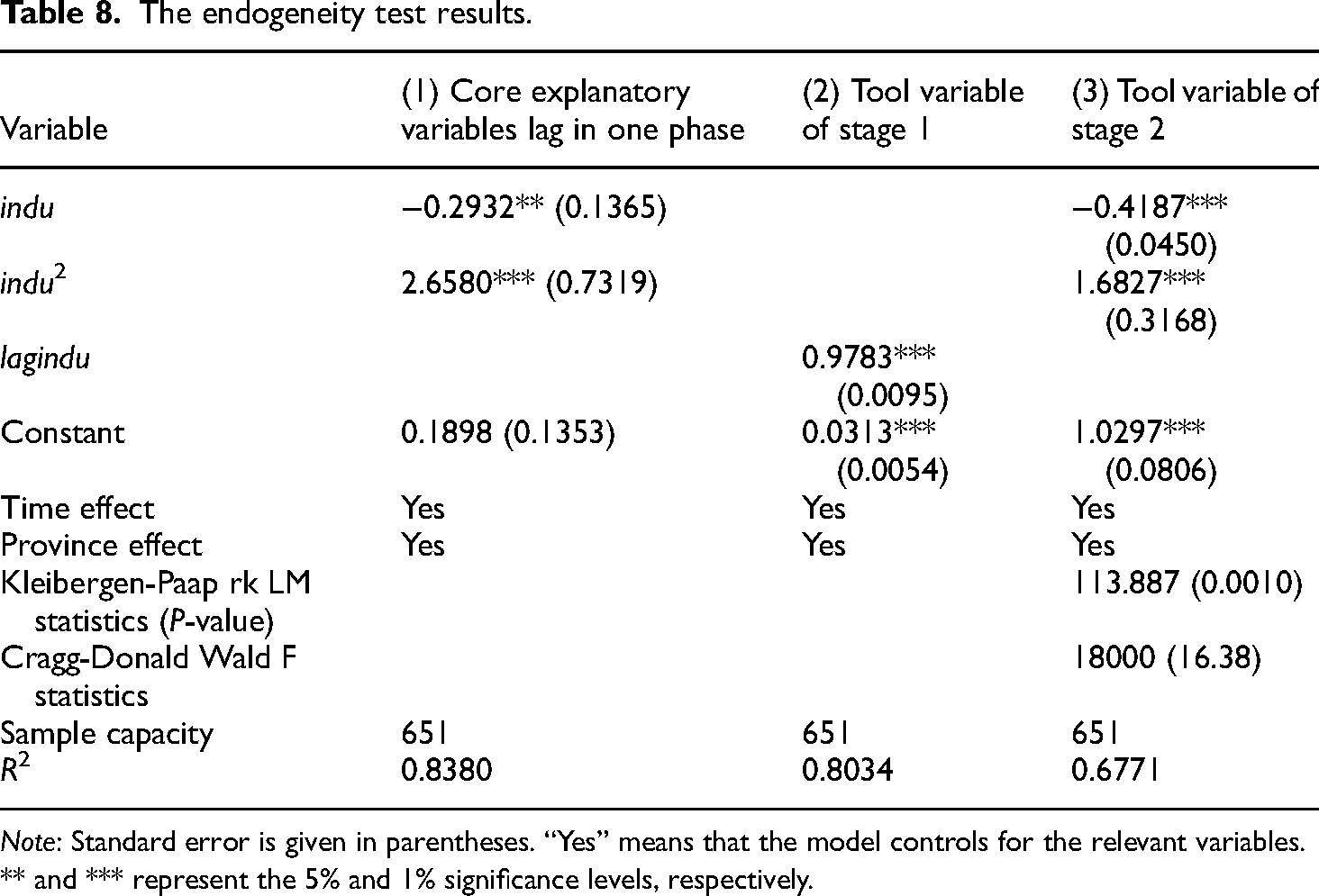
There may be an endogeneity problem with this paper, and it may come from two sources. On the one hand, there may be a reverse causal relationship between industrialization and agricultural carbon productivity, and on the other hand, despite controlling for other factors that may affect agricultural carbon productivity, important variables may still be missing. To account for potential endogeneity problems due to reverse causality, we lagged the core explanatory variable by one period before running the regression estimation. This method can avoid the influence of current industrialization on agricultural carbon productivity, thus overcoming the endogeneity problem caused by reverse causality. According to the regression results in column (1) of Table 8, the first item of industrialization after the lag phase has a significant negative effect on agricultural carbon productivity, while the second term of industrialization has a significant positive effect. This result is generally consistent with the underlying regression results. In addition, to better address the endogeneity issue, we include the core explanatory variable with the lag phase as an instrumental variable and perform regression estimation. Column (2) of Table 8 reports the regression results of the first phase. It is clear that this instrumental variable has a significant correlation with industrialization with a correlation coefficient of 0.9783 and passes the 1% significance level test. Second, column (3) shows that the LM statistic test for Kleibergen-Paap rk was 113.887, greater than 10 and significant at the 1% level. The Cagg-Donald Wald F statistic was 18000. This shows that the instrumental variables meet the identifiable test and the weak instrumental variable test, indicating that the selected instrumental variables are reasonable and effective. From the regression estimation coefficient, the coefficient of the impact of industrialization on agricultural carbon productivity is −0.4187, which is significant at the 1% level. The coefficient of influence of the quadratic term of industrialization on agricultural carbon productivity is 1.6827, which is significant at the 1% level. This result indicates that after accounting for endogeneity issues, industrialization still has a negative and then positive impact on agricultural carbon productivity, showing a U-shaped characteristic, consistent with the benchmark regression results, i.e. endogeneity issues did not have a significant impact on the research conclusions.
The endogeneity test results.
Note: Standard error is given in parentheses. “Yes” means that the model controls for the relevant variables.
** and *** represent the 5% and 1% significance levels, respectively.
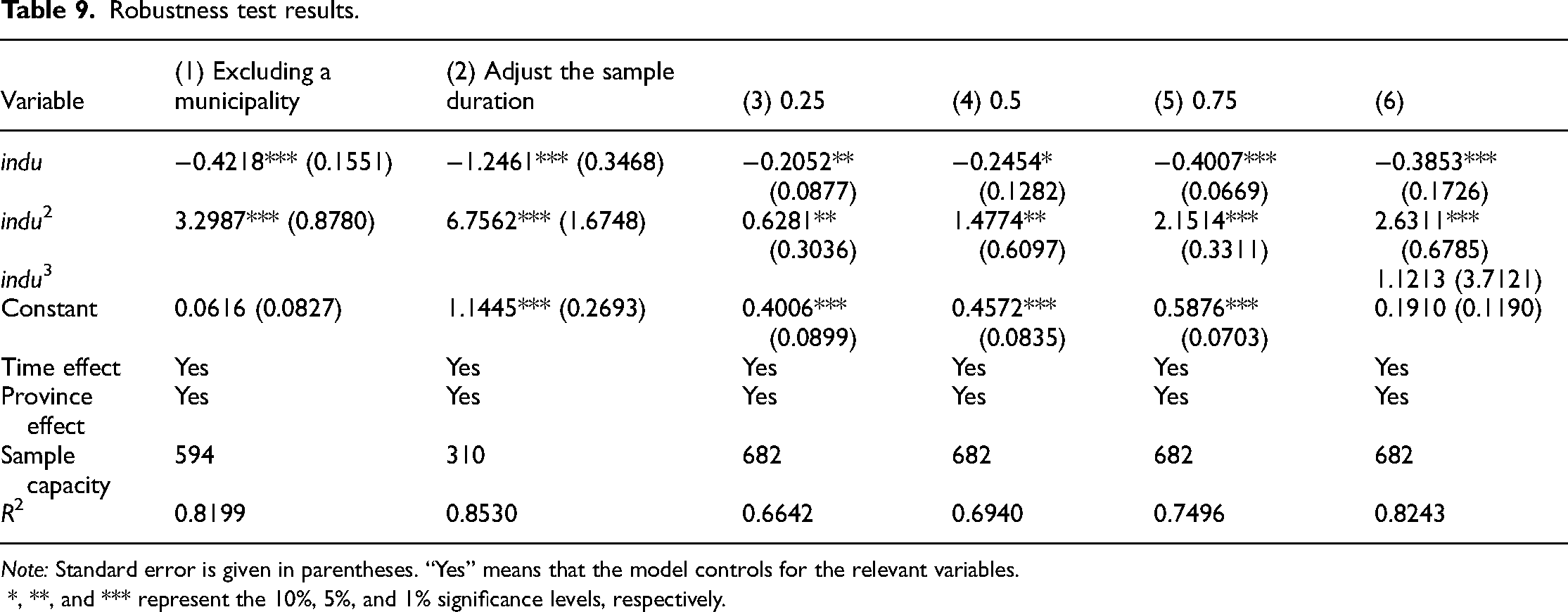
To further validate the robustness of the benchmark regression results, we performed the robustness tests from four perspectives. First, we adjust the sample size. Based on the special administrative system, China has established four municipalities, namely, Beijing, Tianjin, Shanghai, and Chongqing. Compared with the general provinces, the municipalities receive more resources from the state, their industrialization is faster, and their share of agricultural production is lower. Therefore, removing these four special samples makes the results more convincing. Table 9, in column (1), reports the estimated results, which are consistent with the benchmark results.
Robustness test results.
Note: Standard error is given in parentheses. “Yes” means that the model controls for the relevant variables.
*, **, and *** represent the 10%, 5%, and 1% significance levels, respectively.
Second, we adjust the sample period. As shown in Figure 2, the share of China's total industrial output in GDP started to decline in 2012. At the same time, the 18th Congress of the Communist Party of China was held in 2012 to elect a new national leader, which has had an important impact on China's economic development. For these two reasons, we adjusted the sample period to 2012–2021. The regression results after adjusting the sample period are shown in Table 9, column (2), which is also consistent with the benchmark regression results.
Third is the quantile regression. Unlike the mean regression estimates used in the benchmark regression estimation, quantile regression does not require any distributional assumptions be made about the model. This method performs regression analysis on the model using different information contained in the sample, mainly based on different locations. The quantile regression method can not only reduce the bias caused by outliers but also better capture the structural characteristics of industrialization for agricultural carbon productivity. In columns (3)–(5) of Table 9, the regression estimation results show that at 25%, 50%, and 70% locsites, the regression coefficients of the first term of industrialization are significantly negative, while the regression coefficients of the second term of industrialization are significantly positive. The robustness test of the above three methods indicates the good robustness of the benchmark regression results.
Fourth is a further test of the U-shaped relationship: a three-term test. After the regression model of the quadratic term is significant, the third term of the explanatory variable is added to the model to observe whether the relationship between the explanatory variable and the explained variable can be a cubic relationship, that is, an N-type or a horizontal S-type relationship. To this end, this paper also adds three terms of industrialization to the model (indu3), to investigate whether there is a tertiary relationship between industrialization and agricultural carbon productivity. Table 9 column (6) shows that after adding the cubic term of the explanatory variable, the coefficient of the cubic term is not significant, indicating that there is no cubic relationship, supporting the robustness of the U-type relationship between industrialization and agricultural carbon productivity.
Heterogeneity analysis
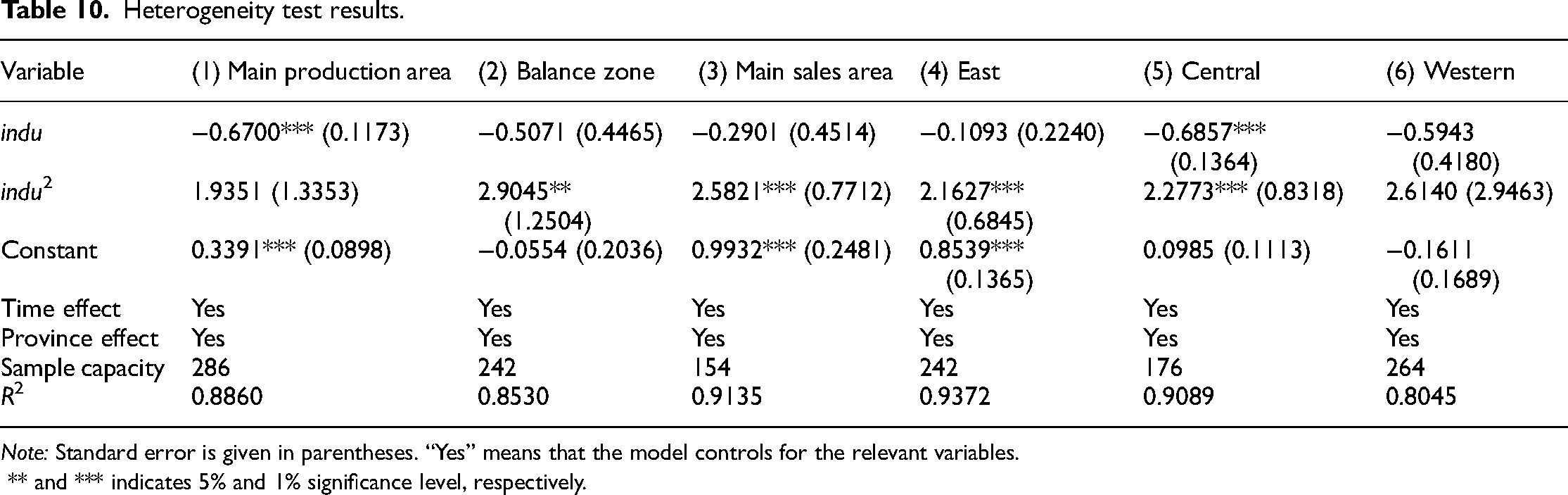
Heterogeneity analysis based on functional zones of grain production. China has a vast area and complex natural conditions, and different provinces play different roles in grain production. There are obvious differences in the grain production capacity of different provinces in China, and the resulting agricultural carbon productivity is also quite different. According to their grain production and sales situation, China has divided 31 provinces (excluding Hong Kong, Macao, and Taiwan) into major grain production areas (13), balanced grain production and marketing areas (11), and major grain sales areas (7). We use this classification method to examine the impact of industrialization in different grain production functional areas on agricultural carbon productivity. The test results are shown in columns (1)–(3) of Table 10. First, in the main grain-producing areas, the estimated coefficient of the primary term of industrialization was −0.6700, significant at the 1% level. However, the estimated coefficient for the quadratic term of industrialization was 1.9351, but not significant. This result indicates that industrialization has a significant negative effect on agricultural carbon productivity in the early stage, but no positive effect in the later stage. This is because in major grain-producing areas, grain production is high and the proportion of cropland is large, so that a large amount of commodity grain can be transferred while ensuring self-sufficiency. As a result, production requires more energy, making major grain-producing areas the main source of agricultural carbon emissions. This also causes the later industrialization of the agricultural carbon productivity improvement effect is not obvious. Secondly, in the grain balanced and main selling areas, the estimated coefficient of the first term of industrialization is negative, but not significant. However, the estimated coefficients of the quadratic terms of industrialization were 2.9045 and 2.5821 and were significant at the 5% and 1% levels, respectively. This result indicates that the negative effect of the early industrialization on agricultural carbon productivity is insignificant, but the positive effect in the later period is significant. The economy of the main grain marketing area is relatively developed, but there are more people and less land, and the grain production is relatively small, so the demand gap is large. The balanced production and marketing area has limited contribution to the national grain production and can only basically maintain self-sufficiency. Therefore, agricultural carbon emissions in these two regions are relatively small, so the later industrialization has a more significant impact on agricultural carbon productivity.
Heterogeneity test results.
Note: Standard error is given in parentheses. “Yes” means that the model controls for the relevant variables.
** and *** indicates 5% and 1% significance level, respectively.
Geographical area-based, heterogeneity analysis. There are clear differences between the level of industrialization and agricultural carbon productivity in different regions of China. Therefore, the impact of industrialization on agricultural carbon productivity in different regions is also different. We divided the study sample into eastern, central, and western regions based on traditional geographical region classification methods, with the aim of exploring whether there is geographical regional heterogeneity in the impact of industrialization on agricultural carbon productivity in different regions. After regression estimation, the results are presented in columns (4)–(6) of Table 10. First, in the eastern region, the estimated coefficient of agricultural carbon productivity is −0.1093. However, the estimated coefficient of the quadratic term of industrialization was 2.1627, which was significant at the 1% level. This suggests that industrialization can significantly increase agricultural carbon productivity in the long run. Secondly, in the central region, the estimated coefficient of agricultural carbon productivity was −0.6857, and the secondary coefficient of industrialization was 2.2773, both of which were significant at the 1% level. This indicates that the effect of industrialization on agricultural carbon productivity has a U-shaped characteristic of first decreasing and then rising. Third, in the western region, the estimated coefficient of agricultural carbon productivity was −0.5943, and the second coefficient of industrialization was 2.6140, but neither was significant. This suggests that industrialization does not have a significant impact on agricultural carbon productivity. The eastern region started early and has a high level of industrialization, which should have a positive impact on agricultural carbon productivity should be greater, but the value of agricultural production in the eastern region is relatively low. Therefore, the negative effect in the early period is not obvious, but the positive effect in the late period is significant. The central region started late and is the main cereal-producing area. Therefore, the impact of industrialization on agricultural carbon productivity will be the U-shaped feature, first decreasing and then improving. However, the western region is limited by special geographical environment and natural conditions, and the development of industrialization and food production is lower than that of the eastern and central regions, so the impact of industrialization on agricultural carbon productivity is not been significant.
Mechanism effect test results
To further explore the mechanism of industrialization on agricultural carbon productivity, based on the mechanism analysis above, we take the level of economic development and urbanization as the mechanism variables. Using equations (2) and (3), a stepwise test is conducted to verify the existence of mechanism effects. The results of the test are shown in Table 11. With economic development as the mechanism variable, the effect of industrialization on economic development is 1.3511, which has passed the 1% level test, which means that industrialization promotes economic development and verifies hypothesis 2. After adding economic development in the second column, the estimated values of industrialization and the second term of industrialization were −1.1034 and 2.1150, respectively, and both were significant at the 1% level. At the same time, the estimated value of economic development is 0.5720, which passed the 1% level test. The slight decrease in the estimates of industrialization primary and quadratic suggests that economic development is the mechanism through which industrialization acts on agricultural carbon productivity. This suggests that there is some mechanism effect of economic development. In the case of urbanization as a mechanism variable, the results are shown in columns (3) and (4). The results in column (3) show that the impact of industrialization on economic development is 0.2027, which has passed the 1% level test, indicating that industrialization promotes urbanization and verifying hypothesis 3. After the addition of urbanization, the estimated values of the first item and the second term of industrialization were −0.6946 and 3.5388, respectively, and all of them were significant at the 1% level. At the same time, the estimated value of urbanization is 1.4205, which has passed the 1% level test. This indicates that there is a mechanism effect of urbanization.
Results of tests for mechanism and moderator effects.

Note: Standard error is given in parentheses. “Yes” means that the model controls for the relevant variables.
*** represent the 1% significance levels, respectively.
To further test the reliability of the mechanistic effects, we conducted a Soble's test for mechanistic effects. The results showed that for economic development and urbanization as mechanism variables, the P-value was less than 0. 05, rejecting the original hypothesis and indicating that the mechanism effect was established. In the process of industrialization affecting agricultural carbon productivity, the mechanism effect of economic development accounts for 7.5% and that of urbanization accounts for 10.34%.
Moderating effect test results
In the process of moderator effects testing, due to the need to include the product term of the two variables in the econometric model, this may lead to the problem of producing multicollinearity between the core explanatory and moderator effects variables and the product term of both. To eliminate the problem of multicollinearity, Robinson and Schumacker (2009) have treated the data with zero mean processing. 45 Zero mean processing refers to the subtraction of the mean or mathematical expectation of the data. Data zero-averaging processing is a data preprocessing method that aims to eliminate the difference between the characteristics of variables, which can make different characteristic variables have the same scale so that the degree of influence on the parameters is consistent. The zero mean treatment of the data does not affect the correlation between variables. The data zero-averaging processing mainly includes two steps. The first step is to perform zero mean normalization on the core explanatory variables and moderating effect variables separately, in order to attenuate collinearity between individual variables and variable product terms; the second step is to multiply the zero mean processed core explanatory variable and moderating effect variable and enter the product term into the regression equation.
Based on the theoretical analysis, we will investigate and examine the moderator effect of transport infrastructure. After the zero averaging of the core explanatory variables and the moderator effect variables, the product terms of indu × infra and indu2× infra are simultaneously entered into equation (4), and regression estimation is performed. The regression estimation results are shown in Table 11 column (5). The estimated coefficient of the first item of industrialization is significantly negative, and the estimated coefficient of the quadratic term of industrialization is significantly positive, which is consistent with the benchmark regression results. However, the estimated coefficient of indu × infra is −0.6260, which passes the 1% significance level test. The estimated coefficient of indu2 × infra was 1.7091, which passes the 1% significance level test. Meanwhile, the influence coefficient of transportation infrastructure on agricultural carbon productivity was 0.1649, passing the 1% significance level test. It shows that transport infrastructure can promote the increase of agricultural carbon productivity. The above results indicate that the improvement of transportation infrastructure has a significant positive moderator effect on the results of industrialization on agricultural carbon productivity, and hypothesis 4 is verified.
Discussion
Impact of industrialization on agricultural carbon productivity based on different stages of development
Although there is no literature that directly examines the impact of industrialization on agricultural carbon productivity, the relevant literature uses industrialization as a control variable. It reflects the impact of industrialization on agricultural carbon productivity from the side. In the study of Huang et al. (2022), industrialization was found to have a significant negative impact on agricultural carbon productivity. 53 This study does not consider the different stages of industrialization, which may have different impacts on agricultural carbon productivity. Cheng et al. (2018) conducted a study in terms of spatial spillovers and found that industrialization has a significant positive spatial spillover effect. 54 That is, industrialization has a significant positive impact on agricultural carbon productivity in other regions, but the impact of industrialization on agricultural carbon productivity in this region is not obvious. This result is quite different from the conclusion of this paper. In this literature review, industrialization is only used as a control variable, and the actual influence of the development stage is not considered, so the conclusion is inconsistent with this paper.
Through theoretical analysis and empirical testing, this paper found that the influence of China's industrialization on agricultural carbon productivity changed from a significant negative influence to a significant positive influence during the period 2000–2021. The main reason for this change is the transformation and development of China's industrialization, and the development characteristics of different stages have produced different influence effects. In 2001, China successfully joined the WTO, and the opening-up entered a stage of rapid development. China began to pay attention to improving industrial total factor productivity, and industrialization entered a stage of transformation and development. Since then, with the development of information technology, it has entered the digital age in 2010. In order to improve the quality of development, China has issued the “Outline for Quality Development (2011–2020),” which requires a higher level of quality assurance for industrial development. In 2012, the American scholar Jeremy Rifkin proposed the “Third Industrial Revolution,” and the US government promoted the “re-industrialization.” To this end, China proposed “Made in China 2025” to further promote the development of industrialization. China's agricultural development also has a similar stage of development. 2002–2011 is the stage of increasing farmers’ income, which is a period of great transformation in agricultural policy. The top-level design changes from “taking” to “giving,” industry feeds agriculture, and cities support the countryside and gradually improve spending on agricultural policy, improving transport and other infrastructure. Since 2012, China has launched its rural revitalization strategy, which has improved agricultural production and operation efficiency, while paying attention to ecological protection. In summary, based on the reality of China's industrialization and agricultural development at different stages, the impact of industrialization on agricultural carbon productivity will have a U-shaped influence, and factors such as urbanization and transport infrastructure will also act accordingly.
In order to better play the role of industrialization in promoting agricultural carbon productivity and realize the low-carbon development of China's agriculture. In the future, we should accelerate the construction of new industrialization and feedback the development of modern agriculture. First, the impact of industrialization on agricultural productivity at different stages of development should be fully explored. The impact of industrialization on agricultural carbon productivity has passed the declining phase of the first half of the U-shape and entered the promoting phase. Therefore, we should further improve the quality of industrialization development to industrial industries should activate the potential of agricultural development, improve the “hematopoietic” function of agriculture itself, and improve the overall efficiency of agricultural production. Second, take different measures in different circumstances, for example, in major grain-producing areas, where the scale of agricultural production is large. We should continue to make full use of the technological advantages of industrialization, accelerate the improvement of agricultural production technology and production efficiency, increase the value of agricultural production, and reduce agricultural carbon emissions. At the same time, in response to the reality of barren land and lack of water resources in western China. On the one hand, we should minimize the scale of agricultural production and, on the other hand, increase the application of advanced agricultural technology and reduce resource consumption. Third, in the process of industrialization, the mechanism of making full use of economic development and urbanization in the process of industrialization to create a good economic environment and market space for low-carbon agricultural development, promoting agricultural industrialization, intensification, and market-oriented development. The fourth is to improve the transport infrastructure. In particular, it is necessary to strengthen the construction of transport infrastructure in rural areas and provide basic support for industry to feed back into agriculture.
Limitations
There are still some shortcomings in this paper that need to be improved. First, the current theoretical research on the relationship between industrialization and agricultural carbon productivity has not yet formed a unified system. This paper is based on the theoretical analysis framework of industrialization and carbon emissions, and whether this analysis framework can really clarify the relationship between industrialization and agricultural carbon productivity needs to be verified by more empirical evidence. Future studies could be further analyzed by selecting different topics to clarify the theoretical relationship. Second, this paper focuses on the gradual impact of China's industrialization on agricultural carbon productivity. The conclusions obtained are also based on the unique data of China, and it is unclear whether they are universal is unknown. Future studies should select countries with different economic sizes to draw more comprehensive conclusions. In addition, due to the limited availability of data, this paper only selects Chinese provincial data for empirical testing, while the more representative prefecture-level cities and counties were not analyzed.
Conclusion
Taking China as an example, this paper empirically examines the impact of industrialization development on agricultural carbon productivity by using data from 2000 to 2021 and applying an econometric model based on theoretical analysis and draws the following conclusions. First, the impact of industrialization on agricultural carbon productivity deteriorates and then improves, showing significant U-shaped characteristics. Industrialization can significantly improve agricultural carbon productivity in the areas of balanced grain production and main sales, as well as in the eastern and central regions. However, its effect is not significant in the main grain-producing areas and western regions. Second, both economic development and urbanization play a mechanistic role in the U-shaped impact of industrialization on agricultural carbon productivity. Industrialization can promote economic development and urbanization and thus have a U-shaped impact on the production of agricultural carbon productivity. Third, transport infrastructure plays an important positive role in regulating the U-shaped impact of industrialization on agricultural carbon productivity.
Footnotes
Acknowledgments
The authors thank the editors and reviewers for their comments.
Author contributions
GZ: writing—original draft, writing—review and editing, conceptualization, data curation, and Supervision. HW: conceptualization, data curation, writing—review and editing, writing—original draft, and software.
Data availability
Data will be made available on request.
Declaration of conflicting interests
The authors declared no potential conflicts of interest with respect to the research, authorship, and/or publication of this article.
Ethical approval
Not applicable.
Funding
The authors received no financial support for the research, authorship, and/or publication of this article.
