



Abstract
To evaluate the quality of life (QOL) of children with asthma and analyze the related factors. A total of 360 children diagnosed with asthma were enrolled. We conducted the pediatric asthma quality of life questionnaire (PAQLQ). The differences in clinical characteristics between the two groups were compared. Clinical characteristics were compared between high and low QOL. More female was observed in low QOL group (p = 0.013). Patients with higher income (p = 0.003) were shown with higher QOL. Female patients presented significantly lower values for activity limitation (p = 0.016) and emotional function (p = 0.016) as compared to male patients. For patients who have low income, the QOL scores for dimensions of activity limitation was significantly worse than those have higher income (p = 0.001). Univariable results showed that gender (p = 0.013) and income (p = 0.001) were factors associated with QOL in asthma children. However, multivariate analysis suggested that only gender (OR = 0.558, p = 0.008) and income (OR = 1.762, p < 0.001) were the independent factors that affected the QOL levels. In this study, we found that the QOL dimensions of pediatric asthma differed between various subpopulations. For patients with risk factors of poor QOL, target intervention is advised in order to increase QOL.
Introduction
Asthma is an airway allergic inflammation and highly responsive disease, mainly based on airway eosinophils and mast cell responses.1,2 Asthma is a disease affecting 1%–18% of the population in different countries. 3 Asthma is the most common chronic disease of childhood. Asthma often begins in early childhood in up to half of people with asthma. No intervention has yet been shown to prevent the development of asthma or modify its long-term natural course.1,2,4
Studies have been reported that pediatric asthma could impact the quality of life (QOL) among patients.4–7 The QOL was proposed by Calbraith in the late 1950s. 8 The current QOL assessment has become one of the most important criteria for analyzing the health status and treatment effects of patients.
Although the clinical treatment goals for asthma are relative clear. 9 The relationship between the asthma and the QOL of children is still a controversial topic.10,11 Therefore, the purpose of this study is to assess the QOL of children with asthma and analyze their potential risk factors.
Subjects and methods
Subject
This study is a cross-sectional study. A total of 360 children with asthma were enrolled from August 2015 to December 2018. The enrollment criteria were: (1) aged 7 to 16 years; (2) asthma diagnosed for at least 3 months. The diagnosis of asthma is based on the GINA guidelines. 3 Exclusion criteria: Children with acute and chronic diseases that seriously affect lung function in addition to asthma, such as heart disease, pneumonia, restrictive lung disease, and interstitial lung disease. All patients and/or guardians signed informed consent, and this study was approved by the Children’s Hospital of Anhui Province ethics committee.
In this study, in Education variable, “Primary” refers to parents received less than 9 years of education. “Secondary” refers to parents received between 9 and 12 years of education. “Tertiary” refers to more than 12 years of education. In the Income variable, “Low” refers to the monthly household income below 5000 RMB, “Middle” refers to the monthly household income between 5000 and 10,000 RMB, and “High” refers to more than 10,000 RMB.
Evaluation of the Pediatric Asthma Quality of Life Questionnaire (PAQLQ)
The PAQLQ score was recorded. PAQLQ is a 23-question question specifically designed for children with asthma between 7 and 17 years old.12,13 The questionnaire is divided into three parts, including symptoms (10 questions), activities (five questions), and emotions (eight questions).
This questionnaire is completed by the patient and the guardian together. They completed the questionnaire surveys without any interference or disruptions. Research members were available to answer if any question occurred with understanding the survey.
Statistical methods
Statistical analysis was performed using SPSS software (version 16.0; SPSS Inc., Chicago, IL, USA). A Student’s t-test and Pearson’s χ2 test were chosen when appropriate. When the number of groups ≥3, one-way ANOVA is conducted. A multivariate regression model was used to evaluate the independent risk factor associated with poor QOL. Differences were defined as significant for p values less than 0.05.
Results
Clinical characteristics among patients
A total of 360 children with asthma were enrolled and evaluated in our study. The median score of PAQLQ score is 4.97. Hence, all children were divided into two subgroups, the low quality of life group (<5.0). With the high quality of life group (≥5.0). The clinical characteristics were compared between those two group. More female was observed in low QOL group (p = 0.013). Patients with higher income (p = 0.003) were shown with higher QOL. As shown in Table 1.
Characteristics of pediatric patients with asthma.

QOL of patients in different dimensions
In order to determine the dimensions of QOL that were impacted by these factors, we analyzed the differences between the two groups. The results showed in Figure 1. Female patients presented significantly lower values for activity limitation (p = 0.016) and emotional function (p = 0.016) as compared to male patients (Figure 1(a)). For patients who have low income, the QOL scores for dimensions of activity limitation was significantly worse than those have higher income (p = 0.001, Figure 1(b)).

The difference in quality of life in different dimensions: (a) female patients presented significantly lower values for activity limitation (4.3 ± 0.94 vs 4.55 ± 1.02, p = 0.016) and emotional function (5.38 ± 0.63 vs 5.54 ± 0.57, p = 0.016) and (b) for patients who have low income, the quality of life scores of activity limitation was significantly worse than others (4.08 ± 0.89 vs 4.42 ± 1.02 vs 4.62 ± 0.96, p = 0.001).
Independent risk factor associated with QOL
Univariable and multivariable analyses were conducted to explore the independent factors that affected QOL. Univariable results showed that gender (p = 0.013) and income (p = 0.001) were factors associated with QOL in asthma children. However, multivariate analysis suggested that only gender (OR = 0.558, p = 0.008) and income (OR = 1.762, p < 0.001) were the independent factors that affected the QOL levels (Table 2).
Factors associated with HRQoL

OR: odds ratio; CI: confidence interval.
Independent risk factor associated with activity, symptoms, and emotion related QOL
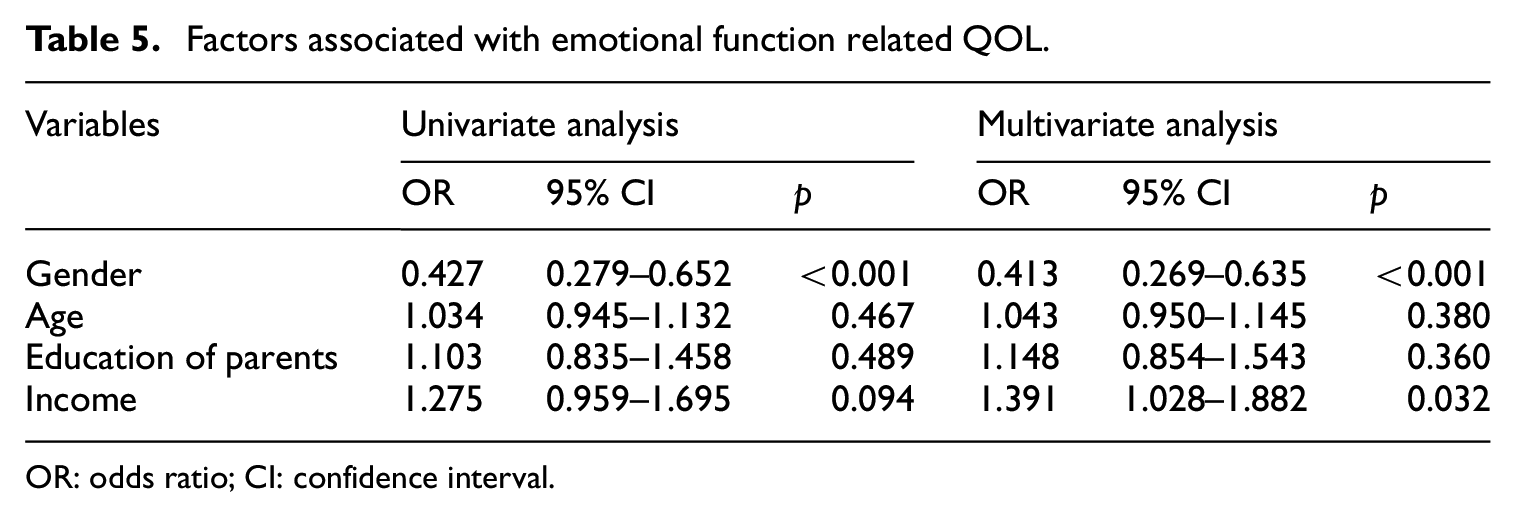
To further evaluate the related risk factors associated with different dimensions related QOL. univariable and multivariable analyses were conducted. Results showed that gender (OR = 0.431, p < 0.001), age (OR = 0.903, p = 0.035) and income (OR = 1.625, p = 0.002) were factors associated with activity related QOL (Table 3). For symptoms related QOL, income showed a trend related with symptoms related QOL but without statistically significant (OR = 1.323, p = 0.062, Table 4). For emotion related QOL, only gender (OR = 0.413, p < 0.001) and income (OR = 1.391, p = 0.032, Table 5) were related factors.
Factors associated with activity limitation related QOL.

OR: odds ratio; CI: confidence interval.
Factors associated with symptoms related QOL.

OR: odds ratio; CI: confidence interval.
Factors associated with emotional function related QOL.
OR: odds ratio; CI: confidence interval.
Discussion
PAQLQ is one of the most widely used QOL scales in the world.14,15 In this study, female patients, lower income was observed related with low QOL. In addition, gender and income were the independent factors that affected the QOL levels.
Indinnimeo et al. 16 found that female patients were more likely to have poor QOL than male patients. The results were confirmed in our study. According the result from our study, more female was observed in low QOL group. Moreover, in our study, we further found the different dimension of QOL among female and male patients. Female patients presented significantly lower scores of QOL in activity limitation and emotional function. For female child with asthma, more care should be provided to improve the QOL.
Previously studies suggest that exposed to passive smoking is a greater negative impact on QOL, suggesting that avoiding exposure to this modifiable risk factor is important.17,18 Passive smoking has been reported to be closely related to asthma. In this study, because the oral report of passive smoking was not accurate enough and we did not detect tobacco metabolites in serum, passive smoking was not included in the analysis. However, current evidence already supports smoking cessation actions for parents of children with asthma might be an issue to be considered.
In our study, we found that higher income related with higher QOL. Previous study has reported that income have a closely relationship with QOL.19–21 One possible explanation is that higher income may provide more high-quality health care than those without high income family. For patients with asthma, high-quality health care is important have been establishment.
In our study, we found that gender and income were factors associated with QOL in asthma children. Multivariate analysis suggested that only gender and income were the independent factors that affected the QOL levels. For female and patients with low income, we should pay more attention to to increased QOL in a timely manner.
There are some limitations in our study. One limitation of this study is that there is no calculation and justification of the sample size selected for this study. Certain social characteristics were not included in the statistics. Furthermore, because all the patients were from one medical center, a prospective multicenter study is still necessary. In our study, we failed to further explore the reasons why gender and income contribute to the QOL. We believe that a well-designed controlled study is needed to answer this question.
Conclusion
In summary, we found that female patients and lower income were associated with poor QOL. In addition, gender and income were the independent factors that affected the QOL levels.
Footnotes
Declaration of conflicting interests
The author(s) declared no potential conflicts of interest with respect to the research, authorship, and/or publication of this article.
Funding
The author(s) received no financial support for the research, authorship, and/or publication of this article.
Ethical approval
The Institutional Review Board of Children’s Hospital of Anhui Province had approved this study. All procedures followed were in accordance with the ethical standards of the responsible committee on human experimentation and with the Helsinki Declaration of 1975, as revised in 2008.
Informed consent
Informed consent was obtained from all patients for inclusion in the study.
