




Abstract
The outcomes of patient care are improved by adequate knowledge, practical skills, and positive attitude. Currently, there is a lack of data on medical research activities among resident doctors in Saudi Arabia. This study aimed to evaluate the perception, barriers, and research attitudes among various residency programs running in different cities of Saudi Arabia. A total of 434 surgical and medical residents participated in the current study. A cross-sectional study encompassing multiple training centers in the eastern province of Saudi. Convenient sampling technique was used to include all the working training residents. A self-administered questionnaire was formulated for data collection. Descriptive statistics were employed to analyze the data. The mean age of the residents with various specialties was 27.83 ± 2.41 years. Approximately 61.7% had participated in research, while 38.3% had never participated in any research. A total of 26% of junior and 44% of senior residents have one publication only. While 11% of junior and 9% of senior residents have three publications or more. Inadequate facilities for research, lack of baseline research skills, and personal commitments were the reasons which over 60% of respondents had agreed on. Institutional reasons: lack of professional supervisor support and lack of research curriculum in the training program was reported by 308 (71%) and 305(70.3%) residents, respectively. A lack of interest for research was prevailed more in males (19%) compared to females (14%) (OR 1.43, 95% CI: 0.86–2.38, p-value 0.17). A subset of residents had one or three publications, while some had none. A lack of baseline research skills and inadequate facilities for scientific explorations, time, and funds were the main constraints among training residents. However, several residents had a positive attitude toward research but fewer publications. Thus, training in medical research methodology should be obligatory in the residency curriculum in all specialties. Further research is needed.
Introduction
Medical research is essential to acquire knowledge in the field of health and medicine as this can aid in understanding medical literature and increasing their appraisal ability. 1 In addition, research is important in the practice of medicine as the treatment provided by doctors is based on “the best available evidence.” 2 The practice of evidence-based medicine allows for the integration of the best available research evidence with clinical expertise and patient values. 3 Research also keeps the doctors informed about the changes in their specialization, encourage communication with colleagues, and improve their medical knowledge. 4 Strikingly, research activity of postgraduate medical trainees offers improved clinical care, critical reasoning, and lifelong learning. 5 Early training for skills and experience of research have been associated with continued professional academic work, and this guides the career decisions of the residents. 6 Intriguingly, a study by De Haven et al. 7 described a comprehensive curriculum that includes support for research, protected time, and opportunities for presentation that are essential to address these obstacles. In India, most of the resident doctors conduct research projects during the second or third years of residency. 8 A cross-sectional study conducted in a military hospital, Saudi Arabia demonstrated that the majority of the general practitioners working in primary health care centers did not have any publications or plan for new projects despite a positive attitude toward research. 9 This could be attributed to the lack of time, support, and funds. In addition, the most commonly perceived barriers to conducting research were lack of research training, lack of time, work-related stress, and lack of supervisors. 10 Thus, investigative studies are crucial for encouraging research orientation in resident doctors.
Most of the studies conducted to evaluate the research perception and attitude in Saudi Arabia were based on a single institution or in one city. Literature is lacking to provide studies based on multiple cities and/or among various professionals. Hence, this study was designed to evaluate the perception and attitude toward research among various residency programs running in different cities of Saudi Arabia. Therefore, this study aimed to evaluate the perceptions and attitude of registered physicians in residency programs toward research in Saudi Arabia and explore the barriers that impede this research. The secondary objective of the study was to investigate the factors involved in influencing the residents’ knowledge and interest in scientific research. These data might aid in improving the existing medical education system to foster research culture among the resident doctors.
Methods
The study was approved by the Institutional Review Board at Imam Abdurahman Bin Faisal University. Informed consent was taken from all participants. A cross-sectional survey was conducted among all resident doctors in the eastern province hospitals in Saudi Arabia from March 2016 to January 2017. A total of 654 residents from different specialties were invited to participate in the study. All the specialties of training programs in the eastern province were included in this study. The questionnaires were sent to more than 17 specialties: Internal Medicine, General Surgery, Dental, Obstetrics and Gynecology, Pediatrics, Family Medicine, Neurology, Psychiatry, Anesthesiology, Urology, Otolaryngology, Dermatology, Ophthalmology, Radiology, Orthopedic Surgery, Emergency Medicine, and Laboratory Pathology. We used both online and setting questionnaires to increase the response rate. The consent was the initial step. To collect the data electronically, the survey was designed by using software available for online surveys and then a link was sent via email. Authors of the study contacted the program directors to get the list of email addresses of all registered residents. The cover page in the electronic survey was made to explain the purpose of the study, instructions on how to respond to the questions and consent was taken. If participants agreed to participate, they clicked on the agree button to proceed. The same cover page was used in setting the questionnaire where the signature of a participant was taken as consent.
The questionnaire was re-sent to the remaining residents who had not submitted the completed original questionnaires. The email was sent twice to the residents who did not respond initially. A structured questionnaire was used to collect the data. The language of the questions was English, and participants were asked to answer the questions according to their thoughts and practice. The questionnaire consisted of six sections: (1) socio-demographic information about the participants including name of college, age, gender, marital status, GPA, and sponsors, (2) obstacles and barriers that prevent the participants from conducting research and whether it is personal or institutional, (3) availability of research resources in their program, (4) previous experience and any involvement in research work, (5) participants’ attitudes, and (6) perceptions of research work. A pilot testing of the questionnaire was conducted first in which after getting the initial 40 responses, validity testing was performed, and the score was 0.605. The collected data were subjected to statistical analysis using the statistical package for social science (SPSS v.23). A chi-square test for categorical variables and two independent samples T-test to test the variation in mean between the two groups were employed for the comparison. A p-value <0.05 was considered significant.
Results
Of 654 medical and surgical residents invited to participate in the study, 434 residents responded and filled in the questionnaire with an overall response rate of 66.4%. The mean age of the cohort was 27.83 ± 2.41 years (range, 23–40 years), and the sample encompassed various specialties (Figure 1). Of the total, 249/434 (57.8%) were married. The number of male residents (n = 230; 53%) was more than compared to the females (n = 204). Interestingly, 91% (394/434) graduated from Saudi Arabia Medical Colleges, while the remaining 9% (39/434) graduated from outside Saudi Arabia medical schools as shown in Table 1. Affirmative responses to the questions asked about possible reasons for not conducting research, as well as about the resources provided by multiple obstacle levels, mainly personal, institutional, and program resources. The highest levels were for inadequate facilities for research (302, 69.6%) and a lack of a research curriculum (305, 70.3%) (Table 2).

Number of residents involved in the research for each specialty and response.
Variable response of residents involved in the study.

The obstacles: number of positive responses with percentage toward each possible factor.

Participation in the research was significantly higher among female residents compared to males (p-value = 0.03). Almost 58 residents had not participated in any type of research. However, the majority of the respondents had carried out statistical analysis and protocol writing (Figure 2). In addition, descriptively, participation in research was high in unmarried individuals compare to married ones; however, differences in proportion was not statistically significant. Furthermore, residency levels had a significant association with participation in research (p-value = 0.002) (Table 3). The average number of published articles was found higher among female residents compared to males with a p-value 0.011. Furthermore, the average number of published articles by senor residents was significantly high compare to junior residents (p-value = 0.037) (Table 4). The complexity of the approval process prevented 282 residents (65%) from participating in research activities. A total of 427 (98.3%) residents agreed that research improved the patient outcome, while 391 (90.1%) residents suggested that the methodology course should be a part of the residency curriculum. Additionally, 335 (77.2%) residents complained of high workload. A total of 149 (34.3%) respondents had participated in a research via a conference during their residency, while 72 (16.6%) respondents had successfully published their research in a journal. Based on the specialty training of the residents, the order of participation in the research was as follows: Internal Medicine (35, 13.1%), Radiology (27, 10.1%), Pediatrics (26, 9.7%), and General Surgery (22, 8.2%) (Figure 1).

Number of positive responses of participants in research skills.
Association between participants’ demographics and participation in research.

Statistically significant at 0.05 level of significance.
Relationship between participants’ demographics and average publications.
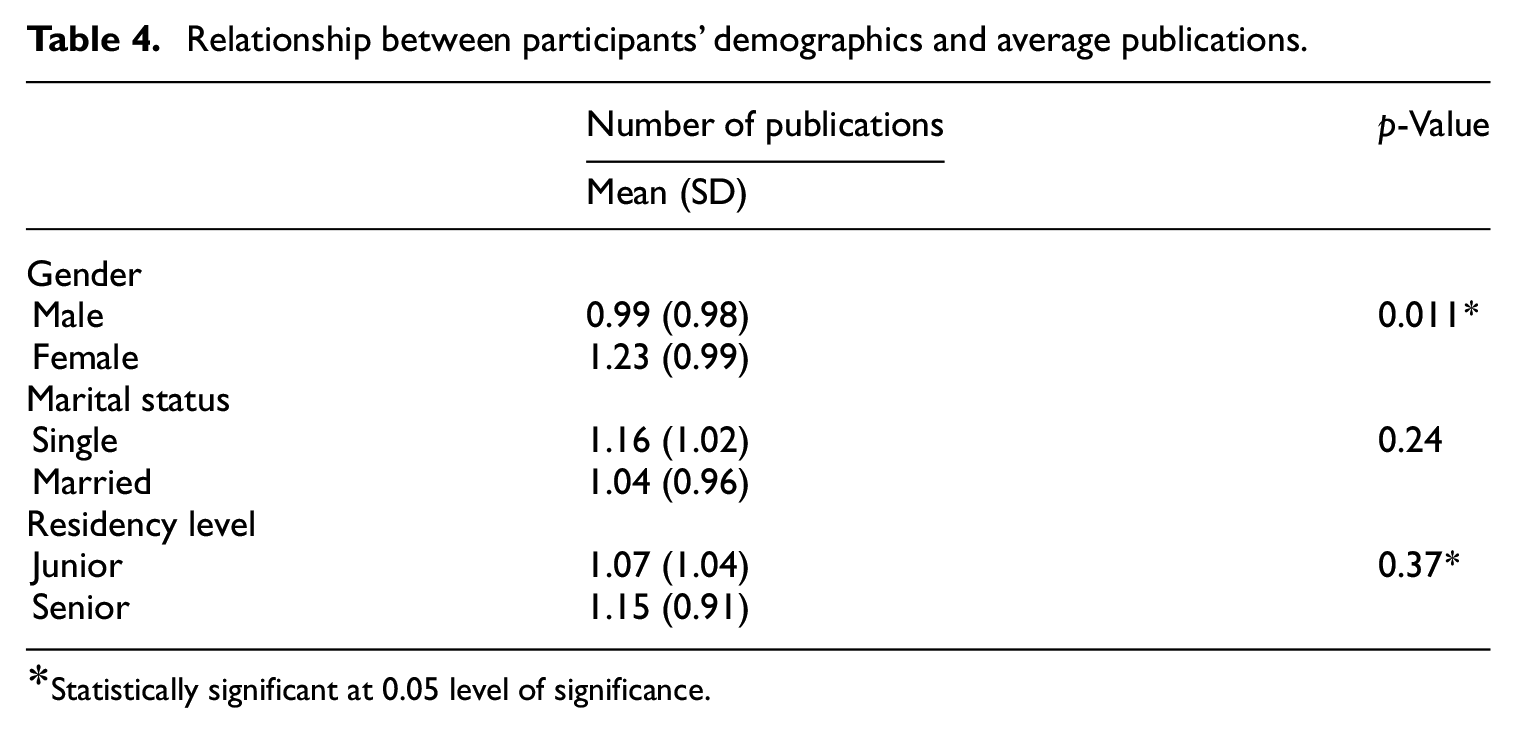
Statistically significant at 0.05 level of significance.
In response to the question “Research should be mandatory criteria for final examinations of a postgraduate curriculum,” a significantly high proportion of female residents strongly agreed (70.6%) (p-value 0.014) compared to male residents (29.4%). Furthermore, the proportion of females who strongly agreed to add research methodology in residency curriculum (77.8% vs 22.2%, p-value 0.004) was also high. In contrast, 61.3% of those who had done research before the residency program strongly disagreed to keep research mandatory as criteria for the final examination compared to those who had no previous research experience (38.7%, p-value 0.021). Around 69% of residents had previous research experience and indicated to have published articles while 31.3 had published without having previous research experience (p-value 0.000). Similarly, 65.7% had participation in research during their residency program with previous research experience while 34.3% were participating without previous experience (Table 5). Comparing the specialties, there was a significant lack of baseline research skills among 61.8% Medicine residents and 85% Ophthalmology specialty (p = 0.04). Furthermore, 78.3% of the ENT residents had inadequate facilities for research as compared to 56.6% among Medicine (p = 0.048). Similar data were collected when compared to other specialties such as Psychiatry, Radiology, and Surgery (p = 0.01, 0.001, 0.008, respectively). The reasons preventing residents from conducting medical research were significant with respect to personal commitments such as family issues and marriage as compared to Medicine and Obstetrics and Gynecology p = 0.02, Medicine to Psychiatry 0.04, and Medicine to Radiology (p = 0.009).
Effect of previous research experience on research perception.

Statistically significant at 0.05 level of significance.
Compared to 62.9% Surgery residents, 81.6% of the Medicine residents agreed that undertaking research increased the workload on an already overworked resident (p = 0.003). However, lack of research and teaching role models was significant among medical residents (46.7% and 50%, respectively).
Institutional obstacles that prevented the residents from conducting medical research due to the process of research approval were significant in Medicine residents (64.5%) as compared to Radiology residents (36.8%) (p = 0.02). However, most of the specialties found a lack of interest by faculty as an obstacle preventing medical research: 60.9% ENT, 30.2% Medicine, 55.6% Obstetrics and Gynecology, and 70.6% Psychiatry residents (p < 0.004). Another vital factor was financial support for residents under program resources, deemed as an obstacle for research: 30.2% Medicine, 12.9% Surgery, and 47.3% Neurology residents (p < 0.02).
Discussion
Involvement in research by the residents in different medical specialties was found to be over 61% while over 18% of the total participants had published articles. The findings are quite in line with the studies published earlier among residents and medical students.11,12 Although, residents were involved in research projects, they mentioned some obstacles like a lack of basic research skills that are not unusual but are frequently reported in other studies.11,13 Inadequate facilities, a lack of professional supervisor support, of time, and of a research curriculum in the training program were also common reasons provided by the responders. These barriers were mentioned in the study conducted by Al-Abdullateef 9 in Riyadh. Despite all the barriers faced by either medical students or residents, publications were produced by Arab countries from 1987 to 2001, and Saudi Arabia and Egypt had the highest number of publications. 14 Previous research experience and residency levels were the two factors which showed positive and significant association with participants’ attitude and perception regarding research. Furthermore, participation in research during residency and the number of publications were found higher among those with previous experience and seniority in residency level. Khan et al. 15 reported on the attitude and experience toward research among undergraduate dental students and found that those who were involved in research during under graduation were more interested in doing research in the future. Other studies reported that early exposure of medical students toward research may enhance their research skills.16,17 Khan et al. 18 found that residency level did not have a significant association with knowledge and attitude toward research; however, other studies reported that year of medical education had significance with knowledge and attitude toward research. 19 About 16% of residents in family medicine are involved in research, while only 0.4% of cardiac surgery. Pathology and pediatric neurology residents are the least involved. Our study is in agreement with previously published studies in regards to lacking of time as the major obstacle for conducting research during residency training.9,13 Herein, the type of research was primarily retrospective (13.2%), similar to the results of a study in Saudi in 2014 (13%), and cross-sectional (11.1%). The demographic data revealed that married residents participated in research more than single ones. This result was similar to the results obtained from a study in Saudi in 2014 and is a contrast to the results of a study in India where marriage is considered an obstacle. A subset of 44% participants viewed the lack of faculty interest as an obstacle in conducting research. Residents who graduated with an average GPA of 3–3.74 and 3.75–4.24 participated in research more than those with lower (<3) and higher (>4.25) GPAs. Junior residents participate more than seniors (61.3% and 59.2%, respectively). The highlight of the current study was that we investigated the awareness of the residents among different specialties, and not the net residents, without considering the difference in specialty. Thus, participating in research is important to update and prompt the physician to analyze and criticize any encountered medical information. This would enable the physician to improve his practice and patient care. Therefore, to overcome the obstacles preventing the residents from participating in research, we recommend incorporating it in the residency curriculum, prompting the mentors of each specialty to supervise the resident’s research, and allocating sufficient duration to their project. Nevertheless, the limitation of this study was the relatively small sample size involving only the eastern province residents. Therefore, we recommend a study with a large sample size involving Saudi residents with different specialties from all over the kingdom.
Conclusions
In summary, despite having a positive attitude, the majority of the residents are unable to conduct adequate research activities. The obstacles in carrying out research activities are primarily categorized into personal, institutional, and program resources. A lack of baseline research skills and inadequate facilities for scientific explorations, time, lack of financial support, work-related stress, and lack of supervision are the main constraints among training residents that hinder their research activities. Most residents among various specialties also complain about increased workload due to research activities. Thus, it is crucial to distinguish between the residency training and research time. Taken together, adequate training in medical research methodology in the residency curriculum is imperative to prompt the residents to take up research as part of their medical routine. This would apprise the physicians with up-to-date knowledge in their specialization and improve the outcomes of patients care.
Supplemental Material
sj-pdf-1-sci-10.1177_00368504211010604 – Supplemental material for Perceptions, barriers, and attitudes toward research among in-training physicians in Saudi Arabia: A multicenter survey
Supplemental material, sj-pdf-1-sci-10.1177_00368504211010604 for Perceptions, barriers, and attitudes toward research among in-training physicians in Saudi Arabia: A multicenter survey by Abdulaziz Saud AlEnazi, Abdullah Saeed Alamri, Abdullah Saeed AlGhamdi, Abdulelah Hassan Almansour, Nouf Faihan Bin Rubaian, Futoon Khaled Al-Otaibi, Farouk Tawfiq Alreshaid, Mohammed Saad Alaftan, Ziyad Esam Himdy, Rawan Abdulrahman Makhdom and Mohammed Alshahrani in Science Progress
Footnotes
Author contributions
All the authors have contributed equally to the manuscript for conceptualization, formal analysis, investigation, methodology, writing, and final editing. All authors have read and agreed to the published version of the manuscript.
Author’s Note
Abdullah Saeed AlGhamdi is currently affiliated with Department of Pediatrics, Royal Commission Hospital in Jubail, Saudi Arabia.
Declaration of conflicting interests
The author(s) declared no potential conflicts of interest with respect to the research, authorship, and/or publication of this article.
Funding
The author(s) received no financial support for the research, authorship, and/or publication of this article.
Ethics approval
Ethical approval for this study was obtained from the Institutional Review Board of College of Medicine at Imam Abdurrahman Bin Faisal University, informed consent was given by all participants.
Informed consent
Written informed consent was obtained from all subjects before the study, written informed consent from the subjects prior to study initiation, or whether this requirement was waived by the Institutional Review Board/Ethics Committee. Please include the waiver number if applicable.

Supplemental material
Supplemental material for this article is available online.
Author biographies
References
Supplementary Material
Please find the following supplemental material available below.
For Open Access articles published under a Creative Commons License, all supplemental material carries the same license as the article it is associated with.
For non-Open Access articles published, all supplemental material carries a non-exclusive license, and permission requests for re-use of supplemental material or any part of supplemental material shall be sent directly to the copyright owner as specified in the copyright notice associated with the article.
