




Abstract
Major distresses such as rutting, fatigue, and thermal cracking are facing asphalt pavement structures due to continuous heavy traffic loading and climate change. The modification of asphalt binders (one of the main components of the asphalt paving mix) has the potential to mitigate distresses through using different additives. Polymer modified asphalt (PMA) binders showed a noticeable resistance to pavement distresses as reported in previous studies. The present study aims to evaluate the effect of polymer modification on the rheological properties of asphalt binders through laboratory tests. The polymers included styrene-butadiene-styrene (SBS) and epolene emulsifiable (EE2) types. The 60/70 binder was used as a control for comparison. The Mechanistic-Empirical Pavement Design Guide (MEPDG) was also utilized to simulate the effect of PMA binders on the rheological properties under different climatic conditions and structural capacities. Additionally, the MEPDG was further utilized to compare the effect of asphalt binders on rheological properties using four different binder input levels. Findings of the study showed that laboratory tests experienced varying outcomes regarding the most efficient asphalt binder by means of distresses resistance. However, the MEPDG evaluation showed that the overall ranking of asphalt binders positively impacting the rheological properties was as following: (1) 4.5% EE2 PMA, (2) 4% EE2 PMA, (3) 60/70 binder, (4) 5% SBS PMA, and (5) 4% SBS PMA binders. Furthermore, statistical analysis illustrated that the effect of using different binder input levels on the performance of pavement varied relatively to the evaluated distresses. The analysis showed that using different binder input levels would affect, to a certain extent, the asphalt binder influence on rheological properties only when evaluating rutting and fatigue distresses. Therefore, it is recommended that precise asphalt binder inputs, that is, shear complex modulus (G*) and phase angle (δ) are used when designing pavement structures in regions with hot and mild climate conditions.
Keywords
Introduction
Asphalt pavements experience stresses due to vehicular loads and climatological conditions. Therefore, asphalt mixtures should be able to sustain the variation in loads during hot and cold periods of their service life. Asphalt mixtures are typically composed of asphalt binders, aggregates, and air voids. 1 Asphalt binder is a complex viscoelastic material with a behavior that depends on both loading time and temperature. At low and intermediate temperatures, asphalt binders show brittle-viscoelastic behaviors; while at high temperatures, they behave in a fluid manner. 2 Due to such behavior, several distresses are observed in the asphalt pavement as a result of changes in climate conditions. For instance, low temperatures during cold seasons may cause cracking in the asphalt pavement as the stiffness of the asphalt binder increases, such phenomenon is known as thermal cracking. 3 On the other hand, high temperatures during hot seasons cause a type of distress in the asphalt pavement known as rutting, which is permanent deformation in the wheel paths due to decreased asphalt binder stiffness. 4 Due to those distresses, in addition to increasing traffic intensities, vehicle loads, and temperature variations, as well as the introduction of new axle configurations, effective strengthening of asphalt pavements is required. 5
Asphalt pavement strengthening can be achieved by various techniques, including the modification of asphalt binders. Various types of modifiers have been tested by researchers in order to mitigate the distresses associated with the behavior of conventional asphalt binders.3,6–9 The main purpose of asphalt binder modification is to increase its complex modulus during high temperatures while reducing it during intermediate and low temperatures. Among the different tested modifiers, polymer additives were found significantly functional due to their perceived superior performance, as they increase the stiffness of binders at high temperatures while upholding flexibility at lower temperatures.10–13 Polymer-modified asphalts (PMAs) shows greater resistance to thermal cracking and rutting, as well as reduced fatigue damage, temperature susceptibility, and stripping.14–18 PMAs are typically produced by mixing asphalt binder with 3% to 7% polymer additive by weight through mechanical dispersion under high shear. 19 Polymer modifiers are categorized into five main categories with different attributes, namely: (1) thermoplastics, (2) natural and synthetic rubbers, (3) thermoplastic rubbers, (4) thermosets, and (5) mixed systems. 20
This study aims to investigate the effect of adding SBS and EE2 polymers under different volume concentrations on the rheological properties of asphalt binders. EE2 polymer was implemented in the study due to its low coefficient of friction and an enhancing additive for surface slip properties. Moreover, it is an asphalt modifier that has low softening point and low viscosity which contribute to improving hardness with shorter drying time. In addition, the effect of PMA binders on the asphalt mixture performance is assessed through the Mechanistic Empirical Pavement Design Guide (MEPDG). Furthermore, as the level of asphalt binder inputs used in the MEPDG analysis are expected to influence the rheological properties rheological properties, the study also compares the impact of using different asphalt binder input levels in the MEPDG on the predicted rheological properties rheological properties using PMA binders.
Literature review
Various studies have been conducted throughout the literature in order to assess the effects of different types of polymer modifiers on the performance of asphalt binders and mixtures. A thorough analysis of PMA binders was conducted by the Federal Highway Administration (FHWA) and found that such binders significantly improved the fatigue cracking performance, as well as the rutting performance until large rut depths. 1 Moreover, modifying asphalt binders with different concentrations of styrene-butadiene-styrene (SBS) polymer significantly improved the binder rheological properties under high and low temperatures.21–25 Zhang et al. 26 found that SBS-modified binders improved the rutting parameter (G*/sinδ) after short-term aging by an average of 48.01% to 91.10% using multiple concentrations of SBS polymer and under different temperatures. Al-Dubabe et al. 27 concluded that, at 70°C, a 6% SBS-modified binder had a G*/sin δ value of 4.312 kPa compared to 0.74 kPa for neat asphalt binder after short term aging. Moreover, Behnood and Olek found that the G*/sin δ value of a PG-64 binder ranged between 4 and 19 kPa, at 52°C to 70°C, respectively, while the G*/sin δ values ranged from 5 to 35 kPa using 2%, 3%, and 4% SBS-modified binders under the same temperatures at 52°C to 76°C, respectively, after short term aging. The study also found that the G*sinδ values ranged between 1700 and 5100 using 2% SBS-modified binders at 31°C to 22°C, respectively, and 1700 and 6800 kPa using 3% and 4% SBS-modified binders at 31°C to 19°C, respectively, compared to 1700 to 5500 kPa for the PG-64 binder after long-term aging at 31°C to 22°C, respectively. Additionally, modifying asphalt binders with 2% SBS reduced the creep stiffness [S(t)] by 11.3 and 28 MPa at −12°C and −18°C, respectively. 23 It was concluded that asphalt binder modified with SBS has showed a significant improvement in terms of high temperature properties, compared to the modification effect in the intermediate temperatures, by increasing the complex shear modulus and decreasing the phase angle. Another type of polymers used is EE2, which showed a G*/sinδ value of around 5.0 kPa compared to approximately 1.0 kPa for a neat binder sample at 70°C. 28 The study found that polymer modified asphalt binders with EE-2 is the most appropriate for paving applications due to the ability of decreasing penetration, increasing softening point and high resistivity to rutting. Also, using 4% and 5% EE2 in binder modification reduced the G*sinδ value to 3.994 and 3.097 MPa, respectively, compared to 4.38 MPa given by a 60/70 control binder after long-term aging. 29 Moreover, it was found that using EE-2 gave the mixture more stability and higher density compared to the unmodified mixture and other polymers, respectively. Furthermore, another effective polymer used in modifying asphalt binders is the ethylene vinyl acetate (EVA), which showed a G*modified/G*bitumen of 2.4 to 8.3 using multiple concentrations at 45°C. 30 Also, the study found that EVA polymer modifications have increased the binder stiffness and elasticity at high temperatures. In addition, 5% EVA-modified asphalt showed failure against rutting at 88°C with a G*/sin δ value of 3.89 kPa after short-term aging, compared to failure at 64°C with a G*/sin δ value of 3.60 for a 70/100 binder sample. 15 Other polymers such as polyethylene (PE), polymer-modified nanoclay, polybilt, and ceramic fibers at different concentrations were also found to increase the binder resistance against fatigue, rutting, and thermal cracking failures.31–34 The modification of asphalt binders using polymers showed indications of longer service life and better quality for asphalt pavements which accommodated superior economical and safety requirements compared to conventional unmodified binders.19,35–37
Methodology
The study focuses on investigating the rheological properties of PMA binders using different concentrations of polymers under multiple temperatures. The polymers used in the study are the Styrene-Butadiene-Styrene (SBS) and the Epolene Emulsifiable (EE2) polymers. The SBS is a synthetic rubber derived from styrene and butadiene that is considered a thermo-plastic elastomer used with asphalt binders to enhance its elastic properties. On the other hand, the EE2 is a medium density polyethylene polymer used with asphalt binders to enhance its durability. The rheological properties of PMA binders were compared with the properties of a 60/70 penetration grade (PG) control asphalt binder. The MEPDG was utilized to evaluate the performance of all modified binders against different distresses under a wide range of simulated climatic conditions. In addition, the different influence of multiple binder input levels on rheological properties is compared using statistical analysis. The methodology presents the main characteristics of examined asphalt binders, followed by the laboratory testing conducted to assess the rheological properties of selected asphalt binders. Furthermore, the MEPDG evaluation of the selected binders is thoroughly explained.
Asphalt binders
Five asphalt binders were examined in the study, including 4% and 4.5% EE2-modified asphalt binder with 4% and 4.5% concentrations by volume of binder, and SBS-modified asphalt binder with 4% and 5% concentrations by volume of binder, as well as a control asphalt binder asphalt binder (a 60/70-penetration grade binder). EE2 and SBS polymers were used in order to enhance the adhesion and cohesion of the asphalt, enhance rutting performance and the resistance to fatigue. 3 The control asphalt binder used in the study is the 60/70 PG asphalt binder, which was tested in the laboratory in order to evaluate the potential of modifying the binder with polymers. Several tests were conducted to obtain different mechanical and physical properties of the 60/70 control and PMA binder, such as the penetration value, flash and fire points, ductility, as well as rotational viscosity. The values for the previously-mentioned properties were experimentally obtained according to the American Association of State Highway and Transportation Officials (AASHTO) standards. 38
Laboratory testing
The selected binders were tested using the dynamic shear rheometer (DSR) and bending beam rheometer (BBR) laboratory tests. The laboratory testing followed the Superpave standards SHRP. Figure 1 shows the basic procedure for both the DSR and BBR tests. The DSR test was used in order to evaluate the binder viscoelastic behavior against rutting and fatigue failure under high and intermediate temperatures, respectively.39,40 The outcome of the DSR test include the complex shear modules (G*), which represents the stiffness of the binder, and the phase angle (δ), which represents the elasticity of the binder. Therefore, the G*and δ values were used in order to predict the performance of asphalt binders against rutting and fatigue cracking by computing the rutting parameter (G*/sinδ) and fatigue parameter (G*sinδ), respectively. As rutting is commonly observed at the initial stages of the pavement service-life, the DSR test was carried out for unaged binders as well as short-term aged binders using the rolling thin film oven (RTFO) procedure. 41 A stiff and elastic asphalt binder is required to sustain rutting failure, therefore, the Superpave criteria established minimum values of 1.0 and 2.2 kPa for the rutting parameter for unaged and short-term aged binders, respectively. On the other hand, as fatigue cracking is commonly observed during the later stages of the pavement service-life, the DSR test was carried out for long-term aged binders using the pressure aging vessel (PAV) procedure. 41 In contrast to rutting failure, a soft and elastic binder is required to sustain fatigue cracking, therefore, a maximum value of 5000 kPa was set by the Superpave criteria for long-term aged binders.

Procedures of the conducted laboratory tests: (a) DSR and (b) BBR Tests.
Furthermore, the BBR test was performed to evaluate the thermal cracking behavior of binders through under low temperatures during the service life of the pavement. 39 The outcome of the BBR test includes the creep stiffness as a function of time [S(t)], and the m-value which represents the binder rigidity with time. 3 In order to sustain thermal cracking, the Superpave criteria established a maximum value of 300 MPa for S(t) and a minimum value of 0.300 for the m-value in order to ensure a rigid binder.
MEPDG assessment
Background and features
The MEPDG was developed under the National Cooperative Highway Research Program (NCHRP) and sponsored by the American Association of State Highway and Transportation Officials (AASHTO). 38 The MEPDG was developed based on the experience of several pavement experts, in addition to several data that was retrieved from multiple pavement response tests. The main objective of the MEPDG is to predict and evaluate the stresses, strains, and deformations occurred in the pavement. Those parameters are influenced by repeated traffic loading and environmental conditions involving climate behavior and temperature changes. 42 The fundamental output of the MEPDG analysis is the dynamic modulus (E*), which is a key parameter used in evaluating both rutting and fatigue distresses in the pavement. 43
The main inputs required for MEPDG analysis are traffic loading data (structural capacity of the pavement) and climatology data. Three hierarchical levels (Levels 1, 2, and 3) are specified in the MEPDG that refer to the accuracy of inputs used for binders and asphalt mixture evaluation. Level 1 refers to inputs with supreme accuracy and is designed to account for actual gathered data mainly obtained from laboratory testing. Level 2 designates less accurate inputs than level 1 with inputs that are commonly gathered from several local agencies or by using estimation using correlation, which is used when part of the inputs data is missing. 44 Additionally, level 3 is used when there is a significant lack of local inputs, hence, national default inputs are used for analysis. It should be noted that it is not necessary to have all inputs at the same level, therefore, inputs of different accuracy levels can be utilized for performance assessment. In this study, the traffic loading input data, such as the annual average daily truck traffic, traffic growth rate, vehicle class distribution factor, and truck hourly distribution factor were acquired through local agencies (level 2). However, climate inputs were obtained accurately from weather stations (level 1). Additionally, the asphalt binder properties were obtained through lab testing as previously mentioned (level 1). On the other hand, due to conducting the experimental work only on asphalt binders, default values were used to account for the asphalt mixture aggregate gradation (level 3). It should be noted that the input data regarding binder properties should be after the RTFO aging procedure.
Assessment scenarios
As previously mentioned, the MEPDG was used in order to: (1) assess the effect of selected binders on rheological properties and (2) the impact of using different binder inputs on their influence on rheological properties. In both parts of the assessment, the analysis was conducted for a 20-year pavement service-life using default traffic values and using two types of pavement structures (thick and thin) as shown in Figure 2. In addition, all assessment parts were carried out under three climate conditions accurately acquired from weather stations. For the first part, the Superpave complex shear modulus (G*) and phase angle (δ) were used to compare the different impact of PMA binders on the rheological properties. In the second part, other binder inputs such as the viscosity, performance grade, and penetration grade, were used to identify the impact of using different binder inputs on the rheological properties using statistical analysis.

Pavement structures used for MEPDG assessment: (a) thin and (b) thick structures.
For the first part of the assessment, a total of 30 scenarios were simulated through the MEPDG as a result of five binders, three climate conditions, and two structural capacities. As for the second part, additional 54 scenarios were simulated as a result of using three binders (excluding 4% and 5% SBS PMA binders), three different binder inputs, three climate conditions, and two structural capacities. Therefore, the total scenarios simulated through the MEPDG and used for the second part of the assessment is 84 scenarios. Figure 3 shows a summary of the simulated scenarios using the MEPDG. Furthermore, the performance of pavement structure was evaluated using four parameters: (1) International Roughness Index (IRI), (2) Rutting depth, (3) bottom-up fatigue cracking, and (4) thermal cracking.
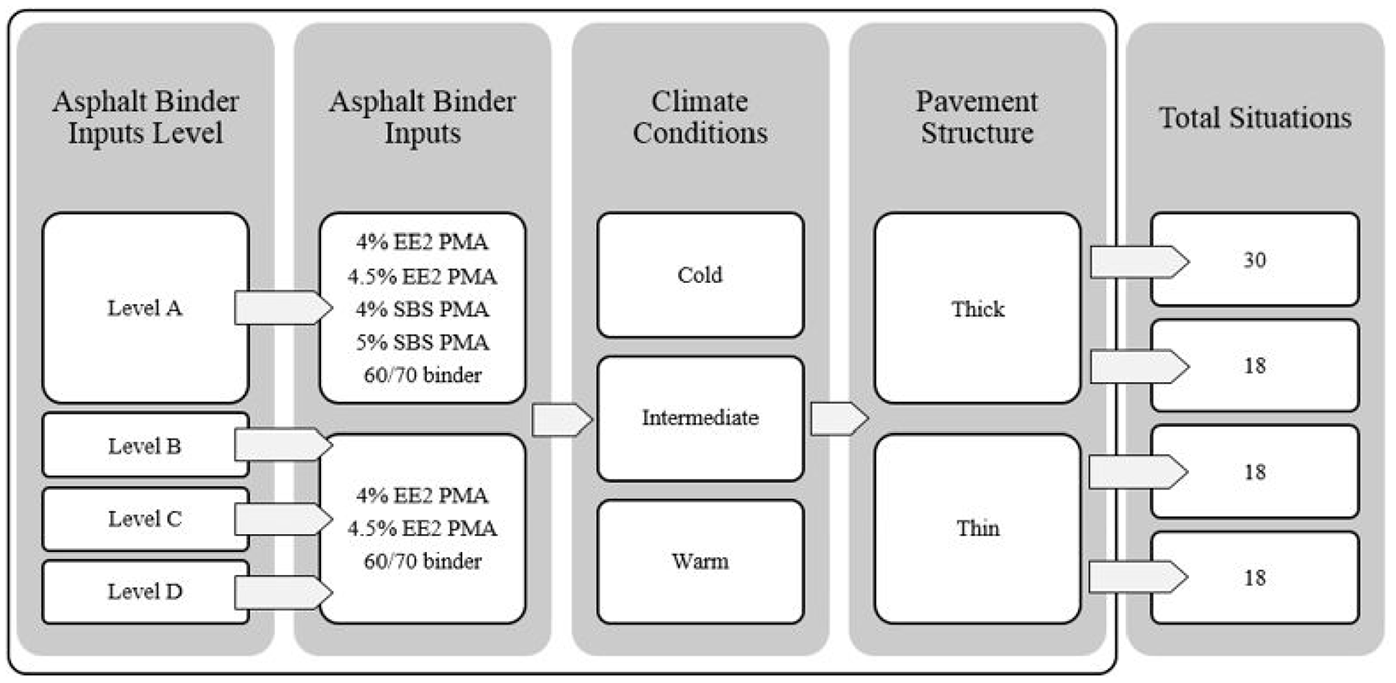
Summary of conducted simulations in the MEPDG analysis.
Results and discussion
The discussion covers the outcomes of studying the effect of polymer-modification on the rheological properties of asphalt binders. 4% and 4.5% EE2 as well as 4% and 5% SBS PMA binders were evaluated under different temperatures using multiple tests and compared with a 60/70 control asphalt binder. Moreover, the effect of PMA binders on the rheological properties was evaluated through the MEPDG under 84 simulations (refer to Figure 3). Furthermore, the effect of using different binder inputs on the rheological properties is compared through statistical analysis.
Lab tests results
DSR and BBR tests were conducted to evaluate the effect of polymer modifiers on the rheological properties of unaged and RTFO-aged binders. As the expected PG for the tested samples will vary by changing the polymer dose in the mix, the DSR tests was performed under different temperatures. The results were compared to similar tests conducted for a 60/70 control binder. The DSR tests was utilized to compute the rutting parameter (G*/sin δ) for unaged binders as well as RTFO-aged binders. Figure 4 shows the rutting parameter values for both unaged and short term-aged binders under multiple temperatures. It should be noted that the minimum values set by the Superpave for unaged and RTFO-aged rutting are 1.0 and 2.2 kPa, respectively. For unaged binders, it was found that the 4% EE2-modifed binder had a higher G*/sin δ value of 4.55 kPa compared to other tested binders at a common 70°C temperature which indicates a higher stiffness and resistivity for the rutting distress. In addition, for RTFO-aged binders, the 4.5% EE2-modified binder had the highest G*/sin δ value of 7.06 kPa at the same common temperature which indicates an enhanced performance against rutting resistance in terms of stiffness compared to unaged samples.

Rutting parameter after the DSR test for selected binders: (a) unaged and (b) RTFO-aged binders.
As for fatigue failure, the fatigue parameter (G*sin δ) was computed through the DSR test after long-term aging using the PAV procedure for the 4% EE2 PMA, 4.5% EE2 PMA, and 60/70 control binders as shown in Table 1. The fatigue parameter criterion set by the Superpave is a maximum value of 5000 kPa. It was found that the G*sin δ for the 60/70 binder was the lowest with a value of 397 and 283 at 31°C and 34°C, respectively. Also, the G*sin δ for 4% and 4.5% EE2 PMA were 434 and 402.5 kPa at 31°C, respectively, and 343.5 and 312.9 kPa at 34°C, respectively.
Fatigue parameter from the DSR test on selected binders after PAV.

Moreover, the BBR test was used to evaluate the thermal cracking resistance for 4% EE2 PMA, 4.5% EE2 PMA, and 60/70 binders. The evaluation of thermal cracking resistance is carried out by computing the creep stiffness [S(t)] and ability to dissipate stresses (m-value) under low temperatures. The Superpave criteria for thermal cracking are maximum S(t) value of 300 MPa and minimum m-value of 0.300. Figure 5 shows the S(t) and m-value for three binders. It was found that the 60/70 control binder had the lowest S(t) values of 14.7 and 17.6 MPa at −6°C and −12°C, respectively. However, the 4.5% EE2 PMA showed the only m-values higher than the minimum, with values of 0.404 and 0.306 at −6°C and −12°C, respectively.

S(t) and m-value after the BBR test for selected binders: (a) S(t) and (b) m-value.
According to the previous results, it is shown that different types of modified binders showed better results than the others in only certain parameters. For instance, the EE2 PMA binders showed better resistance to rutting than other selected binders, while the 60/70 control binder showed better fatigue resistance. Such variability in outcomes suggest that further analysis is required in order to identify the better modified binders to be used in pavement structures.
MEPDG simulation
In this study, the MEPDG simulation is divided into two parts: (1) assessing the effect of PMA binders on rheological properties and (2) comparing the different effect on rheological properties using different binder inputs.
Rheological properties
The effect of using different PMA binders on rheological properties was evaluated over a 20-year service-life period through MEPDG simulations. Shear complex modulus and phase angle values after short-term aging for each binder were used for rheological properties prediction. Table 2 shows the G* and δ values acquired from the lab for the selected binders after RTFO-aging. The evaluation was based on identifying the effect of modified binders on four pavement parameters: IRI, rutting, bottom-up fatigue, and thermal cracking.
G* and δ values for the tested binders after RTFO-aging.

Figures 6 and 7 show the impact all tested binders on the rheological properties under three climate conditions, two structural capacities, and according to four evaluation parameters. Generally, EE2-modified binders showed greater performance for pavement structures under all simulations. The overall ranking of the tested binders positively impacting the performance of pavement structures over a 20-year service life period was found as following: (1) 4.5% EE2 PMA, (2) 4% EE2 PMA, (3) 60/70, (4) 5% SBS PMA, and (5) 4% SBS PMA binders. For instance, 4% EE2 PMA binders showed an IRI value of 180 in/mile (failure at 17.75 years) under cold climate for thick pavement. On the other hand, 4.5% EE2 PMA binders showed the best performance compared to other binders with an IRI value of 186 in/mile (failure at 16.08 years) and 193 in/mile (failure at 13.83 years) for intermediate and warm climates, respectively. However, for thin pavement, 4.5% EE2 PMA binders outperformed other asphalt binders in all climates with values of 176.2 in/mile (failure at 18.83 years), 178.1 in/mile (failure at 18.33 years) and 172.5 in/mile (failure at 19.92 years) for cold, intermediate and warm climates, respectively. As for rutting evaluation, 4.5% EE2-modified binders showed greater rutting resistance compared to other binders with a value of 1.75 in (failure at 2 years) and 1.25 in (failure at 4.92 years) for hot climate in both thick and thin structures, respectively. The same superior performance of 4.5% EE2 binders was clearly shown in resisting fatigue cracking in where it did not fail in all three climate conditions for thick and thin pavement sections. Finally, the superior thermal cracking resistance was dominated by both 4% EE2-modified and 60/70 control binders with the same value of 27.17 ft/mile in cold climate for both thick and thin pavement sections.

Effect of selected binders on thick pavement performance according to four parameters: (a) IRI, (b) rutting, (c) fatigue cracking, and (d) thermal cracking.

Effect of selected binders on thin pavement performance according to four parameters: (a) IRI, (b) Rutting, (c) fatigue cracking, and (d) thermal cracking.
Asphalt binder inputs evaluation
In the second part of the MEPDG assessment, the effects of different asphalt binder inputs on rheological properties were evaluated and compared. As previously mentioned, four levels of asphalt binder inputs were used and compared for three selected binders (refer to Figure 3). In addition to level A (using G* and δ as inputs), Table 3 shows the required binder inputs used in levels B, C, and, D. Eighty-four scenarios were simulated through the MEPDG covering three asphalt binders, three climate conditions, and two pavement structures.
Binder inputs used for levels B, C, and D.

Statistical analysis by means of the t-test: paired two sample of means approach was used for evaluation of the results from using four binder input levels. In such approach, the values of multiple simulations under each two levels together are evaluated in order to check if the levels produced similar effects on the rheological properties or not. As a sample of the statistical analysis calculations, Figure 8 shows the variation in IRI values for the 4% EE2 PMA binders under different climatic conditions and structural capacity scenarios when using four input levels.
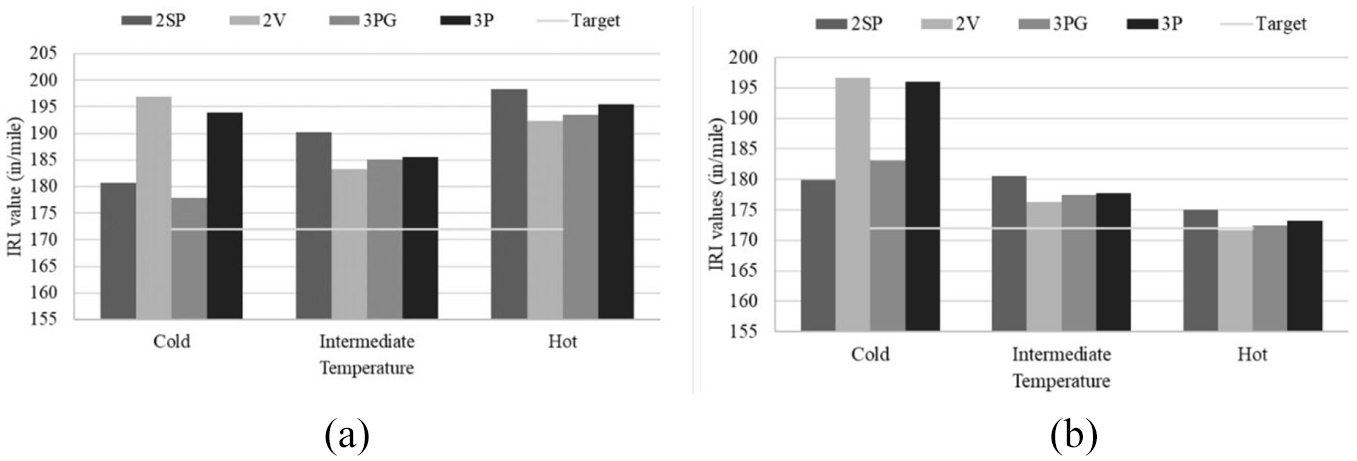
Difference in IRI values for 4% EE2 PMA binder according to four input levels: (a) thick and (b) thin structures.
Additionally, Table 4 shows all IRI values under different conditions for the 4% EE2 PMA binder according to levels A and B. In addition, the IRI values shown in the table are statistically analyzed using the mentioned t-test. The t-test calculates two statistical values that indicate the similarity of outcomes; the t-stat and the critical t-stat (Tc). When the t-stat value is less in magnitude than the critical t-stat, the outcomes of two samples are considered similar. In the present example, the t-stat value was −4.29 for the IRI outcomes for the 4% EE2 PMA binder when comparing input levels, A and B, while the Tc was 2.57. Therefore, since the t-stat value is higher than the Tc value, the statistical analysis indicates that using input level A provides different performance outcomes for IRI values compared to level B.
IRI values for the 4% EE2 PMA binder using input levels A and B.

The process explained is carried out for all other input levels, leading to a total of 72 comparisons (6 input levels combinations × 3 binders × 4 evaluation parameters). Table 5 summarizes the complete results of the conducted statistical analysis. The results show that for IRI, minimal differences in the effect of the change in the asphalt binder input level on the rheological properties were found. Additionally, no differences were found in the predicted resistance to thermal cracking when changing the input level. However, for rutting and fatigue resistance, changing the binder input level would, to a certain extent, change the predicted the rheological properties. Thus, it is recommended to take further precise binder input levels (G* and δ) when designing pavement structures in regions with intermediate and high temperatures. However, when designing pavement structures in relatively cold regions, the change of binder input levels would not have a significant effect based on the results of this study.
Summary of the conducted two sample t-test.

In addition, the one-way ANOVA statistical test was used to evaluate any significant differences between the four binder input levels at once. The difference between the two utilized statistical approaches is that the t-test limits the comparison between two groups only. However, the one-way ANOVA test is equivalent to conducting multiple t-tests by means of evaluating all four groups together, which results in a more accurate conclusion. The main outcome of the one-way ANOVA test is the p-value, which indicates if the analyzed groups are similar or not. If the p-value was found to be less than 0.05, it is concluded that there is a significant variance between the four tested means. Table 6 summarizes the results of the one-way ANOVA test. The results showed that changing the binder input level will not affect the evaluation of 4% EE2 PMA binder behavior against the existing distresses except for IRI which had a p-value< 0.05. On the other hand, both 60/70 and 4.5% EE2 PMA binder were not significantly affected by the input level variation except for fatigue cracking.
Summary of the conducted one-way ANOVA test.

The one-way ANOVA test showed relatively similar results compared to the two-sample t-test where minimal differences in the effect of the change in the asphalt binder input level on the rheological properties were found for IRI. In addition, no differences were found in the predicted resistance to thermal cracking, which is a similar outcome compared to the two-sample t-test. Moreover, the difference in the rheological properties under various binder input levels against fatigue cracking were found significant to a certain extent according to the one-way ANOVA test. However, the on-way ANOVA test showed no significant differences in the rheological properties against rutting under different binder input levels, which disagrees with the outcome of the two-sample t-test. Therefore, similar recommendations based on the two-sample t-test can be concluded based on the one-way ANOVA for using more precise binder input levels in pavement design for regions with mild and warm climate conditions.
To the knowledge of the authors, no previous studies have been conducted in the literature aiming at evaluating the effect of using different binder input levels on the rheological properties. However, the results of the conducted statistical analyses tests in the present study can be justified. Such results may be illustrated by the MEPDG competence in predicting pavement distresses using less accurate levels. However, the variability in prediction of IRI and fatigue cracking especially may be related to the interferences of different aspects within these two variables. As a result, using the MEPDG for predicting both the IRI and fatigue cracking within different input levels could be influenced by the changing of input level accuracy.
Conclusion
The study aimed at comparing the rheological properties of PMA binders using 4% and 4.5% EE2, as well as 4% and 5% SBS with the 60/70 control asphalt binder properties under multiple temperatures. The conducted analysis evaluated the performance of PMA through an acquired data from DSR and BBR laboratory tests. Additionally, MEPDG was implemented in the analysis to check the effect of selected binders on the performance of pavement structures for a 20-year period under three climate conditions and two structural capacities. Moreover, the effect of utilizing various asphalt binder input levels on the rheological properties was evaluated by the MEPDG and using statistical analysis by means of the “t-Test: Paired Two Sample for Means.” The main conclusions and findings drawn from the analysis and results of this study are summarized below:
The DSR lab test showed that the tested concentration based EE2-modified binder samples had higher rutting resistance compared to other selected binders samples. However, the 60/70 binder showed better fatigue resistance compared to other binders.
Utilizing MEPDG in the analysis had led to an overall ranking of the PMA binders in terms of positively impacting the rheological properties over a 20-year service life as following: (1) 4.5% EE2 PMA, (2) 4% EE2 PMA, (3) 60/70, (4) 5% SBS PMA, and (5) 4% SBS PMA binders.
Statistical analysis showed that the different binder input levels used to simulate pavement performance through its rheological properties resulted in adequate differences in the rutting and fatigue cracking performances for the same asphalt binder. However, minimal and no significant difference were found in the IRI and thermal cracking performances between the different input levels for the same asphalt binder, respectively.
The results of the statistical analysis suggest that using further precise input levels, that is, using G* and δ values, is preferable when designing pavement structures in regions with mild and warm climate conditions.
Following the above-mentioned conclusions, it is recommended that in order to validate the effect of PMA binders on the rheological properties against distresses, further analysis needs to be conducted using accurate field data. Moreover, a further assessment of selected PMA binders is required, such as life cycle costing, to obtain a more precise insight regarding the optimum polymer modification to be used in pavement structures.
Footnotes
Declaration of conflicting interests
The author(s) declared no potential conflicts of interest with respect to the research, authorship, and/or publication of this article.
Funding
The author(s) received no financial support for the research, authorship, and/or publication of this article.
