




Abstract
Asphalt pavements are consistently subjected to environmental and loading conditions that affect their durability, such as oxidative aging. Modification of the pavements assists in reducing the aging-induced stiffness. One of these solutions is crumb rubber (CR)-modified warm mix asphalt (WMA) binders. This study aims to assess the long-term performance and effects of aging on CR-modified WMA binders through a series of physical, rheological, and chemical tests. 2% and 4% of Sasobit, a wax-based additive, and 1.5% and 3% of Zycotherm, a nano-based chemical additive, with 10%, 15%, and 20% CR, were utilized. The binders were aged using a rolling thin film oven (RTFO) and pressurized aging vessel. The unaged and long-term aged asphalt binders were tested. Rheological properties, using master curves and zero shear viscosity, physical properties measured through elastic recovery, along with chemical analysis using Fourier transform infrared (FTIR) spectroscopy, were carried out on the binders before and after aging. Based on the physical and rheological aging indices, Sasobit-modified asphalt binders exhibited superior resistance to aging and rutting compared to Zycotherm-modified binders. Specifically, the Sasobit 4% and 20% crumb rubber blend showed the highest resistance to physical aging, while Zycotherm-modified binders demonstrated improved chemical aging resistance. Adding crumb rubber significantly enhanced the stiffness and elasticity of the asphalt binders, further reducing the effects of aging. FTIR analysis confirmed that Sasobit and crumb rubber reduced oxidation and volatile component loss during aging.
Introduction
Asphalt pavements are the backbone of transportation systems, enduring substantial loading and environmental conditions throughout their service life. Researchers have introduced various modifiers to improve the resistance of hot mix asphalt (HMA) to rutting, fatigue, and thermal cracking.1–4
Asphalt binder aging occurs in two stages: short-term aging during production and laydown and long-term aging during the pavement's service life. 5 In short-term aging, oxygen reacts rapidly with reactive compounds in the asphalt, altering the asphaltene ratio. This reaction rate slows after laydown and compaction, marking the onset of long-term aging. 6 Aging-induced stiffening increases HMA brittleness, susceptibility to fatigue, thermal cracking, and altering the stress distribution within the pavement structure.7,8
Aging impact on asphalt binders is conducted using aging indices that correlate with physical, rheological, 9 chemical,10,11 or microstructural properties before and after applying artificial aging.10,11 Various correlations, such as mechanical and rheological indices, have been developed to predict the degree of aging12–15 or recover the binder's lost properties during aging using materials known as rejuvenators. 16 These include antioxidants, nanomaterials, rubbers, bio-oils, and warm mix additives. 17
Sasobit® is a synthetic wax produced via the Fischer–Tropsch process. 18 It reduces the viscosity of asphalt binder during mixing, lowering the production temperature. 19 With a melting point of around 100 °C, it liquefies in heated asphalt, reducing viscosity, and crystallizes upon cooling, increasing binder stiffness. 20 Sasobit enhances performance grade (PG), 21 reduces non-recoverable creep compliance, 22 and improves fatigue resistance at intermediate temperatures, 23 but may slightly increase the risk of low-temperature cracking. 24
Zycotherm® is a newer additive designed to increase HMA's anti-stripping capability and reduce mixing and compaction temperatures. 25 However, Zycotherm has not been effective in improving rutting performance while decreasing moisture damage susceptibility.26,27
Crumb rubber (CR), a recycled material, enhances asphalt binders and mixtures. 28 Adding crumb rubber to asphalt binder causes the rubber to expand up to five times its original size, absorbing maltenes and increasing the asphaltenes ratio29,30 which enhances physical and rheological properties and resistance to permanent deformation, fatigue, and thermal cracking, but compatibility issues due to phase separation remain challenging.31,32 Adding CR to warm asphalt binders might overcome these challenges33,34 and has shown improved rutting resistance and low-temperature thermal and fatigue cracking resistance while decreasing viscosity.35,36
In addition to the performance-enhancing capabilities of warm mix additives and CR, warm mix additives and CR both exhibit anti-aging capabilities. 37 Warm mix additives retard the aging of the asphalt pavement over the pavement's service life due to lowered mixing and compaction temperatures and changes in the molecular structure.38–40
CR resists aging through interactions with asphalt binder.41–43 Carbon black antioxidants in CR absorb light components, reducing volatilization and oxidation. 44 Additionally, the polymeric chains in CR degrade during aging, releasing maltenes that reduce oxygen reaction with volatile components, thus mitigating aging effects. 45 In HMA, the anti-aging action of CR modified is accompanied by thicker asphalt films around the aggregates, providing additional barriers against aging. 46
Asphalt binder aging increases stiffness, brittleness, and susceptibility to fatigue and thermal cracking. To counter these effects, various modifiers have been introduced to enhance the durability of asphalt binders. These modifiers help improve resistance to aging, rutting, and cracking by altering the binders’ physical, rheological, and chemical properties. However, the durability of CR and warm binders over time is not fully understood; however, initial studies suggest strong aging resistance. 47 Given the limited exploration of aging resistance in CR-modified warm asphalt binders, this research investigates the long-term performance and aging effects on CR-modified warm mix asphalt (WMA) binders. The study employs various modifier contents and utilizes techniques such as the master curve, zero shear viscosity (ZSV), elastic recovery, Fourier transform infrared (FTIR) spectroscopy, and respective aging indices.
Materials
Penetration grade 60–70 asphalt binder was obtained from Shell Corporation, with properties shown in Table 1. Crumb rubber was sourced from Beeah Waste Management Company in Sharjah, UAE. Sasobit and Zycotherm were provided by the Sasol wax and Zydex industries, respectively. 2% and 4% Sasobit (S), 1.5% and 3% Zycotherm (Z) were added by weight of asphalt binder and mixed mechanically at 1000 rpm and 150 °C for 30 minutes. Crumb rubber was added to the WMA-modified binder in 10%, 15%, and 20% dosages by weight of the modified asphalt binder, then mixed at 2000 pm and 170 °C for 60 minutes. The dosages as well as the percentages used were decided based on previous and on-going research conducted on the materials. Published work can be found elsewhere. 48
Asphalt binder properties.

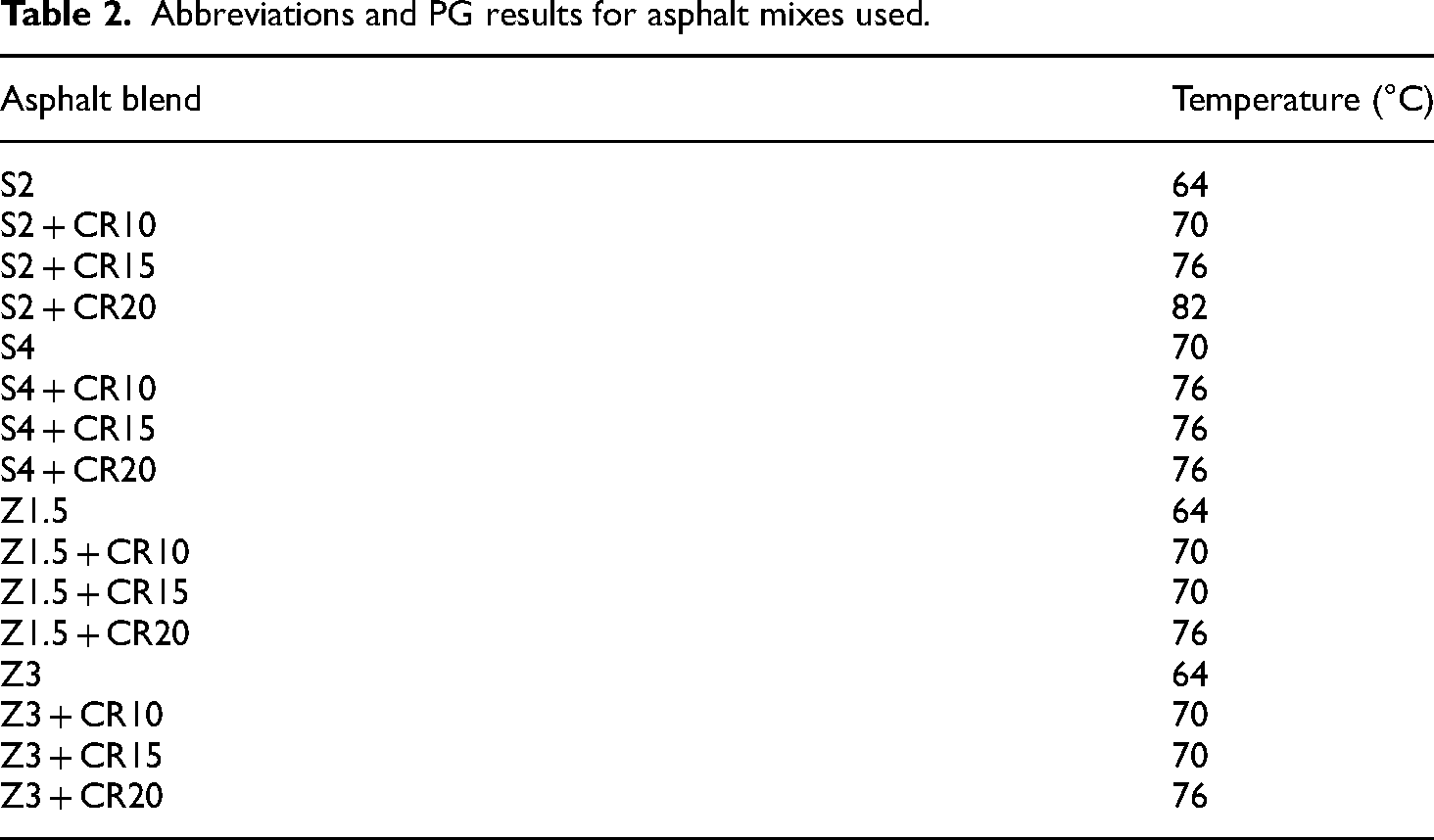
PG, per ASTM D7175, 53 was then carried out to find the actual PG of the binders. The abbreviations are used for the warm mix additive and crumb rubber content throughout the rest of the paper. For example, Sasobit 2% and crumb rubber 10% will be called S2 + CR10. The PG results and abbreviations are shown in Table 2.
Abbreviations and PG results for asphalt mixes used.
Testing methods
Asphalt binder aging
The rolling thin film oven (RTFO) and pressurized aging vessel (PAV) devices simulated asphalt binder aging. Short-term aging is simulated using RTFO according to [ASTM D2872], 54 while long-term aging is simulated using the PAV [ASTM D6521]. 55 RTFO simulates the aging of the asphalt mix during mixing at the asphalt mixing plant and laydown at the construction site. The aging method includes pouring 35 g of the original asphalt binder into standard glass bottles. The bottles are placed in a rotating shaft inside the RTFO for 85 minutes at 163 °C and subjected to 4 L/min airflow.
PAV simulates the long-term field conditions of the asphalt pavements. In this method, RTFO residue is poured into standard PAV pans 50 g each, and the samples are placed in a rack inside the PAV for 20 hours at 110 °C under a pressure of 2.1 MPa.
All the tests described above were performed on the unaged (original) and PAV-aged levels.
Rheological testing
Master curve
A master curve is used to quantify the rheological performance of asphalt binders as a function of time and temperature.
56
The frequency sweep test was used to construct the master curves for each binder at unaged and PAV-aged levels. The test used a dynamic shear rheometer (DSR) with a stress-controlled mode. The loading frequency ranged from 0.1 Hz to 16 Hz, and the temperature ranged from 10 °C to 70 °C in 10 °C increments. For temperatures between 40 °C and 70 °C, a 25 mm sample was used, while an 8 mm sample was used for temperatures between 10 °C and 40 °C with 40 °C overlapping. Complex shear modulus (|G*|) phase angle (δ) master curves were constructed from the frequency sweep test using a symmetric standard logistic sigmoidal (SLS) equation from the mechanistic-empirical design guide (MEPDG). To construct the master curve for G* and δ, the following equations, MEPDG SLS, Eqs. (1) and (2), data shifting was done using the quadratic polynomial equation (Eq. (3)) were utilized:


Zero shear viscosity
Since ZSV was linked to the rutting performance of asphalt binders,57,58 it was carried out to investigate the rutting performance of the asphalt binders at 50 °C, 60 °C, and 70 °C. Using the frequency sweep test results, the complex viscosity, angular frequency, and complex modulus were obtained to calculate the complex viscosity using the Carreau model,
59
Eq (4).
Elastic recovery
Following the ASTM guidelines [D6084], an elastic recovery (ER) test was performed to evaluate the fatigue susceptibility of asphalt binder. A ductility device was used for this test. Samples of the asphalt binder were poured into aluminum molds designed for elastic recovery and then submerged in a water bath at 25 °C. The samples were stretched to a distance of 50 mm, cut, and let to recover for 1 hour, then returned to their original position to determine the recovered length. The test was conducted at 50 mm length due to the hardening of the aged specimen, which snaps when stretched to 200 mm. The elastic recovery was then calculated using Eq (5):
Chemical testing
FTIR spectroscopy was conducted on the representative samples of warm mix additives and CR contents to assess the chemical changes to the asphalt binder. S4 + CR20 and Z1.5CR15 were chosen to represent the effect of the warm asphalt modifiers and CR on the asphalt aging resistance. An 8 mm sample was prepared and placed on the ATR diamond to measure the absorbance. The test was carried out at 400 cm−1 to 4000 cm−1 wavelength spectra. The area under the peaks was calculated for carbonyl and sulfoxide peaks to determine the aging indices.
Aging indices as aging indicators
An aging index (AI) is calculated for the ZSV, and elastic recovery is as follows:



Results and discussion
Of impact of aging on the complex modulus and phase angle
Master curves were constructed for complex modulus (G*) and phase angle (δ) at a reference temperature of 40 °C using Eqs. (1)–(3). These curves were created using time–temperature superposition for all the investigated binders, as depicted in Figure 1. The effect of different additives, Sasobit 2% and 4% and Zycotherm 1.5% and 3%, on the performance of G* and δ was analyzed, followed by the effect of CR on the warm binders.

Master curves of (a) Zycotherm- and (b) Sasobit-modified asphalt binders.
It was observed that Sasobit 2% and 4% had a slight increase in G* at low temperatures (high frequencies), while Zycotherm 1.5% and 3% decreased it. As the test temperatures increased (low frequency), the enhancement was more visible, with Sasobit 4% remarkably increasing the G* compared to the other binders. Sasobit 2% also showed a slight increase in the G*. In comparison, the control asphalt binder outperformed the Zycotherm binders.
The phase angle shows the viscoelastic behavior of the asphalt binder, with a smaller δ indicating higher viscoelasticity. The control asphalt binder had similar δ to Zycotherm 1.5% and 3%, showing negligible enhancement in performance. Sasobit 2%, on the other hand, had a minor decrease, while Sasobit 4% significantly reduced the δ. This indicates that Sasobit 4% has a superior viscoelastic response and stiffness compared to the other binders.
From the results, it is evident that Sasobit outperformed both the control and Zycotherm asphalt binders. This is due to the microstructural enhancement mechanism of Sasobit, which forms a crystalline lattice network structure below its melting point of 100 °C. This structure increases the stiffness of the asphalt binder while enhancing the viscoelastic behavior, ultimately decreasing rutting susceptibility. 24 Studies have shown this behavior is linked to enhanced rutting resistance. 26 In contrast, Zycotherm asphalt binders did not exhibit improved stiffness and viscoelasticity at high temperatures, reducing rutting resistance. However, it was found that the decreased stiffness of Zycotherm, like other chemical warm mix additives and asphalt binders at low temperatures, is associated with higher thermal crack resistance. 27
After blending the warm binders, crumb rubber was added to address the shortcomings of the WMA additives. Master curves were constructed at 40 °C. Adding CR generally increased the G* of the asphalt binders as the degree of enhancement depends on the amount added. As evident, the addition of 10% CR increased the performance of Sasobit 2 + CR10, and the Zycotherm binders matched with the control asphalt binder; meanwhile, the G* of Sasobit 4 + Cr10 did not increase.
The addition of 15% CR, Figure 2(b), resulted in an overall increase in G* compared to 10% CR. Sasobit asphalt binders G* increased at low and high temperatures, while the Zycotherm binders had similar G* values to the Sasobit binders at low temperatures, the G* at higher temperatures is still lower than the Sasobit binders. As for 20%, the G* of all the binders increased remarkably. Zycotherm binders G* increased to match Sasobit 2 + CR20 at low temperatures, but the difference between the increase of G* in Sasobit and Zycotherm binders is observable at intermediate and high temperatures.

Complex modulus and phase angle master curves for (a) 10% CR warm binders, (b) 15% CR warm binders, and (c) 20% CR warm binders at a reference temperature of 40 °C.
Phase angle decreased with the increase in CR content. However, the decrease is inconsequential as the CR content is increased. Sasobit 2 + CR10 had the smallest δ at low temperatures, while at 15% CR, the Zycotherm asphalt binders displayed close values of δ, indicating an enhancement in the viscoelastic response of the Zycotherm binders. Zycotherm binders displayed a trend with the addition of 20% CR; at high temperatures, the δ master curve increases then decreases to δ values below the Sasobit binders. This behavior occurs at high temperatures and frequencies in softer binders; softer binders change from solid to liquid phase during testing, i.e. from elastic to viscous. The enhancement in G* and δ in Sasobit rubber asphalt binders is due to a combination of the enhancing properties of both additives. Sasobit crystalline structure and the polymer network of CR increase the stiffness of the asphalt binder, thus reducing rutting deformation.
At high temperatures, the stiffness of the asphalt binders indicates the rutting resistance. Therefore, asphalt binders with higher G* are preferred. High G* weakens the asphalt binder in thermal and fatigue cracking resistance at low temperatures. This means that Sasobit asphalt binders are superior in rutting resistance, while Zycotherm binders can be used for rutting resistance; the Zycotherm binders are more suitable for thermal and fatigue cracking resistance. 21
During the service life of asphalt pavements, oxidation stiffens the HMA. This is evident in the master curves constructed for the aged binders. As is apparent in Figure 3, the aging caused an upward shift for both the G* and δ for all the asphalt binders. At low temperatures, the Zycotherm and Sasobit 2% had similar G*, while the control and Sasobit 4% G* increased slightly. At intermediate and higher temperatures, the G* for the control and Sasobit 4% asphalt binders increased more than the rest. This shows that Zycotherm binders resisted the aging impacts more than the Sasobit binders due to lower stiffness initially. Adding the CR enhances the aging resistance of the binders. At 10% CR, Sasobit 2% + CR10 had the lowest G*, while Sasobit 4% G* increased slightly. Zycotherm binders aged significantly, as observed in the upward shift of the G*, to match the G* of Sasobit 4%. At 15% CR, a remarkable increase in G* values is observed at high temperatures in Sasobit 2 + CR15 and Sasobit 4 + CR15. This is attributed to the high stiffness of the Sasobit asphalt binders combined with the stiffening effect of CR. At 20%, the stiffness of the Zycotherm and Sasobit 2 + CR20 is the same, suggesting an insignificant change in G* due to aging, while Sasobit 4% + CR20 had a slight increase in G*.

Master curves for (a) Aged warm mix, (b) aged 10% CR warm binders, (c) aged 15% CR warm binders, and (d) Aged 20% CR warm binders.
Phase angle increases as the asphalt ages and stiffens, lowering the viscoelastic response and reducing fatigue and thermal cracking resistance. As presented in Figure 3, the phase angle of the binders approaches 90°, which implies the binders are losing their elasticity. However, the increase depends on the warm mix additives and CR contents. Zycotherm binder increased by over 90 °C, while Sasobit binders have a lesser phase angle. Adding CR decreased the phase angle for all the binders, with Sasobit 4 + CR10 having the lowest phase angle. Increasing the CR content to 15% and 20% resulted in a further marginal decrease, especially for Zycotherm binders.
As asphalt ages and stiffens, the phase angle (δ) increases, reducing viscoelastic response and resistance to fatigue and thermal cracking. The results show phase angles approaching 90°, indicating reduced binder elasticity. Zycotherm binder increased by over 90 °C, while Sasobit binders had a lesser increase. Adding CR decreased the phase angle for all binders, with Sasobit 4% + CR10 having the lowest phase angle. Increasing CR content to 15% and 20% resulted in further marginal decreases, especially for Zycotherm binders.
Impact of aging on zero shear viscosity
Since the ZSV is linked to the rutting performance of asphalt binders, 56 the ZSV was calculated from the temperature/frequency data. From Figure 4, the viscosity decreases with frequency and temperature. Sasobit's 4% modified binder had the highest ZSV values at all test temperatures and frequencies, followed by Sasobit's 2%. The Zycotherm did not enhance the rutting performance, as chemical additives are not effective in improving the asphalt binder's rutting resistance as these additives increase the polarity of the asphalt binder to better coat the aggregates in HMA only. 27 As observed, the viscosities of the Zycotherm binders are slightly lower than those of the control.

Zero shear viscosity of warm and rubber asphalt binders at (a) 50 °C, (b) 60 °C, (c) 70 °C. The legend is for all the asphalt binders used.
From Figure 4(a), the Sasobit binders remain non-Newtonian as the temperature increases, whereas the control and Zycotherm asphalt binders change their behavior towards more Newtonian at 50 °C. As evident in the results, the viscosity of Sasobit 4% increases significantly as the shear rate decreases, which is considered a shear-thinning behavior. While it is expected that the Zycotherm decreases the viscosity, Sasobit exhibited the opposite behavior.
After aging, the asphalt binder stiffness increases. This is also observed in ZSV—the loss of resins and maltenes and increase in asphaltenes agglomeration causes the asphalt binder to be susceptible to shear thinning, thus becoming non-Newtonian at low temperatures. 8 As shown in Figure 5, the asphalt binders aged significantly and became non-Newtonian. The same trend is observed for the Zycotherm asphalt binders; while the aging is notable, the impact of aging is lower than the aged control asphalt binders. Aging the CR warm asphalt binders resulted in increasing the complex viscosity. At 10% CR, the Sasobit 4 + CR10% binders aged drastically compared to the Zycotherm binders, while Sasobit 2 + CR10% aged complex viscosity was the least. At 15% CR, a similar trend is observed when compared to the warm asphalt binders. Sasobit 4 + CR15 has the highest complex viscosity, followed by Sasobit 2%, Zycotherm 1.5%, and Zycotherm 3%. At 20% CR, Sasobit 4 + CR20 had the highest complex viscosity due to aging and the unaged high stiffness.

Zero shear viscosity of aged warm and rubber asphalt binders at (a) 50 °C, (b) 60 °C, (c) 70 °C. The legend is for all the asphalt binders used.
ZSV was calculated using Carreau's model from the absolute ZSV, then equation (6) was used to determine the aging impact, as shown in Figure 6. Sasobit binders are observed to resist aging more than the Zycotherm and control asphalt binder. However, for every CR content, an optimum warm additive is observed. For 10%, Sasobit 2% is best. For 15% and 20%, Zycotherm 1.5% and Sasobit 4% are suitable, respectively. It is worth noting the indices are calculated at 50 °C, 60 °C, and 70 °C to assess the rutting at a wide range of temperatures.

Zero shear aging indices for asphalt binders used.
ZSV results show that the reduced viscosity of Sasobit asphalt binders is due to the interaction mechanism between Sasobit and the CR in the asphalt binder, in addition to the anti-aging capabilities of CR. Sasobit melting the asphalt binder at high temperatures reduces the viscosity at the aged and unaged levels while enhancing the self-healing of asphalt binders.23,37 CR, on the other hand, degrades in the asphalt binder during aging. CR has been found to resist asphalt binder aging by interacting with the binder. As the binder ages, CR releases carbon black, which delays the reaction between the volatile components in the binder and oxygen. Additionally, the breakdown of polymeric chains in CR during aging reduces the reaction with oxygen in the volatile components of the binder. CR also releases maltenes as it degrades, which further retarding effects on the binder.36,46
Impact of aging on elastic recovery (ER)
The literature used elastic recovery to assess asphalt binders’ fatigue cracking and rutting susceptibility. Research has shown that asphalt binders with high ER have better fatigue cracking and rutting resistance. 60 As presented in the unaged state, Sasobit 4% had the highest ER compared to the control and Zycotherm asphalt binders, as shown in Figure 7(a). Zycotherm reduced the ER, which can be attributed to the low stiffness and viscosity from adding Zycotherm; this reduction is expected from chemical additives.21,22 Adding the CR, the ER for all binders increased; however, the increase depends on the CR content. At 10% and 15%, Sasobit 2% was suitable, while at 20%, Sasobit 4% was suitable. The E.R. is better for Sasobit, as research confirms that Sasobit enhances the asphalt binder elasticity compared to the negligible effect of chemical additives.24,26 Sasobit enhances the elastic behavior of the asphalt binder through the reaction between Sasobit and the asphalt binder. 23 Conversely, CR absorbs the resins and oils, increasing the molecular weight. 32 Moreover, the large CR particles prevent further deformation and micro-crack propagation at intermediate and low temperatures. 33

Elastic recovery of unaged (a) warm asphalt binders and (b) rubberized warm asphalt binders.
Aging the asphalt binders increases the stiffness, increasing the E.R., as shown in Figure 8. Sasobit 4% had the lowest E.R. among the control and warm binders. CR addition increased the E.R. overall. At 10% CR, the E.R. is almost the same for all the binders. At 15%, Sasobit 4 + CR15 had the least E.R. The remaining binders had similar E.R. At 20% CR, Zycotherm 3 + CR20 E.R. increased significantly, followed by Sasobit 2 + CR20. In contrast, Sasobit 4 + CR20 and Zycotherm 1.5 + CR20 had similar ER. Based on these results, the elastic recovery aging index (ERAI) was calculated using Eq. (7) to show the aging degree of the binders. As presented in Figure 9, the ERAI for Sasobit asphalt binders is much lower than that of Zycotherm. Even with the addition of CR, Sasobit remained best in resisting aging. Sasobit 2% is better suited for lower CR contents, while Sasobit 4% is suited for higher CR (20% and more).
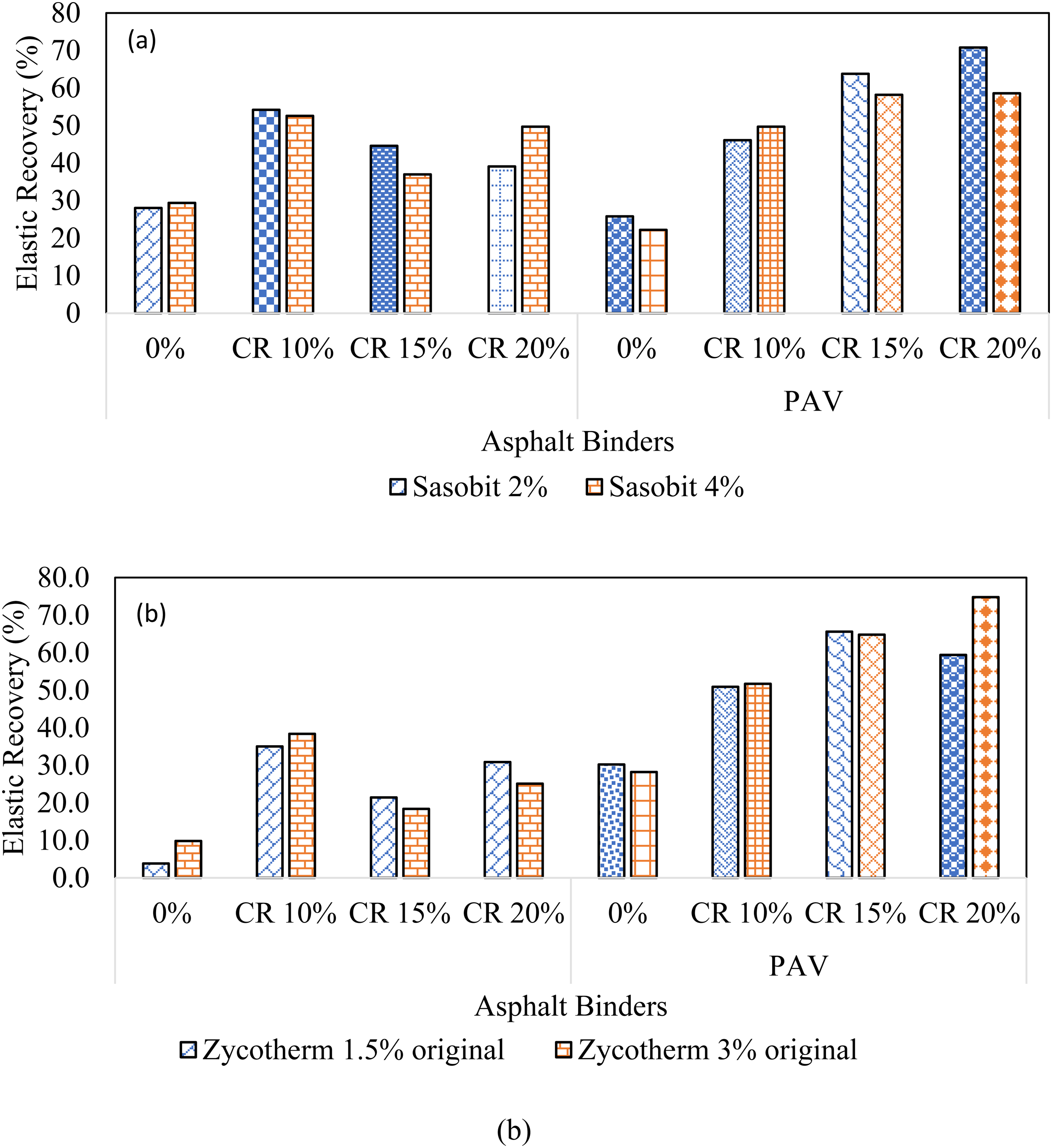
Elastic recovery of unaged and aged (a) Sasobit asphalt binders and (b) Zycotherm asphalt binders.

Elastic recovery index for all the asphalt binders tested.
FTIR analysis
FTIR is used to analyze the chemical composition of asphalt binders as the test allows the assessment of the changes in carbonyl and sulfoxide groups before and after long-term aging in addition to the effect of modifiers on asphalt binder aging resistance. 61 The FTIR was carried out on five binders: control (unaged and aged), Sasobit 4% (unaged), Zycotherm 1.5% (unaged), Sasobit 4%+CR 20% (unaged and aged), and Z1.5 + CR 15 (unaged and aged). S4 + CR20 and Z1.5CR15 were chosen to represent the effect of the warm asphalt modifiers and CR on the asphalt aging resistance. Since Zycotherm binders did not show any improvement in the unaged and aged states, Figure 10(a) shows the FTIR spectrums for the control and WMA-modified asphalt binders. The prominent peaks identified are 1030 cm−1, 1455 cm−1, 1600 cm−1, 1700 cm−1, and 2850 cm−1. These peaks correspond to sulfoxides stretching (S=O), methyl (CH3), aromatic (C=C), carbonyl (C=O), and methylene (CH2), respectively.

FTIR results for (a) unaged warm asphalt binders and (b) unaged and aged crumb rubber warm asphalt binders.
Group indices, Table 3, were calculated to investigate the relative increase in the peaks at 1450 cm−1 and 2850 cm−1 wavelengths. While Figure 10(a) shows an increase in the peaks for Sasobit at 4% and Zycotherm at 1.5%; the relative methylene index shows a minimal increase compared to the control asphalt binder. This increase in the Sasobit peaks is due to the high hydrocarbon chains in the Sasobit additive. 23 However, the absence of any new peak formation suggests no complex chemical reaction occurred between the warm mix additives and the asphalt binder.
Group indices of peak groups in FTIR.

Adding CR, Figure 10(b), to the warm binders caused a downward shift in the absorption at a wavelength of 750 cm−1, which corresponds to the bending of cis-distributed alkene, and a new peak formed at 966 cm−1, corresponding to trans-distributed alkene. As for the Zycotherm-modified asphalt binder, new peaks were formed at 760 cm−1, related to 1,3-distributed C–H. Table 3 indices were used to determine the change in the main chemical components. The methyl, sulfoxide, and aromatic indices increased for S4 + CR20 and Z1.5 + CR15. The methyl peaks are related to the CR polymeric make-up released in the Sasobit- and Zycotherm-modified asphalt binder, while the sulfoxide increase is due to the release of the sulfur components in the CR to the asphalt binder. The decrease in the carbonyl index is due to the breakdown of the C=C while mixing and the formation of the new peaks. These findings are close to previous studies, although the readings vary due to the different asphalt binders used.43,45
Aging the control binder and the CR-modified warm binders was carried out to investigate the modification efficacy in reducing the impact of aging on the chemical properties. As observed in Figure 10, the control PAV has formed peaks at 1058 cm −1, 1158 cm −1, and 1579 cm −1, representing the aromatics group. Another distinctive peak, 1100 cm −1, was formed in S4 + CR20 PAV and Z1.5CR15 PAV, related to the Si–O–Si bond from nano silica present in the CR. This peak is formed due to the stretching vibration of nano silica found in CR, as documented in previous studies. 41
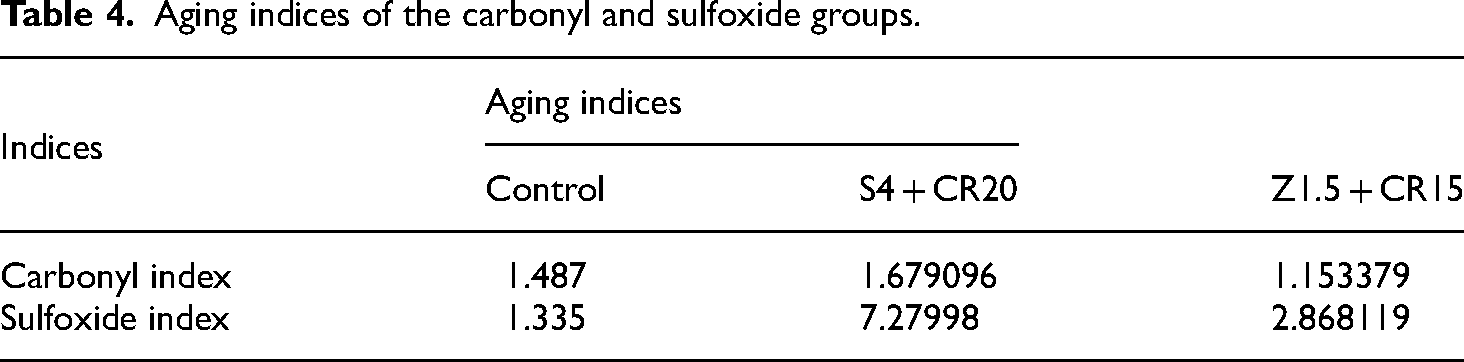
The impact of aging can be assessed through the carbonyl and sulfoxide indices calculated using Eqs. (8) and (9). The indices will be compared to the control binder to assess the overall aging. Using the indices, this shows that oxidation occurs during aging, increasing the S=O and C=O indices. Similarly, the resins react with oxygen to form aromatic hydrocarbon structures. 62 The aging impact for the CR is presented in Table 4. The indices indicate that S4 + CR20 did not prevent the chemical aging of the asphalt binder, while Z1.5 + CR15 slightly inhibited the aging., as presented in the CAAI. These findings confirm previous studies that reported higher chemical aging resistance of chemical additives compared to wax-based additives. 39
Aging indices of the carbonyl and sulfoxide groups.
Discussion
The impact of aging on asphalt binders has been studied extensively using several techniques, including the master curve, ZSV, and FTIR spectroscopy. These methods collectively provide a comprehensive understanding of how aging affects HMA during its service life. One significant effect of aging is oxidation, leading to the HMA's stiffening. This stiffening is evident in the master curves, where the complex modulus (G*) and phase angle (δ) show an upward shift for all aged binders.
During the service life of asphalt pavements, oxidation stiffens the HMA, as shown by the upward shift in both G* and δ for all aged binders in the master curves. At low temperatures, Zycotherm and Sasobit 2% had similar G*, while the control and Sasobit 4% showed a slight increase. At intermediate and high temperatures, G* for the control and Sasobit 4% binders increased, indicating that Zycotherm binders resisted aging impacts better due to lower initial stiffness. Adding CR enhances binder aging resistance.
As asphalt ages and stiffens, the phase angle (δ) increases, diminishing the viscoelastic response and reducing resistance to fatigue and thermal cracking. The results show that phase angles for aged binders’ approach 90°, indicating a significant reduction in binder elasticity. Zycotherm binders experienced an increase in phase angle by over 90 °C, whereas Sasobit binders had a lesser increase. This implies that Sasobit binders retain more elastic properties over time than Zycotherm binders.
The increased stiffness of the asphalt binder can be observed through the viscosity changes. ZSV results show that the reduced viscosity of Sasobit asphalt binders is due to the interaction mechanism between Sasobit and the CR in the asphalt binder, in addition to the anti-aging capabilities of CR. Sasobit's ability to lower viscosity and enhance stiffness at performance temperatures contributed to its superior performance. Sasobit melts in the asphalt binder at high temperatures, reducing viscosity in both aged and unaged states while enhancing the self-healing properties of asphalt binders.
Moreover, CR degrades in the asphalt binder during aging. CR resists asphalt binder aging by interacting with the binder; as the binder ages, CR releases carbon black, which delays the reaction between the volatile components in the binder and oxygen. Additionally, the breakdown of polymeric chains in CR during aging reduces the reaction with oxygen in the volatile components of the binder. CR also releases maltenes as it degrades, further mitigating aging effects on the binder.
As observed in the master curves, the Sasobit binders’ G* increase was less than the Zycotherm and control binders, combined with lower mixing and compaction temperatures, i.e. a decrease in the loss of volatile components, resulted in increased resistance to aging as evident in the elastic recovery results. On the other hand, Zycotherm did not modify the asphalt binder and, therefore, did not enhance the aging resistance. These findings align with numerous studies that assess the aging degree of wax and chemical warm mix additives.20,21,24 As mentioned, ER is linked to fatigue cracking resistance. 63 A lower ERAI indicates increased aging resistance and reduced susceptibility to fatigue cracking. Sasobit binders exhibit a lower ERAI, suggesting they maintain better elastic properties over time than Zycotherm and control binders. This enhanced aging resistance makes Sasobit theoretically better suited for high-traffic areas where the pavement undergoes substantial stress and deformation.
The comprehensive evaluation of Sasobit binders, including their improved performance at lower temperatures and greater resistance to aging, suggests they are more effective in maintaining pavement integrity over time. Meanwhile, Zycotherm binders, despite their ability to reduce mixing and compaction temperatures, did not significantly enhance aging resistance. This distinction is critical for selecting appropriate additives for asphalt binders, especially in regions with varying temperature ranges and traffic loads.
The asphalt binders were ranked according to their respective indices, as shown in, a clear difference in aging resistance is observed. S2 + CR10 ranked first, followed by S4; this can be attributed to the low contents of CR, which degrades as the binder ages; moreover, low mixing and compaction temperatures increase the aging resistance. Another noteworthy observation is the high ranking of Z1.5CR15, which ranked third. While it is known that chemical additives do not physically enhance the asphalt binder performance, an apparent effect is observed chemically, as mentioned in the FTIR results, which could explain the increased resistance compared to other Zycotherm and CR contents. This can be assumed to be an optimum blend between Zycotherm and CR. ERAI results were in favor of the Sasobit binders as well, with S4 being the first. This is also due to the low mixing and compaction temperatures and the CR-enhanced impact on asphalt binder aging.
Table 5 shows that ZSVAI at three temperatures did not show a clear trend. However, based on the results at 50 °C and 60 °C, S2 + CR10 resisted the aging the most, followed by S4 + CR20. At 70 °C, a clear difference in aging resistance is observed. S2 + CR10 ranked first, followed by S4; this can be attributed to the low contents of CR, which degrades as the binder ages; moreover, low mixing and compaction temperatures increase the aging resistance. Another noteworthy observation is the high ranking of Z1.5CR15, which ranked third. While it is known that chemical additives do not physically enhance the asphalt binder performance, an apparent effect is observed chemically, as mentioned in the FTIR results, which could explain the increased resistance compared to other Zycotherm and CR contents. This can be assumed to be an optimum blend between Zycotherm and CR. ERAI results were in favor of the Sasobit binders as well, with S4 being the first. This is also due to the low mixing and compaction temperatures and the CR-enhanced impact on asphalt binder aging.
Asphalt binder rankings based on the aging indices.

Conclusion
This study aimed to investigate the impact of aging on rubberized warm asphalt binder through a range of rheological and chemical indices. Based on the results, the following is concluded:
Complex modulus master curves constructed for all the binders indicate higher stiffness for the Sasobit asphalt binders with and without the CR. Zycotherm had a negligible effect on the asphalt binder's stiffness. Phase angle master curves showed a lower phase angle for Sasobit than the Zycotherm binders, which is an enhancement in the viscoelastic response of the Sasobit binders. ZSV curves showed a tendency for Sasobit binders to undergo shear-thinning at all frequencies and temperatures, while the control and Zycotherm binders remained Newtonian. This is due to the crystallization of Sasobit at low temperatures, which reorients with the direction of shear force. Adding CR did not affect non-Newtonian behavior, and the ZSV for Sasobit binders was increased. Elastic recovery showed a similar trend to the master curve and ZSV findings. Sasobit binders have better elastic recovery and higher resistance to rutting and fatigue. EARI showed a higher resistance of the Sasobit binders than Zycotherm, implying a higher resistance to fatigue cracking in the long term. Aging the asphalt binders increased the stiffness and phase angle, implying a weaker viscoelastic response to loading. Sasobit binders were capable of resisting aging-induced effects. However, Sasobit's content must be chosen carefully to fully increase the self-healing capabilities of a given CR content. FTIR analysis showed that Sasobit-modified asphalt binders do not resist aging, and neither does Zycotherm-modified binders. However, both additives were relatively chemically aged worse than the control asphalt binder. The addition of crumb rubber formed a peak at 1100 cm −1, which indicates the degradation of the crumb rubber particles in the asphalt mix and the release of sulfates within the crumb rubber network. Ranking of the asphalt binders based on aging resistance showed that Sasobit is a better additive to resist aging overall. However, Z1.5CR15 can be an alternative to Sasobit.
Finally, future studies could focus on exploring the long-term performance of crumb rubber-warm-mix additives modified binders in field conditions to validate the laboratory findings. Moreover, the combination of Sasobit and Zycotherm presents a promising area for further research, as the two additives offer complementary benefits. Sasobit enhances rutting resistance, while Zycotherm improves chemical aging resistance.
Footnotes
Acknowledgments
The authors would like to thank Eng. Fatima Mohamed Abla for her assistance in FTIR testing. The authors also thank Eng. Sara Alattieh for her assistance in master curve testing.
Declaration of conflicting interests
The authors declared no potential conflicts of interest with respect to the research, authorship, and/or publication of this article.
Funding
The authors received no financial support for the research, authorship, and/or publication of this article.
