




Abstract
In order to study the heat transfer characteristics between two rough surfaces of two contacting blocks with different bulk temperatures and sliding reciprocating motion, a two-dimensional heat transfer model was used to analyze the dimensionless average heat flux, considering thermal contact conductance. The results of a series simulations were presented, covering a wide range of operating parameters including dimensionless amplitude
Introduction
Surface heating at a sliding contact interface has long been of interest. Most studies1–8 involving this aspect have focused on unidirectional sliding. In contrast, the heat source is time-varying, and the sliding motion is periodic in sliding contact involving reciprocating motion, which is anticipated to behave differently not only in terms of its different tribological characteristics but also in its thermal response. 9 Such contact conditions are often found in many applications, such as in reciprocating pistons in cylinders, in sealing components in reciprocating pumps, or in sliding bears.
In the range of a typical oscillatory amplitude of a fretting contact, 10–100 μm, there is a response of the nominally static joints to vibration. However, when the amplitude of motion is greater than the size of the body, some regions experience periodical contacting and separating. Depending on the amplitude of the motion, the heat transfer behavior and temperature distribution in the heated zone are quite different. Greenwood and Alliston-Greiner 10 analyzed the surface temperature in fretting contact by separating the sinusoidal heat source into constant and periodic heat inputs using a Fourier transform. Based on the Green’s function method, Tian and Kennedy 11 presented that the surface temperature rise in oscillatory sliding can be assumed as the sum of the nominal temperature rise and the cyclic local temperature rise in an oscillatory contact. Kalin and Vizintin 12 pointed out that the flash temperature of a low-amplitude fretting motion is much different from that of a high-amplitude fretting motion. In their particular case, the flash temperature averages from 45°C to 768°C, corresponding to the motion amplitude from the lowest to the highest.
Besides amplitude, the frequency of the sliding motion also significantly affects the surface temperature and the heat flux at the interfaces. 13 Wen and Khonsari 14 investigated the periodic oscillations of the surface temperature rise with different types of heat sources (circular, rectangular, and parabolic) over a wide range of frequencies and amplitudes. They suggested that a lower dimensionless frequency or a higher dimensionless amplitude results in a greater oscillation of the overall surface temperature. Simulation and experimental results show that an increase in the oscillation frequency yields a higher average contact temperature rise. 9
Significant efforts have been devoted to study the heat transfer and temperature field generated by friction in fretting contact. However, until today, there has been no specific study on the relationship of the heat exchange caused by differences in body temperatures versus frequency and amplitude. In this case, the regions of different temperatures are juxtaposed to enhance heat transfer relative to the static case. To some extent, motion is a form of convective heat transfer. At the same time, well-known imperfect contact to static solids should be considered in reciprocating sliding contact. The thermal contact conductance of non-static contacts has been identified.15–17 The authors 18 investigated the thermal contact conductance, considering speed, mean contact pressure, and surface roughness.
This article studied the heat transfer between two objects due to temperature differences. A finite element model was implemented in the general finite element code ABAQUS to analyze the heat transfer of the reciprocating contact under dry sliding conditions. The changes in the heat flux were correlated to the changes in the mechanical parameters of the reciprocating sliding contact, such as amplitude, frequency, surface roughness, and pressure. The effective thermal contact conductance was believed to provide more efficient and accurate calculations.
Statement of the problem
Consider a system consisting of a stationary (lower) body

where

A model of reciprocating motion.
The corresponding displacement is given by

where
The contact interface on the microscale appears as a thermal resistance on the macroscale. In its inverse form, thermal contact conductance can be considered as characterizing the transfer of heat across the contacting interfaces. 19
Based on the principle of conservation of energy, the mean heat flux of the interface can also be obtained as the product of the temperature change

where the thermal contact conductance

where C is a combined factor consisting of thermal and physical parameters, and a brief description is shown in Appendix 1.
Heat conduction analysis
Incomplete contact occurs at the interface of the two bodies. The transient behavior with constant thermophysical properties is performed by the following governing equations.
For the upper body



For the lower body


where
Dimensional considerations
The equations were solved numerically; thus, it is crucial to make use of dimensionless variables to extend the generality of the results. The following dimensionless parameters are used to derive the solution

which ensures that the evolution of the sliding contact is the same for all the parameters in dimensionless space-time. The product of
The sliding velocity is normalized as

where the dimensionless parameter
For the problem with the local temperature change

In these dimensionless coordinates, the heat conduction equation in the dimensionless form is

According to the Fourier law, the heat flux per unit area along axial direction is

Substituting equations (3), (4), and (11)–(13) into equation (15) gives

In this dimensionless problem, three dimensionless parameters affect the heat flow, and they are

where the amplitude of the dimensionless oscillation
Numerical solution
The finite element results of the heat conduction problem described in the “Statement of the problem” section were obtained using the two-dimensional model shown in Figure 2, which consisted of two blocks with the identical contact surfaces. The lower body

(a) Finite element model. (b) Partial amplification drawing.
The ABAQUS finite element software package 22 was used to predict the thermal behavior of the reciprocating sliding contact model. The mesh was constructed using two-dimensional continuum elements in the ABAQUS/Standard library consisting of a coupled temperature–displacement four-node solid elements CPE4T with full integration and hourglass control. The user-defined subroutine GAPCON was called to define the effective thermal contact conductance and to establish the heat transfer between the sliding contact surfaces. This effective thermal contact conductance includes all the geometric details of the micro-topography, the contact pressure, and the sliding speed.
It should be noted that the number of elements used on the contact interface significantly affects the heat exchange at the contacting interface. The surface temperature of the upper contact center of the upper body

Dimensionless nodal temperature variations at the center of the contact of the upper body
Results and discussions
A series of results were presented to study the effects of the dimension frequency
Dimensionless input data.

The normalized average heat flux at different dimensionless frequencies versus

Comparisons of the average dimensionless heat flux with

A comparison of the simulated and calculated average dimensionless heat fluxes is shown in Figure 5. In the figure, error lines with relative errors of ±10% and ±20% are also presented. Detailed analysis indicates that 84% of the data is within a relative error of ±20%, and 64% of the data are within a relative error of ±10%. It can also be seen that an excellent fitting result can be obtained under the conditions of

Comparison of calculated and simulated average dimensionless heat flux.
When
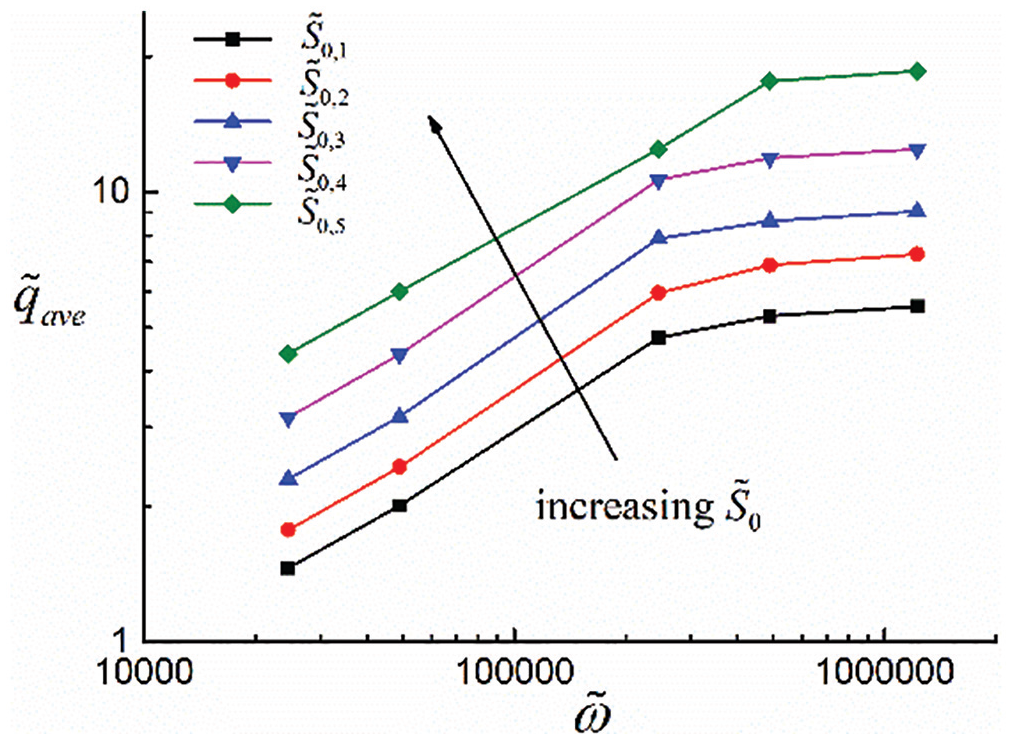
Comparisons of the average dimensionless heat flux with the dimensionless frequency for various dimensionless amplitudes of reciprocations, where
From the comparative study of Figure 7, it was found that all of these average dimensionless heat fluxes showed an increasing trend with an increase in dimensionless amplitude

Comparisons of the average dimensionless heat flux with the dimensionless amplitude of reciprocation for various
Conclusion
The heat transfer affected by the oscillatory sliding motion under a bulk temperature difference was investigated. The average heat flux at the interface was characterized by three dimensionless parameters that represent the amplitude of motion, frequency, and the interface conductance due to surface roughness. The computational results of the parametric study for various dimensionless operating parameters are presented. Simulation results show the following:
Increasing the dimensionless frequency
For a fixed dimensionless amplitude
When the dimensionless frequency
We suggest
Conducting further experimental studies to compare with the simulation results.
Conducting the heat transfer analysis of frictional heating without temperature difference.
Footnotes
Appendix 1
The thermal contact conductance
where
If the two surfaces are identical, equation (19) reduces to
where
Acknowledgements
The authors greatly acknowledge Professor J. R. Barber, Professor Y. H. Jang and Professor Xiuming Li for their enlightening discussions and valuable suggestions.
Declaration of conflicting interests
The author(s) declared no potential conflicts of interest with respect to the research, authorship, and/or publication of this article.
Funding
The author(s) disclosed receipt of the following financial support for the research, authorship, and/or publication of this article: This article was partially supported by the National Natural Science Foundation of China (grant 51804313) and by the Tribology Science Foundation of State Key Laboratory of Tribology, Tsinghua University (SKLTKF18B06).
