




Abstract
Reliability assessment of multi-component systems under competing degradation and random shocks has been intensively investigated in recent years. In most cases, the parameters associated with competing degradation and random shocks are represented by crisp values. However, due to insufficient data and vague judgments from experts, it may produce epistemic uncertainty with those parameters and they are befitting to be described as fuzzy numbers. In this article, the internal degradation is treated as a continuous monotonically increasing random process with respect to operating time, whereas the amount of cumulative damage produced by each external random shock is modeled by a geometric process. As components in a system suffer the same environmental condition, an external random shock will produce different amounts of cumulative damage to each component simultaneously. Each component fails when either the internal degradation or cumulative damage from the random shocks, whichever comes first, exceeds its corresponding random thresholds. Moreover, the parameters associated with the internal degradation and the random shocks are represented by triangular fuzzy numbers. The fuzzy reliability functions of components and the entire system are evaluated by a set of optimization models. A multi-component system, together with some comparative results, is presented to illustrate the implementation of the proposed method.
Keywords
Introduction
Reliability modeling and assessment are critical issues for complex engineering systems. It is challenging to accurately assess the reliability for such systems because of many factors such as the failure competing or dependencies, impact from external environments, and epistemic uncertainty associated with parameters of component failure/degradation models. According to the failure mechanism, most of the industrial systems and their components, such as bearings, compressor blades of airplane engines, and primary coolant systems of nuclear power plants, fail not only due to the internal deterioration which is also called “degradation failure,” such as wear, crack growth, erosion, and corrosion, but also due to the cumulative damage from external random shocks, such as vibration and power surge, which could cause a sudden “catastrophic failure.”
In the literature, many models and approaches have been developed to analyze and evaluate the reliability of various degradation systems. For example, Guan et al. 1 utilized the Wiener process to study the accelerated degradation test from a Bayesian perspective. Van Noortwijk 2 reviewed the application of gamma processes in reliability modeling and maintenance. By employing an additive Wiener process model that consists of both a linear and a non-linear degradation part, Wang et al. 3 proposed a general degradation modeling framework for hybrid deteriorating systems. Peng 4 developed a degradation model based on an inverse normal–gamma mixture of inverse Gaussian process.
The aforementioned models are not suitable for some applications where the system can be damaged by external random shocks. There are many engineering systems that suffer from not only the internal degradation process but also the external random shocks. For instance, a DVD player suffers aging of a laser reader and random excess voltage and current to its circuits; the motor may fail under the degradation of bearing wearing and external random shocks such as sudden excess load, vibration, and switch. Research efforts on the reliability analysis in the case of internal degradation and external random shocks can be generally classified into two research directions. In the first direction, it is assumed that random shocks cause a jump in the degradation level of the system, leading either to failure if the magnitude of this jump is sufficiently large to cross the failure threshold or to incremental damage otherwise. 5 For the first direction, Peng et al. 6 developed reliability models and maintenance policies for systems subject to multiple dependent competing failure processes. In addition to continuous degradation, random shocks can result in incremental damage or direct failure depending on their magnitude. Song et al. 7 proposed a reliability model for parallel systems with components experiencing dependent degradation processes and categorized shocks. A multi-objective optimization model for imperfect maintenance policy was proposed by Wang and Pham. 8 The studied systems are subject to multiple competing and hidden failure processes. By taking account of the hard and soft failures with dependent shock effects, a reliability assessment method for multi-component systems was proposed by Song et al. 9
The second research direction assumes that random shocks influence the degradation rate of the system in contrast to causing a jump in the degradation level. For example, Rafiee et al. 10 developed a reliability model for systems subject to dependent competing failure processes of degradation and random shocks. The degradation rate of the system can change according to particular random shock patterns. Lin et al. 11 extended a multi-state physics model framework for the reliability assessment of components subject to multi-state degradation and random shock processes, and a Monte Carlo simulation algorithm was developed to compute the reliability measures. Song et al. 12 proposed a new system model where individual failure processes for each component and the component failure processes are statistically dependent. Huang and Askin 13 investigated the reliability of an electronic device subject to multiple competing failure modes which can result in performance degradation, and this approach can be used to predict the dominant failure mode on the product. Moreover, by dividing the degradation trajectory into several discrete states, the multi-state systems have also received considerable attention in recent years.14–17 Some other research relevant to the deterioration system can be found in the literature.18–23,31
Nevertheless, the aforementioned research efforts adhere to the assumption that the parameters associated with the internal degradation process and external random shocks were crisp values. Such an assumption may not always hold in reality. Due to the insufficient data and/or vague judgments from experts, it may inevitably produce epistemic uncertainty with these parameters. In contrast to the aleatory uncertainty which is irreducible uncertainty associated with natural stochastic variability and can be represented by existing probabilistic tools, the epistemic uncertainty arises due to insufficient data and/or vague judgments from experts. Many non-probabilistic methods and tools, such as the fuzzy set theory,24–26 the evidence theory,27,28 and the interval method,29,30 can be implemented to quantify the epistemic uncertainty associated with the parameters associated with the internal degradation process and external random shocks. The fuzzy set theory has been intensively implemented in reliability engineering as it can be constructed on the basis of expert vague attitudes/judgments rather than a large amount of objective information. For instance, the fuzzy set theory has been widely used in the reliability assessment of multi-state systems when the component state probability contains epistemic uncertainty. As shown by Ding and Lisnianski 25 and Liu and Huang, 26 the epistemic uncertainty of component state probability has propagated to the system reliability evaluation and the system reliability became a fuzzy number too.
In this article, the system reliability assessment with the internal degradation process and external random shocks is conducted under the fuzzy environment. The system consists of multiple components, and every component has its own degradation path but suffers the same external random shocks simultaneously. Thus, the system degrades with its components. The internal degradation is assumed following a continuous random process and the cumulative damage resulting from random shocks is presented by a geometric process with a Poisson arrival pattern. Moreover, the parameters associated with the internal continuous degradation process and the geometric process are represented by triangular fuzzy numbers (TFNs). The approximate reliability functions of components and the entire system at any α-cut level are evaluated by a set of optimization models. A multi-component system, together with some comparative results, is presented to illustrate the implementation of the proposed method.
The rest of this article is organized as follows: Section “System description” presents the basic assumptions and definitions of the studied systems. Some preliminaries of the fuzzy set theory are provided in section “Preliminaries.” The mathematical models to derive the analytical reliability of each component and the entire system are formulated in section “Reliability evaluation under the fuzzy environment.” Two numerical cases are given to demonstrate the implementation of the proposed method, and an approximating algorithm is used to reduce the computational complexity in section “Case studies.” Section “Conclusion and future work” presents a brief conclusion.
System description
In many engineering cases, components in a system are subjected to several distinct degradation processes. Each process has its respective growing path and pattern, for example, gears in a transmission system suffer crack growth and wear. As a system consists of multiple components, each component in the system is functionally and physically different from one another, and hence they suffer various internal degradation processes and failure mechanisms. In this study, the internal continuous degradation of component
Under the fuzzy set theory,
24
the state of component
The fuzzy cumulative damage
It is assumed that the arrival of random shocks is memoryless. Based on this memoryless assumption, the homogeneous Poisson process is used to characterize the arrival of the external random shocks with a constant intensity
The thresholds of internal degradation and external random shocks, denoted by
As the damage caused by the external random shocks increases with the number of shocks, the geometric process is used in this work to model this phenomenon by increasing the cumulative damage produced by each individual shock. The geometric process is defined as follows.
Definition 1
Suppose that
The above stochastic ordering of two random quantities can be denoted as
Definition 2
Assume that
The fuzzy cumulative damage

where

Hence,
Preliminaries
In this section, we will briefly review the fundamentals of the fuzzy set theory, including the TFN, the extension principle, and the parametric programming, which are used in the subsequent sections.
TFN
A TFN
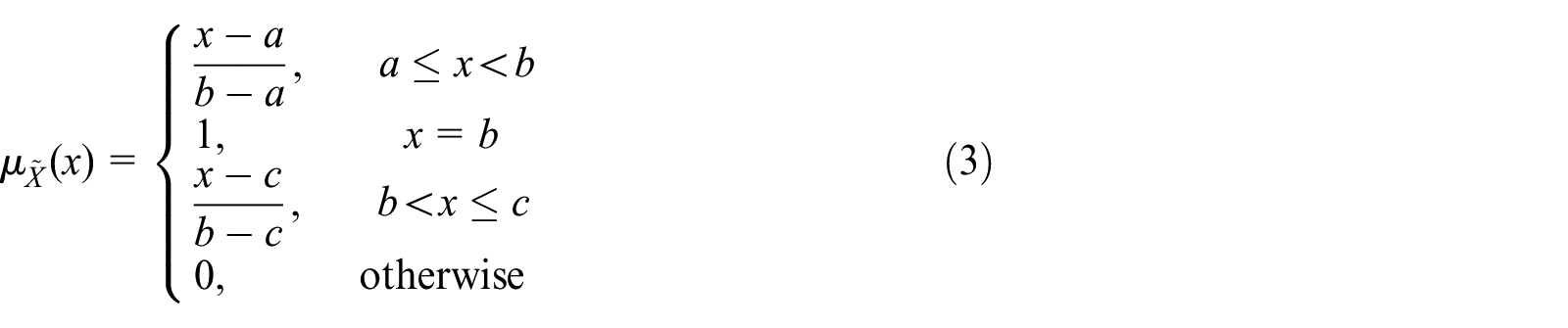
where

The membership function of a TFN.
Let

The extension principle and parametric programming technique
The extension principle, introduced by Zadeh, 24 allows one to obtain the membership function of a function with respect to n input fuzzy numbers

where

while the lower and upper bounds of

and

Reliability evaluation under the fuzzy environment
The reliability of a single component and a multi-component system under the fuzzy environment is discussed in this section under the internal degradation and external random shocks.
Fuzzy reliability evaluation for a single component
The fuzzy reliability

where

The α-cut level of the reliability function of component

and the upper bound

where the detailed procedures of computing
Suppose that the arrival of the external random shocks follows a Poisson process with a fixed arriving rate

As the sequence of the cumulative damage



where * is the convolution operator. The α-cut level of

and the upper bound

where the α-cut level of fuzzy CDF

and

Let

Then, the α-cut level of

and

Hence, the fuzzy probability
Without loss of generality, the internal continuous degradation process of component

By plugging equation (23) into

Therefore the α-cut level of the fuzzy survival probability of component l under the internal continuous degradation process, denoted as

and

Then, by substituting equations (21), (22), (25), and (26) into equation (9), the α-cut level of the reliability function of component
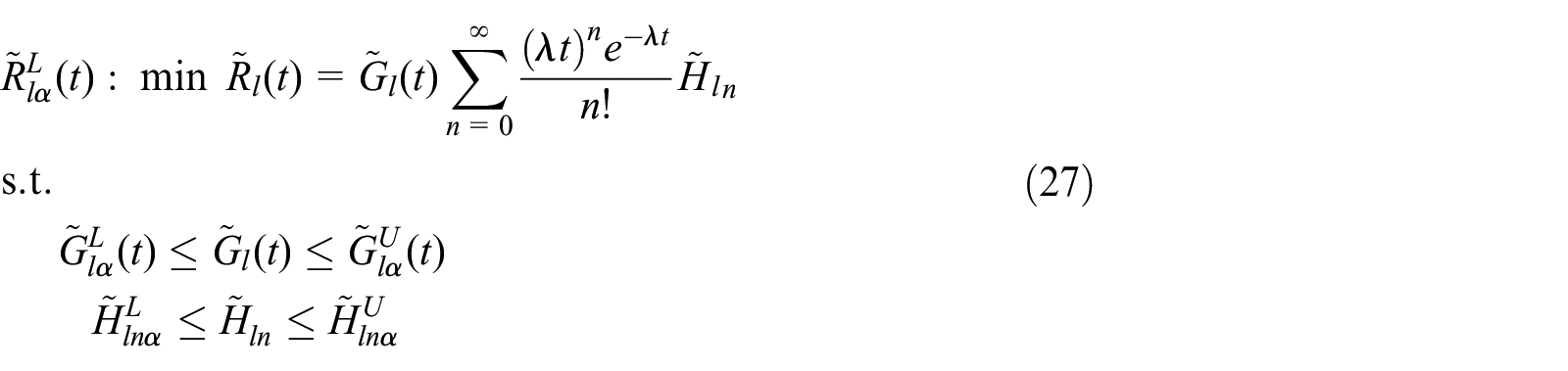
and the upper bound
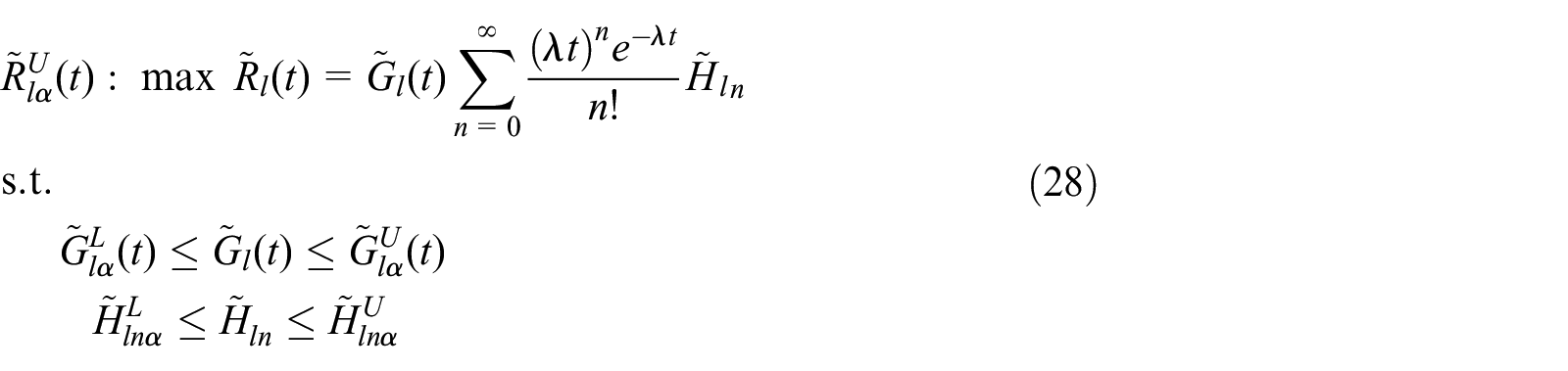
It should be noted that the fixed arriving rate
Fuzzy reliability evaluation for a multi-component system
In the previous subsection, the fuzzy reliability of a single component is derived. In this section, we focus on the scenario that a system consists of multiple components. Actually, a complex system can be simplified to some basic structures such as series and parallel, and the system reliability indices can be calculated iteratively. Thus, the reliability functions of series and parallel systems can be computed, respectively, as follows.
The α-cut level of fuzzy reliability for a series-connected system with

and

respectively, where
In the same fashion, the fuzzy reliability function of a parallel system at any α-cut level with

and the upper bound

where
Case studies
The approximating numerical algorithm
In fact, it is very difficult to obtain the analytical solution for the system reliability from the convolution reliability function given in equations (21) and (22). In this section, an approximating numerical algorithm of calculating equations (21) and (22) is derived. First, the approximating numerical algorithm is conducted under the fixed parameters associated with the external random shocks. Then, the approximating numerical algorithm is extended under the fuzzy set theory. The Poisson process has an arrival rate
Under the fixed parameters associated with the external random shocks, the survival probability under the cumulative damage by shocks, denoted as
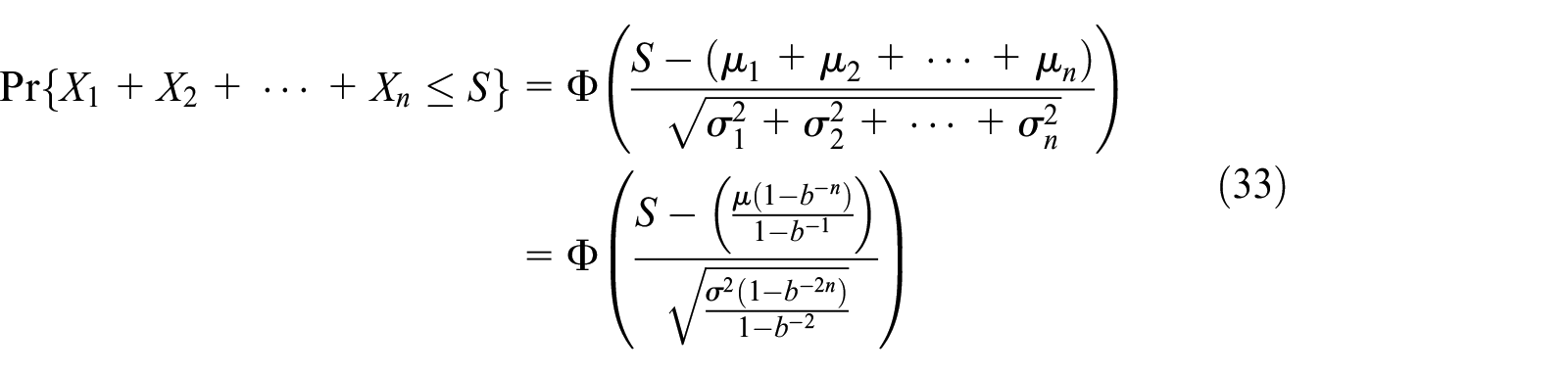
where
Based on the CDF of the Poisson distribution, a threshold value of

where
If

The sum of possibilities under

The approximating numerical algorithm can be extended under the fuzzy set theory when the parameters associated with external random shocks are represented by TFNs. The α-cut level of

and

Subsequently, equations (35) and (36) will be used to approximately calculate the fuzzy survival probability of components caused by external random shocks.
A multi-component system
The studied system is composed of three components, where components #2 and #3 are connected in parallel and then in series with component #1 (see Figure 3). As mentioned in section “Reliability evaluation under the fuzzy environment,” the internal degradation processes of components are governed by Weibull distributions. The time-dependent shape and scale parameters of component

and


A series–parallel system.
However, due to insufficient data and/or vague judgments from experts, the parameters associated with the time-dependent shape and scale parameters of component
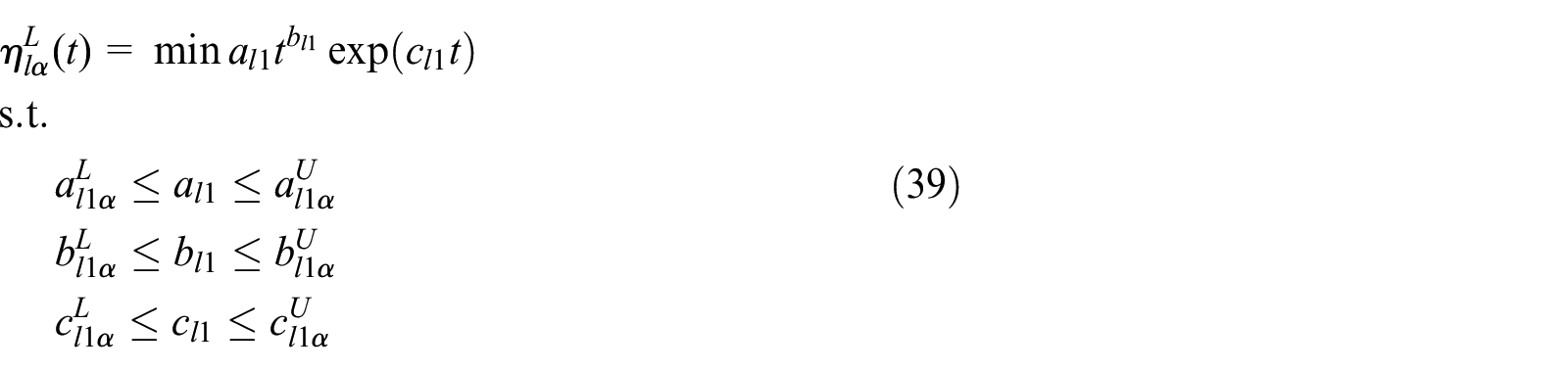
and the upper bound

In the same fashion, the α-cut level of the scale parameter of component
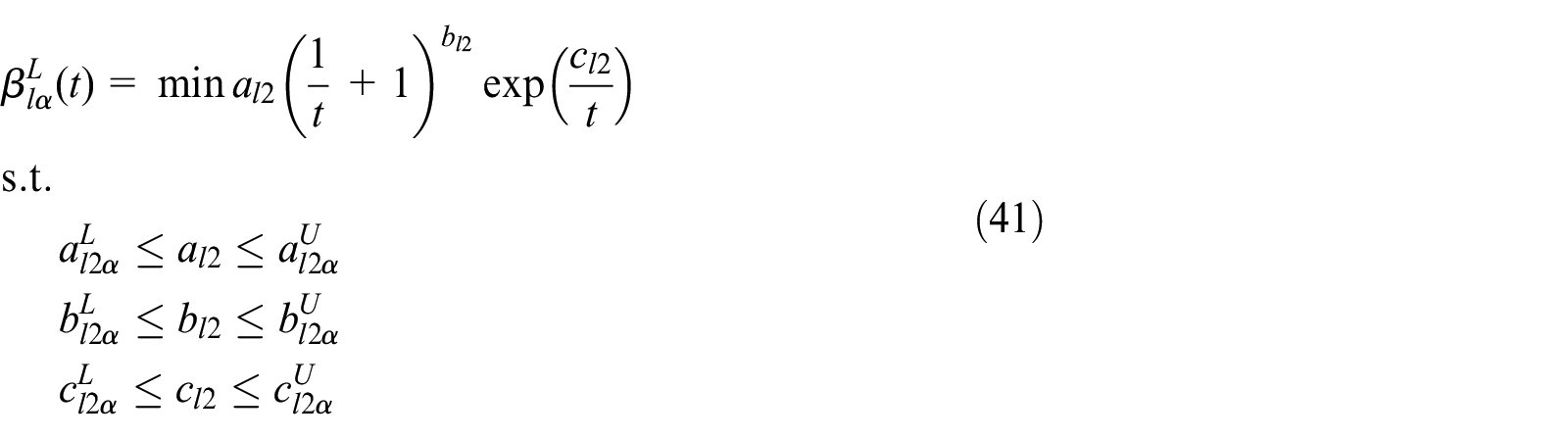
and the upper bound

In this example, all the fuzzy parameters are represented by TFNs and are tabulated in Table 2. Based on equations (27) and (28), the fuzzy survival probability of each component can be calculated under the internal degradation processes. As an illustration, the fuzzy survival probability of each component at time t = 10 months under the internal degradation processes is depicted in Figure 4. As shown in Figure 4, all the survival probabilities under the internal degradation processes are extended to fuzzy numbers. Component #3 has the largest fuzzy survival probability, whereas component #2 has the smallest fuzzy survival probability under internal degradation processes.
Fuzzy parameter settings for each component.


The fuzzy survival probability for each component under internal degradation processes.
Furthermore, based on equations (35) and (36) and the approximating numerical algorithm, the fuzzy survival probability of each component can be calculated under the external random shocks. The results are delineated in Figure 5. As shown in Figure 5, all the survival probabilities under the external random shocks are extended to fuzzy numbers and component #2 has the smallest fuzzy survival probability under the external random shocks.
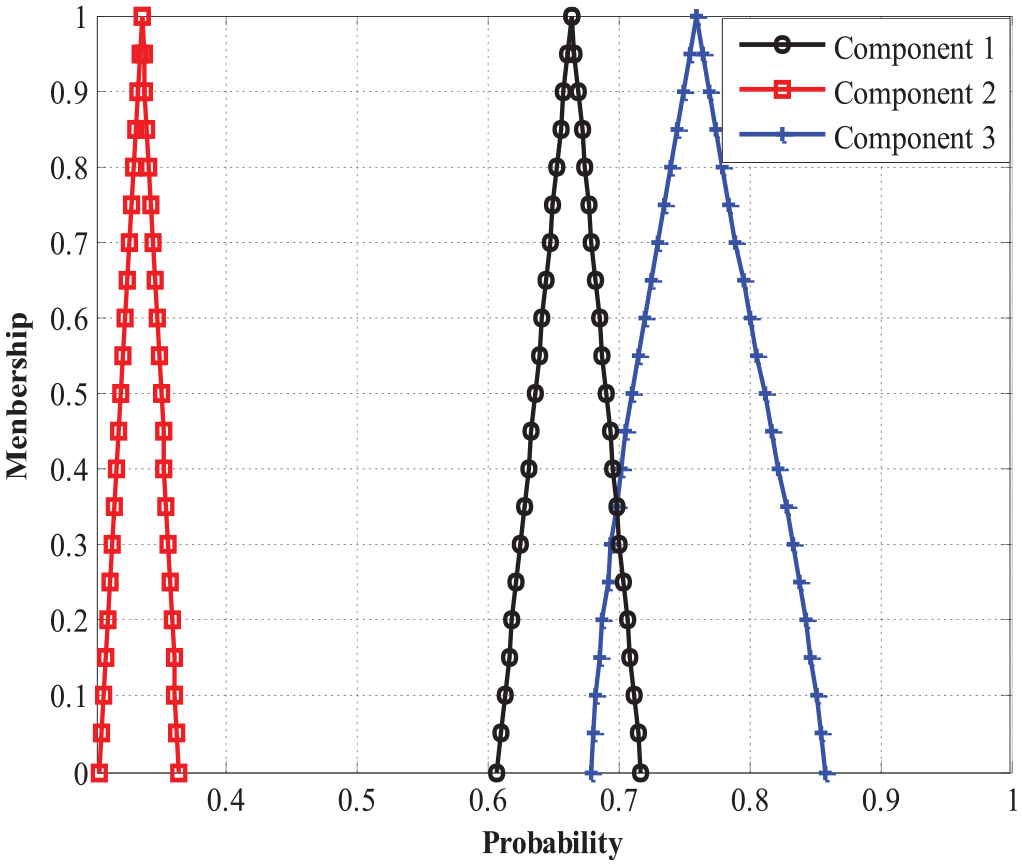
The fuzzy survival probability for each component under external random shocks.
The fuzzy reliability functions of components #1, #2, and #3 can be calculated by equations (27) and (28), and the results are shown in Figure 6, respectively. Based on the series–parallel configuration of the system, the fuzzy system reliability function is given by

Therefore, the α-cut level of the fuzzy system reliability can be represented as

and the upper bound


The fuzzy reliability of each component.
By setting time instant t in equations (43) and (44) to be any time of interest, the fuzzy system reliability over time can be evaluated. The results, as shown in Figure 7, indicate that the system reliability extended to fuzzy values due to the epistemic uncertainty of the insufficient data and/or vague judgments from experts.
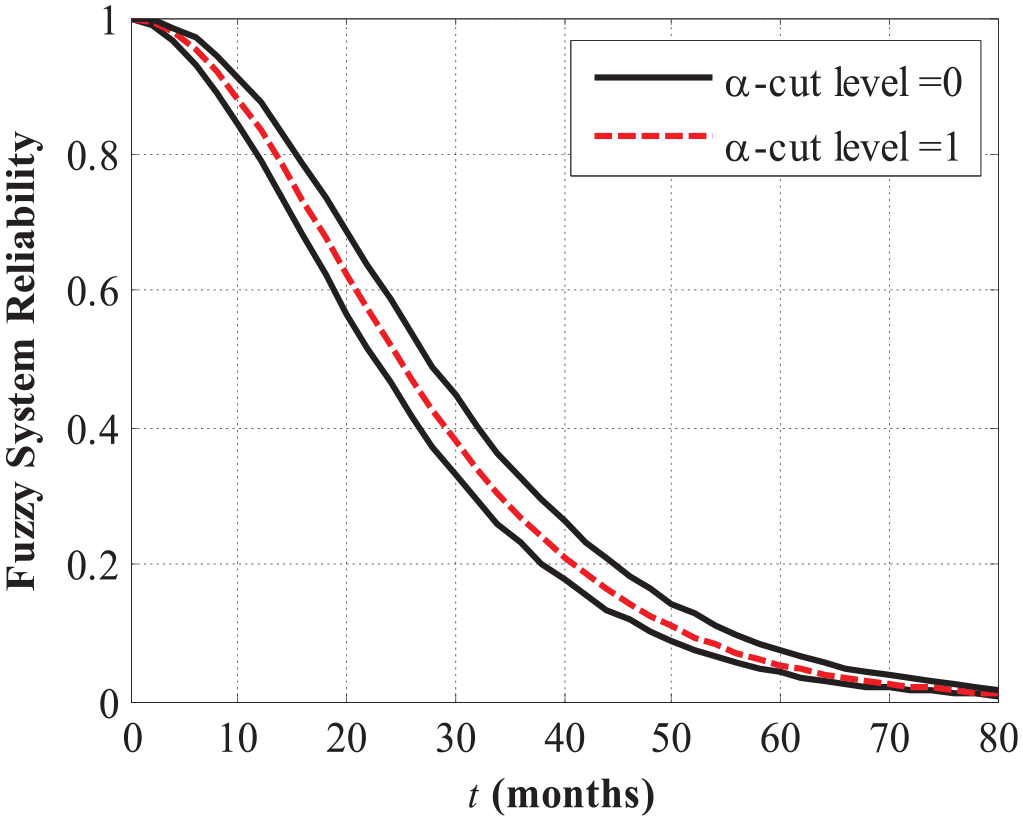
The fuzzy reliability of the system.
Conclusion and future work
In this article, the fuzzy reliability evaluation for systems suffering two competing failure modes, that is, internal continuous degradation process and external random shocks, was conducted. The internal continuous degradation process was treated as a continuous monotonically increasing random process with respect to operating time, whereas the geometric process was utilized to characterize the increasing cumulative damage caused by each shock. All the parameters associated with the internal continuous degradation process and external random shocks were represented by TFNs. The fuzzy reliability function of the series–parallel systems was formulated by a set of optimization models. Two numerical examples were presented to illustrate the implementation of the proposed method and the approximating numerical algorithm. The result from the approximating numerical algorithm was very close to that of the analytical method.
It is worth noting that there are still some works needed to be explored in the future. First, it is worth considering to relax the independent property of continuous and discrete (external random shocks) degradation processes. One may employ the discretization method to represent the continuous process through a discrete process with finite state space, and then the system state is determined based on the combinational matrix of continuous and discrete degradation processes. Another promising direction is to examine the availability of the system under various inspection policies, and how to minimize the inspection cost and maximize the availability under different criteria is worth discussing.
Supplemental Material
SCI-19-0168_Title_Page – Supplemental material for Reliability assessment for systems suffering competing degradation and random shocks under fuzzy environment
Supplemental material, SCI-19-0168_Title_Page for Reliability assessment for systems suffering competing degradation and random shocks under fuzzy environment by Hongping Yu and Mao Tang in Science Progress
Footnotes
Appendix 1
Declaration of conflicting interests
The author(s) declared no potential conflicts of interest with respect to the research, authorship, and/or publication of this article.
Funding
The author(s) disclosed receipt of the following financial support for the research, authorship, and/or publication of this article: This study was financially supported by the National Science and Technology Major Project of the Ministry of Science and Technology of China (No. 2015ZX04005004-3).

Author biographies
References
Supplementary Material
Please find the following supplemental material available below.
For Open Access articles published under a Creative Commons License, all supplemental material carries the same license as the article it is associated with.
For non-Open Access articles published, all supplemental material carries a non-exclusive license, and permission requests for re-use of supplemental material or any part of supplemental material shall be sent directly to the copyright owner as specified in the copyright notice associated with the article.
