




Abstract
How to improve efficiency is still a very active research point for pump as turbine. This article comes up with a method for optimal design of pump as turbine impeller meridional plane. It included the parameterized control impeller meridional plane, the computational fluid dynamics technique, the optimized Latin hypercube sampling experimental design, the back propagation neural network optimized by genetic algorithm and genetic algorithm. Concretely, the impeller meridional plane was parameterized by the Pro/E software, the optimized Latin hypercube sampling was used to obtain the test sample points for back propagation neural network optimized by genetic algorithm, and the model corresponding to each sample point was calculated to obtain the performance values by the computational fluid dynamics techniques. Then, back propagation neural network learning and training are carried out by combining sample points and corresponding model performance values. Last but not least, back propagation neural network optimized by genetic algorithm and genetic algorithm were combined to deal with the optimization problem of impeller meridional plane. According to the aforementioned optimization design method, impeller meridional plane of the pump as turbine was optimized. The result manifests that the optimized pump as turbine energy-conversion efficiency was improved by 2.28% at the optimum operating condition, at the same time meet the pressure head constraint, namely the head difference between initial and optimized model is under the set numeric value. This demonstrates that the optimization method proposed in this article to optimize the impeller meridional plane is practicable.
Introduction
In today’s increasingly serious energy issues, it is particularly important to carry out research on energy conservation and emission reduction. Pump as turbine (PAT) is a kind of energy-recovery equipment, which can recover the residual energy in the technological fields of fertilizer, water distribution network,1–3 water desalination, and petro-chemical industry, 4 as well as many other processes.5,6 Therefore, the research on PAT has important practical significance. Why using PAT as an energy-recovery equipment in the aforementioned processes is that it has many outstanding merits, for instance, simple structure, quantity production (lower cost), perform reliably, small volume, convenient maintenance, and so on. 7 However, the efficiency of PAT is relatively low. 8
From the flow direction of the liquid in the pump (forward run) and turbine (reverse run), the pump is a diffused flow channel, and the turbine is a contraction flow channel. According to fluid mechanics knowledge, for the pipe flow, the loss of the contracted flow channel should be smaller than the diffused flow channel, but the efficiency of the pump in turbine condition is actually poorer than the pump mode. This means that these geometries suitable for pump is not perfectly suited for turbine operation. So, parts of geometry need to optimize, so as to improve the performance of pump in turbine condition.
Yang et al. 9 discovered that half of the hydraulic loss of the PAT occurred in the impeller. It shows that the bad performance of PAT is primarily caused by the PAT impeller. In order to improve the performance of the impeller, it is necessary to develop an appropriate impeller-optimization design method and optimize the key geometric parameters of the impeller. Then, the internal flow structure of the model before and after optimization should be analyzed in detail (like pump),10–12 and the essential reason for the poor performance of the impeller is obtained, which provides theoretical support for the efficient development of the PAT.
To date, there has been a lot of research focused on the PAT.9,13–24 Singh and Nestmann 13 found that the rounding of impeller blade can enhance the efficiency of PAT and suggested that the rounding of impeller blade be used for various pump reversals, as well as different standard of rounding. Yabin and Lei 14 and Yue and Lei 16 study the hydraulic performance characteristics of mixed-flow PAT. Tao et al. 17 have carried out detailed numerical study on the blade angle distributions of PAT and their results show that the blade angle distributions have little influence on volute and draft but have obvious effect in the impeller, and the linear distribution law is relatively good. The influence of impeller blade wrap angle on PAT performance was studied by Yang et al., 9 the results of research show that the flow rate of the best efficiency point (BEP) of the PAT increases gradually with the decrease in impeller blade wraps angle. Yang et al. 21 made some numerical studies of PAT in blade inlet angel and their results show that the impeller blade inlet angel between 25° and 35° is more suitable, if the PAT is a volute case. Blade pattern, which is the foundation of the blade, is vital for the impeller; its performance will affect the whole performance of PAT directly. Miao et al. 22 put forward a method of optimization for the impeller blade profile. This method contains the geometric parameterization of the impeller blade, experimental sampling method—optimized Latin hypercube sampling (OLHS), back propagation (BP) neural network, computational fluid dynamics (CFD) techniques, and genetic algorithm (GA). Using this method, the performance of the optimized blades has been improved largely. A method for optimal design (incomplete sensitivity algorithm) of PAT was presented in reference literature. 24 And using this method, the head, efficiency, and torque of optimized PAT was improved greatly.
Besides the design of blades, for the impeller, another important design of impeller is the meridional plane, which also determines the performance of the PAT impeller directly. The optimization of impeller meridional plane is common in rotating machinery like compressors, fans, and pumps,25–30 but only few reports can be found on PAT.
An optimization technology combining a back propagation neural network optimized by genetic algorithm (GA-BP) and GA is developed and used to solve the optimization problem of the impeller meridional plane, so as to improve the performance of the impeller meridional plane of PAT. This optimization technology contained the parameterization of impeller meridional plane, the OLHS, the CFD techniques, the GA-BP neural network, and GA.
Geometric parameters of PAT
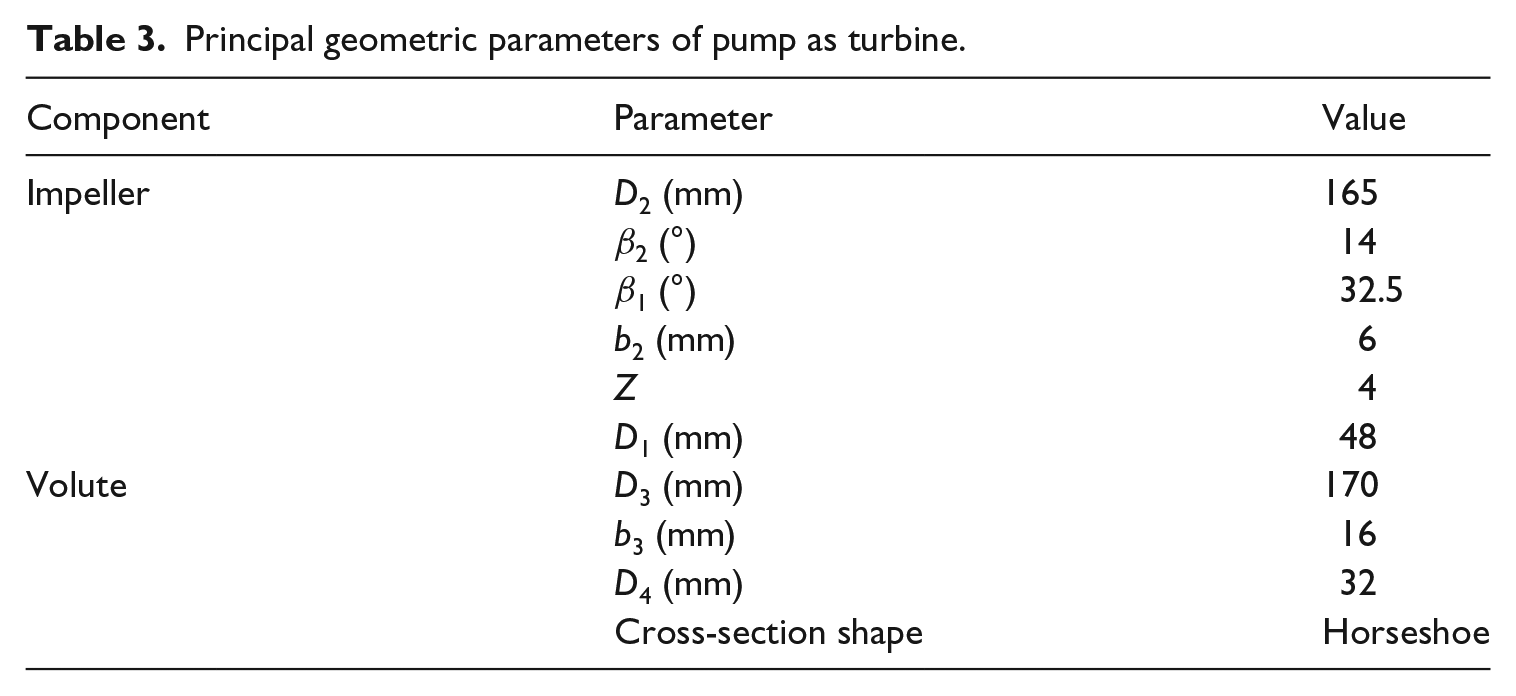
In this article, a pump was selected as a turbine. The design parameters 22 of this pump are shown in Table 1. Table 2 shows the performance parameters of the PAT. Figure 1 is the impeller axial projection and plane projection of the PAT. The main geometric parameters of the PAT are shown in Table 3.
Design parameters of pump.

Performance parameters of pump as turbine.


Projection of PAT: (a) meridional plane and (b) planar projection.
Principal geometric parameters of pump as turbine.
Determination of design variables and parameter control of impeller meridional plane
In this article, the initial impeller meridional plane of the PAT was designed by the double circular arc method, namely front shroud is composed of a section of straight line and two circular arc, rear shroud by a straight line and a circular arc, as display in Figure 2(a). It also can be seen from Figure 2(a) that the variable control parameters on the meridional plane are the inclination angle of front shroud

Impeller meridional plane. (a) Geometric sketch; (b) Parametric schematic diagram.
In the optimization of the impeller meridional plane of the PAT, it is necessary to build a large number of test samples automatically using three-dimensional (3D) modeling software Pro/Engineer (Pro/E). The key to automated modeling is the use of “relational” functions in Pro/E. “Relation” is the equation between user-defined symbol and geometric parameter. Figure 2(b) shows the user-defined symbol of the impeller meridional plane. From Figure 2(a) and (b), we can see the correspondence between the symbols and the design parameters, that is,
sd40 = 94.00;
sd60 = 90.00;
sd43 = 71.00;
sd49 = 21.00;
sd13 = 53.00.
The concrete process of establishing the model is as follows: first of all, according to the design variables and its range of values, experimental design method is used to generate test samples for training GA-BP neural network. Each test sample corresponds to different impeller meridional plane, that is, corresponds to different PAT models. Second, each test sample is need be simply processed to conform to the expression format of “relation,” before start modeling, so as to make the test sample data can run successfully in Pro/E. Third, start modeling in Pro/E: the first step is to import the impeller of the initial PAT into the Pro/E, and then “edit the definition” of impeller meridional plane on the basis of the initial impeller; the second step is to import one of the test samples processed, and then clicking the “OK” button, a new impeller model will be generated. This is the establishment process of a sample model, and the specific steps of the process are included in the trail file. By analogy, when building other models, it is only need to change the names of the relationships between the samples one by one, and make all the processes into an input file. After importing to Pro/E, all the impeller of all the test samples can be generated automatically. Last but not least, by creating a simple model assembly file, the automatic assembly of the model is realized and the geometric files (IGES file or step file) to be divided into the grid are derived.
Establishment of the optimization model of impeller meridional plane
According to the geometry feature of the impeller meridional plane, optimized design variables selected, show in Figure 2, are
Range of design variables.

In addition, in order to make the head of PAT do not change greatly before and after optimization, the constraint condition is about PAT head that should be within the initial setting range. Finally, the optimization objective function of impeller meridional plane is described as follow

where X is the design variable.
Numerical research
3D modeling and mesh generation
In the optimization, the 3D modeling software Pro/E was used to generate the fluid domain model. Each fluid domain model is made up of draft tube, leakage channel, impeller, volute, and suction casing, which is shown in Figure 3.

3D models of various parts of the PAT.
After the modeling of the fluid domain model, meshing software ICEM generates the hexahedral mesh of fluid domains. Before optimizing, using six kinds of size of grid to divide the initial model, mesh numbers are 506,484, 694,260, 926,242, 1,178,560, 1,368,766, and 1,608,472, respectively. Then, the grid independence was studied. It displays that if the grid numbers exceeds 1.1 million, the efficiency changes within 0.5% as show in Figure 4. The final grid number is 1,178,560. In the subsequent optimization design process, the grid number of other sample models was nearly equal. Figure 5 show the meshes of impeller and whole fluid domain.
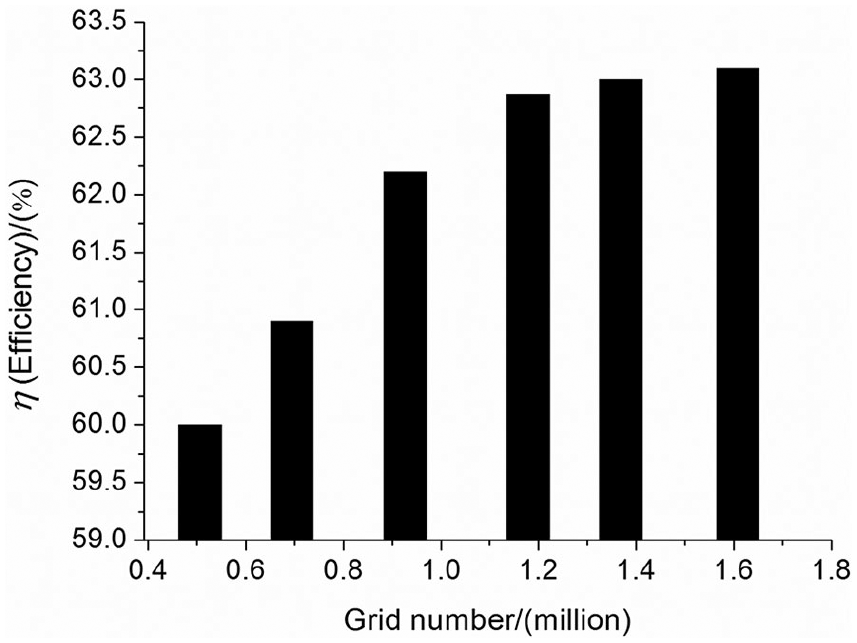
The efficiency of PAT varies with grid numbers.

Mesh of PAT.
Solution parameters
The FLUENT software was used for numerical calculation of flow field. In the calculation process, the convergence criterion was
Boundary conditions.

Optimization method
GA
GA is an intelligent optimization method that simulates the genetic and evolutionary process of organisms in natural environment. It was first proposed in the 1960s by Professor John h. Holland of the University of Michigan. This algorithm can find the optimal solution of various objective functions, whether objective functions are clear or complex. It does not need too much mathematics except for objective functions and fitness functions that guide the search direction. Selection, cross-validation, and variation are basic operators of GA. In the process of evolution, the ergodicity of three operators in each generation enables GA to seek the global optimal solution of the problem in way of possibility. Because of the implicit relation between design variables and objective functions and the non-linearity of objective functions, using GA is a good choice to optimize PAT geometric in this article.
Proxy model and experimental design sampling method
When GA is used to optimize the objective function, it is necessary to evaluate the fitness of each individual in the population. If CFD technique is used to calculate the model one by one, undoubtedly the calculation cost is too high, especially solving Navier–Stokes equations takes too much time. Artificial neural network (ANN), which imitates the structure and characteristics of a human brain, is a new type of information-processing and nonlinear dynamic system formed by connecting a large number of basic processing units (neurons) according to a certain topology. It is characterized by highly nonlinear mapping ability, strong adaptive learning ability, parallelism, structural variability, robustness, and fault tolerance. At present, most ANN adopts BP neural network or its derivative form. The GA-BP not only makes the network training have faster convergence speed but also has better prediction accuracy. Therefore, GA-BP neural network is introduced in this article as an approximate model, which replaces CFD to obtain the head and efficiency data of the optimized individual.
In order to make the GA-BP neural network have good response characteristics of objective function in the optimal space, the optimized Latin hypercube test design sampling is adopted to select as many sample points as possible to train GA-BP neural network. In this article, 300 test samples were generated in the design space at first; then, CFD numerical calculation was performed for the PAT corresponding to each sampling point to obtain its performance value; last but not least, GA-BP neural network was trained according to the geometrical parameters of the test samples and the performance value of corresponding PAT. The specific process is shown in Figure 6. And in this process, using the software batch file which is processed automatically for similar models is necessary because it can short the optimization time greatly.

Performance calculation of experimental samples and training of approximate models.
Optimization process
When training of GA-BP neural network is completed, the geometrical optimization of impeller meridional plane can be started. The optimization flow chart was shown as Figure 7.
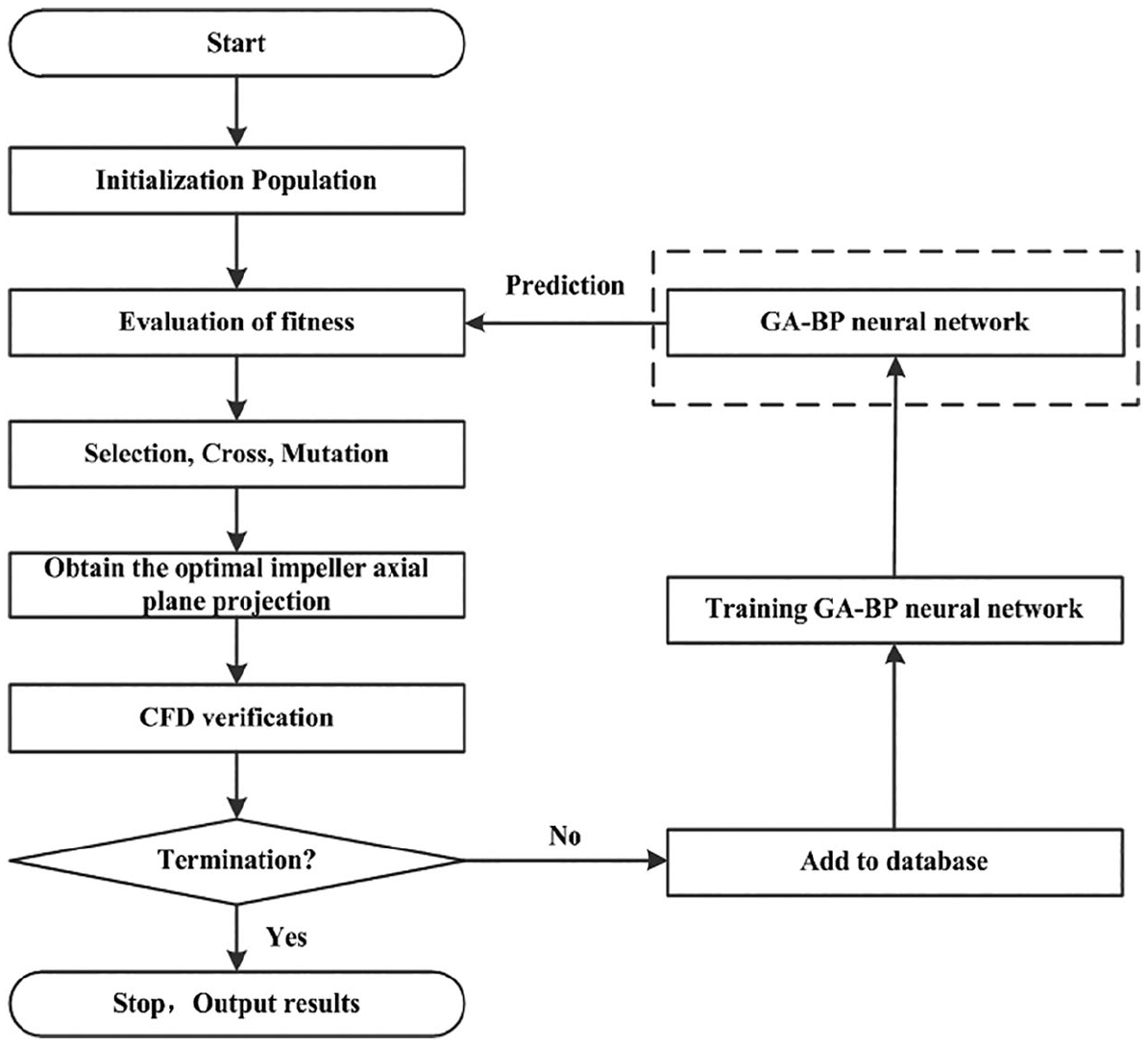
Optimize design flow chart.
Optimization results and analysis
Geometrical comparison of impeller meridional plane before and after optimization
Impeller meridional plane has been optimized according to the aforementioned optimization flow. The settings parameters of GA are that population size is 60, evolution for 40 generations, crossover probability set as 0.2. The initial and optimized parameters of impeller meridional plane are listed in Table 6.
Comparison of impeller meridional plane’s parameter.

Geometrical comparison of impeller meridional plane between initial and after optimization is shown in Figure 8.
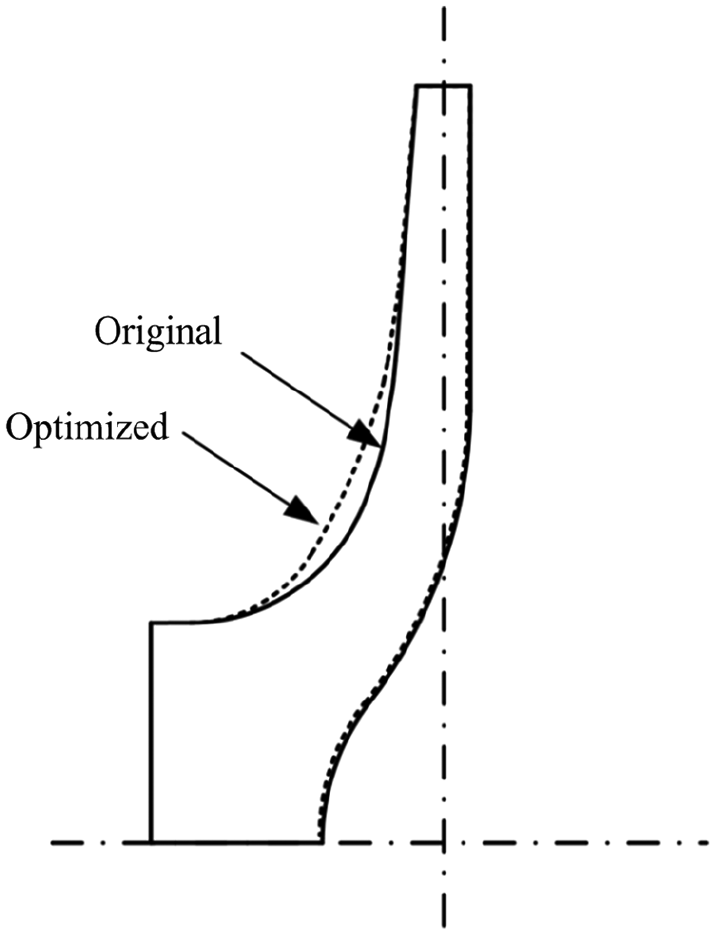
Comparison of impeller meridional plane between original and optimized.
Performance comparison of impeller meridional plane between initial and optimized
The models of initial and optimized were calculated by CFD numerical method, respectively, so as to compare the performance of the initial impeller meridional plane with that of optimized one. Table 7 lists the head and efficiency values of initial model and the optimized model at the BEP (27.5 m3/h), respectively.
Efficiency and head comparison between before and after optimization, respectively.

As can be seen from Table 5, the efficiency of the optimization model is improved by 2.28% compared with the original model. And the head difference of the model before and after optimization meets the constraint condition.
In order to further understand the performance of the optimization model under other flow rates, additional eight flow rates which include low flow conditions and large flow conditions were added. And the original model and optimized model were calculated by CFD under these eight operating points, respectively. The performance curves were shown in Figure 9.

Performance curves comparison between before and after optimization model.
From Figure 9, it can be seen that the efficiency of the optimized PAT has been improved not only at the designated operating point (the optimal operating condition) but also at the small flow rate and part of the large flow rates. However, with further increase of flow rates, the efficiency of the optimized PAT is almost the same as that of the efficiency of the before optimization, even slightly lower than the efficiency of before optimization. This is mainly because the optimization of this article is only aimed at the optimal operating point and has been improved at the optimal operating point. This shows the effectiveness of the optimization method in this article, but there is the possibility of the decrease of efficiency in other working conditions. If the performance of the optimized PAT is further improved in a wide range, when the calculation amounts were allowed, the multiple operating points should be optimized simultaneously.
Inner flow field comparison between initial and optimized model
The external characteristic parameters reflect the internal flow field characteristics to a certain extent. In the aspect of propelling design theory, external characteristics are not enough. It is necessary to combine the inner flow field. Likewise, in order to know the difference of performance between original model and optimized model, the internal flow field of the PAT should be analyzed. Turbulence eddy dissipation
31
is the rate of change of turbulent kinetic energy into kinetic energy of molecular thermal movement, which is the relative index used to assess the level of losses. It does not have the explicit correspondence relation for the external characteristic of PAT, but on the other hand, it can value characterize the flow conditions, the losses’ size indirectly—if the turbulence eddy dissipation of the model is smaller, it represents that the flow loss is smaller, vice versa. Figure 10 is the turbulence eddy dissipation distribution of the midsection of a PAT model, under a small flow rate

Turbulence eddy dissipation comparison between initial model and optimized model under three flow rates: (a)
From Figure 10, it can be seen that the turbulence eddy dissipation of an optimized impeller meridional plane is obviously smaller than the original one at the small and optimal flow rates. Therefore, the flow losses in the PAT will become smaller after optimization. At the large flow rate, the internal turbulence eddy dissipation of optimal model is almost the same as that of the initial model. This is consistent with the efficiency of PAT at the large flow rate in Figure 9, that is, the efficiency of optimized PAT is basically equal to the efficiency of initial model. In a word, through the optimization of impeller meridional plane, the hydraulic loss of impeller was reduced at the vast majority of flow rate. Hence, the optimized PAT impeller has the good performance.
Conclusion
Parameterization of the impeller meridional plane of PAT using Pro/E software and replacing the CFD numerical calculation by the GA-BP neural network can shorten the optimization calculation time and improve the optimization efficiency greatly in the geometry optimization process.
At the BEP, the efficiency of the optimized PAT is improved by 2.28% compared with the initial PAT, and the constraint that head difference between initial and optimized model is less than set value is ensured at the same time. This proves that the method adopted in this article is practical to optimize impeller meridional plane of PAT selected in this article.
In order to further improve the performance of PAT, especially in the condition of large flow rates, it is necessary to carry out the optimization design of multiple conditions on the impeller meridional plane.
Footnotes
Appendix
Acknowledgements
The authors would like to thank the support of the Natural Science Fund of Gansu province, China (grant no. 17JR5RA110), the National Natural Science Fund of China (grant no. 51569013), and the Open Research Subject (grant no. szjj2017-091).
Declaration of conflicting interests
The author(s) declared no potential conflicts of interest with respect to the research, authorship, and/or publication of this article.
Funding
The author(s) received no financial support for the research, authorship, and/or publication of this article.
