




Abstract
Sound quality (SQ) has become an important index to measure the competitiveness of motor products. To better evaluate and optimize SQ, a novelty SQ evaluation and prediction model of high-speed permanent magnet motor (HSPMM) with better accuracy is presented in this research. Six psychoacoustic parameters of A-weighted sound pressure level (ASPL), loudness, sharpness, roughness, fluctuation strength (FS), and perferred-frequency speech interference (PSIL) were adopted to objectively evaluate the SQ of HSPMM under multiple operating conditions and subjective evaluation was also conducted by the combination of semantic subdivision method and grade scoring method. The evaluation results show that the SQ is poor, which will have a certain impact on human psychology and physiology. The correlation between the objective evaluation parameters and the subjective scores is analyzed by coupling the subjective and objective evaluation results. The average error of multiple linear regression (MLR) model is 7.10%. It has good accuracy, but poor stability. In order to improve prediction accuracy, a new predicted model of radial basis function (RBF) artificial neural network was put forward based on genetic algorithm (GA) optimization. Compared with MLR, its average error rate is reduced by 3.16% and the standard deviation is reduced by 1.841. In addition, the weight of each objective parameter was analyzed. The new predicted model has a better accuracy. It can evaluate and optimize the SQ exactly. The research methods and conclusions of this paper can be extended to the evaluation, prediction, and optimization of SQ of other motors.
Keywords
Introduction
Made in China 2025 has planned ten key equipment areas to be developed vigorously, eight of which are closely related to high-performance motors.1,2 High-speed motor is the main component of high-performance motor, which has remarkable advantages such as high-power density, small size, light weight, etc.3,4 A high-speed motor usually refers to a motor whose maximum speed exceeds 10,000 rev/min. 5 On the other hand, permanent magnet motor (PMM) has been extensively used in various fields by virtue of good mechanical properties and high efficiency. 6 Compared with induction motor, PMM does not need excitation current, so the power factor can be significantly improved.7,8 In addition, PMM has no rotor resistance loss in stable operation, and reduces stator current and stator resistance loss.9,10 In general, the efficiency of PMM is more than 5% higher than that of the induction motor of the same specification.11–13 Therefore, the high-speed permanent magnet motor (HSPMM) has a broad application prospect in many fields, such as industrial equipment, energy security, energy saving, and emission reduction.
SQ has become an important index to measure the competitiveness of motor products. In most cases, the noise generated by the motor will be directly or indirectly spread to the human ear and eventually cause subjective discomfort.14–17 The noise of poor quality seriously affects people’s life and work, and even harms our health. In previous studies, A-weighted sound pressure level (ASPL) is regarded as the main parameter for evaluating sound quality. 18 But this evaluating method is not comprehensive. More and more studies have shown that the significance of psychoacoustic parameters such as loudness, sharpness, preferred-frequency speech interference (PSIL), and fluctuation strength (FS) in the evaluation of SQ should not be ignored.19,20
The noise of the surface PMM was tested and analyzed by Ma and Zuo. 21 The sound pressure level spectrum of surface PMM was obtained under different speed, switching frequency, and load. The main peak of the sound pressure level and the corresponding frequency was analyzed.
Kondelaji et al. 22 analyzed the characteristics of switched PMM electromagnetic noise and studies the noise reduction methods based on structural mode analysis. The ASPL was decreased by 3.25 dB. A recent study by Kusuma et al. 23 put forward a comprehensive method to reduce the noise of PMM. This ASPL can be reduced by 4.7 dB of PMM at the rated speed of 2000 r/min. But more psychoacoustic parameters are not taken into account in their study. Therefore, it is difficult to say that these noise reduction methods effectively improve the SQ. One of the most cited studies is that of Qian et al. 24 who analyzed and evaluated the SQ of the electrical vehicle driven by PMM based on BP neural network. The average error of the neural network model is 7.81%, which has good fitting accuracy. However, the convergence speed of this model is slow, and the weight of each parameter is not involved. Subjective evaluation of SQ of HSPMM based on semantic subdivision method was conducted by Singli and Michael. 25 The annoyance degree of SQ of high-speed induction motor under different working conditions was analyzed. However, the influence relationship between objective parameters and subjective scores is missing. In a study conducted by Riel et al., 26 SQ of HSPMM was evaluated subjectively and objectively. The prediction model of SQ was established by means of multiple linear regression (MLR). He found that loudness, ASPL are well correlated with the subjective evaluation. But the accuracy and stability of the model are not good. There may be a big deviation in the evaluation of SQ by using this model.
In this paper, a novelty evaluation and prediction model of SQ was developed based on genetic algorithm (GA)—radial basis function (RBF) artificial neural network. The paper is organized as following. The noise of HSPMM was tested under various working conditions in Section 2. SQ was evaluated using subjective and objective evaluation methods. In Section 3, an evaluation and prediction model of SQ was established through MLR and GA-RBF artificial neural network, respectively and the accuracy and stability of the two models were compared. In addition, the weight of each objective parameter was obtained. Section 4 discusses the advantages of GA-RBF artificial neural network and expound the main contribution of this paper. The final section presents the conclusion of this research.
Materials and methods
Noise measurement and evaluation of HSPMM
Noise measurement
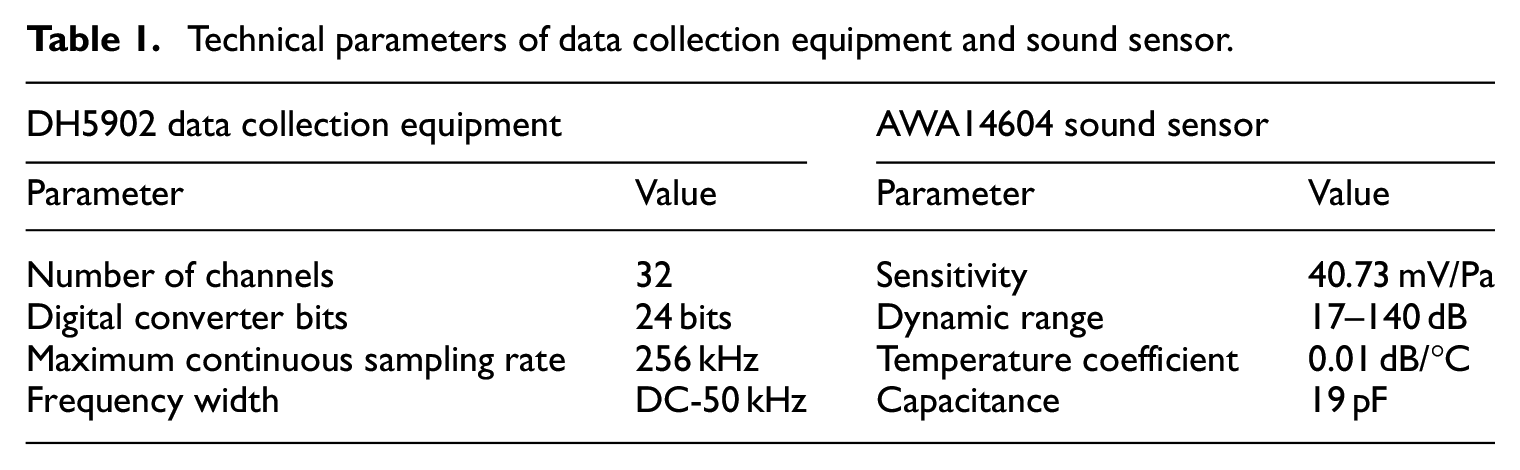
Four various kinds of HSPMM with rated power of 7.5 kW, rated speed of 24,000 rpm were selected as measurement objects. Noise signals were collected and analyzed by using DH5902 data collection equipment and AWA14604 sound sensor. The technical parameters are listed in Table 1. The working conditions of the testing samples were elaborately considered. The test conditions are selected below. (1) In the steady operating state, the noise was collected every 3000 rev/min at a stable rotational speed from 9000 rev/min to 24,000 rev/min. (2) In the unsteady operating state, noise was measured when the rotational speed linearly increases from 9000 rev/min to 16,500 rev/min and from 16,500 rev/min to 24,000 rev/min. (3) The sampling frequency is 51,200 Hz and the length of each noise signal is not less than 15 s. (4) The noise samples can be played back with high-fidelity headphones for subjective evaluation of SQ. Eighty noise samples under different operating conditions were collected in the experiment.
Technical parameters of data collection equipment and sound sensor.
Objective evaluation
The subjective sensitivity of the human ears to the sound with different frequencies is distrinct. In general, the sound perception ability of human ears in low frequency band and high frequency band is not as good as that in middle frequency band. This phenomenon is especially obvious when the sound pressure level is low. Previous studies have shown that the human ear is the most sensitive to sound in the 3000–5000 Hz frequency range. 27 ASPL is used to describe the sound pressure level taking into account the auditory characteristics of the human ear. Generally, there are nine psychological parameters that can be adopted for SQ evaluation. They are ASPL, loudness, sharpness, roughness, FS, PSIL, traffic noise index, C-weighted SPL, and 24-h equivalent SPL. But traffic noise index is mainly used for urban road noise evaluation. C-weighted SPL is mainly used for noise evaluation of airports and stations. 24-h equivalent SPL is mainly used for the nighttime noise evaluation. Therefore, the other six parameters are selected as of psychoacoustic indicators for objective evaluation. In this way, the SQ of HSPMM can be evaluated comprehensively. Loudness is used to describe the sound intensity. Sharpness is used to describe the harshness degree of sound. The sound fluctuation degree of high frequency and low frequency components is characterized by roughness and FS, respectively. PSIL is used to describe the masking effect of background sound on conversation. Owing to the large number of noise samples, the noise samples of a tested HSPMM under different operating conditions were selected for objective evaluation of SQ.
Figure 1 show that the ASPL, loudness, PSIL, and sharpness gradually increased with the rotational speed. ASPL and loudness at 24,000 rev/min are 34.11% and 67.91% higher than those at 9000 rev/min, respectively. This may be due to a significant increase in mechanical noise at high speed. PSIL increased by 19.45%, indicating that the speaker has to raise the volume to ensure that his voice can be heard by others. The sharpness at 24,000 rev/min is 33.83% higher than that at 9000 rev/min. The electromagnetic force at high speed will produce high-frequency howling noise, so the noise harshness is significantly enhanced. Roughness and FS fluctuate in a certain range with the increase of rotational speed, but show an upward trend as a whole.
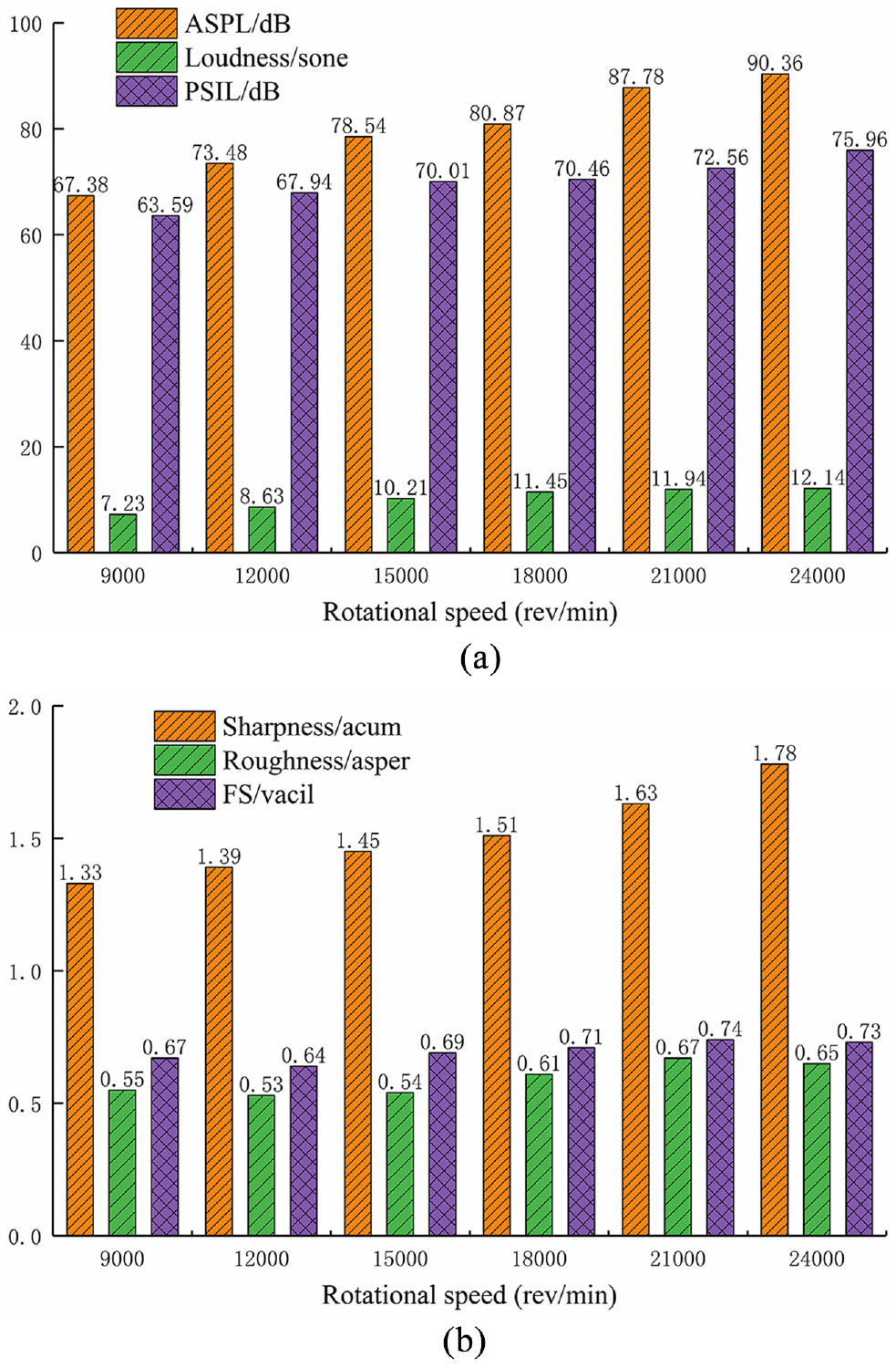
Objective evaluation results: (a) ASPL, loudness and PSIL at different rotational speed and (b) sharpness, roughness and FS at different rotational speed.
When the rotational speed exceeds 12,000 rev/min, the ASPL exceeds 73 dB, and its peak value is 90.36 dB. Normal conversation will be seriously disturbed if ASPL exceeds 70 dB. When the ASPL is in the range of 80–100 dB, it will damage the hearing of the human ear to a certain extent. When the ASPL reaches 130 dB, it will cause pain in human ears. Therefore, when people are exposed to the noise generated by the tested motor for a long time, it may cause some harm to their physiological health.
Subjective evaluation
The combination of semantic subdivision method and grade scoring method was used to subjectively evaluate the SQ of tested HSPMM. The annoyance degree is used as the evaluation index, which is set to 10 grades, corresponding to 1–10 points respectively. One point indicates a very low degree of annoyance. On the contrary, 10 points means a very high degree of annoyance. At the same time, 35 evaluators (21 males and 14 females) with good health and normal hearing are recruited for subjective evaluation. These participants included acoustic experts, workers, engineers and students. Part subjective evaluation results are shown in Table 2.
Part subjective evaluation results.

The Spearman correlation coefficient method was used to test the evaluation results of 35 evaluators, in order to ensure the validity of the subjective evaluation results. The evaluation results with a correlation coefficient less than 0.7 were eliminated. The correlation coefficient of each evaluation result is shown in Figure 2. The correlation coefficients of the evaluators numbered 11, 15, 18, and 32 are less than 0.7, while those of the other evaluators are more than 0.7. Therefore, these four evaluation results were excluded.
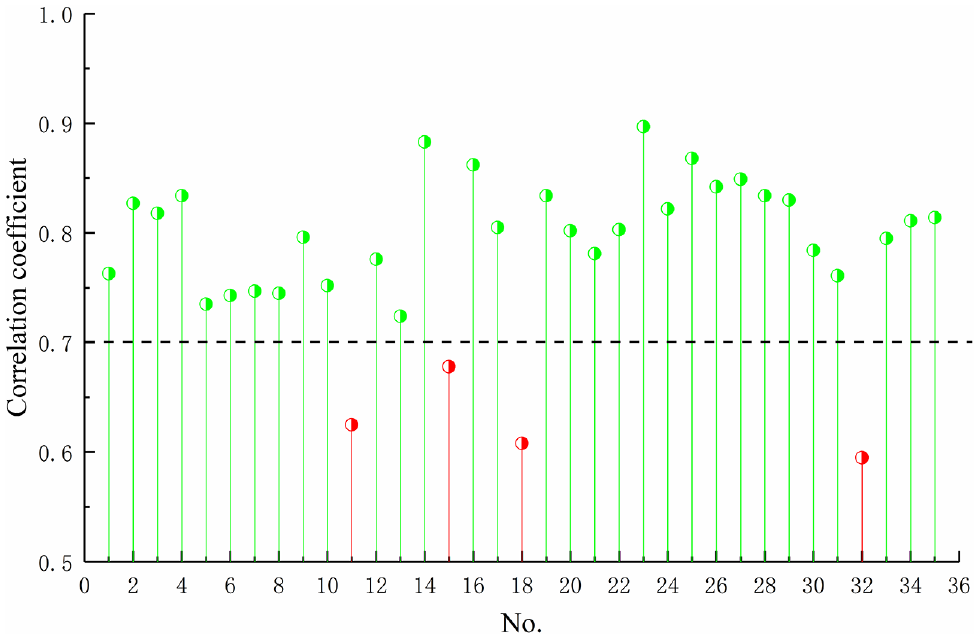
Correlation coefficient of each valuator.
The average value of subjective evaluation of 80 noise samples is 6.13. The maximum value is 8.363, and the minimum value is 4.217. This shows that the subjective annoyance may be caused by the noise of HSPMM. When people are exposed to this noise environment for a long time, it will not only accelerate the fatigue feeling, but also affect the physiological health. Some effective measures should be taken to improve SQ of HSPMM.
Multiple linear regression
The objective and subjective evaluation results of 80 noise samples are shown in Table 3. The correlation coefficient between objective evaluation parameters and subjective evaluation scores was analyzed based on statistical theory. The correlation analysis results are shown in Table 4.
Part subjective and objective evaluation results.

Correlation analysis results.

It is apparent from Table 4 that the correlation coefficients of loudness, ASPL, sharpness, and PSIL are 0.924, 0.893, 0.817, and 0.808, respectively. It shows that there is a strong correlation between the four objective evaluation parameters and the subjective scores. However, the correlation coefficients of roughness and FS are only 0.704 and 0.643 respectively. These two parameters have no significant effect on subjective scores.
Seventy-two sets of data were used for multiple linear regression, and the remaining eight sets of data were used for result validation. The regression equation is shown in Formula 1. The verification results are shown in Table 5. The determination coefficient of multiple regression equation is 91.06%. It indicated that the MLR equation has high fitting confidence.

Verification results of multiple linear regression.

In this formula,
What stands out in Table 5 is that the average value of absolute relative errors of MLR is 7.10%. However, its standard deviation is larger with the value of 3.259 and the maximum relative error is 10.94%. The minimum relative error is only 1.73%. Although MLR can well fit the subjective and objective evaluation results of SQ, the fitting stability is poor. This means that for an evaluation result, it may produce a considerable error. Therefore, it is necessary to establish a more intelligent and accurate algorithm for the accurate prediction of SQ.
Model establishment and analysis of SQ based on GA-RBF
RBF artificial neural network
RBF artificial neural network is a feedforward network composed of three layers. The first layer is the input layer, and the number of nodes in the input layer is equal to the dimensions of the input variables. The second layer is the hidden layer, and its number of nodes is determined according to the complexity of the problem. The third layer is the output layer, and the number of nodes is equal to the dimensions of the output variables. In this paper, the number of nodes in the input and output layer is 6 and 1, respectively. The hidden layer of RBF artificial neural network is nonlinear. The basis function converts the input vector space to the implicit layer space, thus transforming the linear inseparable problem into linear separable. RBF neural network principle is shown in Figure 3. The learning algorithm of RBF neural network can be divided into two stages. The first stage is the process of determining the center of the radial basis function in the hidden layer and the second stage is the process of adjusting the weights in the radial basis function

RBF neural network principle.
The node function of the hidden layer is a Gaussian function generally. It can be expressed by Formula 2.

The output layer function is

The output layer function can also be expressed as formula 4 by combining formula 2 and formula 3

In the above formulas,
RBF artificial neural network has the following properties: (1) RBF network is a universal approximator. It can approximate any continuous function with arbitrary precision as long as there are sufficient hidden layer nodes. (2) There is always a set of coefficients to ensure that the approximation of the RBF network to the function is optimal, for an unknown nonlinear function.
GA-RBF artificial neural network model
The RBF neural network model has the following disadvantages. Firstly, it is easy to fall into local optimization for RBF neural network. Secondly, RBF neural network is strongly dependent on initial weight. This means that the initial weight may affect the accuracy of the model significantly. In order to avoid the above problems, GA is adopted to optimize the RBF neural network. The optimized flow chart of GA-RBF artificial neural network is shown in Figure 4.
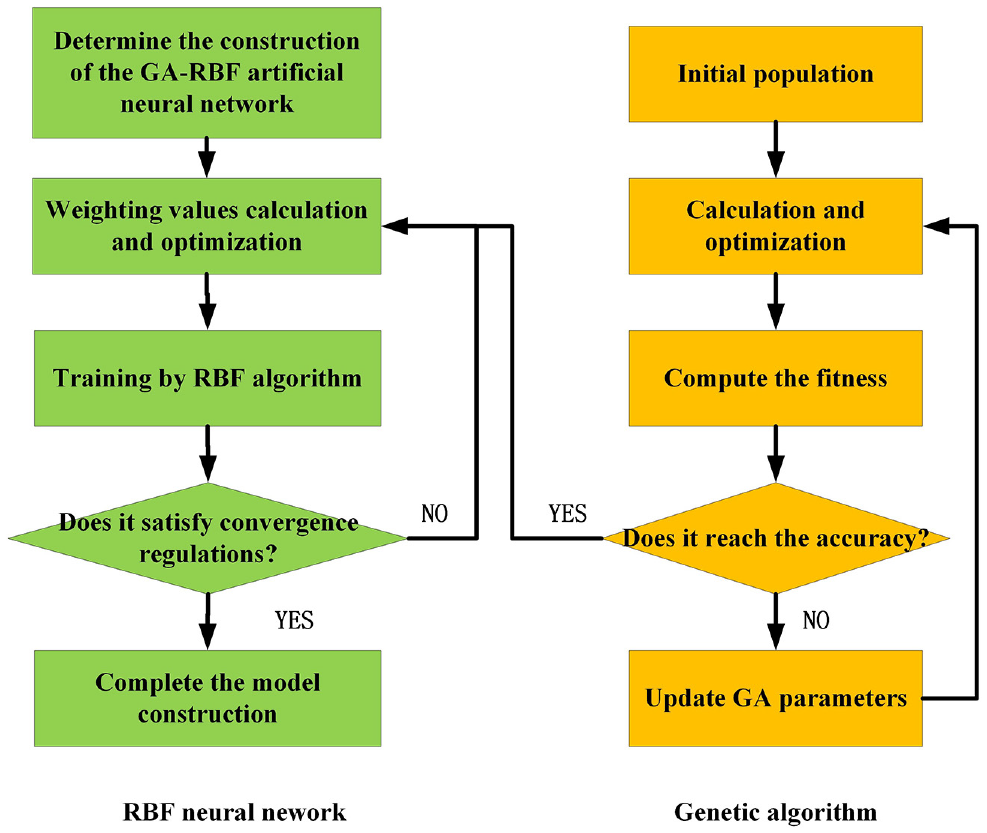
The optimized flow chart of GA-RBF artificial neural network.
A parameter combination optimization was conducted according to the empirical recommended range. The GA parameters were adjusted continuously and its output accuracy was observed. Finally, the optimal GA parameters listed in Table 6 were determined.
GA parameters settings.

The parameters of GA-RBF artificial neural network are trained by using 72 groups of noise samples. The remaining eight groups of noise samples are used for verification. The diffusion factor which is an empirical parameter is set to 25, and the maximum number of hidden layer nodes is set to 100. The determination coefficient of GA-RBF neural network under different number of hidden layer nodes is shown in Table 7. When the number of hidden layer nodes is 66, the determination coefficient is optimal. If the number of the hidden layer nodes is greater than 66, the determination coefficient hardly changes. But it will increase calculation time.
The determination coefficient under the different number of hidden layer nodes.

The analysis result of correlation scatter of training samples is shown in Figure 5. The determination coefficient of GA-RBF neural network for 72 training samples is 97.914%. The error is small. The determination coefficient is increased by 6.854% compared with MLR. The actual and predicted values of eight verification samples are shown in Figure 6 and the error rates of the eight verification samples is shown in Figure 7.

Correlation analysis scatter diagram of training samples.
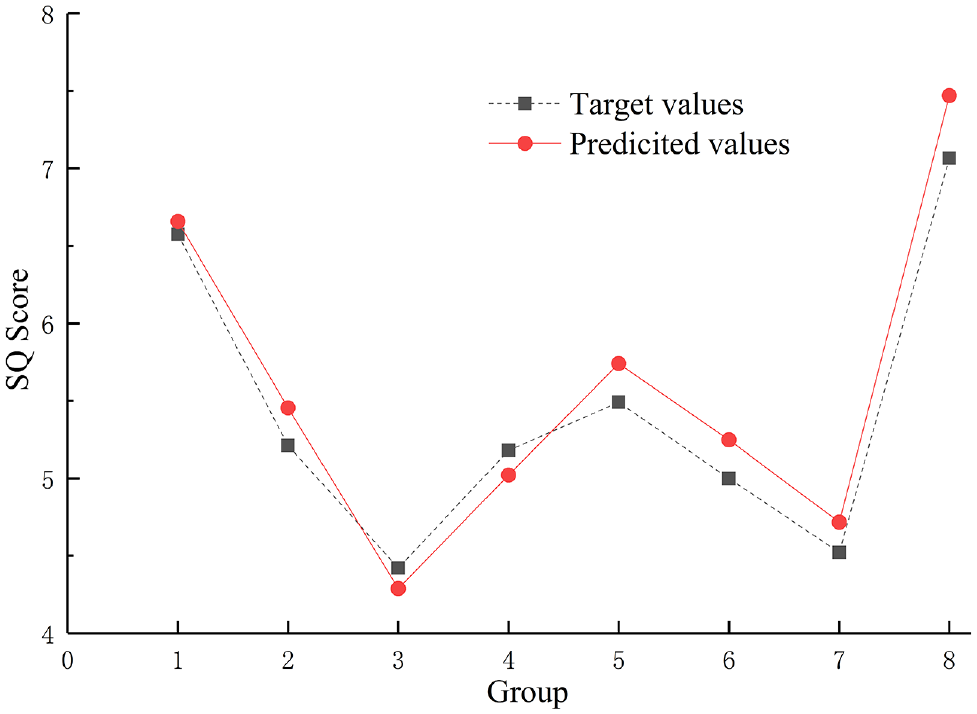
Target and predicted SQ score of the tested samples.

Error rates between target and predicted SQ score of the tested samples.
These figures are quite revealing in several ways. The error between the target value and the predicted value is 0.404 for the eighth group. It has the maximum positive error rate with 5.72%. The error is −0.158 for the fourth group. It has the minimum error rate with 1.28%. The mean and standard deviation of the error rate for the eight verification samples are 3.94%, 1.418 respectively. Compared with MLR, the average error rate of GA-RBF neural network prediction model is decreased by 3.16% and the standard deviation is reduced by 1.841. The accuracy and stability of the SQ prediction model are obviously improved.
Verification of model universality
In order to further verify the universality of the developed model, the SQ evaluation of three other HSPMMs was conducted. Three samples are randomly selected for each motor. The actual and predicted SQ scores of nine samples are shown in Figure 8 and the error rates of the nine samples is shown in Figure 9.

Target and predicted SQ score of the 9 verification samples.

Error rates between target and predicted SQ score of the 9 verification samples.
The average error rate of the nine verification samples is 3.546%. The sixth verification sample has maximum error rate with 5.25% and the 2nd verification sample has minimum error rate with 1.74%. These data demonstrate that the established evaluation model has good universality. It can accurately evaluate and predict the SQ of HSPMM.
Weight analysis of objective evaluation parameters
In RBF artificial neural network, the weight represents the influence of input on output. For the established SQ prediction model, the weight represents the influence of the objective parameters on the subjective evaluation. Xie et al. discussed about Garson method and 28 proposed that the influence of input variables on output parameters can be calculated by using the weight between the layers of the neural network. The calculation formula can be expressed as

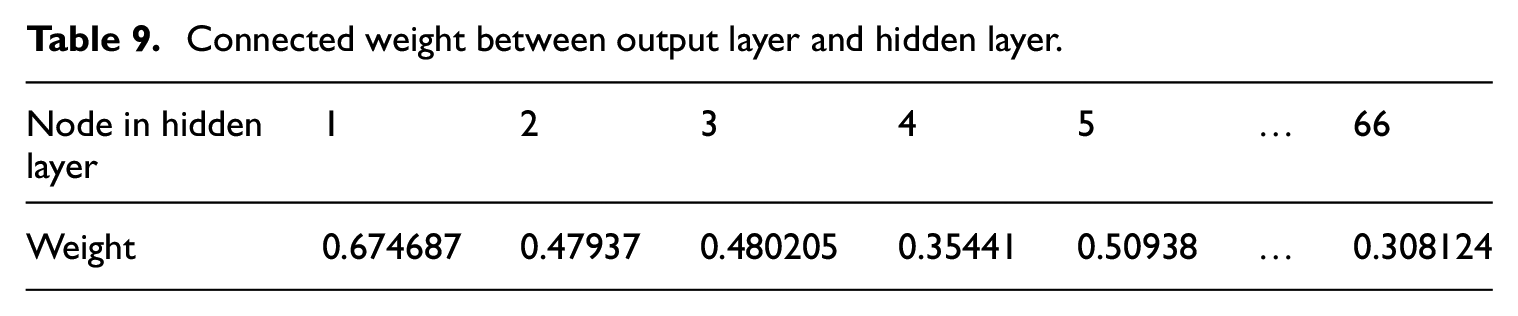
For the established SQ prediction model, the connected weight between input layer and hidden layer is shown in Table 8 and connected weight between output layer and hidden layer are shown in Table 9. Weight of each objective evaluating parameters displayed in Figure 8 can be calculated according to Formula 5.
Connected weight between input layer and hidden layer.

Connected weight between output layer and hidden layer.
The weight of each objective evaluating parameter is shown in Figure 10. The weight ratio of loudness is 30.14%, which means that it has the greatest influence on SQ. The weight ratio of ASPL and sharpness are 23.25% and 20.58% respectively, which have a certain influence on SQ. PSIL has little effect and its weight ratio is 17.54%. The weight ratio of roughness and jitter is very small, which can be ignored in SQ evaluation.

Weight of each objective evaluating parameter.
Conclusions
In this paper, the SQ of HSPMM under different working conditions is tested, evaluated and predicted. A new SQ prediction and evaluation model is constructed based on MLR and GA-RBF intelligent neural network algorithm. The main conclusions are as following: (1) Six psychoacoustic parameters of ASPL, loudness, sharpness, roughness, FS, and PSIL are adopted to objectively evaluate the noise of HSPMM under multiple operating conditions. The SQ of HSPMM is subjectively evaluated by the combination of semantic subdivision method and grade scoring method. The evaluation results show that the SQ is poor, which will have a certain impact on human psychology and physiology. (2) The results of MLR show that loudness, ASPL, PSIL, and sharpness have significant influence on subjective scores. The average error of MLR is 7.10%. It has good accuracy, but poor stability. (3) The prediction model of SQ based on GA-RBF neural network has better accuracy. Compared with MLR, the average error rate is reduced by 3.16% and the standard deviation is reduced by 1.841. Both prediction accuracy and stability are significantly improved for GA-RBF neural network. In addition, the weight of each objective parameter is calculated and analyzed. Loudness, ASPL, sharpness and PSIL have great influence on SQ, while the other two parameters have little influence. In addition, there is a limitation in this study. The SQ evaluation model based on GA-RBF intelligent neural network algorithm may only be applicable to HSPMM. It is unknown whether this developed model is suitable for other types of motors. In future work, the generalizability of the model need to be further improved. The research methods and conclusions of this paper can be extended to the evaluation, prediction and optimization of SQ of other motors.
Discussion
The calculation error rates of eight verification samples of MLR and GA-RBF intelligent neural networks are compared, and the results are provided in Figure 11. The prediction accuracy of GA-RBF intelligent neural network model has been significantly improved. That was a highly statistically significant distinction between the two methods. The maximum error rate has been reduced by 5.20%, and the average error rate has been reduced by 3.16%.
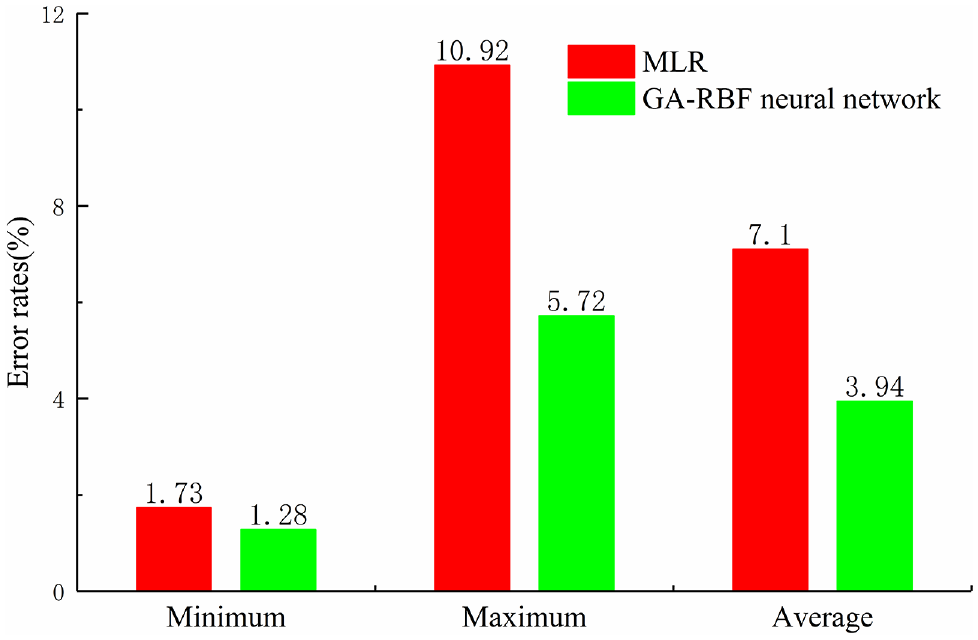
Error rates comparison between multiple regression and GA-RBF neural network.
There are three main contributions of this paper. Firstly, only ASPL was used for objective evaluation in previous studies. Six various kinds of psychoacoustic parameters are selected to objectively evaluate the SQ of HSPMM. It can evaluate SQ more objectively and comprehensively. Secondly, the prediction model of SQ is constructed by using RBF intelligent neural network, and the parameters are optimized based on GA. RBF neural network converges faster compared with back-up neural network. In addition, GA is employed to prevent RBF neural network from falling into local optimization. Compared with previous studies, the average error rate of SQ prediction model based on BP neural network is generally not less than 7%, while the average error rate of GA-RBF neural network of this paper is only 3.94%. Thirdly, the influence degree of each objective evaluation parameter on SQ is obtained based on the weight coefficient of each layer of GA-RBF intelligent neural network. The results provide a theoretical basis for effectively improving the SQ of HSPMM. It is suggested that researchers should give priority to reducing the loudness, ASPL, sharpness, and PSIL, which have great influence on SQ of HSPMM.
Supplemental Material
sj-docx-1-sci-10.1177_00368504211031114 – Supplemental material for A new evaluation and prediction model of sound quality of high-speed permanent magnet motor based on genetic algorithm-radial basis function artificial neural network
Supplemental material, sj-docx-1-sci-10.1177_00368504211031114 for A new evaluation and prediction model of sound quality of high-speed permanent magnet motor based on genetic algorithm-radial basis function artificial neural network by Kai Hu, Guangming Zhang and Wenyi Zhang in Science Progress
Supplemental Material
sj-xlsx-2-sci-10.1177_00368504211031114 – Supplemental material for A new evaluation and prediction model of sound quality of high-speed permanent magnet motor based on genetic algorithm-radial basis function artificial neural network
Supplemental material, sj-xlsx-2-sci-10.1177_00368504211031114 for A new evaluation and prediction model of sound quality of high-speed permanent magnet motor based on genetic algorithm-radial basis function artificial neural network by Kai Hu, Guangming Zhang and Wenyi Zhang in Science Progress
Footnotes
Declaration of conflicting interests
The author(s) declared no potential conflicts of interest with respect to the research, authorship, and/or publication of this article.
Funding
The author(s) disclosed receipt of the following financial support for the research, authorship, and/or publication of this article: This work has been supported by the Research and Development Program of Chinese Academy of Agricultural Sciences (Grant no. CAAS-NRAM-SJ-201903). And partly supported by the National Research and Development Plan. (Grant no. 2017YFD0700704).

Supplemental material
Supplemental material for this article is available online.
Author biographies
References
Supplementary Material
Please find the following supplemental material available below.
For Open Access articles published under a Creative Commons License, all supplemental material carries the same license as the article it is associated with.
For non-Open Access articles published, all supplemental material carries a non-exclusive license, and permission requests for re-use of supplemental material or any part of supplemental material shall be sent directly to the copyright owner as specified in the copyright notice associated with the article.
