



Abstract
In order to make the pump as turbine (PAT) run efficiently and safely, a multidisciplinary optimization design method for PAT blade, which gives consideration to both the hydraulic and intensity performances, is proposed based on multidisciplinary feasibility (MDF) optimization strategy. This method includes blade parametric design, Latin Hypercube Sampling (LHS) experimental design, CFD technology, FEA technology, GA-BP neural network and NSGA-II algorithm. Specifically, a parameterized PAT blade with cubic non-uniform B-spline curve is adopted, and the control point of blade geometry is taken as the design variable. The LHS experimental design method obtains the sample points of training GA-BP neural network in the design space of variables. The hydraulic performance of each sample point (including the hydraulic pressure load on the blade surface) and the strength performance analysis of blades are completed by CFD and FEA technology respectively. In order to save calculation time of the whole optimization design, the multi-disciplinary performance analysis of each sample in the optimization process is completed by single-coupling method. Then, GA-BP neural network is trained. Finally, the multi-disciplinary optimization design problem of PAT blade is solved by the optimization technology combining GA-BP neural network and NSGA-II algorithm. Based on this optimization method, the PAT blade is optimized and improved. The efficiency of the optimized PAT is improved by 1.71% and the maximum static stress on the blade is reduced by 7.98%, which shows that this method is feasible.
Introduction
Blade is the core component of PAT. Its performance is directly related to the overall performance of PAT unit. At present, most of the optimum design of PAT blade mainly focuses on the influence of geometric parameters (such as blade profile, wrap angle, inlet angle and outlet angle, et al) on the hydraulic performance of PAT.1–6 Few studies have been reported on the strength performance of PAT blade. However, through research results and production practice at home and abroad, it is found that the flow rate, head and power at the best efficiency point of a pump operating under turbine conditions are all greater than their values under pump conditions.7–12 Therefore, the structural stress of PAT in the vicinity of the optimal operating conditions and in the operation of large flow conditions must also be considered as a key factor. In order to ensure the efficient and safe operation of PAT blade, the design and optimization of the blade must take into account both its hydraulic performance and structural performance. These two aspects involve two disciplines, namely, fluid mechanics and solid mechanics. Therefore, the optimization design of PAT blade is a multi-disciplinary optimization design problem. In order to solve the shortcomings of PAT blade optimization design at present, multidisciplinary optimization (MDO) 13 design method is proposed to comprehensively improve the hydraulic performance and strength performance of PAT blade.
Multidisciplinary optimization technology is commonly used in turbo-machinery with compressor, airfoil and turbine working medium as compressible fluid.14–24 For example, Li et al. 14 used multidisciplinary optimization design software to optimize the aerodynamic performance of a wind turbine airfoil. After optimization, the lift-drag ratio of the airfoil was increased by 15.9%. It was pointed out that the integrated optimization method of the software could achieve multidisciplinary or multi-objective optimization of the airfoil. Lei et al. 20 proposed a multidisciplinary optimization design method of coupling relaxation, and carried out multidisciplinary optimization design of flow-solid-heat for a centrifugal compressor. Shen and Long 24 carried out multidisciplinary optimization on the efficiency of the aerodynamic channel and the quality of the rotor structure of the turbine passage. After optimization, the aerodynamic performance and structural strength performance of the turbine were improved. But there are few reports on turbo-machinery with incompressible fluid such as water as working medium. 25 Therefore, it is necessary to study the multidisciplinary optimization technology of PAT blade and explore a multidisciplinary optimal design method for the main flow components of the PAT.
Based on MDF optimization strategy,26–28 a multidisciplinary optimization design method for PAT blade is presented in this paper, which can take into account both hydraulic performance and structure performance. Based on MDF strategy, the whole optimization design system of PAT blade is built. Then the geometric shape of PAT blade is parameterized by non-uniform B-spline curve in the system, and the control point of blade geometry is taken as design variable. The LHS experimental design method obtains training approximation in the design space of variables. The efficiency of PAT and the maximum static stress on blade are obtained by CFD and FEA numerical calculation. Then the two performance approximation models of efficiency and maximum static stress on blade are studied and trained respectively. Finally, the multi-disciplinary optimization design of PAT blade is carried out by combining the training approximation models with the optimization technology of NSGA-II algorithm, and it is successfully applied to the multidisciplinary optimization design of blade of the model described in this paper.
Main parameters of PAT
This paper chooses a single stage single suction centrifugal pump as turbine. The design parameters of the pump working condition are as follows: ns = 48, Q = 12.5m3/h, H = 30.7 m, n = 2900 rpm. Figure 1 is the impeller projection diagram of the selected model. The main geometric parameters of model are listed in Table 1.
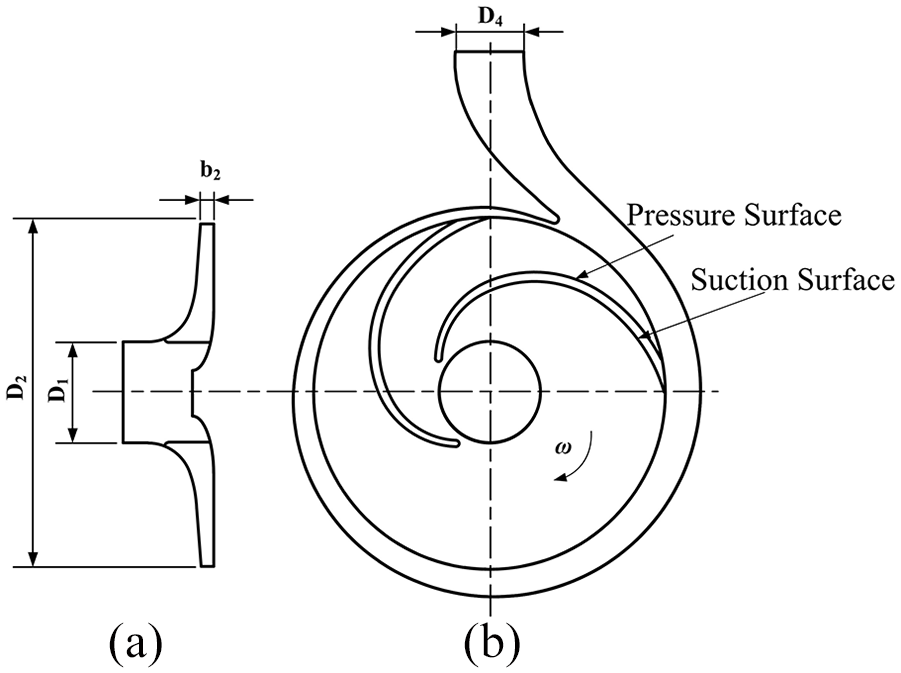
Projection of PAT: (a) meridional plane and (b) planar projection.
Principal geometric parameters of model.

Parameterization of blade
Blade parameterization is the basis of optimal design. The relationship between blade geometry and design parameters is established through blade parameterization, which provides design variables for optimal design. The blade profile of the cylindrical blade of the PAT remains unchanged along the axis, so only the two-dimensional cross section of the blade needs to be parameterized. Two-dimensional section of blade includes blade profile and blade thickness distribution law. In this paper, the blade back profile of a three-order non-uniform B-spline curve parameterized 29 PAT is adopted. The mathematical expression of B-spline curve is shown in equation (1). The change of blade profile can be controlled by the control point. By superimposing the same thickness distribution as the initial blade on the changed blade profile, the two-dimensional section of the changed blade is obtained, and then the three-dimensional blade is constructed by stretching. Figure 2 is a parameterized diagram of the blade of the PAT described in Part 2.

in which u is an independent variable implicitly expressed by the curve,

Blade parameterization.
Performances computing of various disciplines
The performance calculation of various disciplines of PAT is the prerequisite for the realization of optimal design. In this paper, the performance of the selected model under optimal operating conditions is studied for multidisciplinary optimization design.
CFD flow field calculation and explanation of validation of numerical simulation
In the process of blade optimization of PAT, the fluid analysis software ANSYS-FLUENT14.5 is used to calculate the flow characteristics of optimize individual, at the same time, the pressure load is provided for the finite element strength calculation. The computational domain of flow field analysis includes volute, impeller, front chamber, rear chamber, inlet extension section and draft tube. ICEM-CFD14.5 is used to divide the grid of the centrifugal impeller after the calculation domain is determined. Figure 3 shows the initial model mesh schematic.

Initial model mesh schematic.
The mesh number independence shown in Figure 4 of the initial model is studied. The results show that when the number of mesh is more than 1.1 million, the change range of efficiency is less than 0.5% points. Therefore, the number of model mesh used in the study should be no less than 1.1 million. Through the block partition of the model and the setting of grid parameters, the final mesh number of the initial model is 1 178 560. Other models generated during optimization are similar to the initial model, so the same grid topology is adopted.

The relationship between mesh number and PAT efficiency.
When the model is numerically calculated by ANSYS-FLUENT14.5 software, the parameters are set as follows: the equation describing the flow in the PAT is the N–S equation with Reynolds time average incompressible; the analysis type of flow state is steady state; the turbulence model chosen for numerical calculation is standard k-ε; working medium is clean water at room temperature; the boundary conditions of inlet and outlet are set to velocity inlet and pressure outlet respectively; flow near the wall is defined by a standard wall function; the convergence criterion for numerical calculation is set to 10-4.
The geometric model and numerical calculation method used in this manuscript are the same as the previous paper, 30 and the verification of the accuracy of numerical prediction has been done in previous paper.
Strength performance calculation of blades
In the optimization process, the finite element analysis module in Workbench 14.5 is used to analyze the strength performance of each optimized individual. Unstructured grid is used to divide the grid of the PAT impeller. The grid is shown in Figure 5. In the process of solution and analysis, rotation and radial displacement constraints are applied to the axle hole surface, and axial displacement constraints are applied to the rear end of the axle hole. 31 Consider the blade’s gravity load, rotating centrifugal force load (303.69 rad/s) and the water pressure load on the blade surface. The blade structure material is grey cast iron. Its material characteristic parameters are: density is seven 200 kg/m3, elastic modulus is 1.1 × 10¹¹ Pa, Poisson’s ratio is 0.28. The strength performance of the PAT blade is judged by the maximum static stress on the blade, which is expressed by the variable Maxstress.

The finite element mesh of impeller.
Multidisciplinary optimization models
Establishment of multidisciplinary coupling model
This study involves the analysis of fluid and solid disciplines, and takes into account the coupling between the two disciplines. There are two coupling modes for fluid analysis and solid strength analysis, that is, bidirectional coupling and unidirectional coupling. Bidirectional coupling is to construct the governing equation of fluid, solid and the coupling action between them into a governing equation system, and to solve all variables simultaneously. Unidirectional coupling is to solve the fluid governing equation and the dynamic equation in turn. The numerical results of the two equations transmit information through the intermediate data exchange interface. Because the fluid and solid governing equations with mutual coupling need to be solved simultaneously in the process of bidirectional coupling, the computational cost is higher, while the unidirectional coupling needs less computational resources to complete the required solution. In view of the need for performance calculation of a large number of sample points and fluid-solid coupling calculation of each sample point in the process of multidisciplinary optimization of the PAT blade, so this paper adopts unidirectional coupling method to realize data transmission between the two disciplines. In the coupling process, the water pressure loads on the blades calculated by FLUENT are transferred to the finite element strength calculation software Static Structural by using Workbench software, so as to realize the data transfer between the two disciplines.
Establishment of blade profile optimization model
Multidisciplinary optimization of PAT blade is to enable them to operate safely and efficiently, especially under optimal operating conditions. In this paper, the control points (①, ②, ③, ④, ⑤, ⑥, ⑦, and ⑧) shown in Figure 6 are selected as design variables. The control points ⑨ remain unchanged, that is, the outlet location of the PAT blade remains unchanged. In the process of optimization design, in order to make the optimization design possible, the number of optimization design variables should be controlled within the acceptable range of calculation quantity, and at the same time, the significance of optimization design should be kept. So in this paper, polar coordinates
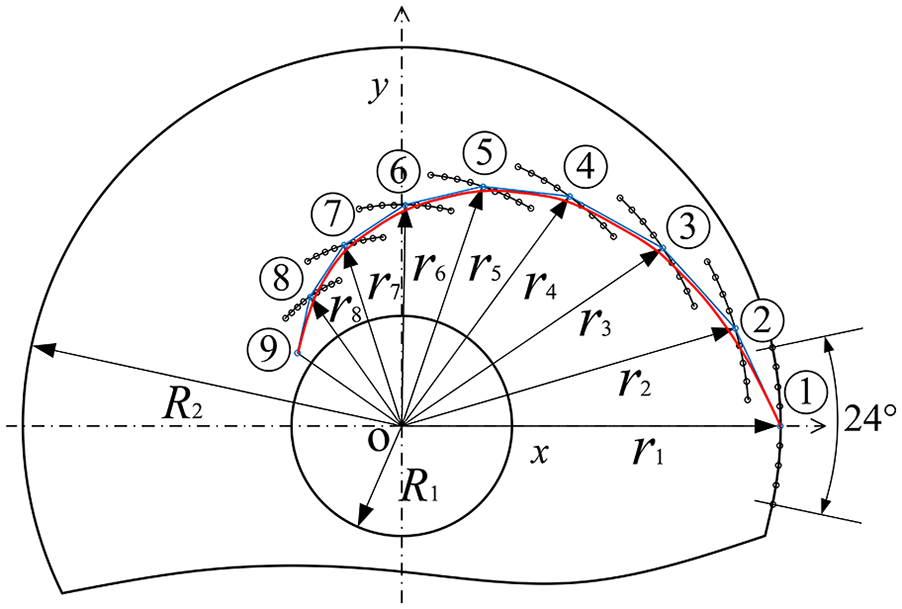
The optimum design scheme.
Design variables and their range of change.

r i is the radius of the circumference of the control point i.
Considering the characteristics of PAT applications, the multidisciplinary optimization of PAT blade is described as follows:

Constraint:
In the formula,
Optimizing algorithm and process
Selection of optimal algorithms
NSGA-II algorithm 32 introduces fast non-dominated sorting algorithm and elite selection strategy. The quick non-dominated sorting algorithm reduces the computational complexity, and the elite selection strategy allows the parent population and its descendants to compete for the next generation population, so good individuals will not be lost and the quality of the population will be improved. At the same time, NSGA-II uses congestion degree and congestion degree comparison operator as the comparison criterion of the same class individuals in the population, so as to get a broader Pareto frontier. In view of the above advantages of NSGA-II algorithm, it is chosen as the multidisciplinary optimization algorithm for this study, and the objective function is optimized.
Optimizing process
The parameterization of the PAT blade is based on the principle described in Part 3. Firstly, code is written in MATLAB R2012b to generate blade back profile that can be identified by Pro/E 5.0. Secondly, blade back profile of the blade was successfully imported into Pro/E. According to the same thickness distribution law as the initial blade, the blade back-to-face is thickened to generate two-dimensional cross section of the blade. Through the characteristic command of Pro/E, the fluid domain and solid domain models of PAT are obtained respectively. The mesh generation and numerical calculation of fluid domain and solid domain of multiple sample points are all implemented by batch files of corresponding software, thus forming three independent modules, namely, parametric modeling module, CFD flow field analysis module (including mesh generation) and FEA finite element strength analysis module. Parametric modeling module generates PAT fluid domain geometry model files and blade solid domain geometry model files according to optimization design variables. The CFD flow field analysis module divides the grid and calculates the CFD flow field according to the PAT fluid domain geometry model file. Finite element strength analysis module of FEA carries out mesh division and finite element strength calculation according to blade solid domain. The fluid-structure coupling data exchange of blades is realized in workbench software.
When using NSGA-II algorithm to optimize, it is necessary to evaluate the fitness of each individual in the population. In this way, the efficiency value of each individual and the maximum static stress data on the blade need to be obtained. If numerical method is used to calculate it one by one, it will undoubtedly cost too much, which is mainly reflected in the time-consuming solution of three-dimensional Navier-Stokes equation of fluid. Therefore, this paper introduces two approximate models, both GA-BP neural networks, which are used to replace CFD flow field calculation and FEA blade finite element strength calculation respectively. In order to make approximate models have fine response characteristics of objective function in the optimization space, the LHS experimental design method is used to select as many sample points as possible to train GA-BP neural network. In this paper, 1000 test samples are generated by using the LHS experimental design method with eight design variables. In order to ensure that the blade formed by each sample does not distort and the blade is a backward-curved blade, it is required that the control polymorphic inner angle formed by control points is less than 180 degrees or the second derivative of the blade profile is always less than 0. According to this condition, code is compiled and 322 samples are selected from 1000 samples. After obtaining the required samples, the CFD flow field is numerically calculated, and the efficiency value of the PAT and the water pressure load of the blades are obtained. The information of water pressure load obtained from flow field analysis is transferred to the finite element strength analysis module of workbench software. The maximum static stress on the blades is solved by the finite element strength analysis module of workbench software. Thus, the PAT efficiency corresponding to the sample points and the maximum static stress of the blades are obtained. Then, GA-BP neural networks are trained for the efficiency of PAT and the maximum static stress of blades. When the output error of GA-BP neural network reaches the set standards, the approximate models are established. Finally, the optimization technology combining GA-BP neural networks and NSGA-II algorithm is used to solve the multi-disciplinary optimization problem of PAT blade. Figure 7 is an optimization flow chart based on MDF strategy.

Multidisciplinary optimization process of PAT blade.
Results and analysis
Geometric comparison between optimized blade profile and original profile
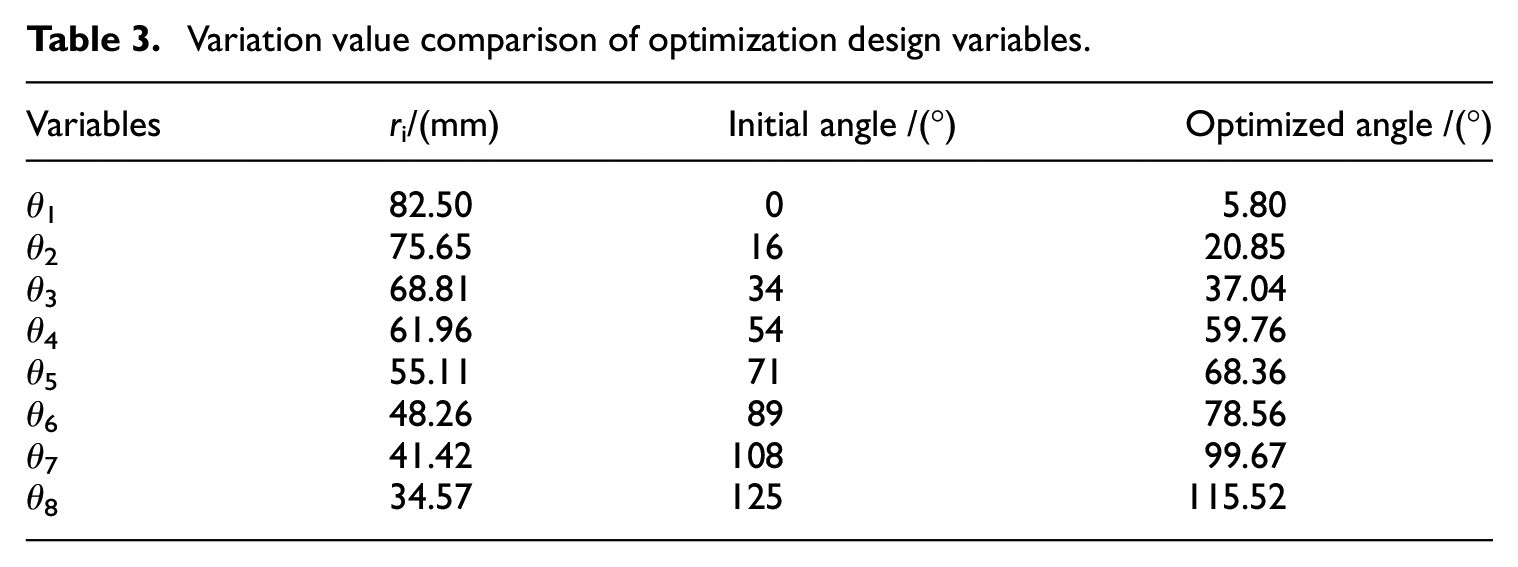
According to the multi-disciplinary optimization design flow of the PAT blade proposed in this paper, the multi-disciplinary optimization design method of the PAT blade described in Part 2 is studied. The parameters of NSGA-II algorithm are as follows: population size is 60, evolutionary algebra is 30, crossover probability is 0.8, and mutation probability is 0.1. After optimization, the evolutionary distribution of population in solution space is obtained, as shown in Figure 8. According to the degree of improvement of objective function, the final solution of optimization of the PAT blade is chosen in Pareto solution as in Table 3.

Distribution of population in optimization of the PAT blade.
Variation value comparison of optimization design variables.
From the population evolution of Figure 8, it can be seen that the population evolution is advantageous to the objective function, which shows that the NSGA-II algorithm can be effectively applied in this area.
The geometric shape comparison between the initial blade and the optimized blade is shown in Figure 9 below.

Geometric comparison of blade before and after optimization.
From Figure 9, it can be seen that the inlet angle, outlet angle, wrap angle and blade profile have changed after optimization. In order to analyze the influence of the change of blade geometry on its hydraulic performance and structural performance, the following section makes some analysis.
Performance comparison of various disciplines
The performance of the PAT before and after optimization was calculated by numerical method in two disciplines. Table 4 lists the maximum static stress of the blade and the efficiency of the PAT before and after optimization. The efficiency and static stress values in the table are basically the same as those corresponding to the red circle in Figure 8, which also shows that the two approximate models used in this paper have better prediction accuracy. Figure 10 shows the stress distribution on the pump blade before and after optimization.
Comparison of each disciplines performance values between initial and optimal at the design flow rate.


Stress distribution comparison of initial and optimal blade: (a) before optimization and (b) after optimization.
From the results in Table 4, it show that the efficiency of the PAT improved by 1.41% under the optimum operating conditions, and the maximum static stress on the blade decreased by 7.98%. This shows that the optimized blade not only improves the efficiency of the PAT, but also has better stress performance. Figure 10 shows the stress distribution of the PAT blades before and after optimization. It can be seen from the figure that the maximum static stress of the optimized PAT blades decreases, and the stress distribution on the blade is more uniform than before, which shows that the stress performance of the optimized PAT blades has been improved to a certain extent.
In order to compare the hydraulic performance difference between the optimized blade and the original blade more comprehensively, 10 operating points are added besides the optimal operating condition, and CFD is carried out for the PAT corresponding to blades before and after the optimization. The results are shown in Figure 11.
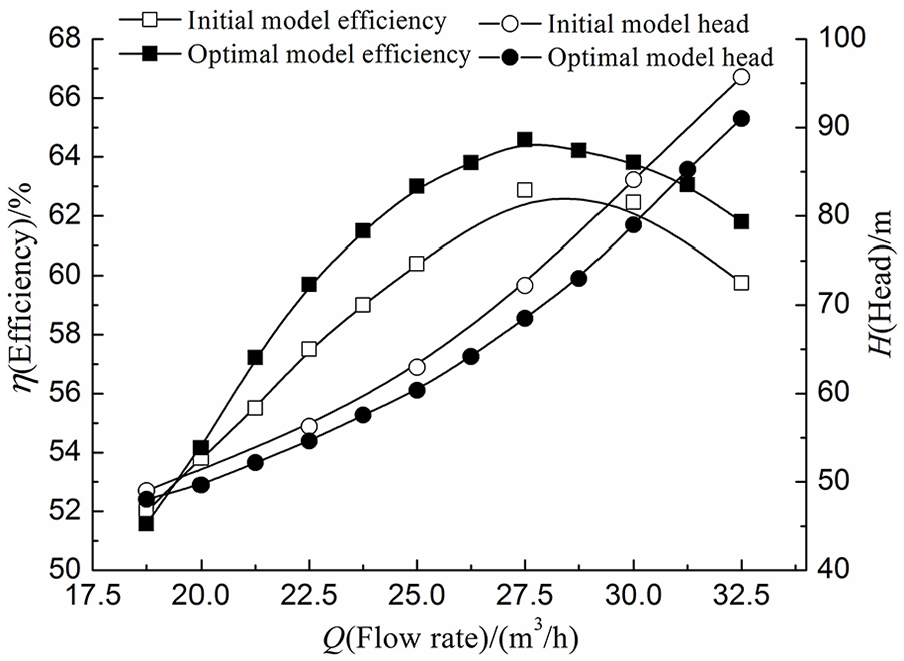
Hydraulic performance curves of the initial and optimal PAT.
As can be seen from the curve in Figure 11, the efficiency of the optimized blade PAT has been improved not only in the optimal operating conditions, but also in other flow rates (except the first one). After optimization, the pressure head of the PAT decreases to a certain extent in all working conditions, and the changes of pressure head are related to the change of the inlet and outlet angle of the optimized blade.
Conclusion
In this paper, the multidisciplinary optimization design method of the PAT blade is studied, and the multidisciplinary optimization design process of the PAT blade is established through multidisciplinary feasibility optimization strategy. The blade of the PAT was designed and optimized by using the multidisciplinary optimization design process established. Through the analysis of the optimization results, it was concluded that:
Under the optimum conditions, the efficiency of the PAT is increased by 1.71% and the maximum static stress on the blade is decreased by 7.98%. The stress distribution of the blade is more reasonable after optimization. At the same time, the optimization design not only improves the efficiency of the PAT at the optimum operating point, but also has a beneficial effect on the operating point nearby. This shows that the multidisciplinary optimization design method for the PAT based on multidisciplinary feasibility optimization strategy is feasible.
Footnotes
Appendix
Declaration of conflicting interests
The author(s) declared no potential conflicts of interest with respect to the research, authorship, and/or publication of this article.
Funding
The author(s) disclosed receipt of the following financial support for the research, authorship, and/or publication of this article: This paper is supported by Lanzhou University of technology hongliu outstanding young teachers program, Open Research Subject of Key Laboratory of Fluid and Power Machinery (Xihua University), Ministry of Education (LTDL2020-007, szjj2019-016) and Fund National Natural Science Fund Project of China (51569013).
