




Abstract
Animal welfare is a growing societal concern and the well-being of animals used for experimental purposes is under particular scrutiny. The vast majority of laboratory animals are mice living in small cages that do not offer very much variety. Moreover, the experimental procedure often takes very little time compared to the time these animals have been bred to the desired age or are being held available for animal experimentation. However, for the assessment of animal welfare, the time spent waiting for an experiment or the time spent after finishing an experiment has also to be taken into account. In addition to experimental animals, many additional animals (e.g. for breeding and maintenance of genetic lines, surplus animals) are related to animal experimentation and usually face similar living conditions. Therefore, in terms of improving the overall welfare of laboratory animals, there is not only a need for refinement of experimental conditions but especially for improving living conditions outside the experiment. The improvement of animal welfare thus depends to a large extent on the housing and maintenance conditions of all animals related to experimentation. Given the current state of animal welfare research there is indeed a great potential for improving the overall welfare of laboratory animals.
Introduction
There is no reliable, let alone official, number of laboratory animals used worldwide. Even for highly regulated areas like the EU, comprehensive data is published with a considerable delay. Moreover, the data available comprises a fuzziness as there is no uniform convention on what exactly to count. The latest numbers available for the EU are for the year 2017, with 9.4 million animals used for animal experimentation. 1 Many countries provide yearly statistics on animal use, allowing some general conclusions to be drawn and enabling more current estimates. For example, the numbers for 2018 published by the German Federal Ministry of Food and Agriculture, 2 as well as the numbers of procedures in the UK in 2018, 3 can help to conclude some general directions. Overall, the latest numbers published were comparable to preceding years, and again, the most widely used species was the mouse with roughly 1.54 million individuals in Germany and 2.57 million procedures carried out with mice in the UK. For the year 2017, for the first time, not only the number of experimental animals but also the number of animals used for breeding and maintenance as well as the number of animals bred but not used was assessed throughout the EU. Overall almost 14 million additional animals were counted in 28 EU countries indicating that for every two experimental animals additionally three surplus animals have to be counted.1 Assuming that the majority of the additional animals are mice as well, we will focus on mice for the most part of this impulse paper, but the discussion that is being fostered here will of course also apply to other experimental animal species.
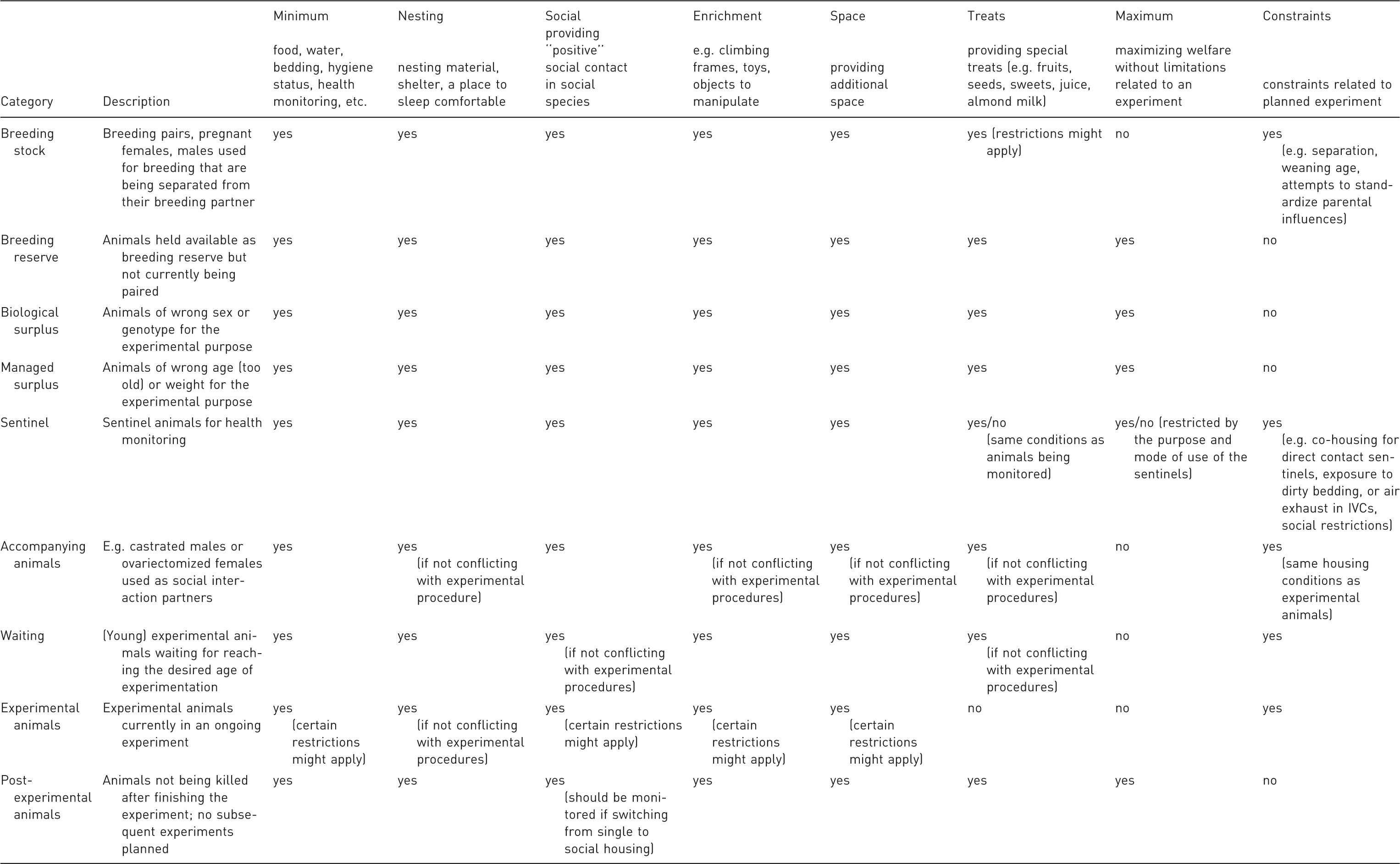
Subjects categorized with regard to their relation to animal experimentation (rows) and different measures and constraints related to animal welfare (columns) that might be applicable.
What is animal welfare?
Animal welfare much alike human welfare is a term that is notably hard to access and disentangle and there is no unambiguous consensus.6–10 An early approach in defining animal welfare was raised by a press release of the Farm Animal Welfare Council in 1979, tracing back to the “Brambell Committee 1965,” 11 and is referred to as the five freedoms (i.e. freedom from 1. hunger and thirst, 2. discomfort, 3. pain, injury, and disease, 4. fear and distress, and 5. restrictions to express normal behavior). The five freedoms, however, state what has to be avoided in order to prevent poor animal welfare rather than defining what constitutes animal welfare per se. Consequently, the later literature emphasizes subjectivity for animal welfare and incorporates the view of animals as perceived animal welfare.12,13 The five freedoms lately have been advanced to the “five provisions” focusing on what should be provided to achieve good welfare. 10 It was also recognized that animal welfare is not static and thus concepts include adaptive capabilities in terms of coping with environmental challenges and/or being able to achieve certain goals.9,14–16 Today's view on animal welfare also largely includes a quality of living approach,17,18 focusing on good living rather than mere avoidance of unfavorable conditions. Quality of living inherently reflects a much more holistic view over an animal's life and is thus less affected by short timed events (e.g. pleasurable moments, few minutes of fear). 17 Our definition of animal welfare is based on the current literature and deliberately reflects the difficulties that come along with defining as well as with assessing animal welfare.
Animal welfare describes (objectively verifiable) the status of a subjectively perceived quality of life of an individual at a given period and is measured on an ordinal (nonlinear), multidimensional scale.
The core unit of animal welfare is the subjective perception of an individual. This makes welfare especially hard to measure, as individual perception seems to notoriously elude scientific quantification. However, recent advances in theoretical concepts and methodology increasingly allow to quantify for example affective states.16,19–21 The multidimensionality results from the different levels on which animal welfare can be affected: An individual might suffer from an injury (an obvious indicator for bad welfare) but might be engaged in positive social interaction (indicator for positive welfare) at the same time. Naturally, this complicates the assessment of animal welfare as calculation of potential compensatory and/or additive effects between different dimensions is inherently difficult. Moreover, the difference between categories such as poor and very poor welfare is not necessarily the same as the difference between good and moderate welfare, thus the scale has to be considered ordinal. In the same vein, nonlinearity owes to the fact that physical and physiological parameters as well as descriptors of affective states do not follow simple mathematical additive rules in relation to their impact on animal welfare. Although physiological parameters like heart rate or stress hormonal levels are measured on an interval scale they are not linearly related to animal welfare.15,22
Although the status of animal welfare is usually assessed at a given point in time, the measurement reflects a period of unknown length preceding the assessment. In addition, preceding lifetime events affect a current state of animal welfare differentially depending on frequency of occurrence, length, and intensity, for example.
Assessing animal welfare
It is obvious from the above that measuring animal welfare is not an easy endeavor. It is, however, feasible to measure animal welfare on an ordinal scale and to annotate labels ranging from very poor to very good welfare with reasonable precision. Poor welfare can be measured by evaluating to what extent the first four freedoms are met. In a broad sense, being free from pain, discomfort, hunger and thirst, fear, and disease can be considered a minimum standard that should be expected to be the normal state a laboratory animal is in. Although not always overly trivial, these parameters are generally considered to be measurable reasonably well.10,14,23 Above obvious signs for poor welfare like sickness behavior, wounds, signs of starvation or dehydration, physiological parameters (e.g. stress hormones, heart rate) may be indicative for how well an animal is able to cope with the challenges introduced by the environment provided under laboratory conditions. The fifth freedom to be free to show normal behavior is far more difficult to assess. A wide spectrum of species specific behavior is related to coping with challenging situations in the wild that one can reasonably assume not to be applicable for laboratory animals (e.g. extensive foraging, predator avoidance, exaggerate aggressive encounters). Therefore, it is not unequivocally established what constitutes “normal behavior” in a laboratory animal. Nevertheless, monitoring day-to-day behavior of laboratory animals and comparing time budgets allocated to different behavioral domains is a feasible approach to analyze normal behavior in laboratory animals. In a similar vein, disturbed circadian rhythm or other behavioral deviations such as stereotypic behavior or hair pulling are considered to be associated with impaired animal welfare.24–27 Finally, post mortem analysis (e.g. ulcers, adrenal weights) can also help to retrospectively assess poor animal welfare. 28
Measuring good animal welfare on the other hand, is generally considered to be more complicated although not impossible. 29 Play behavior and affiliative behaviors, as well as some vocalizations, 30 appear to be promising measurable indicators for assessing positive animal welfare. 31 In addition, recently newly developed approaches in human animal interaction were also related to positive emotions, e.g. clicker-training and tunnel handling might indeed be perceived as positive interactions by the animals.32,33 Finally, with regard to the quality of living, which would reflect a more holistic view of animal welfare, an ideal assessment should take into account that welfare throughout an animal's life (within and outside the experiment) has to be considered as well.
Specific conditions in animal experiments
For many years, it has been fostered to try keeping external physical, social, and internal physiological states as constant as possible. This was meant not only in order to standardize experimental conditions but also to guarantee the fulfillment of animal needs. Unfortunately, this approach falls short in regard to animal welfare as biological systems have evolved to cope with transience of external stimuli and therefore allostasis (“stability through change”) rather than homeostasis is a key element of animal welfare.15,34 This has been partially addressed by improving housing conditions especially by introducing environmental enrichment over the last decades. On the other hand, experimental set ups naturally require a standardization strategy (including, e.g., systematic variation to increase external validity 35 ) to minimize animal use and maximize test sensitivity. Still, boredom as a natural consequence of under stimulation should be considered a major concern with regard to animal welfare of laboratory animals. 36 Sensation seeking is reflecting such a need for change and has been measured for example as proneness to sensory stimuli in mice, 37 self-administration of glucocorticoids in rats, 38 or seeking even aversive stimuli in mink. 39 Consequently, balancing standardization against boredom along with the animals' “need for change” will remain a challenge in future experimental designs. It would be fallacious to expect that any individual animal (or human) could be in a superior welfare state at all times. Thus fluctuation in welfare states is an inherent part of an animal's life and also contributes to a life worth living. 14 Overall, transience between welfare states within the range of very good, good, neutral, and even lightly aversive is most likely part of an interesting life worth living. This, however, is not at all easy to be realized for laboratory animals. Even if we assume that there were no restrictions with regard to financial shortage, qualified personnel, and available space, at least some categories of laboratory animals will be less eligible for the full range of possible welfare enhancement (see Table 1).
Enhancing animal welfare
Although assessing animal welfare is coming along with a number of problems with regard to accuracy, specificity, and generalizability, there is also a pragmatic approach when the goal is to increase animal welfare of laboratory animals. A positive welfare state can be derived by being able to engage in activities that are perceived as rewarding. Such behaviors are expected to be capable to elicit positive affects which are related to anticipation of achieving goals, achieving the goal itself, and retrospectively eliciting the memory of having previously achieved a goal. 10 Consequently, any measures that enable laboratory animals to engage in rewarding activities, as well as states associated with anticipation or memory of rewarding activities are likely to enhance animal welfare. A classical reward is the provision of treats, which is very common, e.g. in companion animals. In laboratory animals, however, treats are often restricted to experiments of operant and classical conditioning where special food items are provided as a reward to increase their performance. If paying attention to nutritional needs, there should be no principle objections against providing special treats to other laboratory animals as well. However, one should bear in mind that if anticipated rewards are suspended the mismatch between expected reward and the reality check possibly leads to frustration. 40 Therefore, withholding treats or other positive stimuli that previously have been granted can also negatively affect animal welfare.
Positive affective states are also elicited in positive social interactions. Social interactions concern the entire life of social mammals and incisive experiences in early life also affect later social behavior. For example, it has been shown that delayed weaning increased social behavior later in life. 41 However, the weaning age is usually designed to maximize breeding success and does not necessarily correspond to the natural breeding behavior of the species. Social housing for laboratory animals later in life is generally recommended except for solitary species. However, group housing for animals that frequently engage in aggressive encounters, e.g. as observed in male groups of many mouse strains,42,43 is sometimes not feasible. This is something that has to be taken into account when planning experiments and choosing the right model species, strain, or sex. As already outlined above, boredom due to a lack of stimuli and missing opportunities to engage in rewarding activities in laboratory housing systems is a growing concern. 36 This can be partially ameliorated by means of environmental enrichment and providing materials to perform species typical behavior (e.g. for rodents, nesting material, burrowing and gnawing substrate). For laboratory mice nesting material and shelters were slowly introduced over the last three decades and can nowadays be found in almost all European animal facilities as this is required by the EU directive 2010/63/EU. Still there is much room for improvement with regard to entertaining enrichment and providing opportunities to engage in rewarding behaviors. This can be realized by providing novel stimuli (e.g. new enrichment items that can be explored 44 ), by introducing cognitive training (e.g. puzzle boxes, clicker training 32 ) into the home environment, or by measures of occupational therapy (e.g. running wheels, or letting the animals work in order to get access to water or food). In addition, home environments could be improved by providing better opportunities for play behavior. Although play behavior is most prominent in juveniles and adolescents, adults of many species, including mice and rats,45–47 do also play. Play behavior is usually considered to be an indicator for positive animal welfare, 48 but sometimes even elicited when coping with negative affective states. 49 Nevertheless, the absence of play behavior in an otherwise playful species certainly is an example for a deviation from “normal” behavior and thus should generally considered to be an indicator for disturbed animal welfare. Adult mice engage frequently in locomotor play if provided with enough space.45,46 Indeed, more than 85% of play behavior in mice involves locomotor play. 50 Therefore providing more space (e.g. larger cages, connecting several small cages with tubes) or other opportunities to engage in locomotory activity should be taken into account to improve housing conditions for laboratory mice. Noteworthy, there is an ongoing debate with regard to the costs and benefits of changing “established” housing conditions with regard to size, type of nesting and bedding material, or different forms of enrichment. For example, excessive usage of running wheels might resemble stereotypic behavior in some individuals,51,52 but in group housed mice no signs of stereotypic running wheel behavior were found. 53 Moreover, several behavioral as well as morphological, and physiological parameters can be affected by introducing environmental enrichment. 54 Also it is known that housing conditions can have interaction effects with pharmacological treatments. 55 However, concerns that enrichment generally increase variation in experimental results could not be substantiated. 56 Overall, possible interferences of improved as well as of restricted housing conditions with the experimental design, reproducibility, and external validity should be kept in mind. Enrichment is generally thought to enhance animal welfare although sex differences might apply (i.e. aggressive behavior 42 ), and it is not always clear how different items are perceived by the animals themselves and thus animal centric strategies like preference tests will help to assess and rate different items. 57
Improving animal welfare in- and outside the experiment
Generally speaking, we should aim to maximize animal welfare of laboratory animals owing to the fact that we are responsible for their well-being. As animal experimentation is under special scrutiny there is a high ethical standard ruling animal experimentation and it has become mandatory to consider refinement measures in the experimental design. Moreover, it is widely accepted that above the ethical concerns there is also a scientific need for improving the welfare of laboratory animals. 58 However, restrictions affecting the welfare of experimental animals cannot always be overcome if they are directly related to the experimental aims. In our view, relating to historical data or established housing conditions alone does not suffice to refuse enhancing the living conditions. One of the main lessons to be learnt from the reproducibility crisis should be that only data that can be replicated in other contexts are truly biologically meaningful. 35 Experimental animals spend much of their lives outside the experiment and a large number of animals are not even used for experiments but held available for breeding or other maintenance related purposes. Table 1 summarizes the potential of enhancing animal welfare for different categories of laboratory animals. For each category of animals one should ask what can reasonably be done to maximize their welfare. Experimental animals and animals waiting for an experiment are probably more restricted with regard to maximizing their welfare as many measures potentially counteract the experimental purpose. Nevertheless, quality and size of measures to increase welfare depend on the experimental design and should be evaluated accordingly. On the other hand, for post-experimental animals there is basically no limit on what could be done to increase their welfare, even if it might only be for a short time compared to the life expectancy. 5 All in all, the time outside the experiment can be considered a special opportunity to improve the overall welfare of laboratory animals.
Footnotes
Declaration of conflicting interests
The author(s) declared no potential conflicts of interest with respect to the research, authorship, and/or publication of this article.
Funding
The author(s) disclosed receipt of the following financial support for the research, authorship, and/or publication of this article: This work was funded by the DFG (grant numbers FOR2591, LE 2356/5-1, and JI 276/1-1).
ORCID iD
Lars Lewejohann https://orcid.org/0000-0002-0202-4351 Christine Häger https://orcid.org/0000-0002-6971-9780 Paulin Jirkof 