




Abstract
Researchers rely on animals for their clinical applicability and ease of monitoring. However, careful management is required to ensure the animal and financial costs are minimized. The incorporation of ‘smartphone’ technology in research has increased exponentially, with a focus on the development of innovative research-based applications. We have developed a smartphone application designed to address the needs of modern researchers in the management of their colonies. ‘Lennie’ introduces a new method for the management of small to medium-sized animal colonies. Lennie allows users wireless access to their colonies with the ability to create and edit from virtually anywhere. Lennie also offers the ability to manage colonies based on experiments by assigning animals based on priority. Experimental time-points are also recorded with integrated scheduling options using the calendar function. Lennie represents an alternative to current large-scale software options, as the application design is simple, and requires no training or manuals. As the technological landscape is constantly evolving, we must continue to find ways to improve upon current practices to ensure that research is completed with efficiency and efficacy. With this new method of animal management, researchers are able to spend less time record keeping and can focus their efforts on continued innovation.
The use of animals in research has contributed to discoveries in all aspects of modern medicine. They provide invaluable research models as their physiological responses are easily monitored with considerable clinical applications to humans. Thus, proper care and management of animals is essential for the success of a research institution. Russell and Burch (1959) described the ‘Three Rs’, which promote the replacement, reduction and refinement of animals in research. 1 Accurate and efficient animal management is central to this tenet and to the reduction of animals used in research. Furthermore, fees associated with animal care and husbandry are among the highest expenditures in research. Per diem costs (CDN) range from $0.60 to $1.80 per cage for mice and up to $2.00 per cage for rats. Larger mammals such as pigs and sheep can cost over $30.00 per animal per day. For a typical colony, costs can total from $40,000 to $80,000 per year in basic animal care fees. These costs are a major concern at many research institutions, with low animal care costs serving as a deciding factor for recruitment offers. 2 There is an increasing trend for researchers to base job decisions on animal costs as opposed to salary or on-campus facilities. Affordable animal costs are critical for scientists undertaking research relying heavily on animal models (such as physiologists, immunologists and neuroscientists). 2 Reducing the burden of animal care costs allows researchers to spend less time writing grant proposals, and frees up resources to increase the frequency and complexity of their experiments.
There are numerous methods available for the management of animal colonies. Many researchers continue to use traditional methods of record keeping such as handwritten notebooks, spreadsheets or integrated codexing. However simple, these manual approaches are highly susceptible to human error3,4 and can become complicated once different genotypes and experimental endpoints are introduced. Furthermore, electronic systems are typically designed for billing purposes as opposed to tracking animals and coordinating experiments. However, for small to moderately-sized colonies, manual methods may still be preferable when compared with the computer database alternatives that are available. Various programs are commercially available, designed to manage different animal colonies using databases.5–7 These programs are useful for colonies with multiple genotypes or care centers managing multiple strains, but may be too costly, complicated and labor-intensive for smaller laboratories to implement. Furthermore, these databases require a computer to access or update records, which may not be convenient if the animals are housed in a separate facility.
The emergence of ‘smartphones’ offers computer access and functionality virtually anywhere. Currently, Nielsen estimates over half (61%) of all US mobile subscribers own a smartphone, with a recent report by Google citing comparable statistics in Canada (56%). These numbers have increased by more than 10% from 2012, supporting the increasing demand for smartphone technology. By 2017, global penetration is expected to approach 50%. 8 Smartphones have rapidly gained popularity in both consumer and business markets and are also gaining prominence in the field of scientific research. The use of smartphones in research is indisputable, with PubMed citations increasing exponentially over the past decade. Researchers have begun utilizing this technology and there is a new focus on the development of research-based applications. In medicine, numerous smartphone applications have been developed to improve image distribution,9,10 treatment,11,12 and patient care.13–16 Alternatively, applications have also been designed to improve field research and data collection.17,18 Recently, a team from the University of California Los Angeles (UCLA) developed a lensless microscope for cell phone cameras improving the accessibility of telemedicine and furthering our advancements in the progression of smartphone technology. 19 Our next generation of scientists intuitively gravitate towards application-based software and away from spreedsheets and pen-and-ink documentation.
Here we describe ‘Lennie’, a novel method of animal management. Lennie is an animal colony management smartphone application designed for the maintenance and management of small to moderately-sized animal colonies. It introduces a new type of accessibility allowing researchers to access and modify their animal colonies wirelessly from their mobile devices and streamlines efficiency and efficacy. Lennie was developed using PhoneGap, an open-source mobile development framework for the Blackberry and Android operating systems. Coding was completed using HTML5 and JavaScript libraries provided by jQuery and jQueryMobile. Initial testing and development was completed online using Google Code before testing on mobile interfaces. Mobile testing was completed using BBOS version 6. The application is available on major smartphone platforms and is freely available for download through the Blackberry App World or Google Play stores. Housing and experimental procedures for our animal colonies were approved by the Animal Care Committee at the University of Guelph in conformity with the guidelines of the Canadian Council on Animal Care.
Lennie is broken down into a series of datatype subsystems. Each subsystem is designed to handle the unique commands associated with the datatype with separate subsystems in place to manage data storage and flow of information through the application. Integral to the design of the application is the ability of each subsystem to redirect the user based on the specific demands without having to return to an index page. This allows for research efficiency in which multiple endpoints can be achieved in one sitting.
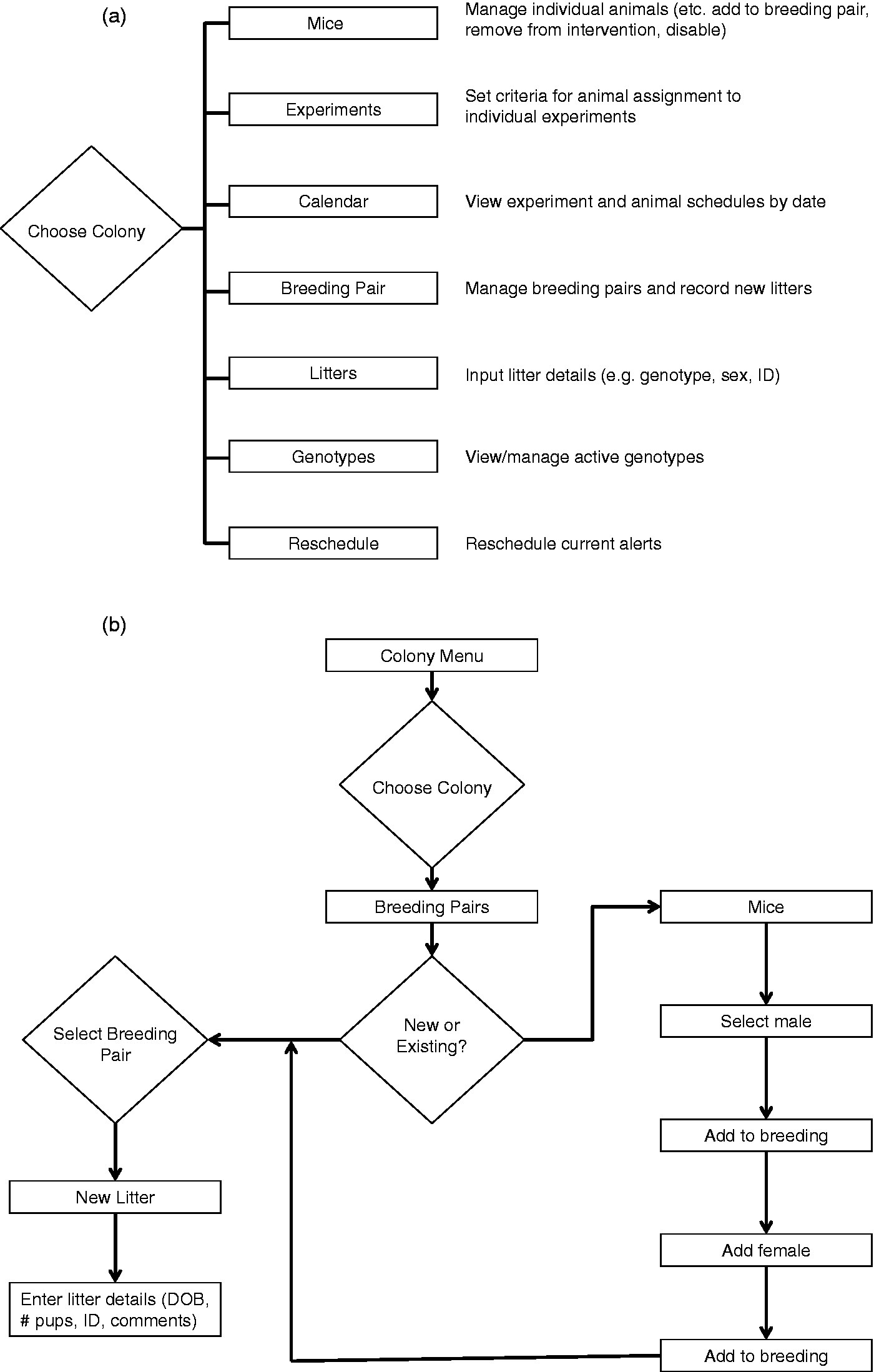
Lennie has been designed to aid animal researchers without overloading the user with complicated features. A seamless design provides for a user-friendly experience and the unique features offered directly address the daily requirements of an animal researcher. Upon launching, the user is brought to the colony subsystem index screen (Figure 1a). From this subsystem, the user has the option to manage existing colonies or create a new one. Once a colony has been selected, the user will be brought to the colony main menu (Figure 2a). From this screen, the user is presented with numerous options from which to manage their colony. One of the unique features Lennie offers is the ability to manage colonies based on experiments. From the colony main menu, the user is able to enter the experiment subsystem in which they are able to create or manage existing experiments (Figure 1b). Each experiment is assigned a priority level that ensures animals are assigned to each intervention in a timely and highly organized fashion. Using the integrated calendar function, the user is able to view upcoming experimental time points detailing animals available for use (Figure 1c). The requirements for the inclusion of animals within an intervention (such as age and genotype) are easily monitored and modified within the intervention subsystem (Figure 1d) located on the experimental menu. All naming conventions and labels are modifiable, ensuring that the application is able to fulfill diverse user needs. The simple design of the program ensures that, regardless of the option chosen, the user is directed to their chosen endpoint quickly, without needing to pass through unnecessary checkpoints. For example, when recording a new litter, a breeding pair can be simultaneously added without needing to backtrack (Figure 2b). This is critical for maximizing the efficiency of the application as it prevents needless time moving between various subsystems to accomplish a single task.
Screenshots of Lennie displaying colony menu (a), experimental menu (b), calendar feature (c) and intervention edit screen (d). (a) Illustration of available options from colony menu. (b) Decision tree outlining the addition of a new litter.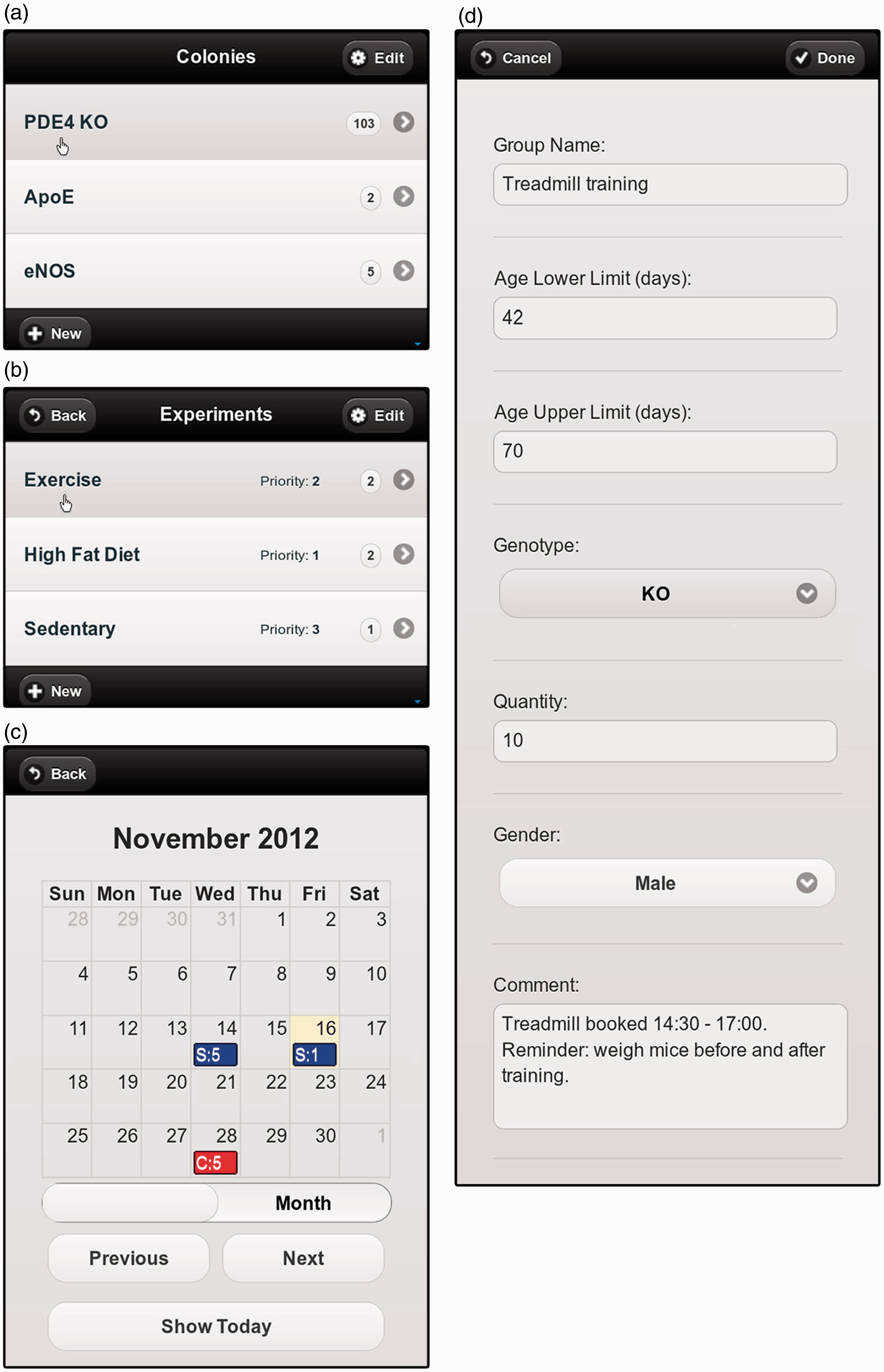
By utilizing smartphone technology, Lennie offers a novel alternative in the field of animal care management. The application is designed to provide researchers with a simple yet effective way to manage different colonies and experiments independently of internet or cell service. Lennie is specifically designed for animal-based researchers as it seamlessly integrates colony management with a specific research plan. It offers a user experience that is simple and saves time by reducing labor and animal costs. Furthermore, the application is compatible with major smartphone platforms ensuring that all users can have immediate and reliable access to the application, despite their mobile preferences. Future updates for Lennie will focus on data export to enable data sharing and permanent storage. We will also look to integrate device camera and calendar functions with the application to improve functionality. By increasing the ease and simplicity of animal management, we are working towards improving our current research practices and further promoting the ethical use of animals in research.
Footnotes
Funding
This work was supported by Canadian Institutes of Health Research grant 111159 (to JAS). JAS is a new investigator with the Heart and Stroke Foundation of Ontario (H&SFO). The funders had no role in study design, data collection and analysis, decision to publish, or preparation of the manuscript.
Declaration of conflicting interests
None.