




Abstract
Early death of mouse pups is a commonly known problem in breeding mice colonies, which is still often regarded as ‘normal’ or is even overlooked due to the counting procedures applied. As reduced breeding performance probably indicates reduced well-being, this seems to be an underestimated welfare issue in laboratory mouse breeding. The present study compares the influence of three different forms of enrichment in breeding cages on infant survival rate and development of C57BL/6J mice. Our data reveal that lack of enrichment results in greater preweaning pup mortality, reduced weight and delayed development. Changing the environmental conditions after birth cannot prevent litter loss but improves the development of pups born in impoverished environments. Overall, our results underline the importance of early counting of mice for optimizing refinement strategies to ensure well-being and breeding success.
Introduction
Despite researchers devoting extensive attention to finding alternatives for animal experiments, we are still far from reaching the goal of full replacement. Biomedical research still strongly depends on experiments involving animals, and therefore, millions of animals are used annually worldwide. Their short reproduction period, small size and easy maintenance have contributed to mice becoming the most commonly used mammal in biomedical research. Roughly 2 million mice are used in Germany alone every year. 1
Successful breeding is one of the pillars of providing large amounts of animals. Pup mortality can notably impair reproduction efficiency and consequently lead to an increased number of mice required for breeding in order to satisfy the need for laboratory animals. This counteracts the aim of reducing the number of laboratory animals demanded in Directive 2010/63/EU. 2 In particular, the growing number of mice with burdened phenotypes, due to the possibilities of genetic engineering,3,4 that might suffer during breeding should be kept to a minimum.
Early death of mouse pups is a commonly known problem in breeding mice, which can clearly impair breeding performance. For C57BL/6J, one of the most used inbred lines in biomedical research, reported preweaning pup mortality rates vary, but they can reach up to 50%.5–7 Despite its obvious impact, preweaning pup mortality is still often regarded as normal or is even overlooked due to the applied counting procedures, which implement the first counting at weaning. Dead pups often go unnoticed because quite often they are eaten by the mother.8,9 Particularly with a first litter, the loss of pups or even the whole litter is regarded as normal due to the young mother's inexperience. 10 On the other hand, it is critically important that reduced breeding efficiency is recognized as an indication of diminished well-being.6,11 Evidence also points to some degree of suffering involved in peripartum death,12,13 which should clearly always be avoided. Therefore, preweaning pup mortality is a critical, often overlooked welfare problem.
Reasons for pup mortality are not always easy to define. Mice are altricial, and therefore, the pups depend strongly on the maternal qualities of the dam. 14 Even small changes in the peripartal environment can cause stress, which easily leads to altered maternal behaviour.15,16 Enrichment is one environmental factor that is known to influence maternal behaviour.17,18 Providing nest-building material has been revealed to play a crucial role in successful breeding of laboratory mice.19–21 This is proven by the fact that litters from mice that spend more time building nests before parturition have an enhanced survival rate. 22 Nest building allows mice to create microclimates, which are important for preventing the naked-born pups from cooling. Mice are highly motivated to perform nest building, as it allows the mice to shape their environment and build hiding places, which can decrease anxious behaviour, thus indicating an improved well-being. 23
Previous research compares different designs of environmental enrichment, and these studies agree that laboratory mice benefit from enrichment.6,20 There is also evidence that enrichment in general seems to support the validity, reliability and replicability of scientific results.24,25 However, none of these studies gives a ‘gold standard’ in enrichment. Even the definition of enrichment varies. 26 These variations of enrichment, on the other hand, reduce reproducibility and increase the variability of experimental results. 27 Therefore, it is of particular importance that exact details of enrichment are given in scientific publications. 28
The present study investigates the influence of different degrees of environmental enrichment in breeding cages on infant survival rates and development. The subsequent implementation of knowledge gained from this study is one step in fulfilling the 3R Principle.
Materials and methods
Ethics statement
The experimental set-up was conducted in accordance with the German Animal Welfare Act and was approved by the local authorities (G15-1-061).
Animals
Primiparous timed-pregnant C57BL/6J mice (SPF, specific-pathogen-free, tested according to the FELASA, Federation for Laboratory Animal Science Associations, recommendations 29 ) were purchased on gestation day 14 from a registered international breeder (Janvier Labs, Le Genest-Saint-Isle, France), where they were kept in type II cages (330 cm2) with 100 g of bedding material (spruce, Rettenmaier, Rosenberg, Germany) enriched with nest-building material (7-8 g sizzle nest per two pregnant females). A successful mating is indicated by a vaginal plug. The day the plug was detected was considered day 0.
On arrival at our facility, all dams were single housed in type II long, filter-top cages (Tecniplast, Buguggiate, Italy; SealSafe Plus, polyphenylsulfone, 365 mm L × 207 mm W × 140 mm H Greenline) with varying enrichment described in experimental design. The mice were maintained under a 12:12-h light/dark cycle (lights on 06:00–18:00) in a temperature- and humidity-controlled animal room (22 ± 2℃, 55 ± 5%). Food (ssniff M-Z Extrudat, ssniff, Soest, Germany) and water were supplied ad libitum.
Experimental design
The timed-pregnant mice were housed individually and randomly divided into three different conditions (standard, super-enriched and impoverished). The standard environment consisted of 250 g of bedding material (Midi, ABEDD, Vienna, Austria), one red polycarbonate house (Mouse House, Tecniplast, Buguggiate, Italy) and one tissue paper (2 g, Green Singlefold Hand Towel Advanced, Trok, UK). The super-enriched condition consisted of 350 g of bedding material, two red polycarbonate mouse houses, three tunnels (Thyssenkrupp, Essen, Germany; PVC 100 mm × 40 mm) and four tissue papers (9 g). In the impoverished condition, mice were kept in a cage with 75 g of bedding material without any further enrichment.
Two groups underwent a variation in housing conditions on postnatal day one (P1). Enrichment was added to five impoverished cages (impoverished swap) and taken away from five super-enriched cages (super-enriched swap) on P1, leading to a standard housing condition for both groups.
All dams were otherwise undisturbed until delivery. Animals examined on P7 were visually checked for any signs of fur (usually starting with coloured fuzz behind the ear or around the neck area).
Group size
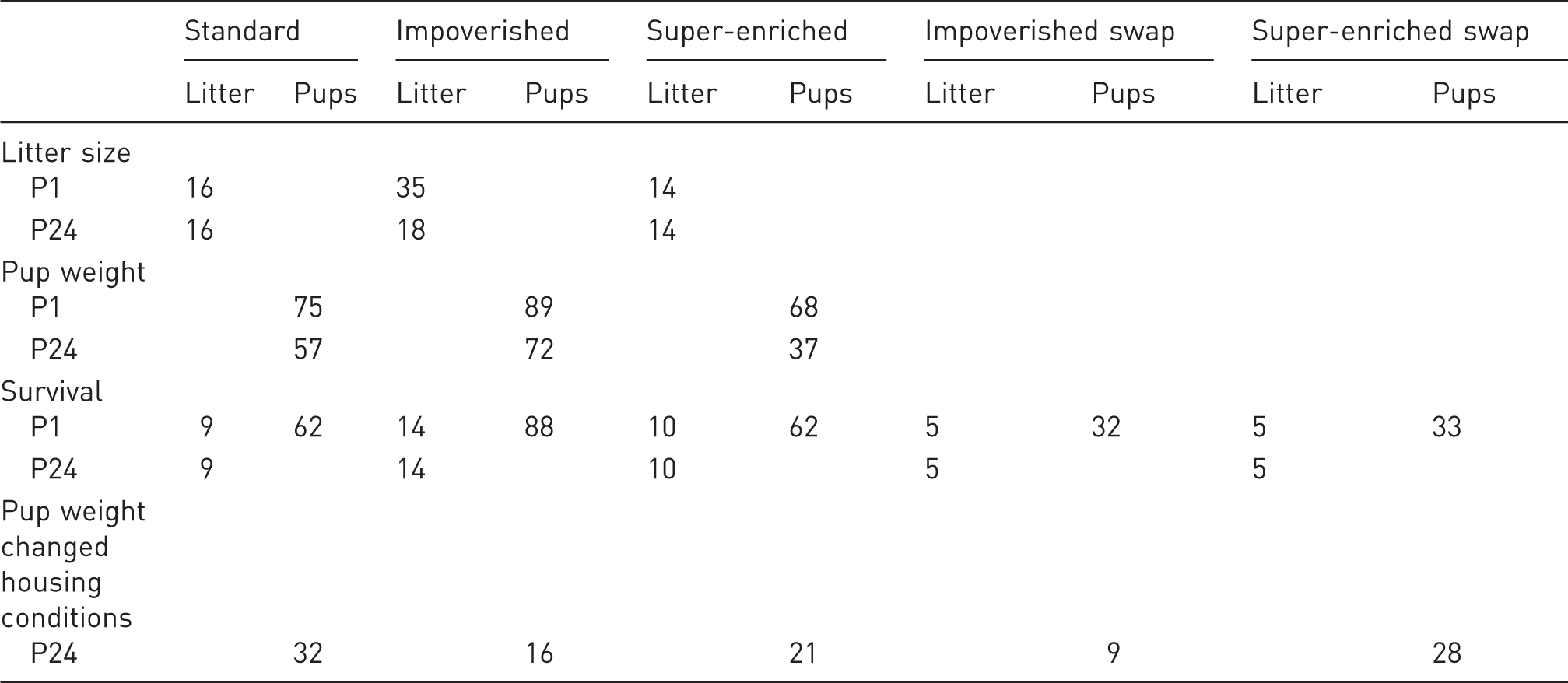
Overview of pups/litters per group.
Litter size
The living neonates were counted at P1 and P24 (at weaning). On P1, the pups of 16 litters in standard conditions, 35 litters in impoverished conditions and 14 litters in super-enriched conditions were counted (experimental unit = litter). On P24, the same 16 litters in standard and the same 14 litters in super-enriched conditions were evaluated. Due to other experimental purposes, only 18 litters of the initial 35 litters in impoverished conditions were analysed on P24.
The litters were also evaluated for entire litter loss versus single pup loss. In order to confirm the death of a pup, they were inspected for the absence of rose skin colour, movement and wounds, as these are indicators of vitality. 8
Pup weight
On P1, 75 pups born in standard conditions, 89 born in impoverished conditions and 68 born in super-enriched conditions were weighed.
On P24, 57 pups born in standard conditions, 72 pups born in impoverished conditions and 37 pups born in super-enriched conditions were weighed. The lower numbers of weighed animals on P24 were due to some losses of pups before P24 and the usage of animals for other experiments (randomly selected).
For the analysis of the effect of changed housing conditions, the pups were weighed on P24 (standard: n = 32; impoverished: n = 16; super-enriched: n = 21; impoverished swap: n = 9; super-enriched swap: n = 28).
Survival
In order to record survival rates, pups from 9 litters born in standard conditions, 14 litters born in impoverished conditions, 10 litters born in super-enriched conditions, 5 litters born in impoverished conditions that were changed to standard on P1 and 5 litters born in super-enriched conditions that were changed to standard on P1 were counted on a daily basis during the first week and upon weaning. The investigation started on P1 with 63 pups born in standard conditions, 90 pups born in impoverished conditions, 63 pups born in super-enriched conditions, 32 pups born in impoverished conditions that were changed to standard on P1 (impoverished swap), and 33 pups born in super-enriched conditions that were changed to standard on P1 (super-enriched swap).
Statistical analysis
Results are expressed as mean ± S.E.M. All data were analysed using GraphPad Prism 6 for Mac OS X. All data were not normally distributed (D'Agostino & Pearson omnibus normality test); therefore, they were analysed using the Kruskal-Wallis test. Subsequently the data were analysed with Dunn's multiple comparison test. For comparison of the survival curves, the log-rank test was used. Probabilities of p < 0.05 were considered significant.
Results
Litter size on P1 and P24 in three different housing conditions
The pups born in three differently enriched cages (16 litters in standard, 14 litters in super-enriched and 35 litters in impoverished cages) were first counted on the day after birth (P1). The litter size of the mice born in the different environments (Figure 1(a)) was not significantly different (Kruskal–Wallis with subsequent Dunn's multiple comparison test, standard vs. impoverished: p > 0.9999, standard vs. super-enriched p = 0.8993). The mean litter size in the standard group was 6.3 ± 1.3 pups, in the impoverished group was 5.8 ± 2.6 pups and in the super-enriched group was 5.2 ± 2.5 pups.
Litter size and pup loss. Mice were housed and gave birth in three different cage environments (standard, impoverished, super-enriched). The pups were counted on (a) P1 (standard n = 16, impoverished n = 35, super-enriched n = 14) and (b) P24 (standard n = 16, impoverished n = 18, super-enriched n = 14). The litter sizes recorded at P1 and P24 are shown as mean ± S.E.M. (c) The proportion of litters that were lost completely in relation to litters where only single or none of the pups died.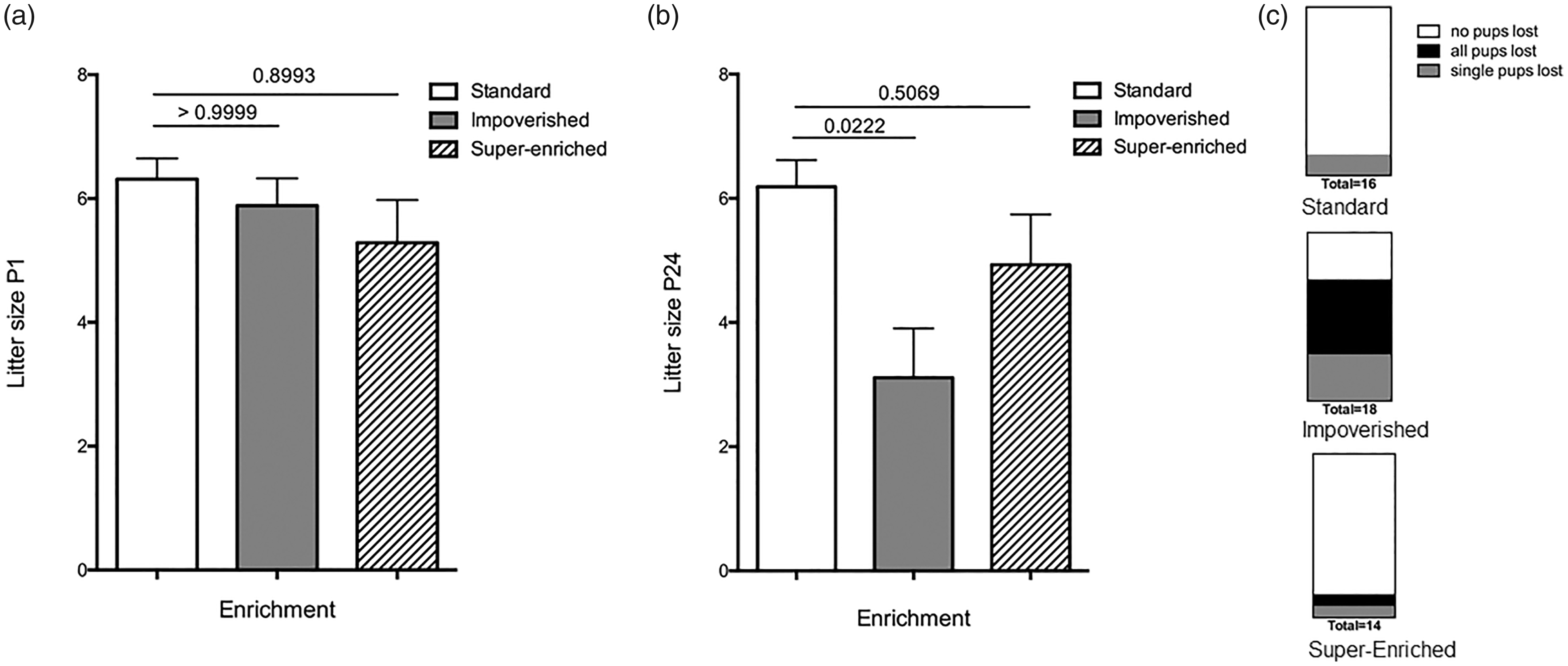
On P24 (at weaning), the picture had changed (Figure 1(b)). The mean litter size of the impoverished group on P24 was 3.1 ± 3.3, which was significantly reduced compared with the mean litter size of the group in the standard housing condition (16 litters standard, 14 litters in super-enriched and 18 litters in impoverished cages; Kruskal–Wallis with subsequent Dunn's multiple comparison test, p = 0.0222, 6.1 ± 1.7). In the super-enriched environment, the mean litter size was slightly, but not significantly, reduced to 4.9 ± 3.0 (Kruskal–Wallis with subsequent Dunn's multiple comparison test, p = 0.5069).
A closer look revealed that in the standard environment, only single pups died whereas in the super-enriched environment a number of whole litters died also. In the impoverished environment, in most of the cases, the whole litter died, but single pups died in only a small number of cases (Figure 1(c)).
Pup weight and development
In contrast to the litter size, the mean pup weight of the impoverished group was already significantly reduced on P1 compared with pups born in the standard environment (impoverished: 1.5 ± 0.27 g, 89 pups; standard: 1.6 ± 0.29 g, 75 pups; super-enriched: 1.7 ± 0.25 g, 68 pups; Kruskal-Wallis with subsequent Dunn's multiple comparison test, p = 0.0033, Figure 2(a)). Visual examinations of the offspring confirmed very small neonates in the impoverished group on P1 (Figure 2(c)). Furthermore, the development of the pups in the impoverished environment was delayed, as they were still hairless on P7 (Figure 2(d)).
Pup weight and development. Mice were housed and gave birth in three different cage environments (standard, impoverished, super-enriched). The pups were weighed on (a) P1 (standard n = 75, impoverished n = 89, super-enriched n = 68) and (b) P24 (standard n = 57, impoverished n = 72, super-enriched n = 37). The weights are shown as mean ± S.E.M. (c) Visual examinations showed the reduced size of the impoverished pups (P1). (d) Impoverished pups remained hairless on P7.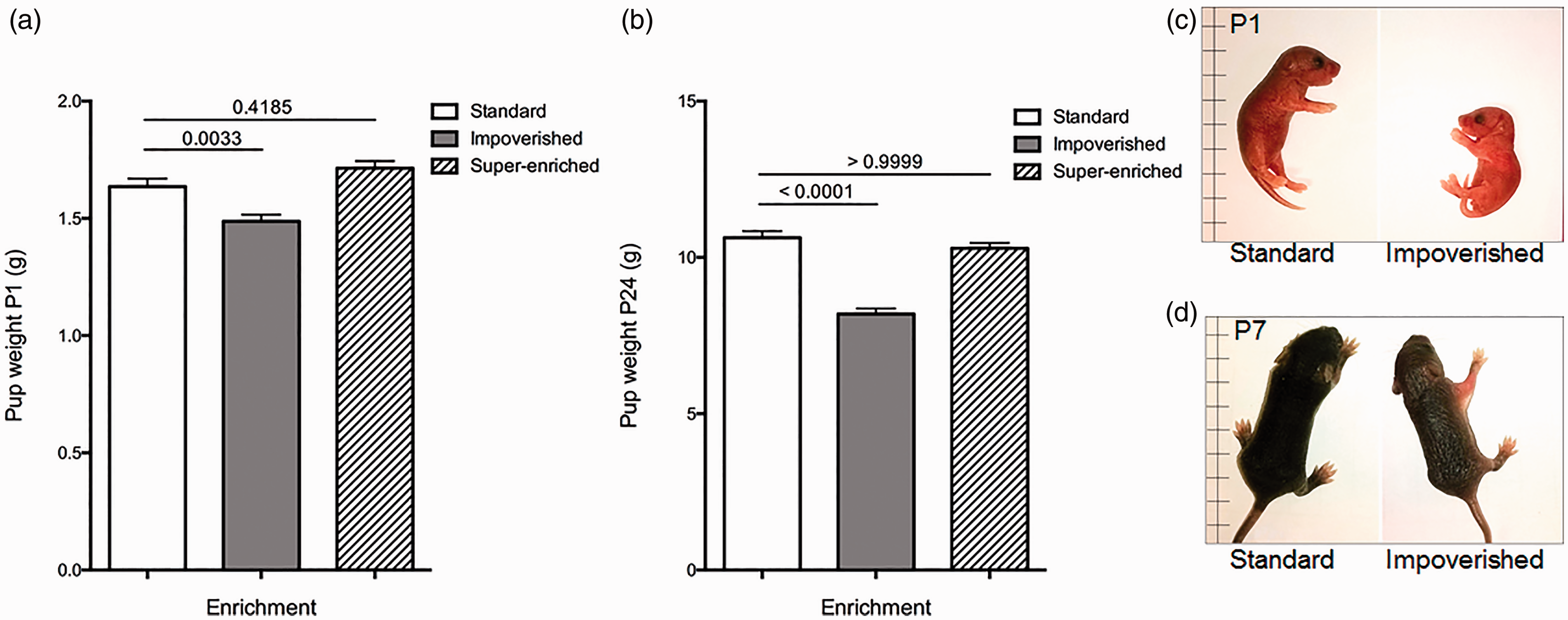
On P24 (at weaning), the reduced weight of the impoverished group is even more striking (Figure 2(b); 57 pups standard, 72 pups impoverished, 37 pups super-enriched, Kruskal-Wallis with subsequent Dunn's multiple comparison test, p < 0.0001). The mean weight of the weanlings of the impoverished group was only 8.1 ± 1.4 g, compared with 10.6 ± 1.6 g in the standard group. The mean weights of the standard and the super-enriched groups, 10.2 ± 1.0 g, were not significantly different (Kruskal–Wallis with subsequent Dunn's multiple comparison test, p > 0.9999).
Survival
In the next step, we took a closer look at the chronological sequence of pups dying. For the first 7 days, we inspected the animals daily. We also counted the pups at weaning. Overall, we observed a high survival rate for the standard group (Figure 3, solid black line, 98% survival, P1 = 63 pups, P24 = 62 pups) and a slightly reduced survival of the super-enriched group (Figure 3, grey solid line, 88%, P1 = 63 pups, P24 = 55 pups). For the impoverished group, the survival rate was significantly reduced (Figure 3, solid red line, Log-rank test, p < 0.0001); only 43% of the born pups survived till P24 (P1 = 90, P24 = 37). In all groups, the highest rate of infant mortality was observed on P2 and P3 (Figure 3; Supplementary Table 1). From the impoverished group, one individual pup died between P8 and P24 (Figure 3, Supplementary Table 1). None of the pups in the others groups died later than P4.
Survival. The survival of mice in the different housing conditions was monitored daily during the critical phase between P1 and P7, and on P24 (standard: black solid line, n = 9; super-enriched: grey solid line, n = 10; impoverished: red solid line, n = 14). Two additional groups (pups of five dams each) underwent changes in their enrichment at P1 (from super-enriched and impoverished to standard, dashed grey and red lines).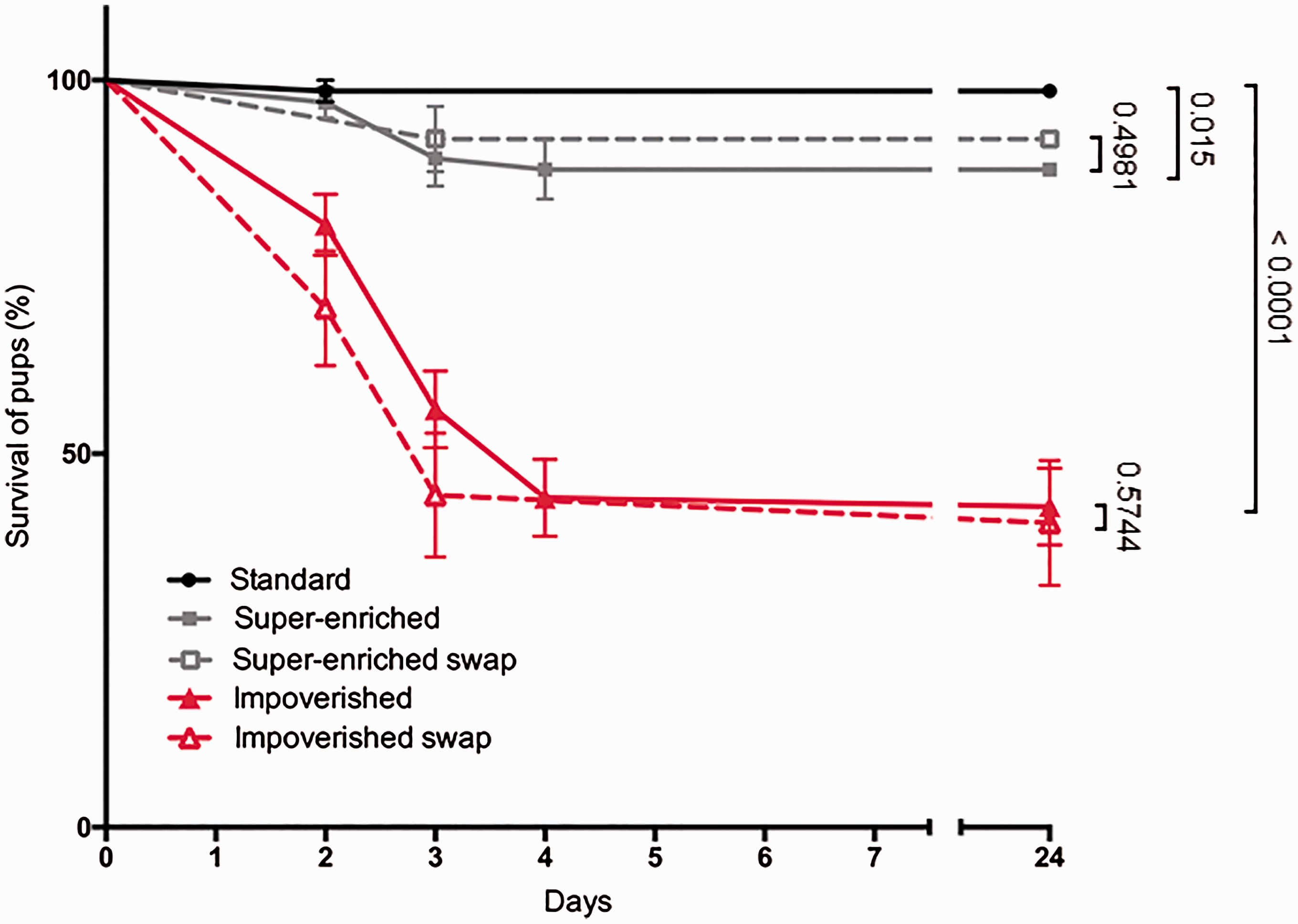
The effect of changed housing conditions
The swapping of housing conditions on P1 did not significantly change the survival rate compared with groups of the same condition that did not undergo a variation in environment (Figure 3, dashed lines, super-enriched swap group, P1 = 33, P24 = 30, 92%; impoverished swap group, P1 = 32, P24 = 11, 40%, Log-rank test: impoverished vs. impoverished swap, p = 0.5744, super-enriched vs. super-enriched swap, p = 0.4981). Further, the time of mortality looked very similar. Here again, the majority of pups died before P4. After swapping the environment from impoverished to standard, a single pup died between P8 and P24.
In contrast, it became obvious that changing the enrichment from impoverished to standard led to a higher weight gain. These pups were able to close the gap in weight by the age of 3 weeks (Figure 4, standard: 10.4 ± 1.6 g, n = 32; impoverished swap: 10.57 ± 0.4 g, n = 9; Kruskal–Wallis test, Dunn's multiple comparison test, p > 0.9999). The weight of the impoverished group again was significantly reduced (Figure 4: 9.0 ± 1.4 g, n = 16; Kruskal–Wallis test, Dunn's multiple comparison test, p = 0.081). Changing from a super-enriched to standard environment did not seem to have an effect on the weight (Figure 4, super-enriched: 10.46 g ± 0.9 g, n = 21; super-enriched swap 9.9 ± 1.5 g, n = 28; Kruskal–Wallis test, Dunn's multiple comparison test, p > 0.9999).
Pup weight in relation to variation in housing conditions. Mice were housed and gave birth in three different cage environments (standard, impoverished, super-enriched). Two additional groups (pups of five dams each) underwent changes in their enrichment at P1 either from super-enriched or impoverished to standard (standard n = 32, impoverished n = 16, super-enriched n = 21, impoverished swap n = 9, super-enriched swap n = 28). The weights on P24 are shown as mean ± S.E.M.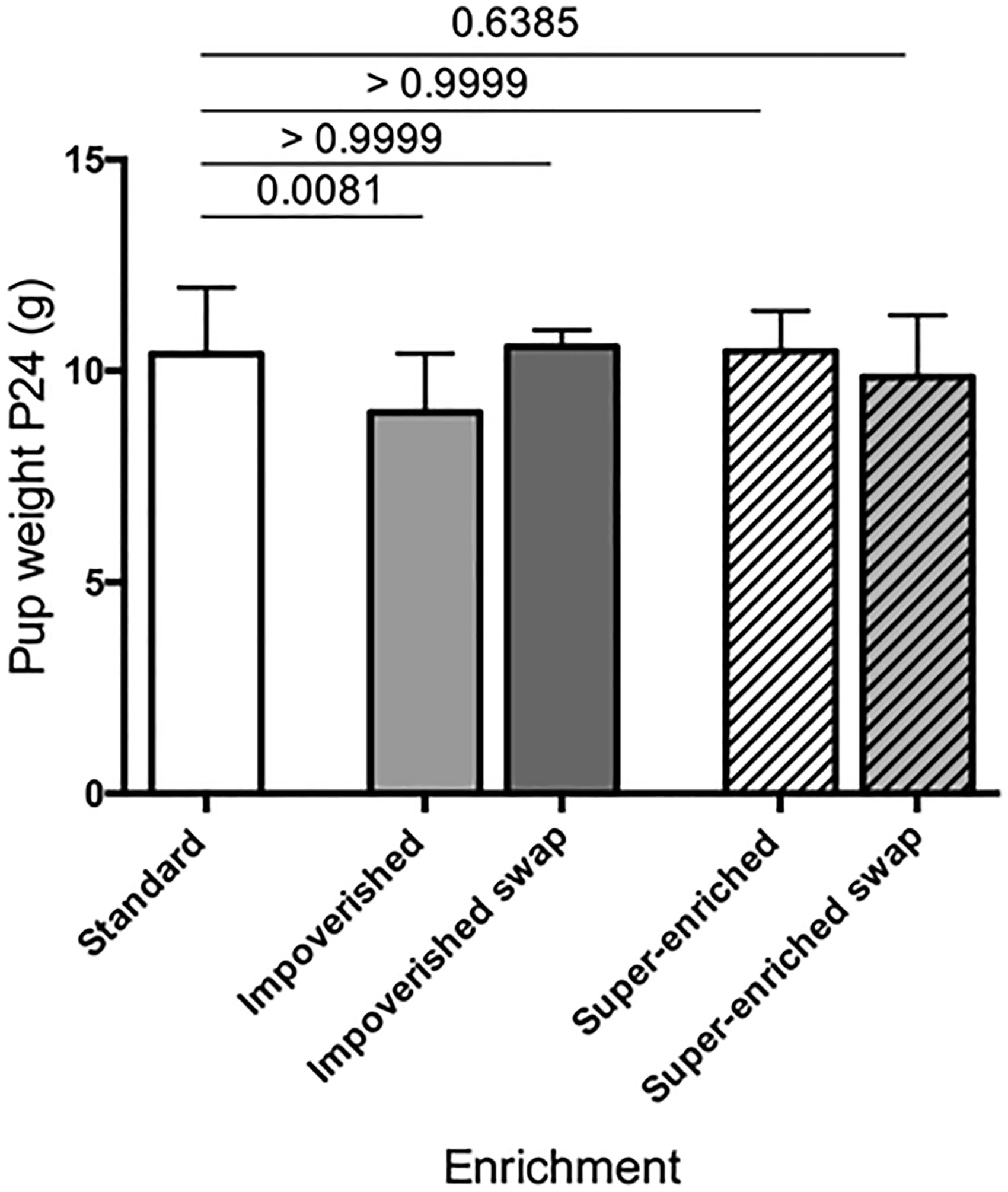
Discussion
Animal experiments still play an invaluable role for progress in biomedical research. The vast majority of the mammals used for experiments are mice. Successful breeding plays a crucial role in providing the millions of mice required for research every year. As lack of breeding success might also indicate poor well-being, particular attention should be paid to breeding efficiency. In order to perform experiments that include the impact of early life experience on the future well-being of animals used for experiments, we bred mice in different housing environments. Striking differences were noticed even before weaning, which led us to a closer investigation.
The mean litter size at birth matched the litter sizes reported in the technical sheet of C57BL/6JRj from our commercial supplier (Janvier Labs) in bigamous mating (Figure 1(a)), with no significant difference related to whether the mice were housed in standard, impoverished or super-enriched environments. 5 In both environmentally enriched groups (standard and super-enriched), the supplier's declared weaning rate of 80% on the technical sheet was clearly exceeded (Figures 1(b) and 3) 5 , and the weaning rates were also notably higher than other published weaning rates ranging from 71.1% to 81.1%,6,30 indicating a good general breeding performance. In this study, we solely investigated primiparous dams, which are believed to exhibit higher pup mortality rates.9,10 Our data do not seem to support a high pup mortality rate for primiparous dams in enriched environments compared to our standard and super-enriched environments. Furthermore, our counting and weighing procedures and also the transportation on gestational day 14 did not seem to have a detectable influence. On the other hand, our data revealed pup loss in the impoverished environment, as the weaning rate was notably reduced. Mice housed in impoverished cages lost about half of their pups (Figures 1 and 3). These results seem to be consistent with other research reporting a correlation of impoverished housing conditions with limited weaning rates or even total failure in breeding.6,31 Due to the fact that the litter loss occurs during the first days of the perinatal period (Figure 3), it can be easily overlooked by the still common practice of first counting the pups at weaning.9,10 As reduced breeding efficiency might indicate reduced well-being and consequently some degree of suffering may be involved, early death of pups should not be underestimated as a critical welfare issue.6,11–13
From the beginning, the pups in the impoverished environment were lighter than those in the standard and super-enriched environments. Therefore, changing the environment on gestational day 14 to impoverished has a considerable impact on the newborn offspring. Consistent with other research, surviving pups in the impoverished environment were still significantly reduced in weight on P24 compared with the mice in the standard and super-enriched environments. 6 It also seemed that they generally had delayed development, as they remained hairless on P7. Because of the possible impact on the results, one should keep this in mind when obtaining pregnant mice for research.
Nest-building material seems to be particularly important for the dam and the offspring.17,32,33 Newborn pups do not have the ability to thermoregulate and therefore depend on the warmth of the parents and their siblings, which is retained by the nesting material, for their survival. 33 Without nesting material, additional energy from the dam is needed to keep the pups warm. 34 This aggravates the resource-consuming phase of lactation and might therefore be in some part responsible for the observed pup loss, as well as reduced weight at birth and at weaning. 35 Missing nest-building material can also lead to increased stress levels, which negatively influence the pup survival, as there is a correlation between stress and reduced reproduction in laboratory mice.30,36,37 Generally, gestation stress can lead to altered maternal behaviour. 38 As the newborn, altricial and poikilothermic mice, depend strongly on the maternal abilities of the dam, this could also give a reasonable explanation for the enhanced mortality in the first 4 days.14,39 In this context, one should also keep in mind that, independent of the underlying reason, stress can lead to alterations in the phenotype of the offspring. 15 Compared with the observed delayed development, this might alter research results. Therefore, it is essential that every researcher is aware of the breeding conditions when buying or breeding animals for research.
Adding enrichment on P1 was not able to improve the survival rate of pups taken from an impoverished environment, but the pups closed the gap in weight on P24. It may have taken some time before the mother recovered from the stress, but it might also be possible that the pups were already too weak to survive. This point is difficult to address because the majority of the deaths occurred very early.
In a number of cases, the dams lost individual pups (Figure 1(c)), which could lead to the assumption that the remaining pups should have increased access to maternal resources, which in general seems to lead to a higher weight. Moreover, one would assume that those pups dying are the weakest ones and therefore also probably the lightest ones. Both these observations would lead to higher average weights. Instead, when observing pups in the impoverished environment, the difference in weight on P24 became even more evident (Figure 2(b)).
Higher amounts of nest-building material and enrichment did not change the weaning rate or pup weights, which were comparable to those pups living in the standard conditions throughout the monitored period. Then again, our super-enriched condition was the one with the highest disturbance of the dams. Enrichment objects had to be removed to properly count and inspect the offspring. In some cases, the nest built in a mouse house had to be disturbed. Such stressors might have a negative effect on the breeding performance. 11 Further, this turned out to be a time-consuming procedure. On the other hand, the disturbance caused by the inspections and also by changing the enrichment on P1 from super-enriched to standard did not seem to have a negative impact on the breeding performance. In our opinion, the critical factor is the availability of enrichment (nest-building material and mouse house). As the mice did not seem to further benefit from the addition of very large amounts of enrichment (super-enriched), we would recommend enrichment, which enables counting and regular checking of the offspring without too much disturbance, not least because early counting turned out to be an appropriate tool to efficiently detect welfare issues, which enables suitable countermeasures to be taken.
Conclusion
The findings presented here underpin the importance of animal welfare in carefully selecting breeding conditions and regular, close observations as a refinement strategy in the perinatal period. Without early counting, in particular, initial welfare-problems like preweaning mortality might be generally overlooked. In addition, the use of enrichment in studies should be looked at very carefully, as it seems to have a major impact, not only on the mortality of the pups but also on their development, and might skew the results.
Supplemental Material
Supplemental material for Environmental enrichment prevents pup mortality in laboratory mice
Supplemental material for Environmental enrichment prevents pup mortality in laboratory mice by Charlotte S Leidinger, Christa Thöne-Reineke, Nadine Baumgart and Jan Baumgart in Laboratory Animals
Footnotes
Acknowledgements
The authors are most grateful to Vanessa Schoon for her technical support.
Declaration of Conflicting Interests
The author(s) declared no potential conflicts of interest with respect to the research, authorship, and/or publication of this article.
Funding
The author(s) disclosed receipt of the following financial support for the research, authorship, and/or publication of this article: this work was supported by the Translational Animal Research Centre of the University Medical Centre of the Johannes Gutenberg-University Mainz.
References
Supplementary Material
Please find the following supplemental material available below.
For Open Access articles published under a Creative Commons License, all supplemental material carries the same license as the article it is associated with.
For non-Open Access articles published, all supplemental material carries a non-exclusive license, and permission requests for re-use of supplemental material or any part of supplemental material shall be sent directly to the copyright owner as specified in the copyright notice associated with the article.
