




Abstract
The slinging of sheep is a commonly reported, yet poorly described procedure, which is useful for the advancement of veterinary and medical preclinical research. We have described a novel, flexible and repeatable method of suspending sheep to varying degrees while not affecting mobility and thereby improving animal husbandry and welfare.
Keywords
The use of sheep in a research environment encompasses many disciplines, from physiological to cardiovascular and orthopaedic; in many of these published studies sheep were required to be held in slings for a nominated period of time during the study.1–3 While reviewing the use of slings for sheep in all the research articles identified, details of the slinging apparatus have not been clearly elucidated in the methods, thus not allowing replication of the studies, validation of the methods or assessments made regarding the husbandry practices while the sheep are in the sling. Most have mentioned that ‘These slings allowed the animals to fully load the limbs but prevented them from sitting’. This implies a support under the animal which limits its ability to sit in sternal recumbency and rest.
Only one manuscript has included a photograph, thereby providing a guide to the mechanics of the sling used. 4
Human orthopaedic research has benefited from the use of preclinical large animal surgical models such as sheep. Size, weight and anatomical similarities of sheep to human bones and tendons provide effective comparative models for many surgical procedures. 5 Sheep can almost be considered to be obligate quadrupeds. While they can ambulate over small distances on three legs, they will always try to weight-bear to some degree on the fourth injured or operated leg; this limits direct postoperative comparison to humans if a period of postoperative partial or full non-weight bearing is required.
The purpose of an animal sling is to support its body weight while not causing any detrimental effects to the animal’s health and physiology. Importantly the animal needs to be able to eat, drink, urinate and defaecate, and to not develop any complications such as myopathies or pressure sores. While there are many ways to sling a sheep, all reported methods report immobilizing the sheep in a fixed frame thus not allowing them to sit or walk around. The percentage of body weight supported by the sling is also fixed at all or nothing. This study describes a new method where the sheep remains mobile, where it can sit or stand, and where the percentage body weight supported can be adjusted as required while remaining constant throughout the slinging period irrespective of the animal’s position. This provides a more practical and flexible method of postoperative ambulatory support which may be of benefit not only for the welfare of the animal, but for practicalities and flexibility of the study as well.
Our sling was designed to allow free movement of the sheep while in its harness and to not interfere with urination or defaecation in both males and females. The sling was manufactured from heavy duty 16 oz canvas.
As shown in Figure 1, size adjustment was incorporated by the inclusion of Velcro tabs at the sides. Two loops were fashioned into the harness to allow the threading of metal poles to provide rigidity and anchor points for the suspension of the sling. The rest of the setup was provided by ropes and knots.
Sling showing a simple design (with dimensions and options), and as fitted.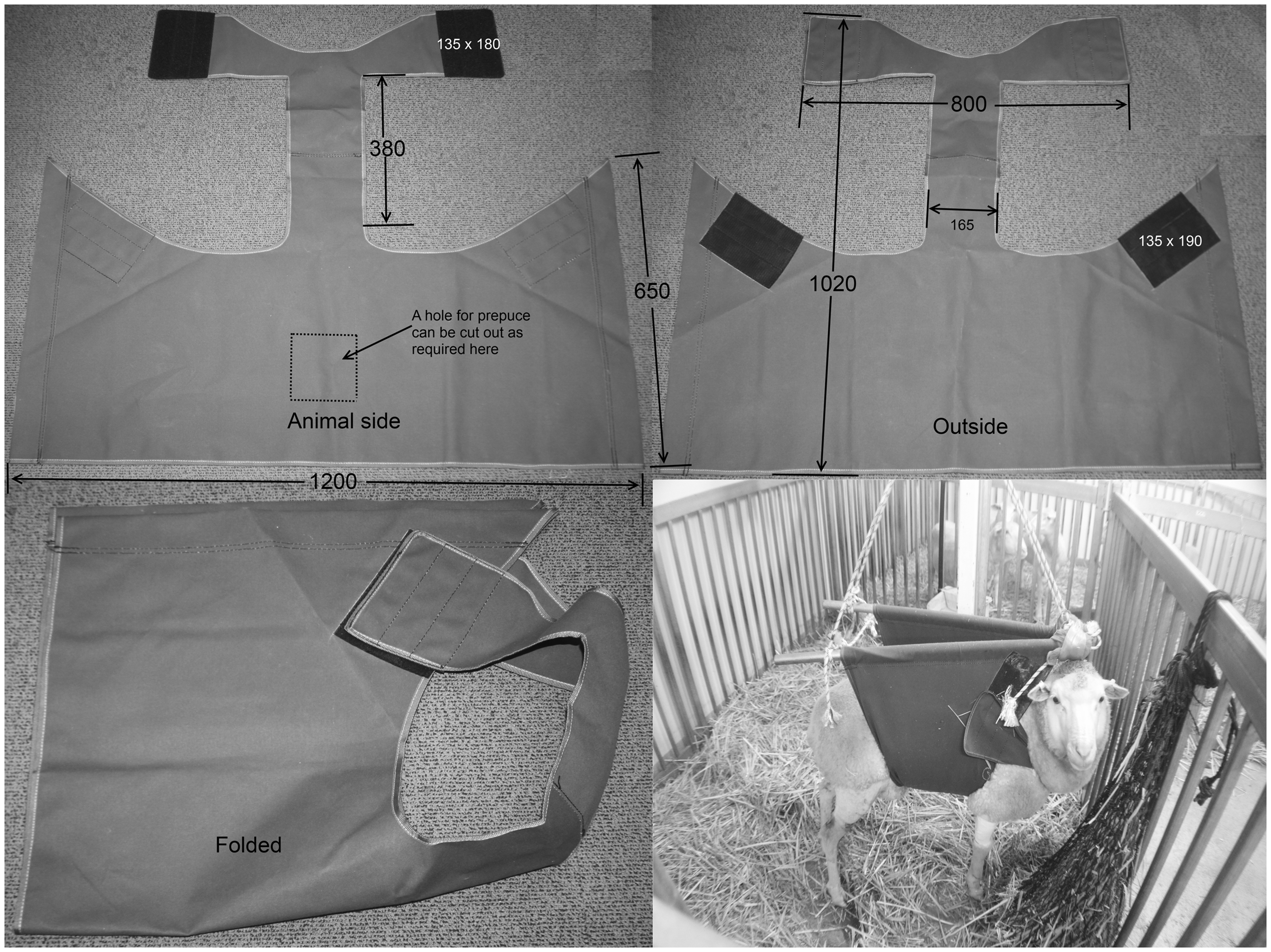
A frame is usually built around the sheep to support its weight, however to allow for freedom of movement the fixation system must originate from over the animal. Our system consisted of a pivoting hook fixed above the sheep that was free to rotate 360°. Attaching the sling and the animal to this overhead point would generally involve an adjustable pulley system to set the desired height for the sheep, enabling it to stand (some degree of weight bearing) or relax (no weight bearing) with its legs dangling below the sling. The difference in our mobile adjustable animal sling is a spring balancer (SB). An SB is an industrial device used to counteract the weight of heavy machinery by partially supporting the load. An SB consists of a coil spring inside housing to which a length of cable is attached. Pulling the cable leads to opposing resistance from the coil spring. SBs come in various sizes capable of supporting a range of weights between an upper and lower limit with an infinitely adjustable screw, allowing for any selected weight within the given range. The size used for our setup had a weight range of 25–35 kg (Kromer; Pacific Hoists, Sydney, Australia). Our aim was to support 50% of the animal’s body weight (that is 50–70 kg in animal live weight).
An SB produces a constant resistance while allowing a free range of movement of up to 2.5 m (the extended length of the cable in the SB), thus the sheep can sit, stand and walk while a constant controlled and manually adjustable lifting pressure is applied to assist in weight bearing. To achieve the desired percentage of weight support, the sheep was placed it its sling and a set of scales was placed under the sheep. The SB was then adjusted so that the target percentage body weight support was met.
Following ethical approval from the University of New South Wales animal ethics committee, this system was used on four Merino X wethers in our research facility in an orthopaedic model investigating the effects of reduced load bearing for a seven-day postoperative period following an orthopaedic procedure. The hypothesis being that a delay in postoperative weight bearing would improve bone implant integration due to the lack of any immediate postoperative bone implant micromovement. The SB was set up such that 50% of the sheep’s body weight was supported and this was distributed evenly on its front and back legs. The sheep were acclimatized to the sling and the SB over a period of one week prior to surgery (see http://lan.sagepub.com for supplementary information on an example of an acclimatization record of two sheep). Following surgery the sheep were placed in their slings while still recovering from the anaesthetic, and they were allowed to remain in lateral recumbency. Postoperative analgesia consisted of transdermal fentanyl patches (Durogesic; Janssen, Macquarie Park, NSW, Australia) at 2 ug/kg/h.
6
The weight of the recumbent sheep kept the SB cable extended. The sheep were monitored and assisted into sternal recumbency as they recovered from the anaesthesia. The sheep were then allowed to stand in their own time; the sling cabling being held in constant tension by the SB whose construction ensured a constant pressure/force on the animal irrespective of its position. The following morning, the sheep were eating and drinking and were mobile with no signs of distress (Figure 2).
Two sheep suspended in their slings showing the complete harness and spring balancer setup. The tape on the animal’s foreleg is where the fentanyl patch is applied.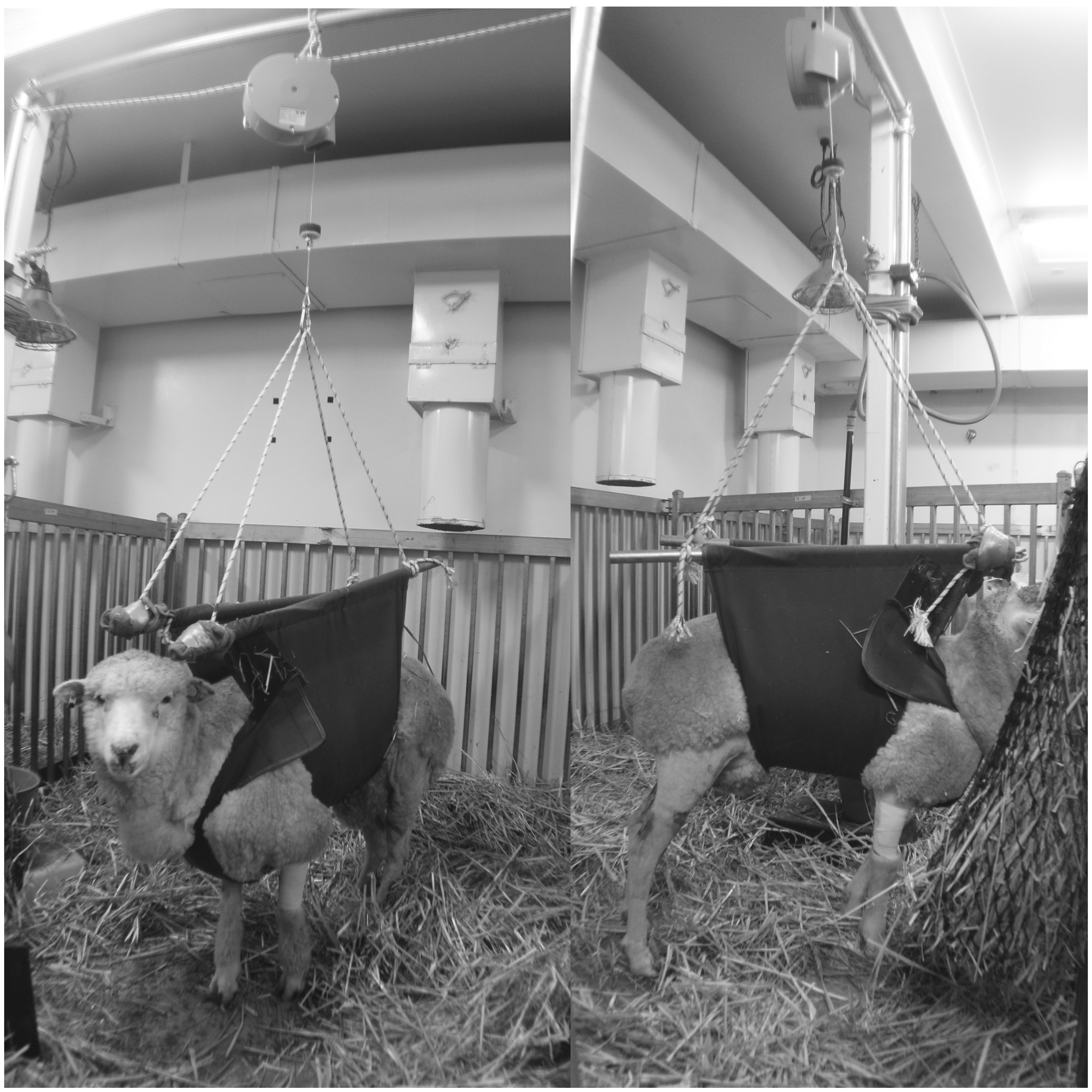
The sheep remained in their slings and were monitored daily for appetite, mobility, demeanour and signs of pressure sores during the seven-day postoperative period. Their appetite was observed to be normal, and they were noted to ease themselves down and ruminate in sternal recumbency without any signs of distress or discomfort. Minor skin irritation was observed on the skin fold at the flank in one sheep where the abdominal skin meets the stifle. This was ameliorated by adding dense foam padding to the caudal edge of the sling (this padding was added for all other sheep to prevent any further issues). Once the seven-day observation period ended, the slings were removed and the sheep continued unaffected by their previous seven days in a sling.
The use of slings in large animal orthopaedic surgery is a commonly used procedure. However while their use has been reported on many occasions, a detailed description of the design and functionality has been absent; and very little detail is provided in the manuscript regarding the sling or the animal welfare implications of this enforced immobility. We have presented a simple, flexible and effective slinging apparatus which can be infinitely adjusted to suit the relevant study usage. Minor adjustments can be made to the shape and size of the canvas harness to accommodate various sized sheep, as well as male or female sheep. A more consistent slinging protocol across research laboratories and within study groups would assist not only direct comparison of different studies, but would also improve animal welfare.
Footnotes
Acknowledgements
The authors would like to thank John Rawlinson and Greg Mitchell for their assistance in all the husbandry and animal handling procedures.
Declaration of Conflicting Interests
The author(s) declared no potential conflicts of interest with respect to the research, authorship, and/or publication of this article.
Funding
The author(s) received no financial support for the research, authorship, and/or publication of this article.
References
Supplementary Material
Please find the following supplemental material available below.
For Open Access articles published under a Creative Commons License, all supplemental material carries the same license as the article it is associated with.
For non-Open Access articles published, all supplemental material carries a non-exclusive license, and permission requests for re-use of supplemental material or any part of supplemental material shall be sent directly to the copyright owner as specified in the copyright notice associated with the article.
