




Abstract
Owners value heritage goods, items that connect them to a shared past, whether through their alma mater or their family history. This research considers the impact of heritage on owners who wish to sell such goods. In five studies, the authors demonstrate that sellers have a lower willingness to accept when selling heritage goods to buyers with a shared heritage connection relative to buyers without this connection (i.e., a heritage discount). This heritage discount cannot be explained by ingroup favoritism, sentimental value, or appropriateness of buyer usage and persists even when sellers perceive that the buyer has a higher willingness to pay. The authors provide process evidence that the effect of the buyer's identity on the seller's willingness to accept is driven by concerns about heritage loss. The findings contribute to literatures on sharing, sentimental goods, psychological ownership, and the endowment effect and have marketing implications for consumer goods (e.g., collectibles) that derive product value by connecting consumers to meaningful history and traditions.
Heritage—a connection to a shared past—can strengthen identity, provide stability, create meaning across time, and increase positive affect (Baumeister 1991; Baumeister et al. 2013; Friedman 1992; Wildschut et al. 2006). Analysis of world heritage sites shows that a heritage designation increases investment at local and national levels, builds civic pride, increases social capital, develops sustainable tourism, provides promotional advantage (PwC 2007), generates substantial economic benefits (Kayahan and Vanblarcom 2012), and is a valuable marketing tool (Caust and Vecco 2017). Airbnb has launched heritage travel, an opportunity for hosts to share their homes with travelers seeking their genetic roots. In an 8,000-person survey, 57% of Americans said they would give up alcohol for a year to enjoy one heritage trip (Killiam 2019). Closer to home, the heritage goods consumers own and access—objects that connect their owners to history and traditions—offer clear well-being benefits (Fujiwara, Kudrna, and Dolan 2014; Sarial-Abi et al. 2017).
This project examines the impact of heritage, and especially a shared past, on how consumers value the goods they own when thinking about selling them to others. We offer two main sets of findings. First, our work demonstrates that there is value in goods that connect us to the shared or archetypal past. We find that a good's connection to that past can increase sellers’ valuation of a good in the present. Crucially, while sentimental goods connect a seller to a personal memory (Sedikides et al. 2008; Yang and Galak 2015), heritage connects the owner to a shared history and to the people who came before. This leads to a critical distinction. Heritage connection can be shared between buyers and sellers, and this shared heritage connection can exist with or without the benefit of personal memory.
Second, our work contributes to the literature on endowment and psychological ownership, which states that consumers place a higher value on the goods they own than on the goods they do not own (Thaler 1980). We find that while a good gains value through association with an individual owner, it also gains value through its connection to a collective past. But, surprisingly, sellers’ high personal valuations of heritage goods do not always result in a higher willingness to accept (WTA); we show that a seller's WTA for buyers who connect to a good's heritage is lower than the WTA for nonconnected control buyers, even when sellers perceive that connected heritage buyers have higher valuations and a higher willingness to pay (WTP).
In the next section, we start by defining heritage connection, and then relate how the current work on heritage connection builds on previous findings in the literature on psychological ownership, the literature on sharing, and the literature on sentimental goods. We then report results from an experiment that examines how shared heritage connection between buyers and sellers drives product value in market transactions. We provide process evidence in three additional studies and validate our results in a final study on Facebook Marketplace. This research, to the best of our knowledge, is the first to quantify the value of measuring connection to the shared past as a source of product value in market transactions between buyers and sellers.
Defining Heritage Connection and Heritage Loss
To begin to understand the role of heritage goods in consumers’ lives, we simply asked them. To do this, we conducted a pilot study with CloudResearch-approved participants (N = 235) on Amazon Mechanical Turk (MTurk) and told them: “We would like to know how you think about heritage goods. Think of a heritage good that you own, and then describe the good you’re thinking about.” A common theme across responses was a connection to the past, to history, and to the people who came before (“music equipment linked to the history of my community”; “a ticket from the opening of Dodger Stadium”; “my great grandfather's watch that he bought when he worked in the PA coal mines”; “a handmade chair carved and assembled by a workman in the 1930s”). Although many participants had inherited their goods (66.4%), some had received them as gifts (20.7%), and others had purchased goods (12.8%) to connect them to a valued past.
We consider a heritage good to be a good that is connected, whether symbolically, historically, or otherwise, to the shared past of a meaningful group identity for the buyer or seller. Heritage goods provide value for consumers by connecting them to the past and to people who lived long ago in a “suppression of time” (Baudrillard 1968). This symbolic link to a collective past generates a good's heritage connection for buyers and sellers. Specifically, we define heritage connection as a good's capacity to bridge the gap between a seller or buyer and the people they care about by helping them remember where they come from, associating them with family or community traditions that matter, giving them a sense of history, and connecting them with the people who came before them. Our research suggests that a good gains value not simply through its connection to an individual owner but also through its symbolic connection to a larger, shared history.
One implication of this shared history is that when a seller who has a high heritage connection trades with a buyer who has a high heritage connection to the same shared past, the seller perceives less of a loss in connection to the good's shared heritage than when trading with a less connected buyer. To account for this, we define and calculate the heritage loss due to trade as the seller's heritage connection minus the seller's perception of the buyer's heritage connection. We interpret this heritage loss as a transaction disutility that a seller may incur in the sale of a heritage good.
Having introduced the concepts of heritage connection and heritage loss, we proceed with our theoretical development. Overall, the present research extends previous research by hypothesizing and providing empirical support for a theory of heritage connection and heritage loss that predicts how products hold or lose value through their association with the shared past.
Theoretical Development
In what follows, we develop our theory by describing our hypotheses for the main effect of the buyer's connection to the past on the seller's WTA, moderation of WTA by the size of the seller's heritage connection, and mediation by heritage loss (from sale to a buyer disconnected from the good's heritage). A premise of this research is that heritage—a connection to a shared past and traditions that matter—is a source of product value for owners. Heritage adds value to a good by serving as a conduit that connects the seller to a shared past and traditions. However, the effects of heritage on a seller’s WTA can operate in a way that is inconsistent with strategic pricing and standard economic theory. Specifically, we predict that a seller with high heritage connection to a good will demand less from a buyer who also shares the seller's high heritage connection (and thus the seller's higher utility and valuation for the item) than from a buyer without such connection. This is surprising since it is often assumed in market transactions that a buyer's higher utility for a good should increase the seller's WTA.
Imagine, for example, an individual who owns a teacup from a small town that connects to their family's history many generations ago. To the owner, the teacup holds high value, and the owner would require a high reimbursement to give it up. When approached by a stranger to sell the item, the owner's WTA will be quite high. If that stranger is also a collector of old teacups, for whom the utility of this teacup is high as a potential part of a larger collection, then a rational seller may decide to raise the WTA even further. However, if the stranger is connected to the same small town and wants a good that maintains that connection to those who came before, the owner may paradoxically offer a lower WTA even though this buyer's WTP might be quite high. In other words, we suggest that—contrary to what economists might expect—when sellers value a heritage good more, they set lower prices for heritage buyers. Thus, we formally predict:
Why do we predict that a seller will reduce their WTA when selling to a buyer with a shared heritage connection despite this buyer’s perceived high valuation and utility for the heritage good? First, while previous research finds that sellers of emotionally laden items have high valuations for their goods (Yang and Galak 2015), these high valuations do not always result in higher selling prices. Sellers of emotionally laden items have a lower WTA for buyers whose future usage of a good they deem appropriate (Brough and Isaac 2012). This stream of research suggests that heritage buyers might, by demonstrating their acceptable usage plans, benefit from a reduced price for heritage goods. However, we note that this prior work assumes knowledge about the buyer's usage. While differences in usage can affect WTA, we argue that shared connection to a collective past—with or without differences in appropriateness of usage—is sufficient to generate a discount in market transactions between buyers and sellers. Thus, we expect that H1 will hold even after controlling for the buyer's intended usage.
Second, the literature on psychological ownership has found that extending ownership beyond simple legal ownership of the object onto a memento or reminder of the object (e.g., by taking a photo of the good) may increase the seller's willingness to dispose of goods they care about (Chu 2018; Chu and Shu 2022; Kellett and Holden 2014; Winterich, Reczek, and Irwin 2017). Since heritage goods connect individuals to a shared past, their psychological ownership is, at least in part, collective (Belk 2010, 2017; Curasi, Price, and Arnould 2004; Epp and Price 2008; Lastovicka and Fernandez 2005; McCracken 1986). Due to the collective nature of this shared past, when heritage goods pass from one member of this group to another, the former owner will no longer call the heritage good “mine,” but they might still call the good “ours” (Lastovicka and Fernandez 2005). Collective psychological ownership can thus extend past the point of the seller's legal ownership of the object, reducing feelings of loss when the good is physically surrendered.
As a result of these two forces, we expect a collective endowment for heritage goods that results in lower pricing for buyers who share a heritage connection and higher pricing for buyers with no such connection (H1). We test this hypothesis by explicitly measuring sellers’ WTA for heritage goods for both heritage and control buyers and measuring sellers’ perceptions of the heritage connection (the strength of the link to a collective past through a material good). Crucially, we expect H1 to hold after controlling for the buyers’ intended usage of the good.
In addition to predicting moderation by a seller's heritage connection, we also hypothesize a mechanism driving the reduction in sellers’ WTA for buyers who share a connection to the past: concern with heritage loss. Heritage loss is defined as the heritage connection of the seller minus the seller's perception of the heritage connection of the buyer. Similar to the effect of loss aversion on the sale of individually owned goods (Kahneman, Knetsch, and Thaler 1991; Knetsch and Sinden 1984; Thaler 1980), we hypothesize that larger feelings of heritage loss will reduce the value of the trade for the seller and thus increase the seller's WTA. In other words, we theorize that heritage loss is a transaction disutility that increases the seller’s WTA for a good that connect to a shared past. Formally, we predict:
An implication of these findings is that, by explicitly connecting to the seller's shared past, a prospective buyer can move from facing a heritage premium to a receiving a heritage discount. Crucially, this heritage discount stems from a connection to a collective past and not simply from a personal relationship between buyers and sellers. In the studies that follow, we empirically demonstrate that a seller's WTA depends on concerns about heritage loss when a good changes hands.
Taken together, these hypotheses generate our model of the value of heritage goods (see Figure 1). To produce our model of the value of heritage goods, we first measure the seller's heritage connection to a good. Second, we manipulate the buyer's perceived heritage connection to the same good by highlighting the buyer's ties to the good's shared past. We then measure the effect of these manipulations on the seller's perception of the buyer's heritage connection to the good, and we calculate the implied heritage loss when the heritage good transfers from seller to buyer. Finally, we measure the price the seller sets: the seller's WTA.

The Value of Heritage Goods for Sellers.
Overview of Experiments
In five main experiments that span laboratory and field contexts, plus several follow-up studies included in the Web Appendix, we provide research that explores how heritage connection drives consumer valuations. Throughout, we hypothesize that psychological connection to the past—to heritage—has value to consumers and that sellers of heritage goods will give a discount to buyers who will maintain this connection to the people who came before.
First, we tested our theory that increasing the buyer's perceived heritage connection to a good reduced the seller's asking price (H1) in an online marketplace scenario, while also testing for ingroup favoritism and sentimental value (Study 1). The effect of heritage held after controlling for psychological ownership, market value, and demographic variables. Next, in a study that controls for social proximity of buyer and seller, we replicated our main effect and began to examine the underlying process. We found a WTA–WTP asymmetry such that although sellers’ perceived that heritage buyers had a high WTP for their good, they were willing to accept a lower price (Study 2). Then, in Study 3, we provided further process evidence that the effect of the buyer's identity on the seller's WTA is driven by heritage loss (H2). To test this further, we ran an incentive-compatible study at a large northeastern U.S. university, in which we found evidence of the heritage discount using a real heritage good that participants chose to sell or keep, a discount that did not hold for a control good without a heritage connection (Study 4, replicated in three follow-up studies). We found that for heritage goods, sellers higher in heritage connection gave heritage buyers a discount, whereas sellers lower in heritage connection did not give heritage buyers a discount, providing evidence of moderation by the seller's heritage connection (H3). Finally, we tested the strength of our effect on Facebook Marketplace, where we made offers to sellers and found real-world support for the heritage discount (Study 5).
Overall, we provide strong evidence that heritage loss predicts the seller's WTA for goods that transmit meaning across time. These studies collectively contribute to a better understanding of how a shared past can affect market transactions in the present. Across all studies, predictions and sample size were preregistered on AsPredicted in advance of the experiments. For all studies, we report all preregistered measures, conditions, and data exclusions. Participant instructions, stimuli, ancillary analyses, all measures, and figures are included in the Web Appendix. Sample sizes and exclusions were preregistered in advance of data collection. For data and further study materials, please see https://osf.io/w7hz8/.
Study 1: Selling a Heritage Good
Our primary goal in Study 1 was to examine whether sellers of a hypothetical heritage good had a higher discount on WTA when selling to a heritage buyer than when selling to a control buyer, and whether this discount was also higher than the discount given to ingroup buyers and buyers with high sentimental attachment. We also tested to see if heritage loss predicted the difference in discount between heritage, ingroup, sentimental value, and control conditions.
Method
In Study 1, 501 CloudResearch-approved participants (Mage = 40.8 years; 52.9% male, 46.9% female, .2% nonbinary) completed a study on MTurk in exchange for payment. As preregistered, we did not include participants with inconsistent preferences (e.g., participants who would sell at a low price, but would not sell at a higher price). Our final sample was 475 participants, and buyer identity was manipulated between conditions (heritage, sentimental, ingroup, control).
Scenario
Since many families must dispose of estate items, we asked participants to imagine an estate sale scenario. We chose this scenario because it is relevant to consumers' lives and because estate sales are a growing market. The value of items sold at estate sales each month has been estimated at $100 million, and there are more than seven times as many estate sale companies today as there were 16 years ago (National Estate Sales Association 2022). Specifically, we asked participants to imagine that they have been cleaning and repairing a vintage car that was driven by grandparents who have since passed away, with the goal of selling it. Although they had chosen to save other possessions, they planned to sell the vintage car because they could not keep it in their driveway. Participants were told that repairing and cleaning the car had helped them feel closer to their grandparents and the life they led, providing them with a connection to the people who came before them and life back then. We showed them a photo of the vintage Lincoln Continental they planned to sell. We told participants that in preparing to sell the car, they had looked up the Kelley Blue Book value for their car. We then showed them an image of the actual value of a 1992 Lincoln Continental as shown on Kelley Blue Book at the time of the study (please see Web Appendix A for study materials) and told them that they had decided to list their car in an online market.
Next, we elicited participants’ WTA for their car by asking them: “How much do you want to ask for this vintage car when selling it?” We first captured their WTA in dollars for their car in the online marketplace before learning of the buyer's identity (a one-way analysis of variance revealed no difference between conditions in WTA; p = .271). We then told participants that a buyer wanted to make an offer on their car. In the control condition this buyer was a stranger. In the sentimental value condition, the buyer sent a note that the car has high sentimental value for them since their family owned a car very similar to this one. In the heritage and ingroup conditions, the buyer was the seller's relative. In the heritage condition, the seller was a relative who is related to the grandparents who drove the car, whereas in the ingroup condition, the buyer was related to the seller but not related to the grandparents who drove the car. We then asked participants if they would accept a lower offer than their listing price from the buyer.
Measures
We presented these discounted offers to sellers using a Becker–DeGroot–Marschak task, a well-validated process designed to collect participants’ WTA in trading environments (Becker, DeGroot, and Marschak 1964; Bohm, Lindén, and Sonnegård 1997; O’Donnell and Evers 2019), in which sellers could choose to accept or reject an offer at each price. To do this, we calculated a range of lower offers based on the seller's own WTA and displayed these discounted prices as a share of that price (0, .1 WTA, .2 WTA, .3 WTA, .4 WTA, .5 WTA, .6 WTA, .7 WTA, .8 WTA, .9 WTA, WTA, 1.1 WTA). Sellers who would not sell at any of the offered prices were assigned 1.2 WTA. There were only two sellers who would not sell at any price (one in the heritage condition and one in the control condition). Eight sellers were willing to give away the car for free (these sellers were in the heritage condition). Results are robust when these participants are excluded from the sample. After measuring the seller's initial WTA and the seller's discounted WTA, we measured several constructs on a seven-point Likert scale. These measures included a single-item sentimental value measure (“This vintage car has sentimental value to the buyer”; 1 = “Not at all,” and 7 = “Very much), two items for ingroup identity (“I feel like [the buyer] is a part of my family”; “In general, being associated with family is an important part of my self-image”; 1 = “Strongly disagree,” and 7 = “Strongly agree), and a measure of heritage loss (“Compared to me as the seller, the [buyer] will feel less connected to the car and my grandparents who drove it”; 1 = “Strongly disagree,” and 7 = “Strongly agree; see https://aspredicted.org/3j36y.pdf).
Results
WTA and heritage discount
Since discounts are usually expressed as a percentage off the original sales price, and the absolute size of a discount often depends on the original offer price, we calculated the discount as a percentage off the participant's original sales price rather than its dollar value. For transparency, we provide results with all sellers included, but these results hold after excluding both the sellers who would not accept any offer and the sellers who were willing to give the car away (NHeritage = 9, NControl = 1; results are provided in Web Appendix A). We found that sellers in the heritage condition gave a greater discount to the buyer (M = 30.87%, SD = 27.36) than sellers in the ingroup condition (19.58% discount, SD = 18.89; p < .001), the sentimental value condition (13.76% discount, SD = 14.84; p < .001), and the control condition (12.44% discount, SD = 13.20; p < .001) with a heritage effect size of η2 = .12, providing support for H1 (please see Figure 2). These results also held using a nonparametric Wilcoxon rank-sum test (W = 28,292; p < .001). The heritage discount was robust to exclusion of the ten participants who did not accept an offer or who gave the car away (η2 = .09), and these results were robust to a nonparametric test (W = 25,306, p < .001).
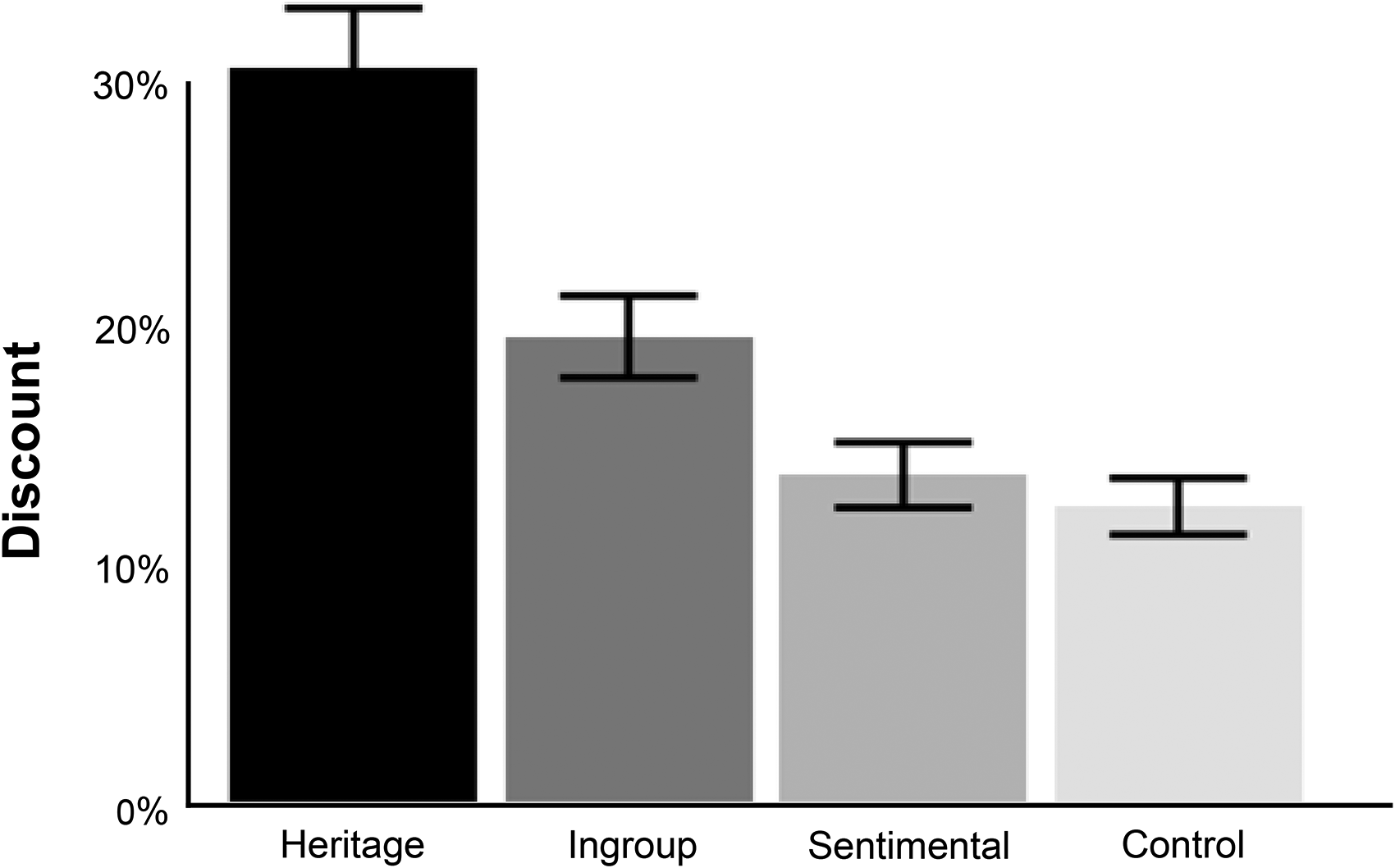
Sellers Give a Heritage Discount.
In addition to measuring the heritage discount, we collected a single-item, mean-centered measure of heritage loss (“Compared to me as the seller, the [buyer] will feel less connected to the contents of the car and my grandparents who drove it”; 1 = “Strongly disagree,” and 7 = “Strongly agree). We find that heritage loss differs by condition, with the smallest heritage loss in the heritage condition (MHeritage = 3.55, SDHeritage = 1.70; MIngroup = 5.27, SDIngroup = 1.55; MSentimental = 4.82, SDHeritage = 1.51; MControl = 5.93, SDControl = 1.31; F(3, 471) = 51.5, all ps < .001, η2 = .25). After adding heritage loss (B = −.03, p < .001, η2 = .05) to a model including condition, the implied size of the discount that heritage buyers (vs. control buyers) received was reduced (B = .12 vs. B = .18; ps < .001), the discount that heritage buyers (vs. sentimental buyers) received was reduced (B = .13 vs. B = .17; ps < .001), and the difference in prices between heritage buyers and ingroup buyers was reduced (B = .06 vs. B = .11; p = .017, p < .001). In a model including condition, heritage loss predicted the size of the discount the buyer received (F(1, 470) = 25.92, p < .001), with lower heritage loss leading to a higher discount, and a mediation model revealed that the discount to heritage buyers (the difference in WTA between heritage condition and nonheritage conditions) was mediated by this single-item measure of heritage loss (5.11%; 95% CI = [2.98%, 7.55%]; Hayes 2018). This mediation holds in a model that includes only heritage and ingroup conditions (7.13%; 95% CI = [3.84%, 11.02%]).
Additional tests
To check for multicollinearity in our data set, we tested for Pearson's correlation between heritage loss and related constructs and found that all correlations (i.e., psychological ownership, r(475) = .16; ingroup, r(475) = −.29; sentimental value, r(475) = −.27; all ps < .001) were less than r = .7. We also added psychological ownership to a model that included buyer type and heritage loss and found that ownership did not improve the model (p = .516). As a further robustness check, we added ingroup and sentimental value to a full model that included buyer type and heritage loss. We found that ingroup increased the seller's discount (B = .02, p = .007, η2 = .02), sentimental value decreased the discount (B = −.01, p = .005, η2 = .02), and the effect of heritage loss was robust to inclusion of both variables (B = −.03, p < .001, η2 = .06). As a further robustness test, we reran this model after excluding ten sellers who opted out of the market by giving their car away or by refusing to sell at the highest available price and found a marginal effect of ingroup (B = .01, p = .054, η2 = .01), an effect of sentimental value (B = −.01, p = .016, η2 = .01), and an effect of heritage loss (B = −.02, p < .001, η2 = .04).
Discussion
The results of Study 1 provide initial evidence that a heritage connection impacts market transactions for goods that connect consumers to a shared past and differentiates heritage connection from related constructs of ingroup bias, sentimental value, and psychological ownership. When sellers indicated their WTA for a vintage car in an online marketplace for a buyer less connected to the heritage of the good, sellers charged more. Although there is a significant discount for ingroup buyers, it does not fully explain the heritage discount; we found that the heritage discount was significantly higher than the ingroup discount, the sentimental value discount, and the price for buyers in the control condition. This study suggests that sellers’ lower WTA for heritage buyers arises due to the additional value yielded by heritage connection. We also began to explore the concept of heritage loss as an explanation for the effect, a concept we test further in subsequent studies. While this initial evidence is encouraging, more evidence is needed to differentiate heritage connection from related constructs, and from psychological ownership. In Study 2, we provide process evidence that begins to explain why sellers might have a lower WTA for heritage buyers.
Study 2: The WTA–WTP Asymmetry
In Study 2, we examine a potential explanation for our findings in Study 1: rational expectations of supply and demand. Study 1 indicated that sellers provided a heritage discount to heritage buyers. A parsimonious explanation of this finding is that sellers have low expectations of heritage buyer demand and price accordingly. In Study 2, we rule out this potential explanation of the heritage discount and instead present evidence of the reverse: sellers perceive heritage buyers to have higher valuations and higher WTP for heritage goods. We examine this WTA–WTP asymmetry in Study 2 and find that it holds when the buyer's relationship to the seller is held constant across conditions. We also attempt to control for ingroup bias by specifying in each case that the buyer is not directly connected to the seller, but rather a friend of a friend.
Pretests
Before conducting this study, we ran two pretests to identify measures that could help test for the role of shared heritage connection in sellers’ WTA. In an initial pretest, we tested ten exploratory items and reduced these items to a six-item measure of heritage connection (please see Table 1). In a second pretest, we ran a confirmatory factor analysis to test these six items for internal validity and found an acceptable Cronbach's alpha (α = .93). Finally, we tested for and found acceptable discriminant validity between our measure of heritage connection and a preexisting measure of individual psychological ownership. We validated the measures of heritage using a factor analysis with a two-factor model with varimax rotation; a scree plot analyzing both ownership and heritage found two optimal coordinates with two eigenvalues greater than the mean, and goodness-of-fit measures were acceptable in the two-factor model (comparative fit index = .98, root mean square error of approximation = .08, standardized root mean square residual = .04; χ2 = 47.36, d.f. = 26, p = .006). For interitem correlations and pretest results, please see Web Appendix B.
Heritage Connection.

Notes: The same seven-point Likert scale was used for all items (1 = “Strongly disagree,” and 7 = “Strongly agree”).
Method
In Study 2, a CloudResearch-approved pool of MTurk participants (N = 400; Mage = 39.1 years; 52.8% male, 47.3% female) participated in an online study in exchange for a nominal payment. We randomized participants into a mixed-design study using a heritage good: a set of chimes. Participants had an option to sell or not to sell a set of chimes to one buyer (heritage vs. control), and then, after indicating their WTA, sellers saw information about both types of buyers and assessed the value of the heritage good to each of these buyers and their WTP.
Scenario
Participants read a hypothetical scenario about a heritage good that connected the owner to the sounds of the past: “You have a set of chimes, and these 1920s chimes were the first thing your great-great-grandmother bought when she moved into her first home in the Shenandoah Valley. These chimes make a great sound when the wind blows since they are designed to make a sound similar to the sounds of the Shenandoah River. When you hear the sound of the river in the chimes you and your family often think of the people who have lived there before you and listened to the same sounds you’re hearing now.”
Next, we informed participants that due to an upcoming move they had considered selling their chimes and had posted about this on social media. To control for proximity of buyer to seller across conditions, we told participants that “a friend of a friend” contacted them about their post. In the heritage buyer condition, we told participants, “They are interested in the chimes because they spent time on the banks of the Shenandoah River when they were young, and the sound of the Shenandoah River helps them feel connected to all of the people of the Shenandoah Valley who came before them.” In the disconnected control buyer condition, we told participants, “They are interested in the chimes because they are very well made, solidly constructed, and because Shenandoah chimes like these should last a long time. They like the high quality of the tone, and the chimes will make a first-rate sound for them to listen to.” To control for future preservation of the chimes, we assured all participants that this friend of a friend “would take care of your chimes in the same way you would.”
WTA and WTP
After reading the prompt, sellers indicated their WTA for the heritage or control buyer using a Becker–DeGroot–Marschak test ($0–$90). Participants who would not sell at $90 were assigned a WTA of $91. Results are presented both with and without these high-value participants. After completing the Becker–DeGroot–Marschak task, all participants, regardless of condition, assessed both heritage and control buyers’ valuation of the chimes on a seven-point Likert scale (1 = “Not at all,” and 7 = “Very much”), and estimated how much each type of buyer would be willing to pay for the chimes (slider scale: $20 to $200, endpoints determined from a different group of participants’ responses in a pretest). Value and WTP measures were completed within subjects, and the order of evaluation was randomized by the Qualtrics survey platform.
Results
The results of Study 2 demonstrate that seller perceptions about the buyer's WTP cannot explain the heritage discount. Instead, we find that sellers accept less for their chimes from buyers they perceive as willing to pay more.
According to our preregistered plan, we did not include participants who had inconsistent preferences (e.g., accepting an offer of $60, but not accepting an offer of $72). We provide results for all participants who cleared this threshold (N = 383).
WTA
We found strong evidence of H1: sellers had a lower WTA for heritage buyers (MHeritage = $46.44, SDHeritage = $27.15) than for control buyers (MControl = $54.51, SDControl = $26.45; t(381) = 2.94, p = .003, η2 = .02), and these results hold using a nonparametric Wilcoxon rank-sum test (W = 21,592, p = .003). As a robustness check, we tested the strength of this finding by adding two additional exclusions. We excluded 14 participants who gave the item away for free (NControl = 5, NHeritage = 9) and 51 participants who would not sell at any available price (NControl = 31, NHeritage = 20). After removing participants who gave away or would not sell their item, these results hold in a standard t-test (t(316) = 2.23, p = .027, η2 = .02) and in a nonparametric Wilcoxon rank-sum test (W = 14,554, p = .019).
Value
Even though sellers had a lower average WTA for heritage buyers, they indicated that heritage buyers valued the chimes more (MHeritage = 6.31, SDHeritage = .83) than control buyers in a paired t-test (MControl = 5.16, SDControl = 1.34; t(382) = 16.44, p < .001, r = .64), and these results hold after excluding participants who either gave the item away or chose not to sell at any price (t(317) = 14.76, p < .001, r = .64).
WTP
Sellers perceived that heritage buyers had a higher WTP for the chimes (MHeritage = $100.79, SDHeritage = $51.58) than did buyers in the control condition (MControl = $86.84, SDControl = $49.78; t(382) = 7.65, p < .001, r = .36), and we find similar results after excluding participants who gave the item away and who would not sell at any price (t(317) = 6.45, p < .001, r = .34). All effects held after controlling for demographic variables, and these results reveal an asymmetry between WTA and WTP in which WTA is lower and WTP is perceived as higher for heritage buyers (please see Figure 3). For further details, please see Web Appendix B and https://aspredicted.org/3bp9s.pdf.

Asymmetry in WTA or WTP for Heritage Goods.
Follow-up study of buyer value and WTP
Although the seller's perception of both the buyer's valuation and the buyer's WTP could not explain our effect in Study 2, it seems possible that heritage buyers intuit this heritage discount and thus expect to pay less and have a lower WTP. If this is the case, then sellers’ decision to set a lower WTA makes them more likely to complete their deal, and the market is efficient. To test this hypothesis, we reran Study 2, but this time we asked a different set of participants (N = 400; Mage = 39.8 years; 59.8% male, 40.3% female) to give their valuations and WTP as a buyer who was either connected to or disconnected from the good's past. For consistency, the description of connection matched that used in the main study. Here we found that the heritage discount could not be explained by a lower WTP on the part of the heritage buyer. Although the median WTP was directionally higher for connected heritage buyers ($80) than for disconnected control buyers ($70), WTP was similar across conditions (t(397) = .39, p = .697), and both groups of buyers had high value for the item (MHeritage = 5.60 vs. MControl = 5.42; p = .158). We find no support for a lower WTP among heritage buyers, and these findings cannot explain sellers’ reduced WTA for a heritage good from heritage buyers. Please see https://aspredicted.org/e7dk3.pdf.
Discussion
In Study 2 and its follow-up we sought to determine if heritage buyers (1) were perceived by sellers to have a lower WTP for a heritage good, and (2) had a lower WTP in such a transaction. If so, this reduced expectation for buyer WTP could explain the heritage discount we observed in Study 1. We did not find support for this explanation of our findings. Instead, Study 2 suggests that the reverse might be true: sellers perceived the connected heritage buyers as having a higher WTP for their chimes than control buyers. Yet despite judging heritage buyers’ WTP to be high, sellers indicated a low WTA for these buyers, resulting in a WTA–WTP asymmetry. In the follow-up study, participants in the role of buyers report a similar WTP whether they are connected heritage buyers or nonconnected control buyers. Another possible explanation is that heritage goods that are inherited, rather than purchased, lead sellers to believe that they should sell at reduced prices to heritage buyers. To test this, we ran an additional follow-up study identical in design to Study 2 but with the chimes purchased rather than inherited (see Web Appendix C); we find that the reduced WTA replicates, indicating that sellers behave equivalently whether they had been gifted the heritage good or had purchased it.
Thus far, we have preliminary evidence to support a heritage discount, and we have found a WTA–WTP asymmetry, suggesting that the discount that connected heritage buyers receive cannot be explained by sellers’ rational expectations of demand or even more recent theories of individual psychological ownership (Shu and Peck 2011). Instead, this study suggests that a connection to a shared past might drive this WTA–WTP asymmetry. We have also found that this effect holds for goods purchased in a market. In the next study, we build on these findings on the value of connection to a shared past and examine potential mediation through the lens of heritage loss.
Study 3: Mediation by Perceived Heritage Loss
Study 2 introduced a six-item measure of heritage loss, the difference in heritage connection between seller and buyer. In Study 3, we more thoroughly investigate the effect of perceived heritage loss on seller WTA using this measure. To do this, we hold the seller's heritage connection to the good constant and manipulate the buyer's perceived heritage connection in a between-subjects design. We hypothesized that sellers of a heritage good (a watch) would sell it for less to buyers with a shared heritage connection than they would to buyers in a control condition, consistent with the main effect in our prior studies, and that this effect would hold after controlling for buyers’ usage. Our findings support this theorizing, and we provide evidence that the seller's perceived heritage loss (the difference between the seller's heritage connection and the buyer's perceived heritage connection) mediates the effect of condition on the seller's WTA.
Method
In Study 3, MTurk participants who had passed four attention check questions in a paid prescreener designed to filter out bots and non-English speakers (N = 400; Mage = 37.7 years; 44.0% male, 55.5% female, .3% transgender, .3% did not respond) participated in the study. One additional participant who started the study in one condition and then reentered and completed the study in another condition was not included in the study. A second participant completed the study twice. Their first entry was included in the data set. We excluded four participants with inconsistent preferences (N = 396). Including these four participants does not change the pattern of results (see Web Appendix D).
Scenario
We asked participants to imagine that they had been going through storage and looking at things they had not looked at in years. As they looked through their storage, they found an old pocket watch left in a package marked “for the future.” Participants were told that as they looked closer, they could see that “the name of your great grandfather is inscribed on the watch.” After participants read this scenario, they wrote about what the watch meant to them, and they rated their heritage connection to the watch.
WTA
After participants answered questions about their watch, a functional good that they could use to tell time, we told them that either a heritage or a control buyer would like to purchase their watch. For the [heritage / control] buyer, they read: “A person who works [in the same line of work as your great grandfather / in an office] and [is connected to your great grandfather's contributions to that line of work / enjoys looking at pocket watches and antiques and curios of all kinds], has been looking for a watch like the one you have. They want the watch so that they can [connect to the past and take out the watch and remember the people who came before them / take it out of their pocket to look at the time and so that they can enjoy listening to time tick away] as they go through their daily work.” Participants indicated their WTA on a Becker–DeGroot–Marschak task by accepting or rejecting 16 offers from $48 to $1,049 (prices were evenly spaced in $91 increments to avoid anchoring on even-numbered prices or salient price points, e.g., $1,000). Participants who would not sell at any available price were initially assigned a WTA of $1,050, but results are similar when excluding these high-value sellers (NControl = 104, NHeritage = 88).
Heritage loss
Sellers assessed their own heritage connection to the watch and rated their perception of the buyer's heritage connection to the watch (see Table 1). Finally, we asked participants to indicate how appropriate they considered the buyers’ usage of their watch on a seven-point Likert scale (1 = “Not Appropriate,” and 7 = “Very Appropriate).
Results
Seller’s heritage connection
As planned, sellers’ own heritage connection to their watch did not vary between conditions (MHeritage = 6.01, SDHeritage = .99; MControl = 5.99, SDControl = 1.02, F(1, 394) = .04, p = .835).
Buyer’s heritage connection
Sellers rated heritage buyers as having a higher heritage connection to the watch (MHeritage = 5.47, SDHeritage = 1.06) than control buyers (MControl = 3.38, SDControl = 1.47; F(1, 394) = 262.1, p < .001, η2 = .40).
WTA
We replicate our support for H1: sellers had a lower WTA for their watch when selling to heritage buyers (MHeritage = $778.31, SDHeritage = $341.09) than when selling to control buyers (MControl = $852.05, SDControl = $293.01; F(1, 394) = 5.33, p = .021, η2 = .01). This difference in WTA is similar when analyzed using a Wilcoxon rank-sum test (W = 21,790, p = .041). Overall, heritage buyers received a WTA $73 lower than that of control buyers for the same watch. The effect size is similar after removal of participants who would not sell at any of the available prices (NControl = 104, NHeritage = 88) when analyzed using a linear regression (F(1, 202) = 3.43, p = .066, η2 = .02) or a nonparametric Wilcoxon rank-sum test (W = 5,982, p = .056).
Appropriateness of buyer’s usage
We found no difference between conditions in appropriateness of buyer's usage, with participants rating both heritage and control buyers’ usage of the watch as highly appropriate (MHeritage = 5.85, SDHeritage = 1.33; MControl = 5.85, SDControl = 1.51; F(1, 394) = .00, p = .989).
Heritage loss
We calculate heritage loss as the seller's heritage connection minus the buyer's perceived connection to the good's heritage. Larger heritage loss values indicate the seller's perception that the buyer will have a lower heritage connection to the good than the seller has. Sellers incurred lower levels of heritage loss when selling to a heritage buyer than when selling to a control buyer (MHeritage = .55, SDHeritage = 1.31; MControl = 2.61, SDControl = 1.88; F(1, 394) = 159.8, p < .001, η2 = .29), and this replicates after removal of participants who would not sell at any of the available prices (NControl = 104, NHeritage = 88; F(1, 202) = 76.95, p < .001, η2 = .28).
Mediation by heritage loss
Having found a main effect of buyer identity on sellers’ WTA, we tested for mediation. Specifically, we tested whether the seller's perceived heritage loss due to trade (the seller's heritage connection minus the buyer's heritage connection) mediated the effect of condition on WTA (H2). We found that it did. Selling the watch to a control buyer increased heritage loss, and this lost heritage increased the seller's WTA for their good ($172.14; 95% CI = [$128.28, $219.72]; Hayes 2018). As a robustness check, we reran this mediation analysis with buyers who would not sell at any of the available prices excluded from the sample to test the robustness of the indirect effect and found a similar pattern of results ($111.82; 95% CI = [$61.63, $168.28]). Overall, this study suggests that sellers have a higher WTA for control versus heritage buyers with an indirect pathway through heritage loss.
We note here that although both the total effect and the indirect effect of the buyer's perceived connection to the good on WTA are negative (WTA goes down when the buyer's heritage connection goes up), the direct effect of a buyer's perceived heritage connection is positive (see Figure 4). Thus, our study provides evidence of competitive mediation on the seller side. This competitive mediation builds on the findings of Study 2, which provided evidence that sellers perceived that connected heritage buyers would have a WTP at least as high as or higher than that of disconnected control buyers and would value the good more. Thus, this finding is consistent with our previous findings that sellers perceive heritage buyers to have high valuations and yet sellers charge them less, because of these buyers’ connection to a shared past. For further details on this study and all analyses, please see Web Appendix D and https://aspredicted.org/s2ia7.pdf.

Heritage Loss Increases WTA and Mediates the Effect of Condition on WTA.
Follow-up study of control sellers
As noted previously, the finding that connected heritage buyers have high valuations and yet are charged less leads to a question of whether sellers charge these buyers less because they are giving them a heritage discount or because sellers perceive that a lower price for these buyers is optimal for market efficiency (i.e., they do not expect the sale to close otherwise). If this is the case, and market efficiency drives the effect, then we should expect that control sellers will also have a lower WTA for heritage buyers (thus ruling out a role of heritage loss). To test this alternative explanation, we reran Study 3 but changed the scenario such that participants were no longer connected to the heritage (i.e., control sellers): “You bought the watch because you liked it.” The control seller decided to list the watch on eBay and would be reviewing offers from potential buyers. As in Study 3 (N = 201; Mage = 38.3 years; 47.3% male, 52.7% female), the buyer was either a heritage buyer, who cared about the good's history, or a control buyer, who had no connection to the good's past but liked antiques. We removed two participants with inconsistent preferences (N = 199). Including these participants does not change the pattern of results (see Web Appendix D). Unlike the heritage seller, the control seller in this follow-up study revealed no difference in WTA between conditions (MHeritage = $368.83, SDHeritage = $252.61; MControl = $386.53, SDControl = $265.12; F(1, 197) = .23, p = .630) suggesting that overall seller perceptions about the buyer's deservingness cannot explain the heritage discount. These results hold after high-value sellers (NControl = 1, NHeritage = 3) are excluded (F(1, 193) = .87, p = .353). Further, we found that control sellers’ WTA for their watch in this follow-up study was less than half of heritage sellers’ WTA for their watch in Study 3, suggesting that heritage sellers valued their good more than control sellers and were willing to charge higher prices. Please see https://aspredicted.org/uu535.pdf.
Discussion
Overall, Study 3 demonstrates that the heritage discount holds, and that mediation by perceived heritage loss explains this discount. First, we provided evidence that heritage buyers were perceived by sellers to have a higher connection to the heritage good. Second, we found that sellers accepted lower offers from heritage buyers than from control buyers. Third, we showed that sellers perceived that less of their good's shared heritage connection would be lost in a potential trade with heritage buyers (i.e., lower heritage loss) than in a trade with control buyers. Finally, we contributed process evidence that this effect of buyer's identity on seller's WTA was mediated by these perceptions of heritage loss. Taken together, Study 3's findings provide evidence that the buyer's heritage connection can reduce the seller's heritage loss in a sale and lower the seller's WTA. Furthermore, our follow-up study demonstrates that these effects do not occur for a control seller without a heritage connection, even when selling to a heritage buyer.
In summary, our results from Studies 1–3 indicate that the sale of a heritage good by a heritage seller to a control buyer leads to a loss of heritage connection: the larger the loss in heritage, the greater the seller's WTA. On the other side of the transaction, heritage buyers receive a discount despite the fact they would likely receive greater utility from the seller's heritage good and thus might be willing to pay a price premium. In Study 4 we investigate the effect of heritage loss on sellers’ WTA in an incentive-compatible experiment using real goods.
Study 4: Selling a Heritage or Control Good
In Study 4, our primary aim was to investigate the effect of a buyer's perceived heritage connection on a seller's WTA for a heritage good in the field. Thus, we designed this study to be incentive compatible by using real goods and including a Becker–DeGroot–Marschak elicitation method. We endowed alumni visiting a university campus for a reunion weekend with either a heritage good that invoked their connection to the university's shared past or a university-branded good with no heritage connection, and we gave them the opportunity to sell that good.
Method
In Study 4, 124 participants were recruited from the campus of a large East Coast university during an annual alumni reunion weekend (Mage = 53.7 years; 52.4% male, 44.4% female, 3.2% did not respond). Since we did not know how many alumni participants would be available during the reunion weekend, we preregistered a larger sample size and noted that we would analyze the data with a smaller sample size depending on alumni availability, and we followed that preregistered plan. One participant was removed from the sample, as they were not associated with the university, leaving 123 alumni participants. These alumni participated in a study with a 2 × 2 (seller: heritage × control, buyer: heritage × control) probabilistically incentive-compatible design; they were told: “Some participants in this study may be randomly selected to have their decisions completed for real money and/or real objects, so please answer carefully and make sure your decisions reflect your real preferences.”
We endowed alumni sellers with a good they could touch and hold in their hands. This good was either a “heritage good,” a university-branded pennant, which connected to the university's past, had a history, and could continue to be maintained into the future, or a “control good,” university-branded chocolate cookies, which were connected to the university's present, did not have a history, and would be eaten that day. We told heritage sellers endowed with the heritage good, “Please take a look at this [university] pennant—imagine it being owned by prior generations of [university] students and how displaying it might make you feel more connected to those alumni that also loved [university]. You can pick it up the pennant and look at it more closely. Think about owning it and taking it home.” We told control sellers endowed with the control good, “Please take a look at these [university]-branded chocolate cookies—imagine how they taste and how enjoyable it might feel to eat them after a long day of walking around the [university] campus. You can pick up the cookies and look at them more closely. Think about owning them and taking them home.”
We then randomly assigned heritage sellers and control sellers to either a heritage buyer or a control buyer condition and assessed sellers’ WTA for these buyers. In the heritage buyer condition, the buyer was a student from the university. In the control buyer condition, the buyer was a nonaffiliated visitor to campus. To elicit participants’ WTA, we used an incentive-compatible procedure, the Becker–DeGroot–Marschak task. Participants saw a list of prices in $1 increments, ranging from $0 to $15, for a total of 16 prices. At each price point, participants indicated their choice to keep or sell the item. They also indicated their own heritage connection to the good (“Through [this good], I feel connected to [university alums] who came before me”) and responded to a single-item measure of heritage loss (“Compared to me as the seller, the [university] student (campus visitor) will feel less connected to prior generations through [this good]”). Both items were measured on a seven-point Likert scale (1 = “Strongly disagree,” and 7 = “Strongly agree”).
Results
We received data from 123 unique participants, with a higher number of participants in the heritage seller condition (n = 72) than in the control seller condition (n = 51) and similar numbers of heritage buyers (n = 61) and control buyers (n = 62). As a result of this slight imbalance in design, all results were analyzed using a linear regression instead of a t-test. For each of the 123 participants, we calculated the lowest price at which the seller indicated that they would sell the item to the buyer. If sellers would not sell at any price up to and including $15.00, we assigned them a WTA of $16.00, and results are robust to exclusion of these sellers.
WTA
We preregistered four tests. As a robustness check, we also reran all four main analyses and excluded participants who would not sell at an available price (NControlSeller = 8, NHeritageSeller = 13) or who gave the item away for free (NControlSeller = 2, NHeritageSeller = 15). First, we tested for a difference in buyer type. As predicted, participants’ WTA for a heritage buyer ($5.79) was lower than their WTA for a control buyer ($11.84, F(1, 121) = 52.76, p < .001, η2 = .30), and these results hold with high-value sellers and participants who gave away the item for free excluded (F(1, 83) = 25.39, p < .001, η2 = .23). Second, heritage sellers had a lower WTA ($7.72) for their good than control sellers ($10.41; F(1, 121) = 7.48, p = .007, η2 = .06), and these results hold with exclusions (F(1, 83) = 5.3, p = .024, η2 = .06). Third, these main effects could be fully explained by a discount that heritage sellers gave to heritage buyers (B = −$12.90, p < .001, η2 = .50), and this interaction holds with high-value and no-sale sellers excluded (t(81) = 8.65, p < .001, η2 = .48). An analysis of variance model comparison reveals better goodness of fit for a model including the heritage discount (the interaction between seller type and buyer type) than for a main effect model (F(1, 119) = 117.92, p < .001). Finally, we tested to see if heritage loss, the heritage discount that heritage sellers give to heritage buyers, predicted this interaction. First, we confirmed that sellers had a heritage connection to their good. Sellers expressed a heritage connection to the good by indicating that they somewhat agreed, agreed, or strongly agreed with the statement “Through this [university] pennant (these [university] cookies), I feel connected to [university alums] who came before me.” Heritage loss was measured with the single item “Compared to me as the seller, the [buyer] will feel less connected to prior generations through the [item]” (recoded as 1 = “Strongly Disagree,” and 7 = “Strongly Agree). If sellers did not indicate a heritage connection to the good, their heritage loss was coded as 0. We found that the interaction between heritage buyers and heritage sellers predicted heritage loss (B = −2.82, p < .001, η2 = .13), and each point of heritage loss increased WTA (B = $.76, p < .001, η2 = .10). Breaking this finding down by seller type, while heritage sellers’ WTA from a heritage buyer ($2.62) was lower than their WTA from a control buyer ($13.76; F(1, 70) = 353.6, p < .001, η2 = .83), control sellers’ WTA from a heritage buyer ($11.41) was directionally higher than their WTA from a control buyer ($9.66; F(1, 49) = 2.37, p = .130, η2 = .05; please see Figure 5). Thus, we did not observe an overall discount given to buyers who shared a connection to the university unless the good sold was a heritage good. Instead, we found that sellers reduced their WTA only for a good that connected them to the generations who came before and only when selling to heritage buyers, who share this connection to a valued past. Please see Web Appendix E and https://aspredicted.org/7wg8i.pdf.

Discount for Heritage Goods.
Follow-up studies
Study 4 provided support in the field for our theorizing that heritage sellers provide a discount to heritage buyers and that this discount can be explained through heritage loss. We further replicated these results and tested for alternative explanations in three additional studies and two posttests, all of which are reported in more detail in Web Appendix F. Those replications provide additional evidence that endowed sellers of university-branded goods have lower WTAs for heritage buyers when selling a heritage good (Web Appendix F Appendix Study 2) and do not have lower WTAs for heritage buyers when selling a control good (Web Appendix F Appendix Study 3), and that the heritage discount cannot be explained by buyer valuation, buyer usage, similarity between buyers and sellers, or ingroup favoritism (see Web Appendix F Appendix Study 4 and posttests).
Discussion
The results of Study 4, along with three follow-up studies and two posttests, provide further evidence that heritage value affects market transactions for goods that connect buyers and sellers to a shared past. When a pennant connecting alumni sellers to past generations was sold to a buyer less connected to the traditions of the university and the heritage of the good, sellers had a higher WTA. In contrast, when university-branded chocolate cookies were sold to a buyer less connected to the traditions of the university and the heritage of the good, sellers had a directionally lower WTA. We conceptually replicate both findings in three follow-up studies to Study 4, while testing for alternative explanations (e.g., buyer valuation, buyer usage, similarity, and ingroup favoritism). Furthermore, in Study 4, a single-item measure of heritage loss—the difference between the seller's heritage connection to the good and the buyer's heritage connection to the good—mediated the effect of condition on pricing. In summary, using real heritage goods and real transactions, we found that the heritage loss from a transaction affected the seller's WTA. In Study 5, we test our theory in a real-world digital marketplace where sellers of heritage goods can actively choose to accept or decline a buyer's offer.
Study 5: Selling a Heritage Good on Facebook Marketplace
In Study 5, our goal was to enter a real-world digital marketplace where sellers exchange their goods for payment, and where buyers can send messages to sellers while submitting an offer lower than the seller's list price. One prototypical example of sending messages to get a discount in large consumer transactions is the real estate industry, where buyers often write “love letters” to get a discount on a house. Real estate websites regularly provide tips on letter writing to sellers (e.g., “Is it an old home that the buyer wants to restore while maintaining its historic character?”). Financial Samurai (2023) notes that “a well-written real estate love letter can reduce a buyer's purchase price by 1%–10%. If we’re talking about a $1 million property, that's $10,000–$100,000 in savings.”
Since it is beyond our research funding to make offers on real estate, we chose to make offers on Facebook Marketplace, where sellers offer vintage items, receive messages from buyers, and choose to accept or reject those offers. Facebook Marketplace is a digital marketplace with a relatively large number of small-volume sellers; we focused on sellers who had listed heritage goods for sale in local markets. To test how a heritage message would affect sales price, we randomized sellers of actual goods to receive a discounted offer from either a heritage buyer or a control buyer. We then measured the effect of buyer message type on sellers’ pricing decisions.
Method
In Study 5, 400 sellers were contacted with discount offers for heritage goods they had publicly listed on Facebook Marketplace. To control for location effects, we contacted 200 sellers within a 60-mile radius of a city in the Northeast and 200 sellers within a 60-mile radius of a city in the Midwest. As preregistered, we started with a 40-mile radius and then expanded that radius to 60 miles in both cities and made offers to 200 sellers of heritage goods within each region. These two regions are areas where the authors had a family connection and, thus, both control and heritage connection buyer messages could be used without deception. Sellers were contacted on the lead author's Facebook account by a research assistant blind to the study hypothesis. Due to the economics of running large studies, we preregistered a plan to contact sellers who listed a “vintage” item, which we use as a proxy for heritage good, for a price between $4 and $10. Each participant received an offer for 60% of their posted price rounded to the nearest dollar (e.g., a seller offering an item for $5 would receive an offer for $3, and a seller offering an item for $10 would receive an offer for $6), and we measured whether sellers would accept this discount offer (see preregistration: https://aspredicted.org/sq94i.pdf).
Two hundred participants received a randomly assigned control message in which the buyer expressed appreciation for the good, an interest in the platform, and financial constraint: “Hi [first name], I really like your [name of item]. I am interested in purchasing on Facebook Marketplace because it is a marketplace that I have not used often, and this seems like a nice thing to buy in the marketplace. I am on a limited budget right now, and was wondering if you would accept an offer of [60%] for your [name of item]?” A different 200 participants received a randomly assigned heritage message in which the buyer expressed appreciation for the good and a connection to the good's heritage: “Hi [first name], I really like your [name of item]. My family has been in [region] for generations and this reminds me of the time spent with my grandparents. It helps me connect to what life was like when they were growing up in [region] and connects me to that time and to my grandparents. I am on a limited budget right now, and was wondering if you would accept an offer of [60%] for your [name of item]?”
Results
We initially contacted 401 unique participants. After removing one participant who had a higher offer price than allowed under the study plan ($20 vs. $4–$10), we had data from 400 unique participants; 200 of these participants received a heritage discount message, and 200 received a control discount message. One participant in the control condition was offered a slightly higher price than planned ($3.50 on a $5.00 item instead of $3.00), but the seller did not accept this higher offer. This seller's data were included, but the results do not materially change if this seller's data are removed. We measured sellers' acceptance of a discounted offer as a binary (yes/no) variable rather than using a continuous WTA as in prior studies.
Overall, 89 participants (44.5%) in the heritage condition agreed to accept the buyer's offer, compared with 63 participants (31.5%) in the control condition, and this difference in choice to sell was statistically significant (χ2(1) = 7.17, p = .007, φ = .13). The difference in likelihood to sell to heritage buyers was similar across the Northeast (42% vs. 29%) and Midwest regions (47% vs. 34%), and a regression revealed no main effect of region on likelihood to accept (p = .300). For more details, please see Web Appendix G.
Discussion
In Study 5 we sought to replicate our findings in Studies 1–4 in a real-world, incentive-compatible context: Facebook Marketplace. However, real-world settings such as this one have limitations on how much we can learn from the data. In this marketplace, there is no way to know for certain if the seller has a heritage connection to the good because we cannot measure this variable directly. The extent of our manipulation was to determine whether sellers (connected or not) accepted or declined an offer based on receiving a heritage or control message. We also note that heritage buyers revealed more personal information than control buyers who were newer to the marketplace. Overall, we made 400 offers to unique real sellers across two geographic regions for their heritage goods and found that sellers were more willing to sell their heritage items to heritage buyers; in other words, Facebook Marketplace sellers of heritage goods provided a discount to heritage buyers.
General Discussion
In a set of five main experiments (as well as a pilot and additional follow-up experiments), we provide evidence that heritage connection affects sellers’ pricing decisions. In Study 1, we found preliminary evidence for a heritage discount such that sellers of heritage goods had a lower WTA for heritage buyers than for control buyers of the same good, and we found a greater discount for heritage buyers than for ingroup or sentimental buyers. Furthermore, the effect of shared heritage connection held after controlling for psychological ownership (Study 1), reduced sellers’ WTA despite heritage buyers’ higher perceived WTP, and was robust even without a direct, personal connection between buyer and seller (Study 2). We demonstrated that the seller's perceived heritage loss due to trade mediated the difference in WTA from heritage versus control buyers (Study 3). Finally, we found the heritage discount in an incentive-compatible study using real goods (Study 4) and a field study with real sellers of heritage goods in an online marketplace (Study 5). The effect of heritage on WTA held after controlling for both market value and demographic variables (Studies 1–4) and could not be explained by sentimental value (Study 1), ingroup favoritism (Study 1, Study 4) or buyer valuations (Study 2). Overall, this research provides strong evidence that buyers’ and sellers’ heritage connection affects product disposition, and this work demonstrates that joint buyer–seller connections to a shared past affect market transactions in the present.
This research contributes to the literature on the endowment effect and psychological ownership. Prior research has found that factors that increase psychological ownership increase WTA (Ariely, Huber, and Wertenbroch 2005; Shu and Peck 2011; Strahilevitz and Loewenstein 1998). Here, we identify situations in which factors that increase psychological ownership can also decrease WTA. Our research provides strong evidence that a heritage good's symbolic ability to connect buyers and sellers to the collective past reduces the seller's WTA and may also create a WTA–WTP asymmetry.
This article also contributes to the literature on sentimental goods. Prior research has found that highly attached owners of sentimental goods demonstrate heightened sensitivity to the future usage of their goods (Brough and Isaac 2012; Yang and Galak 2015). Here, we identify situations where factors that increase heritage connection can decrease WTA after controlling for sentimental value. We find that after controlling for future usage, the effect of heritage connection on the seller’s WTA holds.
This article also contributes to the sharing literature (Belk 2010, 2014, 2017). We respond to this literature's call for greater research on how the aggregate extended self—“us”—affects consumer practices. In our empirical work we first provide evidence that the shared past creates value for consumers. Then, we empirically demonstrate that the heritage loss when a good is sold to a buyer who does or does not connect to the shared past affects the seller's WTA. Further, we demonstrate how collective value, shared between buyers and sellers, drives pricing in surprising ways: sellers indicated a lower WTA for heritage buyers even when they perceived that these buyers had higher valuations and higher WTP. This counterintuitive finding suggests that sellers blend exchange-based market pricing with shared communal benefits that can be quantified as heritage loss (Clark and Mills 2012; Fiske 1991). It is not simply the buyer's valuation but also the heritage loss due to trade that determines the seller's WTA. Critically, as the buyer's heritage connection to a good goes up, the seller's WTA for that good goes down.
Future Research
In this article, we have explored how heritage connection can impact the seller’s WTA. Future research could examine the antecedents and moderators of heritage connection. For example, how does the digital world and technology shape the desire to sell or keep heritage goods? If the antique suppresses time (Baudrillard 1968), perhaps the desire to maintain a connection to goods that evoke the shared past will only grow in the fast-moving digital world. It might be the case that uncertainty about the future drives a search for the security and comfort of the past and increases the desire to preserve heritage goods. Alternatively, a feeling of stability across time might decrease the price premium that sellers charge for heritage goods.
Another dimension that future research could explore more fully is the distinction between hedonic and utilitarian goods. Research has found that consumers may value hedonic goods more highly in forfeiture than in acquisition (Chan 2015; Wertenbroch and Dhar 2000), although this asymmetry does not hold in all cases (Shu and Peck 2011). More recently, work on disposition has found that identity-linked products are less likely to be thrown in the trash (Trudel, Argo, and Meng 2016). In the current work, we have not fully examined differences between hedonic and utilitarian goods. In our main and follow-up studies, we tested functional goods (e.g., a watch, a magnet) that owners might consider more utilitarian, and we tested less functional goods that owners might consider more hedonic (e.g., chimes, cookies, chocolate). The impact of hedonic (vs. utilitarian) attributes on sellers’ disposition was not a dimension we had a clear hypothesis for or directly tested, but future research could look more closely at whether the heritage discount differs by type of good.
Future research could also examine the connection between heritage and shared ownership. Previous work has studied shared ownership as a legal construct (e.g., a timeshare) and sharing as gift-giving (e.g., sharing food), and by this definition heritage goods—sold between a buyer and a seller—do not have shared ownership and are not part of the sharing economy (Belk 2010). Yet, although the ownership of heritage goods cannot be legally shared after a sale, the connection to those who came before is maintained through a reduction in heritage loss. It is possible that buyers have some collective psychological ownership of the good before the sale and that sellers maintain some level of collective psychological ownership of the good after the sale. Even though the heritage good is no longer “mine,” this continued, shared connection to the past may provide value by reducing the seller's feelings of loss through the knowledge that the good remains owned by a buyer within the same connected community.
In the current work, we have focused on tangible, heritage goods that can be sold between buyer and seller. Future research could go beyond the marketplace and explore the value of intangible “living heritage.” The United Nations, which has long protected heritage sites, has designated 631 pieces of “intangible cultural heritage” across 140 countries, and there are some indications that protecting this living heritage spurs economic development and safeguards well-being (Blake 2014). In a variety of examples, including canoe making in Micronesia, traditional textiles in Timor, ancestral music in Namibia, baguettes in France, 1 and the culture of borscht in Ukraine, the global community has paid to preserve these local communities’ connection to the people who came before them. The value of this shared connection to the past for promoting sustainability, social connection, economic benefits, and prosocial behaviors across time could also be further explored. Finally, although we have explored loss of heritage, future research could test the value of increasing past connection: heritage gains.
Practical Implications
These findings have relevance for consumers, marketers, and policy makers. First, this research has potential applications in both the $58 billion self-storage market, in which 10% of American households pay monthly fees to keep treasured possessions they have not sold, and markets that involve resale, such as the $43 trillion U.S. housing market, the $200 billion secondhand market, and the $450 billion collectibles market (Absolute Reports 2023; Credit Suisse 2020; Market Decipher 2023; ThredUp 2023). Many of these goods connect owners to a shared past. For example, to get a discount on an older house, prospective buyers might use home-buyer “love letters” to emphasize their experience living in a house from the same time period and their goal of staying connected to the past while enjoying the house (Lee, Mason, and Malcomb 2021).
Second, understanding consumer valuation of heritage products more generally may allow marketers of new products to appeal to consumers’ desire to maintain a connection to their heritage across time. Marketers may even be able to create new products that help consumers maintain their link to the past for future generations by sharing their possessions (e.g., 23andMe's Airbnb heritage travel partnership). Third, it is possible that heritage could generate value in policy contexts, such as conservation and public health. Conservationists looking to promote environmental sustainability and decrease voters’ support for licensing natural resources (e.g., drilling rights, mining rights, logging rights, emission rights) might increase the perceived value of the resource by invoking the land's connection to past generations and to history, thus emphasizing the heritage loss and reducing the likelihood it would be leased or sold.
Conclusion
In summary, heritage matters: access to the collective past changes how we value our goods and how we sell them. Although heritage goods cannot give the seller or the buyer the ability to travel back to a past they have never witnessed or to travel forward into a future they will never see, they can allow an owner to imagine a past before their birth and a future after their death through connection to a tangible marker of a larger community. We hope that this work increases understanding of the value of the shared past that underlies how sellers choose to keep and sell goods, while also contributing to researchers’ understanding of how consumers value goods across time.
Supplemental Material
sj-pdf-1-mrj-10.1177_00222437231182434 - Supplemental material for The Role of Heritage Connection in Consumer Valuation
Supplemental material, sj-pdf-1-mrj-10.1177_00222437231182434 for The Role of Heritage Connection in Consumer Valuation by Katherine L. Christensen and Suzanne B. Shu in Journal of Marketing Research
Footnotes
Acknowledgments
The authors would like to acknowledge Eugene Caruso, Hal Hershfield, Keith Holyoak, Franklin Shaddy, and Stephen Spiller as well as seminar participants at UCLA Anderson School of Management, Bocconi University, Notre Dame Mendoza College of Business, Indiana University School of Business, and Berkeley Haas School of Business for feedback on an earlier version of this research. The authors appreciate the work of the review team, whose insightful comments improved this paper.
Author Note
This article is based on the first author’s dissertation.
Coeditor
Maureen Morrin
Associate Editor
James Bettman
Declaration of Conflicting Interests
The authors declared no potential conflicts of interest with respect to the research, authorship, and/or publication of this article.
Funding
The authors disclosed receipt of the following financial support for the research, authorship, and/or publication of this article: Funding was provided by the Morrison Center for Marketing & Data Analytics.

Notes
References
Supplementary Material
Please find the following supplemental material available below.
For Open Access articles published under a Creative Commons License, all supplemental material carries the same license as the article it is associated with.
For non-Open Access articles published, all supplemental material carries a non-exclusive license, and permission requests for re-use of supplemental material or any part of supplemental material shall be sent directly to the copyright owner as specified in the copyright notice associated with the article.
