




Abstract
Access-based services (ABS)—in which consumers do not physically own material goods but gain access to services by registering with the provider—have risen in popularity as an alternative to individual ownership and conventional consumption. Yet companies still face key challenges in promoting these services. Prior research indicates that consumers assign significant importance to their material possessions; the current study investigates how psychological ownership, the mental state of perceiving something as one’s own, attained through ABS might lead customers to increase their service use and forgo material ownership. With four studies, using cross-sectional, longitudinal, and experimental data, as well as combined self-reports with usage data, we theorize and demonstrate this effect. Firms that offer ABS can increase customers’ service psychological ownership, which acts as a psychological substitute for physical ownership and increases ABS use. The results suggest ways managers can leverage the psychological power of ownership feelings, rather than try to fight the lack of actual ownership, in access-based consumption contexts.
Imagine no possessions. I wonder if you can.
Access-based services (ABS) have attracted increasing attention as an alternative to conventional consumption of material products through sole ownership (Bardhi and Eckhardt 2012; Hazée, Delcourt, and Van Vaerenbergh 2017; Schaefers, Moser, and Narayanamurthy 2018). Most ABS grant customers temporary access to a material product, in return for an access payment, such that the legal ownership remains with the service provider (Schaefers, Lawson, and Kukar-Kinney 2016; Wittkowski, Moeller, and Wirtz 2013). Many predictions suggest that access-based consumption is the wave of the future (Bardhi and Eckhardt 2017; Schaefers, Moser, and Narayanamurthy 2018), and its power to establish new patterns of consumption is one of the hallmarks of the sharing economy (Perren and Kozinets 2018). Notably, ABS offer a potential approach to counteract overconsumption and contribute to sustainability efforts related to climate change (Eckhardt et al. 2019; Mi and Coffman 2019). However, many ABS providers still suffer from insufficient consumer demand (Needleman and Loten 2014) and remain “small, losing money, and surviving on venture capital” (Cusumano 2018, p. 27). Extant service research also shows that consumers still perceive barriers to adopting ABS (Hazée, Delcourt, and Van Vaerenbergh 2017). Therefore, despite its increasing popularity and media coverage, critical questions remain about how to best promote ABS.
To complement and extend prior insights into how to encourage ABS consumption (e.g., Hazée, Delcourt, and Van Vaerenbergh 2017; Schaefers, Lawson, and Kukar-Kinney 2016), we propose an alternative account of what might prompt consumers to increase their ABS consumption. Prior research suggests that the importance consumers assign to owning material objects constitutes a critical barrier to ABS use (Kahneman, Knetsch, and Thaler 1990; Richins 2004; Weiss and Johar 2013); the importance of material possessions for consumers relates negatively to their use of ABS (Bardhi and Eckhardt 2012; Belk 2014). However, feelings of perceived ownership can emerge toward a range of material and immaterial objects such as cars, music streaming, and even augmented reality holograms (Carrozzi et al. 2019; Danckwerts and Kenning 2019; Pierce, Kostova, and Dirks 2003). We thus leverage symbolic self-completion theory (Wicklund and Gollwitzer 1982) to propose that psychological ownership of ABS might satisfy consumers’ need for ownership and substitute for material ownership. In this case, service managers should not seek to reduce consumers’ desire for ownership as a mental state but rather trade upon it and work to shift their preferences for ownership toward ABS offerings, which subsequently enhances the customers’ ABS usage.
To test this novel proposition, we conduct a series of four studies. In an online experiment, we investigate antecedents of psychological ownership for ABS to understand how it might be induced. Two cross-sectional studies rely on real behavioral data (examining carsharing and music streaming contexts). Finally, we offer further support for our model with longitudinal data gathered from carsharing users, which shows that psychological ownership toward ABS over time increasingly drives the substitution of material possessions. The empirical results obtained across these four studies have implications for efforts to encourage access-based consumption, for the services marketing discipline, and for sharing economy literature. First, we add to the literature on ABS. Specifically, our studies shed light on the relationship between material ownership and access-based consumption. Our results suggest that when ABS customers (e.g., carsharing) develop feelings of psychological ownership toward the service, they perceive the service as a substitute for the corresponding material possession alternative (e.g., car ownership). Customers increase their service consumption in this case, while reducing their material ownership. Second, our findings suggest options for actively promoting ABS. The empirical test of the key antecedents of psychological ownership toward ABS provides guidelines for how ABS managers can actively promote their services, by inducing feelings of ownership and thereby increasing ABS consumption. Third, we advance psychological ownership theory by showing that despite their intangibility, services can replace material products as targets of a sense of ownership. Extant sharing economy and services marketing research predict generally diminishing importance of ownership over time, which may naturally lead to increasing adoption of ABS. Critically, our findings offer insights for managers on how to actively promote their ABS by leveraging psychological ownership for increasing consumers’ ABS consumption.
Conceptual Background
Access-Based Consumption and Material Ownership
Private ownership of material assets is a default mode of consumption, but it is not the only means to access goods that provide value for consumers. Both ABS and conventional ownership often exist in the same market spheres and even may compete (e.g., mobility from car ownership vs. carsharing, music from physical ownership of CDs vs. digital music streaming). Studies of consumer motives for using ABS (e.g., Bardhi and Eckhardt 2012; Belk 2014; Lamberton and Rose 2012; Wittkowski, Moeller, and Wirtz 2013) often note the negative utility of material possessions (i.e., “burdens of ownership”; Schaefers, Lawson, and Kukar-Kinney 2016), arguing that consumers seemingly should prefer access-based consumption (e.g., Bardhi and Eckhardt 2017; Lamberton and Rose 2012; Lawson et al. 2016; Moeller and Wittkowski 2010). Other studies offer empirical evidence that ABS consumption relates negatively to material ownership (e.g., Datta, Knox, and Bronnenberg 2017; Hennig-Thurau, Henning, and Sattler 2007; Liebowitz 2008; Oberholzer-Gee and Strumpf 2007; Zervas, Proserpio, and Byers 2017). Yet we argue that most investigations take a one-sided perspective, investigating how diminished importance of material possessions might affect consumers’ ABS adoption (e.g., Schaefers, Lawson, and Kukar-Kinney 2016) rather than how to make ABS more appealing. The assertion that consumers might prefer temporal access, rather than ownership, because ownership has little meaning for modern consumers also conflicts with a long heritage of research that identifies the importance of ownership and possessions as a deeply rooted human preference (e.g., Beggan 1992; Belk 1988; Morewedge and Giblin 2015; Pierce, Kostova, and Dirks 2001; Richins 2004). In this view, ownership offers a psychological state from which people can buffer existential insecurity (Rindfleisch, Burroughs, and Wong 2009). We take a different approach in this research and theorize that feelings of ownership for ABS can emerge and psychologically substitute for material ownership, in accordance with a broader understanding of the ownership concept.
Extended Self Theory and Psychological Ownership
The important role of ownership has been explained from various perspectives, all of which acknowledge that possessive behavior is universally present in all human societies (Pierce, Kostova, and Dirks 2003). Extended self theory (Belk 1988) is one cornerstone in this line of research and suggests that people and external objects can become deeply entangled. The psychological appropriation of objects helps people create and maintain their self-concepts, so they come to be considered as personal belongings. Belk (1988) describes several forms of this psychological appropriation and acknowledges that even intangible and nonownable objects, such as riding a bicycle, driving a car, or mastering a subway system, may be targets of ownership perceptions. In these examples, people specify their personal mobility according to specific objects and activities, and the self extends to include the facilitators. In this case, personal mobility facilitated by the use of a public transport system becomes part of the rider’s self-concept. Such self-definitional symbols, whether physical or not, serve as important anchors for the individual who in turn develops possessive feelings toward the objects.
The concept of psychological ownership builds on extended self theory (Peck and Shu 2018) and was introduced to organizational sciences by Pierce, Kostava, and Dirks (2001) who describe it as “the state in which individuals feel as though the target of ownership or a piece of that target is ‘theirs’ (i.e., ‘It is mine!’)” (Pierce, Kostava, and Dirks 2003, p. 86). This mental state denotes a sense of possession of a particular target, even in the absence of any legal ownership (Pierce, Kostova, and Dirks 2001; Reb and Connolly 2007). Because psychological ownership reflects human possessive tendencies (Morewedge et al. 2009), it is distinct from related constructs such as brand attachment (Park et al. 2010; Park, Eisingerich, and Park 2013). It also can be directed toward any particular object, including physical items but also ideas (Baer and Brown 2012) or jobs (Wang et al. 2018), and accordingly can prompt territorial responses toward any such object (Kirk, Peck, and Swain 2018).
While prior studies of psychological ownership have largely addressed material possessions (e.g., Peck, Barger, and Webb 2013; Stoner, Loken, and Blank 2018), more recently researchers have explored intangible entities such as services and digital goods as potential targets of psychological ownership (Peck and Shu 2018). Mifsud, Cases, and N’goala (2015) conceptually specify service appropriation as “a process by which customers make the service their own” (p. 719) and develop possessive feelings, over time and through their investment of personal resources. Sinclair and Tinson (2017) and Danckwerts and Kenning (2019) identify psychological ownership in consumers’ experiences of music streaming; Karahanna et al.’s (2015) study also reveals that psychological ownership needs motivate social media consumption. Consumers also refer to their meaningful relationships with virtual consumer goods, such as in-game avatars (Watkins, Denegri-Knott, and Molesworth 2016) or holograms (Carrozzi et al. 2019). Overall, psychological ownership has been cited as a critical factor for service research (Van Doorn et al. 2017).
Although both extended self and psychological ownership theories predict that people develop feelings of ownership for physical and nonphysical entities, we know of no studies that investigate whether and how nonphysical entities such as services might replace material objects as extensions of the self. This question is particularly important in ABS contexts, which aim to provide an alternative to forms of consumption achieved through individual material ownership. Therefore, we extend this theoretical perspective and integrate it with symbolic self-completion theory, which highlights the interchangeable nature of objects that are important to the self or the so-called self-definitional symbols (Braun and Wicklund 1989).
Symbolic Self-Completion and Material Dispossession
The theory of symbolic self-completion asserts that people seek to acquire and display symbols, to themselves or others and in physical and nonphysical form, that relate strongly to their ideal self (Wicklund and Gollwitzer 1982). If the symbols of self-definition are lacking or changing though, people seek out alternative symbols to reclaim their “symbolizing completeness” (Wicklund and Gollwitzer 1981, p. 89). A dispositional tendency prompts most people to strive for a positive, well-defined self-concept and see themselves in a favorable light (Barrick and Mount 1996; Harmon-Jones, Schmeichel, and Harmon-Jones 2009). The corresponding objects become important symbols if they facilitate a desirable self-conception but people also replace objects that fail to do so. Symbolic self-completion theory further notes that objects do not have a specific symbolic meaning per se; rather, this meaning is externally induced (e.g., through social interactions), and when certain symbols become more relevant for the person, other symbols may become less important (Wicklund and Gollwitzer 1981).
Relatedly, Pierce, Kostova, and Dirks (2003) describe how the importance of different targets of psychological ownership varies with the time and context. Previous studies confirm that consumers use possessions as identity-related symbols (Ledgerwood, Liviatan, and Carnevale 2007) and also leverage their symbolic meaning to avoid undesired identities (Berger and Heath 2007). A deliberate disposal of possessions thus can provide a means of identity-related separation (Shelton and Peters 2006). In parallel findings, Chung and Johar (2018) show that psychological ownership activates an object-related self, which improves activities related to this target of ownership but also results in impaired performance on tasks unrelated to the target.
A study of the extent to which nonphysical objects (e.g., services) can induce such denial and disposition of material possessions (e.g., products) is currently missing though. By synthesizing current work on the extended self and symbolic self-completion as an overarching theoretical framework, we theorize that, despite the general importance of ownership for humans, people do not simply hold onto all physical possessions. Rather, they may be willing to dispose of them if a nonphysical entity, as a symbolic substitute, is available and salient due to psychological ownership. Our conceptual model, centered on psychological ownership for ABS, encompasses our predictions about its emergence (antecedents) and substitution effects for material ownership consumption (consequences).
Hypotheses Development
Antecedents of Psychological Ownership for ABS
The mental state of psychological ownership can emerge if directed toward an explicit reference object (Pierce, Kostava, and Dirks 2001). In this research, we investigate psychological ownership of an ABS as a feeling directed toward the totality of the service. To derive likely antecedents of psychological ownership toward ABS, we draw on Pierce, Kostava, and Dirks’s (2001) distinction between the “roots” (efficacy and effectance, self-identity, and having a place) and “routes” (control, intimate knowing, and investment of self) of psychological ownership. The former are human motivations that, if served or satisfied by an object, cause people to develop feelings of ownership for that specific object. The latter instead describe individual interactions with a target object (i.e., controlling the ownership object, coming to know the object intimately, or investing the self in the object), by which people come to develop feelings of psychological ownership.
In an ABS context, the roots of psychological ownership refer to characteristics of the service offerings, and the routes involve several activities consumers may undertake in response to these characteristics. By exploring the roots, we can determine whether ABS can fulfill the need for ownership, so we consider how ABS relates to three types of roots (efficacy and effectance, self-identity, and having a place) of psychological ownership by deriving hypotheses about three related service characteristics (intimacy, identity, and communal identification).
Intimacy
People strive for self-efficacy and effectance (Bandura 1977), related to a human need to be efficacious and in control (Beggan 1992; Furby 1991). When an interaction with an object elicits a feeling of competence, people literally hold onto it, which helps them maintain a positive self-concept (Pierce, Kostova, and Dirks 2003; White 1959). Possession largely stems from a sense of having altered the environment and causing something to happen (Pierce, Kostova, and Dirks 2003). In contrast with ownership of material objects though, because a service is inherently elusive, complex, and time-based (Wirtz and Lovelock 2016), consumers’ perceived intimacy with a service may affect their interpretation of their relational ties with it (Beetles and Harris 2010; Yim, Tse, and Chan 2008). Service intimacy stems from the bondedness and connectedness of a relationship and makes customers feel good whenever they use the service (Yim, Tse, and Chan 2008). This is specifically important for ABS as previous research has shown that the “difficulty associated with understanding, accessing, transacting, and using” ABS can be a reason for consumers to refrain from using the service (Hazée, Delcourt, and Van Vaerenbergh 2017, p. 447). In turn, we suggest when a person perceives intimacy with an ABS, which is a feeling of connection with the service stemming from the perceived expertise to use it, psychological ownership toward that object should emerge, and we hypothesize the following:
Identity
Psychological ownership associations with an external object help people define, retain, and reinforce a specific self-identity (Pierce, Kostova, and Dirks 2003). The need to express identity through external objects encourages a sense of psychological ownership when the object seems to function well as an identity-related symbol (Dittmar 1992; Pierce, Kostova, and Dirks 2001). Identity then can emerge from category labels with which consumers associate themselves, and possessions can help consumers fit into favorable categories (Reed et al. 2012). Especially in industrialized societies, the belief that “you are what you own” is well established. Distinctive forms of consumption such as ABS also may constitute identity-related expressions of personal consumption values (Bardhi and Eckhardt 2017), or customers’ compatibility and image concerns could erect psychological barriers to ABS adoption (Hazée, Delcourt, and Van Vaerenbergh 2017) if the ABS elicits negative cognitive associations that conflict with consumers’ identity-related criteria for preferable lifestyles. Consumers rely on the social meaning of objects to instrumentalize their performances, in accordance with their desired identities (Blumer 1969; Solomon 1983). If customers believe that a specific ABS refers to and emphasizes access-based consumption as a preferable element of their identity, they will employ that specific ABS to support their identification with access-based consumption. Therefore:
Communal identification
Finally, people feel psychological ownership and sense that they “have a place” when they perceive their affiliation with an environment (Pierce, Kostova, and Dirks 2001; Van Dyne and Pierce 2004). Because humans have innate territoriality needs, they seek out objects that help create a secure environment, and they strive to possess certain spaces (Ardrey 1966; Kirk, Peck, and Swain 2018; Lorenz and Leyhausen 1973). If an object symbolically captures the concept of home it evokes perceptions of personal possession (Pierce, Kostova, and Dirks 2001), and such an effect should be valid for an intangible, socially constituted environment too. As previous research has shown, communal consumption relationships create value because they make an individual customer feel like part of a like-minded group (e.g., Algesheimer, Dholakia, and Herrmann 2005; Schau, Muñiz, and Arnould 2009; Wirtz et al. 2013). If an ABS fosters feelings of communal identification among customers (Carrozzi et al. 2019; Schaefers, Lawson, and Kukar-Kinney 2016) and makes them aware of and sympathetic with other users of the service, it should elicit a feeling of being embedded in a home-like environment. We argue:
Consequences of Psychological Ownership for ABS
We consider two paths by which people interact with an ABS toward which they perceive psychological ownership to predict the outcomes.
Substitutive value and material ownership reduction
Consumers should perceive an ABS as a substitute for a corresponding material possession if that service psychologically satisfies their need for possession, which we denote as substitutive value. Such substitution might be actively encouraged by an ABS based on the notion that feelings of ownership toward an object cause people to assign it a higher value (Kahneman, Knetsch, and Thaler 1990; Morewedge et al. 2009). In other words, people will evaluate an object more favorably than comparable objects merely because of their feelings of ownership (Beggan 1992; Dommer and Swaminathan 2012; Reb and Connolly 2007). We do not expect a direct effect, such that psychological ownership toward an ABS would reduce the rates of material ownership per se, but this relationship should be mediated through a consumer’s perception that the service substitutes for the material product. We predict that consumers diverge from the consumption domain of material ownership if they sense that access-based consumption provides a satisfying substitute (Berger and Heath 2007; Shelton and Peters 2006). With the prediction that the perceived substitutive utility of access-based consumption reduces ownership of corresponding material products, we formally hypothesize:
Usage and material ownership reduction
Previous research into the adoption and diffusion of ABS highlights functional aspects such as low-cost benefits (Bardhi and Eckhardt 2012; Lamberton and Rose 2012) and identifies a positive relation between ABS usage and material ownership reduction (Schaefers, Lawson, and Kukar-Kinney 2016). Extending these findings, we propose that consumers’ usage of ABS increases with the degree of their ownership feelings toward the service. When psychological ownership toward an object is established, it should prompt increased engagement with that object (Dittmar 1992; Pierce, Kostova, and Dirks 2003). For example, Avey et al. (2009) find that psychological ownership in organizational contexts leads to citizenship behavior associated with additional effort by and engagement of employees for the benefit of their company. Similarly, psychological ownership increases engagement with the target, including ABS, so it should increase customers’ ABS usage intensity too. We propose:
Study Overview
Figure 1 illustrates our formal hypotheses and research model, which we test in four studies.
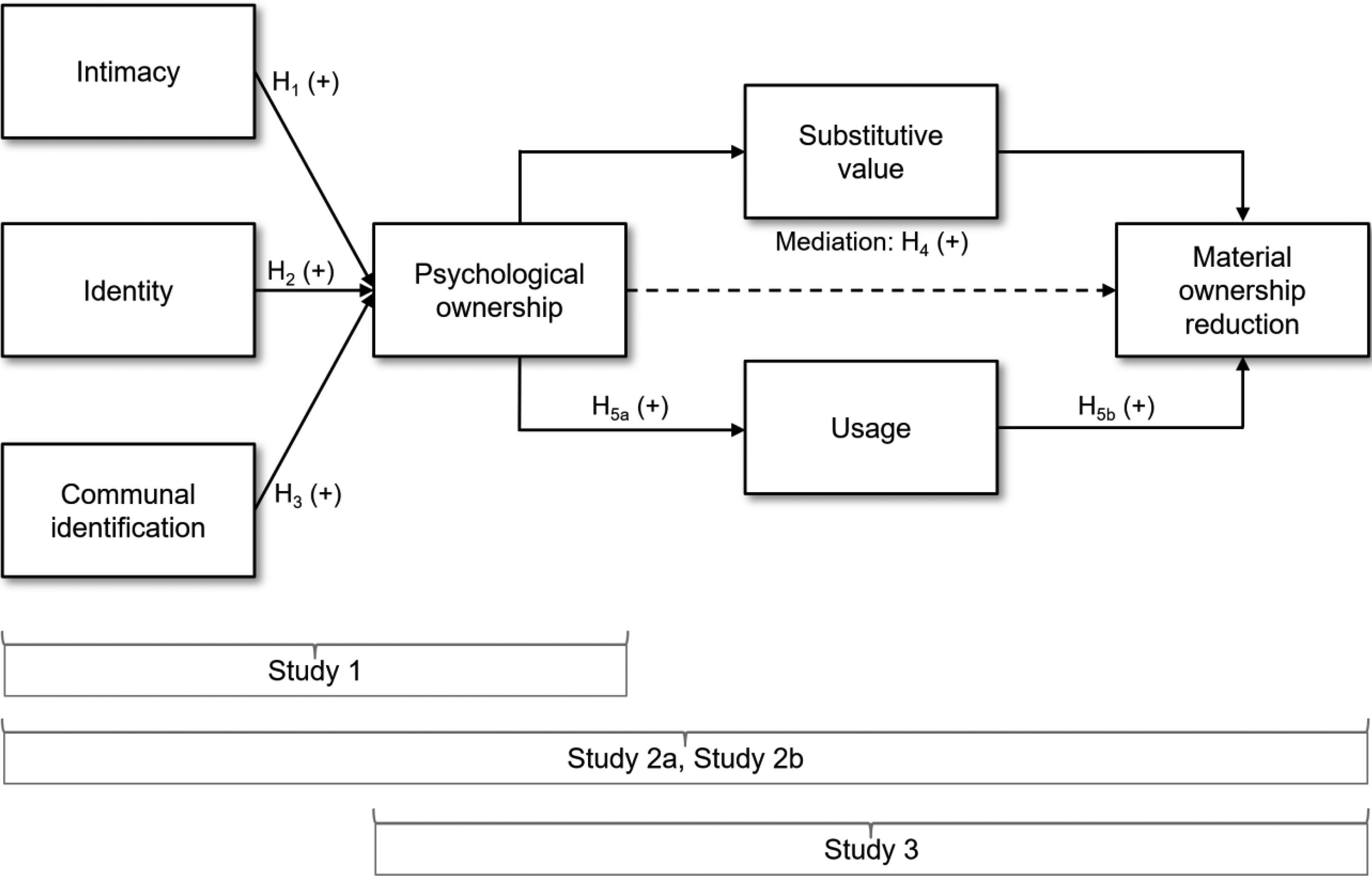
Research model: Antecedents and consequences of psychological ownership for ABS
Study 1, an online experiment, uses a between-subject design to explore the antecedents of psychological ownership in a carsharing context. This study helps foster understanding on how psychological ownership for ABS emerges and might be induced. Studies 2a and 2b build on these findings and test the model with real behavioral data and self-reported consumer data. Both contexts differ regarding the nature of the accessed items. While Study 2a investigates our research model in the carsharing context where consumer access a material good as common for most ABS, Study 2b tests it in the music streaming context where consumer access a digital good. This distinction is important for testing the substitution effect of ABS for material possessions in two ways. First, investigating multiple contexts extends the external validity of our findings. Second, ABS that provide material objects are closer to the material ownership consumption context as in both contexts the customers access a material product. Referring to music streaming as an additional context, we test if the substitution effect of ABS also holds when consumer access a nonmaterial item. Digital items like songs or videos distributed on streaming platforms have almost zero marginal costs and consumers might thus value them less than their physical alternatives (Atasoy and Morewedge 2018; Wirtz et al. 2019), which in turn potentially attenuates or completely prevents the substitutive value of ABS. Finally, with a longitudinal design, Study 3 provides evidence of increased psychological ownership toward ABS over time and its effects in decreasing material ownership, mediated by the perceived substitutive value of ABS and actual usage of carsharing services. Study 3 extends the static between-subjects perspectives of the previous studies and complements our findings by testing the dynamic nature of the effect based on within-subjects differences.
Study 1: Antecedents of Psychological Ownership
This scenario-based online experiment includes manipulated between-subject factors (high vs. low) for the three hypothesized antecedents of psychological ownership: intimacy, identity, and communal identification. The context for the experiment involved carsharing. We employed an online questionnaire and recruited respondents in Germany from the panel of a market research firm that provides small monetary incentives for participation. To increase statistical power and reliability, we included the instructional manipulation check by Oppenheimer, Meyvis, and Davidenko (2009, p. 868), which instructs participants not to answer a question about their sports activities and simply to proceed to the next question.
Pretest
Manipulation Checks
We checked the manipulations of the three antecedents. After removing 18 participants who failed the instructional manipulation check and participants who did not complete the survey, the final sample size of the pretest was 270 participants (43.7% women, mean age 35.5 years). They read a description of a carsharing service we called MoveIt, which remained on screen for at least 10 seconds by default. The service description familiarized participants with carsharing and contained basic information about usage procedures. They had to imagine that they had used MoveIt for a while in their city. Participants were randomly assigned to one of the eight scenarios that vary in levels of the three antecedents, manipulating high or low conditions of intimacy, identity, and communal identification. Each scenario appeared on a separate page and could not be skipped before 10 seconds had elapsed. To avoid order effects, the scenario presentation was random. After reading the scenario, participants completed a survey, which included established multi-item scales for the three antecedents (2 items for the Intimacy Scale from Aaker, Fournier, and Brasel 2004; 2 items for the Identity Scale from Sivadas and Machleit 1994 [see also Chugani, Irwin, and Redden 2015; Leung, Paolacci, and Puntoni 2018]; 2-item Communal Identification Scale from Hennig-Thurau, Henning, and Sattler 2007). We present the measurement details in Table 1.
Measurement Items, Studies 1–3.
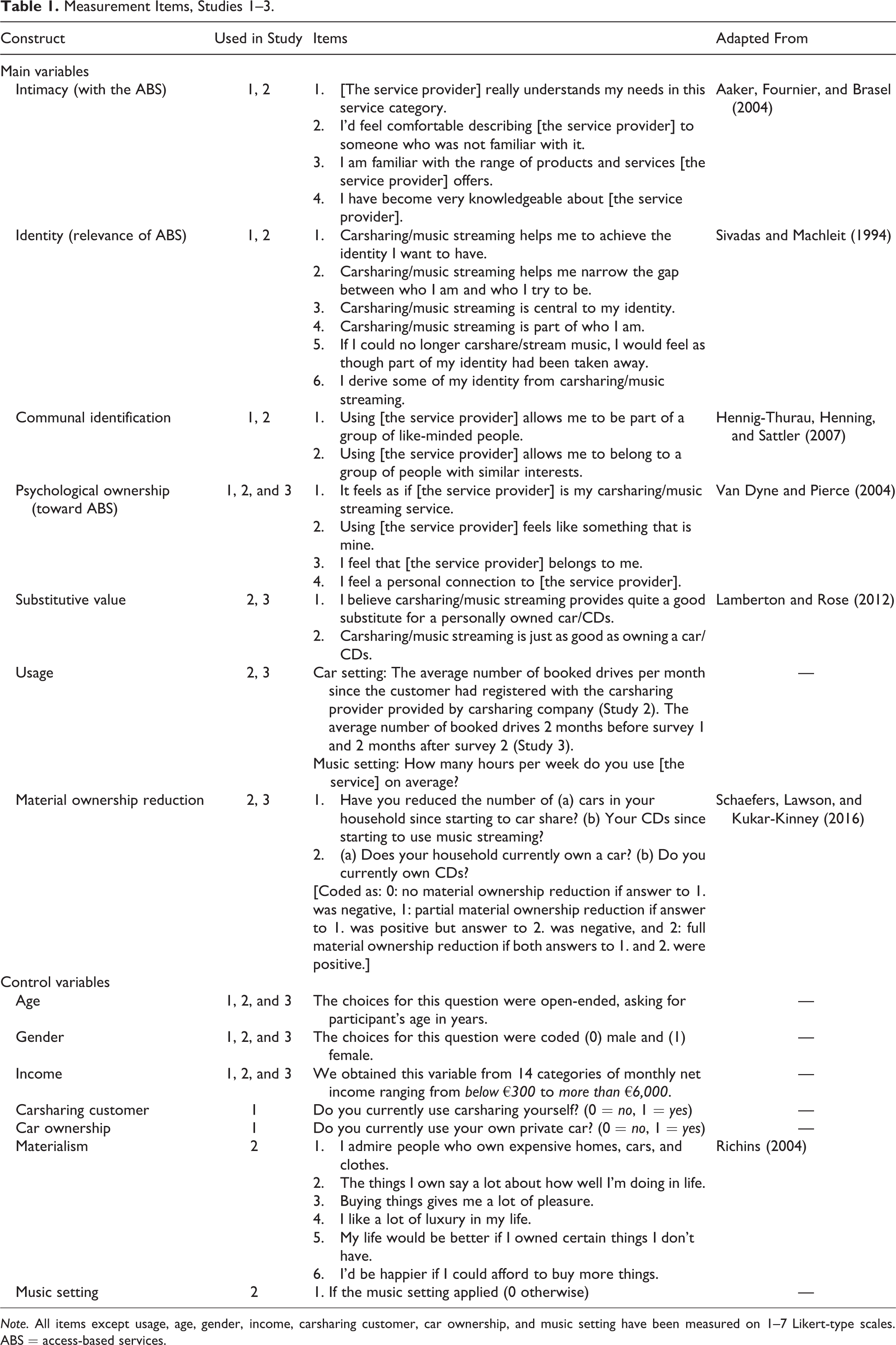
Note. All items except usage, age, gender, income, carsharing customer, car ownership, and music setting have been measured on 1–7 Likert-type scales. ABS = access-based services.
The full description and manipulations for all studies are available in Online Appendices A and B, respectively. Briefly, the intimacy manipulation for participants in the high [low] condition included statements such as, “You are [not] really familiar with MoveIt” and “You feel [not] understood by MoveIt.” Participants in the high-intimacy condition (Mhigh = 5.95, SDhigh = 1.31, N = 138) scored significantly higher on the Intimacy Scale than those in the low-intimacy condition (Mlow = 2.66, SDlow = 1.49, N = 132, p < .001). The high [low] identity manipulation contained expressions such as, “You are a [not] proud car sharer and most people you know would agree that carsharing is [not] very important to you.” Participants in the high-identity condition (Mhigh = 5.93, SDhigh = 1.56, N = 134) indicated significantly higher ratings on the Identity Scale than those in the low-identity condition (Mlow = 2.30, SDlow = 1.54, N = 136, p < .001). Participants assigned to the high [low] communal identification condition were exposed to statements like, “You [do not] know a lot of other people who use MoveIt” and “You [do not] feel a connection to other users.” Participants in the high communal identification condition (Mhigh = 5.54, SDhigh = 1.47, N = 133) scored significantly higher on the Communal Identification Scale than those in the low communal identification condition (Mlow = 2.66, SDlow = 1.70, N = 137, p < .001). We observed no significant two- or three-way interaction effects across experimental conditions in the manipulation check assessments.
Main Study
Method and Measures
After removing 47 participants who failed the instructional manipulation check or did not complete the survey, we retained a sample of 497 respondents. We used the pretested manipulations and asked participants about their sense of psychological ownership, using a 4-item scale (Table 1) adapted from Van Dyne and Pierce (2004).
Results
We conducted an analysis of covariance (ANCOVA) on psychological ownership. As covariates, we included whether a participant is a current carsharing customer (12.9%) or car owner (64.0%), as well as demographics (female = 48.3%, Mage = 35.6 years, SDage = 11.4). The ANCOVA revealed significant positive main effects of all three antecedents: identity, F(1, 497) = 28.049, p < .001, η2 = .055, intimacy, F(1, 497) = 62.115, p < .001, η2 = .114, and communal identification, F(1, 497) = 16.131, p < .001, η2 = .032, in support of Hypotheses 1–3. There were no significant interaction effects of the three factors.
Study 2: Antecedents and Static Consequences of Psychological Ownership
In Studies 2a and 2b, we investigate two access-based consumption settings: carsharing (N = 857) and music streaming (N = 196), respectively. The detailed measurement items are reported in Table 1.
Method
Study 2a
We cooperated with a large, German-based, business-to-consumer carsharing provider to collect data from its customers in Germany using online surveys. The company provides services in several cities in Europe and North America. Access-based car usage is charged according to per minute rates, after customers pay a one-time registration fee. There is no monthly charge, and the pay-per-ride rates are all inclusive. The company provides its service according to a free-floating principle within a predefined usage area, meaning that customers can locate and reserve vehicles using an app for mobile devices or the company’s website or hotline; they can also pick up any available vehicle on a walk-in basis.
The company provided information on actual usage behavior, or the average number of bookings per month, for each customer. This average was calculated by dividing the number of bookings by the customer’s active months using the service. The first month referred to the customer’s first booking. We received these calculated usage data from the company, which also confirmed that customers book steadily on an individual basis without major swings, so the average number of bookings across all months likely represents their individual behavior well. We matched these external data about usage intensity with the self-reported survey data on an individual level, using an external link that marked each questionnaire. Of 1,022 initial participants, 857 finished the survey and could be matched with their usage data from the customer database. Their average age was 35.8 years (SD = 10.7), 264 (30.8%) were women, and their median monthly net income was €1,500–2,000 (skewness = .84). We collected the data in two waves (first wave 439, second wave 418 participants, 3 months later) and control for this difference in time. No participant of the first wave participated in the second wave; when we compared the first 25% with the last 25% of respondents in each wave, we found no significant differences, indicating the absence of a nonresponse bias.
Study 2b
Invitations to participate in the study were distributed via email to a German university’s student mailing list. We received 212 questionnaires from actual Spotify users, out of which we excluded 16 incomplete responses, leaving 196 usable responses (59.2% women). The respondents’ average age was 23.2 years (SD = 3.4), and their median monthly net income was €500–1,000 (skewness = 2.08). Because we could not get actual usage data from Spotify, we asked the participants how many hours per week they used the service on average.
Results of Studies 2a and 2b
Partial Least Square (PLS)
For both studies, we used partial least squares structural equation modeling (PLS-SEM) that is particularly suitable when the main research objective is theory development (Hair, Ringle, and Sarstedt 2011; Henseler et al. 2014). We also estimated the structural model with maximum likelihood structural equation modeling (AMOS Version 25) but could not find significant differences for the parameter estimates. Furthermore, PLS supports the simultaneous use of single- and multi-item scales, as well as analyses for mediation effects (Hair et al. 2017). Following recommendations by Henseler, Hubona, and Ray (2016), we estimate the structural models using a bootstrap resampling procedure of 5,000 subsamples, which also accounts for the nonnormal distribution of the behavioral variables (i.e., material ownership reduction and usage intensity with skewness values of 0.25 and 3.48). The calculations rely on SmartPLS software (Ringle, Wende, and Becker 2015; Version 3.2.8). We examined the quality of the measurement model by testing for predictive relevance, internal consistency, convergent validity, and discriminant validity.
Internal Consistency and Convergent Validity
In Table 2, the values for the multi-item constructs indicate good internal consistency of their respective measurement scales in both studies. Principal component analysis reveals the hypothesized factor structure for each construct. Bootstrapping confirms that all factor loadings of the designated scale items are statistically significant at the 1% level. We also establish indicator reliability, in that the items loaded high on their designated constructs and exceeded the conservative threshold of .70 for both studies (Hair et al. 2017).
Descriptive Statistics, AVE, and Reliability, Study 2.
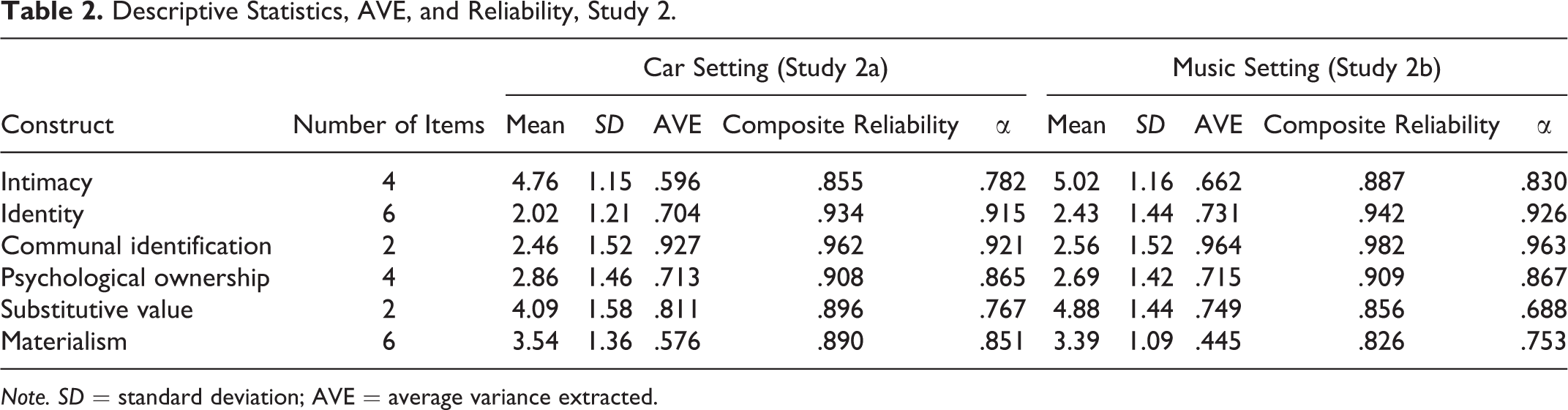
Note. SD = standard deviation; AVE = average variance extracted.
Discriminant Validity
All of the items’ factor loadings are greater for their designated construct than for any other construct. That is, all cross-loading differences exceed the suggested threshold of .10 in both studies (Gefen and Straub 2005), in support of discriminant validity at the item level. To check for discriminant validity at the construct level, we consider whether the square root of the average variance extracted for each construct is greater than the construct’s highest correlation with any other construct (Fornell and Larcker 1981). This criterion is met for all constructs. Henseler, Ringle, and Sarstedt (2015) also recommend employing the stricter heterotrait-monotrait (HTMT) criterion to test for discriminant validity. The HTMT ratio for our correlation results shows that, as stipulated, all values are below .85 (Henseler, Ringle, and Sarstedt 2015; see Online Appendix D). Moreover, the variance inflation factor values between the exogenous constructs fall well below the threshold of 5 (Hair et al. 2017) for both studies, indicating that multicollinearity is not an issue.
Common Method Variance
We account for potential common method bias in our data by applying procedural remedies in the data collection stage and empirically testing for potential common method variance (MacKenzie and Podsakoff 2012; Podsakoff et al. 2003). First, as recommended, the design of the survey proactively seeks to mitigate threats of common method bias (Conway and Lance 2010). We actively guided participants through the different parts of the survey, with one part referring to carsharing in general and another citing the specific carsharing service. Prior to starting each section, they read an introduction that prompted them to refer to the object of interest when answering. This priori consideration helps ensure psychological separation of the different measurements (Podsakoff et al. 2003).
Moreover, we included real behavioral data to measure the usage intensity of ABS, varied the scales used to measure some constructs (e.g., material ownership reduction), and randomly permuted the order of items in each multi-item construct to prevent sequence effects (MacKenzie and Podsakoff 2012). Respondents were assured of confidentiality and that their responses would be anonymous (Podsakoff et al. 2003). A contraindication of common method bias is construct validity (Conway and Lance 2010), as we established previously. In addition, we compared the coefficients with a model that includes a common latent factor and find only small, insignificant differences, indicating that no common factor accounts for the covariance among the surveyed constructs.
Hypotheses Testing
The results of the structural model path analysis for the car and music settings are listed in Table 3. For each setting, we present the results without and with covariates (Becker et al. 2016). The paths of the three antecedents of psychological ownership are significant in all models, in support of Hypotheses 1–3. Psychological ownership significantly links to substitutive value, which then leads to reduced material ownership. The indirect effect of psychological ownership, through substitutive value, on material ownership reductions is significant in all four models (1: γ = .057, 95% confidence interval [CI] = [.035, .084]; 2: γ = .062, CI [.036, .092]; 3: γ = .059, CI [.021, .108]; 4: γ = .055, CI [.016, .102]), in support of Hypothesis 4. In Models 2–4, the direct link from psychological ownership to material ownership reduction is weaker but still significant on the two-sided 5% level, suggesting complementary mediation. We find that psychological ownership links to usage, in support of Hypothesis 5a, but usage does not relate to material ownership reductions, so we must reject Hypothesis 5b. The indirect effect of psychological ownership, through usage, on material ownership reduction is not significant in all four models (1: γ = .001, 95% CI [−.005, .008]; 2: γ = .001, CI [−.005, .009]; 3: γ = .014, CI [−.010, .050]; 4: γ = .015, CI [−.008, .055].
PLS Results, Study 2.
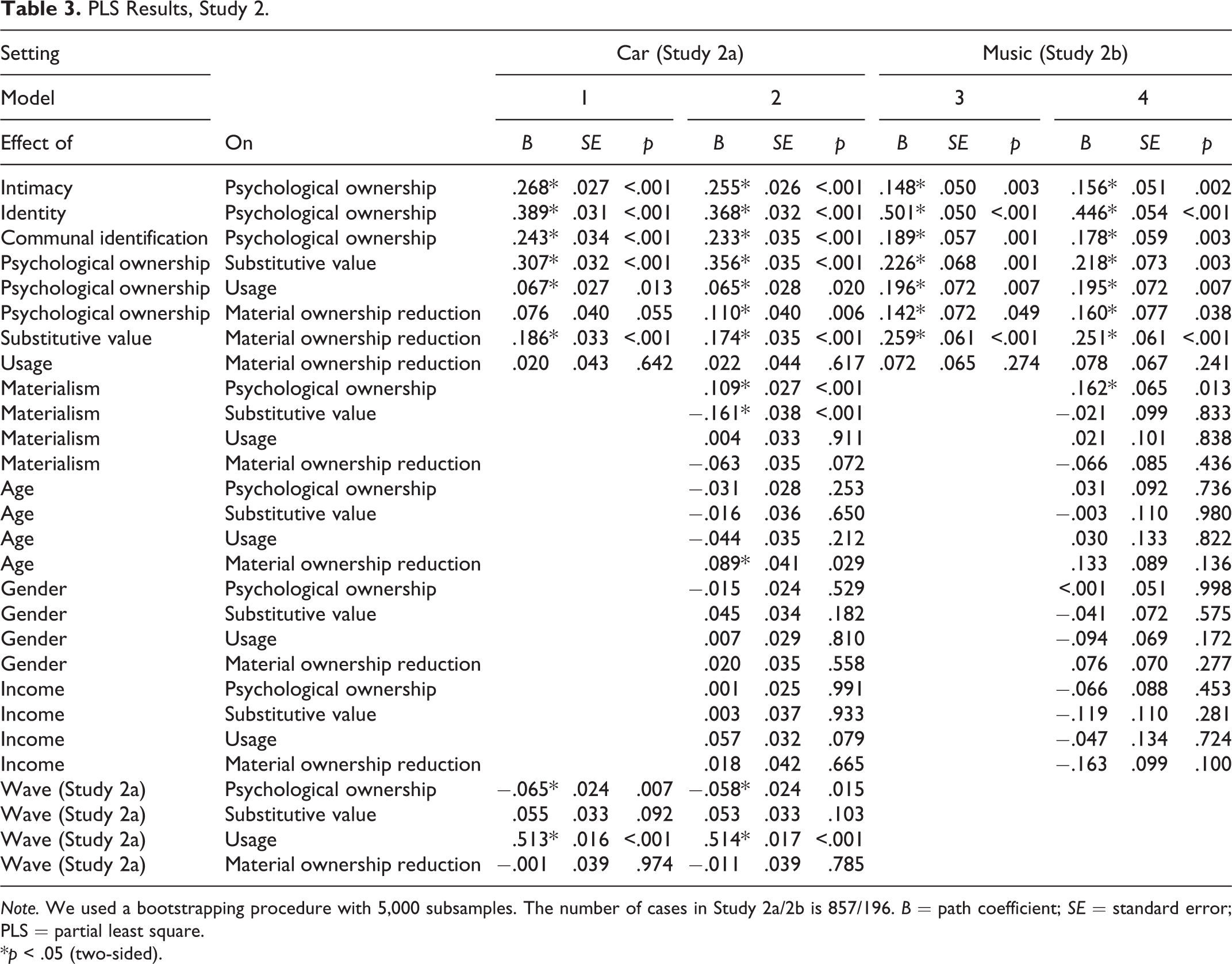
Note. We used a bootstrapping procedure with 5,000 subsamples. The number of cases in Study 2a/2b is 857/196. B = path coefficient; SE = standard error; PLS = partial least square.
*p < .05 (two-sided).
As robustness checks, we controlled for the financial and social risk of ownership (DelVecchio and Smith 2005) and brand loyalty in the carsharing setting, as well as current uses of different physical media such as CDs in the music setting. None of these controls had any impact on the results. Thus, we find that when ABS customers develop a sense of psychological ownership toward a service (carsharing or music streaming), they perceive the service as a substitute for material ownership and consequently reduce their material ownership. We further find support that psychological ownership relates positively to usage intensity.
Predictive Relevance
To examine whether the exogenous constructs had predictive relevance for the endogenous constructs, we tested the model using the blindfolding procedure suggested by Hair et al. (2017). The sample reuse technique developed by Stone (1974) and Geisser (1974) fits our PLS-SEM modeling approach and can evaluate structural model specifications (Wold 1982). The model has predictive relevance when Stone–Geisser’s Q2 values are larger than 0 (Chin 2010), which we confirm for our data.
Study 3: Dynamic Consequences of Psychological Ownership
Method
With Study 3, we test the dynamic effects of psychological ownership of ABS on the proposed downstream variables: substitutive value, actual usage, and material ownership reduction. Again, we cooperated with the German-based, business-to-consumer, carsharing provider to collect data from its customers using an online survey and actual usage data. We sent two waves of surveys, each available online for 1 week (t1: February 2018; t2: May 2018), then matched survey responses from both waves and usage data by customer. This longitudinal data collection was part of a larger survey research project by the company. As compensation, the participants had the chance to enter a raffle at the end of the survey to win one of the five coupons for 100 minutes of use, sponsored by the carsharing company. In both waves (t1 and t2), we measured consumers’ sense of psychological ownership toward the ABS and, as endogenous constructs, substitutive value, and material ownership reduction. 1 The carsharing company provided actual usage data averaged for 2 months before t1 and for 2 months after t2.
The carsharing company confirmed that the demographics of the participants who completed the survey in Wave 1 corresponded generally with its customer base. We also compared the first 25% with the last 25% of respondents and found no significant differences in any of the variables, across both waves, so nonresponse bias is not a concern. Moreover, we compared the sample characteristics in t1 (Nt1 = 8,807; Mage(t1) = 39.13 years, SDage(t1) = 12.23, 30.4% women) with those in t2 (Nt2 = 559; Mage(t2) = 40.45 years, SDage(t2) = 12.11, 24.5% women), which are generally equivalent. Therefore, survival bias does not appear to affect the data collection either. For six participants, we could not obtain usage data and thus a total of 553 participants completed both data collection waves and all attention checks.
We assessed age, gender, income, whether the participant lives in an ABS area and whether he or she owns a car as covariates. We used the scale items for the main variables from Study 2 to measure psychological ownership, substitutive value, and material ownership reduction (Table 1). With the longitudinal measurements (t1 and t2), we aimed to observe natural variance over time. Psychological ownership toward the ABS should increase over time, due to personal resource investments that customers make over repetitive, long-lasting interactions with the ABS (Mifsud, Cases, and N’goala, 2015; Pierce, Kostova, and Dirks 2003).
Results
To analyze substitutive value and actual usage over time, due to longitudinal changes in psychological ownership, we applied two-level mixed-effects robust regression analyses. We model the main effects without and with covariates and find no significant differences. The results in Table 4 support our hypotheses: An increase in psychological ownership increases substitutive value and usage. We also find that usage increases, whereas substitutive value does not change significantly over time.
Two-Level Mixed-Effects Robust Regression Results, Study 3.
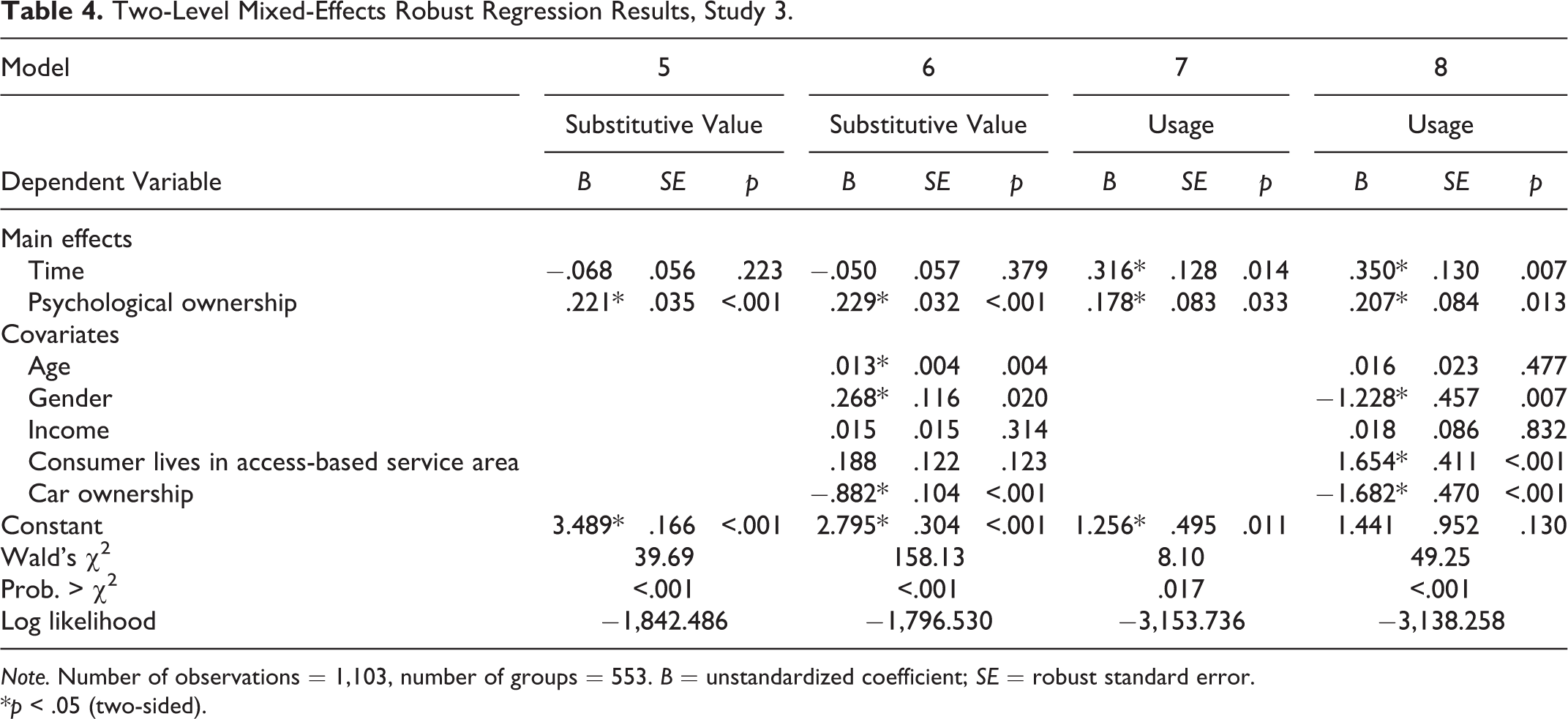
Note. Number of observations = 1,103, number of groups = 553. B = unstandardized coefficient; SE = robust standard error.
*p < .05 (two-sided).
For material ownership reduction, we apply a two-level mixed-effects robust ordered logit regression. We also applied the same models with probit regression but find no significant differences in the results (see Online Appendix E). The results reveal no direct link between psychological ownership and material ownership reduction. Instead, the parallel mediations from psychological ownership through substitutive value and usage are positively associated with material ownership reduction, again in support of Hypotheses 4 and 5a. In contrast to the static perspectives in Studies 2a and 2b, this dynamic perspective also provides support of Hypothesis 5b. We detail these results in Table 5.
Two-Level Mixed-Effects Robust Ordered Logit Results, Study 3.
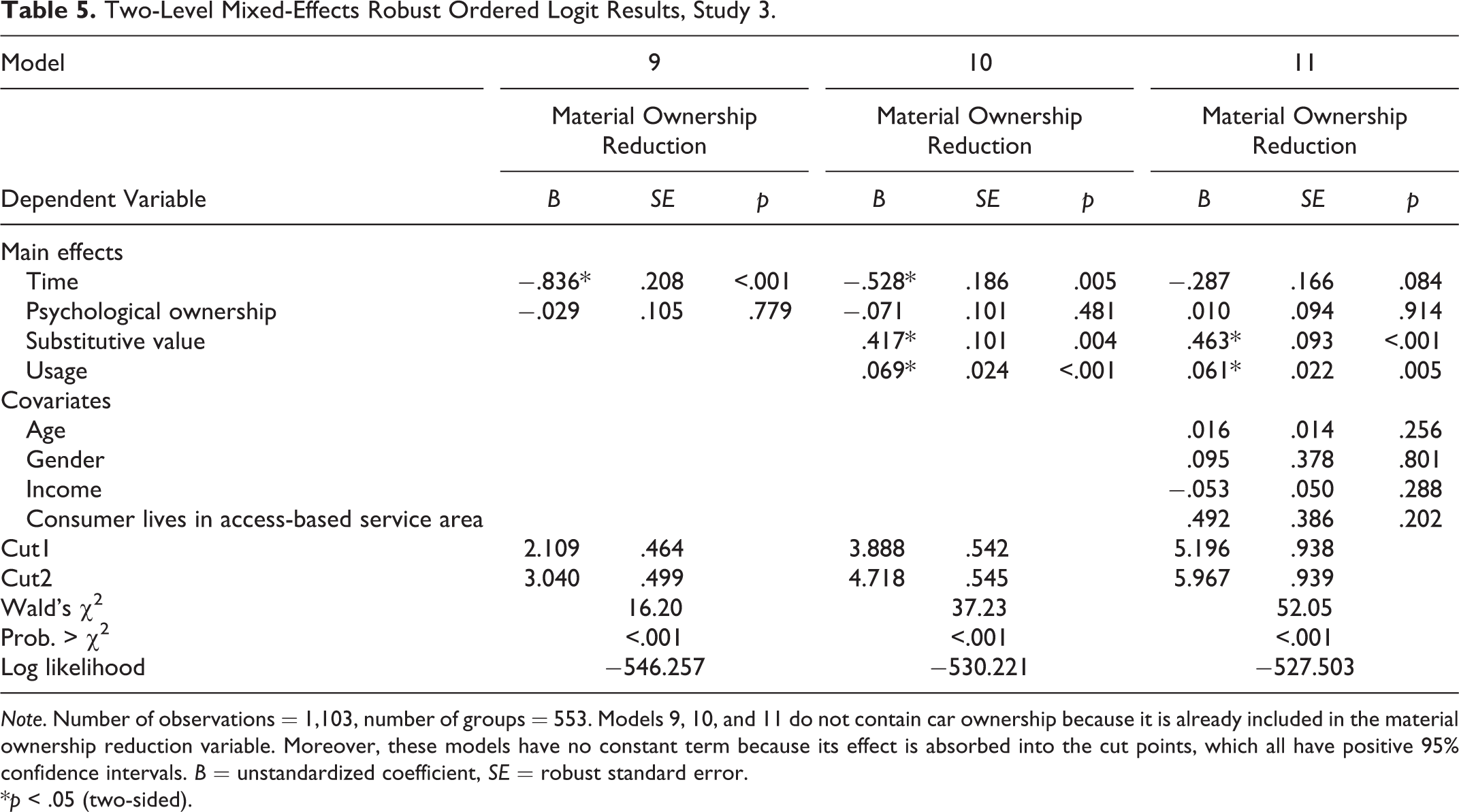
Note. Number of observations = 1,103, number of groups = 553. Models 9, 10, and 11 do not contain car ownership because it is already included in the material ownership reduction variable. Moreover, these models have no constant term because its effect is absorbed into the cut points, which all have positive 95% confidence intervals. B = unstandardized coefficient, SE = robust standard error.
*p < .05 (two-sided).
Conclusion
Theoretical Contributions
Scholars and practitioners have debated the extent to which the sharing economy will truly disrupt traditional markets. Its influence on material product sales has gained significant traction in academic literature (e.g., Liebowitz 2008; Wlömert and Papies 2016), and ABS, as a hallmark of the sharing economy, have risen in popularity. But ABS providers continue to struggle to attract sufficient consumer demand. By extending insights into how to reinforce ABS consumption (Hazée, Delcourt, and Van Vaerenbergh 2017; Schaefers, Lawson, and Kukar-Kinney 2016), we test a novel approach that aims to increase consumers’ ABS use. Our theory and findings suggest that when ABS customers develop a stronger sense of psychological ownership toward the service, they grow to perceive the service as a substitute for a material possession (e.g., owning a car). And they ultimately reduce their material ownership while increasing their service consumption. With this perspective, our study contributes to psychological ownership theory, sharing economy research, and the services marketing literature.
Although psychological ownership theory already has predicted that ownership can apply to nonphysical entities, we extend existing literature by theorizing and empirically examining the extent to which such entities fulfill the need for possession in comparison with material objects. Critically, to our best knowledge, no prior research has addressed the relationship between psychological ownership toward ABS and the meaning of material ownership consumption. Our findings thus enhance understanding of the dispossession of material goods (Albinsson and Perera 2009; Lastovicka and Fernandez 2005), with specific insights for sharing economy research. Atasoy and Morewedge (2018) found that consumers have a lower willingness to pay for digital goods than for their physical counterparts on the single-item basis (e.g., physical vs. a digital copy of a book or movie). Moreover, conspicuous consumption literature suggests that physical products outperform nonphysical ones in terms of symbolic value (Heffetz 2011; Yang and Mattila 2017). In contrast, our findings caution that when it comes to ownership feelings gained through a certain mode of consumption, services can be a valid substitute for material objects in the context of the sharing economy. We demonstrate that ABS can psychologically satisfy the human need for ownership and accordingly replace material objects. These results also stand in contrast to Bardhi and Eckhardt (2012) who conducted interviews among Zipcar users and concluded that “access does not produce a sense of joint or perceived ownership” (p. 895). Our results gathered in different contexts, and employing multiple study designs put forth a different yet consistent pattern and offer a fresh perspective. We propose that there are multiple contingency factors that help to explain this divergence in extant empirical findings such as the ownership reference object or the specific service characteristics.
We also advance service research on ABS and how to engage customers with them (e.g., Hazée, Delcourt, and Van Vaerenbergh 2017; Schaefers, Lawson, and Kukar-Kinney 2016). Sharing services promise to offer important business revenue streams. They also might foster more sustainable economies. We theorize and introduce psychological ownership as a potential determinant of consumers’ preference when they can choose between material ownership and access modes of consumption. Prior research frequently highlighted the low-cost benefits of access-based consumption (e.g., Bardhi and Eckhardt 2012; Lamberton and Rose 2012; Tussyadiah and Pesonen 2016), but we go beyond these functional advantages to show how consumers can be actively guided to increase their ABS consumption, by leveraging the psychological power of ownership feelings. These novel insights in turn can help ABS managers and public policy stakeholders effectively increase the diffusion of access-based consumption.
Finally, based on a legal ownership understanding, the sharing economy is often considered as a nonownership domain (for an overview, see Eckhardt et al. 2019) or a postownership economy (Belk 2014). While our findings emphasize the transformative potential of the sharing economy, we also stress that the importance consumers attach to psychological aspects of ownership not just disappears but rather remains present within this relatively new domain. We hope that this perspective provides scholars and practitioners with a new lens for observing marketplace activity within the sharing economy.
Managerial Implications
Managers of ABS still seek to create demand and gain market share, while competing with traditional markets. Understanding consumption decisions in such settings is thus highly relevant, and we propose a new lens through which ABS providers can observe and govern marketplace activity in a sharing economy. Specifically, our study provides new insights into why people forgo material product ownership in favor of ABS consumption because they perceive a sense of ownership of the services. Managers therefore should work to encourage such ownership feelings to increase consumers’ engagement rather than devoting time and effort to combating the desire for actual ownership through communications that highlight cost reduction motivations. In particular, to help consumers choose to substitute sole ownership with ABS, managers can facilitate relevant ownership feelings, and these perceptions toward ABS can help detach consumers from their material possessions, thereby overcoming a critical, persistent barrier to ABS usage. Because access-based consumption promises more sustainable societies (Mi and Coffman 2019), public policy makers also might be interested in promoting ABS consumption, by inducing a sense of psychological ownership toward them.
Specifically, promotional campaigns that emphasize the social desirability of access-based consumption could cite the identity-related importance of this mode of consumption. Managers should relate their ABS to an identity that is appealing to consumers, as exemplified by the promotional claim of being “proud to share,” used by the German-based carsharing provider car2go. However, consumers’ identity motivations are somewhat beyond the influence of managerial interventions because any identity-driven connection with ABS also depends on external factors in a society at a certain point of time (Pierce, Kostova, and Dirks 2003). In contrast, consumers’ intimacy and perceived communal identification can be primed and managed to encourage a sense of psychological ownership. For example, to evoke a sense of communal identification among customers, the ABS provider could create a service-related online community that facilitates exchanges about the service and coordinates customer interactions (Wirtz et al. 2019; Wirtz et al. 2013). Customers’ intimacy with the service likely would be increased by a service infrastructure that fosters an enjoyable customer experience. Moreover, managers would be well advised to educate customers and build more intimate relationships with them, to elicit service psychological ownership (Eisingerich and Bell 2008). Intimacy can also be related to interpersonal familiarity, which might help in overcoming customer contamination concerns and should therefore be fostered by ABS providers (Hazée et al. 2019). Because these antecedents of service psychological ownership likely vary in their effectiveness, managers also should consider status quo assessments of these variables through market research among customers, before designing marketing interventions such as promotion campaigns.
Finally, our results offer an important caution for companies that both sell manufactured products and provide ABS, such as in the case of carsharing companies, which are often subsidiaries of car manufacturers. Our results show that consumers engage in access-based consumption and diverge from other consumption domains, such as material ownership, because they have developed feelings of ownership toward ABS. Thus, manufacturing companies should consider clear “servitization” strategies (Vandermerwe and Rawa 1988) and position ABS carefully within their overall portfolio; introducing ABS could lead to self-induced market cannibalization for the sale of their own material goods. Consumers’ ABS adoption and ownership feelings might ultimately erode the economic foundation for firms that still seek to transition from goods to service solution providers (Forkmann et al. 2017).
Limitations and Research Opportunities
Some limitations should be considered when interpreting the results, and several research opportunities emerge from the current findings. Although we tested our model in two access-based business model contexts, namely carsharing and music streaming, continued research could explore the role of psychological ownership in other ABS contexts too. Moreover, we investigate psychological ownership feelings at the service level (e.g., carsharing service), not the goods level (e.g., shared vehicles). Future research that takes a closer look at the emergence of psychological ownership for different target objects in ABS and their interplay could reveal further important insights.
We recommend that ABS managers should foster stronger identity links and build customer communities that induce a sense of communal identification. However, many ABS providers already have tried to achieve these goals, with varying success. Because ABS tend to be anonymous, customers often do not directly interact (Perren and Kozinets 2018). Further research into effective ways of inducing individual and communal identification among ABS customers to determine access-based consumption therefore would be relevant. Another noteworthy observation is that identity is a stronger antecedent of psychological ownership than intimacy and communal identification in Studies 2a and 2b. One rationale for this finding might be that psychological ownership is more individual and less related to others. Indeed, while psychological ownership can be both individual and collective, previous research also suggests that individual ownership feelings precede a collective sense of ownership (Pierce and Jussila 2010). It might be worthwhile to further investigate the interdependence and hierarchy of the antecedents over time.
Moreover, additional research that explores cases in which access-based consumption fails to induce feelings of psychological ownership is richly deserving. What keeps an ownership effect toward ABS from arising? Do some segments of consumers simply regard sole ownership as the only viable form of ownership? In which conditions might access be unable to substitute for ownership because these formats lead to divergent outcomes? How does psychological ownership relate to various effects of message framing (e.g., loss- and gain-framed; Seo and Park 2019)? Can further factors such as consumer lifestyle, status-seeking behavior, or product involvement mitigate the effects of psychological ownership? These are all important questions worthy of additional exploration.
Finally, we investigate how psychological ownership toward an ABS might increase existing customers’ usage intensity. We encourage additional work to examine how psychological ownership of a service might help motivate consumers to start using ABS. Further research could help clarify the role of psychological ownership for ABS consumption over time and at different stages of consumption.
Supplemental Material
Supplemental Material, Executive_Summary - Access-Based Services as Substitutes for Material Possessions: The Role of Psychological Ownership
Supplemental Material, Executive_Summary for Access-Based Services as Substitutes for Material Possessions: The Role of Psychological Ownership by Martin P. Fritze, André Marchand, Andreas B. Eisingerich and Martin Benkenstein in Journal of Service Research
Supplemental Material
Supplemental Material, Web_Appendix_(Revision_3,_final) - Access-Based Services as Substitutes for Material Possessions: The Role of Psychological Ownership
Supplemental Material, Web_Appendix_(Revision_3,_final) for Access-Based Services as Substitutes for Material Possessions: The Role of Psychological Ownership by Martin P. Fritze, André Marchand, Andreas B. Eisingerich and Martin Benkenstein in Journal of Service Research
Footnotes
Acknowledgments
The authors are grateful to the editor Michael K. Brady, the associate editor, and the anonymous reviewers for their constructive comments and suggestions on this research.
Declaration of Conflicting Interests
The author(s) declared no potential conflicts of interest with respect to the research, authorship, and/or publication of this article.
Funding
The author(s) received no financial support for the research, authorship, and/or publication of this article.

Supplemental Material
Supplemental material for this article is available online.
Note
References
Supplementary Material
Please find the following supplemental material available below.
For Open Access articles published under a Creative Commons License, all supplemental material carries the same license as the article it is associated with.
For non-Open Access articles published, all supplemental material carries a non-exclusive license, and permission requests for re-use of supplemental material or any part of supplemental material shall be sent directly to the copyright owner as specified in the copyright notice associated with the article.
