



Abstract
Pronounced gender segregation and inequality evident in Saudi Arabia reflect profoundly patriarchal socio-cultural norms and values that have traditionally regulated women's roles and aspirations. Yet greater employment feminization has potentially notable implications for human resource management. In this context, the research investigates how women's labour power is managed in Saudi firms. For this purpose, the paper derives a gendered employment relations approach, one which treats the employment relationship as a ‘structured antagonism’ and incorporates a ‘gender lens’. Using data collected from women workers and managers in five Saudi firms, the paper illuminates the dynamics of gender and the employment relationship. In particular, it points to the growing dependency of Saudi firms on women's labour power, the importance of women workers’ agency and interests, the workplace tensions arising as a consequence and the presence of distinctive kinds of accommodation. The paper's main contribution is to demonstrate how the management of women's labour intersects with prevailing socio-cultural norms to influence the dynamics of gendered employment relations.
Introduction
In the context of greater employment feminization, increasing attention is being paid to gender in studies of human resource management (HRM) in Gulf states such as Saudi Arabia, where patriarchal socio-cultural norms have traditionally limited women's employment participation. The focus is largely restricted to issues relating to women managers, particularly the challenges they experience, or limited to the perspective of managers (Al-Asfour et al., 2017; Tlaiss and Al Waqfi, 2022). Yet how the labour power of women workers is managed in such environments and the influence of patriarchy on the gendered dynamics of their employment relationship have largely been neglected. In seeking to tackle these gaps, the paper uses data collected from women workers and managers in five Saudi firms to address a key research question: how do socio-cultural norms intersect with the structural features of the employment relationship to influence the management of women's labour power? In order to conceptualise the research, we develop what we call a ‘gendered employment relations’ approach. As well as viewing the employment relationship as a ‘structured antagonism’, it also applies a ‘gender lens’ to understanding this relationship (Edwards and Hodder, 2022; Rubery and Hebson, 2018).
Saudi Arabia is a highly appropriate setting for our investigation. It has long been well-known for having among the lowest levels of women's employment participation in the world and for its extensive gender segregation and inequality (Aldossari and Calvard, 2022; Syed et al., 2018). These reflect the powerful influence of patriarchal socio-cultural norms that have traditionally regulated Saudi women's activities. Yet a key aim of the country's programme of economic and labour market reforms, centred upon the Saudi Vision 2030 initiative, is to increase the proportion of women in employment from 22% to 30% by 2030 (Abalkhail, 2020).
Importantly, in Gulf states such as Saudi Arabia the operation of workforce localization policies has stimulated greater employment feminization (Tlaiss and Elamin, 2016). The Saudi Nitaqat quota system, established in 2011, incentivizes firms to hire indigenous citizens, including women, upon whom they have become increasingly dependent, in preference to foreign workers (Albelali and Williams, 2022; Basahal et al., 2023). Whereas women were traditionally largely excluded from private sector jobs, their presence is becoming more commonplace in sectors such as retail, banking and services (Sian et al., 2020). Our research findings illuminate how women's experiences of the workplace have influenced their expectations and aspirations, providing new knowledge about gendered change in Saudi workplaces. In doing so, they help to advance our understanding of ‘gendered employment relations’ as a tool for conceptualising the dynamics of gender at work.
Literature review
Given the context of growing employment feminization, better knowledge and understanding of how firms in Gulf states such as Saudi Arabia manage the labour power of the growing number of women they employ is needed. In the specific case of Saudi Arabia, the influence of highly conservative socio-cultural norms, derived from a particular interpretation of Islam and a legacy of tribalism, which privilege male authority, needs to be recognized. While women are ‘honoured’, they are, ‘at the same time, constrained and subordinated’ by men (Sian et al., 2020: 4). Women are expected to devote themselves to household and family matters, helping to uphold their virtue, honour and reputation (Aldossari and Calvard, 2022; Syed et al., 2018; Tlaiss and Elamin, 2016). In such a profoundly patriarchal environment, the necessity for Saudi women to receive permission from a male guardian before being able to take a job was traditionally a notable barrier to their labour market participation (Abalkhail, 2020; Al-Asfour et al., 2017; Syed et al., 2018).
While there has been an easing of restrictions, and women have been entering the labour market in greater numbers, patriarchal socio-cultural norms still constrain their opportunities (Aldossari et al., 2023; Alshareef, 2022). Restrictions on their mobility, by curbing the scope of their work activities (e.g. a lack of opportunities to travel and visit clients), act as barriers to women's participation and advancement in employment (Aldossari et al., 2023; Sian et al., 2020). Women's labour remains insufficiently valued. They are often corralled into low-level, low-paid positions, which lack status and opportunities for advancement (Basahal et al., 2023; Sian et al., 2020). Tribal and family norms regarding the undesirability of mixed-gender environments mean that women can be restricted to roles where interactions with men are limited (Aldossari and Calvard, 2022; Basahal et al., 2023; Eger et al., 2022; Syed et al., 2018). Behaviours by men, that disparage and exclude women, further reinforce gender disadvantage in Saudi firms (Aldossari et al., 2023; Alkhaled, 2021; Tlaiss and Al Waqfi, 2022).
One way of theorizing women's work in Saudi Arabia would be to draw upon the concept of ‘contemporary patriarchy’ which has been applied to developments in the neighbouring Gulf state of Qatar. This captures how ‘women encounter new opportunities, including opportunities for employment, while their dependence on men and on a male-privileged kinship structure is preserved’ (Salem and Yount, 2019: 502). Saudi women can find themselves troubled by the challenges arising from having an increased prominence in workplaces, and the greater potential opportunities this offers, and their attachment to traditional socio-cultural norms, such as the importance of family responsibilities, which regulates their aspirations (Aldossari et al., 2023).
The ‘contemporary patriarchy’ approach is potentially highly useful for understanding women's work in Saudi Arabia, insofar as it attests to the presence of conservative socio-cultural norms that influence women's orientations and behaviours. However, it pays insufficient heed to the efforts made by managers in Saudi organizations to advance gender equality and inclusion, and the consequences of such efforts. Using institutional theory to investigate gender and HRM in Saudi Arabia, Tlaiss and Al Waqfi (2022) demonstrate that a more strategic role for HR is evident, one concerned with promoting equality, in a context of employment feminization. As they show, though, Saudi firms are embedded in a specific institutional setting, marked by the presence of distinctive ‘cognitive-cultural’, ‘regulatory’ and ‘normative’ pillars. Regulatory change, in the form of legal liberalization, has enabled HR managers to promote women's inclusion (Tlaiss and Al Waqfi, 2022). Efforts to encourage women's career development and develop flexible working arrangements that are attractive to women, and from which they benefit, are evident (Abalkhail, 2020; Sian et al., 2020). Yet progress towards greater inclusion and equality is hindered by the presence of a deep-rooted and highly conservative ‘traditional gender ideology’, something which is sustained by powerful ‘cultural-cognitive mechanisms’, systems of beliefs about the appropriate roles and behaviours of men and women, and ‘normative forces’, shared social norms and values that uphold gender stereotypes (Tlaiss and Al Waqfi, 2022: 1838, 1837).
The application of institutional theory by Tlaiss and Al Waqfi (2022) has improved our understanding of the dynamics of HRM and gender in Saudi firms. However, in emphasising the role of HR managers change agents, albeit within the parameters of prevailing socio-cultural norms, it overlooks the experiences and interests of women workers themselves. Importantly, though, these do increasingly feature in the wider literature relating to work and organizations in Saudi Arabia (Aldossari et al., 2023; Sian et al., 2020; Syed et al., 2018), including the role of women as active subjects (Aldossari and Calvard, 2022), with some notable implications for theorization. In a study of a multinational company, and using ‘tokenism’ as a theoretical lens, Aldossari et al. (2023: 53) highlight how Saudi women experience and navigate the tensions arising from working in an organization marked by ‘superficially progressive Western values’ and an espoused commitment to gender equality. A ‘relational’ approach to tokenism captures how the ‘interplay of societal and organisational contexts…created paradoxical situations…classified as Catch-22 s – that is, instances where contradictory conditions of modernity/progressiveness and social convention/traditionalism coexisted’ (Aldossari et al., 2023: 46) – manifest in a complex politics of (in)visibility in particular.
This points to the importance, when seeking to understand women's work in Saudi Arabia, of eschewing ‘Western-centric’ assumptions about their orientations and behaviour (Aldossari and Calvard, 2022). Two things are critical here. First, we should reject a reductionism that assumes that Saudi women are ‘silent or reified objects’, being straightforwardly oppressed, but rather view them as ‘active participating subjects’ (Jamjoom and Mills, 2023: 957). Second, conformity and resistance among Saudi women can be manifest in distinctive ways, different from those evident in the West (Alkhaled, 2021; Jamjoom and Mills, 2023). As Aldossari and Calvard (2022: 885) observe, women workers in Saudi Arabia ‘experience and enact distinct ethico-political patternings of gendered conformity and resistance. These patternings are culturally and relationally embedded in both societal and organizational webs of meaning, which shape how women navigate and respond to gendered norms and practices in particular ways’.
Clearly, there is a notable emerging body of literature devoted to illuminating the experiences and behaviour of women workers in Saudi Arabia, in a context of greater feminization. There is a growing focus on understanding women workers as active subjects themselves, in a way that has stimulated new theoretical insights. One important lacuna, though, concerns the status of women workers as labour, parties to an employment relationship with an employer. The value of a perspective which emphasizes the importance of understanding Saudi workers as labour, and how employers look to secure labour power from them, through efforts to manage their employment relationships, is becoming increasingly evident in studies of HRM in Saudi Arabia (Adham and Hammer, 2021; Hammer and Adham, 2023). However, workplace gender relations are not a concern of this emergent literature. This is why a gendered employment relations approach, as derived for this paper, is so useful conceptually, for understanding how women's labour power is managed in Saudi firms, in a context of greater employment feminization.
Our gendered employment relations approach comprises two main elements. First of all, it involves viewing the employment relationship as a ‘structured antagonism’. Although workers and employers are dependent upon and must cooperate with, each another, there is always the potential for conflict between them to arise, which, depending upon the context, and under certain circumstances, can become manifest in various ways (Edwards, 1986). This is because the employment relationship is characterised by an underlying ‘clash of interests’ (Edwards and Hodder, 2022: 223), stemming from the indeterminate nature of this relationship and the efforts of employers to secure productive effort from workers and exercise control over them accordingly. As a consequence, the job of managing HR is invariably marked by tensions and the search for accommodations, given the need to be responsive to workers’ interests. Securing labour power from workers thus involves having to ‘negotiate over the terms of the labour contract’ – a process of ‘effort bargaining’ (Edwards and Hodder, 2022: 225). One key implication of this is that in order to understand HRM properly it is imperative that the experiences and interests of workers are integral to any research enquiry (Harney et al., 2018).
Second, in addition to viewing the employment relationship as a ‘structured antagonism’, our gendered employment relations approach accords a privileged position to gender. When it comes to understanding HRM and employment relations, the importance of taking a gendered perspective has long been emphasised (Holgate et al., 2006). Using a ‘gender lens’ (Rubery and Hebson, 2018) should not be narrowly focused just on understanding the experiences and interests of women workers, important though these are. Instead, it should primarily be concerned with illuminating how relationships and interactions between men and women in work settings can be understood, as social processes, particularly the dynamics of power relations (Bradley, 1999; Holgate et al., 2006). Applying a gendered employment relations approach enables an understanding of how the management of women's labour power in Saudi firms is shaped by the intersection of socio-cultural norms with the structural features of the employment relationship in a context of greater employment feminization. By focusing on the interests and activities of women workers themselves, influenced by the nature of their relations with (male) managers, it augments relevant existing theoretical perspectives relating to women workers, gender and HRM in Gulf states such as Saudi Arabia.
Research methods
For the purpose of investigating the dynamics of gendered employment relations in Saudi workplaces, a phenomenological interpretivist method was deemed suitable (Bonache, 2021). The phenomenological dimension was important in facilitating a concern with the interests of Saudi women workers. It did so by enabling a focus on their narratives and how they made sense of their social world (Moustakas, 1994), and was consistent with a feminist emphasis on understanding women's lives and ensuring that their voices were heard (Fisher, 2010). The interpretivist element meant that the importance of subjectivity was recognized in the research process. Saudi women are active subjects, who have their own distinct ways of making sense of, and responding to, as necessary, the tensions that arise from their workplace experiences (Aldossari and Calvard, 2022; Jamjoom and Mills, 2023). An interpretivist dimension enabled our research to focus on the subjective interests of Saudi women workers, in the context of their relations with managers and employers, teasing out the dynamics of cooperation and conflict in a way that was consistent with viewing the employment relationship as a ‘contested terrain’.
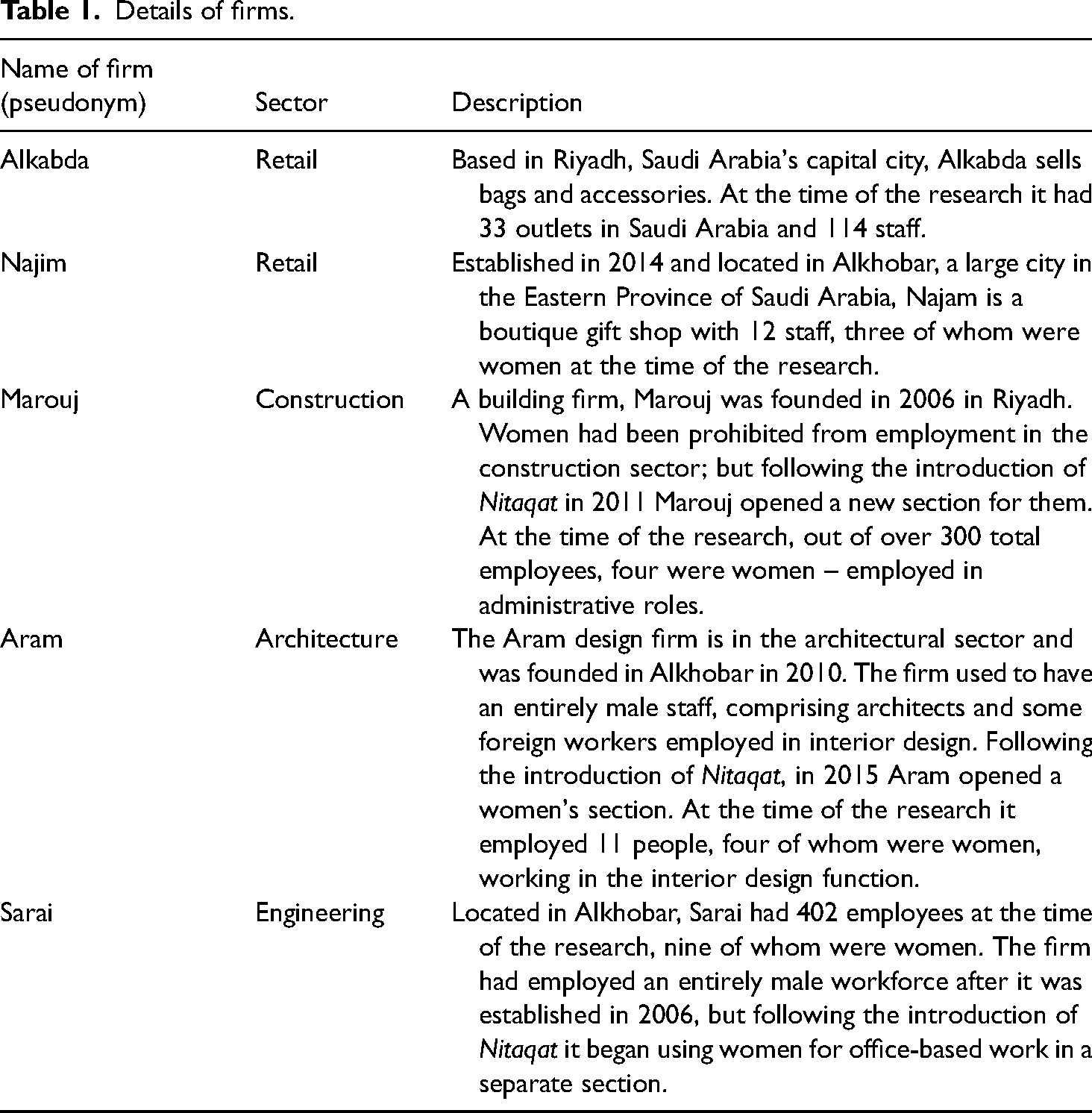
A qualitative research strategy was utilized, consistent with the phenomenological interpretivist methodology. To this end, semi-structured interviews were undertaken with women workers (and managers) in five firms. See Table 1 for details of the firms, that have been given pseudonyms. The firms which provided research participants were selected purposively on the basis that at the time the research was undertaken, in 2017, they had started employing women workers – following the 2011 introduction of the Nitaqat quota policy. Otherwise, though, they differed markedly. In the retail sector, Alkabda employed women who had relatively little formal education in routine sales positions considered to be low-status. By contrast, while Najim was also a retail firm, it was a much smaller, more niche, operation than Alkabda. The women in Najim all had bachelor's degrees, and the firm's owner-manager was herself a woman. Feminization notwithstanding, the workforces of Marouj and Sarai respectively remained overwhelmingly male dominated. In these firms, the women workers, who also all had bachelor's degrees, were funnelled into office-based, administrative roles, facilitated by the establishment of separate women-only sections. The architectural and interior design firm, Aram, employed highly educated women, who held appropriate qualifications and were engaged in professional jobs attracting relatively high social status. In collecting data from five separate firms, the research aimed to capture the potentially varied nature of women workers’ experiences, and thus the implications for gendered employment relations in Saudi Arabia – based on the sector in which the women worked, their social and educational background, their position within the firm and the nature of their respective job roles.
Details of firms.
In-depth interviews with research participants are a very suitable means of conducting qualitative research in work settings. A total of 26 in-depth, semi-structured interviews, between 30 and 45 min in length, were undertaken with managers and women workers, across the five firms. See Table 2 for details of the fieldwork. Interview transcripts, taken from audio recordings, were produced in Arabic. One notable challenge in qualitative research, where data are collected in one language, but analysed and written up as research findings in another, involves ensuring that the process of translation is undertaken accurately (Temple and Edwards, 2002). For the purpose of ensuring accuracy, in translating interview data from Arabic to English, the lead author clarified the meaning of randomly selected samples of text with a native Arabic-speaking senior academic at her thenhost institution.
Fieldwork details.
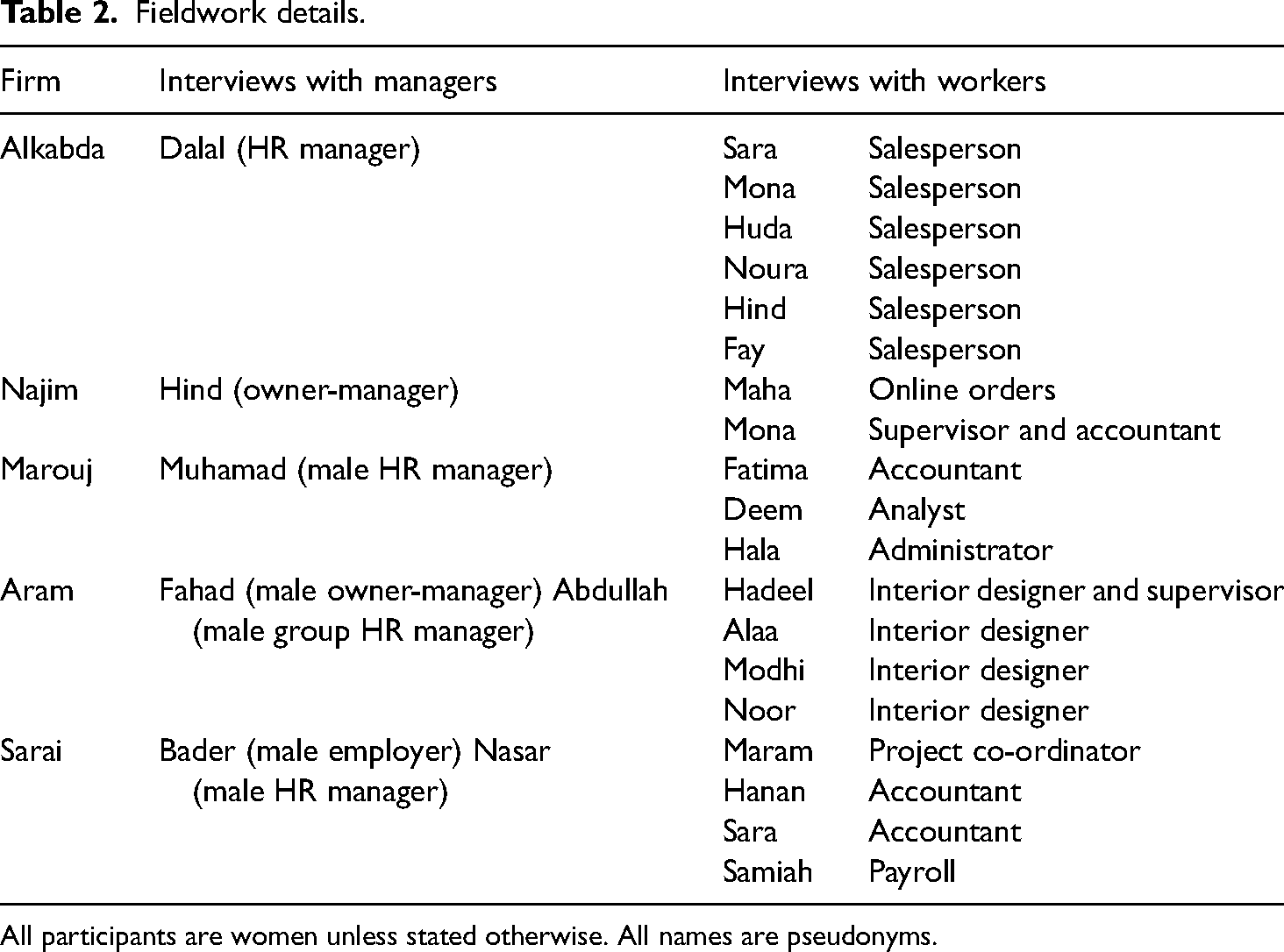
All participants are women unless stated otherwise. All names are pseudonyms.
A thematic analysis approach was used for the purpose of analysing the research data from the project as a whole. It offered the flexibility that is desirable when looking to acquire an in-depth understanding of research participants’ perspectives (Braun and Clarke, 2013). Following a process of data familiarisation, interview data from each firm were coded separately, on an inductive basis. Following a process of code refinement, the codes were used to derive three key themes, organizing the findings for each firm – the effects of the Nitaqat quota policy on female employment; the workplace experience of female employees; and HRM and female employees. This process was undertaken using the Atlas.ti programme. It proved to be a highly effective device for organizing and analysing the qualitative interview data, in particular by providing a holistic perspective on the research that produced rigorous findings. Atlas.ti's visualization features enabled the connection of codes, the generation of themes and the creation of relationships between codes and themes for the purpose of interpreting data (Friese, 2014). See Figure 1 for an illustration – based on the data collected from Alkabda – of how the relevant codes were organized into one of the three themes, that of ‘HRM and female employees’.
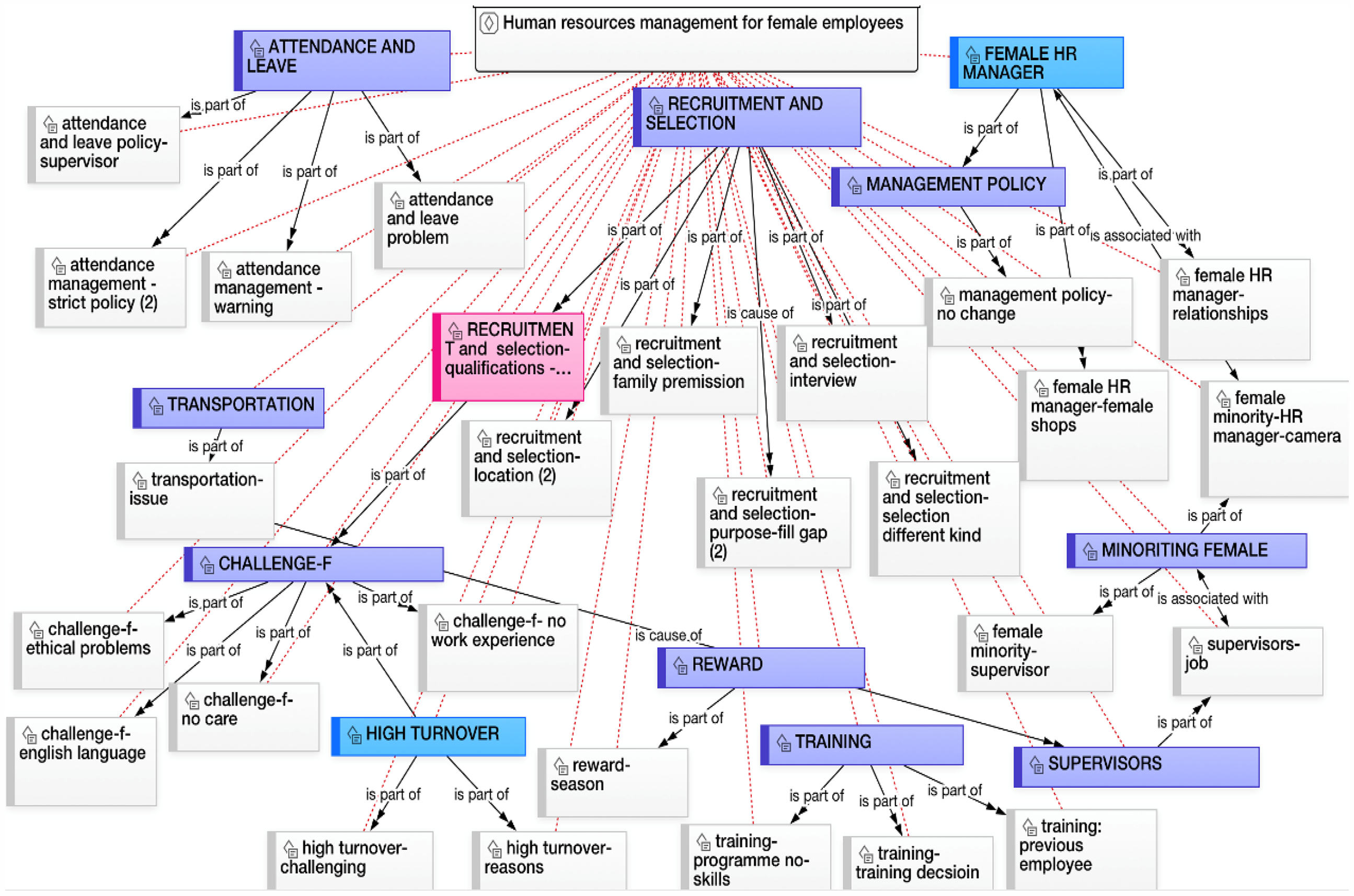
Alkabda – HRM and female employees theme.
For the purpose of this specific paper, a further round of thematic development was then undertaken, in order to illuminate the nature of gendered employment relations in each of the five firms. This involved three steps. First, three categories were derived – concerned with elucidating how women's labour power is hired, used and enhanced, respectively – to capture the dynamics of the employment relationship. The second step was to specify three dimensions – women workers’ interests, the nature of their effort bargain (cooperation and/or the potential for conflict) and the influence of gender – integral to the gendered employment relations approach. The third and final step involved a mapping exercise, whereby the codes derived from the Atlas.ti exercise and initial phase of theme development were reviewed to ascertain their relevance. Applied to Alkabda, for example, this exercise registered the high turnover recognized in the coding process, and its relevance to the theme of ‘HRM and female employees’ (see Figure 1), while also highlighting its connections to the commodified and coercive basis of the women's employment relationships.
The involvement of the researcher in a qualitative study of this kind necessarily influences how participants engage with the research and the nature of the data collected and, subsequently, the processes of analysis and interpretation (Gabriel, 2015; Leavy and Harris, 2018). The lead author, who undertook the fieldwork, was aware of how her position, as a Saudi woman, could potentially influence the research outcomes (Gabriel, 2015), but was careful to exercise appropriate reflexivity throughout the research process. Her deep familiarity with the socio-cultural setting meant that she could build trustworthy relationships with research participants, enabling the production of a particularly rich set of qualitative data – of a kind an outsider would have been unlikely to obtain. This included being able to engage with women workers on an emotional level. For example, one of the women in Alkabda felt comfortable in expressing her feelings of sadness about the strictness of her employer and the importance of supporting her family to the lead author. This kind of personal engagement helped to enrich the research findings. The lead author's efforts to ensure sufficient rigour were reinforced by the involvement of a non-Saudi co-author in the analysis and writing processes.
Research findings
In order to investigate how women's labour power is managed in Saudi firms, in a context of greater employment feminization, we cover the findings of the research in three separate sections. We begin by focusing on the process of hiring women's labour power before turning our attention to this power is used by Saudi firms and, lastly, its enhancement, through training and development interventions and opportunities for advancement.
Hiring women's labour power
One very clear finding from the research was how Nitaqat had incentivised Saudi firms – directly or indirectly – to hire women workers for the first time. Only Aram already employed sufficient (male) Saudi nationals to comply with its quota obligation. Instead, it saw the Nitaqat policy as an opportunity to employ women as interior designers, replacing foreign workers. In Sarai, Marouj and Alkabda there was a clear emphasis on engaging women for the purpose of quota compliance, albeit in ways that varied. In the case of Marouj, Muhamad, the HR manager, was adamant that the firm did not want to employ women and only did so because it was obliged to. Construction was perceived as a sector that was unsuitable for women's work. For Deem, who was employed as an analyst in Marouj, the rationale for hiring women was clear: I feel they employed us just to fill job quota gaps … there is no clear plan or work! …they don’t want us here; they employ us just to fill job gaps.
With regard to hiring women workers a key tension was apparent in some of the firms. On the one hand, women's labour power was regarded as important, not least for the purpose of Nitaqat quota compliance in a context of greater employment feminization. On the other hand, though, the women often (with the exception of those in Aram and Najam) believed themselves to be treated as if they had little of value to offer – a reflection of their marginalized and commodified status. Even in Najam, there was a sense that women were hired in roles that, because they are low-paid, were unattractive to men. Employing women in sales roles also helped to attract women customers, who otherwise experienced difficulties communicating with male staff. Maha explained why she believed she was employed by Najam: I have my qualifications and I have knowledge of marketing, which only helps me in my work here … the management employed me not just for my qualification … but also for my skills regarding the nature of the job.
One clear feature of the research was the dissatisfaction evident among women workers, with the exception of those in Aram, because of their belief that they were hired into low-status and low-paid roles which gave them few opportunities to progress. As has already been noted, Marouj was opposed to hiring women at all, let alone employing them purposefully, because of a belief that working in construction was unsuitable. Deem expressed frustration about her situation: Even though Nitaqat provides jobs, my working here provides a low salary and a very low-level job - entering data into a computer, arranging files, etc. The only challenge I face in the employment of women is finding qualified females who are prepared to work in the mixed environment; their family may prevent them from working here, because they don’t allow them to communicate with male employees or male customers. We faced challenges in the mixed environment, when first employed at this firm…the male employees didn’t accept me in the firm; they saw female employment as a strange thing, especially Saudi female employment! The male employees didn’t accept us; for example, when I was working in Accounts and the men made mistakes, they didn’t accept me correcting them, because I’m female.
Using women's labour power
Once hired, how is women workers’ labour power then used by Saudi firms? A gendered employment relations approach holds that because of their divergent interests the process of securing productive effort from women workers by employers produces specific tensions and antagonisms that need accommodating. One key aspect of this concerns the nature of supervisory and managerial control arrangements. A notable feature of the research was the marked variation that was evident between Alkabda and Marouj, on the one hand, where a low-trust approach was apparent, and Najam and Aram, on the other, which both looked to operate a more commitment-based agenda, characterized by an emphasis on building high-trust relations to secure flexibility and performance improvements.
In the case of Alkabda, the important extent to which the firm sought to use women workers as a low-cost and supposedly easily controllable substitute for foreign staff was evident. It operated a highly coercive and authoritarian approach based on strict and intensive monitoring and surveillance techniques, with the women themselves unable to communicate at all with (male) senior management – other than through Dalal, the woman HR manager. One of the sales staff, Mona, claimed that the women workers: …are treated as a commodity to do work and accept any decision! I will not make an effort for the firm to increase its profits and I don’t care about the firm. We work in low-paid administrative jobs. In reality, there is no serious work. It has happened sometimes that no paperwork was received at work for a whole day!. In the short period since I first came here, the HR manager has given me responsibility and trust… she has given me freedom over how I work, and this means she trusts me and appreciates my work. The manager gave me a project, despite me still being new in the firm, and I worked on it, and this encouraged me to put all my effort into it… even though I am younger than them, they gave me a workspace; they shared their project with me and asked me my opinion….
A second key aspect of how Saudi firms seek to use women's labour power concerns the distinctive spatial configuration of workplaces. A gendered employment relations approach holds that employers must attempt to manage women workers’ expectations appropriately in order to secure productive effort. In the Saudi setting, given prevailing socio-cultural values governing interactions between women and men in public, the provision of an appropriate spatial environment, one which satisfies women workers’ expectations, and those of their families, as well as male managers, colleagues and clients, and which enables women to feel valued and contribute effectively, is integral to workplace employment relations. Four of the five firms featured in the research operated ‘mixed-gender’ spaces; environments where women and men could work together. The exception was Marouj, where the women workers were physically separated from the rest of the firm in their own private women-only section. In the retail companies, Alkabda and Najam, the ‘mixed-gender’ spaces were the stores themselves, which were patronised by men and women. Both Sarai and Aram appreciated the benefits of operating ‘mixed-gender’ spaces since they facilitated collaboration and allowed men and women to share and learn from each other's experiences.
However, some notable challenges in operating ‘mixed-gender’ environments were evident. One key source of antagonism was that women could sometimes experience hostility from men – from male customers and colleagues who oppose women's employment, in environments where they come into contact with men. When working in ‘mixed-gender’ environments, women generally wore a hijab, conforming with their values of modesty and privacy. But this could create difficulties. In Alkabda, for example, at the time of the research, the women sales staff were required to wear hijabs and cover their faces, even though they did not want to, throughout the duration of long shifts, creating considerable discomfort. Elsewhere, though, the firms had created separate, private sections for women only, facilitating their inclusion and securing their engagement. Samiah, who worked in payroll for Sarai, noted: As I [usually] cover my face, I feel very comfortable in the private section. If I worked with men, I would have to cover my face for nine hours! … the private female section in the firm is a big advantage for me working here; the private section gives us a sense of privacy, we feel comfortable, we can eat and do things with nothing annoying us.
Yet by facilitating their inclusion, separate gendered spaces are suggestive of the efforts women make to ‘navigate within an ethico-political praxis and…push the masculine systems in place while creating new arrangements and possibilities’ (Jamjoom and Mills, 2023: 979). Using a gendered employment relations approach, though, also demonstrates how the provision of separate spaces, alongside so-called ‘mixed-gender’ environments, enables Saudi women workers to regulate their interactions with men. In emphasizing their agency, within the structural constraints of their employment relationships, and shaped by prevailing socio-cultural norms, it illuminates how the experiences and expectations of women workers influence the dynamic of workplace gender relations in Saudi firms.
Enhancing women's labour power
The third part of the findings are concerned with investigating how women's labour power is enhanced in Saudi firms, through training and development interventions and opportunities for progression and advancement. From a gendered employment relations perspective, employers should be concerned with securing greater productive effort from women workers, through opportunities for training, development and progression; but workers have their own interests and expectations which may conform or conflict with those of their employers. One key source of antagonism evident from the research was the lack of formal training and development opportunities for women. But there was some notable variation otherwise. Aram made use of external provision; as did Sarai. The women in Sarai also recognised the importance of informal learning. According to Sara: I’ve gained a lot of experience in the firm; I have made mistakes and then learned a lot; our managers help us more than training courses I’ve been working here for two years; I have learned how to communicate socially with people. Previously, I didn’t have these communication skills, and I was unable to deal with different types of people. I really want to improve my skills, but there are boundaries. For example, if the manager asks me to give a financial statement over the phone, I can’t learn and understand! I can’t understand anything! Especially in Accounting, it is difficult, unless there is paperwork with a male employee, and we can share together. Even though I graduated from university in Accounting, I need to gain experience at work!.
Such attitudes impede women's advancement at work and help to entrench workplace gender segregation. But a notable feature of the research concerned the extent to which their workplace experience had changed women's expectations, improved their self-confidence and raised their aspirations. This was certainly evident among the well-qualified, professional women who were employed by Aram. But even women workers who had been hired in low-level roles – in the Alkabda, Najam and Marouj firms – appreciated that being in paid employment offered greater economic opportunities. Interacting with others, particularly managers and clients, had given them experience of the workplace, enabled them to develop, increased their sense of self-confidence, made them less dependent upon their families and raised their career ambitions. Deem, for example, explained that working at Marouj had positively affected her personal development: After working here, my personality changed a lot. I can see more growth in my personality, in terms of communicating with different people. I’ve learned a lot of information in work. I am also practicing with computer and information systems in the workplace, which has developed my skills and contributed to me positively! Working in the firm has given me confidence in everything; it has built up my personality a lot … before working, we depended on our families, but now I feel I can do anything. Honestly, I have ambitions to work in a better job…. a private business, or being a partner or employer, but not to be responsible for the whole firm; it is very difficult, I want to be a part of the management.
Discussion
The use of a gendered employment relations approach – applied to understanding the processes of hiring, using and enhancing women's labour power – offers some notable insights into gender and HRM in Saudi Arabia in a context of greater employment feminization. In particular, the findings illuminate the intersection between the gendered socio-cultural values and norms prevailing in Saudi Arabia, that govern the role of women and the nature of their interactions with men, and the structural features of women workers’ employment relationships, highlighting some distinctive gender dynamics. Three aspects are particularly evident from the research.
First, firms have become more dependent upon employing women workers, not least because of the direct and indirect impact of the Nitaqat quota scheme. With the exception of Aram, though, women's labour was largely disparaged, reflecting the influence of socio-cultural norms about the perceived undesirability of women's work outside the home (Al-Asfour et al., 2017; Aldossari and Calvard, 2022). In four of the five firms, there was a mismatch evident between women workers’ expectations, which had evolved as a consequence of their exposure to the workplace, and their experience of being segregated into low-paid, low-status roles – reflective of prevailing patriarchal socio-cultural norms that compromise efforts to challenge gender disadvantage (Aldossari et al., 2023; Sian et al., 2020). Clearly, the kind of ‘contemporary patriarchy’ that Salem and Yount (2019) identify in Qatar is manifest in Saudi Arabia too. Our gendered employment relations approach augments this work by illuminating how, in the context of the employment relationship, given its basis as a structured antagonism, tensions arose as a consequence of the women's experience of paid employment and how this experience had shaped their interests. Working in the firms had given the women increased self-confidence, contributing to a greater sense of independence – including independence from men. Yet they were frustrated by the perceived lack of opportunities to contribute or have their contribution recognised. Our gendered employment relations approach thus augments existing work on labour in Saudi Arabia (Adham and Hammer, 2021; Hammer and Adham, 2023) – by using a ‘gender lens’ to illuminate the evolving interests of women workers and how these influenced relations with their (largely male) employers.
This links to a second distinctive gender dynamic evident in the research – concerning the notable agency of women workers. The application of institutional theory has made an important contribution to understanding gender and HRM in Saudi Arabia, particularly by highlighting how HR managers advance gender equality – within a distinctive setting (Tlaiss and Al Waqfi, 2022). Our gendered employment relations approach augments such existing work by placing the interests, experiences and agency of women workers centre stage. It demonstrates how change in HR is a product of the dynamic relationship that exists between (largely male) employers and women workers, as a ‘contested terrain’, with managerial efforts to secure women's labour power creating tensions that need regulating.
Studies of Saudi women workers highlight the importance of viewing them as active subjects who navigate tensions arising from any clashes between expectations derived from traditional socio-cultural norms and values, on the one hand, and their employment role, sometimes in more ‘Westernized’ organizational settings, on the other (Aldossari et al., 2023; Jamjoom and Mills, 2023). Our gendered employment relations approach adds to existing work on the complex ways in which Saudi women workers seek to make sense of, and respond to, their circumstances (Aldossari and Calvard, 2022); not just by highlighting the role of women as active subjects, but also by emphasizing their status as ‘labour’. In the context of the employment relationship, as a structured antagonism, securing women's labour power, in a setting where firms are becoming more dependent upon it, requires that managers respond to, and even accommodate, their interests. Yet any such responses and accommodations, arising from the structural nature of the employment relationship, are conditioned by the distinct patriarchal socio-cultural norms evident in Saudi Arabia.
The third distinctive gender dynamic revealed by the research concerns the way in which women workers’ interests are accommodated through the distinctive spatial configuration of their workplaces – regulating their interactions with men. Existing studies demonstrate how, given the deep-rooted socio-cultural norms about non-family contact between women and men that prevail in Saudi Arabia, arrangements that limit interactions between men and women, through separate women-only spaces, can exacerbate gender disadvantage by reinforcing segregation (Basahal et al., 2023; Eger et al., 2022). Yet a key finding of our research was that the provision of separate spaces, alongside so-called ‘mixed-gender’ environments, could facilitate women's greater inclusion. This is redolent of the kind of ‘paradoxical situation’ that Saudi women have to navigate, managing their own (in)visibility, as they become more established in work organizations (Aldossari et al., 2023). Yet to characterise such a situation as a ‘Catch-22’ seems problematic, given the implication that women workers are somehow trapped. Instead, the gendered employment relations approach views Saudi women's employment relationships as, if not inherently paradoxical, at least marked by a profound contradiction – between the cooperation that arises from mutual dependency, on the one hand, and the potential conflict produced by divergent interests, on the other. The gendered spatial configuration of workplaces enabled women to regulate their interactions with men, especially given the negative experiences these often generated, satisfying their desire, and their families’ expectations, for appropriate privacy – and accommodating their interests.
While a ‘Western’ style of feminism might deprecate such segregation, in the context of Saudi Arabia the use of women-only spaces can be viewed as a manifestation of the kind of ‘distinct ethico-political patternings of gendered conformity and resistance’ noted by Aldossari and Calvard (2022: 885). But using a gendered employment relations approach also demonstrates how spatial segregation is legitimized, in a way that reflects the intersection between prevailing socio-cultural norms and the structured antagonism that lies at the heart of the employment relationship. The existence of gendered spaces both expresses conformity with such norms and the kind of accommodation that characterises the employment relationship as a ‘contested terrain’.
Conclusion
Women's employment is becoming more prevalent in Gulf states such as Saudi Arabia – linked to efforts to advance economic and labour market reforms, including the use of workforce localization policies, the Saudi Nitaqat quota scheme for example, to reduce dependency on foreign (male) labour (Albelali and Williams, 2022; Basahal et al., 2023; Sian et al., 2020; Tlaiss and Elamin, 2016). There is growing interest in the implications of employment feminization in Saudi Arabia (Basahal et al., 2023), including the nature of gender disadvantage in Saudi organizations (Aldossari et al., 2023; Sian et al., 2020) and the implications for HRM, particularly the role of HR in promoting gender equality (Tlaiss and Al Waqfi, 2022). Yet although there are emergent studies of labour and workplace issues in general (Adham and Hammer, 2021; Hammer and Adham, 2023), the nature and dynamics of Saudi women's employment relationships have hitherto been neglected by the existing HRM literature. This paper addresses the gap in our knowledge by investigating how women's labour power is managed in Saudi firms, drawing largely on the experiences and voices of Saudi women workers themselves.
In illuminating the management of women's labour power in Saudi Arabia, the paper makes a more general contribution to advancing theory – in two parts. The first part of the theoretical contribution involves the development of a ‘gendered employment relations’ approach – for the purpose of framing the research conceptually. Using this approach – applied to understanding the processes of hiring, using and enhancing Saudi women's labour power – highlights the dynamics of gender and HRM in Saudi Arabia in a context of greater employment feminization. Saudi women workers and the firms that employ them are dependent on each other, but given the nature of the employment relationship as a structured antagonism, their interests also diverge, resulting in tensions, as firms seek productive effort, which need accommodating (Edwards, 1986; Edwards and Hodder, 2022). Moreover, the application of a ‘gender lens’ (Rubery and Hebson, 2018) illuminates the intersection between the gendered socio-cultural values and norms prevailing in Saudi Arabia, that govern women workers’ roles and aspirations and how they interact with men, and the nature of their employment relationships.
The gendered employment relations approach asserts that the interests of Saudi women workers, as labour, are both aligned with and differ from those of their employer – with efforts to manage their labour power producing distinctive workplace gender dynamics. It thus complements and adds to existing theory concerned with understanding women workers, gender and HRM in Saudi Arabia. One way it does this is by acknowledging the relevance of ‘contemporary patriarchy’ (Salem and Yount, 2019), given the potentially powerful influence of prevailing patriarchal socio-cultural norms on how women's labour power is managed in Saudi firms. In viewing the employment relationship as a structured antagonism, marked by contradictions and the potential for conflict, our gendered employment relations approach holds that managers must be responsive to, and accommodate, the interests of women workers. In doing so, it augments the work of Tlaiss and Al Waqfi (2022), by asserting the importance of women workers’ agency, and their potential, as active subjects themselves, to influence HRM, as sources of institutional dynamism. Importantly, then, the gendered employment relations approach also builds on existing studies that emphasize the agency of women workers as they navigate the – often contradictory – imperatives arising from the intersection of traditional socio-cultural values and the nature of their role and activities in organizations (Aldossari and Calvard, 2022; Jamjoom and Mills, 2023) by underlining their interests as labour, and how this influences their orientations and actions.
The research thus highlights the important extent to which the dynamic of the gendered employment relationship itself is a potentially key influence on HRM in Saudi Arabia; first, because it contributes to a sense among Saudi women workers that they are becoming less dependent upon men; and second, by producing tensions that need accommodating. It implies that progress towards greater gender equality and inclusion in Saudi Arabia and similar settings cannot necessarily be restricted to top-down efforts by the state, firms and HR managers. Existing literature highlights how Saudi women have increasingly taken responsibility for forging their own careers – as entrepreneurs, for example, or in family businesses – as their economic participation grows. In so doing, they benefit from gender liberalization evident in Saudi Arabia, taking advantage of greater opportunities that arise. At the same time, though, they also influence the nature and trajectory of the liberalization process themselves, not least through the gender empowering potential of enacting entrepreneurship (Alkhaled and Berglund, 2018; Alsahli and Al-Dajani, 2021; Alshareef and Al-Dajani, 2024). Our study adds to existing work that stresses women's agency by demonstrating that gendered change in Saudi Arabia is not just a function of their activities in business. It is also a product of interactions between Saudi women workers and their (male) colleagues, managers and customers, and the accommodations these engender, in specific workplace environments.
As well as augmenting existing theory, the research also advances theorization through the insights it provides about the nature of gendered employment relations, conceptually, based on the Saudi setting. The second part of the theoretical contribution, then, concerns the implications of the research findings, relating to the management of women's labour power in Saudi firms, for understanding the gendered nature of employment relations more broadly. Addressing the research question, the paper demonstrates how the dynamics of gendered employment relations are shaped by the intersection between the employment relationship as a structured antagonism, wherein women workers have their own interests and agency, as labour, and the influence of prevailing socio-cultural norms. In the Saudi context this is manifest, for example, in the influence of distinct ‘ethico-political’ practices (Aldossari and Calvard, 2022; Jamjoom and Mills, 2023), forms of gendered spatial segregation for example, that influence women's labour power, and thus shape their interests. In incorporating a concern with gender, and in recognizing the role of women workers as active subjects, the gendered employment relations approach needs to be sensitive to the distinct characteristics of the setting to which it is applied.
Footnotes
Acknowledgements
We thank the two anonymous reviewers for their constructive and rigorous feedback on earlier versions of this paper, which helped us to improve it.
Data availability
Anonymised data can be made available on request to the corresponding author.
Declaration of conflicting interests
The authors declared no potential conflicts of interest with respect to the research, authorship, and/or publication of this article.
Funding
The authors received no financial support for the research, authorship, and/or publication of this article.
