




Abstract
Extending tokenism theory, and Kanter’s work on numerical representation within organisations, we emphasise the societal context of gender inequality in order to understand token women’s lived experiences at work. Based on analysis of 29 in-depth interviews in a multinational (MNC) situated in the distinctive socio-institutional setting of Saudi Arabia, the article expands Kanter’s typology of roles, to capture token assimilation in a context-embedded way. In particular, we explore the interaction of a seemingly Western MNC espousing liberal values, rules and norms with the enduring patriarchal and traditional context of Saudi Arabia. Further adding texture to Kanter’s theory, this study reveals that the organisational context cannot be seen as fundamentally neutral and inevitably interacts with the societal context, resulting in unique manifestations of tokenism.
Introduction
Across the globe, women continue to be under-represented in management and leadership positions. In 2018, women held 39% of senior roles in the United States, 22% in the UK, and 20% in India (Catalyst, 2018). This figure was only 7% in Saudi Arabia where gender, work and social relations continue to be underpinned by traditional patriarchal structures, tribalism, a conservative adherence to Islam and a strict code of gender segregation (Syed et al., 2018). Recently, the country set a target for increasing women’s workforce participation, specifically in leadership positions, by 2030 (Vision 2030, 2019). However, these initiatives have been criticised as mere tokenism since Saudi women subsist within patriarchal legal and socio-cultural systems that considerably restrict their careers (Al-Rasheed, 2018). This article focuses on how token women working in a large Saudi a multinational corporation (MNC) negotiate seemingly egalitarian Western organisational values, policies and norms against an enduring patriarchal societal backdrop. Fittingly, we use the concept of tokenism which Kanter (1977a, 1977b) developed to investigate and highlight key organisational challenges faced by numerically under-represented women including heightened performance pressures, isolation and role entrapment. However, our article extends the significant body of work on Kanter’s (1977a) theoretical ideas (e.g. Haas et al., 2016; Simpson, 1997) by focusing on contextually unique experiences and expressions of tokenism. We specifically explore the potentially contradictory interaction between organisational (encapsulated by an emphasis on gender equality and female quotas) and societal pressures (for instance, skewed gender ratios and patriarchal structures).
This article uses Kanter’s (1977a) theory as a lens, yet adjusts the focus from the organisation to the unceasing interplay between individual, organisational and societal-level influences that generate distinct and nuanced forms of tokenism. Using Saudi Arabia as an illuminating case, the central aim of the article is to understand the shape and form of tokenism experienced by Saudi women and their responses to their token status within the boundaries of their constrained agency at the interplay of organisational and societal contexts. Our article presents novel insights from an under-researched context, thus adding to the overall repertoire of evidence on mechanisms of gender inequality at work. Importantly, the article’s contribution extends beyond the empirical as we demonstrate how one of the most influential theories of gender and work can be usefully employed in a relational manner, moving Kanter’s (1977a, 1977b) theory beyond the confines of an organisational-level focus which implicitly presumes the influence of the societal level as invariable.
The next section begins with an overview of Kanter’s (1977a, 1977b) theory of tokenism as a useful frame for exploring the experiences of under-represented women at work, highlighting key theoretical criticisms and how our article bridges under-explored research gaps. Next, we consider Saudi Arabia’s gendered employment context, followed by a methodological description. The findings section is split into two parts: the first sub-section explores token women’s experience of, and responses to, the contradictory interaction of societal and organisational factors; resulting in contextually-unique Catch-22s. The second findings sub-section specifically explores the manifestation of role entrapment in a distinctive context like Saudi Arabia. The article concludes with a discussion section which highlights the main contributions of this research, as well as future research directions.
Under-represented women at work: Theory of tokenism
The theory of tokenism (Kanter, 1977a) explores how numerical representation translates into advantages and disadvantages for majority and minority groups, thereby creating three key perceptual challenges. First, members of the minority group (tokens) experience heightened visibility which leads to perceived ‘uniqueness’ and increased performance pressures (Simpson, 2000; Simpson and Lewis, 2005; Torchia et al., 2011). For instance, Gardiner and Tiggemann’s (1999) study of a male-dominated industry shows that women experience higher levels of stress, scrutiny and performance pressures than their male co-workers. Second, members of the majority/skewed group (dominants) may isolate the minority by emphasising differences, and keeping ‘the token slightly outside’ (Kanter, 1977a: 210), through the deployment of jokes, interruptions, ‘loyalty tests’, limiting tokens’ access to information and excluding them from informal professional networks and collegial support mechanisms (Haas et al., 2016; Simpson, 1997). A third perceptual challenge involves dominants’ stereotypical beliefs fuelling the distortion of tokens’ social characteristics (Lewis and Simpson, 2012).
This third perceptual challenge in turn enables the pigeonholing of token women into ‘role traps’ assigned by the majority group (Kanter, 1977a). Kanter’s (1977a) seminal study identified four key role traps: (1) a ‘mother’ – emphasising women’s socially ascribed role as sympathetic care-givers and the underlying assumption that women are available to provide comfort and emotional support to men; (2) a ‘seductress’ – emphasising their sexuality and desirability as determined by the male gaze whereby women perform observably ‘feminine’ behaviours, and usually a male in a position of power within the organisation adopts the role of her ‘protector’; (3) a ‘pet’ – underlining women’s subordinate positions in terms of technical/professional competence so token women are perceived as sweet, amusing, humorous, but ultimately incompetent cheerleaders for their male colleagues; and (4) an ‘iron maiden’ – symbolising the aggressive, non-conforming female who is seen as strong, competent, pushy, actively resisting the other role traps, and usually criticised for displaying masculine personality traits and not being ‘feminine enough’. Role entrapment primarily defines women in terms of their relationship with their male colleagues and offers a condensed classification of women which men can make sense of and respond to; undermining the level of power tokens have either at work or at individual level (Kanter, 1977a). However, research has highlighted that it is usually easier for token women to conform to these roles than to resist male expectations (Chambliss and Uggen, 2000; Powell et al., 2009). For example, Whittock’s (2002) study on women working in manual male-dominated trades such as construction, highlights that women often accept role stereotyping in order to advance their careers and be accepted by their male colleagues.
Kanter’s theory of tokenism (1977a) has generated an influential body of work that studies the experience of token women across a range of occupational and organisational contexts for instance, females working in elite law firms (Chambliss and Uggen, 2000); holding executive positions (Lyness and Thompson, 2000); or working as managers (Simpson, 1997), and firefighters (Yoder and Berendsen, 2001). However, much of the extant research, in emulation of Kanter’s (1977a) original work, focuses on the interaction between the organisation and the individual (Chambliss and Uggen, 2000; Whittock, 2002). This over-emphasis on the organisational level of analysis underplays the ‘contingent nature of tokenism’ (Watkins et al., 2018: 335) and so we know very little about the origins of the roles, stereotypes and expectations and the extent to which individual-level interactions and organisational policies are ultimately embedded within the broader societal context.
Some studies do explore how the negative experiences of token women, specifically problems tied to visibility, contrast, and assimilation, are the result of societal norms being reproduced within organisations (Ridgeway, 1991). However, both Holgersson and Romani’s (2020) and Watkins et al.’s (2018) recent reviews highlight that societal and cultural norms remain under-studied in existing tokenism literature. Therefore, in this article we go beyond the organisation and explore tensions associated with token status that are impacted by the interaction of the organisational and societal contexts. This explicit consideration of the societal context is important because cultural beliefs and societal structures create a hierarchy of ‘nominal characteristics’ (for instance, gender, race and religion) with different levels of cultural prestige and ‘status values’ attached to each characteristic (Ridgeway, 1991: 368). The societal hierarchy of nominal characteristics impacts interactions within organisations and between individuals, which like ‘ripples in a lake’ help maintain the structural conditions that created the hierarchy in the first place (Ridgeway, 1991: 368, 375). This inherent circularity of interaction between societal, organisational and individual levels highlights the importance of exploring how the societal gender narrative impacts organisational expectations and individual-level behaviours and experiences of dominants and tokens.
Furthermore, Kanter’s work (1977a, 1977b) has already been critiqued for being gender neutral whereby she expects token men to have similar experiences if they were an organisational minority (Lewis and Simpson, 2012). This ‘politics of optimism’ sees the effects of gender differences as accidental, and fixable, and instead emphasises similarities between men and women (Halford et al., 1997). In doing so it underplays how role traps, stereotypes and dominants’ expectations from tokens are all underpinned by masculine hegemony (Holgersson and Romani, 2020), and unequal power relations between the male dominant centre and the female margins (Lewis and Simpson, 2012). Previous research has highlighted differences in the experiences of male and female tokens in terms of wage growth, career outcomes and performance measurement (Wingfield, 2009). Token men in female-dominated professions experience very few adverse effects on account of their minority status (Holgersson and Romani, 2020) ‘because men have a higher status than women due to their gender and place in society’ (Watkins et al., 2018: 351). Therefore, a key research gap to explore is how token status manifests when a group is both numerically and symbolically under-represented. Our research aims to highlight this symbolic dimension of under-representation which becomes visible only when the societal context is accounted for.
Relatedly and finally, against the societal backdrop of male privilege, dominants in the workplace can maintain their organisational power through two pre-conditions: i) unrecognised and ‘unproblematized’ organisational reproduction of socio-cultural gender biases (Lewis and Simpson, 2012: 146) and ii) the practice of boundary heightening, whereby dominants exaggerate commonalities with each other and differences with tokens (Holgersson and Romani, 2020). These two conditions create a visibility–invisibility paradox (Tatli et al., 2017) whereby gender inequality is rendered invisible and legitimate whilst gendered expectations are highlighted and naturalised (Acker, 2006). As a result, token women simultaneously experience hypervisibility, for example, on account of auxiliary features like dress/physical appearance, and invisibility, whereby their negative social interactions with dominants remain unrecognised (Lewis and Simpson, 2012). Our article evidences these striking dynamics of visibility/invisibility for token women in workplaces that are embedded in the highly traditional patriarchal societal context of Saudi Arabia, briefly described below.
Background and context: Employment of women in Saudi Arabia
In April 2016, Prince Salman announced the ambitious Saudi Vision 2030, aimed at transforming Saudi Arabia to a knowledge-based economy. A key objective of this vision is to improve women’s economic involvement by increasing their workforce participation rate from 22% to 30% (Vision 2030, 2019). Several governmental initiatives involving the ‘feminisation’ of certain jobs and sectors (that is, jobs restricted specifically for women), and mandatory segregation (whereby employers have to provide segregated physical spaces for their female employees in accordance with Islamic principles of modesty) were introduced (Naseem and Dhruva, 2017). Moreover, populist moves like ending the ban on women driving, and changing guardianship laws to permit women to work without their male guardian’s permission (Arab News, 2019) were also pursued to increase females’ labour force participation. However, these reforms have been criticised as superficial public relations exercises; for instance, women being allowed to drive is seen as institutionalised tokenism since Saudi women’s political and civil rights are completely neglected (Al-Rasheed, 2018). For instance, women who had campaigned for the right to drive remain in prison, highlighting how token public reforms are deployed to divert attention from ongoing human rights violations (Ehteshami, 2018).
Women’s employment generates widespread debate in Saudi Arabia. Liberals promote unfettered female labour participation while conservatives campaign to limit female employment to ‘women’s jobs’ that typically preclude interaction with males (Moshashai et al., 2020). Governmental initiatives have increased the total number of working women, crucially in private mixed-gender organisations (for example, a 152% increase in women working in the private sector) (General Authority for Statistics Kingdom of Saudi Arabia, 2018). However, the role of Saudi women in society remains a divisive topic. Conservative segments seek to restrict women, as representatives of family/tribal honour, to the domestic sphere (Syed et al., 2018), and view gender equality initiatives as endangering the family unit and traditional Islamic identity (Moshashai et al., 2020). However, the liberal elite support Vision 2030’s social emancipation agenda and women from these circles specifically benefit from exceptional ‘first’ tokenism appointments (Al-Rasheed, 2018). A third narrative views these reforms with scepticism as political tools designed to cement the Crown Prince’s leadership rather than a genuine expansion of women’s rights (Eum, 2019).
Nevertheless, institutionalised gender inequalities at the cultural-political level persist and influence gender regimes within organisations (Acker, 2006), generating context-specific forms of gendered schemata for sorting, allocation and valuation of employees. For instance, Saudi women predominantly work in the segregated public sector (primarily education and social care) that is considered ‘gender appropriate’ (Syed et al., 2018). Additionally, women’s career advancement is hindered by patriarchal attitudes (Hennekam et al., 2017), whereby male supervisors’ traditional attitudes are seen to curtail women’s work autonomy and hinder their ability to fulfil their job responsibilities (Elamin and Omair, 2010). Similarly, Hennekam et al.,’s (2017) study of Middle Eastern organisations’ implementation of the quota system (aimed at increasing female participation in the workforce) highlights the policy as a managerial box-ticking exercise that conversely heightened prejudices and stereotypes against women. There is also evidence of significant vertical segregation whereby men hold top-level, high-status jobs while women occupy support roles (Syed et al., 2018).
Given our relational perspective on tokenism, and our research objectives of simultaneously exploring societal and organisational levels of analysis, as well as the manifestation of role traps in the distinctive socio-institutional context of Saudi Arabia, we seek to answer two key research questions:
RQ1: How does the interplay of organisational and societal factors impact the lived experiences of token women within the workplace?
RQ2: How are role traps manifested and experienced in a distinctive socio-institutional context like Saudi Arabia?
Method
We seek to extend tokenism theory’s emphasis on gender imbalances at the organisational level (Kanter, 1977a, Simpson, 2000) by exploring the complex interplay of individual, organisational and societal factors via qualitative, semi-structured interviews that enable an in-depth understanding of the context, capture participants’ attitudes, opinions and lived experiences (Denzin and Lincoln, 2017), and highlight how participants construct themselves and their organisation in naturalistic settings (Patton, 2002). Primary interview data (gathered by one of the authors) was supplemented with additional sources such as non-participant observation and company documents.
Case study: SaudiCo
We draw on a global Saudi Arabian MNC (SaudiCo); chosen because it is a) a mixed-gender organisation in contrast to Saudi Arabia’s gender-segregated public sector, and b) as one of the largest energy organisations is subject to both local and international influences. SaudiCo was originally established by American interests but eventually became entirely Saudi state-owned. Given its historical antecedents, SaudiCo has maintained an American style of management (for example, English is still the official language) and applies its own rules and values that may differ from more conservative Saudi laws. For example, women were allowed to drive freely within organisational premises before the driving ban officially ended in 2017. SaudiCo’s fenced-in residential compound resembles an American town where the employees live with their families. Christmas and Halloween are celebrated, employees’ children are enrolled in the on-site school that teaches an American curriculum, and most striking is the conspicuous absence of religious police and the presence of unveiled women.
SaudiCo has developed a positive image in the media for supporting women’s development and empowerment, integrating women into traditionally male-dominated jobs in engineering, science, and technology, promoting women to leadership positions in key roles/divisions (for example, appointing the first female executive director, first female petroleum scientist, and first woman in charge of an overseas subsidiary) and advocating for broader socio-normative changes. Recently, SaudiCo announced an ambitious target to increase female representation to more than 20% of its workforce (currently, only 8 % of the company’s total workforce of 76,000 are women). The MNC seeks to be a ‘motor of change’ for society at large; financing 250 small-scale projects run by women, investing in women’s technical skills, funding expensive study-abroad programmes/conferences and creating employment opportunities for women in the external labour market. Many of these organisational initiatives could be classified as atypical in the Saudi Arabian context, pursued with the specific intention of presenting a progressive and ‘Western’ organisational image.
Data and analysis
This research focuses on female participants’ experiences of, and responses to, their under-represented status in SaudiCo. While research access in Saudi Arabia is challenging (Zahra, 2011), one of the author’s background (as a native Saudi woman) played a major role in gaining access to the organisation and alleviating interviewees’ initial anxieties in openly discussing their lived experiences. The researcher also engaged in a one month non-participant observation which offered many opportunities to engage with the participants informally, observe their daily work activities, and gain a deeper insight into the work setting and organisational culture. The researcher had the advantage of a shared cultural, social, and linguistic background with the participants and therefore, was accepted as a native insider during fieldwork. Being recognised by locals as a cultural insider generates trust, and enables a researcher to handle interviews ‘in a sensitive and responsive manner’ (Bishop, 2008: 148). However, the researcher’s position as an insider (that is, a Saudi national) was also supplemented by her position as an outsider (that is, an academic who had been living and studying in a Western country for over 10 years).
We adopted a non-random selection approach (Stake, 1995) and in line with Kanter’s (1977a) classification of tokenism as organisations where females constitute less than 15% of the workforce, chose a gender-mixed Saudi MNC where women comprised only 8% of the total workforce. Data collection was conducted solely within SaudiCo’s corporate head office given its large size and strategic importance within the MNC’s global operations. Participant recruitment relied on purposive and snowball sampling (Patton, 2002; Yin, 2013). During purposive sampling three gatekeepers, with significant tenures within SaudiCo, were identified via one author’s personal connections with the intention of gaining access to these gatekeepers’ organisational networks. In order to increase the total sample size, participants were subsequently recruited through interviewees’ recommendations (snowball sampling). Key selection criteria included being a woman, a Saudi national, with more than three years of work experience in SaudiCo. Based on this sampling strategy and selection criteria, 34 women employees were invited to participate – four declined and one refused to continue the interview given her discomfort with being recorded. In total, 29 semi-structured interviews were conducted, capturing a diverse range of perspectives across different ages, marital status, family structures, types of jobs, years of work experience, hierarchical positions and occupations (see online Appendix 1)
Our interview schedule was informed by both key themes highlighted in Kanter’s (1977a, 1977b) seminal work on tokenism such as availability of developmental opportunities for women and participants’ lived experiences at work (in terms of job satisfaction, work-related stress and frustration); as well as our own research objectives (such as the impact of socio-cultural norms/values on gender relations in the workplace). Furthermore, the semi-structured approach offered flexibility to pursue any emerging themes during the course of the interview itself. Interviews were conducted on SaudiCo premises and typically lasted for 30–40 minutes. All interviews were conducted in Arabic, then fully transcribed and translated into English. To ensure the accuracy of translation, a sample of transcripts was back-translated to Arabic by a third party, and then again to English.
Thematic analysis relied on Strauss and Corbin’s (1990) three-stage protocol of coding. Interview transcripts, organisational documents and the researcher’s observation notes were coded into successively more sophisticated and interrelated patterns that illuminate how our participants experienced tokenism at work (see Figure 1).
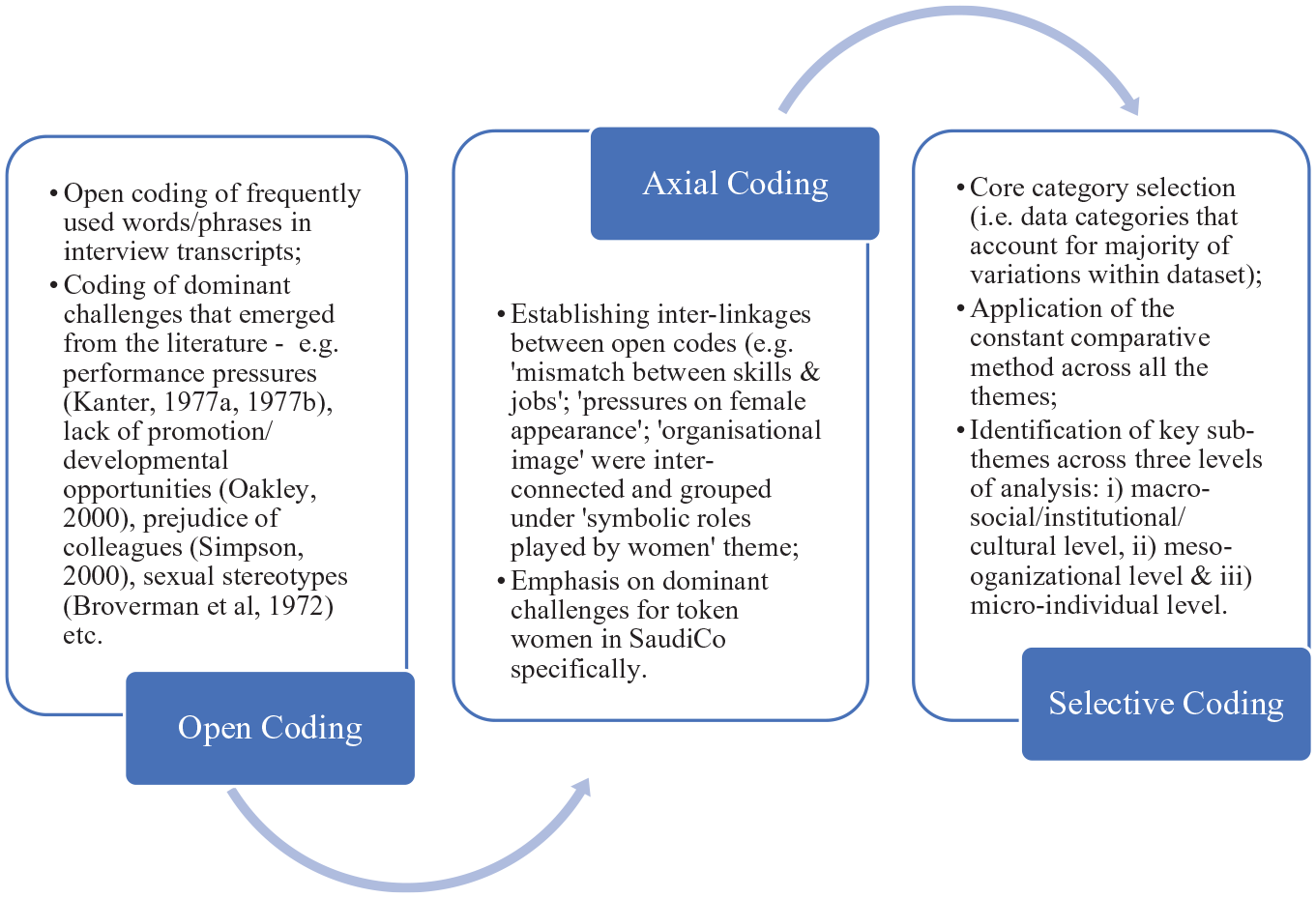
Data analysis process.
Findings
Our findings below are organised and presented in line with our key research questions. Therefore, in the first section we explore RQ1 by highlighting how, despite SaudiCo’s Western antecedents, the implementation of organisational policy is intrinsically tied to the distinctive societal context. This somewhat contradictory interplay of organisational and societal factors, and individual interpretation of this incongruence, in turn creates paradoxical situations (that is, Catch-22s). The second section unpacks RQ2, focusing on Kanter’s (1977a) typology of role traps and extending the notion of role entrapment through the lived experiences of token women against the distinctive socio-institutional backdrop of Saudi Arabia.
Caught in a Catch-22: The contradictory interaction of organisational policy and societal norms
Overall, SaudiCo presented a progressive and ‘Western’ organisational image by proactively offering a range of equal opportunities and positive action initiatives, atypical in the Saudi Arabian context. Degree programmes and conferences abroad were funded because ‘the management tries to. . . advertise that the company has female employees’ (Management & professional development advisor, 29 years old, married, BSc). Commitment to a modern organisational image meant that in external interactions (with other businesses, the media or the Royal family) women employees were more likely to be chosen as presenters and hosts – notably those women who physically conformed to the liberal, ‘Western’ image: . . .when they have a business trip they don’t nominate females who wear Abaya. Although the company is a Saudi company. . .they want us to be Western. . . (Administrative assistant, 38 years old, single, Diploma)
There were also instances of positive discrimination whereby women were sometimes offered atypical career opportunities compared to their male counterparts which went against established gender social norms that tend to favour men: In the same week the female geologists returned to the company after finishing their degree abroad, we received direction from the upper management that they should be sent for a master’s degree. . .although the system in the company is that any employees to be sent for master’s degree should have minimum 3 to 4 years, working experience, and these females are fresh graduates. So, imagine, some of the guys with amazing GPAs were waiting for 5 years for their turn to go for a master’s degree, and they found out that their (female) colleagues who were fresh graduates were (being) sent (immediately). (Management & professional development advisor, 29 years old, married, BSc)
However, these progressive organisational policies were not stand-alone and per force interacted with societal norms that continued to favour patriarchal traditionalism. For instance, the cultural norm of male guardianship, whereby women cannot travel without a Mahram’s (that is, a male guardian like a father/brother/husband) permission (Syed et al., 2018), impacted female employees’ actual uptake of these atypical training and development opportunities, often involving international travel: . . .(we) can’t go out without a Mahram. . . they (SaudiCo) say that they can’t spend money on you and your Mahram. . .(so) it is easier and cheaper to send a male (instead). (Digital cartographer, 35 years old, married, BA) When a woman goes for an assignment she must. . . take a Mahram. . . The company will not be responsible for (the extra financial cost. . .) but when a male goes to the same assignment and if he is married (with) three or four wives he can bring all his wives. . .(Supervisor, 40 years old, married, BSc)
Applying a relational lens was instrumental in capturing this uneasy and often invisible interaction between the progressive organisational norms (mirroring ‘Western’ norms) and societal traditionalism (rooted in immutable cultural and religious mores). Our participants’ lived experiences highlighted many unacknowledged instances of prejudiced, unsupportive and discriminatory behaviour from male colleagues whereby male managers informally requested a woman employee be shifted out of their team, pregnant women were excluded from lucrative projects and men walked out of meetings if women were attending.
This contradictory interplay of societal and organisational contexts in turn created paradoxical situations which we classified as Catch-22s – that is, instances where contradictory conditions of modernity/progressiveness and social convention/traditionalism coexisted. The first Catch-22 that emerged from our data analysis was the politics of visibility and invisibility. Tokens experienced heightened visibility on account of their numerical minority and physical appearance (given increased emphasis on the latter in the Saudi Arabian context). Crucially, this visibility was controlled by the dominants whereby unveiled women were used to present a progressive image of the organisation externally (signalled higher external visibility) while veiled women were excluded from training, development or promotional opportunities (signalling higher internal invisibility): Certain types of women are usually encouraged to apply for senior positions or to go for training abroad. . . they have an image and the lady who fits this image will go for training abroad. . . She must be open-minded, have Western looks, not wearing the Hijab (veil). They have a certain design in their mind, and ladies who fit this design will get the benefits. (Digital cartographer, 35 years old, married, BA)
Token women were aware how this contradictory manipulation of their visibility by male colleagues further enabled their numerical token status. Crucially, dominants’ manipulation of visibility politics resulted in the creation and/or replication of ‘feminine spheres’ which further normalised token women’s occupational and professional invisibility. Therefore, dominants’ societally-driven interpretation of progressive organisational norms reinforced the professional invisibility of the token women: The girls are just as good as the boys. . .but unfortunately a lot of supervisors will treat their female employees as admin assistants. . .regardless of their degree. . . and regardless of where she studied they will give her the fluff work. It is a cultural thing! (HR systems analyst, 51 years old, divorced, BSc)
A second Catch-22 was the micro-level reactions of token women themselves whereby contradictory responses of endorsement and rejection co-existed. A small minority of interviewees actively agreed with societal norms that symbolically buttressed their token status; and dominants’ reproduction of these societal norms within SaudiCo. These token women eschewed progressive organisational policies and instead advocated gender-segregation (in meetings and physical office space) and women being assigned backend/support work, refused to travel without a male guardian (even to nearby locations like Dubai), and embraced the veil in line with Islamic principles of modesty: Not all jobs suit women. . .God created our bodies in a way that. . . we aren’t physically or mentally strong. . . Female engineers can’t work for long hours under the sun in the field, but men are capable of doing that. . . (Safety group leader, 42 years old, divorced, BSc) I think that some women’s personalities aren’t fit to become leaders. . .Women are. . . weak and emotional, they are not strong enough to be managers. . . (HR systems analyst, 51 years old, divorced, BSc)
However, other interviewees actively rejected their token status through persistent questioning of both societal norms and contradictory implementation of organisational policies. Some female managers openly criticised persisting gender inequalities in the workplace and advocated for policy changes with senior management. For example, one of the respondents highlighted how they were trying to initiate change in an international assignments policy that funded male employees’ dependants while they were abroad while female employees had to self-fund their dependants: . . .they talk about the role of females, but deep inside they look down at us. . .But I (will) continue doing workshops. . .I will do things that. . .make me competent . . . that will make me seen. (Training and professional development advisor, 41 years old, Married PhD)
Token women’s experiences of role entrapment in SaudiCo
Our data analysis highlighted that traditional patriarchal structures prevalent externally, were also reproduced within SaudiCo, whereby men were perceived as the primary/sole breadwinners while women were venerated as mothers and wives that needed to be provided for (Syed et al., 2018). These stereotypical cultural beliefs resulted in token women being ascribed specific attributes, constituting what Kanter (1977a) calls role traps. The ‘mother’ role, which describes women as the caring and comforting support act, was a predominant one in SaudiCo and manifested in two key ways: i) token women were predominantly delegated to subordinate, support roles and ii) their identity as mothers/wives/daughters outside of the organisation was actively maintained by the dominants inside the organisation and given precedence over their professional/work identity.
SaudiCo’s organisational structure was strongly gendered and a majority of the women employees appeared to be clustered in support services with very few occupying positions in the core operations of engineering and geology. Women were primarily recruited as administrators, office assistants, junior advisors with the aim of providing support for senior male colleagues, regardless of their qualifications or previous work experience: Management always put women in jobs that facilitate male jobs. . .(we) provide services that make men’s jobs easier. Women (are) concentrated in low-productivity jobs. . . (even) highly educated Saudi women. . . (Administrative assistant, 38 years old, single, Diploma) Women’s roles are limited to specific positions that men are ashamed to work in, for example, training coordinator, HR coordinator. . .these positions (are) dominated by women only. (Trainee advisor, 31 years old, married, BSc)
Additional gendered horizontal segregation emerged whereby dominants replicated and maintained societal support roles conferred on women (as wives/mothers) by assigning them office work. Office work was seen as safer and more appropriate for women and therefore, token women were deliberately excluded from the more financially lucrative field-based work which required travelling and atypical hours that could potentially create tensions in women’s acquittal of family responsibilities: . . .female geologists are not allowed to stay in the company after working hours. The management argue that it is not safe; they believe it is not safe for female employees to enter the building alone and work alone with the guys at night time. (Management & professional development advisor, 29 years old, married, BSc) Although the girls are willing to work late, they are willing to give up some of their weekends, but their supervisors feel no, she is a girl, we can’t do this to her. . . this is a cultural thing. (HR systems analyst, 51 years old, divorced, BSc)
Furthermore, women were expected to marry and take charge of their households/families and were not seen as primary breadwinners, irrespective of their actual circumstances or preferences. Dominants’ application and maintenance of these societal gender norms meant that women were expected only to ‘meet the minimum requirements in your appraisal (and) don’t show any initiative’ (HR coordinator, 46 years old, single, MBA), bypassed for promotions, and given unimportant tasks when pregnant or with a young baby while ‘men are put in first priority when it comes to getting a higher grade or a promotion . . .’ (Professional development programme coordinator, 27 years old, single, BSc): Usually managers say that males need promotion, that they are the household (head). . .you don’t know much about me, maybe I am sending money to my parents, maybe I am also a (breadwinner), how do you assume I am not, because I am female? (Training and professional development advisor, 41 years old, married, PhD) . . .most promotions are awarded to male first because of the social belief that men. . . have more responsibilities than women. (Travel consultant, 33 years old, Single, BA)
Interestingly, these gender biases were so deeply entrenched that even expatriate managers from more gender egalitarian contexts were seen to replicate them: . . .(my) American manager. . . not (even) an Arab. . .said that we will not give you a good evaluation because your income is disposable. . .you are going to fritter it away on make-up and stuff you don’t really need. (HR systems analyst, 51 years old, divorced, BSc)
Kanter’s (1977) role trap of ‘pet’ also emerged in our data analysis whereby: i) SaudiCo’s women employees were seen as incompetent on the basis of their gender (regardless of their actual qualifications/work experience) and ii) this presumed incompetence was visible both implicitly and explicitly through a range of organisational practices. Several interviewees highlighted that male managers had low expectations of women, considered them less competent, and therefore gave them very few chances to progress and develop: Whatever we do they will not appreciate it. . .they will think that we got help in doing this hard work. . . they will never believe that this work was done 100% by a woman. (Travel consultant, 33 years old, single, BA) The general attitude is that a woman is not capable of thinking and working like a man. (Division secretary, 31 years old, married, BSc)
This narrative of gendered incompetence, and women being treated as ‘pets’ with lower capability, was visible in the obvious mismatch between their qualifications/skills and assigned jobs. Implicit manifestations of the ‘pet’ role trap included the example of a woman manager with a PhD and 20 years of work experience in SaudiCo who was never chosen to stand-in for the division head while he was on annual leave: Our division head is a PhD-holder like me, and every time he goes on leave, I have never been called to cover for him. They bring another male from another organisation to cover for him. What does that mean? It means that they think I am not capable. (Training and professional development advisor, 41 years old, married, PhD)
Explicit manifestations of the pet role trap were the many instances in which women were working beneath their qualification grade and in functions not relevant to their expertise. The demographic information of this study’s participants (see online Appendix 1) offers a salutary snapshot of many interviewees holding degrees in varied subjects (ranging from business, engineering to computer sciences) and still being recruited into administrative/support positions: When they first employed me, they gave me a choice to go for either the help desk or HR. I decided to join HR, which is not related to my major. My major is computer information systems. (HR coordinator, 28 years old, single, MSc) I am an Admin Assistant. . . My degree is in finance. I am not really happy in my job because this is not what I want to do. . .it is very far from my education but this is what I (was given). (IT technical clerk, 35 years old, married, BSc)
Interestingly, our analysis did not offer any support for Kanter’s (1977a) other identified roles of ‘seductress’ or the ‘iron maiden’ potentially because Saudi women are seen as symbols of family honour and therefore, are not expected to publicly display their sexuality or challenge patriarchal structures/norms. However, the context-specific Catch-22 of visibility/invisibility of token women generated a completely new role trap which we have titled the ‘Hecate’. Hecate is a Greek goddess who symbolises a crossroads (between the past, present and future) and represents polarities like night and light. In line with this terminology our analysis highlighted that Saudi women employees faced a dually-binding trap of simultaneously representing progressive and traditional values. Thus, while senior, predominantly male, managers actively contributed to the maintenance of mother and pet role traps (emphasising caring, non-influential and powerless roles for female employees), they also used token women who were overtly confident, did not cover their heads and had embraced a more Western style of dressing to represent SaudiCo externally. Our participants were conscious that women were deployed as an organisational symbol of progressiveness and Westernisation in external events that involved the Royal family, competitor foreign organisations or the Western media: Whenever we have an event or tour from outside, females are the ones who are chosen to participate. It is for the organisation’s image. (Management & professional development advisor, 29 years old, married, BSc)
Yet, despite being symbols of progressiveness, women were still expected to uphold traditional Islamic principles of modesty, cover up/take the veil, be meek, and implicitly judged for working in a non-segregated organisation like SaudiCo: A lot of male supervisors say to us that women should stay at home. They usually quote the verses of Qur’an that say ‘stay in your houses, and do not display yourselves like that of the times of ignorance’. . . Men use the Qur’an as a weapon (to) justify the discrimination against women. (Training and professional development advisor, 41 years old, married, PhD) Some of the men. . .don’t even speak to you. . .some people will walk out if you are in a meeting with them. They don’t want to be in a mixed meeting. (Project manager and HR group leader, 49 years old, married, BSc)
Crucially, the role trap of ‘Hecate’ and associated expectations of traditionalism/modesty versus modernism/confidence was seen to be controlled by the dominants. This enabled the replication and preservation of societal masculine hegemony within the organisation, reduced female agency and consigned tokens to the margins.
Discussion and conclusions
Applying a relational lens to Kanter’s tokenism theory (1977a, 1977b) enabled us to study the interplay between individual, organisational and societal-level influences; offering several unique theoretical and empirical insights. First, our findings underlined the need to move beyond an organisational-level conceptualisation of tokenism and explicitly consider the societal impact on organisational norms and individual organisational agents. In response to Holgersson and Romani’s (2020) and Watkins et al.’s (2018) critique of existing tokenism literature for lacking a theoretical and empirical conceptualisation of societal and cultural norms this article explored how SaudiCo’s seemingly progressive policies were inextricably tied to societal traditions. Our research highlights that gender hierarchies and masculine hegemony are under-written by cultural beliefs and societal structures which not only reinforce the token status of women in overall society but also impact patterns of interaction within organisations and between individuals. Crucially this reinforces a symbolic level of tokenism that extends beyond the numerical under-representation of women within organisations.
Second, our findings highlight how token Saudi women negotiate this contradictory interaction of superficially progressive Western values and rules at the organisational level and a traditional patriarchal societal context. Our participants experienced heightened visibility (tied to their physical appearance), unequal access to career opportunities and gender-based discrimination despite working in an MNC that emphasised gender equality. This corroborates previous studies on negative workplace outcomes for token women (Gardiner and Tiggemann, 1999) such as heightened visibility and isolation (e.g. Haas et al., 2016; King et al., 2010; Simpson, 1997), occupying fewer senior positions and experiencing career barriers (Simpson, 2000). Extant work has also highlighted how women’s experience of heightened gender-based visibility creates pressure to outperform their male colleagues (Simpson, 2000; Simpson and Lewis, 2005; Torchia et al., 2011). Our findings extended this gender visibility narrative by highlighting the co-occurrence of heightened ‘visibility’ because of numerical under-representation and physical appearance. Crucially, this was in conjunction with heightened ‘invisibility’ with respect to token women’s occupational and professional identities and access to work opportunities. We argue that by adopting a relational approach to the study of tokenism this research highlights the importance of the societal context and the limitations of adopting homogenous conceptualisations of Kanter’s (1977a) work.
Third, we offer important theoretical implications for Kanter’s (1977a) third perceptual challenge of assimilation and token women’s experience of role entrapment specifically. Our research highlighted that Saudi female employees were primarily perceived as either ‘mothers’ (offering emotional support for men both within and outside the workplace) or as ‘pets’ (occupying non-influential and powerless roles that required lower levels of skills and competency). However, our analysis did not offer any support for Kanter’s (1977a) other identified roles of ‘seductress’ or ‘iron maiden’ potentially because of the unique societal context of Saudi Arabia. The prevalent religious ideology of Islam, in combination with enduring patriarchal norms whereby females are seen as representations of family and tribal honour (Syed et al., 2018) perhaps mitigated the overt sexualisation of women. Thus, public manifestation of their femininity was culturally abhorrent and subsequently organisationally impermissible. Furthermore, Kanter’s (1977a) conceptualisation of the ‘iron maiden’ role trap signified female agency and proactive resistance, which is unlikely in the Saudi context given strong political control by the Royal family and the government, lack of enforceable equal opportunity legislation, and the absence of employee representation structures like trade unions.
Furthermore, a new context-specific role trap emerged from our data which we classified as Hecate, capturing the dually-binding trap of token women simultaneously representing progressive and traditional values. The absence of Kanter’s (1977a) ‘seductress’ and ‘iron maiden’ roles and the emergence of the ‘Hecate’ role underline how interaction of the societal and organisational contexts can result in a unique manifestation of tokenism. This is in direct contrast to suggestions that the social context does not play a significant role (Kanter, 1977a). In line with Yoder’s (2002) critique of tokenism theory, we argue that role entrapment in fact cannot be studied at the organisational/occupational level alone given the impact of broader social, cultural and religious forces on the organisation. In this article we demonstrate how the organisational context is not neutral territory and reproduces societal specificities with respect to prevalent work attitudes (of both male and female employees) as well as employment experiences and outcomes (in terms of career opportunities, workplace dynamics, and horizontal and vertical job segregation). This again underscores how tokenism goes beyond concerns of numerical representation as it also encompasses symbolic representation – whereby one group holds a dominant position over the other in the broader societal context and these symbolic discrepancies in power dynamics are in turn replicated within organisations. In doing so, we shine a critical light on gender-neutral theorising within tokenism (Holgersson and Romani, 2020; Lewis and Simpson, 2012). Our expanded relational approach to tokenism can also be usefully employed to explore the experiences of other groups (for instance, sexual, racial, ethnic or religious minorities) that are numerically under-represented in the organisation and hold a status of historical and structural disadvantage in the society.
In conclusion, our focus on the interaction of the organisational and societal contexts also has relevance for large swathes of the Global South (Ashraf et al., 2019; Gupta, 2015; He and Wu, 2018; Hennekam et al., 2017) that are socio-institutionally distinctive compared to the predominantly Western contexts studied in extant tokenism literature (King et al., 2010; Young and James, 2001). While Yoder (2002) and Watkins et al. (2018) have called upon gender researchers to consider different social contexts when conceptualising tokenism, our study is the first empirical attempt that offers a relational perspective of the societal context with respect to tokenism. Researchers have previously concentrated on narrower markers of the gendered context, for instance, race in unorthodox work occupations (Whittock, 2002), but there is no research to date that investigates tokenism vis-a-vis the societal context. Therefore, this current research expands existing conceptualisations of gendered contexts and offers a broader assessment of perceptions of gender equity.
Supplemental Material
sj-pdf-1-wes-10.1177_09500170211035940 – Supplemental material for Catch-22: Token Women Trying to Reconcile Impossible Contradictions between Organisational and Societal Expectations
Supplemental material, sj-pdf-1-wes-10.1177_09500170211035940 for Catch-22: Token Women Trying to Reconcile Impossible Contradictions between Organisational and Societal Expectations by Maryam Aldossari, Sara Chaudhry, Ahu Tatli and Cathrine Seierstad in Work, Employment and Society
Footnotes
Funding
The authors received no financial support for the research, authorship, and/or publication of this article.

Supplemental material
Supplemental material for this article is available online.
References
Supplementary Material
Please find the following supplemental material available below.
For Open Access articles published under a Creative Commons License, all supplemental material carries the same license as the article it is associated with.
For non-Open Access articles published, all supplemental material carries a non-exclusive license, and permission requests for re-use of supplemental material or any part of supplemental material shall be sent directly to the copyright owner as specified in the copyright notice associated with the article.
