




Abstract
Does the way in which people do gender influence their career advancement strategies? Based on semi-structured interviews with Saudi women senior managers and drawing from the postcolonial feminist theory, we discover in this study that it does. We show that Saudi women choosing to do gender well, the Sailing Through cohort, achieve career advancement by amplifying their commitment to family responsibilities, enacting respectful femininity, and invoking family associations to build winning alliances. We describe this form of resistance as crafty agency. In contrast, Saudi women choosing to do gender differently, the Trailblazing cohort, achieve their advancement goals by acting in a serious, composed, and competitive manner, investing in their human and professional capital, and effectively using self-promotion and self-advocacy. We describe this form of resistance as determined agency. Overall, our study demonstrates that Saudi women’s agency is not fixed, or definite, or passive but rather it is fluid, multifaceted, and transformational. This article contributes to gender studies by showing how different stances on doing gender drive the reinvention of gender identities and pursuit of alternative career advancement strategies. It also provides a nuanced understanding of how Saudi women attain senior management positions as they navigate the messiness and contradictions of gender roles and gendered contexts, agency, doing gender well and doing gender differently, and career advancement strategies.
Keywords
Introduction
Saudi Arabia (SA) furnishes a compelling setting for research on gender and culture. In 2016, SA released Vision 2030 as a blueprint for developing the country’s economy and society (Tlaiss and Al Waqfi, 2022), and recognized women’s empowerment as a top national priority (Vision 2030, 2016). The government introduced legal reforms that significantly expanded women’s social and work rights, including laws granting them the right to travel freely and seek employment without a male guardian’s consent and banning gender discrimination in the public and private sectors. The deep-seated legacy of male domination and gender segregation is increasingly challenged by Vision 2030 (Tlaiss and Al Waqfi, 2022) and the resulting strong impetus for economic growth and modernization that has resulted in the redrafting and redrawing of a traditionally gender-segregated society. Against this developing backdrop, SA has long been viewed as a conservative country (Alkhaled and Berglund, 2018), where women’s work outside the home has been regarded unfavorably (Sidani, 2005). Austere interpretations of Islam culminating in the legal requirement of male guardianship in all aspects of women’s lives during the late 1980s (McAdam et al., 2019) underscored these views. Accordingly, previous studies are preoccupied with exposing societal and organizational gendered barriers to women’s work outside the home (Abalkhail, 2019; Al-Asfour et al., 2017), ignoring their career advancement and presenting Saudi Muslim women’s compliant agency (Mustafa and Troudi, 2019). However, recent research has questioned portrayals of Saudi women as agentless or weak by demonstrating how they have long fought for their right to work and advance their careers, and have resisted gender inequity and discrimination (e.g. Aldossari and Calvard, 2022; Jamjoom and Mills, 2023). The first objective for this study is to explore the gendered career advancement strategies of Saudi women who successfully advanced their careers to senior managerial positions. The second objective is to explore whether Saudi Muslim women’s agency can unfold in forms that not only defy the mainstream descriptions of Muslim women’s agency as pious, docile, and compliant, but also change gender dynamics and reinvent femininity by doing gender well and doing gender differently (Mavin and Grandy, 2013; Mavin et al., 2014). The third objective for this study is to examine the interface between the heterogeneity of agency and the gendered career advancement strategies in Arab Muslim countries.
Using in-depth, semi-structured interviews, we explore the narratives of Saudi women who successfully attained senior managerial positions years before Vision 2030 and the recent government-initiated reforms. Specifically, we explore the strategies that Saudi women apply toward career advancement, defined as “progress towards achieving career aspirations” (Bowles et al., 2019: 1645), and how various ways of doing gender influence and inform career advancement strategies, while paying attention to the uniqueness of the Saudi cultural landscape. While exploring Saudi women managers’ career advancement strategies, we draw from the postcolonial feminist theory that emphasizes the importance of studying the unique forms of human subjectivity, agency, and resistance in non-western cultural contexts as opposed to judging them condescendingly, and sometimes disparagingly, based on some preconceived western ideas (Gandhi, 2019; Mohanty, 1988; Spivak, 1988). We also approach gender as a socially and culturally constructed concept (West and Zimmerman, 1987) that can be done “well and differently” through multiple enactments of femininity and masculinity in the process of identity management (Mavin and Grandy, 2013; Mavin et al., 2014).
Our findings reveal how Saudi women senior managers exhibit contrasting attitudes toward gender discrimination, embrace two opposite forms of agency (i.e. crafty agency vs. determined agency), and differ in their gendered career advancement strategies. Accordingly, our research makes several theoretical contributions. First, we advance the postcolonial feminist research (Mohanty, 1988; Spivak, 1988) by questioning prior characterizations of Muslim women’s agency as pious, docile, compliant, or confined (Mahmood, 2001, 2005; Mustafa and Troudi, 2019). We instead introduce the concepts of crafty agency and determined agency deployed by Saudi Muslim women as they actively pursue career advancement. We also demonstrate how the marginalized “other” women (Gandhi, 2019; Mohanty, 1988; Spivak, 1988), including those in Arab Muslim countries, especially SA, cannot be perceived as one coherent and predominantly passive group. Second, we contribute to research on women’s agency as we demonstrate the fluid and heterogeneous nature of Saudi women’s agency. In so doing, we show that even within the same cultural context, women may practice different agencies that hinge on their attitudes toward gender discrimination and inequality. We also demonstrate that even the less combatant, crafty agency is neither compliant nor confined, as Saudi women use it to skillfully take advantage of the myth of men’s superiority and of men’s beliefs in gender preeminence. Third, we contribute to research on doing gender well and doing gender differently (Mavin and Grandy, 2012, 2013) as we show that doing gender well does not necessarily mean accepting traditional gender roles, but rather using them opportunistically while developing an alternative gender identity. Although prior research has characterized doing gender well and doing gender differently as combining men’s and women’s scripts in a certain way (Mavin and Grandy, 2012, 2013), we suggest that women’s scripts continually take on new meanings in the process of gender interaction and reinvention, generating novel approaches to doing gender well and doing gender differently. Finally, we extend the existing literature on women’s career advancement strategies (Bowles, 2012; Ford et al., 2021; Mavin and Grandy, 2013; Mavin et al., 2014) and gendered strategies (Pacholok, 2009) by showing that Saudi women managers may actually apply strategies identified in prior research in the western world (Bowles, 2012; Bowles et al., 2019) while adjusting them to fit their particular contexts.
This article is structured as follows: we begin by examining the cultural and business environment of SA, with a special focus on recent studies that report on gender inequality and gender discrimination. Then, we reflect on women’s agency in the Muslim world and women’s gender identities and career advancement in SA in the 2000s. Subsequently, we discuss our methodology, explain our research process, present our empirical evidence, and show how we have arrived at specific findings. The article concludes with a discussion section highlighting the study’s contributions, outlining its limitations, and offering recommendations for future research.
Saudi Arabia and women’s resistance to gender discrimination
SA is a developing Middle Eastern Arab country widely known for its traditional social structure. Before the unveiling of Vision 2030 and the monumental change it introduced to the Saudi culture, gender roles were strictly defined and specific. Women in SA were expected to be communal, kind, and primarily focused on performing domestic chores and on their roles as mothers, wives, daughters, and sisters (Elamin and Omair, 2010). In contrast, men were regarded as agentic, independent, and dutifully concerned with providing for the family, going to work, advancing their careers, and excelling in management and leadership roles (Al-Asfour et al., 2017). Men were granted power over women by virtue of their gender (Al-Ahmadi, 2011). Furthermore, despite its current adherence to the Islamic principle of moderation (Vision 2030, 2016), SA society has been highly impacted by Wahabism’s essentialist interpretations of Islam (Jamjoom and Mills, 2023). Wahabism is a conservative interpretation of Islam that limits the roles of women to that of wives and mothers (Hamdan, 2005) and ultimately provides few opportunities for women to work outside the home (Sidani, 2005). This interpretation translated into gender segregation and the legalization of male guardianship in all spheres of public life, including employment (Alkhaled and Berglund, 2018).
Following a major shift in Saudi government policies in 2016 with the unveiling of Vision 2030, organizations in SA began to actively recruit and promote women. However, career advancement continued to be hampered by structural arrangements and conservative social attitudes. The prevailing cultural belief was that management is a man’s job (Al-Asfour et al., 2017). Men were routinely promoted ahead of women into senior management roles because they were seen as the main breadwinners entitled to better positions and higher salaries (Abalkhail, 2019). Also, women were not considered suitable for management positions (Hamdan, 2005). Even as more women graduated from universities, joined the workforce, and were promoted to lower levels of management (Elamin and Omair, 2010), their talent, knowledge, and professional skills and accomplishments were not taken seriously (Al-Ahmadi, 2011). Accordingly, previous studies focused on identifying the various social, cultural, and organizational barriers hindering women’s employment opportunities and career advancement (Abalkhail, 2019; Al-Asfour et al., 2017; Elamin and Omair, 2010; Hamdan, 2005). Unfortunately, these studies also portrayed Saudi women as passively accepting their lack of visibility in the workplace. In marked contrast, a small emerging stream of studies questioned the pervasive cultural myth of Saudi women’s apathy. This emerging stream of study has focused on uncovering Saudi women’s resistance to gender discrimination, including their alternation between infrapolitical and insurrection strategies (Aldossari and Calvard, 2022), defiant refusal to take part in the culturally prescribed genuflection to male benefactors (Jamjoom and Mills, 2023), and the strong influence of Islamic feminism on women’s rationalization of their fight for equality (McAdam et al., 2019).
In a study that examined the career advancement strategies of women leaders, Bowles (2012) contrasted the “navigating” accounts of women who explained their career progress as gradual growth and transition from one position to another and the “pioneering” accounts of women describing their career advancement as a process of formulating a new strategic vision and subsequent recruitment of followers and supporters. In another study, Bowles et al. (2019) differentiated between the three strategies women used in negotiating their compensation that essentially range from the simple act of asking for a promotion, to bending rules and shaping or reshaping cultural norms. This suggests that women may choose from a broad spectrum of strategies, ranging from traditional (e.g. navigating and asking for a promotion or salary increase) to experimental (e.g. bending the rules) and visionary (e.g. pioneering accounts or reshaping the existing norms). Previous studies also reflect on how, to advance, women have used the hard tactics of assertive and aggressive behaviors, and rational tactics that stress exchange and compromise (Bolino et al., 2016; Kipnis and Schmidt, 1985, 1988; Smith et al., 2013). We build on these previous analyses of women’s career advancement as we examine the narratives of Saudi women senior managers in the Saudi workplace of the early decades of the 21st century.
Muslim women’s agency and gendered strategies
Postcolonial feminism is driven by the rejection of western scholars’ simplistic portrayals of non-western women as hapless and incapable of agentic behavior (Mahmood, 2001, 2005; Spivak, 1988). Postcolonial feminism also challenges the perception of the marginalized “others” (i.e. non-western women) as passive, noncommittal, and lacking a distinct identity. These studies shed light on how Muslim women think, feel, and express themselves and examine their experience as active subjects that enacted alternative, non-essentialist, non-western ways of survival and resistance (Jamjoom and Mills, 2023). For example, Mahmood (2005) demonstrated that Muslim women in Egypt exhibited their agency as they participated in the grass-roots movement of individuals gathering in neighborhood mosques for discussions about religion and offered social help to less fortunate community members. Yet, while portraying Muslim women as active, engaged, and civic-minded, these feminist writings also characterized Muslim women as bound by tradition and taking collectivistic rather than individualistic stances; from this perspective, Muslim women’s agency was defined as docile (Mahmood, 2001), pious (Mahmood, 2005), and even compliant or confined (Mustafa and Troudi, 2019). The idea is essentially that Muslim women might show initiative and be engaged in collective action, but primarily devote themselves to performing their religious and family duties and responsibilities (Mustafa, 2017; Mustafa and Troudi, 2019).
Scholars have argued that passivity may be a form of agency in Muslim countries such as Indonesia (Parker, 2005), and that instead of practicing active resistance, Muslim women may undertake “strategic maneuvers”, by expressing their resistance surreptitiously (Mustafa, 2017). Indeed, when resistance is romanticized (Abu-Lughod, 1990), only its most active and extreme forms may be recognized. Such an approach could obscure more covert, infrapolitical forms of resistance (Mumby et al., 2017). For example, Bedouin women in SA used secrets and silences to defy many restrictions imposed upon them by their custom-bound society, resisted marriage proposals from unwanted suitors, and passionately rebelled against arranged marriages (Abu-Lughod, 1990). Muslim women certainly may practice tacit and clandestine strategic maneuvers (Mustafa, 2017) to attain their goals while avoiding confrontation with the powers that be. This does not mean, however, that Muslim women’s agency is inherently confined and compliant (Mustafa, 2017; Mustafa and Troudi, 2019). Making this claim would represent yet another manifestation of essentialism that would be just as erroneous as denying Muslim women agency altogether. Indeed, it would be hard to claim that a Saudi woman who stood up to her husband’s threat to dissolve their marriage if she sought employment (Aldossari and Calvard, 2022) exhibited compliant agency. Such examples suggest that Arab Muslim women’s agency may take multiple forms since there is considerable heterogeneity in the way these women build and advance their careers.
In this research, we are motivated to build on previous studies and to enhance understanding by exploring Saudi women’s agency and resistance on a spectrum that ranges from individual and collective infrapolitics to insubordination and insurgence (Mumby et al., 2017). Our discussion of women’s agency draws from the theory of doing gender (West and Zimmerman, 1987, 2009), to look at doing gender well and doing gender differently (Mavin and Grandy, 2012). Responding to the criticism of West and Zimmerman’s (1987) claim that gender cannot be undone, Mavin and Grandy (2012: 221) suggest that gender, can in fact be “re-done, or done differently. In doing gender differently, sex category cannot be ignored as there is engagement with masculine and feminine scripts.” However, we would like to propose that the difference between feminine and masculine scripts may be elusive and unsettled. Specifically, we propose that women may display traits that are habitually associated with masculinity but enact them in a feminine way, whereas men may display traits that are habitually associated with femininity but enact them in a masculine way. Furthermore, both femininity and masculinity are continually remodeled and influence one another as a result of ongoing interaction and changing institutional norms (Mavin and Grandy, 2012; West and Zimmerman, 1987). Also, prior research has shown that women may seek to capitalize on their display of respectful femininity and emphasize their modesty and humility in order to advance their careers (Fernando and Cohen, 2014; Mavin and Grandy, 2016). Nevertheless, the ideals of respectful femininity and by analogy, of courteous masculinity are culture-specific and evolve historically, thus, setting the background for gender interaction. To that end, our study seeks to explore how doing gender unfolds in Saudi women’s career advancement strategies.
Methodology
This study explores the accounts of women who have successfully built their careers to become senior managers in the Saudi Arabian sociocultural context. We deliberately chose an interpretivist approach as we sought to capture women’s lived experiences (Tlaiss and McAdam, 2021). This approach allowed us to collect real-time and retrospective accounts (Corley and Gioia, 2004). It also facilitated the surfacing of various conceptual themes, such as selecting a certain form of agency, choosing to do gender well and do gender differently, and deciding how to tackle organizational and societal barriers related to gender discrimination. To achieve our objective, face-to-face, semi-structured interviews were conducted with 22 Saudi women senior managers. Following Mavin and Grandy’s (2013) recommendations, the interviewees were asked to talk unreservedly about their careers and work in general, while reflecting on how they have ascended to senior management positions. The adopted format of a freewheeling interview allowed the women to tell stories that went back and forth in time and thus supported the collection of rich and unique material.
Data collection and sample
Data collection from women in SA can be challenging as many women are reluctant to share their personal stories with researchers. Hence, we applied a purposeful sampling strategy (Pratt, 2009) to obtain access to potential respondents using our network ties and reference sampling (Patton, 2014). The first author utilized her personal network and connections with professional Saudi women, who in turn effected introductions to a peer group of women in senior management positions. Reference sampling was also utilized, whereby key informants possessing the experience relevant for the study were contacted with a request for an interview. The sampling criterion was focused on identifying Saudi women who occupied senior managerial positions in large private organizations. Data collection continued until theoretical saturation was reached and new data did not further clarify the issues under study (Strauss and Corbin, 1990). Hence, the current sample size was deemed sufficient, given that the validity of qualitative research is determined by its information-richness rather than by the sample size per se (Patton, 2002).
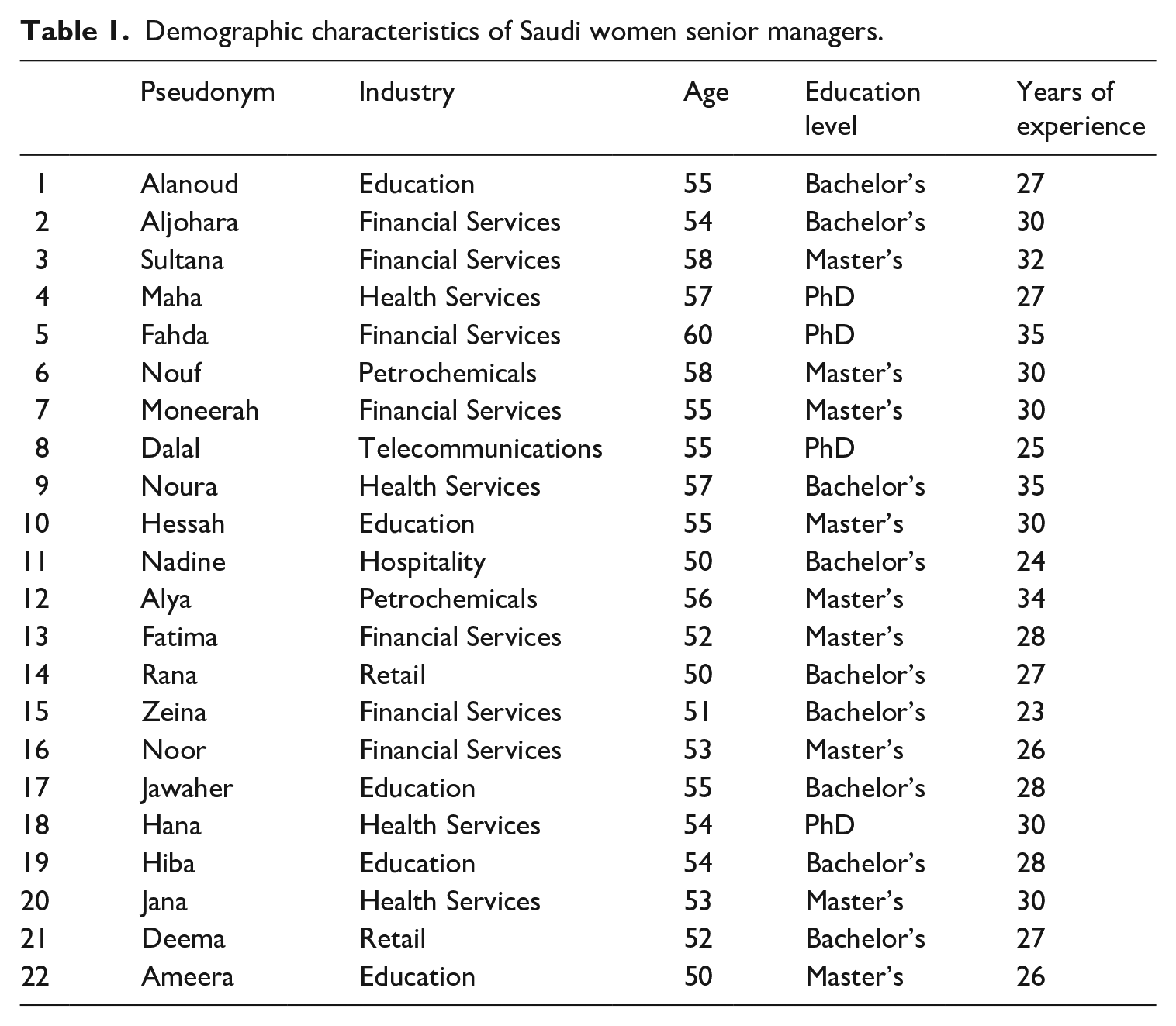
Table 1 provides the background characteristics of the interviewees. All were interviewed in person by the first author between 2017 and 2019. All the women had at least five years of experience as senior managers and were classified as senior managers by their employers. The women held a wide range of jobs/titles, which differed based on company vernacular and included director, head/director of department, to vice president and senior manager. All the interviewees were over 50 years of age, were married with at least three children, and held at least a Bachelor’s degree. The high level of education of the interviewees was not surprising given that higher education for women has been available in SA since 1962 (AlSubaie and Jones, 2017). Although we did not set out to identify the socioeconomic status of our interviewees, all stated, during the interviews, that they did not come from privileged, wealthy backgrounds.
Demographic characteristics of Saudi women senior managers.
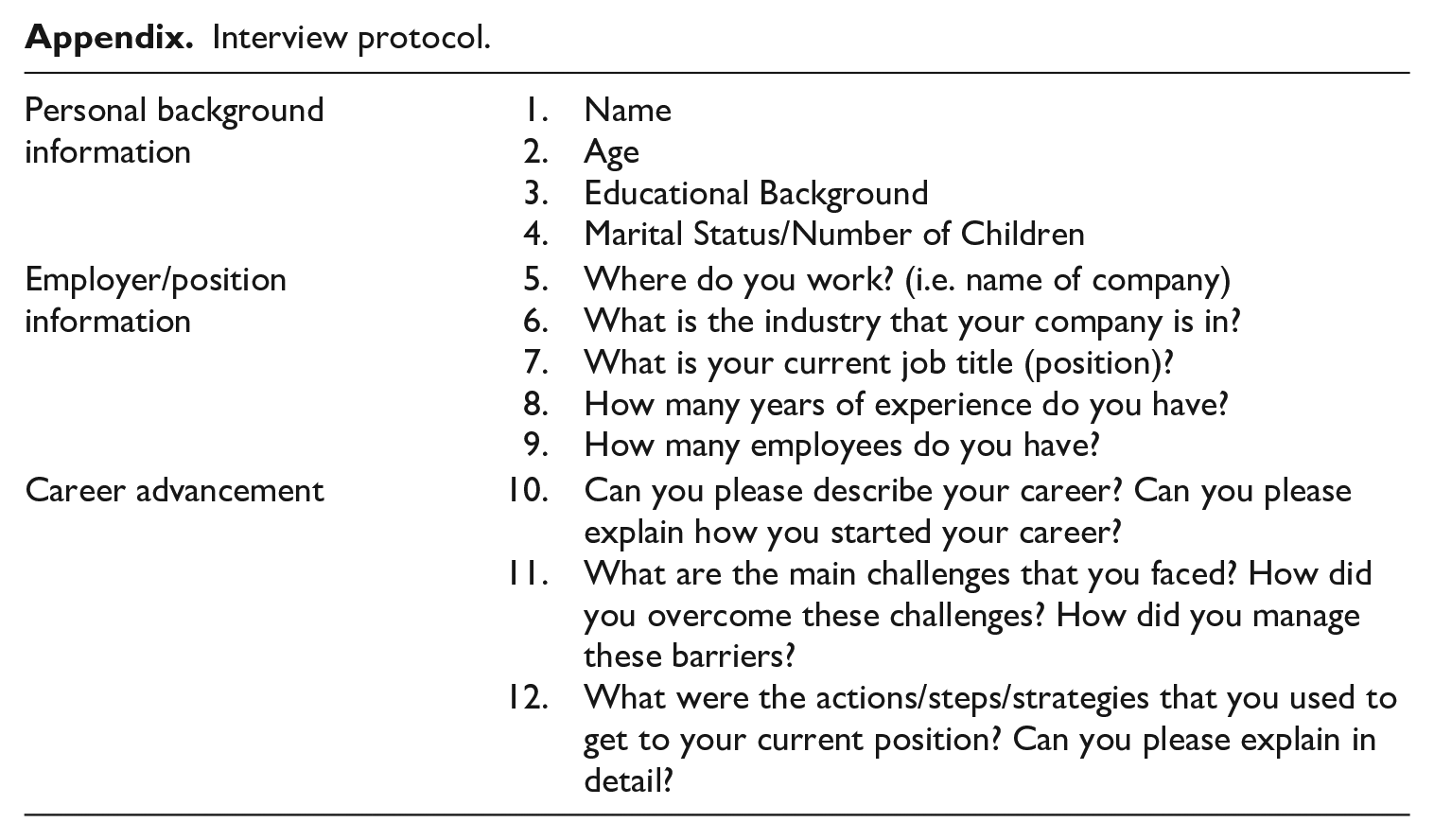
The first author started each interview by thanking the interviewee for her participation, assuring her of anonymity, and confirming that pseudonyms would be used in any published data. The recorded interviews took place in locations chosen by the interviewees, including offices, homes, coffee shops, and hotel lobbies. The interviews entailed frequent transitions from English to Arabic and back. Back-translation was used to increase interpretation validity and eliminate any errors (Tlaiss and McAdam, 2021). Conversations lasted anywhere from two to four hours and helped develop an intimate understanding of the interviewees’ working lives, career choices, and dynamics (Ford et al., 2021). To create a comfortable atmosphere conducive to information sharing (Essers and Benschop, 2009), the first author started the interviews by asking the interviewees some general, introductory questions about their educational background, age, marital status, and years of experience. Subsequently, the first author asked the interviewees to discuss their careers. Whenever it was needed, the first author would pose a question asking for clarification, such as, “Could you speak a little more about this?”, “Could you explain this, please?”, “What do you mean by that?”, and “Could you give me an example?” The protocol of the interview is reported in the Appendix.
Similar to the participants in Essers and Tedmanson’s (2014) study, the participants in our study appeared happy to be invited for an interview dedicated to learning about their life experiences, challenges, and professional accomplishments. Nevertheless, it was necessary to consider power locations when “making and writing up” (Essers et al., 2010: 326) our findings as we considered our reflexivity (Golombisky, 2006) as researchers. We realize that the Saudi women’s life and career stories could be co-produced situationally by the interviewees and the interviewer. Hence, the first author stayed alert to “how this relationship might have affected the utterances of the interviewees and the interpretation of the authors” (Essers and Benschop, 2009: 409). The first author was also aware of the differences in power relations between the interviewer and the interviewees, which could lead the interviewees to say what they thought the interviewer wanted to hear (Phoenix, 1994). On the one hand, following Essers and Tedmanson (2014), the interviewees could feel pressured to produce desirable answers. On the other hand, the interviewees could feel encouraged by the attention given to their stories, rise to the occasion, and generate creative reflections that might even surprise themselves with unexpected insights.
Although the first author is originally an Arab woman, she is from another Arab country, and has education and work experience garnered in western countries. Hence, she assumed a dual positioning as both insider and outsider. Such natural but purposeful dual positioning allowed her to emphasize her understanding of many gender and sociocultural issues that are common across the Arab and Muslim world and yet express her curiosity and interest in the specifics of the SA sociocultural and work environment. This mutually recognized implicit commonality also helped create a comfortable and trusting environment and made it easier to discuss sensitive topics, such as modernizing yet clinging to the traditions of Arab societies, the prevalent power of gender stereotypes, and Islamic feminism. At the same time, the first author accentuated her differences with the interviewees pointing out that she came to SA as an expatriate and would not be aware of all subtleties and nuances in the culture, gender relations, and environment in the workplace. This estrangement, that is, deliberate presenting as a stranger, was also helpful as it motivated the interviewees to provide more detailed information and explain intricacies. While expressing her understanding and genuine interest, the first author urged the interviewees to tell their stories spontaneously, without inhibition, which helped garner rich accounts of multi-layered experiences.
The interest that the first author demonstrated in the lives and careers of the women interviewees helped at least some of them to feel comfortable and appreciated. This in turn allowed the women to express themselves freely, as demonstrated by email and verbal expressions of gratitude. For example, Sultana wrote: This [the interview] was a great experience for me. I am grateful for you taking the time to meet with me and for the interest you showed in my career. I am also grateful for you being such a good listener . . . Below you can find the details of two women, who are in senior positions, along with their contact details. I already contacted them and informed them that you might call them and also encouraged them to participate because I was happy sharing my experiences with you.
During the interviews, the women spoke about the long working hours and the energy they put into their careers as well as their drive to succeed and persistence to overcome challenges, while also raising children. Accordingly, our interpretation of the data was informed by how the women and their stories made us feel. To further explain, the first author was inspired by the Saudi women’s stories given her personal experience of career advancement’s challenges in academic and larger societal contexts. It was therefore encouraging for the first author to listen to such stories as she could relate to the interviewees not only in terms of gender and religion, but also of life and career experiences. The second author is a non-Arab man who has education and work experience garnered in the United States. He has worked for over three years in SA and has considerable interest in the country’s modernization process and issues of gender equality. He immersed himself in the interviewees’ stories and related them to what he learned from his Saudi women students who were completing their MBAs while also performing managerial responsibilities at work and taking care of family duties. The stories of the interviewees helped him better understand the Saudi culture and appreciate both recent changes as well as the agency that Saudi women have been demonstrating for several decades.
Data analysis
Data analysis involved three major steps. In step 1, we started with open coding, which refers to the process of reviewing the transcripts and identifying codes directly related to the interviewees’ statements. Through open coding, we were able to break the data into specific incidents, events, or acts and give each a name (Cardador et al., 2022). For example, a statement such as “a woman will always be perceived primarily as a mother, wife, and daughter” was related to the association of women with family roles (rather than work duties). Another statement, such as “it was very challenging to be a woman and pursue a career in management” was related to the obstacles faced by women striving to ascend to higher positions in an organizational hierarchy. Subsequently, we listed all the open codes to discover the linkages between the identified open codes and to subsume them under larger subcategories (Cardador et al., 2022). Thus, open codes such as “I accepted our society as it is . . . for it may take ages for a culture to change” and “these traditions are hundreds of years old and no one believed that they can or will change” were grouped together for the Sailing Through cohort under the subcategory of “acceptance of gender inequity and gender discrimination”.
In step 2, axial coding (Pratt et al., 2006) was applied by conducting a continual comparison of various data fragments to uncover underlying similarities and differences. At this juncture, we bundled subcategories into second-order themes (Cardador et al., 2022). To achieve this, we looked for relationships between and among the first-order themes or subcategories to reduce their number and classify them into higher-order or second-order themes. For example, the subcategories of “approaching gender inequity and discrimination as impossible to overcome in the short run,” “willingness to accept gendered roles as they are”, and “putting up with gender inequity for the time being” were bundled to form the theme of “Do not fight windmills” (i.e. the concept of multiple moving forces that have to be navigated). We similarly established other second-order themes: “we are family”, “men and women are equals in Islam”, or “crafty agency” and “determined agency”.
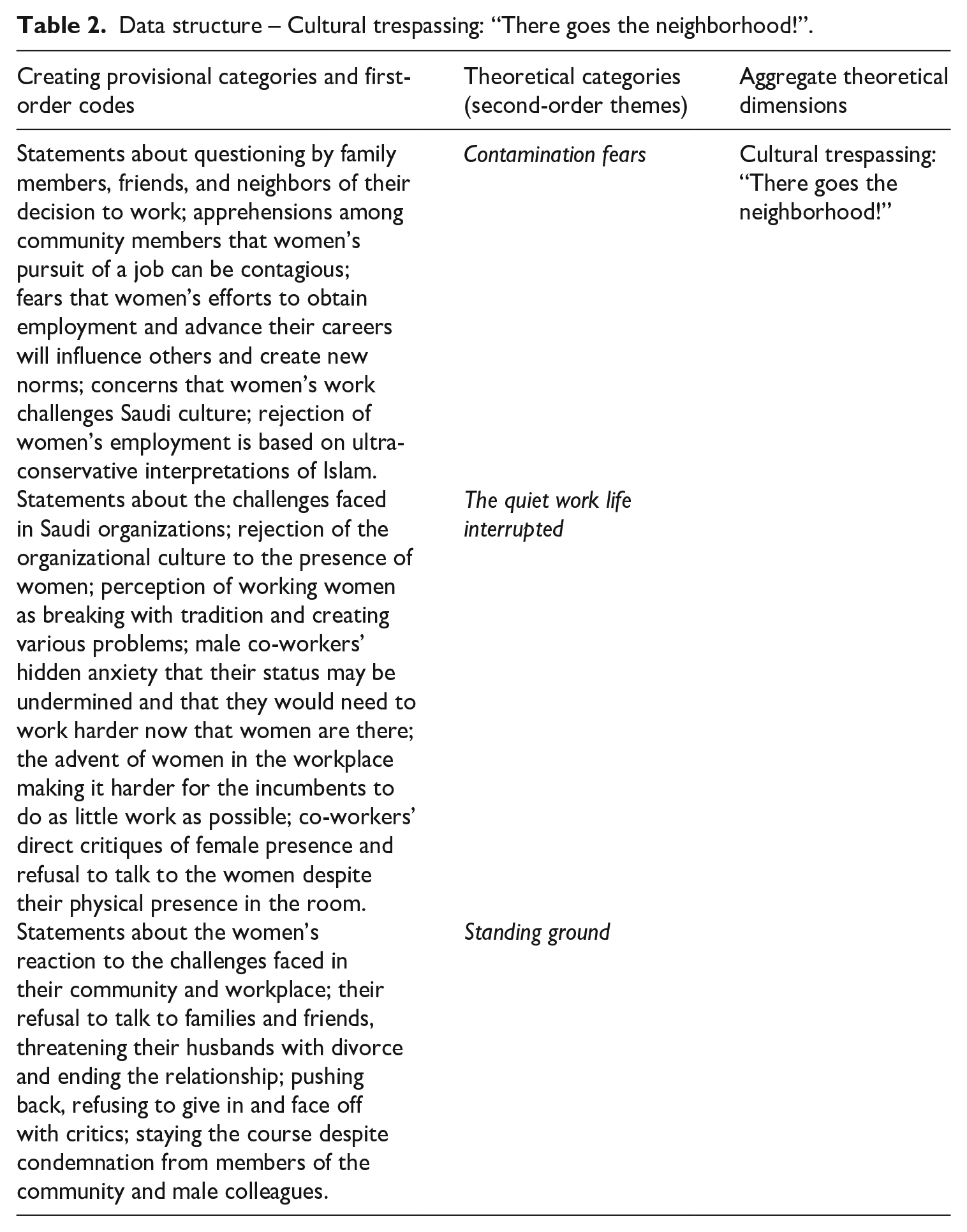
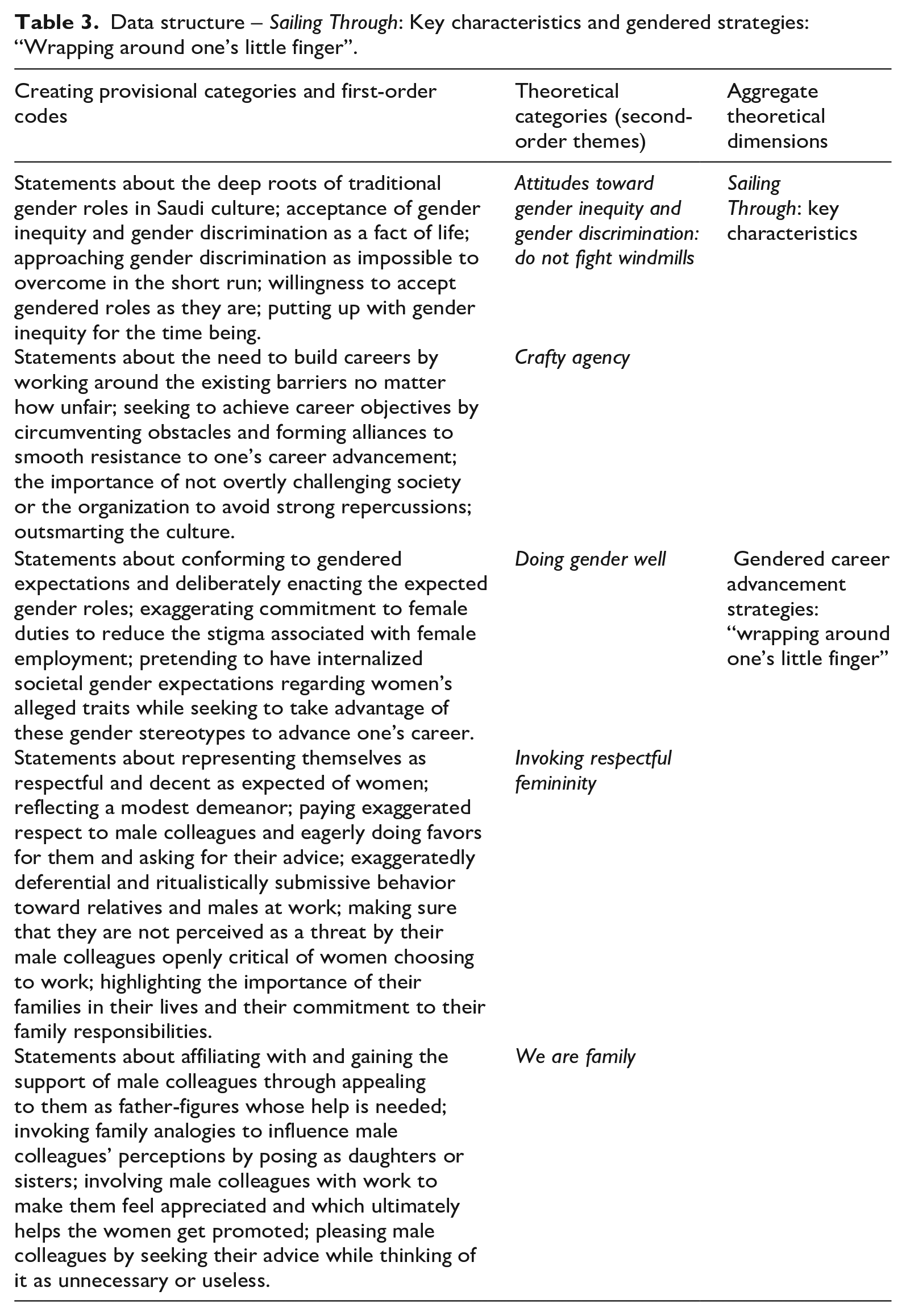
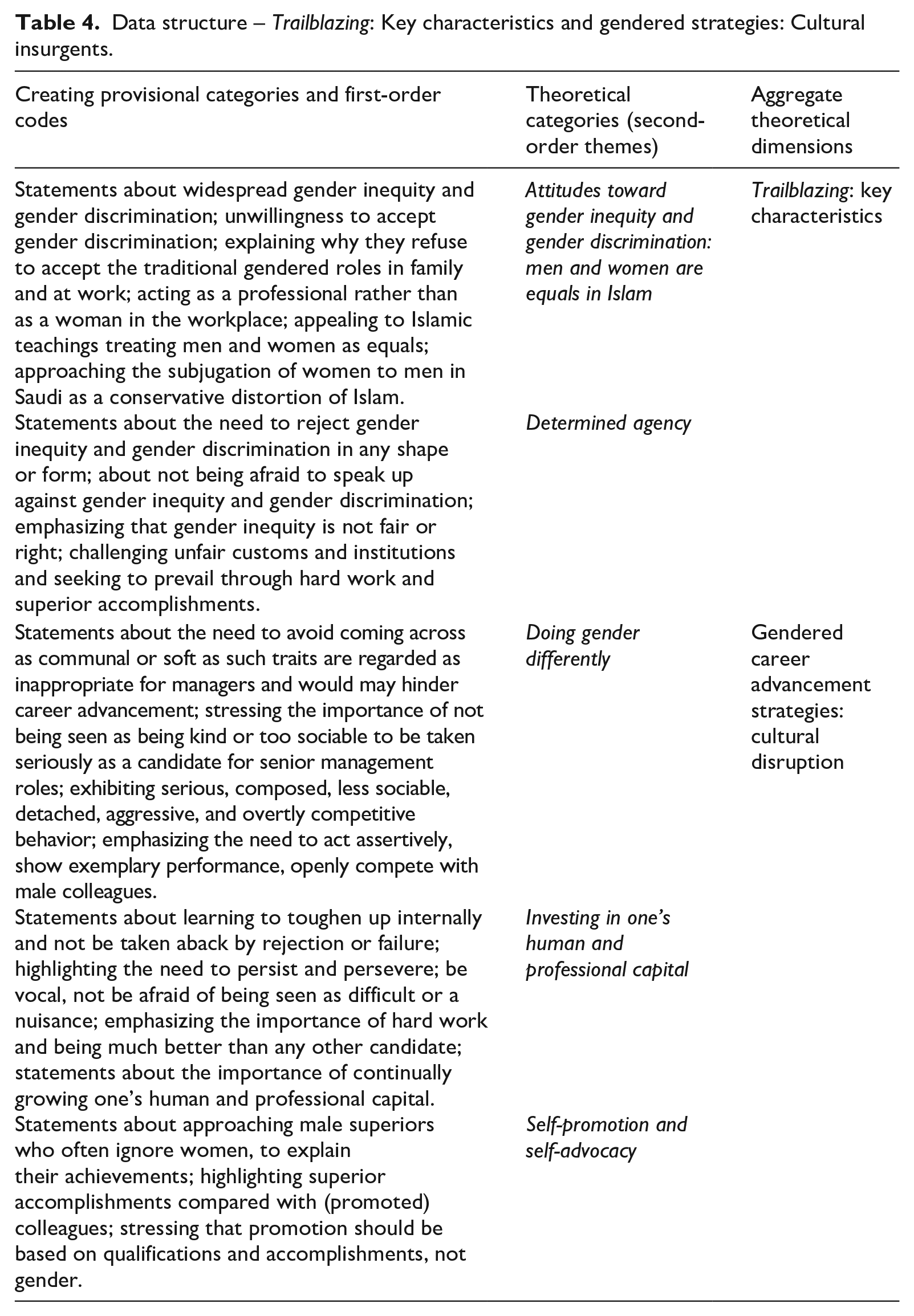
Finally, in step 3, we focused on exploring the relationships between second-order themes to establish aggregate themes (Corley and Gioia, 2004). We created aggregate dimensions such as “cultural disruption” and “wrapping around one’s little finger” and defined the relationship between these dimensions (Cardador et al., 2022). Although we refer to these three analytical processes as steps, “the process was not strictly sequential” (Cardador et al., 2022: 247), but rather iterative (Pratt et al., 2006). Tables 2 to 4 summarize the data structure resulting from this ongoing analysis. The iterative process was facilitated by the authors, who met frequently to discuss and agree on the codes, sub-categories, and naming. Occasionally, robust discussions ensued and transcripts had to be reviewed multiple times in order to reach consensus.
Data structure – Cultural trespassing: “There goes the neighborhood!”.
Data structure – Sailing Through: Key characteristics and gendered strategies: “Wrapping around one’s little finger”.
Data structure – Trailblazing: Key characteristics and gendered strategies: Cultural insurgents.
In accordance with Lincoln and Guba’s (1985) recommendation, we also took the following three steps to ensure the trustworthiness of our data. First, both authors have extensive exposure to SA having worked there for a minimum of three years. We have immersed ourselves in Saudi culture and maintained regular, daily contact with Saudis. Thus, we have achieved a “prolonged engagement” (Beigi et al., 2017) and developed a deep understanding of SA’s culture, customs, and codes of conduct. Second, we achieved “peer debriefing” by asking two colleagues not involved in this study, but immersed in qualitative research, to review the emerging themes and provide us with feedback on our overall findings (Beigi et al., 2017). This step helped us as field researchers to vet our ideas by gaining an outsider’s perspective. The peers are qualitative researchers from other universities (Corley and Gioia, 2004). Third, we asked an experienced qualitative researcher to conduct an audit of our empirical data going through the interview protocol, our codes, and random samples of the interview transcripts to evaluate whether the conclusions we reached were reasonable (Corley and Gioia, 2004).
After spending time living and working in Saudi, the authors are familiar with the changes taking place in SA and the national efforts to empower women, increase their participation in the workforce, and reduce gender discrimination. They have also had the opportunity to meet and talk with a large number of Saudi women in managerial roles who were either guest speakers or students in their university classes or who they met at social events. These experiences, along with the post-colonial feminism approach, helped the authors approach data analysis as a process of exploration and discovery, whereby the main focus was to reflect the experiences of the women. Nevertheless, we have gone through several modifications in our approach toward data analysis. Initially, we focused on analyzing the backdrop of the study – the obstacles faced by women seeking employment and career advancement in SA. Gradually, however, we began to identify substantial differences between the Sailing Through (focused on enduring gender inequity) and Trailblazing accounts (focused on challenging gender inequity). At the next stage, we once again looked for differences and similarities between the two cohorts and revised our previous interpretation as we realized the different forms of agency that were mobilized and that doing gender well and doing gender differently represent reinvention of femininity in the Saudi context. Finally, we began to approach both the Sailing Through and Trailblazing cohorts as they try to legitimate their career advancement pursuits.
Findings
In this section, we explain how we have conceptualized the empirical material, moving from interviewee statements to second-order themes (denoted in italics), and finally, developing aggregate theoretical dimensions through the use of the most compelling evidence to illustrate the prevalence of key themes (Pratt, 2009). The findings section is comprised of two main subsections. The first subsection, “Cultural trespassing: ‘There goes the neighborhood!’” describes the challenges faced by Saudi women who chose to seek employment as well as their reactions to these challenges. These ordeals constitute the background of the study since the ways the interviewees chose to do gender was profoundly affected by their common experience of their culture and salient gender roles. Hence, this section is critical for understanding how gender was reinvented in two different ways and how such reinvention affected the career advancement strategy chosen. In the second subsection, “Sailing Through vs. Trailblazing”, we analyze the two cohorts in terms of attitudes toward gender inequity and gender discrimination, forms of agency used, doing gender (doing gender well and doing gender differently), and gendered career advancement strategies.
Cultural trespassing: “There goes the neighborhood!”
As the interviewees recounted their career and life stories, they frequently recalled criticism from family members regarding their decision to seek employment on the basis that it undermined their primary role as mothers and wives. The Saudi women also recounted stories of how community members protested against their pursuit of a professional career, especially in non-feminine sectors, considering it a violation of traditional gender roles held sacred by society. Relatives, friends, and neighbors were concerned that the women’s decisions to work would possibly influence their own sisters and daughters to follow suit. We describe this theme as contamination fears to encapsulate societal and cultural concerns about the potentially contagious effect of women’s employment. Nouf narrated: It was very challenging to be a woman and pursue a career in management . . . I remember how our neighbors used to tell my husband that allowing his wife to go to work was against our tradition, as the right place for a woman was her home with her children . . . Spending time outside the house, being away from your children was considered inappropriate for women and could put the husband, who allowed his wife to work, in an awkward position socially . . . as he would be perceived as being too soft or disrespectful of tradition and . . . culture.
Along with the chorus of criticism from extended family members and the community, the interviewees suffered an equally frustrating environment at work, expressed through the adverse reaction of male colleagues. The interviewees noted how male workers ignored and intimidated them, while others ridiculed their contributions and disapproved of their ideas by pretending that the women did not exist. We describe this theme as the quiet work life interrupted. Dalal recalled: For a very long time, I was the only woman in the room and my male colleagues would crack jokes about me, saying that I should just stay home. They belittled my ideas because they believed that working as a manager, setting goals, and using expertise was something that only men could do . . . I was told bluntly: “go home and take care of your children” . . . The manager who hired me was often criticized for his “absurd” decision to hire a woman as a manager.
However, the women’s narratives not only contained litanies about adverse reactions from the community and male colleagues. They also discussed how they had responded to societal and personal criticism of their decision to be employed. We define this theme as standing ground. The incessant allocation of blame coming from many quarters was upsetting to the interviewees. However, they refused to surrender their pursuit of senior management positions, sending a strong signal to their detractors and indicating that they were not going to be intimidated and would not give in. Some women showed their resolve and stopped talking to their families and friends. Deema said: . . . but I was not willing to give up. I stopped visiting both families and informed them that I was not willing to give up my right to work . . . I also told my husband that I will not leave my job even if divorcing him was the price I had to pay . . . it was my right.
Overall, we aggregated these three second-order themes as “Cultural trespassing: ‘There goes the neighborhood!’” since the relatives, friends, neighbors, and colleagues assumed that a woman’s decision to become employed was an act of disruption (see Table 2). The critics’ attacks were aggressive, came from all directions, and were seemingly designed to make the women abandon their careers to avoid damaging the Saudi way of life and contaminating the community (“There goes the neighborhood!”).
Sailing Through vs. Trailblazing
There are many societal and organizational-level commonalities in the interviewees’ experiences of gender discrimination in SA. Nevertheless, their reactions to these experiences and the way they reinvented their gender identity in the process of ongoing gender interaction with their male managers and colleagues differed. The interviewees also differed substantially in terms of their doing of gender (West and Zimmerman, 1987, 2009). Eventually, we were able to categorize our interviewees as belonging to one of the two cohorts we described as – Sailing Through or Trailblazing.
The difference between the two cohorts was especially salient in terms of attitudes toward gender inequality and gender discrimination. The Sailing Through cohort believed that gender inequality and gender discrimination would be inherent in SA. Hence, they thought that it would be quixotic to challenge these deep-seated social practices. However, the Trailblazing cohort refused to accept gender inequality and gender discrimination and were prepared to challenge it.
Alongside these contrasting attitudes, our analysis showed that the two cohorts shared commonalities in how they capitalized on different forms of agency. The Sailing Through cohort applied what we term “crafty agency”, which allowed them to navigate around the unavoidable gender inequity and gender discrimination and to use compromise and manipulation to achieve their goals. The Trailblazing cohort used what we term “determined agency”, which sought to challenge the traditions and migrate the Saudi culture in the direction of Islamically mandated gender equality.
In terms of specific gendered strategies used in career advancement, the Sailing Through cohort focused on doing gender well by enacting a culturally accepted (and viewed as gender-appropriate) manifestation of femininity (Mavin and Grandy, 2012, 2016). This interpretation corresponds to the ideal of respectful femininity (Fernando and Cohen, 2014; Mavin and Grandy, 2016). In contrast, the Trailblazing cohort enacted an alternative interpretation of femininity. The Trailblazing cohort was not concerned about being culturally appropriate. Instead, they emphasized their professionalism and performance. The Trailblazing cohort therefore did gender differently, and used gendered strategies focused on applying strong pressure upon male gatekeepers and stakeholders in order to achieve recognition and promotion for superior accomplishments. In the next section, we expand on these findings regarding career advancement strategies. We will start by considering the main characteristics of the Sailing Through cohort and then will turn our attention to the Trailblazing cohort.
Figure 1 illustrates the hierarchy of themes unveiled in this study, including the different ways of doing gender and their influence on the adoption of alternative career advancement strategies.
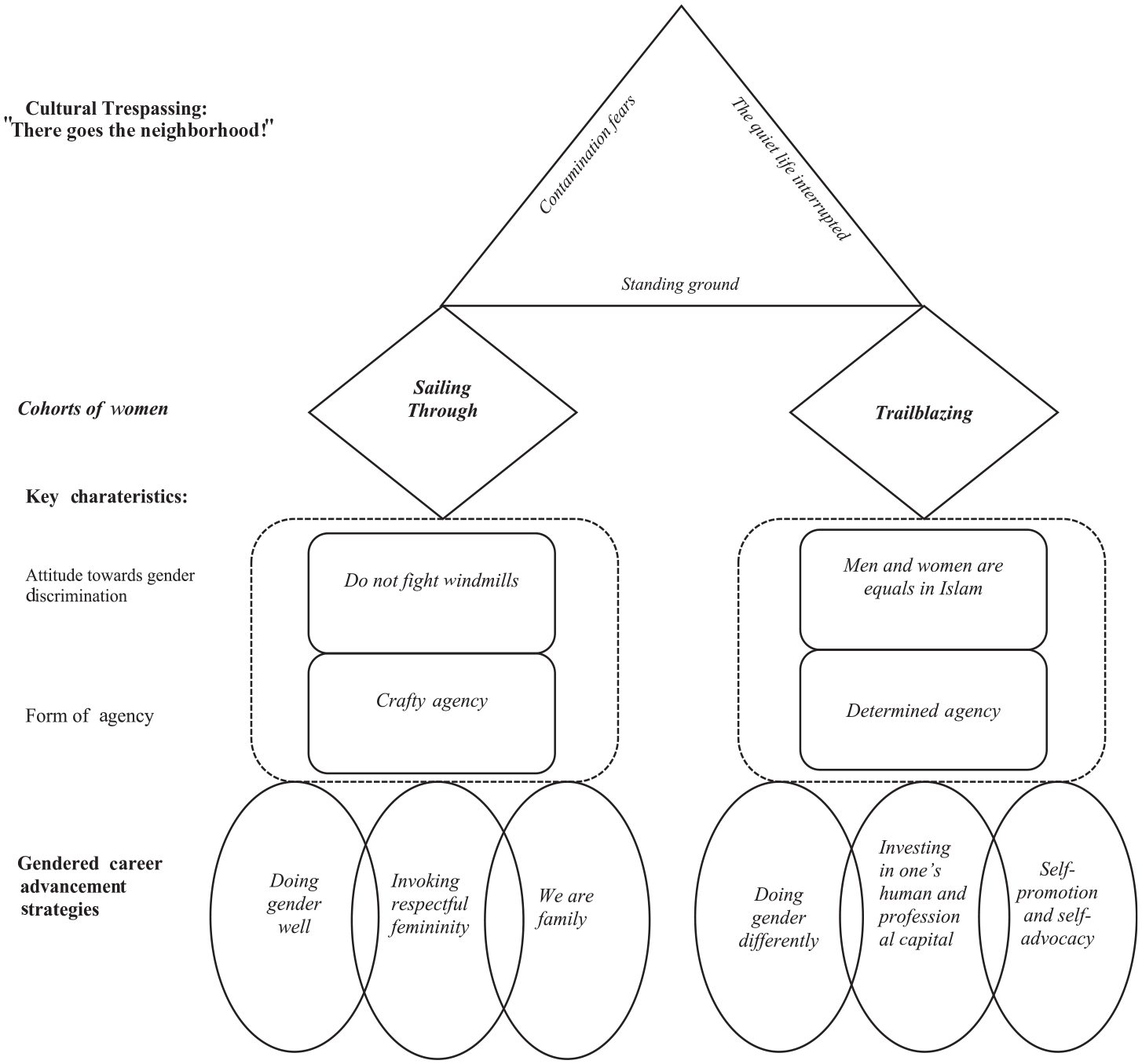
Cultural trespassing: “There goes the neighborhood!”
Sailing Through: Key characteristics
Attitudes toward gender inequity and gender discrimination: Do not fight windmills
The Sailing Through cohort of women consider gender inequity and gender discrimination as matters experiencing a slow pace of change. Hence, the women thought it would be unrealistic of them to fight and that doing so would not help advance their careers. We described this pragmatic theme in the Sailing Through women’s discourse as do not fight windmills. This term is often used to describe the futility of fighting imaginary opponents and we used it to highlight the Saudi women’s perception of the futility of trying to fight traditions and customs. Alya reflected: I accepted our society as it is . . . for it may take ages for a culture to change . . . Instead, I have focused on building a career and finding my way . . . in these surroundings, with all their problems . . . a battle I was never going to win, so why bother?
Form of agency: Crafty agency
Although the Sailing Through cohort refused to fight windmills, the form of agency they embraced was far from “compliant agency” (Mustafa and Troudi, 2019). Instead, they sought to navigate obstacles that blocked their advancement and to outsmart the prevailing culture through creative compromises. The ultimate objective behind this cohort’s use of agency was to use existing gendered institutions to their advantage; by understanding the stereotypical perception of women as helpless and lacking the attributes for management. Crafty agency transpires in the Sailing Through women’s efforts to avoid being perceived as troublemakers, which could elicit a negative reaction from their male colleagues and supervisors. Alanoud explained: People in Saudi did not like sudden changes, especially coming from women . . . so, give them what they want, just be a good mother and wife and then you can achieve what you desire and build your career . . . Smart women who wanted to advance have realized this a long time ago, the need to work around the institutions of our society . . . I learned this early on and had to operate within the confines of the prevailing perception of women as homemakers. I also had to act the same way at work.
The Sailing Through women’s crafty agency was applied to smooth the “shocking” effect of their presence in management positions in male-dominated workplaces and was used to manage things on the home front so that family objections would be minimized. Ultimately, deploying crafty agency helped this cohort of Saudi women to leapfrog their male counterparts to promotions.
Gendered career advancement strategies: “Wrapping around one’s little fingers”
Influenced by their crafty agency, the women mobilized career advancement strategies that were meant to hold detractors at bay and to allow them to out-maneuver the system by ostensibly following its rules to obtain the results the very same system wanted to prevent. Hence, we named the aggregate theme comprising the three career advancement strategies of the Sailing Through cohort as “wrapping around one’s little finger”.
The first career advancement strategy used by the Sailing Through women can be defined as doing gender well (Mavin and Grandy, 2012). This strategy entailed expressing commitment to enacting a traditional gender identity as a way to tackle the stigma associated with women’s employment and managerial career advancement. The cohort chose doing gender well, that is, acting in accordance with expectations of them as women and so overcome resistance from male colleagues. The Sailing Through cohort sought to reduce familial and male colleagues’ anxiety by being communal, kind, caring, and soft. While seeking to do gender well, the Sailing Through women emphasized that they did so out of necessity, using role play. Rana and Alya described this strategy: Thus, I capitalized on being kind, quiet, and soft-spoken . . . I gave them what they expected from me as a woman and all I wanted in exchange was to get a promotion . . . I did not want anyone to see me as a troublemaker . . . I would bring snacks and coffee for everyone at work. (Rana) I brought coffee and cookies to work . . . so that they would get what they wanted, a nice, kind and powerless woman . . . our men like us to be soft and loving . . . they are used to that. (Alya)
The second career advancement strategy was invoking respectful femininity (Mavin and Grandy, 2016), which entailed stressing the importance of acting reverentially, modestly, and conservatively. Appealing to the norms of respectful femininity (Mavin and Grandy, 2016) in the Saudi context, which stressed the woman’s obligation to take care of the family and male relatives (i.e. fathers, husbands, and sons), in particular, the Sailing Through women also stressed their commitment to performing their duties as daughters, wives, and mothers. Invoking respectful femininity amounted to enacting a ritualistically compliant behavior and displaying extra respect toward male colleagues. Hiba and Hessah respectively reflected: Saudi women are socialized to act modestly . . . to behave decently . . . to be conservative and respectful . . . to be shy . . . so since the bosses were all men and I wanted a promotion, I have focused on behaving respectfully . . . worked on being well mannered, decent, and always referred to my role as a wife and talked about how much I cared about my children so that they (i.e. male colleagues) would not be intimidated . . . I did not want anyone to fear that I could steal their job. . . . men have big egos . . . they can’t stand strong independent women . . . so I have focused on showing my feminine side . . . being kind and sweet . . . always referring to my family or husband. I would always talk about how much I respect my husband . . . which was in line with their concept of women . . . also making sure that they see me as respectful and decent.
The third career advancement strategy used by the Sailing Through cohort can be summarized as we are family. The interviewees referred to treating their male supervisors as fathers and endeavored to be viewed as daughters. They also invoked family associations in their interactions with other male colleagues by treating them as brothers or uncles. The Sailing Through women asked male colleagues questions and solicited their advice with the goal of making them feel significant. This helped reduce feelings of resentment towards the women. Jana provided the following example: All my bosses were men and they were all much older than I was. In fact, I was the age of their daughters so I capitalized on that . . . I used to tell my boss that I viewed him as my father and I used to complain to him about not being treated well or being discriminated against. So, he saw me as his daughter and I was able to go to him for help.
Trailblazing: Key characteristics
Attitudes toward gender inequity and gender discrimination: “Men and women are equals in Islam”
The Trailblazing cohort rejected gender inequity and gender discrimination claiming that it runs counter to the fair treatment of women emphasized by Islam. They asserted that the widespread doctrine that women are subservient to men contradicted the spirit and letter of Muslim teachings. Nadine argued: Saudi women are invariably portrayed as helpless victims, with no power or no say in any decisions and Islam is blamed for their situation. But nothing could be further from the truth. Islam is very fair to women; it gives women rights and respect. The problem is not with Islam. The problem is that it has been reinterpreted in a very conservative fashion . . . The problem is that Saudi society was too masculine . . . the whole Arab world was too masculine.
Drawing from their deep knowledge of the Quran and Islamic teachings, the Trailblazing women embraced an Islamic feminist interpretation of Islam, attributing gender inequity and discrimination to patriarchal, masculine customs rather than an Islamic tradition proffering that “men and women are equals in Islam”. Ameera argued: Islam recognized men and women as equals and this is how women should be treated . . . Throughout the entire Quran, men and women are regarded as equals and when men were given a position of power, they were expected to support women and treat them fairly.
Form of agency: Determined agency
The Trailblazing women refused to accept or excuse gender inequity in any shape or form. They chose to subvert prevailing gender practices by enacting determined agency and showing commitment to serving professionally, excelling in their duties, and advancing their competencies. Unlike their Sailing Through counterparts, the women set their minds on challenging their male colleagues on their own turf. The women in this cohort also demanded opportunities to enhance their expertise and to attain promotions within hierarchical organizational structures. Zeina reflected: Once I started working, I quickly became aware of gender discrimination . . . Each time I applied for a transfer to another department because I felt that I have already learned everything there was to learn where I was, my requests were denied. On what grounds? I was told that other departments had a greater workload and that as a female I would not be able to handle it . . . I applied for a promotion three times and each time I was passed over. One explanation for that given to me was that my subordinates would be men who would refuse to take orders from a woman . . . All this discrimination only motivated me to believe more in myself . . . Why should I be treated as a second-class citizen? I was as educated as my male colleagues or even better educated. I know that it was common in my society to give all the important positions to men but I was not willing to accept this discrimination.
The Trailblazing women recognized that culture change would be difficult but did not allow that to stop them. They rejected the partly implicit and partly explicit norms of respectful femininity (Mavin and Grandy, 2016) and argued that the special treatment of men was discriminatory toward women. Maha expressed these ideas.
As a Saudi woman, I was never happy with the way my parents used to allow my brothers do whatever they wanted. At work, as a woman, I was not expected to say “no” . . . and I was not willing to accept that. On the contrary, I was very vocal in my protests. I would go on and complain to the senior manager and tell him that I was not treated fairly . . . I was not going to put up with that . . . nonsense. Just because I am a woman does not mean that I have to accept being treated as someone inferior.
Gendered career advancement strategies: Cultural disruption
The Trailblazers believed in standing up for themselves and earning promotions through performance, dedication, and continual personal and professional growth. They passionately rejected gender discrimination, challenged it, and endeavored to change it by showing that it runs counter to the spirit of Islam and is not fair to women. We named the aggregate theme underlying the three gendered career advancement strategies used by the Trailblazers as cultural disruption.
The first advancement strategy was doing gender differently (Mavin et al., 2014). The Trailblazers challenged traditional gender roles by demonstrating their seriousness, strength, professionalism, persistence, and determination. Hana reflected on her experience: I did not want to be seen as too soft; otherwise, no one would take me seriously . . . men in Saudi think that women are too soft to be good managers, and thus, should not be appointed as supervisors . . . so, I had to become less feminine and become more assertive and firmer and more formal, more serious . . . somewhat masculine . . . so I started smiling less, started talking in a louder voice, and was acting less sociably toward my employees and colleagues.
The Trailblazing cohort argued that women should come across as assertive, composed, and committed in order to be viewed as true professionals and suitable for senior managerial positions. The need for such reinterpretation of femininity had to do with the ingrained association of women in SA with the domestic sphere and caring for family as well as performing supportive rather than senior managerial roles in the workplace. Consequently, a redrawing or repositioning of femininity as serious, strong, and detached was required in order to be appointed and succeed as a senior manager. Moneerah explained: For a Saudi man to be able to regard a woman as a manager, he cannot see her as being kind and sweet or he will not accept her as his boss . . . If a woman wants to be taken seriously here, she needs to position herself as being professional and serious and masculine . . . even to get a promotion, your boss must see you as being serious and formal and even aggressive.
Second, while facing multiple challenges and setbacks in their quest for career advancement, the Trailblazing group focused on growing (and developing their inner strength) as a way to overcome societal, organizational, and personal barriers. Fahdah explained the challenges of this continual self-development: Every day was a test to prove myself . . . I had to put in long hours and work very intensely and always show superior performance to prove to my senior management that I deserved a promotion . . . I was let down several times but I persevered . . . it was a lot of work but I wanted it. I was not willing to give up and kept coming back to the senior managers to make my case, and I was willing to work as hard as necessary . . . I do not give up and I do not quit!
The Trailblazing women continued to invest in their human (i.e. growing inner strength and resilience) and professional capital by volunteering for new assignments and inter-organizational rotations and by taking courses and attending conferences. The women in this cohort emphasized their commitment to gaining new experiences, advancing their education, and enrolling in training programs as they sought to improve their skills and develop new competencies. Dalal remarked: I knew that the system was against me and that I had to be a lot better than a male competitor to get the job, so I worked on myself . . . I pursued a PhD and I always attended conferences abroad to keep myself abreast of all the constant changes taking place in the industry.
The third career advancement strategy was self-promotion and self-advocacy. The Trailblazing women drew attention to their superior performance and demanded recognition and rewards. They worked methodically on enhancing their visibility in their organizations and approached senior managers to emphasize their accomplishments and seek promotions. Importantly, this strategy effectively demonstrates cultural disruption since the women needed to draw attention to themselves in order to advance. Sultana explained: There were few women in management . . . and I think senior management sometimes forgot about us. So, periodically, I would schedule meetings with senior managers, and in every meeting, I would describe my performance, summarize my accomplishments . . . and ask for more responsibilities and greater authority . . . Of course, I did not get what I wanted the first time or the second time or even the third time, but I was relentless . . . I kept visiting these decision-makers . . . was seen as being pushy, perhaps, but I wanted to get a fair share . . . I knew that if I did not do this I would never get promoted . . . Eventually, after I would get the promotion, my manager admitted that he should have promoted me a long time ago because I was outperforming all my male colleagues . . . I was also later told that my success in high positions encouraged the senior management to appoint more women as supervisors.
Importantly, the women in the Trailblazing cohort not only asked for senior roles (Bowles et al., 2019), they also bent the rules (Bowles et al., 2019) by self-advocating directly with senior management. They stressed the legitimacy and validity of their candidacy for senior management positions by elaborating on the superiority of their performance compared with that of male colleagues. Thus, Aljohara stated: Every time I asked for a promotion, I did it because I knew that I was entitled to it because my performance always surpassed the standards and was superior in comparison with the performance of my male colleagues who did receive a promotion . . . I would not have asked if I was not sure that I was better than anybody else and that I deserved the promotion.
Discussion
Postcolonial feminist theory has challenged the prevailing portrayals of non-western women as voiceless victims operating within male-dominated environments, replete with gender inequity and gender discrimination (Mohanty, 1988; Spivak, 1988). Moreover, researchers have shown that Arab Muslim women exhibit an idiosyncratic form of agency (Mustafa and Troudi, 2019) as they enact culturally appropriate ways of exercising initiative (Tlaiss and McAdam, 2021) and taking collective action (Mahmood, 2001). While redefining Arab Muslim women as agentic, scholars described their agency as acquiescent rather than defiant, that is, devout, peaceful, and obedient. Approaching Muslim women’s agency as pious, docile, passive, compliant, or confined (Mahmood, 2001, 2005; Mustafa and Troudi, 2019; Parker, 2005) was a step forward compared with the blanket statement that Muslim women are not agentic. Nevertheless, we believe that it would be incorrect to assume that Arab Muslim women cannot enact more active forms of agency. In fact, recent studies provided evidence that Saudi women have become involved in different forms of resistance against gender inequity and gender discrimination (Aldossari and Calvard, 2022; Jamjoom and Mills, 2023). Based on prior research and our findings, we argue that while some women’s agency may be characterized as passive and docile, other Arab Muslim women’s agency can be characterized as active and transformational. We demonstrate how Arab women’s agency is not fixed or static but is fluid, dynamic, and heterogeneous as well as culturally specific and idiosyncratic. We also show that while Arab Muslim women’s agency is markedly different from western women’s agency, it does share some important commonalities.
In this article, we establish that Saudi women senior managers fought gender inequity and gender discrimination long before the recent government-led reforms made it imperative for Saudi companies to hire and promote women. The novelty of our findings lies in showing that women managers essentially reinvent femininity in the Saudi context, while espousing opposite attitudes toward gender inequity and gender discrimination. The women studied also embrace contrasting forms of agency (crafty agency vs. determined agency), which then pave the way for applying different sets of gendered strategies of career advancement. The first cohort of women, which we described as Sailing Through, adopted the ideology of cultural conformism. They seek to do gender well and apply careerist crafty agency to navigate gender inequity and gender discrimination and to achieve their career objectives. The second cohort of women, which we described as Trailblazing, appears to have adopted the ideology of disruption by rejecting gender inequity and gender discrimination in any shape or form. They seek to do gender differently and apply determined agency by challenging the unfair treatment of women as a distortion of Islam that regards men and women as equals. Despite these substantial differences in stance on doing gender, both cohorts epitomize strong forms of agency as the women fight tooth and nail to advance their careers and succeed.
Although we initially paid most attention to identifying the differences between the two ideologies, we gradually came to realize that they also share some important commonalities as both represent a redrawing of gender boundaries and reinvention of femininity in the Saudi cultural context. The Sailing Through and Trailblazing women alike seek career advancement. The Sailing Through women assert that it would be unrealistic to try to change the culture outright and refuse to fight windmills as they think that it will take a long time to remove gender discrimination. Nevertheless, they do change the culture by obtaining senior management positions despite resistance from male colleagues who regard them as trespassers. To further explain, scholars have shown that gender identity represents an integral part of social structures, hierarchies, and power systems (Nentwich and Kelan, 2014; West and Zimmerman, 1987). However, doing gender may range from doing gender well, highlighting and exaggerating the culturally accepted manifestations of a certain gender, to doing gender differently, “performing alternative expressions of femininity or masculinity” (Mavin and Grandy, 2012: 219). Advancing this approach, we argue that gender is continually redone, reinvented, and remodeled in a specific sociocultural context, while the conventional, binary distinctions between genders are subverted in the process of gender interface. In essence, the Sailing Through and Trailblazing women had to tackle the controversy of having a job outside the home because the community regards them as cultural trespassers and guilty of dereliction of duty by not paying sufficient attention to their loved ones (parents, husbands, and children). Hence, in responding to this problem and ascending the managerial hierarchy, the women reconstructed their gender identity, though, in opposite ways. The Sailing Through women chose to tackle this controversy and advance by doing gender well and emphasizing, in an exaggerated way, their tradition-bounded femininity (Mavin and Grandy, 2012). They emphasized their primary commitment to performing family duties and responsibilities and enacting respectful femininity toward their male colleagues as well as seeking to invoke family associations so that they could be seen as daughters and sisters. Yet, they do so by merely conforming with the prevailing ideas of what can be seen as respectful femininity (Mavin and Grandy, 2016). By using femininity to minimize resistance to their career pursuits from male colleagues and superiors, we argue that the Sailing Through women weaponize their femininity and use it skillfully. In contrast, the Trailblazing women do gender differently as they eschew tradition-bounded behavior and emphasize their superior achievements. The Trailblazers fight this controversy by doing gender differently, that is, reinventing their gender identity as professional, composed, competitive, and aggressive, growing their human and professional capital, and using self-promotion and self-advocacy to fight for recognition.
In reinventing their gender identities, the Sailing Through and Trailblazing women become engaged in gender reinvention practices creating new combinations of women’s scripts and changing the rules of gender interface (Mavin and Grandy, 2016). Prior research has interpreted doing gender well and doing gender differently as embracing different combinations of feminine and masculine scripts (Mavin and Grandy, 2012, 2016). Advancing this perspective, we argue that both genders are actively remodeled in the process of gender interaction. Our research establishes that Saudi women senior managers, regardless of whether they choose to do gender well or differently, display strong, proactive femininity that takes pride in being goal-oriented and ambitious. Also, both the Sailing Through women (doing gender well) and the Trailblazing women (doing gender differently) are reinventing their gender identities, which helps them to advance their careers in a challenging environment. Consequently, as more Saudi women enter the workforce and actively compete for career advancement, the previously prevalent understanding of gender identities will be laid bare as a mere social construct that steps aside for new, remodeled gender identities to emerge.
Contributions
In this article, we make the following theoretical contributions. First, we extend postcolonial feminist research (Gandhi, 2019; Mohanty, 1988; Spivak, 1988) by demonstrating that the marginalized “other women” should not be represented as a homogenous group with identical preferences. We advance postcolonial feminist theory by examining how Saudi women’s agency can manifest itself in idiosyncratic, context-specific and culture-appropriate forms. We establish that Saudi women senior managers adopt some very active yet heterogeneous and fluid forms of agency. We also demonstrate how Saudi women reinvent their femininity and become senior managers while facing challenges from the community members and male colleagues who criticize their employment and claim that women cannot be senior managers.
Second, we contribute to research on Arab and Muslim women’s agency by building an argument that Muslim women’s agency is not necessarily acquiescent: passive, pious, docile, confined, or compliant (Mahmood, 2001, 2005; Mustafa and Troudi, 2019; Parker, 2005), but can be active and transformational. We establish that the forms of Arab Muslim women’s agency can be equally strong, yet stem from very different, even opposite, stances and utilize a unique spectrum of gendered career advancement strategies. Thus, the Sailing Through women use crafty agency and achieve their career goals without directly criticizing or challenging gender discrimination and while expressing conformance with or even an exaggerated acceptance of this tradition. In contrast, the Trailblazing Saudi women use determined agency and challenge gender discrimination at both macro and micro levels. These two types of agency (crafty and determined) illustrate the heterogeneity of Arab Muslim women’s agency as femininity is reinvented creatively within the same cultural context. Although crafty agency and determined agency are dissimilar, they could be perceived as different forms of strong agency that extend previous conceptions of Muslim women’s agency as pious and compliant (Mahmood, 2001; 2005; Mustafa and Troudi, 2019). Together, these two forms of women’s agency remodel the prevailing gender identity, thus changing the dynamics of the gender interface. In turn, we also demonstrate how certain forms of agency pave the way for specific career advancement strategies that are closely aligned with the chosen form of agency.
Third, we contribute to the theory of doing gender (West and Zimmerman, 1987, 2009) and the theory of doing gender well and doing gender differently (Mavin and Grandy, 2012; 2016) as we demonstrate that contrasting stances on doing gender may lead to the adoption of alternative career advancement strategies. Following prior research, we show doing gender well as a more tradition-aligned choice (Mavin and Grandy, 2012, 2016) and reveal how it is oriented toward invoking respectful femininity. In contrast, doing gender differently entails pursuing alternative versions of femininity or masculinity (Mavin and Grandy, 2012). However, we develop an updated understanding of doing gender well and doing gender differently as equally representing a redrawing of gender boundaries. Based on our analysis, doing gender well represents an alternative version of femininity that masks its true intentions by amplifying compliance with traditional gender roles. It emphasizes commitment to family responsibilities to tackle the controversy of women’s employment depriving the family of proper attention. Hence, we assert that both doing gender well and doing gender differently reinvent prior, socially constructed, conventional understanding of gender identity so that the characteristics traditionally regarded as masculine may be reconstructed as characteristically feminine, and vice versa. This demonstrates the artificiality of gender distinctions previously regarded as natural and immanent as they are thoroughly redrawn. Therefore, it is not clear if masculine and feminine scripts (Mavin and Grandy, 2012) can be defined as they continually evolve and take on new meanings.
Fourth, this study contributes to research on career advancement strategies (Bowles, 2012; Bowles et al., 2019; Ford et al., 2021; Mavin and Grandy, 2016; Mavin et al., 2014) and on gendered strategies (Pacholok, 2009), while simultaneously moving beyond the narrow confines of western cultures. Specifically, we show that both the Sailing Through women and the Trailblazers are essentially bending the rules within Saudi organizations. Yet, there are also some substantial differences between the two cohorts as the Sailing Through women mask their rule-bending as asking. In contrast, the Trailblazers emphasize that they intend to transform the environment and openly demand professional recognition. Furthermore, we advance the emerging stream of studies on Saudi women’s resistance strategies (Aldossari and Calvard, 2022; Jamjoom and Mills, 2023) by showing that the Trailblazers follow Islamic feminism (Badran, 2009; Mernissi, 1991). These women senior managers reject male hegemony in interpretations of Islam while seeking to restore the original Islamic teaching that is supportive of women’s professional and business endeavors. Our findings ultimately illustrate the dynamic interdependence between societal and organizational barriers, different forms of agency, career advancement strategies, and thus our research responds to the call for a nuanced understanding of women’s careers in the Arab world (Tlaiss and Al Waqfi, 2022).
Limitations and future research
We propose that future research may address some of the limitations of this study. Future research could adopt a multi-level approach and analyze the experiences of senior, middle, and junior women managers with the goal of seeking to understand if career advancement strategies differ based on the employee’s position in an organizational hierarchy. Also, more research is needed to explore the impact of Vision 2030 on Saudi women’s careers and career advancement strategies. Taking a broader intersectionality perspective, more research into the ways in which femininity is reinvented in Arab Muslim societies is needed, paying particular attention to the interface of social status, religion, level of education, and gender.
Footnotes
Appendix
Interview protocol.
| Personal background information | 1. Name 2. Age 3. Educational Background 4. Marital Status/Number of Children |
| Employer/position information | 5. Where do you work? (i.e. name of company) 6. What is the industry that your company is in? 7. What is your current job title (position)? 8. How many years of experience do you have? 9. How many employees do you have? |
| Career advancement | 10. Can you please describe your career? Can you please explain how you started your career? 11. What are the main challenges that you faced? How did you overcome these challenges? How did you manage these barriers? 12. What were the actions/steps/strategies that you used to get to your current position? Can you please explain in detail? |
Funding
The authors received no financial support for the research, authorship, and/or publication of this article.
