




Abstract
Saudi Arabia’s economic objectives outlined in Vision 2030 have led to a significant increase in women’s participation in the workforce. By applying a relational lens on inclusion theories, we offer insights from women’s experiences of actively negotiating their inclusion in response to societal and organisational contexts as part of the first generation to enter the workforce. Our analysis of 56 interviews with Saudi Arabian working women reveals how women negotiate tensions between labour market participation and societal gender ideals. Applying the concept of gendered moral rationalities to capture the complexity of the interplay between women’s gender roles and work roles, we identified three orientations: traditionalists, pragmatists and trailblazers. Drawing from our findings, we emphasise the necessity for current theories of workplace inclusion to extend beyond organisational efforts and focus on ways individuals actively negotiate workplace inclusion in the broader societal context.
Introduction
In different parts of the world, the experiences of inclusion (or exclusion) can vary significantly based on the organisational and cultural practices encountered by women and minorities (Hennekam et al., 2017; Nemoto, 2013). Saudi Arabia has a long-standing history of gender inequality that has limited women’s economic activities for decades, making it one of the most gender-segregated nations in the world (Al-Rasheed, 2013). However, since 2016, one of the central objectives of the well-publicised Saudi Vision 2030 has been to increase the labour market participation of Saudi women from 22% to 30% (Kingdom of Saudi Arabia, 2016). Within one year of the announcement of the 2030 vision on 25 April 2016, approximately 500,000 Saudi women entered the labour market (General Authority for Statistics Kingdom of Saudi Arabia, 2018). In addition, recent Saudisation drives (job localisation) have adopted a progressively gendered focus, leading to the feminisation of the Saudi workforce by enabling Saudi women to participate economically (Varshney, 2019). While the Saudi Arabian government’s modernisation project has primarily pursued a political approach to promoting the economic inclusion of Saudi women in the labour market, this structural approach lacks corresponding changes in social norms (Sian et al., 2020) and indeed conflicts with socio-institutional norms rooted in tribal culture and religious influences. Therefore, our study aims to understand how the socio-institutional backdrop, including a conservative tribal culture and strictly patriarchal interpretations of religious views on women working (Al alhareth et al., 2015; Alkhaled and Berglund, 2018), shape organisational approaches to inclusion practices aimed at increasing women’s workforce participation, and how women perceive organisational inclusion practices and policies within the broader societal context.
Although workplace inclusion, like diversity management, has been viewed as a multilevel system of practices (Syed and Özbilgin, 2009), the existing body of research predominantly focuses on how organisational processes at the meso level facilitate employment opportunities for individuals and engender a sense of belonging and contribution(s) to organisations (Conrad and Meyer-Ohle, 2022). Alternatively, studies examine individuals’ characteristics and attributes at the micro level and their impact on experiences of inclusion/exclusion (Bayrakdar and King, 2022; Richard and Hennekam, 2021). However, this approach often overlooks the socio-institutional context and macro-level mechanisms that influence inclusion practices and outcomes. We argue that current inclusion theories offer only partial explanations as they fail to consider how inclusion entails negotiating tensions among practices, processes and norms deeply embedded in institutional arrangements such as family, tribe and society, which unfold between organisations and individuals. Consequently, we adopt a multilevel approach by embracing a relational framework (Syed and Özbilgin, 2009) to understand inclusion. This approach captures the different mechanisms (macro/national, meso/organisational and micro/individual levels) and their interaction with one another, thereby offering a comprehensive contextual picture of workplace inclusion in Saudi Arabia.
Furthermore, we employ the lens of ‘gendered moral rationality’ (Duncan and Edwards, 1997) to understand how women perceive structural and institutional conditions that shape their strategies and tactics to negotiate inclusion. Our objectives are twofold: (1) to understand the experience of women as recent entrants to the labour market and how they perceive inclusion as individuals; and (2) to assess the extent to which women actively negotiate their own inclusion in response to societal and organisational contexts, considering gender and work roles within the framework of gendered moral rationalities. Notably, the article highlights the significance of the societal context and the theoretical and practical limitations of employing homogenous conceptualisations of gendered inclusion.
A relational and multilevel perspective on inclusion
In the context of developed Western countries, there is an ongoing debate and effort focused on decreasing discrimination against women and other minority groups that have been historically excluded (Adamson et al., 2021). These efforts include providing marginalised groups equal access to opportunities and resources and improving their work experiences (Oswick and Noon, 2014). As a result, scholars and practitioners have increasingly recognised the importance of fostering organisational practices that cultivate a sense of inclusion in the workplace (Oswick and Noon, 2014). An inclusive environment is, thus, framed as where ‘individuals of all backgrounds, not just members of historically powerful identity groups, are fairly treated, valued for who they are, and included in core decision making’ (Nishii, 2013: 1754). Therefore, an organisation’s approach to inclusion is often assessed through employees’ perceptions of the extent to which they support fair treatment, involvement in decision-making, and the social integration of all employee groups (Nishii, 2013).
In mainstream management studies, social psychology scholars view inclusion as predominantly ‘a psychological state’ (Adamson et al., 2021). For instance, Mor-Barak (2015) links inclusion to the extent to which individuals feel a sense of belonging within an organisation, while Shore et al. (2011) highlight that the fulfilment of an individual need for uniqueness is an additional component of inclusion. Building upon this perspective, Shore et al. (2018) have developed a framework for workplace inclusion orientation that illustrates how meso-level factors influence belongingness and uniqueness, which combine to create workplace environments characterised by exclusion, assimilation, differentiation and inclusion. According to Shore et al.’s (2018) framework, an inclusion environment implies that individuals are treated as insiders in the organisation while being encouraged to maintain their uniqueness within their workgroup. On the other hand, when individuals are neither treated as organisational insiders nor valued for their uniqueness, organisations are deemed to have an excluded environment. An assimilation environment occurs when individuals feel compelled to downplay their distinctiveness and conform to the prevailing organisational cultural norms to be accepted as insiders. Lastly, a differentiation environment refers to a situation where an ‘individual is not treated as an organisational insider in the workgroup, but their unique characteristics are seen as valuable and required for group/organisation success’ (Shore et al., 2011: 1266).
Although existing research has made significant contributions to understanding the individual and organisational aspects of inclusion, in line with Adamson et al., (2021: 215), we argue that ‘it is necessary to bear in mind that an individual’s psychological state is not formed in a social vacuum’. While the management literature emphasises that organisational practices that promote a balance between uniqueness and belongingness foster inclusion within the workgroup (e.g. Shore et al., 2011), the underlying individual-centric perspective seems to overlook the unique national and social context at the macro-structural level, which can shape how employees experience uniqueness and belongingness. For example, in collectivist tribal cultures, a sense of ‘belongingness’ to the community may take precedence over the sense of belonging to the organisation (Barakat, 1993). Adamson et al. (2021) draw attention to the limitation of narrowly defining belongingness solely as the need to be part of a workgroup, neglecting the importance of the individual need to be part of the broader collective cultural context for their perceptions of inclusion.
Empirical research is still needed to explore the process of inclusion, the underlying dynamics of the tensions involved and how different contextual conditions can shape inclusionary/exclusionary organisations’ practices (Hennekam et al., 2017). Scholars have recently recognised the importance of adopting a multilevel framework that considers the unique culture, history, legislation and socio-economic environments to contextualise diversity management processes and practices (Tatli, 2011). The relational framework proposed by Syed and Özbilgin (2009) captures the interconnectedness of these multilevel factors, spanning macro/national, meso/organisational and micro/individual levels, to offer a contextual approach to diversity management and inclusion. This framework also aims to bridge objective and subjective aspects of equality, which are crucial in understanding an individual’s perceptions of inclusion. This conceptual framework has been used to research the identity transition to motherhood in the Netherlands (Hennekam et al., 2019), the use of the quota system in the United Arab Emirates (Forstenlechner et al., 2012) and the underrepresentation of female medical doctors in Pakistan (Mohsin and Syed, 2020). Building upon this research stream, our study seeks to contribute by adopting a relational and multilevel perspective that provides a comprehensive understanding of the challenges women face as they navigate inclusion in the workplace in the context of Saudi Arabia.
Saudi Arabia’s socio-institutional context offers a unique setting for understanding the interplay between society, culture, organisation and individual perceptions of gender inclusion. At the macro level, existing research in Saudi Arabia highlights the significant influence of societal norms, cultural traditions and social codes on women’s status and gender equality (Al-Rasheed, 2013), particularly concerning women’s inclusion in the workplace (Aldossari et al., 2021). Within Saudi Arabia, the social codes surrounding women’s modesty, in which family honour and pride are tied to the reputation of the woman, play a central role in governing woman’s lives and impose various restrictions on interactions between genders (Aldossari and Calvard, 2022; Sian et al., 2020). Observance of modesty ‘entails humility and restraint in dress, conversation and dealings between men and women who are not mahram’ (Banihani and Syed, 2017: 137). A mahram refers to ‘a woman’s immediate family whom she cannot legally marry’ (Banihani and Syed, 2017: 138). Under the mahram system, Saudi women are required to obtain permission from a male guardian for various aspects of public life, including education, work opportunities, travel and even access to health services, due to the perceived ‘lack of capacity’ of women (Le Renard, 2014; Sian et al., 2020).
Although the male guardianship system was abolished in 2019 as part of more extensive public policy reforms (Arab News, 2019), the influence of tribal culture continues to have a significant impact, contributing to the exclusion of women from the public domain and reinforcing gender segregation at the societal level (Varshney, 2019). Tribal traditions impose patriarchal control and assign subordinate roles to Saudi women within society (Al alhareth et al., 2015). Tribalism, which is associated with being a member of clans originating in Saudi Arabia, enforces certain restrictions on tribal women, dictating their behaviour and defining what educational and occupational opportunities are considered appropriate for them (Hakiem, 2021). Recent research on working women in Saudi Arabia (Aldossari and Calvard, 2022; Alkhaled and Berglund, 2018) highlights that tribal norms view women working in gender-mixed settings as socially unacceptable. Consequently, women are encouraged to seek employment in gender-segregated organisations, which further restricts their career options to specific professions (Aldossari and Calvard, 2022). These enduring patriarchal structures promote traditional gender segregation of labour and restrict women’s work to limited, stereotypically ‘feminine’ roles in both public and private sectors (Hennekam et al., 2017).
Recently, the Saudi government has prioritised women’s empowerment and increased their participation in the workforce as part of its broader modernisation agenda to transition to a knowledge-based economy and move beyond its tribal Bedouin heritage (Kingdom of Saudi Arabia, 2016). Various governmental initiatives have been implemented to integrate women into the Saudi labour market, including granting them access to jobs and sectors previously restricted to men (Jamjoom and Mills, 2023). However, despite these state-driven policy reforms, recent research has highlighted that progress in Saudi Arabian social attitudes and norms, particularly concerning daily work and career development, does not align with government initiatives (Jamjoom and Mills, 2023; Sian et al., 2020; Syed et al., 2018). Therefore, our research aims to gain insights from a unique situation in which women represent the first generation to be included in new environments that were previously off-limits to them. Tracing inclusion or exclusion from different levels of influence in this setting, therefore, provides an opportunity to investigate how women perceive organisational inclusion practices and policies, as well as the broader societal context. Additionally, we seek to explore the individual strategies and tactics that women employ to negotiate their own inclusion in the face of these challenges.
In this research, we focus on exploring the influence of organisational structural factors at the meso level on gender inclusion/exclusion in the workplace and the potential impacts of macro-societal influences on these organisational-level factors. The effect of influences at the macro-societal level is particularly relevant in settings like Saudi Arabia, where contextual factors profoundly shape organisations’ formal and informal practices (Aldossari and Robertson, 2016). At the organisational level (meso level), previous research has identified several prominent organisational structures that are influenced by the societal factors affecting Saudi women’s careers, such as limited opportunities for development and advancement (Hennekam et al., 2017), the absence of family-friendly policies (Metcalfe, 2007) and the presence of gender stereotypes and discriminatory organisational policies and practices (Sian et al., 2020). In this research, we focus on how women perceive organisational inclusion practices aimed at increasing women’s participation in the workforce, particularly in response to government initiatives and pressures for recruiting Saudi women in public and private organisations. By adopting a multilevel and relational approach (Syed and Özbilgin, 2009), we aim to facilitate an interdisciplinary understanding of inclusion within the specific context of Saudi Arabia. This approach combined the organisational psychology perspective, which emphasises the action organisations can take to create inclusive environments for individuals (Shore et al., 2018), with a sociological perspective that considers the societal, structural and institutional conditions that shape individual strategies and tactics for negotiating inclusion (Duncan and Edwards, 1997). To understand the socially embedded process(es) through which Saudi women negotiate and evaluate their work inclusion, we will delve into the literature on gendered moral rationality in the next section.
Gendered and cultural moral rationalities
Historically, women have employed diverse tactics to find their place as new entrants within various work settings. These ‘pioneering’ women fully experience the challenges women face in negotiating their roles in workplaces, organisations and jobs often defined in masculine terms (Rydzik and Ellis-Vowles, 2019). Although much of the research on gendered inclusion tends to focus on women’s experience as ‘individual struggles’ for inclusion (e.g. Denissen, 2010) without considering the broader societal context that might shape these experiences, other theories often highlight how deeply ingrained societal norms shape the division of labour and gender roles and responsibilities, which are then reproduced in organisations (Acker, 2004). Therefore, there is a need to move beyond the current focus on individuals as separate entities and understand women’s inclusion as a (re)negotiated response to shared gendered expectations and beliefs within the larger society (Duncan and Edwards, 1997). We draw upon Duncan and Edwards’s (1997) concept of ‘gendered moral rationalities’ to understand the socially embedded processes through which Saudi women negotiate and evaluate their work inclusion. The notion of gendered moral rationalities revolves around the ‘social and cultural collective understandings about what is best, and morally right, for men, as well as women – that provides a basis for individuals’ economic decision-making within families’ (Duncan and Edwards, 1997: 30). These moral rationalities are shaped by gender and involved careful individual negotiations with structural and institutional conditions that shape patterns of behaviour and what is considered appropriate and socially acceptable (Doucet, 2001). According to the framework of gendered moral rationalities, mothers engage in three rational moral considerations in relation to their employment decisions: (1) they consider the specific attributes of a job that permit or restrain them in fulfilling both work and family obligations; (2) they consider organisational policies and practices that support mothers’ employment, such as childcare facilities or flexible arrangements; and (3) they consider family support and social approval of their employment. Importantly, Duncan et al. (2003) emphasised that these economic decisions are socially negotiated and vary among social groups (such as class, ethnicity and sexuality) and across other welfare states.
A significant body of literature (Duncan, 2005; Duncan et al., 2003; Hagelskamp et al., 2011; Herbst-Debby and Benjamin, 2020; Kerrane et al., 2022; O’Reilly et al., 2014) has adopted the concept of gendered moral rationalities to examine how women negotiate the dual roles of motherhood and paid worker. For example, Duncan et al.’s (2003) research explains how deeply ingrained gendered moral obligations to prioritise children’s needs affect mothers’ decisions regarding participation in paid work. Similarly, Hagelskamp et al. (2011) employ the framework of gendered moral rationalities to capture the complexity of how low-income women experience the interplay between their roles as mothers and workers. More recently, Kerrane et al.’s (2022) study demonstrated that middle-class Singaporean working mothers engage in what Duncan et al. (2003) refer to as ‘gendered moral rationalities’ to justify their work and care decisions. While this body of literature contributes to our understanding of the social processes through which mothers make decisions about working, we argue that focus on the biological imperative (i.e. how mothers combine paid work with motherhood) in the concept of gendered moral rationalities leads to a somewhat narrow conceptualisation of gender differences. Therefore, other equally important historical, geographical, social and cultural moral expectations that shape how women (with or without children) navigate their career development remain underexplored. We propose the need to go beyond a singular emphasis on ‘motherhood’ in the framework of gendered moral rationalities and to consider women living in more socially circumscribed or collective contexts, where rational choices for many women are embedded in tribal and social ties that influence their everyday life experiences. By adopting a multilevel and relational perspective, our study aims to extend the existing body of work on gendered moral rationality by examining how relatively conservative social structures in Saudi Arabia (Aldossari and Calvard, 2022; Moshashai et al., 2020; Syed et al., 2018) may influence women’s negotiation of their dual work and gender roles, as well as how they employ individual strategies and tactics to negotiate inclusion for themselves.
Methodology
Although there is growing research interest in gender relations in the Middle East (Jamjoom and Mills, 2023; Sian et al., 2020), relatively little is known about how Saudi women navigate and negotiate aspects of their inclusion in segregated and mixed organisations. A qualitative multi-case approach was adopted in this research, focusing on five selected organisations based on their positions as leading national organisations in Saudi Arabia. The multi-case study design ensured evidence from different circumstantial settings (gender-mixed versus gender-segregated) and economic sectors: a petroleum company (gender-mixed), a hospital (gender-mixed), a travel services call centre (gender-segregated), a bank (gender-segregated) and a national recruitment company (gender-segregated).
This study employed purposive and snowball sampling strategies for participant recruitment (Corbin and Strauss, 2014). In the initial stage, five gatekeepers (one from each organisation) were recruited through one of the authors’ personal contacts (purposive sampling) to facilitate access to initial participants. In Middle Eastern countries, personal connections are crucial in obtaining access (Zahra, 2011), especially when involving hard-to-reach populations such as Saudi women (Alkhaled, 2021). The remaining participants were recruited through recommendations provided by the interviewees (snowball sampling). The selection criteria included being a Saudi national woman with more than three years of working experience in the selected organisations. With this sampling strategy, 56 in-depth semi-structured interviews were conducted with Saudi women holding various roles (e.g. operational and technical roles, professional services roles, supervisory and managerial roles). All interviews were conducted in participants’ workplaces, allowing the researcher to observe them within their work environment. The age range of respondents was 24–51, with 24 participants being married, 28 single and four divorced. Participant profiles are summarised in Table 1.
Summary of the participants’ demographic characteristics.
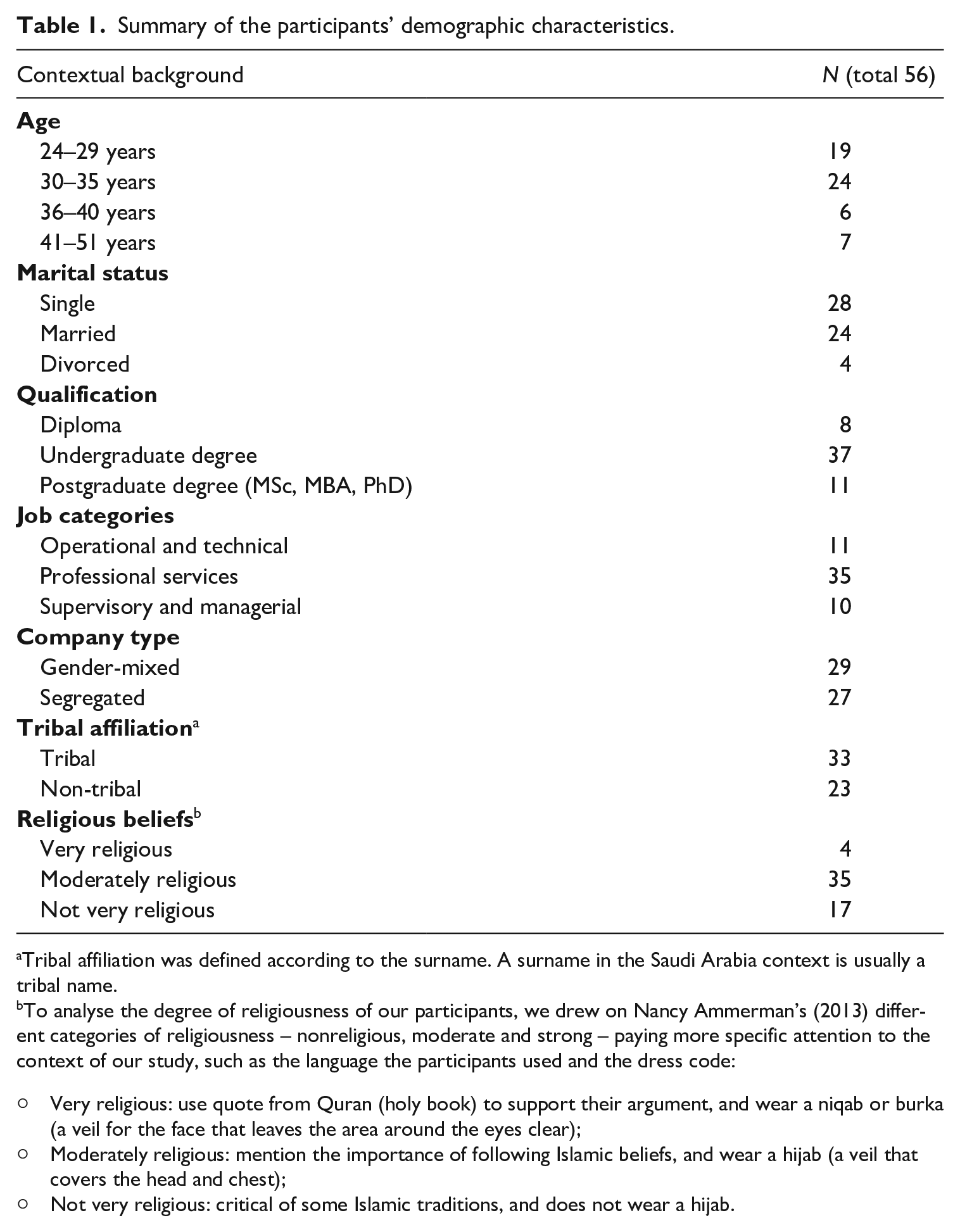
Tribal affiliation was defined according to the surname. A surname in the Saudi Arabia context is usually a tribal name.
To analyse the degree of religiousness of our participants, we drew on Nancy Ammerman’s (2013) different categories of religiousness – nonreligious, moderate and strong – paying more specific attention to the context of our study, such as the language the participants used and the dress code:
○ Very religious: use quote from Quran (holy book) to support their argument, and wear a niqab or burka (a veil for the face that leaves the area around the eyes clear);
○ Moderately religious: mention the importance of following Islamic beliefs, and wear a hijab (a veil that covers the head and chest);
○ Not very religious: critical of some Islamic traditions, and does not wear a hijab.
Data were collected in two phases: phase one took place from June 2018 to September 2018, and phase two from April 2019 to June 2019. The interview schedule was designed to capture individual-level perceptions of employee inclusion in the organisation and their strategies for establishing their place. Each interview lasted approximately 40–55 minutes and was voice-recorded with the assurance of complete anonymity and confidentiality at the participants’ workplaces in the Eastern Province of Saudi Arabia. The first author, a female native Arabic speaker originally from Saudi Arabia, conducted all the face-to-face interviews in Arabic. The researcher and participants shared the same gender, nationality, religion and culture, which helped alleviate the initial anxieties of participants when discussing sensitive topics related to their experiences as working women in Saudi Arabia. Consistent with Pini (2005), we contend that a shared background between the researcher and participants can facilitate interaction, foster trust and enable a deep understanding of women’s societal experiences. However, the researcher’s position as an insider (that is, a Saudi national) was supplemented with her position as an outsider (that is, an academic who had resided in a Western country for over 10 years). All interviews were transcribed into Arabic and then translated into English. A back-translation technique was employed to ensure the preservation of meaning during the process.
The initial analysis aimed to capture participants’ perceptions of ‘work role’ and ‘gender role’. To develop our coding framework, we utilised the concept of gendered moral rationalities (Duncan and Edwards, 1997). Through carefully reading the interview transcriptions, we identified themes related to women’s expectations of their gender roles, their experiences in their work roles and societal expectations placed upon them. We also extracted women’s accounts of the structural and institutional conditions, such as tribe and religious beliefs, that influenced their understanding of what is considered appropriate and socially acceptable. This analytical approach primarily involved categorising shared themes underlying women’s perceptions of the interplay between their gender roles and work roles. Through constant comparison processes, we grouped these thematic clusters into three gender/work orientations: traditionalist, pragmatist and trailblazer. These clusters represented how gender and work roles were reconciled or sometimes integrated, drawing upon previous work that focused on mechanisms of compromise, rationalisation, negotiation, or other methods (Duncan and Edwards, 1997).
The second analysis stage focused on participants’ perceptions of inclusion policies and values within their organisations while considering the social, cultural and political context in which these occurred. We specifically examined whether each organisation practised gender segregation and whether the participants belonged to a tribe. Drawing on Shore and colleagues’ (2011) framework on inclusion and diversity at work, we classified participants’ perceptions of their organisation’s inclusion orientation into four types: exclusion, assimilation, differentiation and inclusion. Our emphasis in this stage was on isolating participants’ perceptions of their organisation’s policies and practices regarding the employment and treatment of men and women rather than their reactions to these actions. The final analysis stage involved establishing theoretical connections between themes identified in the previous stages. At this stage, we regrouped themes into different levels suggested by Syed and Özbilgin’s relational framework: micro (gender and work role), meso (organisational approaches to inclusion) and macro (tribe and religious beliefs).
Findings
The self-narratives provided by respondents offer valuable insights into the process through which the women in this study reconciled the tension between sustaining economic productivity (entering the labour market) and balancing societal gender ideals. Our analysis was guided by Duncan and Edwards’s (1997) framework of gendered moral rationalities, which we supplemented with existing literature on inclusion that focuses on individuals’ experiences (Shore et al., 2018) and the impact of structural and institutional conditions on these experiences (Syed and Özbilgin, 2009). The findings revealed that participants approached the reconciliation of work and societal gender ideals in three distinct orientations: traditionalists, pragmatists and trailblazers. We defined traditionalists as women who fully embrace and prioritise their gender-traditional roles and view work roles primarily as a means to fulfil their families’ responsibilities. Pragmatists were defined as women who strive to balance the tensions between maintaining economic independence through their work role and meeting gender role expectations. Trailblazers were defined as women who prioritise their job and self-reliance, using their work roles to challenge existing gender-cultural expectations. Our findings contribute to the expansion of Duncan and Edwards’s (1997) gendered moral rationality framework by shedding light on the social and structural influences that shape the meaning of work and gender roles in the lives of our participants and inform their perceptions of organisational inclusion.
Traditionalist orientation
We classified women as ‘traditionalists’ in terms of their gender role and work role if they showed evidence of reconciling the dual demands of work and society’s expectations by fully embracing and prioritising their gender-traditional role (i.e. being a mother, a wife, or a daughter), and occasionally perpetuating patriarchal traditions in their approach to the work. Traditionalists believed that men should be the primary breadwinners, emphasising women’s biologically determined childcare responsibilities and household tasks. It is noteworthy that traditionalists did not associate their employment with personal fulfilment or achievement but instead viewed it as a means of providing for their families. In this research, a total of 20 participants (36% of the sample), many from tribal backgrounds, were identified as traditionalists, with 65% working in gender-mixed organisations. Most of these women were married or divorced, with children (65% of the traditionalists), and all held strong or moderate religious beliefs.
The interaction of participants’ tribal backgrounds and religious views gave rise to two distinct mechanisms within the traditionalist orientation regarding their perspective on work. First, traditionalist participants with moderately strong religious beliefs appeared to accept the notion of ‘pre-given gender roles’ (Duncan, 2005: 56), which unequivocally depicted men as the primary ‘breadwinner’ and assigned women to the traditional roles of mothers and housekeepers. Traditionalist participants rationalised their position by asserting that women’s responsibilities in childcare and housework held greater significance than paid jobs. Their responses often encompassed statements such as: Women have not been created for the purpose of getting a job; women have a lot of other responsibilities. Women take care of their children and their homes. (Participant 11, married, moderately religious, gender-mixed organisation)
Gendered assumptions permeate the discourse of traditionalists, assuming that women’s primary moral responsibilities revolve around family and childcare. These participants simultaneously legitimised and rationalised their decision to work by arguing that they only do so to meet their family’s financial needs: I don’t encourage women to work if they are going to be (completely) absorbed in it because they will get exhausted when doing other activities. I had a lot of activities before work . . . I used to go to Quran study centres in the morning and search for many activities, even if they were voluntary. I worked here mainly to cover my expenses needs since I am a divorcée, so I needed money to take care of my children. (Participant 17, divorced, three children, very religious, gender-mixed organisation)
Second, traditionalist participants who adhered to religious teachings not only embraced the existing gender norms but actively opposed any form of gender inclusion. They consistently argued that women should remain at home to raise their children with Islamic values and expressed criticism towards Western concepts of equality: People misunderstand the term equality because they think it means Western equality; we don’t need that. Women in the Western culture are treated exactly like men, they work as hard as men, but women aren’t physically built like men are. Women can’t work extra hours when going through their period and when they have children. (Participant 46, single, very religious, segregated organisation)
Our findings indicate that some women with a traditionalist orientation transitioned from unquestioned acceptance of traditional gender roles to actively embracing and promoting societal and cultural norms. The interplay between reactive acceptance and active commitment to traditional gender roles was evident in their perceptions of organisations’ stance of inclusion. Most traditionalists (75%) viewed organisational practices that required adaption to male-dominated norms as natural. Additionally, 20% of the traditionalist participants perceived organisational practices as inclusive, fostering a strong sense of belonging.
The norms imposed by organisations, predominantly established by men in gender-segregated and gender-mixed workplaces, were considered ‘ordinary’ and ‘natural’ by the participants. The prevailing gendered nature of employment was justified based on biological preferences. First, essentialist traditional views suggested that women’s biological factors led them to leave work and focus on raising children, resulting in limited participation in leadership positions. Second, participants claimed that women are mentally and physically ‘weaker’ than men, with men naturally possessing the attributes necessary for leadership roles, as exemplified below: The nature of women is different. Men can work in any field, and they don’t have problems with long hours and travelling. Women can’t do that; they aren’t as physically capable as men. (Participant 49, single, moderately religious, segregated organisation)
The interaction between participants’ traditionalist orientation and their perception of work was also evidenced in how they accepted their line managers’ views regarding working women. Participants shared that male supervisors explicitly expressed the belief that a woman’s place should be at home, and they were not expected to be a breadwinner but rather to marry, stay at home and focus on household responsibilities: Many male supervisors have said to us that women should stay at home. They usually quote verses from the Quran that say, ‘stay in your houses, and do not display yourselves like that of the times of ignorance’. (Participant 11, married, moderately religious, gender-mixed organisation)
However, it is essential to note that in contrast to the frustrations expressed by other participants, traditionalist participants perceived their male line managers as more ‘equal’, ‘supportive’ and ‘understanding’. This perception was based on the belief that the male managers sympathised with and understood women’s primary roles as mothers or wives and accommodated those roles within the workplace. Consequently, our research findings indicate that traditionalist participants’ assimilations to the dominant norms contributed to a heightened sense of belonging within their workgroups.
Overall, our findings emphasise the influence of broader social and structural factors on the moral elevation of the socially reinforced gender roles among traditionalist participants, significantly impacting their perception of work. These participants fully embraced and prioritised gender roles shaped by society and reinforced by organisational practices, viewing work primarily as a means to fulfil familial responsibilities. Their decisions to engage in paid work were guided by the moral idea of ‘good mothering’, which extends beyond maternal responsibilities as defined by Duncan and Edwards (1997) to include societal values. In the context of Saudi Arabia, traditional gender roles encompass being a good mother, wife and daughter and upholding tribal honour. Our study expands existing literature (Al-Rasheed, 2013; Metcalfe, 2007) by highlighting that tribal codes of honour not only restrict women’s employment but also influence their perception of work, even in a gender-mixed environment. By adopting a relational and multilevel perspective on gendered moral rationalities, we gain insight into the unique national and social context that shapes women’s understanding of inclusion as a personal experience, which corresponded to collective beliefs and societal expectations at large. Consistent with Syed and Özbilgin (2009), we argue that the complexity of the inclusion process necessitates the consideration of societal factors that shape individual experiences of inclusion.
Pragmatist orientation
Women categorised as ‘pragmatists’ in their orientation towards the dual gender–work role engaged in careful negotiations with structural and institutional conditions that influenced their behaviour and perceptions of what was socially acceptable. Out of the total sample, 14 participants (25%) were identified as pragmatists, with 65% coming from tribal backgrounds and working in gender-segregated organisations. Pragmatist participants expressed a need for belonging in both work and society, striving to balance the tension between maintaining economic independence and meeting gender role expectations while avoiding cultural conflicts. Unlike traditionalists, who emphasised the conflict between pre-given gender roles and employment, pragmatists viewed holding a job and pursuing a career as integral to maintaining good relationships with their families and tribal connections. Importantly, pragmatist women did not actively challenge cultural norms or seek to change organisational practices for greater inclusion; instead, they navigated patriarchal male-dominated contexts to achieve their personal goals. Despite limited opportunities at work due to their gender, this group strongly emphasised the importance of having career in their lives, as exemplified below: My job is very important to me, and I get really bored when I take a day off to stay at home because I don’t know what to do. My eldest daughter always tells me to quit my job because she wants to see me more often. She said she wants me to cook for her and asked me to become a teacher at her school so she can always see me. But I told her that I can’t just sit at home and cook because I need to be able to go out to work and have a life. . . . [later, the participant added] I applied for an international assignment at the company several times, and they keep rejecting my request. I told my father that I want to quit my job at [organisation x] because the company is holding me back from achieving my ambitions. He told me that I must stay in my job because it will guarantee a good life for me. My husband agreed with my father on that. They don’t like this sudden step where I have to leave my job and country. (Participant 10, married, two children, non-tribal, gender-mixed organisation)
The quote above highlights how women strive to reconcile their pre-given gender roles (such as being mothers or upholding family honour) with their full-time employment. Another participant further expands on the significance of having a job in her life while also acknowledging the influence of her family and tribal affiliations, which limited her options to employment in gender-segregated organisations due to societal norms surrounding tribal and family honour: Work is the biggest part of my life. I feel that I am productive. I was really excited when I graduated, and I had a lot of dreams, but then suddenly, all of those dreams faded away. This job is the only opportunity that I got, so it’s either take it or leave it! . . . It is hard for women to work in mixed workplaces. When a woman works in a mixed environment, that will affect her because not everybody accepts the idea of working in a mixed place, my family doesn’t. (Participant 35, married, two children, moderately religious, tribal, gender-segregated organisation)
Our data highlighted that these pragmatist participants (65% from a tribal background) subtly navigated the restraints imposed by patriarchal norms and traditional culture. As such, those women negotiated the work aspects of their lives without breaching the social code set by society. Most pragmatist women, who worked in gender-segregated organisations (58% of the pragmatists), perceived that their organisations adopted a differentiation orientation, providing them with distinct career opportunities at work while still adhering to cultural norms. For example, one participant stated: Women show unwillingness to mix with men here, so the company has a special segregated call centre only for women. (Participant 30, single, not very religious, gender-segregated organisation)
In addition, 31% of the pragmatist participants perceived organisational practices as exclusive and highlighted line managers’ influential role in perpetuating and reinforcing gender differences. Many participants described their managers as not considering women as integral parts of the larger organisation, resulting in managerial segregation and isolation based on gender. One participant explained: Our company is strict and working alone with men isn’t allowed. The CEO and the management are very religious, and this affects the way they run the business. (Participant 44, married, one child, moderately religious, gender-segregated organisation)
Nevertheless, most participants perceived the differentiation orientation (and, in some cases, the inclusive practices) as a positive initiative. They believed it created career opportunities for women while still respecting cultural norms. This viewpoint reflected a dynamic perspective that acknowledged the evolving nature of gender equality and the increasing accommodation of working women. Notably, many participants in these organisations originated from ancestral Saudi tribes, which traditionally imposed restrictions on women’s employment due to normative pressures related to tribal honour and identity (Al-Rasheed, 2013). Similarly, Metcalfe (2007) found that for women in the Middle East, working in gender-mixed environments is considered socially unacceptable to some extent and perceived as a breach of codes of honour within their society.
Participants working in a mixed-gender environment employed various strategies to address negative gender stereotypes and workplace inequalities. One of the participants shared her approach of disregarding discriminatory behaviour and focusing on acquiring additional skills and knowledge through voluntary work. The following quote exemplifies the tension between the participants’ personal aspirations and the influence of cultural and societal pressures: My sister is in Switzerland; the sky is her limit. When I meet my sister in the summer, and she talks about her experience at work, I should also have something to say. I am not going to say that culture limited my accomplishment; no, I will not. I am going to say the voluntary workshop makes me happy, fulfilled, satisfied, and that will put me on the same level as my sister. (Participant 1, married, not very religious, gender-mixed organisation)
Overall, the data revealed that women were aware of gendered challenges in their organisations and society. Despite the disadvantaged position of women within the organisations, they saw work as an opportunity to express their suppressed talent and derive personal satisfaction, even in the presence of limited avenues for women. The participants exhibited ambition and considered themselves equally competent and professional as men. While they perceived little influence over their culture, they employed various strategies to navigate gender inequalities at work and find aspects of their lives where they could experience a sense of achievement and work inclusion. They also hoped to effect changes by instilling gender equality awareness in their children.
In conclusion, pragmatist participants adeptly combined gender roles with work roles and emphasised the subjective fulfilment they derived from their employment. They seamlessly integrated their need for economic independence, represented by their work role, with their gender role by conforming to what was considered appropriate and socially acceptable. Our findings illustrate the influence of gendered moral rationalities (Duncan et al., 2003) on women’s silent pursuit of tactics to negotiate and evaluate their work inclusion, highlighting the significance of societal factors in shaping women’s career paths and their perceptions of organisational inclusion policies. By adopting a multilevel and relational approach (Syed and Özbilgin, 2009), our analysis provides insights into the complex interplay between individual experiences, societal factors and organisational inclusion practices.
Trailblazer orientation
We classified women who challenged pre-given gender roles and male-dominated institutions while fully embracing and prioritising their work roles as trailblazers. These trailblazer working women forged new paths for themselves and others, highlighting the benefits that employment brought to their lives. They expressed the value they placed on their jobs and the resulting self-reliance, which allowed them to defy cultural expectations regarding gender roles. This group comprised 22 participants (39% of the overall sample), with 73% originating from tribes. The majority of the trailblazers recognised the prevailing norm of limited representation and inclusion for women in their workplace, reflecting organisational orientation that ranged from differentiation (32% of trailblazers) to outright exclusion (55% of trailblazers). Notably, many participants believed they affected societal changes by being pioneers in their fields. For instance, one participant in a hospital described her experience as being one of the first Saudi women in her department, serving as a role model for other women: I was one of the first Saudi females in the department, and I started from scratch. In the beginning, I worked as a receptionist because we had to know everything, from A to Z, and now I am a specialist in Echo. (Participant 24, married, four children, not very religious, gender-mixed organisation)
A recurring theme that emerged from the interviews was the participants’ determination to challenge patriarchal norms and promote the acceptance of women working in diverse fields. For example, several participants who worked at the Saudi women’s first all-female travel call centre recounted the hostility they initially encountered within their communities upon gaining employment. Furthermore, trailblazer women emphasised the importance of forming alliances with like-minded women to overcome male dominance in their society: The situation for women is improving. I believe that there is a generation of females who are ready to become leaders. The first step towards changing and improving women’s circumstances is by trusting each other, supporting one another, and offering help. (Participant 39, single, not very religious, gender-segregated organisation)
Interviewees with a trailblazer orientation had diverse experiences within different organisational settings, particularly in their sense of belongingness and uniqueness. Those working in gender-segregated organisations perceived that the policies and practices reflected a differentiation inclusion orientation, which provided them with distinct career opportunities: This office is the first women’s office, but the company is predominantly male. At the beginning of my career, I felt that women were not widely accepted in the workplace. This call centre is the first of its kind for women in the Kingdom. We started from scratch. Women have proved themselves in many ways, and as a result, more fields have opened up for women. (Participant 33, married, moderately religious, gender-segregated organisation)
Participants saw the organisation’s differentiation approach of creating jobs specifically ‘for women’ while excluding them from the same professional development opportunities as men as insincere in terms of inclusion. Within this perceived differentiation inclusion strategy, participants noted that male managers held lower expectations of women, viewed them as less competent and provided them with limited opportunities to succeed and excel. Women felt that managers did not consider them as integral parts of the larger organisation and, in some cases, experienced gender-based segregation, isolation and control: Most men-managers don’t expect women to work with precision, so we have to work hard to prove our efficiency. I encountered this just last week when my manager assigned me a task and asked one of the male colleagues to stay with me until I finished it. (Participant 42, single, moderately religious, gender-segregated organisation)
From our interviews, it became evident that trailblazers played a crucial role in actively driving the change process for workplace inclusion within their male-dominated organisations, in terms of both structural and cultural aspects. For example, one participant shared an incident: Last year, we had the first female bachelor graduates in Saudi Arabia in Geology and Geophysics to work in our department. Although fieldwork for long trips is forbidden, I proposed to my manager to take them to the field. Well, when I first proposed the fieldwork trip, they told me it’s impossible, and people were mocking me. Fortunately, we got approved, and females went to the field. Now they will start doing those trips more often. (Participant 5, married, moderately religious, gender-mixed organisation)
Furthermore, several participants shared that their strategy for challenging traditional gender stereotypes involved raising awareness among women and creating opportunities for other women. The trailblazer women consistently emphasised the need for a broader shift in the societal standing of women and highlighted the various tactics they employed to achieve this within their workplace. Notably, 73% of the trailblazers originally came from tribes. Some participants expressed that belonging to a tribe imposed additional constraints. One participant stated, ‘I come from a tribe, it is like a curse, it’s like you are always observed, everything you do is associated with the tribe’s name!’. However, being part of a tribe also gave them elevated social status, affording them certain freedoms. In other words, there was a paradox in pursuing a work role in a context characterised by social restrictions but within the protective framework of a high-level social status. Overall, trailblazers fully embraced their work roles and exhibited tremendous confidence in their capacity to effect change by pushing the boundaries of male-dominated organisational practices and challenging traditional gender role expectations.
Discussion and conclusions
Adopting relational and multilevel lenses (Syed and Özbilgin, 2009) allowed us to capture the complex interplay between macro/national, meso/organisational and micro/individual influences that shaped the experiences of women who were among the first to enter workplaces in Saudi Arabia. Our research indicates that culture and tribal norms at the societal level play a significant role in shaping the approaches to gender inclusion within organisations (e.g. offering gender-segregated workplaces to increase women’s participation in the workforce). Furthermore, the interaction between societal and organisational levels influences how individuals negotiate their gender and work roles to attain inclusion for themselves. Thus, our study provides a comprehensive understating of how societal, organisational and individual-level characteristics are interconnected and collectively impact how women perceive their dual gender–work roles and subsequently navigate inclusion for themselves.
Our findings contribute to theoretical and empirical knowledge in several ways. First, our research highlights the need to expand the current understanding of gendered inclusion beyond a purely ‘psychological state’. Instead, it emphasises the importance of considering the social embeddedness of the inclusion process, considering the unique cultural, historical and socio-institutional contexts that shape individual responses to organisational efforts to promote gender inclusion. In line with Adamson et al.’s (2021) critique of existing inclusion literature for its limited conceptualisation and theorisation of gendered inclusion beyond individual perspectives, our study explores how broader organisational and societal structures influence the mechanisms and processes of gender inclusion. Our findings reveal that gender inclusion is deeply influenced by societal and cultural beliefs that not only perpetuate gender segregation in society but also impact interaction within organisations and individuals’ attitudes towards inclusion. For instance, our research demonstrates how participants’ tribal backgrounds influenced their perception of the differentiation approach to inclusion (i.e. organisations offering gender-segregated work environments) as a positive, highly inclusive initiative. Thus, we argue that the existing individualistic ontology of inclusion, prevalent in mainstream psychological and management studies, only offers a partial explanation. Inclusion entails navigating tensions across practices, processes and norms within different institutional contexts, shaped by variations across family, tribe and society, which influence organisations and individuals.
Our second contribution to the literature on inclusion is the application of the gender-rational morality lens, which enhances our understanding of how women experience belongingness and uniqueness in the workplace. While the existing literature suggests that inclusion is achieved when individuals experience a balance of belongingness and uniqueness (Mor-Barak, 2015; Shore et al., 2011), our research demonstrates that these experiences are influenced by external pressures that enforce pre-given gender roles. In this context, our participants prioritised a sense of belongingness to their extended family and tribe over the desire to belong to a social group in the workplace. For example, participants in the pragmatist group perceived the differentiation approach adopted by gender-segregated organisations to increase women’s inclusion to maintain their strong belongingness to their family and society. Similarly, traditionalist participants assimilated to the male-dominant cultural norms in the organisation to enhance their sense of belongingness while still embracing their uniqueness as mothers or wives. In Saudi Arabia, gendered uniqueness is associated with recognising women’s roles as caregivers, and traditionalist participants described their managers as ‘supportive’ and ‘understanding’ of their needs. Therefore, our research highlights the complexity of experiencing belongingness and uniqueness in contexts where collective norms and cultural values influence women’s perceptions of inclusion. We argue that adopting a relational approach and the gender-rational morality lens in the study of gendered inclusion highlights the importance of the societal context and cautions against adopting homogenous conceptualisations of inclusion.
Our third contribution pertains to the theoretical implications of Duncan and Edwards’s (1997) theory of gendered moral rationalities. Despite the sociological lens that gendered moral rationality adopts, we argue that its distinction between mother and work roles is limited and does not adequately capture the diverse meanings associated with gender and work roles shaped by societal factors, especially in Eastern contexts. We contend that the rationality types proposed by Duncan and Edwards (1997) are somewhat narrow and based on Western understandings of gender role expectations and family structures, and they do not fully encompass the socio-ethical and cultural distinctions that shape these roles in Eastern contexts. Our research highlights how Saudi women’s responses to job opportunities and their stances on inclusion (segregation versus gender-mixed) by evaluating their dual roles, consisted of (1) gender roles tied to family and tribal approval of their employment environments and (2) worker roles tied to their sense of values and achievements. These dual roles are embedded in the sociocultural context where families and tribal norms persist and significantly contribute to the exclusion of women from the public sphere (e.g. Varshney, 2019). While previous research (Duncan, 2005; Duncan et al., 2003; Herbst-Debby and Benjamin, 2020; O’Reilly et al., 2014) has utilised the gendered moral rationalities lens to capture the ongoing process of women negotiating dual roles of motherhood and worker, our findings demonstrate the limitation of solely focusing on the biological imperative. We advocate for a broader perspective within the gendered moral rationalities framework, one that includes women living in socially negotiated and collective contexts where rational choices are embedded in tribal and social ties that shape their everyday experiences. Therefore, our approach offers a substantial contribution to Duncan and Edwards’s (1997) ‘integral mother/worker’ categories by drawing attention to the diverse macro-social, cultural and structural factors that shape women’s work experience and gender role beliefs beyond the scope of motherhood alone.
Our findings have practical implications for policymakers and organisations aiming to enhance women’s labour force participation in Saudi Arabia. If policymakers are committed to increasing women’s inclusion in the Saudi labour market, it is crucial to introduce initiatives that consider women’s perceived tensions in negotiating their gender and work roles. Our research demonstrates that the societal and cultural expectations that position women as primary caregivers play a significant role in how they navigate and perceive work. This gender role as primary caregivers is reinforced by Saudi labour law, which grants women 10 weeks of paid maternity leave compared with only three days for fathers as paternity leave. From a policy perspective, the introduction of shared parental maternity leave could encourage fathers to take a more active role in childcare, alleviate the unequal burden of childcare and caregiving on working mothers, and legitimise women’s employment within the broader society. At the organisation level, as more women enter the labour market in response to ongoing governmental reforms, employers must focus on training and developing women who have been historically marginalised. This investment in their development will help women feel valued and respected as valuable members of their employing organisations, fostering a sense of inclusion. Finally, foreign organisations operating in Saudi Arabia must have a realistic understanding of inclusion policies that align with societal expectations. While previous research suggests that Saudi Arabia’s traditional approach to gender segregation limited women’s work to specific ‘feminine’ professional roles (Sian et al., 2020), our findings reveal that providing the option of separate working spaces for men and women might encourage women with traditionalist gender orientations to pursue paid work. Therefore, localising inclusion practices to consider how societal gender expectations may affect women’s entry into the labour market will be a valuable tool for foreign companies.
In conclusion, this study, although focused on the unique context of Saudi Arabia, provides a valuable framework for understanding women’s efforts to negotiate their dual gender and work roles and increase their workplace inclusion across the Arab world. The identified gendered moral rationalities orientations of traditionalists, pragmatists and trailblazers shed light on the sociocultural uniqueness of these contexts compared with the predominantly Western-focused literature. Future research could explore specific social-institutional mechanisms, such as tribal culture on women’s gender role orientations, and conduct cross-gender comparisons to understand how tribal affiliation affects work experiences. Additionally, research should investigate context-specific factors in the Arab region, such as the absence of anti-discrimination policies, political pressures tied to a monarchy-based rule and sectarian religious tensions (Hennekam et al., 2017), which are likely to shape the experience of marginalised groups and communities, such as the stateless in Kuwait (Abu Sulaib, 2020), the Shia in Syria, Kuwait and Saudi Arabia (Syed and Ali, 2021), the Kurds in Syria and Iraq (Monshipouri and Whooley, 2011), and Druze in Lebanon (Karam, 2022) in terms of workplace inclusion or exclusion. Overall, this study contributes to understanding how individuals in minority positions navigate their organisational and societal contexts and extends the understanding of inclusion and gendered moral rationalities beyond Western contexts, emphasising the significance of the societal context. By examining the interaction between the workplace and broader social, cultural and religious influences in negotiating dual roles, this research makes theoretical and empirical contributions to the fields of inclusion and gendered moral rationalities. Although the study focuses on a context deeply rooted in tradition, religion and law regarding the treatment of women, the insights gained have relevance for women facing similar challenges in other industries, professions and companies as pioneers, tokens or minority representatives.
Footnotes
Funding
The authors received no financial support for the research, authorship, and/or publication of this article.
