




Abstract
This study reports on an investigation of the relationships between teacher empowerment and organisational citizenship behaviours. Data were collected from 457 teachers working in secondary schools in the Eastern Province of Saudi Arabia. The results indicated that teacher empowerment was positively correlated with organisational citizenship behaviours among teachers. Regression analysis indicated that teacher empowerment explained 48% of the variance in organisational citizenship behaviour scores. The results of the study revealed that decision making, professional growth, status and impact had the most contribution in explaining the variance of total organisational citizenship behaviours. These results indicated the significance of empowering teachers in the school settings. The more the teachers are empowered, the more they exhibit behaviors that go beyond their traditional roles towards the advantage of their students, colleagues, and schools. Directions for further research are discussed.
Introduction
Over the past 40 years, teacher empowerment has received much attention throughout the world. The rationale for this attention is grounded in empirical research that has verified the positive effects of teacher empowerment on school effectiveness, school improvement and student achievement (Marks and Louis, 1997). The key to improving the schools lies in upgrading teacher empowerment, which will lead to improvements in a teacher's performance. However, in many nations, even as leaders have recognised the significance of empowering teachers, scholars have accentuated constraints in the educational systems that continue to limit the empowerment of teachers (Emira, 2010). Further research is required to understand how teachers’ sense of empowerment shapes the behaviours of the teachers.
Deciding why teachers exhibit organisational citizenship behaviours (OCBs) has gained a substantial amount of attention of research (e.g. Kao, 2017; Khasawneh, 2011;Marinova et al., 2019; Shapira-Lishchinsky and Tsemach, 2014; Somech, 2005; Somech and Ron, 2007). Research indicates that teachers who feel a sense of potency, impact and control on the work exhibit higher levels of OCB (Bogler and Somech, 2005; Kirkman et al., 2004). Empowered teachers tend to have an enhanced sense of self-efficacy and model higher performance beliefs about themselves and students (Bandura, 1986; Conger and Kanungo, 1988). Over time, these beliefs of the teachers enhanced feeling of meaning and strong OCBs. They tend to perform more effectively and take on extra roles that are not part of formal responsibilities (Somech and Drach-Zahavy, 2000).
Since the knowledge base on teacher empowerment research has emerged and evolved in western countries, (e.g. Rinehart and Short, 1994; Rinehart et al., 1998, 1997; Scully et al., 1995; Short, 1994) more empirical research should be conducted to examine the consequences of teacher empowerment in non-western contexts. This poses a problem in these contexts where the teachers within the schools are asked to be more involved in decision-making processes to strengthen their efficacy. For example, Wang et al. (2019) indicate the need for empowering teachers in the school setting to introduce the reforms to be conducted and assume responsibility for planning and mentoring the processes.
In the present study, the author systematically examines the relationships between teacher empowerment and OCBs among school teachers in Saudi Arabia. The independent variable is the empowerment level of teachers. The dependent variables are the OCB and its dimensions. The contribution of this study stems from two major considerations. First, this study corresponds to the Saudi policy makers’ efforts to improve teacher performance and effectiveness. Second, this study provides a baseline on teacher empowerment in Saudi Arabia where the research on teacher empowerment is limited. Furthermore, few studies have been conducted to address the consequences of teacher empowerment in the Saudi context. The author hopes that this study will contribute to the Arab scholarship in educational leadership and management (EDLM) and to the diversification of the global knowledge base in EDLM.
Theoretical perspective
The author begins with a short description of the context of the study. Then, the author presents the relevant constructs for this study.
Context of the study
Education in Saudi Arabia is based on the belief that ‘the citizen has the duty for the pursuit of learning and the state's duty is to provide learning for its citizen’ (Ministry of Education, 2004, p. 6). Education in Saudi Arabia is a highly centralised and standardised system. At the kingdom level, the Ministry of Education (MoE) is responsible for issuing plans and policies, recruiting and selecting staff, authoring textbooks, and supervising professional development programs. At the local level, education is administrated through provincial education departments. There are about 5,119,953 students in the public schools, 345,998 students in foreign schools, 721,843 students in private schools and half a million teachers in the education institutes in Saudi Arabia (MoE, 2020).
The Saudi Arabian school system consists of 6 years primary, 3 years intermediate, and 3 years secondary school. There are two paths of secondary education: scientific and humanistic. The postsecondary education system includes universities and vocational and technical institutes. Currently, there are 29 public universities, and 52 private universities and colleges (MoE, 2018).
The responsibilities of teachers in Saudi Arabia are delineated in documents written by the MoE and monitored by the school leaders and educational supervisors. Teachers are appointed by the MoE. They have to attend professional development programs supervised by MoE. Teachers in Saudi Arabia implement the national curriculum introduced by the MoE. Nonetheless, they are expected to enrich the academic environment, adopt new teaching practices, facilitate the learning process and assess how well the students are performing (Algarni and Male, 2014).
Recent reforms in Saudi Arabia (e.g. Tatweer education reform project, and Saudi Vision 2030) have developed the capability of the teachers within the schools to ‘move from traditional learning centred to a learner centred’ (Algarni and Male, 2014). For example, the Tatweer education reform project encourages Saudi Ara context bian teachers to participate in decision making in work processes to strengthen their teaching effectiveness.
Teacher empowerment
Teacher empowerment is a concept that has gained significance in EDLM literature. Teacher empowerment is defined as ‘a process whereby school participants develop the competence to take charge of their own growth and resolve their problems’ (Short et al., 1994, p. 38). Empowerment enables experiences that can foster choice, autonomy and responsibility. Empowerment is an active, interactive and efficient process (Devos et al., 2014). Empowerment measures the power teachers have over curriculum decisions within their classrooms and teachers’ involvement in decision making beyond the classrooms (Dunst, 1991). Mahshoush (2019) defined empowerment as unleashing teachers’ inherent capabilities through delegating authority to take decisions while ensuring they have the willingness to improve the situation in which they operate.
Teacher empowerment has been associated with a number of important outcomes including teacher performance, school effectiveness and quality improvement (Bezzina and West, 1997; Kirkman et al., 2004; Pounder, 1998; Sweetland and Hoy, 2000). A sense of empowerment is often associated with increased professionalism, organisational commitment (Al-Basheer and Hammad, 2018; Al-Ruwqi, 2016; Devos et al., 2014, Dee et al., 2002), job satisfaction (Bogler and Nir, 2012; Rice and Schneidr, 1994) and innovation (Spreitzer, 1995). For example, Dee et al. (2002) indicated that highly empowered teachers are more apt to foster collaborative responsibilities and take on tasks than less-empowered teachers.
As a measurable construct, teacher empowerment can be further clarified through the following dimensions: Decision making, professional growth, self-efficacy, impact, autonomy and status (Short and Rinehart, 1992). Decision making refers to the extent to which teachers have influence over important decisions that affect their jobs. Teachers' involvement in decision making can strengthen teachers' sense of the whole, reduce their professionalism, and ultimately change the school (Sirianni, 1987). It empowers the teachers to take on roles beyond their work. Professional growth refers to teachers' involvement in professional development programs in a way that enhances their sense of ownership (Hickey and Harris, 2005). Self-efficacy is the teachers’ belief in their abilities to produce positive effects in students’ learning. Self-efficacy beliefs refer to teachers' critique of their abilities to ‘organize and perform a specific behavior’ (Staple, Hullan, and Higgins, 1999). Impact refers to teachers' awareness that they can have an influence on the work-life. Autonomy is the extent to which teachers have control over work processes (e.g. scheduling and instructional planning). Status is the amount of appreciation teachers have for their work. It is about valuing the work of the teachers. Thus, teacher empowerment can be best represented if all these dimensions are satisfied.
Organisational citizenship behaviour
The concept of OCB was derived from the social exchange theory. Interest in voluntarily behaviour can be traced back to |Organ (1977, 1988, 1997) who used the term OCB to describe it (Lepine et al., 2002). Organ argued that OCBs are voluntarily and non-rewarded behaviours that are directly beneficial for the organisation (Bogler and Somech, 2005). OCBs structure the psychological and social context of the organisational environment (Organ, 1997)
OCB has been receiving much attention in recent years (e.g. Dipaola and Tschannen-Moran, 2001; Foote and Tang, 2008; Ho and Le, 2020; Khasawneh, 2011; Lepine et al., 2002; Oplatka, 2006; Organ, 1988; Organ et al., 2006; Yilmaz and Tasdan, 2009) as scholars have recognised its importance to the functioning of the organisation. OCB has been conceptualised as a pivotal factor for predicting key performance indicators such as job engagement, turnover intention (Aryee and Chay, 2001), readiness for organisational change (Organ et al., 2006) and organisational commitment. OCBs provide ‘the flexibility needed to work through many unforeseen contingencies’ (Smith et al., 1983, p. 654).
In this study, OCBs are defined as ‘those behaviors that go beyond specified role requirement and are directed towards the individual, the group, or the organization as a unit, in order to promote organizational goals’ (Somech and Drach-Zahary, 2000, p. 650). This definition features the multifaceted nature of OCB. In this study, OCB is defined with three dimensions, including OCBs directed towards schools, colleagues, and students. Such a multidimensional construct has been validated and used in the school context (e.g. Bogler and Somech, 2005; Somech and Drach-Zahary, 2000). The first dimension refers to behaviours aimed at helping other colleagues (e.g. orienting new teachers). The second dimension refers to behaviours aimed at helping the students to improve their performance and achievement. The third dimension describes impersonal behaviours directed towards the advantage of the school (e.g. assuming roles that are not part of the job).
Relationship between teacher empowerment and OCBs
Recent research on school effectiveness has provided evidence for the claim that effective working conditions affect the school's success. Studies argue that empowering teachers can affect school outcomes through extra-role behaviours such as OCBs (Bogler and Somech, 2005; Locke and Latham, 1990). For example, the research examined the degree empowerment accounts for the variation in teacher commitment, efficacy and satisfaction (e.g. Bogler and Nir, 2012; Dee et al., 2002). These studies evidenced that teacher empowerment is correlated with teacher effectiveness (e.g. Barr and Duke, 2004; Brophy, 1979; Danielson, 2006).
For extra-role behaviours such as OCB, teacher empowerment is an essential school factor, since it provides opportunities for teachers to strength their task motivation and innovation (Spreitzer, 1995). Researchers have argued that empowerment satisfies teachers' need for self-determination, and in turn increases their motivation. Empowered teachers tend to have a high sense of self-efficacy and perceive themselves as capable of teaching their students effectively (Brophy, 1979, p. 736).
More specifically, the components of teacher empowerment (e.g. involvement in decision making) ensures that correct information will be accessible for making decisions that promote teaching and enhance teachers’ sense of self-efficacy (Addi-Raccah, 2009). Furthermore, when teachers found that their input is valued they often made a better decision, sought for continuous improvement and addressed important issues (Hyatt and Ruddy, 1997).
There is an evidence that experiences within professional and supportive school environment would likely provide teachers with meaningful experiences in their work. In such meaningful empowerment, one would expect teachers to produce high levels of determination and effectiveness which will ‘translate into higher levels of OCBs’ (Bogler and Somech, 2005; Kirkaman et al., 2004; Watt and Schaffer, 2003). When teachers have higher levels of impact and autonomy on work life, they often attain greater roles and responsibilities (White, 1992). More specifically, teachers who found their job meaningful and had higher expectations of themselves perform effectively and take on extra-role behaviours that are not prescribed of their job (Bogler and Somech, 2004; Watt and Schaffer, 2003). Thus, it seems acceptable to suggest a positive relationship between teacher empowerment and OCB.
This global body of research is supported by the few studies conducted in Saudi Arabia. For example, Alsharah (2018) found a positive correlation between empowerment and OCBs in universities in Saudi Arabia. Gaber (2020) also found that job empowerment was positively associated with OCBs. To sum up, the relationships between teacher empowerment and OCBs find support from global research on teacher empowerment and limited research conducted in Saudi Arabia. With this in mind, the current study investigated the relationships between teacher empowerment and OCB among teachers in public schools in Saudi Arabia.
Research questions
What is the level of teacher empowerment and OCBs among Saudi teachers based on their perceptions?
What is the relationship between teacher empowerment and OCBs?
What is the effect of teacher empowerment dimensions on OCBs?
Methodology
The current study used a quantitative research design to answer the research questions. The following sections describe the measures, participants and procedures, and data analysis methods.
Measures
Short and Rinehart’s (1992) School Participant Measurement Scale (SPES) was used to measure teacher empowerment. SPES meets high standards of reliability and validity (Klecker, 1996; Psychoyos, 2012). SPES is a superior measure of teacher empowerment in that it measures six basic dimensions of empowerment (Klecker, 1996, p. 56). Internal reliability was measured resulting in (0.83) for decision making, (0. 76), for professional growth, (0.77) for self-efficacy, (0.67) for autonomy, (0.73) for status and (0.83) for impact. The whole scale has a reliability level of (0.81). It should be noted that the reliability coefficients for the instrument exceeded 0.6 (Nunnally & Bernstein, 1994). Therefore, it is a reliable measure of teacher empowerment in the school setting. Sample items include: ‘I was given the responsibility to monitor school programmes’ (decision making), ‘I am treated as a professional’ (professional growth), ‘I believe I can help students to be independent’ (self-efficacy), ‘I have the freedom to make decisions in teaching techniques’ (autonomy), ‘I have the respect of my colleagues’ (status), ‘I have a positive impact on other teachers’ (impact). The scale used a five-point Likert scale.
OCBs were measured by the scale developed by Somech and Drach-Zahavy (2000) and validated in the school setting. The questionnaire consisted of three subscales: OCBs towards the school (eight items) with a reliability level of (0. 86), OCBs towards the students (seven items) with a reliability level of (0.81) and OCBs towards colleagues (eight items) with a reliability level of (0.79). Sample items include: ‘make innovative suggestions to improve the school’ (OCBs towards the school), ‘help other teachers who have heavy work loads’ (OCBs towards the colleagues) and ‘Stay after school hours to help students with class materials’ (OCBs towards the students). The whole questionnaire has a reliability level of (0.85). Therefore, the internal consistency of the instrument was a reliable measure. The scale used a five-point Likert scale ranging from 1 (strongly disagree) to 5 (strongly agree).
Since the measures were written in English, the author employed Brislin’s back-translation technique (1970) for translating the surveys from English to Arabic. The scales were translated into Arabic. Then, we have a meeting with eight educators (e.g., school leaders and teachers) to discuss the Arabic form of the scale. The Arabic version of the scales was ‘reverse translated’ into the English language. The two versions of the scales were finally compared. The Arabic version of the scale was refined to ensure clarity.
Participants and procedures
The study was conducted in public schools in Saudi Arabia in 2020/2021. The author obtained the approval of the General Directorate of Education to conduct the study. Data were collected from teachers in 25 public secondary schools located in the city of Dammam in the Eastern Province of Saudi Arabia. The schools were served by 645 teachers. The author obtained 457 valid responses from the teachers, representing a response rate of 71%. Analysis of the demographic characteristics of the participants showed that 71.5% were women and 28.5% were male. The average length of teaching was 8.5 years. Regarding the academic background, 75.8% of the respondents held a bachelor's degree, 16.2% a master's degree and 8% had a college diploma.
Data analysis
Statistical Package for the Social Sciences (SPSS) was used to analyse the data. Means and standard deviations were used to examine the levels of teacher empowerment and OCBs. Pearson correlations were used to examine the relationships among the variables in this study. Regression analysis was employed to predict the dependent variables (OCB and its three dimensions) by the independent variables (teacher empowerment).
Results
The first question of the study examined the level of teacher empowerment and OCBs among Saudi teachers based on their perceptions. Means and standard deviations were used to answer the first question. It should be noted that the overall mean for teacher empowerment was (M = 4.02, SD = 0.47) showing a high agreement by the teachers towards the practice of empowerment in public schools (see Table 1). For the subscales of teacher empowerment, status had the highest mean score (M = 4.24, SD = 0.48), followed by self-efficacy (M = 4.16, SD = 0.54), professional growth (M = 4.13, SD = 0.48) and impact (M = 4.00, SD = 0.70). Autonomy (M = 3.97, SD = 0.65) and decision making had the lowest mean scores (M = 3. 60, SD = 0.67).
Means and standard deviations for the overall and each of the dimensions of teacher empowerment.
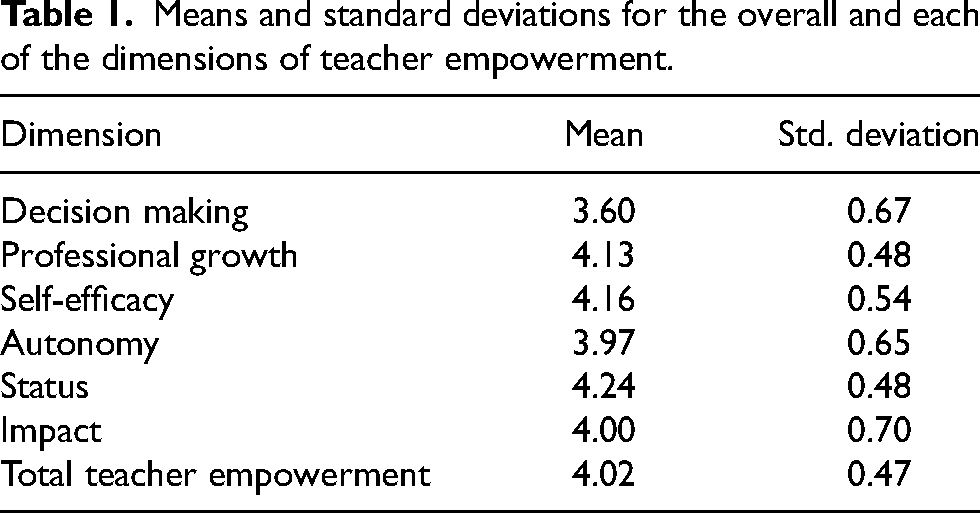
Table 2 shows that the overall mean score for OCBs was (M = 3.82, SD = 0.51) indicating a high OCBs among teachers. For the subscales of OCBs, OCB towards students (M = 3.90, SD = 0.53) was higher than the level of OCB towards colleagues (M = 3.86, SD = 0.51). OCB towards schools had the lowest mean score (M = 3.69, SD = 0.69).
Means and standard deviations for the overall and each of the dimensions of OCBs.
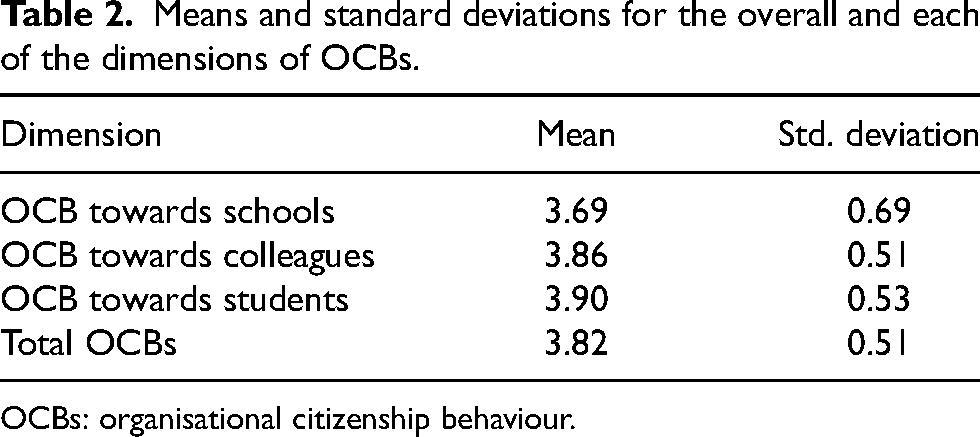
OCBs: organisational citizenship behaviour.
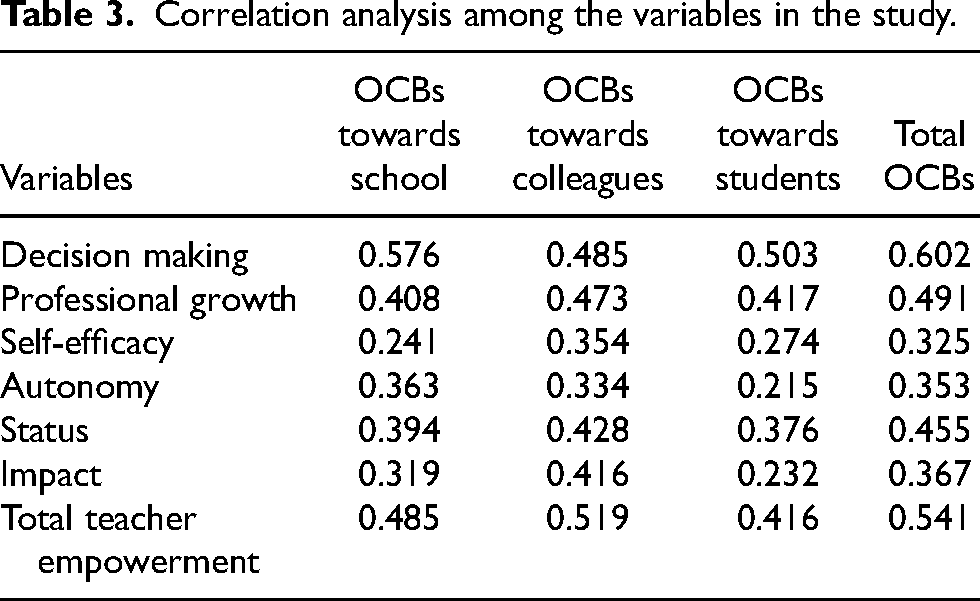
The second research question examined the relationship between teacher empowerment and OCBs. The correlation analysis was used to answer this question. Table 3 reveals that teacher empowerment subscales were positively correlated with total OCBs among teachers (ranging from r = 0.325 to 0.602). The results of the correlation analysis also revealed a positive relationship between OCBs towards school (ranging from r = 0.241 to 0.576), OCBs towards colleagues (ranging from r = 0.334 to 0.519), OCBs towards students (ranging from r = 0.215 to 0.503) and subscales of teacher empowerment.
Correlation analysis among the variables in the study.
Regression analysis of teacher empowerment dimensions on OCBs.
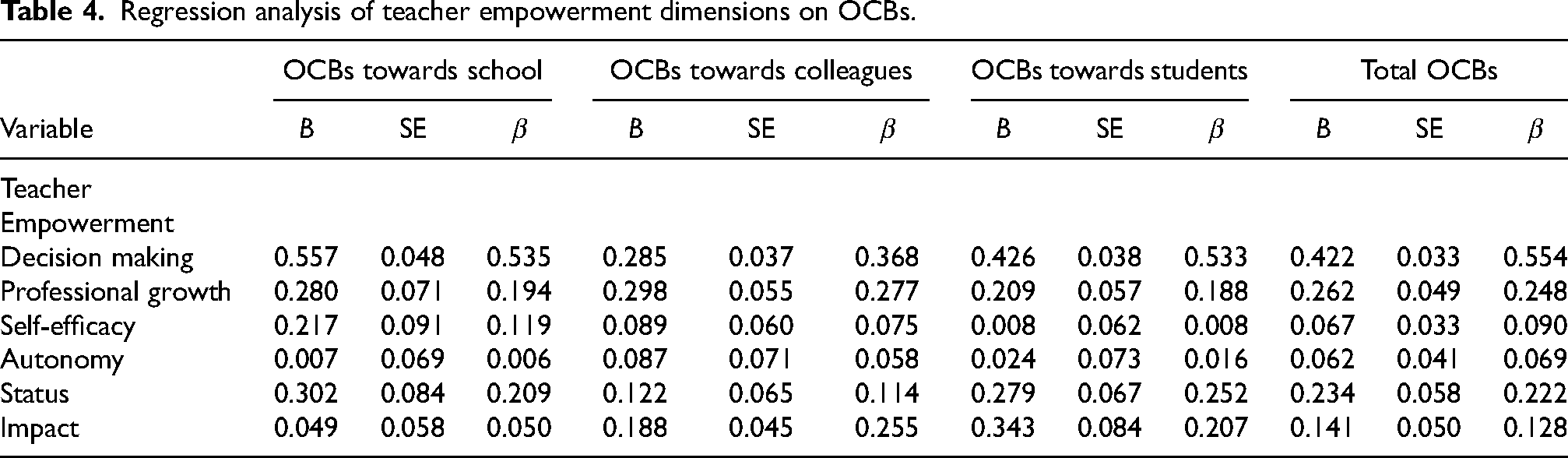
The third research question determined the effect of teacher empowerment dimensions on OCBs. Regression analysis for the variables was used to answer this question. First, a multiple of R of 0.69 accounted for 48% of the variance in total OCB scores (untabled). Table 4 reveals that decision making (β = 0.554), professional growth (β = 0.248), status (β = 0.222) and impact (β = 0.128) had more effect on total OCBs.
Additionally, it was found that a multiple R of 0.64 accounted for 42% of the variance in OCBs towards school scores. The regression analysis indicated that decision making (β = 0.535), status (β = 0.209) and professional growth (β = 0.194) had the most contribution in explaining the variance of OCBs towards the school (see Table 4).
It was also found that a multiple R of 0.61 accounted for 37% of the variance in OCBs towards the colleagues. The standardised regression coefficients revealed that decision making (β = 0.368), professional growth (β = 0.277) and impact (β = –0.225) had the most contribution in explaining the variance of OCBs towards the colleagues (see Table 4). Nonetheless, the variables of self-efficacy, status and autonomy made less contribution to OCBs towards the colleagues.
Finally, Table 4 reveals the results of the multiple linear regression analysis for the variables predicting OCBs towards students. It was found that these variables explained 37% of the variance in OCBs towards students. The standardised regression coefficient (β) indicated that decision making (β = 0.533), status (β = 0.252), impact (β = 0.207) and professional growth (β = 0.188) had the most contribution in explaining the variance of OCBs towards students.
Discussion
The purpose of this study was to examine the level of teacher empowerment and OCBs among teachers in Saudi Arabia based on their perceptions, the relationship between teacher empowerment and OCBs, and the effect of teacher empowerment subscales on OCB and its dimensions. The data analysis showed that teacher empowerment is highly practiced in Saudi secondary schools. These results are consistent with Saudi transformational programs 2020 in empowering teachers.
The results regarding the means of the six dimensions of the SPES are consistent with research conducted internationally. For example, Bogler and Somech (2005) and Wall and Rinehart (1998) reported that status, professional growth, self-efficacy and impact had the highest mean scores, while autonomy and decision making had the lowest mean scores. These results indicate that the participants in this study feel that they do not have sufficient control over their job and are not given appropriate opportunities to be involved in decision making.
These findings have significant practical implications for school leaders. Our school leaders need to develop management strategies that provide more opportunities for teachers to experience meaningfulness in their work and become more involved in important school-related decisions. We suggest that leadership development programs should support school leaders to believe that their teachers can make a positive difference in the improvement of their schools if they are involved in decision making and have more control over their work.
Our findings extend prior research by revealing how teacher empowerment subscales are positively correlated with OCBs (Bogler and Somech, 2005; Kirkman and Rosen, 1999; Kirkaman et al., 2004). These findings indicated the significance of empowering teachers in the school setting because teacher empowerment is positively correlated with OCBs. The more the teachers are empowered, the more they exhibit behaviours that go beyond their traditional roles towards the advantage of their students, colleagues and schools.
The findings indicated that teacher empowerment subscales made different contributions to OCB and its three dimensions. Involvement in decision making and professional growth had more effect on total OCB and its different components. While status made a high contribution to total OCB and its two dimensions (OCB towards schools and OCB towards students), impact made a high contribution to total OCB and its two dimensions (OCB towards colleagues and OCB towards students). Therefore, teachers who are more involved in decisions that influence their job, and provided with opportunities to grow and improve their skills are more likely to exhibit behaviours that go beyond their expected roles to help their colleagues, students and school (Hyatt and Ruddy, 1997). Involvement in making decisions would meet the teachers’ needs of self-actualisation, which increases OCBs (Bogler and Somech, 2005).
When teachers enjoy appreciation of their work, they are more likely to assume roles that are not part of their formal jobs towards the advantage of their school and students. OCBs are essential because job obligations cannot incorporate all the behaviours needed for the schools to reach their goals (Vanyperen et al., 1999). OCBs are important for improving teaching performance, student learning and school effectiveness (Shapira-Lishchinsky and Tsemach, 2014). Thus, meeting the teachers' needs of empowerment through involving them in decision making, improving their skills, recognising their efforts and allowing them to affect the professional life can contribute to improving OCBs. For this reason, Saudi leadership development programs in Saudi Arabia should include strategies for developing teacher empowerment to promote teacher development and student learning.
Limitations and Further research
The current study has some limitations that could be addressed in future research. First, this study examined the perceptions of the teachers regarding the relationship between their empowerment and OCBs. Further research could examine the perceptions of school leaders. Second, the current study used a cross-sectional survey. Therefore, it is recommended that future research could be conducted via other research techniques such as observation and interviews. Finally, this study was conducted in secondary schools located in one city of Saudi Arabia. Thus, future research could be conducted to examine the effect of teacher empowerment on OCBs in other geographical areas. Further research could also investigate the effect of individual and organisational characteristics on OCBs.
Footnotes
Declaration of conflicting interests
The authors declared no potential conflicts of interest with respect to the research, authorship and/or publication of this article.
Funding
The authors received no financial support for the research, authorship and/or publication of this article.

Author biography