Abstract
To analyze the cell cycle regulatory mechanisms in the growth of pituitary adenomas, we investigated immunohistochemically the expression of the cell cycle-related proteins cyclin A and p27 in 48 pituitary adenomas. The frequency of apoptosis and the proliferative potential were also examined. The percentage of apoptotic cells was evaluated by immunohistochemical analysis using the anti-single-strand DNA antibody. The proliferative potential was assessed using the anti-Ki-67 antibody. The mean cyclin A labeling index (LI) for the non-recurrent group was 1.03% and for the recurrent group 2.31%. A positive linear correlation between cyclin A LI and Ki-67 LI was found. The mean p27 LI for the non-recurrent group was 67.4% and for the recurrent group 47.0%. There were significant differences in cyclin A LI and p27 LI between the non-recurrent group and the recurrent group. The mean apoptotic rate for the non-recurrent group was 0.87% and for the recurrent group 1.05%. There was no significant difference. Multivariate regression analysis revealed that high cyclin A LI and high Ki-67 LI were significant factors for shorter progression-free survival. The results suggest that the cyclin A LI is a useful prognostic factor in pituitary adenomas. (
C
A total of 48 histologically confirmed pituitary adenomas, obtained at Osaka City University, were studied. All cases were divided into the recurrent group and the non-recurrent group. Ten tumors showed recurrence. All cases were followed for more than 5 years after initial surgery.
Tumor tissues were fixed in 10% buffered formalin and embedded in paraffin. The expression of the cell cycle-related proteins cyclin A and p27 was evaluated by immunostaining with monoclonal antibodies to cyclin A and p27. The immunostaining was performed using the Dako Envision+ (Dako; Carpinteria, CA) system. After antigen retrieval, endogeneous peroxidase activity was blocked by 0.3% hydrogen peroxidase in methanol. Then the sections were incubated with the primary antibodies (cyclin A ×100; p27 ×50) for 1 hr at room temperature. Then they were incubated with the peroxidase-labeled polymer for 1 hr. Finally, they were incubated with DAB. The percentage of cells showing positive nuclear staining was assessed in each case to determine the cyclin A and p27-labeling index (LI). The percentage of apoptotic cells (apoptotic rate) was evaluated by immunohistochemical analysis using the anti-single-strand (ss)DNA antibody. The immunostaining was also performed using the Dako Envision+ system. The proliferative potential was assessed using the anti-Ki-67 antibody (MIB 1).
Thirty of the pituitary adenomas were in women and 18 were in men: The mean age of patients was 40.7 years. There were 32 gross total removals and 16 subtotal removals.
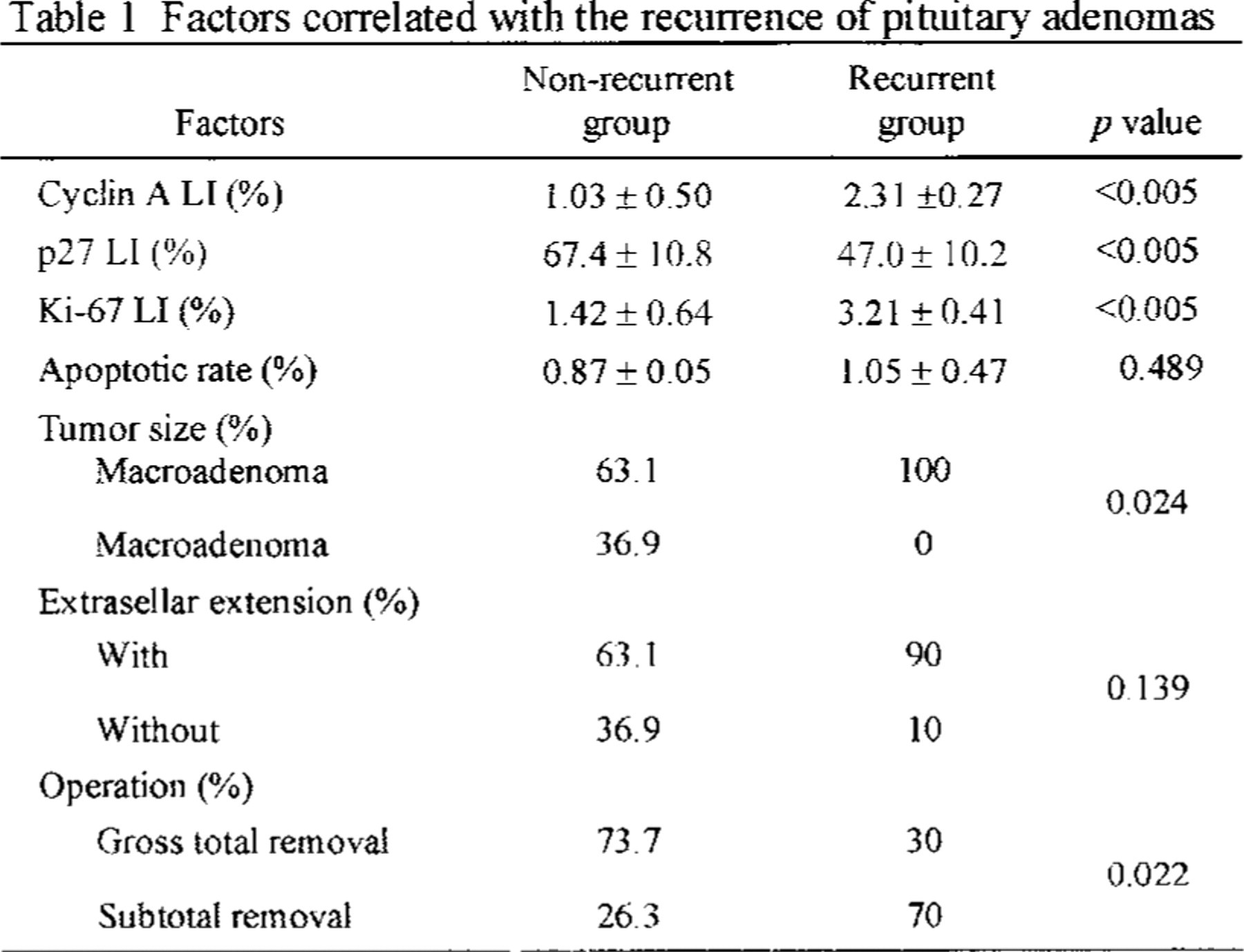
In cyclin A immunostaining, the staining pattern was nuclear (Figure 1). The mean cyclin A LI for the non-recurrent group was 1.03 ± 0.50% and for the the recurrent group 2.31 ± 0.27%. A statistically significant difference in cyclin A LI was observed between the two groups (p < 0.005). A significant correlation was seen between the cyclin A LI and the Ki-67 LI (r = 0.91; p < 0.005). The cyclin A LI showed a tendency to increase as the Ki-67 LI increased. In p27 immunostaining, p27 was expressed in the nuclei (Figure 1). The non-recurrent group had a significantly higher mean p27 LI (67.4 ± 10.8%) than that of the recurrent group (47.0 ± 10.2%) (p < 0.005). Apoptotic cell were observed in 38 of 48 cases. The apoptotic rate was higher in the recurrent group (1.05 ± 0.47%) than in the non-recurrent group (0.87 ± 0.05%), but there was no significant difference (p = 0.489). The recurrent group had significantly higher numbers of macroadenomas (chi-square test p < 0.05) than the non-recurrent group (Table 1). Subtotal removal was also more common in the recurrent group than in the non-recurrent group (chi-square test p < 0.05). Type of tumor and extrasellar extension also did not correlate with recurrence. Multivariate regression analysis revealed that high cyclin A LI, high Ki-67 LI, and subtotal removal were significant factors for shorter progression-free survival.
This study showed that cyclin A expression was associated with tumor recurrence and correlated with Ki-67 LI. These results were generally in agreement with recent studies that reported the correlation of cyclin A expression with cell proliferation and tumor progression in various tumors (Paterlini 1993; Huuhtanen 1999). To our knowledge, there are no reports concerning cyclin A expression in pituitary adenomas. Our results suggest that cyclin A may be positively involved in the increased proliferation of pituitary adenomas. We also found that p27 expression was higher in the non-recurrent than in the recurrent pituitary adenomas. Recent studies have shown that p27 reactivity evaluated immunohistochemically correlates with an unfavorable prognosis in several cancers (Sanchez–Beato 1996; Jordan 1998). Our study showed that, similar to cancers, p27 is downregulated and is associated with recurrence in pituitary adenomas. Several studies have documented that higher level of apoptosis are a negative prognostic index in cancers (Mattern 1998; Evertsson 1999). In this study the recurrent group had a higher apoptotic rate than the non-recurrent group, but there was no significant difference. In conclusion, our results suggest that high cyclin A LI together with low p27 LI is associated with an unfavorable prognosis for pituitary adenomas.
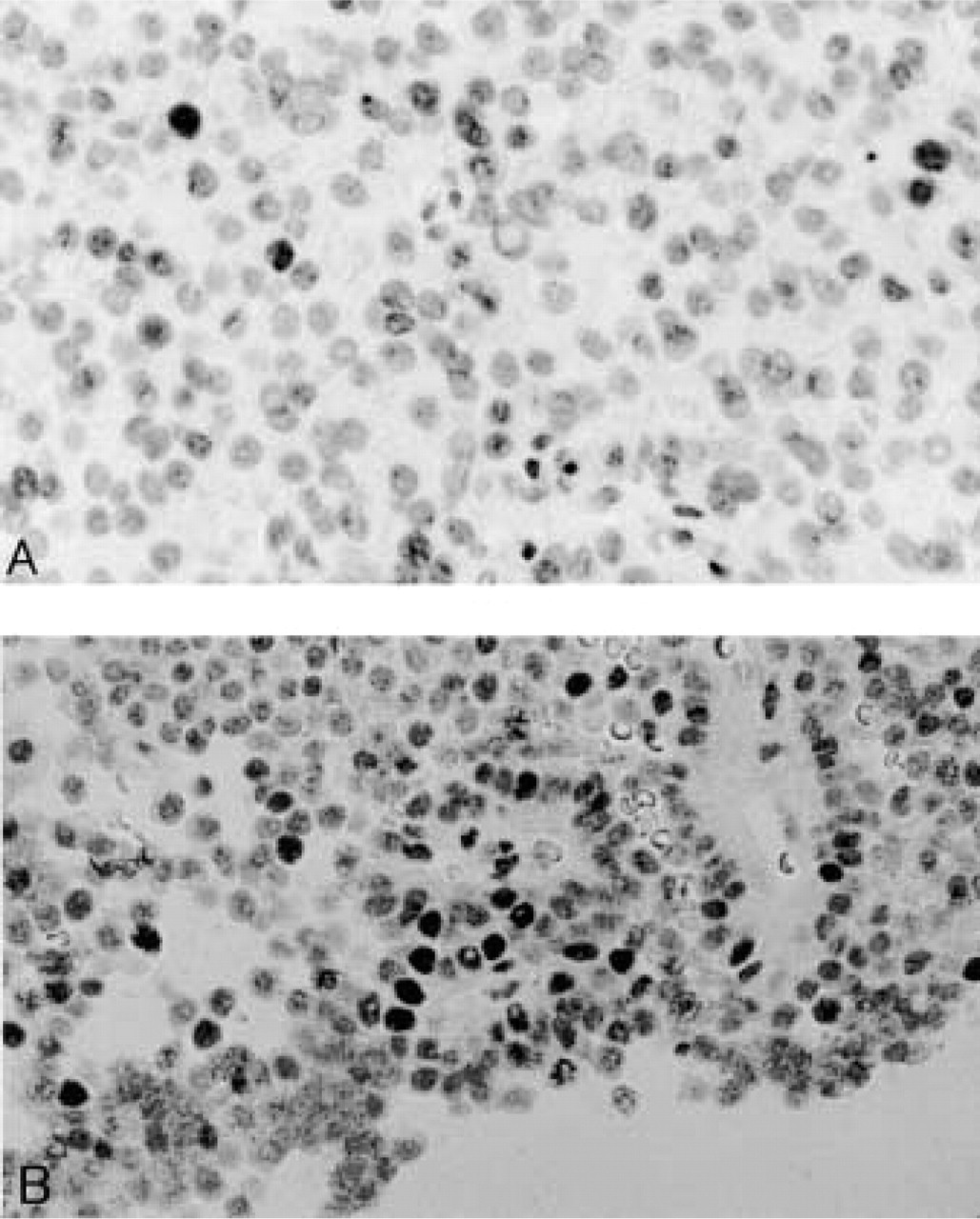
Sections of pituitary adenoma immunostained with cyclin A (
Factors correlated with the recurrence of pituitary adenomas