




Abstract
Based on a Zambian case study of the Movement for Multiparty Democracy (MMD), this paper applies the behavioural theory of party competition to explain how, through vote-seeking and office-seeking strategies, political parties may employ rapacious predatory co-optation of members from competing political parties as a mobilisation strategy. The paper concludes that in the absence of a dominant political party, parties and political elites may resort to predation to bolster their electoral fortunes. While predatory co-optation may strengthen some parties, it also weakens others and undermines or reverses party system institutionalisation and vertical accountability.
Keywords
Introduction
Political parties constitute voluntary organisations of politically like-minded people whose main objective is to seek the election of their members to public office and ultimately influence public policy and governance (Kura, 2007). Debates exist about whether or not political parties are good for democracy. Randall (2007) alluded to this debate by hinting at one assertion that political parties might, in fact, hinder democratic consolidation (p. 633). However, many scholars have affirmed Schattschneider’s (1942) thesis: that in the absence of political parties, would be unattainable modern democracy (see Adejumobi and Kehinde, 2007; Burnell, 2004; Kuenzi and Lambright, 2001; Kura, 2007; Lam, 2010; Lipset, 2000; Lucardle, 2015; Omotola, 2010; Randall and Svåsand, 1999; Simutanyi, 2005; Stokes, 1999; Teorell, 1999). For Kura (2007), ‘even non-democratic regimes cannot do without political parties’ (p. 46).
Parties are essential for democracy because they link the governed with the government; they articulate aggregate interests, recruit electoral candidates, and hold the government accountable. They form government when they win elections (Ezrow, 2011; Yanai, 1999). In addition, in representative democracy, political parties allow voters to elect who governs (Randall and Svåsand, 2002) and an avenue for vertical and horizontal accountability (Wegner, 2016). Therefore, to ‘sustain the democratic process’ (Randall, 2007: 638), political parties must be stable as institutions of political competition. In Lindberg’s (2007) words, ‘political parties must be more durable and institutionalised rather than fluid’ for them to function well (p. 218). In most emerging democracies, however, the reality evinces party and party system volatility (Lupu and Riedl, 2012). Most parties in Africa, for example, are transient (Erdmann, 2004; Van de Walle and Butler, 1999), whose primary existential external and internal sources of volatility are, in part, competitive elections and factionalism (Yanai, 1999), both of which are understudied phenomenon (Boucek, 2009). Other sources include parties’ inability to maintain loyalty among their supporters, low resource endowment to contest elections (Lane and Ersson, 2007), and brand dilution – as in the case of Latin American parties in the 1980s and 1990s (Lupu, 2014).
Together, the above-highlighted threats contribute to party collapse and reversals in party system institutionalisation. Although the evidence on the effects of these existential threats in the extant literature has been palpable, the mechanisms that engender reversals in party system institutionalisation, particularly in ‘weakly institutionalised or inchoate systems’ (Mainwaring, 1998), remain obscured–primarily due to varying and ever dynamic national contexts. Examining these national contexts would provide sharper lenses to explain the volatility and reversals in party and party system institutionalisation in country-specific contexts. This paper, therefore, examines the predatory nature of the interaction among the three major political parties in Zambia between the two general elections of 2011 and 2016: the Patriotic Front (PF), the United Party for National Development (UPND) and the Movement for Multiparty Democracy (MMD). The paper explores the mechanisms that the three political parties employed against each other during the said elections, especially when faced with two conditions: first, a highly competitive election in, second, a party system that does not have a dominant political party. Specifically, the paper teases out predatory co-optation to demonstrate a significant driver of party instability.
Theoretically, the paper draws on Strøm’s (1990) behavioural theory of political parties to demonstrate how the vote – and office-seeking desires among competitive parties threaten party stability and political system institutionalisation. The central premise is that beyond the understanding that ‘what political parties want affects how they make strategic decisions and respond to changes in society’ (Pedersen, 2012: 896), the vote – and office-seeking goals of the political elite can fuel two concurrent but different outcomes: first, the weakening and possible collapse of a previously strong party and, second, the bolstering of previously weaker parties. Voter attachment to political parties (Lupu and Riedl, 2012) and rootedness in society (Basedau and Stroh, 2008) are known strong institutionalisation indicators. However, the elites’ rootedness in political parties – or lack thereof, is a less studied but considerable determinant of party (de)institutionalisation. Therefore, this paper builds on Tavits’ (2008) argument that in political competition, ‘choices of elites may be more responsible for instability than erratic behaviour of voters’ (p. 537).
This paper proceeds in four broad sections as follows: the next section provides an overview of the party systems in Third-Wave democracies in Africa. For Zambia, the focus is on the period since the return to multiparty democracy in 1991. At independence in 1964, Zambia followed a multiparty system, but this was abandoned in 1972 with the ruling party’s declaration of Zambia a one-party-participatory democracy in which only the ruling party, was allowed to conduct political mobilisation activities and represent the electorate (see Phiri, 2001; Sardanis, 2014). Then, it highlights the sources of threats to party stability and the continuous flux in the country’s party system. The third section outlines the study’s methods, while the fourth presents the findings, discussion and conclusion.
Party and party system institutionalisation
Institutionalisation in democratic parlance remains a prominent feature of debates on requisites of democratic consolidation, particularly in emerging democracies (Randall and Svåsand, 1999). In its distilled form, institutionalisation refers to ‘order and stability’ (Taylor-Robinson, 2001: 582), stability and rootedness in society (Randall and Svåsand, 1999). Essentially, institutionalisation entails longevity and functional adaptation, organisational complexity, autonomy and degree of consensus within the party (Basedau and Stroh, 2008). Whereas Lindberg (2007: 215) notes that the institutionalisation of party systems makes democracy work and that strong institutionalisation fosters democratic survival (see also, Bértoa, 2017; Mainwaring, 1998), others have asserted that party institutionalisation is not a panacea for the survival of democracy and that it may hinder democratic consolidation (see Randall, 2007; Randall and Svåsand, 1999).
In Zambia, the Third-Wave of democracy (see Huntington, 1991; Schraeder, 1995) brought a reversion to a multiparty system in 1991 (see Baylies and Szeftel, 1992; Phiri, 2001; Sardanis, 2014) and a change of party in power to the MMD (see Burnell, 2001; Momba and Madimutsa, 2009). Specifically, the 1991 general elections propelled the MMD to power and produced a two-party system, while the subsequent frequent party fragmentations of the MMD swung the system to a multiparty structure (see Kibble, 1992; Larmer and Fraser, 2007; Momba and Madimutsa, 2009; Venter, 2003). In the 1996 general elections, the United National Independence Party (UNIP), which had become the main opposition political party, staged an electoral boycott in protest of the contentious parentage clause in the Constitution, which effectively barred the rejuvenated former President, Kenneth Kaunda, from re-contesting the presidency. The ill-advised boycott denied the Zambians an opportunity to be represented by the only credible opposition party and left the MMD the only major player in the race.
In the ensuing years, degenerative factionalism was the primary driver of political system instability. With the first major factional splits of the MMD during the 2000 to 2001 leadership transition wrangles (Bwalya and Sichone, 2018), new formidable political parties such as the UPND and the Forum for Democracy and Development (FDD) reduced the MMD’s parliamentary dominance in Zambia. A competitive multiparty system took hold despite the electoral volatility between 2001 and 2011 and many new but fleeting political parties that succumbed to the pressure of elite circulation and party-switching. However, elite circulation and party-switching (see Burnell, 2001; Goeke and Hartmann, 2011; Kato and Yamamoto, 2009; Kifordu, 2011; Martin, 2021; Tardoff and Young, 2005; Tobolka, 2013) undermined vertical accountability (O’Donnell, 1994) and party institutionalisation. Thus, Zambia’s party system remained in flux: a two-party system following the general elections of 1991; a dominant party system from 1996 to 2001; a competitive multiparty system from 2001 to 2011; and, essentially, a reversal to a two-party system between 2011 and 2016. While elite circulation and party-switching explain the party system over the years, they do not provide a context-based theoretical explanation of the motivation for this circulation and how this impacted the competing parties and party system institutionalisation.
Methods
With a specific focus on the MMD, a qualitative case study approach was adopted for its strength in answering the ‘how’ and ‘why’ questions on contemporary phenomena (Yin, 2009). The case study sought to explain the PF’s and the UPND’s predatory co-optation of the MMD from September 2011 to August 2016. Two methods were used: first, interviews and, second, electoral data from the Electoral Commission of Zambia, and print media reports co-optations between 2011 and 2016.
Interviews
In-depth interviews with three purposively selected senior party officials were as follows: the MMD official was interviewed on 14 March 2019, the PF on 1 October 2020, and the UPND on 4 October 2020. The ranks within their respective political parties and knowledge of how their parties strategised vote-seeking plans provided bases for their selection as key informants. Following prior request and subsequent authorisation, each political party provided one key informant for interviews from their respective secretariats. Interviews aimed to understand how the parties framed the context and rationale for co-optation from 2011 to 2016. All interviews with the key informants were telephonic.
Election results and print media data
Official election results from the Electoral Commission of Zambia (2011–2016) helped to determine the performance of the three political parties in this study. These comprised the following: first, the 2011 parliamentary and presidential election results provided the starting point for tracing the electoral change at the parliamentary level over the 5 years. Second, the 2015 presidential by-election results compared the parties’ performance at the presidential level relative to the 2011 general elections. Third, the 21 parliamentary by-elections between November 2011 and September 2015 and the 2016 general election results. Fourth, the 2016 general elections results helped evaluate the net effect of co-optations on the electoral performance of the MMD and the co-opting parties. The results also demonstrated the cumulative effect of co-optation on the MMD. Furthermore, public and private print media reports provided rich data sources to explain how co-optation unfolded and its impact on the political parties over the 5 years (2011–2016). As these co-optations were ongoing everyday events, print and electronic media reports were critical to tracking the trends among the three parties over the five years. Specifically, the print media comprised the following newspapers: Daily Nation, The Post, Zambia Daily Mail and Zambia’s Times.
Findings
The following section presents findings on co-optations based on election results: from the Electoral Commission of Zambia and the print media records.
Predatory co-optation (2011–2016)
Co-optations, which Tobolka (2013) characterised as forms of defections, are common strategies to bolster political parties’ electoral fortunes. However, predatory co-optation, as this paper conceptualises, is a rare form of political mobilisation. In the case of Zambia, this form of mobilisation played out among the country’s three leading political parties between 2011 and 2016 – the MMD, the PF and the UPND. Following the electoral defeat in the September 2011 general elections, the MMD became a target for systematic recruitment of its prominent members to the UPND and the PF. The MMD was well-aware of this systematic poaching of its membership but showed no capacity to arrest it. For instance, the National Secretary of the MMD observed, ‘[T]he UPND wanted to cannibalise [emphasis added] the MMD by depleting it’ (Daily Nation, 27 May 2015). Contextually, an interplay of three variables provided a fertile ground for predatory co-optation to thrive in Zambia during the period under review. These comprised a lack of an outright dominant party, skewed regional and ethnic support for both the PF and the UPND, as the election results showed, and the radicalising power-seeking entrepreneurship of the political elite, which manifested through intense factionalism within the MMD. Thus, the two rival parties employed three strategies to co-opt members of the MMD:
Targeting the co-optation of members of the legislature (members of parliament)
Co-optation for ethnic diversity
Targeting of top party leadership
These are discussed individually in the next section.
Co-optation of MMD members of parliament
The PF won the September 2011 general elections with a slim majority over the MMD at presidential and parliamentary levels, while the UPND was a distant third. Little numerical difference existed between the top two parties in the legislature: 61 for the PF, 55 for the MMD, and 29 for the UPND. Furthermore, despite its smallest number of seats in parliament, the MMD had the broadest representation across the country – having won at least a seat in each of Zambia’s then nine provinces (Figure 1). However, with the eight nominated members of parliament, the PF secured a simple majority in parliament.
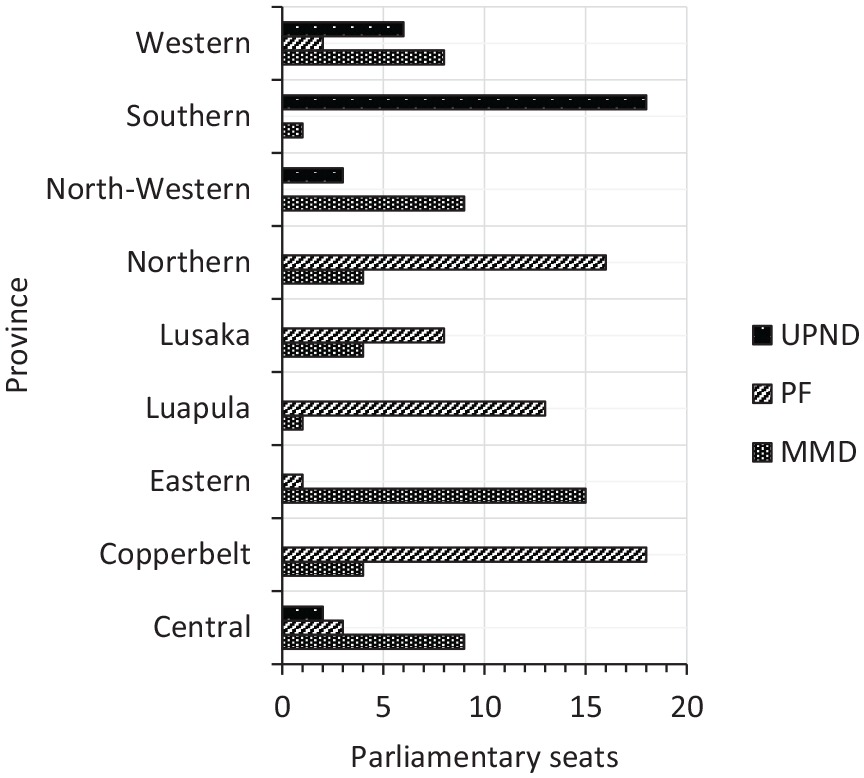
Parliamentary seats won across provinces in 2011 (UPND, PF and MMD).
The opposition political parties and independents secured 87 seats out of 156 in parliament, thereby presenting a potentially formidable challenge to the ruling party in the legislature. With that, the PF could pass all the laws that needed a simple majority in parliament without the support of the opposition members of parliament but could not pass those laws which required the two-third majority in parliament. This scenario unsettled the PF, whose preoccupation soon after the elections was to entice the parliament’s MMD members, especially in provinces where the PF performed poorly. Besides seeking to increase its dominance in parliament, the PF also hoped to attain a national character through the co-optation of opposition members of parliament.
The 2011 general elections produced regionally fragmented support for the top three political parties at the presidential level. In four out of nine provinces, the PF presidential candidate beat other contestants: Copperbelt, Luapula, Lusaka and Northern. The MMD presidential candidate also won in four provinces: Central, Eastern, North-Western and Western Provinces, while the UPND candidate overwhelmingly won only Southern Province (Figure 2). This fragmentation presented challenges for the spatial growth of both the PF and the UPND. While the PF had a slight advantage over the UPND regarding support across ethno-regional boundaries, they both carried tags of strong ethnic support. In the run-up to the 2011 elections, both parties tried to shade off this tag by co-opting new members from the regions where they had no representation in parliament to join.
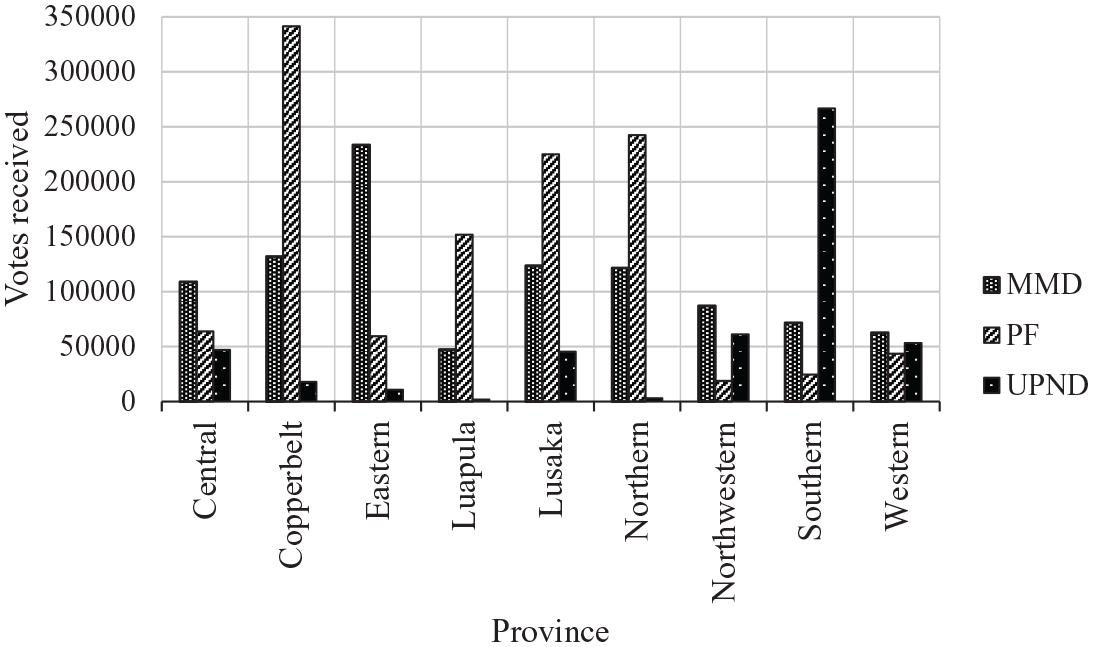
The 2011 presidential election performance – MMD, PF and UPND.
By the time of the presidential by-election in January 2015, following the death of President Michael Sata in October 2014, the UPND had virtually replaced the MMD as the main opposition political party. With the PF candidate, Edgar Lungu, obtaining 48.3% of the total valid votes cast and 46.7% for Hakainde Hichilema of the UPND (Electoral Commission of Zambia, 2016), the two parties were almost even in terms of support nationally. Thus, to counter spatial weakness in support and increase dominance, the two parties sought to widen their electoral footprint in all parts of the country. In 2015, the PF won in six, the UPND in four, while the MMD failed to win any province (Figure 3).
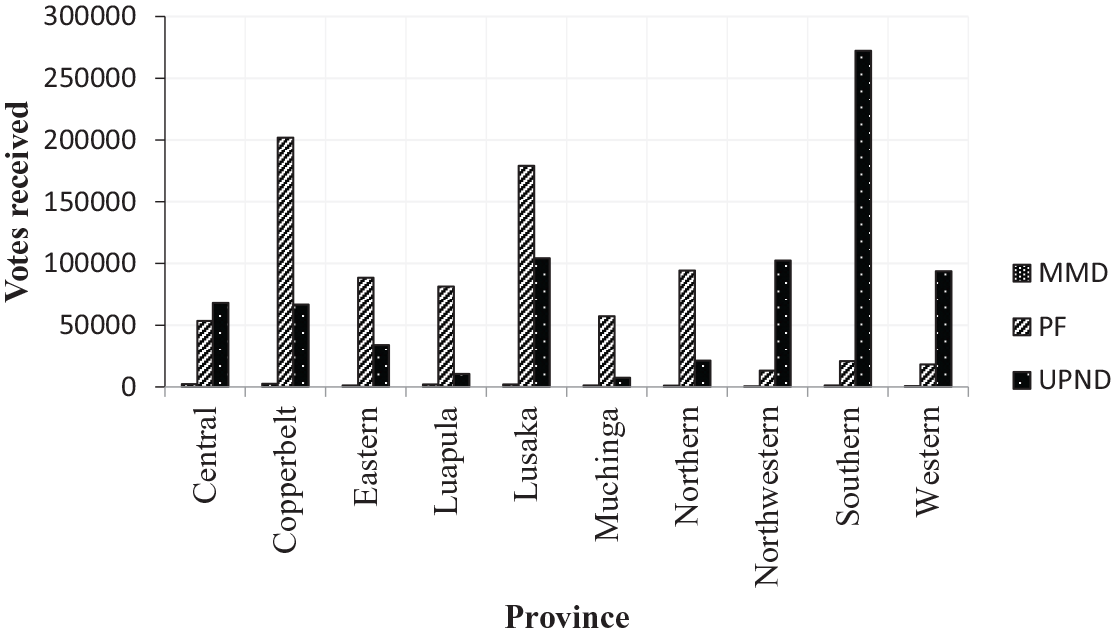
The 2015 presidential by-election performance – MMD, PF and UPND.
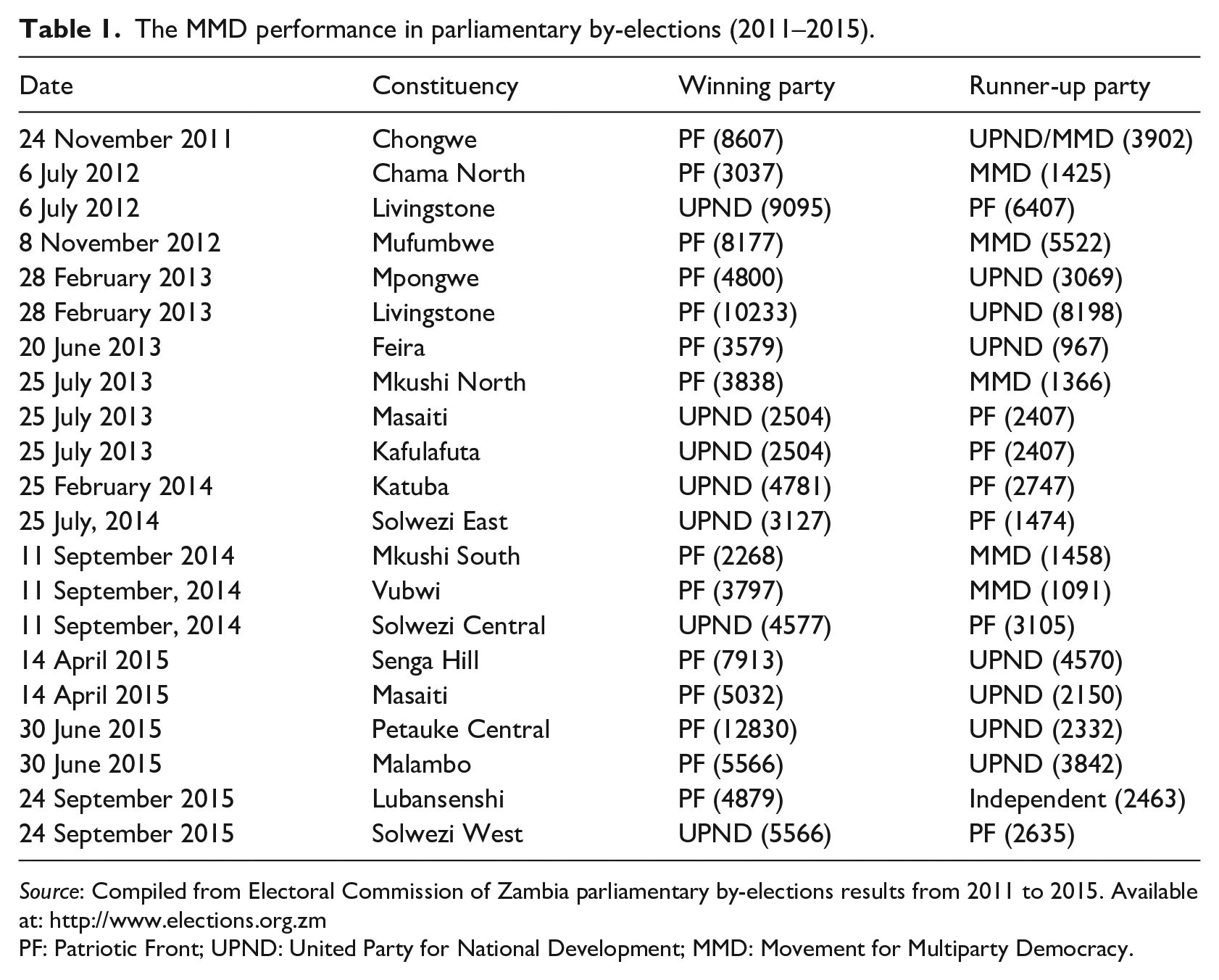
Both the PF and the UPND embarked on predatory co-optation since the 2011 general elections. Conversely, the PF successfully petitioned the September 2011 election results for several parliamentary seats won by the MMD while inducing other members of parliament defection. Both approaches induced by-elections, most of which the ruling party won. The UPND also benefitted from these by-elections by increasing its numbers in the legislature. Despite the MMD’s retention of a few seats in these by-elections, the net effect was progressive attrition in the legislature and, principally, a concomitant rise in the PF’s legislative dominance. Table 1 demonstrates this progressive attrition from 2011 to 2015 due to parliamentary by-elections.
The MMD performance in parliamentary by-elections (2011–2015).
Source: Compiled from Electoral Commission of Zambia parliamentary by-elections results from 2011 to 2015. Available at: http://www.elections.org.zm
PF: Patriotic Front; UPND: United Party for National Development; MMD: Movement for Multiparty Democracy.
From the 21 by-elections (Table 1), 14 MMD parliamentary seats were lost to the PF, while the UPND won seven. An interview with an MMD official demonstrated the party’s awareness of both the external destabilisation and the predation: [T]he MMD faced several destabilising threats, including the PF’s unprecedented petitions of parliamentary election results, attempts to deregister the party, and prosecution of several prominent members on various alleged offences. These included the former Republican President Rupiah Banda. Further, grabbing the party’s fleet of vehicles crippled the MMD’s mobilisation post-2011. (MMD, personal communication, 14 March 2019)
Co-optation for ethnic diversity
Although most of the predatory co-optation targeted the MMD, the ruling party also attempted to extend its legislative dominance and spatial spread through the appointment of UPND members of parliament to Cabinet positions. These included Member of Parliament for Itezhi-Tezhi, Honourable Greyford Monde, and Member of Parliament for Sinazongwe, Richwell Siamunene. The former was first appointed to the position of Deputy Minister of Agriculture and Livestock in February 2013 and elevated to full Cabinet Minister of Fisheries and Livestock in October 2015 (see Daily Nation, 14 February 2013; Funga, 2015; Times of Zambia, 14 February 2013). The latter was first appointed as Deputy Minister of Transport, Works, Supply and Communication in February 2015 and subsequently as full Cabinet Minister of Defence in August 2015 (see Funga, 2015; Zambia Daily Mail, 12 August 2015b). Several traditional leaders from Southern Province, the UPND stronghold, hailed the appointments as a demonstration of ethnic inclusion and an attempt to unite the country (Zambia Daily Mail, 13 August 2015a), while the UPND saw these appointments as PF’s efforts to ‘poach and weaken the opposition’ (Lusaka Times, 13 February 2013). Other co-opted UPND members of parliament got appointed to positions of Provincial Minister: Sinjembela Constituency MP, Poniso Njeulu, became Western Province Minister and Dawson Kafwaya, Solwezi Central Constituency MP, became North-Western Province Minister (October 2015). However, this form of predatory co-optation hardly made any impact on the UPND, as the party branded all the members who agreed to work with the PF as rebels and faced the threat of expulsion from the party and a potential end of their political career (see Lusaka Times, 13 February 2013). On the contrary, the MMD lost several members of Parliament to the PF. A number of these co-optations resulted in appointments to Ministerial positions in the PF government. While a few of these MMD appointees belatedly trekked to the UPND before the 2016 general elections, most remained and eventually re-contested their seats under the PF. The extent of co-optation of MMD members was enough for the PF Secretary-General to observe that: ‘We are now swallowing the MMD . . . ’ (Funga 2015).
For the UPND, predatory co-optation targeted prominent non-Tonga speaking politicians from the MMD to counter its widely perceived regional character. One of the early recruits, Dr Canisius Banda, an Easterner, was instantly appointed the vice-president for politics. Consequently, Banda officially resigned from the MMD on 19 April 2013. Mutale Nalumango, a Northerner, former Minister and Deputy Speaker of the National Assembly under the MMD government, was co-opted in May 2013 and subsequently appointed National Chairperson of the UPND (The Post, 21 May 2013).
Co-optation of top MMD leaders
Several factions around party presidential hopefuls tore the party into smaller constellations, which could not independently survive in the competitive political arena. Three significant factions emerged around the former Republican President Rupiah Banda, former Vice-President Nevers Mumba, and former Commerce Minister Felix Mutati. Each faction leader attracted the attention of the PF and the UPND to negotiation and formation of lopsided alliances and endorsements of rival presidential candidates in either the PF or the UPND. For instance, in endorsing the UPND’s Hichilema, Nevers Mumba stated: ‘I have not come here looking for a job or a special position in this alliance. . . the only special position I ask for is that of a servant. . . ’. (The Post, 27 May 2016b). Towards the 2016 general elections, the UPND had relative success in recruiting several big names from the MMDO and a few from the PF who included the former republican vice-president in the PF government, Dr Guy Scott (The Post, 23 April 2016a). On the other hand, the Mutati faction of the MMD supported the PF and conceded that the party ’. . . did not stand a high chance of winning the elections after a long spell of internal fighting . . . it resolved that the former governing party backs President Lungu’ (Times of Zambia, 23 May 2016).
Factors that influenced predatory co-optation of the MMD
Based on interviews, the first part of this section presents the internal and external environments in which the MMD found itself after losing power in 2011. Within the ambit of the relationship between party [elite] goals and behaviour, the context explains why the party became predisposed to predatory co-optation. The second part presents the mechanisms for predation between 2011 and 2016.
The internal pressure
Following the electoral defeat in the 2011 elections, the MMD faced two significant threats to its viability–internal and external pressure. Two primary drivers of internal pressure were the shock from unexpected loss of power and intense factionalism. The key informant from the MMD put it thus: Intense factionalism from the chaotic leadership transition engulfed the party. This chaos included the National Executive Committee’s (NEC) expulsion of the Party Secretary-General aligned with the new leadership (MMD, personal communication, 14 March 2019). Further, the presidency of Nevers Mumba was a new wine in old skin, which faced resistance from the party’s National Executive Committee. Mumba’s leadership got the blame even for electoral losses in by-elections. With the loss of power, the MMD also lost its advantage. The ‘party’s friends shifted their financial and material support to new centres of power’ (MMD, personal communication, 14 March 2019).
The external pressure
The interview identified the aggressive external pressure to have destabilised the MMD: Under President Sata, the attitude of the PF towards the MMD was very aggressive on several fronts:
The PF unleashed an unprecedented petitions of results for parliamentary seats. These petitions had a seriously destabilising effect on the electorally wounded MMD and its members. Most of the parliamentary seats where nullified results subsequently went to either the PF or the UPND in by-elections.
The PF attempted to deregister the MMD.
The PF government impounded vehicles belonging to the MMD party.
Several former MMD leaders, including former President Banda, faced prosecutions.
Aggressive poaching of its membership through induced defections worsened the party’s precipitous decline between 2011 and 2016.
These fronts destabilised the MMD, which suddenly had no resources to run its activities and freely mobilise its membership across the country. The UPND, on the other hand, was highly opportunistic: they were like vultures who ripped members from the MMD. For instance, they rendered moral support to former President Banda in his court appearances. In that period of vulnerability, the MMD warmed up to the UPND (MMD, personal communication, 14 March 2019).
The PF’s view was that the party wanted to work with the opposition. However, four traits attracted them to work with the MMD: First, the MMD was an independent and progressive party that individuals did not control. Second, the two parties had a similar ideology of being pro-poor. Third, we had a progressive partnership. Without this progressive partnership, the PF would have been tough to get new parliamentary seats in Eastern Province. Fourth, we found it challenging to work with the UPND because they punished all their members who tried to work with the PF (PF, personal communication, 1 October 2020)
On the other hand, the UPND noted that: The MMD became prey because they had wrong, arrogant leadership and a ‘guest’ president. The MMD’s failure to look for leadership that could harmonise members was their undoing. As a result, the UPND and the PF found it easy to prey on the MMD (UPND, personal communication, 4 October 2020).
Effects of co-optations and factionalism on the MMD
Co-optation and the prolonged factionalism weakened the MMD to the extent of failure to field both a presidential candidate and a full complement of countrywide parliamentary candidates in the 2016 general elections. Out of the 150 constituencies countrywide, the party fielded only 36 parliamentary candidates and won only three seats: two in Central Province and one in Eastern Province, representing a 94.5% decline in the number of parliamentary seats the MMD obtained in the 2011 general elections (Figure 4).
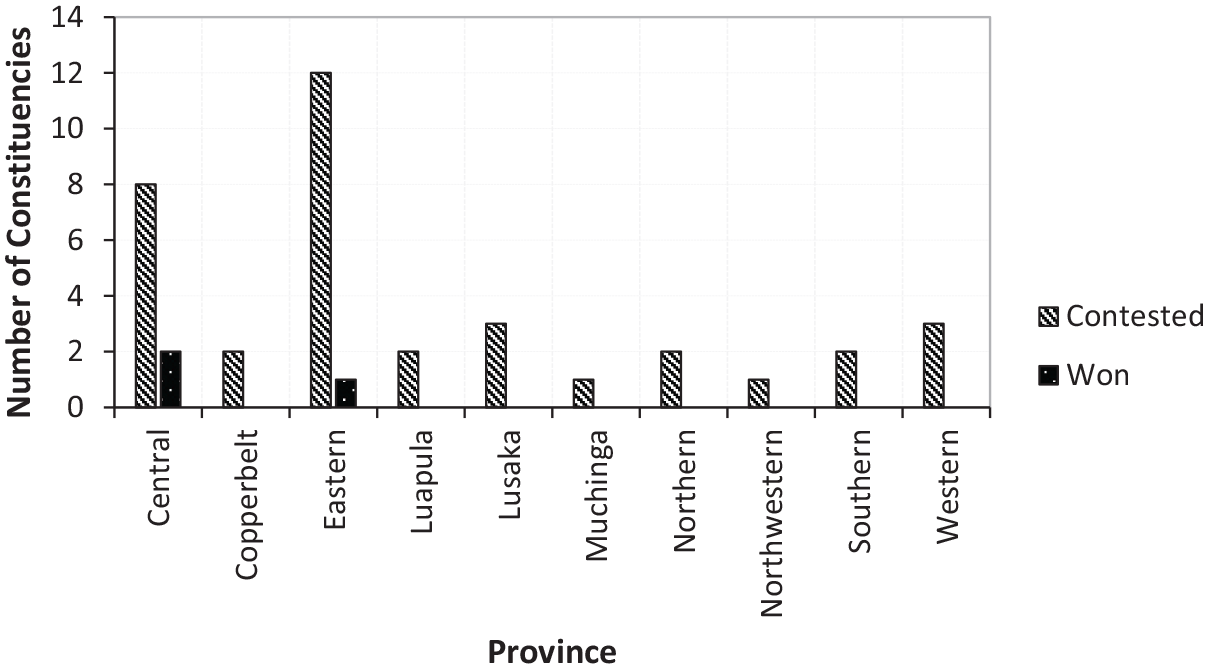
Number of constituencies the MMD contested, 2016 elections.
Compared to the 2011 electoral performance, the MMD had a drastic fall from 15 parliamentary seats in Eastern Province to one in 2016; from nine seats each in Central and North-Western Provinces in 2011 to one and nil respectively in 2016 elections. In the 2016 general elections, 20 former MMD parliamentarians who won the elections in 2011 re-contested their seats under either the PF or the UPND. Thirteen stood on the PF ticket while seven contested on the UPND ticket. Of the 20 who contested, fourteen candidates won their seats – eight under the PF and six under the UPND, while six seats were lost – five under the PF and one under the UPND. The PF increased its parliamentary footprint by five in Eastern Province, two in Northern and one in Lusaka Rural, while the UPND increased by five parliamentary seats: one in Lusaka Province, one in North-Western, and four in Western Province. With this exodus of its members of parliament and other senior officials, the MMD became a nonentity party in less than 5 years.
Discussion
Six key lessons emerge from predatory co-optation as displayed between 2011 and 2016 in Zambia. First, Cheeseman and Hinfelaar (2009) rightly observed that political parties in Africa employ complex strategies of party mobilisation. For this reason, contorting these formations to fit the Western lenses may not always gel but run the risk of what Carbone (2007) termed ‘concept stretching’ (p. 5). While factionalism within political parties and elite circulation is an everyday occurrence, these concepts do not reveal the complexity of party mobilisation and conditions that lead to the breakdown of political parties in emerging democracies, especially in multi-ethnic sub-Saharan African states. The evidence from the Zambian case presented above demonstrates the complexity of party mobilisation on the one hand and party disintegration on the other in ethnically plural nascent democracies. The evidence clearly suggests that despite its rarity, predatory co-optation is an effective strategy that targets specific political elites for the perceived electoral value they possess. In the case of the PF, the co-optation of the key opposition leaders, including the elected members of parliament, allowed it to increase its dominance in parliament, particularly before the 2016 general elections.
On the other hand, predatory co-optation bolstered the UPND’s support base from being a distant third-largest party after the 2011 general elections to the second-largest in the 2016 general elections. The co-optation strategies both the PF and the UPND used underscored the truism that ‘politics can make strange bedfellows’ (Slater and Simmons, 2013: 1367) through ‘collusive democracy’ (Slater and Simmons, 2013: 1371). Furthermore, both the PF and the UPND used predatory co-optation to minimise their respective spatial weaknesses that the 2011 election revealed. As Strøm (1990) put it, vote-seeking parties and also vote-maximisers. Both the PF and UPND employed predatory co-optation to maximise votes. In the context of the behavioural theory of political parties, vote-seeking motivated the co-opting parties. At the same time, office-seeking was the overriding motivation for the co-opted party elites, thereby underscoring Pedersen’s (2012) view that a lack of homogeneity in goals produces varied behaviour across parties.
Second, this form of ‘promiscuous power-sharing’ (Slater and Simmons, 2013: 1366) is characteristic of political uncertainty. In the case of the MMD, predatory co-optation by both the PF and the UPND produced unexpected alliances. Lupu and Riedl’s (2012) view of political uncertainty helps explain the reconfigurations of the three political parties in terms of alliances. Such occurrences may be foreign to experiences of the more developed Western democracies but suggest that context matters. In this Zambian case, uncertainty characterised the MMD, the PF and the UPND political landscape, principally due to the very competitive 2011 elections, which did not produce an outright dominant political formation to which Zambian democracy is relatively accustomed. Based on this evidence, predatory co-optation seems to be a mutually beneficial survival strategy for political parties in crises. Both the co-opting and co-opted parties possess varying degrees of weakness, which predispose them to predatory co-optation. With few exceptions, these weaknesses render political parties ephemeral. These are standard features of political parties on the African continent, such as not being creations of mass movements (see Krönke et al., 2020; Lindberg, 2007: 221). On the one hand, the office-seeking entrepreneurs become eager for alliance-building for office benefits, which Strøm (1990) defined as ‘private goods bestowed on recipients of politically discretionary governmental and sub-governmental appointments’. In behavioural theory terms, vote seekers are also vote maximisers (Strøm, 1990). As such, while the three political parties sought to maximise their votes, the PF and UPND got the better of the MMD.
Further, based on the amended Zambian Constitution (Amendment No 2 of 2016), the winner of the presidential elections was required to obtain more than 50 per cent (50%+ 1) of the valid votes cast. This imperative meant that the two main contending parties in the 2016 elections, the PF and the UPND, needed a more drastic mobilisation strategy, which predatory co-optation presented. However, what was unique was that the second-largest party, the MMD, became a victim of co-optation from a relatively more robust party, the PF, and a relatively weaker party–the UPND. This form of mobilisation was analogous to the phenomenon of what, in business, is termed market cannibalisation (see Lomax et al., 1997; Mason and Milne, 1994). Although there are few cases of this phenomenon in contemporary democracies, the somewhat unstable Israeli politics present a classic equivalent. For instance, Arens (2009) explained how predatory co-optation unfolds: Israel political parties eat each other. Sometimes just a nibble here and a nibble there–one or another Knesset member who has been enticed to cross party lines. At other times it is a more serious bite . . . a whole mouthful, leaving little more than the skeleton of the political party that has been subjected to the cannibal’s bite.
Third, while ‘accountability is a cornerstone of a well-functioning democratic system’ (Bratton and Logan, 2006: 2), elite circulation tends to undermine what O’Donnell (1994) termed vertical accountability – the prospect of elected officials being removed from office by voters through the ballot. In both the PF and the UPND, this targeted co-optation catapulted the co-opted elite to national leadership positions. Despite the MMD’s loss in the 2011 elections, co-optation instantly restored the elite to the corridors of power. In some instances where incumbent parliamentarians re-contested the nullified elections, they bounced back to parliament upon adoption and re-contesting the seats on other party platforms. In a significant way, therefore, the MMD lost elections while a sizable number of party elites retained power through co-optations.
Fourth, although predatory co-optation seems hostile to party institutionalisation and democratic consolidation, the process also mowed the ethnic divide between the UPND and the PF. In an attempt to address the long-standing albatross of a regional party, which opponents were too eager to recite, the UPND co-optation targeted non-Tonga speaking elites from the MMD. Similarly, the PF performed poorly outside the predominantly Bemba-speaking areas and sought to expand its electoral footprint. Therefore, both parties were methodical in co-opting political elites from less-represented ethnic groups. Arriola (2009) noted that patronage-based coalitions tend to connect ethno-regional groups and promote political stability, corroborating Slater and Simmons (2013) view that in times of conflict or political strain, ‘consociationalism’, emanating from promiscuous power-sharing with the elite, may dampen ethnic conflict (p. 1367). This blurring of the ethnic hew in the UPND and the PF might be good for political stability and assuage undertones of ethnic exclusion in Zambia. In the case of the ruling PF, the evidence above supports the argument that the incumbent in most ethnically plural nascent democracies of the sub-Saharan Africa, including Zambia, co-opt members of different ethnic groups in their government primarily to consolidate and prolong their stay in power (Francois et al., 2015).
Fifth, scholars have generally characterised political parties in third-wave democracies as not rooted in society (see Basedau and Stroh, 2008; Kuenzi and Lambright, 2001; Lindberg, 2007; Lupu and Riedl, 2012). In such an inchoate system, competition between parties tends to be volatile and leads to the collapse of some parties while others surge (Mainwaring, 1998). While this is evident, the elite are weakly rooted within parties. They become agents of instability and undermine party and party system institutionalisation due to their weak rootedness. The rate at which the MMD succumbed to predation displays not only the weak state of party institutionalisation, as scholars have outlined (see Basedau and Stroh, 2008; Mainwaring, 1998; Randall and Svåsand, 1999) but also the weak rootedness of the elite to their party. The study also demonstrates that although party system institutionalisation (Mainwaring, 1998; Mainwaring and Torcal, 2005) influences the survival of democracy, its attainment is neither unidirectional (Bértoa, 2017) nor one-off (Chiaramonte and Emanuele, 2017), but reversals may occur.
Sixth, Tavits (2008) asserted that factions of a disintegrating party form a new party when three conditions are present: first, the cost of entry is low; second, the benefit of office is high and, third, when the perceived electoral viability is high (p. 113). In the case of the MMD factions, both the cost of entry and office benefits were high, but electoral viability was low. For instance, at the presidential contest level, the party obtained a paltry 0.9% of the electoral vote in the 2015 presidential by-election and lost scores of MPs through predatory co-optation since 2011. As a result, forming a new party was unattainable. The implication of the MMD’s attrition confirmed Chiaramonte and Emanuele’s (2017) view of trend reversals in the party system institutionalisation. Between 2011 and 2016, predatory co-optation transformed the party system in Zambia from a multiparty to, essentially, a two-party system comprising the PF and the UPND. Third, while factionalism tends to lead to the emergence of new political parties (Laroze, 2017), these form when the cost of entry is low, the benefit of office is high and perceived electoral viability is high (Tavits, 2008). In the case of the MMD, the cost of entry was high, while electoral viability was low. Hence the formation of a new political party was not a viable option.
While the political parties in emerging democracies, such as Zambia, are less institutionalised – less rooted in society, the political elites who drive these parties are equally not rooted in them. This lack of rootedness would explain their propensity towards a path of least resistance to susceptibility to elite circulation to political parties offering higher prospects of clientelistic power-sharing.
Conclusion
This paper has argued that where a party system does not have a dominant political party, as in Zambia between 2011 and 2016, competitive elections and vote-seeking interests may foster predatory co-optation as a mobilisation strategy. The evidence showed that using their vote-seeking goal to rapaciously prey on the MMD, the UPND and the PF aimed at increasing their numbers in the legislature and their national political footprint. With the advantage of incumbency, the PF also extended their co-optation strategy to the UPND, albeit with little success in co-opting UPND members of parliament. While this strategy may not consistently deliver the votes, it proffers a psychological advantage over opponents.
For the MMD, degenerative factionalism and the elites’ office-seeking drive created a fertile ground for predatory co-optation. By the August 2016 general elections, it reduced the MMD to a Cinderella party–unable to field a presidential candidate for the first time in 25 years of Zambia’s return to multiparty party democracy and also depleted the numbers in the legislature from 55 in 2011 to a paltry three seats won in the 2016 general elections. Predatory co-optation contributed to party system de-institutionalisation – from a multiparty to a de-facto two-party system. Overall, this paper has demonstrated that in emerging democracies such as Zambia, understanding why and how parties grow or collapse may require peeling several instability-inducing layers. There may be no one-size-fits-all explanation.
Consistent with the behavioural theory of party competition, the findings also show that vote-seeking and vote maximisation efforts may induce a form of predation as a mobilisation strategy to increase a party’s chances for electoral victory. Concurrently, however, this phenomenon may create instability in the weaker political parties, which are essential for the consolidation of democracy. Under conditions of marginal competitive advantages among competing political parties, the intensity and mechanisms for vote-seeking may manifest through predatory co-optation, such as this study demonstrates. The effects would show through reversals in party system institutionalisation and democratic consolidation.
In multi-ethnic countries such as Zambia, party elites’ vote – and office-seeking goals may undermine vertical accountability and party system institutionalisation. However, the resultant realignments in political party membership may counterbalance pervasive ethnic cleavages. The extent to which this may be true is a subject of further research.
Footnotes
Acknowledgements
The authors gratefully acknowledge the comments from the anonymous reviewers and the Editor.
Funding
The author(s) received no financial support for the research, authorship, and/or publication of this article.
