



Abstract
This article analyzes the modern foreign policy of the New Democratic Party of Canada (NDP). It uses the framework of Aaron Ettinger's work in the International Journal on an emerging left-wing in the US Democratic Party. I first situate the research within the existing literature on leftist internationalism, Canadian foreign policy, and the New Democratic Party. I then analyze a dataset that I created based on the last five NDP federal election platforms and use it to analyze 210 different foreign policy commitments. I use these findings to argue two things: (1) the NDP has a comprehensive foreign policy that reflects dual struggles of electability and left-wing ideals; (2) there is no identifiable left-wing turn in recent NDP platforms. I conclude this article with a discussion on the future of NDP foreign policy.
Keywords
How, for example, can we hope to see a world community so long as there is a great and growing disparity between the poverty-stricken nations of two-thirds of the world and the affluent one-third in North America and Europe? … There is an immense disparity between the resources that we direct to building the world community by economic aid and the amount we spend upon traditional methods of defence. This disparity seems to me to show a lack of values and a lack of ordinary good judgment as to wherein our security really lies.
—Former NDP Member of Parliament Andrew Brewin, 1965 1
Across several liberal democracies, the organized political Left has been undergoing a resurgence in popularity. Whether social democratic, democratic socialist, or otherwise, left-wing solutions have proven their staying power, especially in light of an impending climate crisis, soaring income inequality, and the rise of populist right-wing political actors. Recent research by Aaron Ettinger in International Journal explores a distinct, emerging left-wing foreign policy within the US Democratic Party. 2 The success of the American organized Left, most of whom adopt social democratic policies and ideals, has resulted in ideas inspired by leftist internationalism entering mainstream foreign policy debates. Left-wing candidates have long competed within the party, but with the substantial success of politicians like Bernie Sanders and Elizabeth Warren, they have had to define their foreign policy so voters can see they are ready to govern. 3 In Canada, the rise of the Left is not as apparent. Accordingly, this article sets out to apply Ettinger's model to Canada to ask: is there an emerging left-wing foreign policy in Canada? More specifically, is there an emerging left-wing foreign policy within the New Democratic Party?
The New Democratic Party of Canada (NDP) is Canada's federal social democratic party and well known for its principled stances and commitment to social values. Based upon a close reading of the party, this paper argues that there is no emerging left-wing consensus within the NDP. Instead, the NDP has always had a left-wing flank that has varied in its success in implementing policy. I demonstrate this argument in three ways. First, the NDP's history has been formally committed to left-wing ideals. Second, this left-wing flank of the NDP has resulted in a contest over party foreign policy, often with left-wing ideals successfully impacting party policy. Leading to this is the third and final element of my argument. The party's foreign policy represents the perennial struggle of the NDP and its provincial counterparts: to be the party of the Left or a party that can win government.
Although inspired by Ettinger, this paper's analysis asks how left-wing the NDP's foreign policy has been. In doing so, I show that the foreign policy of the NDP has reflected multilateralism, leftism, and, at times, neo-liberalism. These terms will be explored by closely examining the party's history and Canadian foreign policy. In terms of research, there appears to be little academic research devoted to evaluating the foreign policy of the NDP; instead, research concerning the NDP has focused on labour history, ideology, and party modernization. 4 This paper will seek to fill this gap and provide a detailed look at the foreign policy of the NDP.
I build this argument through a literature review of leftist foreign policy in Canada. Next, I use the history of the NDP to explain two factors: struggles with organized labour and internal ideological conflicts. I then provide a qualitative analysis of the last five NDP platforms through a dataset I created. The article concludes with a discussion on the future of NDP foreign policy. Above all, I seek to contribute to the literature on Canadian foreign policy formation as it relates to the workings of political parties, especially concerning the influence of left-wing ideas.
What's left of foreign policy in Canada?
Scholars in International Relations have long been concerned with why states sanction, intervene, and go to war with one another. Often just as important, however, is studying the political actors and processes outside formal governments. Accordingly, this section focuses on the leftist internationalism detailed by Ettinger before introducing the foundations of leftist foreign policy in Canada. In doing so, it details the anti-imperialist and anti-globalization trends within the left-nationalist tradition and considers prominent critiques of this position.
Leftist internationalism
Studying foreign policy has risen concurrently with the number of democratic states and actors making decisions in the political world. Ideologies in global politics are numerous. For this investigation, however, we need to focus on leftist internationalism. Much like politically left ideologies, leftist foreign policy contains intense diversity. Leftism, in general, is acutely concerned with the effects of capitalism, and accordingly, leftist internationalism has risen concurrently with the spread of neo-liberalism and the speed of capital flows through globalization. 5 Liberal political thought shares many social similarities with leftist ideals but has never really broken from the equality-of-states position put forth by Immanuel Kant and, later, John Rawls. 6 Subsequent writings on global justice have been skeptical of the structure of the world theorized by these liberal theorists; scholars argue that it ignores the injustices of imbalances between states, objects outright to wealth redistribution between unequal societies, and ultimately relies on the arbitrary nature of borders and citizenship to decide on global justice. 7 This critique creates room for a leftist foreign policy focused on power and material imbalances within global politics.
To add nuance to this set of ideas, scholars have argued for defining exact leftist principles in foreign policy. As Ettinger notes, Michael Walzer prominently put forth leftist ideals for foreign policy in A Foreign Policy for the Left. In this text, Walzer anchors leftist foreign policy to various commitments, critiquing the “default position” of leftist policy as focusing on domestic policy to the near exclusion of the global sphere. 8 Instead, Walzer argues that leftist foreign policy is bound to commitments of promoting socialism and democracy abroad, national liberation causes, anti-imperialism and anti-militarism, and only supporting just wars. 9 Walzer also offers a qualification to these commitments: leaders and states who do not support democracy and equality are not to be supported at all by leftist internationalism. 10
I will use Ettinger's framework based on Walzer's ideas to anchor this study of leftist internationalism. Ettinger argues that within leftist internationalism, there are five main principles: (1) the rejection of foreign-domestic distinctions in favour of universal moral commitments; (2) the reform of the existing international order through progressive principles; (3) anti-authoritarianism; (4) anti-militarism; and (5) economic justice and the pursuit of social democracy. 11 I will return to these five crucial principles for the subsequent platform analysis.
Left foreign policy in Canada
Canada occupies a unique position in the world. Canada is a member of several prominent multilateral organizations, such as NATO, the Group of Seven, the Francophonie, and the Commonwealth. Canadian politics, however, is profoundly impacted by its location next to the world's foremost superpower. Former prime minister Pierre Trudeau famously described this phenomenon as akin to sleeping with an elephant: “No matter how friendly and even-tempered is the beast … one is affected by every twitch and grunt.” 12 As a result, scholars argue that Canada's international identity is often defined by its difference rather than its originality. For example, Paul Gecelovsky and Robert Murray argue that Canada's international identity was first constructed as different from the British Empire, and later, the Commonwealth; as British influence in Canada declined, it became about being different from the US and its foreign policy. Put simply, Canada's global identity has been about “defining Canada as not rather than as is”. 13 In recent years, Canadian foreign policy has consistently been sensitive to US foreign policy. The US and Canada, sharing the world's longest geographical border, have a relationship defined by economic, cultural, and political cooperation. Scholars argue that Canada's foreign-policy “identity” can be defined through the enormous impact of the US on Canada's foreign policy, traced to a combination of demography, culture, language, economic structure, and ideology. 14
The Left in Canada has been no stranger to critiques of the United States and the relationship between Canada and the US. In particular, anti-imperialist and anti-free trade critiques have shown constant disdain for American hegemony and the politics of empire. As far back as World War Two, the leader of the leftist Co-operative Commonwealth Federation (CCF), J.S. Woodsworth, embraced a left-pacificism that argued against Canadian involvement. Woodsworth's anti-war position, while against the CCF's anti-fascist and pro-war stance, was emblematic of Woodsworth's belief that “pacificism was absolute and fundamental; war was never justified.” 15 This unique position embraced a radically anti-imperialist pacifism and was unlike many left-wing arguments that saw fascism as the ultimate manifestation of anti-democratic and hyper-capitalist politics. Positions such as the pacifism advocated by Woodsworth in Parliament laid the groundwork for left nationalism in Canada.
The Canadian left-nationalist critique of war and imperialism reached a catalyst with the Vietnam War. Much like many in the US, a large part of the civil society in Canada showed disdain for the war. As Douglas Ross notes, foreign policy at the time was in a liberal-moderate tradition defined by a “consistent desire to constrain US adventurism, and to contribute wherever possible to the limitation and de-escalation of violence in Vietnam and Indochina.” 16 The left-liberal strident opposition to the Vietnam War was curbed by a moderate acceptance of US containment goals in order to keep the peace with the Americans. Ross argues that neither the left-liberal, the liberal-moderate, nor the conservative Canadian foreign policy realms “[ever] subscribed” to US strategic rationales; Ottawa instead remained committed to its own independent strategic rationales. 17 As left-liberal positions accepted concessions to keep peace with the Americans, more left-wing views were forming, showing that the “Vietnam War hit Canadian leftists like a hammer blow, forcing even the most moderate into radical positions on Canadian independence and anti-imperialism.” 18 As a result, left-nationalism took form, and the Waffle movement (within the NDP) and other strident left positions became home to left-wing foreign policy emphasizing left-nationalism and anti-imperialism, among a series of other positions inspired by the New Left elsewhere. 19 So began a resurgence of the left-nationalist position and its unique foreign policy.
The left-nationalist bent bolstered by opposition to Vietnam would continue to materialize in the late twentieth century as an explicit challenge to the emerging neo-liberal consensus and its push for free trade in industrialized Western states. Free trade, represented by the North American Free Trade Agreement (NAFTA), represented a critical juncture in Canadian politics. Mildred Schwartz argues that this period, much like previous debates on free trade, fundamentally questioned Canada's identity, emblematic of a “society beset by structural cleavages stemming from its regional makeup and fostering persistent inequalities.” 20 The 1988 election, widely seen as a sort of referendum on global trade, saw boisterous opposition from the Liberals and NDP; after the Conservative win in 1988, organized free-trade opposition was spearheaded by diverse civil society actors from environmental, religious, cultural, and feminist organizations. 21
Civil society left-wing actors ultimately failed in their domestic efforts, and Canada implemented NAFTA in 1994. Laura Macdonald argues that despite this failure, left-wing civil-society actors successfully formed transnational alliances that would help prevent a proposed Free Trade Area of the Americas. 22 These transnational alliances would not only focus on preventing the expansion of NAFTA but also helped to facilitate cross-national dialogues on left economics. Canadian unions and coalitions of labour groups from countries like Mexico and Chile built alliances with like-minded actors and their resistance to free trade. 23 This process of creating “alternatives to neo-liberalism and seeking transnational and eventually hemispheric consensus on those alternatives [that] was part of a reaction to NAFTA shared throughout Canadian organized labour and beyond.” 24 Rallying against NAFTA resulted in a cohesive left-wing opposition with a global focus on free trade, protectionist economics, and anti-globalization.
The Canadian Left's anti-imperialist and anti-globalization foreign policy has also attracted criticism. In particular, this critique focuses on how the left-nationalist position posits the US as the lone empire while ignoring Canada's entanglements with imperialism and colonialism, both at home with Indigenous nations and abroad in less-developed countries. 25 Todd Gordon's study focuses on the connection between Canadian foreign policy, settler-colonialism in Canada, and Canada's involvement in pushing for structural adjustment and the strategic use of foreign direct investment (FDI) in less-developed countries through the International Monetary Fund and the World Bank. Gordon notes that since Canada's embrace of these financial mechanisms in the 1990s, Canada's status as a provider of FDI is “quite contrary” to the presumptions of left-nationalist dependency theorists who posit Canada as subservient to foreign, in particular, American capital. 26 Paul Kellogg similarly argues that the national question of the left-nationalist position is thus untenable given proper consideration of the national questions of Québec and of Indigenous peoples—entanglements that fundamentally question the Canada-as-dependency argument of left-nationalists. 27
We can conclude that leftist foreign policy in Canada, much like leftist internationalism, has been concerned with arguments of imperialism and globalization. In Canada, these arguments were strengthened through a left-nationalist position developed in the wake of the Vietnam War and the advent of free trade. Nevertheless, critiques of the left-nationalist's dependency idea arise with Canada's colonization of Indigenous nations and the Canada-Québec relationship. As I turn to the NDP's foreign policy, we will see these tensions repeat themselves.
The foreign policy of the NDP
To understand the foreign policy of the NDP, one must understand the party's foundation. In doing so, we can explore the tensions at the core of these foundations, party history, and factors that significantly influence the party's foreign policy. This section will outline two key factors: the NDP's relationship with organized labour and internal ideological struggles.
The New Democratic Party of Canada
The New Democratic Party of Canada began with an amalgamation of the labour union Canadian Labour Congress (CLC) and the socialist/social-democratic political party Commonwealth Co-operative Foundation (CCF) in 1961. Its first leader was Tommy Douglas, formerly the CCF premier of Saskatchewan and a person with a seismic impact on NDP history. Like its predecessor, the CCF, the NDP has always existed as an uneasy coalition between leftist values and electoral viability. To analyze this coalition, we can turn to the history of party discontent, the party's relationship with organized labour, and its conflicts over ideology.
The foundation of the NDP was a strategic combination of organized labour and organized politics. This combination, as Gad Horowitz argues, was an “attempt both to strengthen the labour base of the party and to broaden its appeal to the ‘liberally-minded’ elements of the middle class.” 28 Horowitz notes that the CCF's decision to merge with the CLC was motivated by two reasons: (1) strategic allegiance with organized labour, like had happened in Britain with the Labour Party; (2) the CCF needed a new approach, as the old one was not working. 29 The foundations of the modern NDP represent attempts to appease organized labour and moderate electoral chances, two goals that had long haunted the CCF.
Founding a party with the CLC did not expand the NDP voter base and has led to a factitious relationship with organized labour. In a 1985 study of NDP support, Keith Archer found that despite the merger with the CLC, the total number of unions affiliated with the NDP was dramatically small—demonstrating that the alliance with the CLC did not substantially improve labour votes as was expected. 30 Archer's study found that support for the Liberal party—even within NDP-affiliated unions—was higher amongst unionized workers than the NDP. 31 Nearly forty years later, Larry Savage's 2021 study argues that there remains a fundamental disconnect between organized labour and the NDP. This disconnect has resulted in continuous disagreements, such as the 2011 election when the NDP scored the highest union votes on record despite being snubbed by major labour endorsements. 32 Savage concludes that although union households were likelier to vote NDP, “union leadership has failed to produce a reliable NDP voting bloc of rank-and-file union members.” 33
Ideological struggles have long defined the NDP. The central tension of this struggle is a contest between left ideological commitments and the desire to be electable, that is, to form government. A prime example of this was the ideological battle at the 1969 NDP convention between the party apparatus and the insurgent left-nationalist position of the Waffle Movement. The Waffle called for “an independent socialist Canada” with a platform aimed at curbing the influence of the US and multinational capital; the Waffle's platform “railed against American imperialism and called for public ownership to counter it.” 34 Scholars argue that much of the opposition to the Waffle came from labour unions, while interestingly, these same unions would later embrace these same nationalist positions during the struggle mentioned above against free trade. 35 Concerning Walzer's leftist internationalism, the Waffle challenged tenets of the NDP's belief in social democracy and democracy more generally by taking different positions on the matter of self-determination. On this issue, the Waffle would support Québec nationalists, arguing that the right of self-determination was for every nation to choose. 36 Mel Watkins, a founder of the Waffle, would later note the irony of the Waffle not including Indigenous nations in this formula. 37 The Waffle remains the emblematic case of a faction contesting the NDP's leftist ideals while also representing the various tensions of the left-nationalist position clashing with the history of Canada–Québec relations and the colonization of Indigenous nations.
At the core of the NDP apparatus is a commitment to left ideals, primarily those of social democracy. Within this commitment are two other factors—organized labour and ideological difference—that have consistently shaped the NDP. These factors are directly relevant to understand the underlying tensions within their foreign policy commitments.
Foreign policy and domestic goals
The foreign policy of the NDP has long occupied a unique position relative to the Liberal and Conservative parties in Canada. Unique foreign policy commitments also reflect the ideological tension of the NDP. To analyze foreign policy, we can discuss historical stances before analyzing contemporary NDP foreign policy.
The unique foreign policy of the NDP owes itself to the party's quirky history and its role as the newest major federal party—the Liberal and Conservative parties have existed in some iteration since confederation in 1867. Scholars argue that the NDP has “stood out as the voice in Parliament that historically offered both ends and means differing substantively from those of the major parties”; for example, the NDP's historic pledge (1969–1988) to withdraw from NATO and NORAD. 38 The complicated relationship between the NDP and NATO has always been about the principles of disarmament and peace. The inaugural convention of the NDP made this point of NATO-related disarmament clear: “The New Democratic Party believes that the extension of nuclear weapons to any further states and alliances threatens disaster to the world … Canada should press for a demilitarized zone in central Europe and the simultaneous disbandment of the Warsaw and NATO pacts.” 39 In 1969, this position was taken further as the Waffle and other left-wing activists proposed and got NATO withdrawal as official party policy. Scholars described the position at the time as “semi-alignment” in which the NDP showed a strong skepticism for NATO and its nuclear power, but did not wish for non-alignment; it was a foreign policy that Tommy Douglas argued was informed by neither “neutralism nor pacifism.” 40
Scholars have pointed to the impact of individual NDP members of parliament for the NDP's principled foreign policy stances. Stephanie Bangarth, for example, points to Andrew Brewin's impact on Canada's foreign policy. Brewin was the foreign policy and defence critic for his seventeen-year career in Parliament, a career defined by promoting stances on human rights, multilateralism, pacificism, and internationalism before these themes became prominent in Canadian foreign policy circles. 41 Brewin's seismic impact on NDP foreign policy meant that he played a crucial role in the NDP's twentieth-century advocacy. For example, Brewin joined Progressive Conservative MP and United Church pastor David McDonald on a fact-finding mission to the Biafra region of Nigeria during the Biafra-Nigeria conflict. This trip helped, despite considerable government opposition, drum up public support for an eventual humanitarian mission. 42 Brewin's work in the House of Commons also contributed to Canada's official recognition of the People's Republic of China. Brewin's consistent position on recognizing China came from principles of social justice, pacifism, and multilateral institutions such as the United Nations. 43 These two examples demonstrate how Brewin's work shaped Canada's response to the humanitarian aspect of fragile and failed states and the “high politics” of great states like China; both are a testament to the NDP's impact on Canadian foreign policy.
The NDP's unique foreign policy tones moderated over time through a “professionalization” of the NDP, which has led to contests between modernizing forces and leftist ideals. 44 The party's foreign policy underwent a severe clash between these camps at the start of the twenty-first century. At this time arose the New Politics Initiative (NPI), a left-wing faction of the party led by influential political actors like Naomi Klein and former members of parliament Sven Robinson and Libby Davies. The NPI came out swinging with a 2001 letter calling for a strident return to left-wing policies, most notably for foreign policy. This letter included calls to abolish NAFTA and the World Trade Organization, absolve all the government debts of developing countries, and aggressively realign economic systems to meet Kyoto protocols. 45 When the NPI brought their resolutions to the convention floor, labour votes split, but those unions against the NPI were directly hostile. After this defeat, the NPI would fade and disappear with the election of NPI-friendly Jack Layton. 46 The vigour of the NPI's foreign stances would not be lost on the party. David McGrane's analysis of NDP parliamentary participation finds that “international affairs and foreign aid” occupies 9 percent of the NDP speaking points in the thirty-seventh to forty-first Parliaments. Upon closer examination, we see the impact of the NPI: this number is highest in the thirty-seventh Parliament (June 2001–May 2004) at 13 percent before declining each Parliament to its low of 4 percent during the forty-first Parliament (June 2011–August 2015). 47 After the NPI, NDP priorities drifted away from foreign policy. We should expect a similar move away when we analyze the NDP platforms.
The ultimate domestic goal of the NDP is the same as every federal party: forming government. The national NDP government has never formed government and has only become the opposition once, although its provincial counterparts have been more successful. One potential challenge to asking how left-wing the NDP is concerns whether the NDP considers itself a left-wing party in the first instance. While this was undoubtedly true of the CCF and the early NDP, things have changed. However, David Archer and Alan Whitehorn's 1997 analysis convincingly demonstrates that NDP policy-convention attendees are consistently left-wing, an ideological consistency stronger with the NDP than the Liberals or the Progressive Conservatives. 48 David McGrane and David Desbaillets's analysis makes clear that the ideology of the individual members of the NDP's 2011 record caucus was, with slight variation, overwhelmingly committed to social democracy and its tenets. 49 As this paper has demonstrated, the NDP and its members hold left-wing values; it now can be asked how well this reflects in their platforms.
Platform analysis
Political platforms, while simplistic, are straightforward documents that communicate a party's position on matters to the electorate. Studies have shown the remarkable accuracy with which Canadian governing parties follow the policy commitments from their platforms. 50 Therefore, there are three distinct reasons to use the platform as a method. One, while the NDP has never formed a federal government, it can be assumed that they would continue the Canadian trend of adhering closely to a platform. Two, these documents are collections of the public-facing information voters can access. Three, these platforms allow us to survey information over time, in this case, NDP foreign-policy evolution from 2008 to 2021. To analyze the platforms of the NDP, I analyzed the five most recent Canadian elections. 51 There are substantial benefits to selecting these five cases. They represent three leaders, reflecting the most successful result and stints in their more typical third-party status. The fourth and fifth cases also reflect the NDP holding the balance of power in the House of Commons, providing an ability to see whether these commitments influenced policy.
For the data collection, I only coded commitments and did not code general expressions. The main rule was whether a commitment could prove to have been met or not in a binary fashion. I coded commitments according to three criteria: (1) involving Canada's direct relations with other states; (2) involving international organizations or associations; or (3) referring to some element of Canadian policy that was being affected by something foreign to Canada, such as states, corporations, and individuals. I did include international obligations as they shape domestic policy, such as Indigenous rights, women's rights, or the rights of persons with disabilities because these promises reflect a commitment to multilateralism. Organizations that deal with foreign policy, such as the Canadian Armed Forces, were included only if the commitment involved one of the aforementioned factors. For example, for the 2015 platform, commitments related to pensions and healthcare for the Canadian forces were excluded. However, I included a commitment to “[p]rovide the Canadian Forces with the personnel, equipment, and training they need to defend Canada and protect Canadians.” 52 In total, I collected 210 different foreign policy commitments (Table 1). Using these commitments, we can discuss each platform's foreign policy context.
Foreign policy commitments within New Democratic Party of Canada (NDP) platforms, 2008–2021.
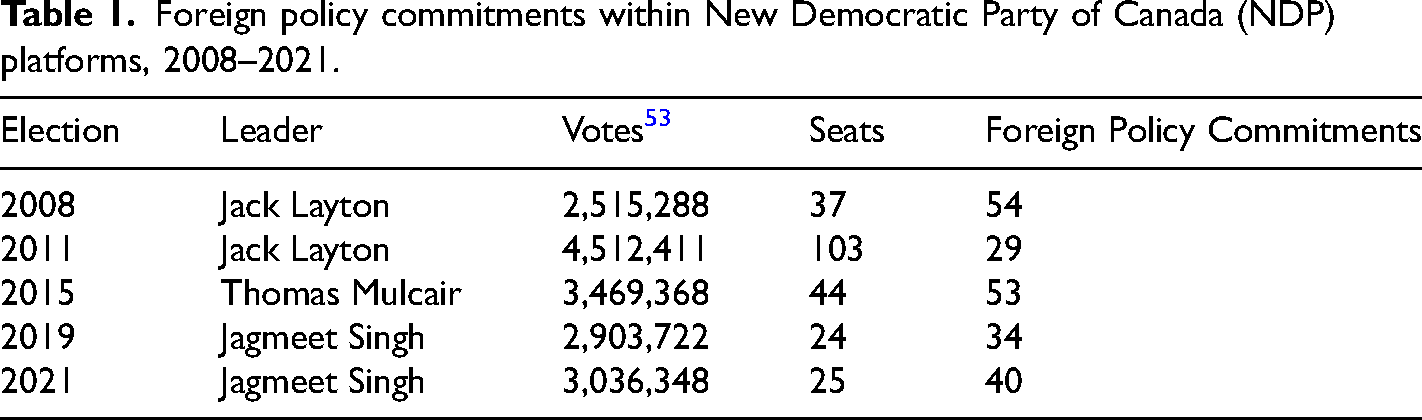
The 2008 election took place in the context of a Conservative minority government, the 2008 global recession, and ongoing Canadian involvement in the war in Afghanistan. The party was led by Jack Layton and involved fifty-four different policy commitments, the most recorded by a slight one-commitment margin. This policy was intricately linked to multilateralism with solid commitments to the United Nations and its institutions, but it was also perhaps the most aligned with leftist internationalism for two reasons. The first is a clear commitment to, as Walzer describes, anti-militarism and anti-imperialism. The platform commits to withdrawing immediately from Afghanistan and, in a more anti-imperialist bent, specifically calls for the US and NATO to be replaced by the UN as the chief actor in Afghanistan and offers refuge to “Iraq War Resisters.” 54 The second is an economic nationalism typical of leftist economics, as Ettinger describes Bernie Sanders's foreign policy, marked by a commitment to a “domestic economic agenda which seeks social protections from the exigencies of the market.” 55 Here, I observed eight commitments toward international trade, with three of them calling for negotiations of NAFTA. 56 This platform was committed to multilateralism and provided unique leftist internationalist commitments.
The 2011 election was the most successful in NDP history, resulting in 103 seats. The results created the first-ever NDP Official Opposition and a Conservative majority—both of these outcomes due to an unprecedented collapse of the Liberal party. Interestingly, this platform was the smallest regarding foreign policy commitments despite Layton still leading the party. Overall, this platform echoes many of the same significant commitments—such as refugee settlement, immigration streamlining, and an end to involvement in Afghanistan—but it also drops the references to NATO and critiquing US military hegemony. Notably, one promise stands out: “We will keep Canada's corporate tax rate competitive by ensuring that our combined federal/provincial Corporate Income Tax rate is always below the United States’ federal corporate tax rate.” 57 This new addition reflects the neo-liberal concept of policy competition, where states lower taxes and regulations to create harmonious conditions for multinational businesses within their jurisdiction. Policy competition reflects a neo-liberal preference for protecting the market from the interventionist economics of social democrats. 58 Accordingly, this defies Ettinger's fifth principle of commitment to social democracy by denouncing neo-liberalism and globalization.
The 2015 election was the first and only platform under Thomas Mulcair. It resulted in forty-three seats, a return to third-party status, and a perception that Mulcair was flanked to the left by Justin Trudeau's Liberal party, which received a majority. 59 The platform has the second-most commitments at fifty-three, reflecting a large number of commitments in relation to the platforms observed. The platform has the most robust commitment to multilateralism, going beyond the routine commitments to the UN broadly and instead promising to sign the UN Arms Trade Treaty, the Optional Protocol to the Convention Against Torture, and the Optional Protocol of the Convention on the Rights of Persons with Disabilities. 60 For trade, similar to 2011, references to NAFTA are absent, but it does criticize the “secretive” nature of the Trans-Pacific Partnership (TPP), instead promising transparency and a commitment to social and environmental rights within new trade agreements. 61 Policy competition is once again present in a commitment to keeping the corporate tax rate below the US, and this time it says below the G7 average as well; additionally, there is a commitment to creating “iCanada,” a one-stop shop for foreign investors to invest in Canada's economy. 62 These commitments once again defy the fifth principle by promoting neo-liberal concepts.
The 2019 election took place after a four-year Liberal majority and saw fresh faces from the Conservatives in Andrew Scheer and the NDP in Jagmeet Singh. It resulted in a Liberal minority and reduced the NDP's caucus to twenty-four seats. However, it also gave the NDP and the Bloc Québécois each the balance of power in the House. The platform, Singh's first as a leader, was the second smallest in terms of commitments. The platform is committed to multilateralism and has protectionist language in trade, manufacturing, and culture. 63 This platform reflects more social democratic economic policies: it scraps the reference to low corporate taxes in favour of a new foreign buyer home tax, principles of corporate social responsibility for Canadian corporations abroad, and taxes for foreign media corporations. 64
The final election took place in 2021, with the most consequential global backdrop—the COVID-19 pandemic. The election resulted in another Liberal minority with a one-seat increase for the NDP. The platform was Singh's second and had forty commitments, the median value recorded. The commitments significantly mirror the commitments of 2019—a fact owing to the nature of the snap election called by Trudeau. It repeats a 2019 commitment to include unions as actors with full standing in trade cases, reflecting the NDP's historical union affiliations. 65 The platform builds on a 2019 nod to foreign interference in a novel way, committing to curb China's influence in favour of Hong Kong and supporting the pro-democracy movement in China. 66 This last commitment is in agreement with Ettinger's third principle of anti-authoritarianism.
The five platforms analyzed here reflect different principles and commitments of the NDP. At times, the NDP has aligned with Ettinger's five principles but has also embraced neo-liberalism in a way uncharacteristic of a left-wing party. NDP foreign policy has also embraced social democracy by taking protectionist stances on economics, reflecting similarities to a left-nationalist position, albeit in a far less radical fashion. To build on this analysis, I conclude with a discussion of the data's implications.
Discussion
This paper sought to analyze whether there is an emerging left-wing foreign policy for the NDP. I argue that while there has always been a left-wing flank, there is no distinct left-wing turn. This argument is rooted in two factors. The first is historical: the NDP has often had a left-wing foreign policy, and today's foreign policy looks less left-wing than historical commitments against NATO and free trade. The second is that while the two most recent platforms of the NDP appear to have a left-wing turn compared to 2011 and 2015, they are as much, if not less, left-wing than the 2008 platform. Despite this, the analysis provided here can provide us with three key insights into the NDP foreign policy and where it goes from here.
The first insight is that the continued success of the organized Left in the US should continue to affect the NDP. As the left flank of the Democratic Party and the Democratic Socialists of America continue to carve out a unique leftist foreign policy, it can be assumed that the NDP will be watching. The success of this left flank can best be measured through a palpable left-wing influence on President Joe Biden's foreign policy, even as it resembles an “uneasy compromise” between left-wing and more mainstream factions of the party. 67 The second insight is that the analysis shows Singh is willing to have the NDP take on distinct foreign policy stances, such as taxing multinational corporations and foreign homebuyers. For example, Singh's recent thirteen demands for the Liberal government in relations with Israel reflect the NDP's historic commitment to peace between Israel and Palestine—it was present in all five platforms. These demands, however, also display the NDP's most public and deliberate stance on the issue—taking a direct stance against Israeli settlements in the West Bank and noting their consideration as illegal under international law. 68 This bold position, however, also opened Singh up to demands from prominent left-wing voices. In response to Singh's thirteen demands, a letter by a bizarre combination of American academic Noam Chomsky, controversial ex-Pink Floyd member Roger Waters, former MP Svend Robinson, social critic Linda McQuaig, and former MPP Steve Ashton publicly called on the NDP to withdraw from the Canada-Israel Parliamentary Caucus. 69 The letter reflects Singh's willingness to have the NDP adopt bold foreign policy stances and the civil society pressure for the NDP to adopt bold stances.
The third insight is the tensions of the NDP's response to key policy issues. Free trade and multilateralism will likely remain critical issues in crafting NDP foreign policy. As for the former, the NDP's once-staunch critique of foreign trade has fizzled, but this issue is likely to continue with the recent re-negotiation of NAFTA, the US withdrawal from TPP, and the UK's withdrawal from the European Union. The civil society Left in Canada, including prominent voices from the Broadbent Institute, Council for Canadians, and Canadian Centre for Policy Alternatives, have all been particularly critical of free trade—representing continued pressure for the NDP to be as well. 70 Canada's role in NATO should continue to influence foreign policy debates, especially with the role of the military alliance in responding to the egregious Russian invasion of Ukraine; as David Blocker argues, and as this paper has noted, the history of differences over NATO date back to the Waffle Manifesto. 71 On multilateralism, the history and tensions of the left-nationalist position are vital considerations for future NDP foreign policy. Infighting within the NDP—whether it be the Leap Manifesto or the feud over the future of oil extraction between the Alberta NDP and the federal NDP—should continue to provoke contests over foreign policy.
On issues of multilateralism, the NDP will have to figure out how to respond to the rise of right-wing populism across liberal democracies. In particular, recent moves by the governing Liberal party towards what Don Pitts calls the “Freeland Doctrine”— or the idea of democracies punishing democratic backsliding through trade and economics—will likely shape Canada's foreign policy scene in the coming years. 72 As seen in the 2021 platform, Singh's NDP is willing to take a combative stance on states like China. However, the NDP's tendency towards economic protectionism will likely produce tension with a trade-heavy liberal internationalist Freeland Doctrine. Economic protectionism, additionally, seems opposed to the strident commitment of the Liberals to free trade during the recent NAFTA negotiations. The NDP's current confidence and supply agreement with the Liberals—to last until, at most, 2025—has been devoid of foreign policy, instead focusing on domestic issues like dental and pharma care. The Freeland Doctrine, however, and its explicit liberal internationalist frame are likely to collide with the NDP's growing criticisms of the profits of “big business” throughout the COVID-19 pandemic and recent rises in inflation. 73 Big business is constitutive of multinational corporations that thrive through liberal internationalism. Whether these persistent criticisms will materialize into foreign policy debates is yet to be seen.
A future research agenda could build on the data collected here through three unique avenues. The first is historical—more NDP platforms could contribute to the database with two critical periods analyzed. Collecting the CCF's last platforms could analyze whether a foreign policy shift exists between the CCF and the NDP. The second time period is the NAFTA negotiations in which the NDP was a fierce critic of free trade. The second research avenue is to decentralize the idea of NDP foreign policy, instead focusing on the various actions of the party within Parliament. The NDP's historic commitments to human rights, feminism, environmentalism, and democracy figure prominently in parliamentary sessions and committees. An example of this is former Foreign Affairs Critic Hélène Laverdière's push to secure funding for Canada's newly created Ambassador for Women, Peace and Security. 74 Laverdière's work to secure women's rights in Parliament reflects the long-standing NDP commitment to women's rights: the analysis showed ten commitments to women's rights, reflected at least once in each platform analyzed. Jennifer Pedersen's close examinations of Canadian arms sales to Saudi Arabia, a country infamous for human rights violations, reveal the tensions of NDP foreign policy: union jobs create Light Armoured Vehicles (LAVs) in the NDP-held riding of London-Fanshawe. 75 A third suggestion for future research would be to analyze NDP policy conventions to quantify how many foreign policy commitments get pitched in the first place. Doing so could show what constituencies within the NDP, such as the Socialist Caucus, prioritize foreign policy and how successful or not these left-wing factions are in pursuing changes to party platforms.
This paper sought to analyze whether there is an emerging left-wing in Canadian foreign policy by analyzing the New Democratic Party. The answer is not as straightforward as Ettinger's case, although NDP platforms do not appear to have a distinct or significant leftward turn. Leftist foreign policy commitments in recent platforms still compare to those of 2008. The conditions of the US case—that is, the rise of Donald Trump and populist, at times far-right, conservatism—seemed to have shaped the American foreign policy landscape more than it has the Canadian one. However, things in Canada could change with the election of Pierre Poilievre as the Conservative Leader of the Official Opposition and his open support of right-wing populist movements such as the Freedom Convoy. If that trend continues, battle lines will likely be drawn between the liberal internationalism of Trudeau and the populist/libertarian conservativism of Poilievre. Based on recent NDP platforms, the question then for the NDP will be not whether the NDP goes left, but how left will the NDP go?
Footnotes
Acknowledgements
I would like to especially thank Adam Harmes for the close mentorship and advice as this paper was developed in his graduate seminar on International Relations at the University of Western Ontario. I remain grateful for the help of two anonymous reviewers for their help in bringing this article to publication. Any and all mistakes are mine alone.
Declaration of conflicting interests
The author(s) declared no potential conflicts of interest with respect to the research, authorship, and/or publication of this article.
Funding
The author(s) received no financial support for the research, authorship, and/or publication of this article.

Notes
Author biography
James Collie is a PhD student in the Department of Political Science at the University of Western Ontario. His research interests are constitutionalism, Crown-Indigenous relations, urban governance, and the history of the Canadian Left.