



Abstract
The crisis of social democracy has been the subject of numerous articles and books from different fields such as party politics, political sociology, and political economy. This article contrasts two competing explanations prevalent in the related literature. According to the postindustrial dilemmas hypothesis, the crisis of social democracy is the inevitable result of the transition from industrial to postindustrial society and the electoral trade-offs social democrats are facing as a consequence. The neoliberal contamination hypothesis instead emphasizes social democracy’s neoliberal turn and the resulting loss of trust in social democracy, especially among working-class voters. It is argued that both hypotheses are not only based on diverging conceptions of partisan politics, pitting Downs against Gramsci, but also on different theories of capitalist development (modernization theory vs Polanyian “double movement”). As a result, each explanation captures important aspects of the current crisis of social democracy but also misses other aspects that are essential to fully understand this phenomenon.
Introduction
Given the long history of social democracy, the electoral decline of social democratic parties in Western Europe has been watched with amazement by friends and foes alike. In the field of political science, numerous authors from different subfields such as party politics, political sociology, and political economy have analyzed the crisis of social democracy from various angles and with different time horizons (e.g. Bailey et al., 2014; Benedetto et al., 2020; Berman, 2006; Berman and Snegovaya, 2019; Frega, 2021; Kitschelt, 1994; Lavelle, 2008; Manwaring and Kennedy, 2018; Moschonas, 2002; Mudge, 2018; Rennwald, 2020).
Most of this work is related to one of two general explanations of social democratic decline. According to the first explanation, which derives from Herbert Kitschelt (1994) and has been advanced by Kitschelt, Silja Häusermann, and others (for the most recent contributions, see Häusermann et al., 2021a, 2021b; Kitschelt and Häusermann, 2021), the crisis of social democracy is the inevitable consequence of the transition from industrial to postindustrial society (postindustrial dilemmas hypothesis). Proponents of the second explanation, such as Sheri Berman (2006), Stephanie Mudge (2018), and Jonathan Hopkin (2020), instead blame social democracy’s neoliberal turn for its current crisis (neoliberal contamination hypothesis). After offering detailed accounts of those explanations, it is argued that both hypotheses are not only based on diverging conceptions of partisan politics but also on different theories of capitalist development. As a result, each explanation captures important aspects of the crisis of social democracy but also misses other aspects that are essential to fully understand this phenomenon.
The Postindustrial Electoral Dilemmas of Social Democracy
The first explanation originates from Kitschelt’s (1994) seminal work The Transformation of European Social Democracy and has been advanced by Kitschelt and other authors focusing on voter preferences and party competition (e.g. Abou-Chadi and Wagner, 2019, 2020; Gingrich, 2017; Häusermann et al., 2021a, 2021b; Kitschelt, 1999, 2004; Kitschelt and Häusermann, 2021; Rueda, 2007). Accordingly, social democrats’ electoral crisis results first and foremost from the ongoing transformation of capitalism, a process driven by economic globalization and especially the transition from industrial to postindustrial society. This transformation is supposed to affect party competition in a number of ways, most of them detrimental to social democratic parties as they can no longer rely on the shrinking and ever more fragmented working class but are instead “compelled to manufacture political coalitions in an economically, socially, and culturally more heterogeneous environment” (Kitschelt, 1994: 33). In addition, economic constraints have robbed social democrats of the policy instruments which secured electoral support in the golden age.
On the demand side of party competition, Kitschelt (1994: 30–37) identified two trade-offs. First, the fragmentation of the working class leads to less homogeneous preferences among this group when it comes to distributive issues. While Kitschelt emphasizes the differences between occupational groups, for example, workers in internationally competitive sectors and workers in sheltered sectors, David Rueda (2007) and others have highlighted the split between labor-market insiders and outsiders (for the state of the art, see Rovny and Rovny, 2017; Schwander, 2019). In each case, social democrats face electoral trade-offs, especially if they are confronted with strong challengers on the left. This dilemma is substantially worsened by a second trade-off which results from the growing salience of sociocultural issues in postindustrial societies (Bornschier, 2010; Häusermann and Kriesi, 2015: 219–227; Kitschelt, 2004). As the major axis of conflict shifts to sociocultural issues such as gender equality, migration, and national identity, “social democrats must decide whether they will rely more on traditional less educated blue collar, working-class voters or more highly educated white collar employees” (Kitschelt, 1994: 32). While social democrats compete with social-liberal parties for the votes of the “new middle classes,” surging parties of the radical right, profiting from a “cultural backlash” against the silent revolution in cultural values (Norris and Inglehart, 2019), are strong challengers when it comes to the working-class vote (Oesch and Rennwald, 2018).
This unfortunate situation for social democrats is further complicated by economic restrictions on the supply side of party competition (e.g. Beramendi et al., 2015; Kitschelt, 1999). Economic growth has slowed substantially over the last decades, reducing social democrats’ ability to adopt their golden-age policies of Keynesian demand management and welfare redistribution (Boix, 1998; Scharpf, 1991). Facing rapid technological change and intensified international competition, social democratic parties thus have to decide whether to use the limited financial resources to continue shielding workers against the negative effects of globalization or to rely on social investment policies to improve workers’ skills and to strengthen international competitiveness (Beramendi et al., 2015). Those competing demands are completed by the challenge to prove fiscal competence to voters generally skeptical about left parties’ ability to balance the budget (Kraft, 2017). As a result, social democrats have been confronted with serious electoral and political-economic dilemmas since the 1980s (Frega, 2021; Kitschelt, 1999).
From this perspective, the different crises unfolding since 2008 have further worsened social democrats’ prospects. The global financial crisis and the subsequent sovereign debt crisis resulted not only in deepened distributional conflicts on the national level but also led to a substantial rise of nationalism in Europe as the crisis pitted northern creditor countries against southern debtor countries (Streeck and Elsässer, 2016). The so-called “refugee crisis” of 2015 put migration at the top of the political agenda, a rather toxic issue for social democrats given their already fragile electoral coalition of left-libertarian segments of the middle-class and socially conservative blue-collar workers (Norris and Inglehart, 2019: 175–211). As a result of those exogenous shocks, political conflicts center more and more on identity issues favorable to parties of the “new left” on the one side and parties of the radical right on the other (e.g. de Vries, 2018; Häusermann and Kriesi, 2015).
Empirical evidence for the postindustrial dilemmas hypothesis comes mainly in the form of statistical analyses of survey data. Studies focusing on voters’ attitudes show that different occupational groups hold opposing views on socioeconomic and especially sociocultural issues and are thus dividing the social democratic electorate (e.g. Abou-Chadi and Wagner, 2019, 2020; Gingrich, 2017; Häusermann and Kriesi, 2015). Other studies highlight the resulting trade-offs by showing that voters desert social democrats in different political directions depending on the chosen strategy (Häusermann et al., 2021a, 2021b; Kitschelt and Häusermann, 2021). Taken together, those findings provide solid support for the hypothesis that social democrats are indeed finding themselves in a “‘tragic’ competitive situation” (Kitschelt, 1994: 34) in postindustrial societies.
The Neoliberal Contamination of Social Democracy
Variants of this explanation have been provided by authors such as Gerassimos Moschonas (2002), Sheri Berman (2006), John Hopkin (2020), and Stephanie Mudge (2018) whose Leftism Reinvented contains arguably the most sophisticated version of this narrative. According to this explanation, the electoral decline of social democracy is not so much the consequence of unfavorable circumstances but of its own shortcomings: “Upon close examination . . . the most significant obstacles to a social democratic revival turn out to come not from structural or environmental factors . . . but from intellectual fallacies and a loss of will on part of the left itself” (Berman, 2006: 210–211). The main reason for this failure is the ideological contamination of social democracy by ideas of the political opponents on the right. By adapting to the neoliberal zeitgeist, social democracy has . . . been transformed from a political force for the moderate promotion of equality within a socioeconomic system that is by definition inegalitarian, into a force for the moderate promotion of inequality in the face of forces that are even more inegalitarian (Moschonas, 2002: 293).
This is fatal for two reasons. The resulting social democratic policies are not only detrimental to the interests of the disadvantaged strata of society but, as social democratic reformism has turned into a “reformism of resignation” (Moschonas, 2002: 294), hardly attractive to party activists and voters alike. The ideological surrender proved absolute when social democrats retained their purely “defensive strategy” even in the wake of the global financial crisis, “unable or unwilling” to capitalize on anti-capitalist sentiments fueled by ever-rising inequality, social insecurity, and blatant injustices (Sassoon, 2014: xxii).
Historically, the electoral crisis has its roots in the stagflation crisis of the 1970s which led to a paradigm shift from Keynesianism to monetarism (Hall, 1993). Crucially, the ideological victory of monetarism was, according to this narrative, not the consequence of the superiority of one economic theory over the other but of ideological battle between capital and labor, with the former emerging victorious (Blyth, 2002, 2013). 1 Driven by the electoral success of the political right in Britain and the United States and the resulting policies of deregulation and marketization, politics entered a long phase of neoliberal hegemony. While social democrats ultimately reacted with their “third ways” which they perceived as an alternative to neoliberalism, their programmatic innovations actually meant the accommodation to the neoliberal zeitgeist (e.g. Manwaring and Holloway, 2021; Moschonas, 2002; Mudge, 2018). This ideological subordination stands in stark contrast to the golden age, when social democrats, then under the strong influence of Keynesian economists, were the ones shaping the discourse on economic issues (Mudge, 2018: 110–166).
Under neoliberal hegemony, social democrats not only accepted but also contributed to the retreat of the state in favor of the market and to the resulting rise in inequality and social insecurity. Just as their opponents from the political right, social democrats became much more responsive to the rich and the highly educated than to the poorer strata of society (Elsässer et al., 2020; Schakel et al., 2020). Thus, social democrats opted for a “progressive neoliberalism,” combining the liberalization of labor markets and tax reductions for capital owners with a highly individualistic stance on cultural issues (Fraser, 2017). Electorally, the neglect of the working class in favor of the progressive elements of the middle class proved successful—but only in the short run: [M]oving to the center captures voters that are no “safe bet” for [social democratic] parties for future elections and simultaneously has the potential to drive more attached “core” voters to other parties on the left side of [social democratic] parties (Karreth et al., 2013: 815).
Thus, the notable electoral successes of social democratic parties at the turn of the millennium were for the main part Pyrrhic victories which have deeply damaged the credibility of social democratic parties as defenders of the weak and vulnerable (Moschonas, 2002). Disappointed by social democrats, many of their former voters have turned away from politics, while others have turned to the radical left and, more recently, to the radical right (Schäfer and Schwander, 2019; Schwander and Manow, 2017).
The decline of social democratic parties all over Western Europe was accelerated by social democrats’ reaction to the global financial crisis. Instead of fundamentally reconsidering their economic policies in the face of anti-capitalist sentiments, social democrats clung to fiscal orthodoxy and “structural reforms” (Bailey et al., 2014; Bremer, 2020). In the Eurozone, social democrats in creditor countries, such as Germany and the Netherlands, sided with conservatives in demanding draconic austerity measures from debtor countries (Varoufakis, 2017). In addition, social democrats supported stricter fiscal rules in the European Union, thus further tightening the EU’s ordoliberal straitjacket. The economic and social turmoil created by those policies fueled anti-establishment resentments directed at center-right parties but especially at social democrats (Hopkin, 2020; Hopkin and Blyth, 2019).
Empirically, support for the neoliberal contamination hypothesis comes on the one hand from in-depth case studies on one or a small number of social democratic parties (e.g. Amable and Palombarini, 2017; Arndt, 2013; Berman, 2006; Mudge, 2018). On the other hand, there is mounting quantitative evidence that third way policies and especially fiscal austerity have indeed driven many traditional voters away from social democrats, although in some cases it took some time for the effect to materialize (Horn, 2020; Karreth et al., 2013; Polk and Karreth, forthcoming; Schwander and Manow, 2017). In sum, there is substantial evidence that social democrats’ contribution to rising inequality and growing social insecurity has led to permanent punishment by once-loyal voters.
Diverging Perspectives on Party Politics and Capitalist Society
Both strands of the literature have for the most part been strangely detached from one another. This section argues that diverging conceptions of politics and different theories of capitalist development complicate the debate. The first crucial point is different conceptions of party politics, one grounded in Downs’ (1957) economic theory of democracy, and the other closer to Gramsci’s conception of political parties. Adhering to a sociological version of the Downsian approach to politics, the proponents of the first explanation perceive electoral politics as a form of market competition (see, for example, Beramendi et al., 2015; Kitschelt, 1994: 8–39). Voters and parties are separated from each other, with the latter providing the political supply to the demands of the former. Voter preferences are mainly based on material conditions, especially on their market experiences shaped by occupational status. The distribution of voter preferences on the electoral market is thus largely determined by the size of occupational groups. Since parties are first and foremost seen as vote- and office-seekers (Beramendi et al., 2015: 2–3), they are expected to sacrifice their ideological goals, if necessary, to accommodate to the electoral market and to craft electoral coalitions between different occupational groups (Oesch and Rennwald, 2018). Parties of all colors are thus, whether they want it or not, forced to accommodate to changes in the social structure, such as the transformation from industrial to postindustrial society, and to the corresponding shifts on the electoral market. At best, they are able to somewhat alter the social structure (and the amount of available policy options) through their policies in the very long run (Beramendi et al., 2015: 3; Kitschelt, 1994: 8).
This market-like conception of politics is at odds with the Gramscian conception of party politics according to which “the counting of votes is the final ceremony of a long process” (Gramsci, 1971: 193). Elections are preceded by a much broader ideological struggle in which political parties are social forces that shape how people define their interests by translating socioeconomic relations into political categories: As Gramsci well understood, marrying leadership with representation requires a certain capacity to shape how people see things. In other words . . . parties cultivate, or seek to cultivate, a specifically cultural or symbolic capacity. Accordingly, Gramsci saw parties as more or less bounded, internally differentiated entities that are compelled to always try to do three things at once: win, represent, and shape how people think (Mudge, 2018: 20, italics in original).
Parties are thus much more than reactive vote-seekers, as they are also able to influence the political terrain on which the vote-seeking takes places (cf. de Leon et al., 2015; Przeworski, 1985: 67–72). Building on Gramsci’s “organic intellectuals,” Mudge (2018: 22) emphasizes the role of “party experts” as “figures who invest themselves in the production of language, conceptions, and truth claims that parties wield in their efforts to pose as rightful representatives and bearers of the power to govern.”
The diverging conceptions of party politics are closely intertwined with differing theories of the development of capitalist societies. The first explanation emphasizes structural changes, especially the transformation from industrial to postindustrial society which is driven by technological change and the integration of global markets (Beramendi et al., 2015: 5–8; Kitschelt, 1994: 20–23). This postindustrial transformation of capitalism resembles Inglehart’s (1997, 2018) version of modernization theory which emphasizes the effect of modernization and postmodernization on people’s beliefs and the resulting conflicts between social and generational groups. In accordance with Inglehart, the outlined perspective stresses the growing salience of the sociocultural issues in postindustrial societies, while it provides a much more sophisticated analysis of occupational groups in advanced capitalism (Oesch, 2006; Oesch and Rennwald, 2018). Crucially, economic modernization shapes and alters the sociological basis for the electoral market on which parties compete with each other. The impact of political parties on this quasi-evolutional process is limited at best which is why the future prospects for social democratic parties look rather grim (Frega, 2021).
In contrast, many proponents of the second approach adhere to a Polanyian view of the historical process (e.g. Berman, 2006: 5; Blyth, 2002: 3–16; Fraser, 2017; Hopkin, 2020: 14–16; Mudge, 2018: xv). Capitalist development is thus distinguished by Karl Polanyi’s famous “double movement,” that is, a process characterized by an “opposition between protection-seeking and market-advancing forces” (Mudge, 2018: 33). But in contrast to Polanyi (1944) who assumed that this process would come to a halt with the re-embedding of the market in the postwar years, contemporary authors see an ongoing process, with the “neoliberal economic order . . . merely the latest iteration of Polanyi’s double movement” (Blyth, 2002: 4). This conception of capitalist development with its emphasis on “Polanyian moments” corresponds to the Gramscian conception of party politics. Thus, political conflicts intensify in what Gramsci (1971: 275–276) has termed “interregnums,” that is, periods of economic and political crisis in which ideological projects struggle for hegemony. It is especially in the interregnum that “political parties become central arenas and actors of contention, as they are potential sources of new economic strategies and realigned coalitions of social forces” (Stahl, 2019: 343). From this perspective, the global financial crisis marked the end of neoliberal hegemony and heralded an interregnum in which neoliberalism is challenged by more protection-oriented ideologies from the left and the right. In this historical context, social democratic parties suffering from neoliberal contamination are caught in the middle and threatened to be pulverized between the opposing forces of Polanyi’s double movement. 2
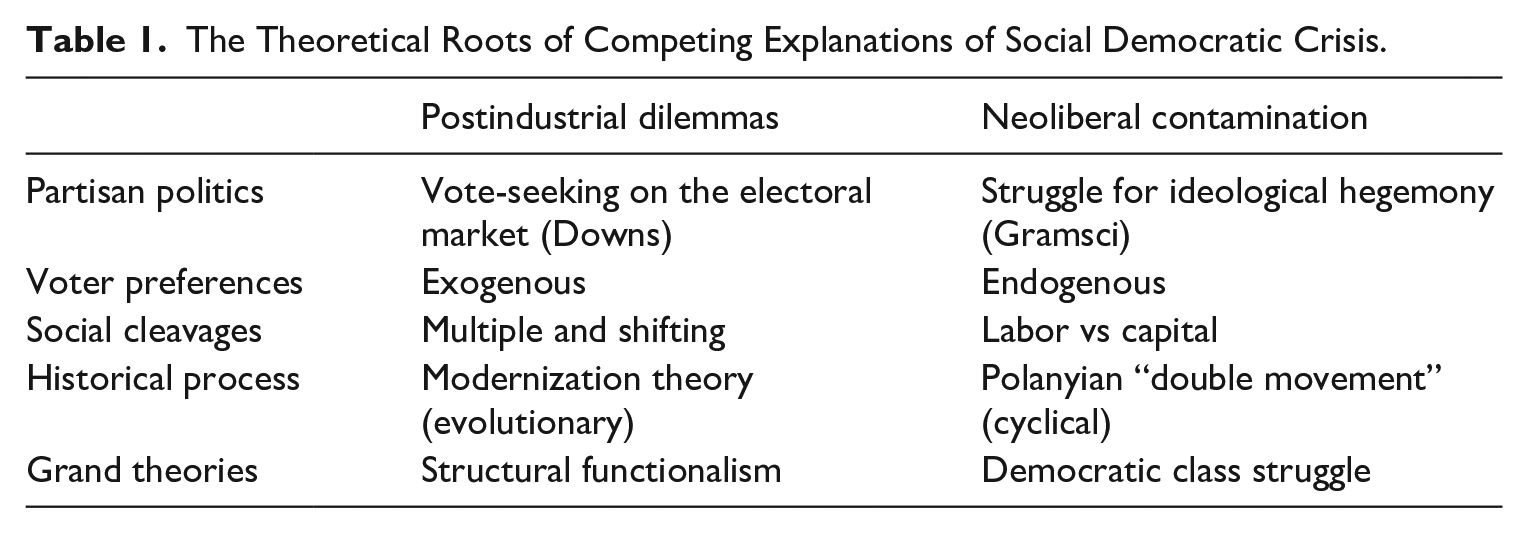
The main differences between both perspectives are summarized in Table 1. Notably, the postindustrial dilemmas hypothesis puts a strong emphasis on the transformation of capitalism and changing social cleavages, while the neoliberal contamination hypothesis stresses the enduring and inextricable conflict between capital and labor at the heart of each form of capitalism.
The Theoretical Roots of Competing Explanations of Social Democratic Crisis.
Conclusion: Strengths and Blind Spots
Given those fundamental differences, an attempt to provide a synthesis of both accounts is beyond the scope of this article. Instead, the approach chosen in this concluding section is to highlight the strengths of each explanation but also to discuss potential blind spots by using the competing explanation as critical lens.
The great strength of studies related to the first hypothesis is their analytical rigor in dissecting the electorate of postindustrial societies to expose the outlined electoral dilemmas of social democracy by applying sophisticated statistical methods to extensive survey data (e.g. Abou-Chadi and Wagner, 2019, 2020; Häusermann et al., 2021a, 2021b; Häusermann and Kriesi, 2015; Kitschelt and Häusermann, 2021). However, due to the focus on strategic behavior and its short-term effects, this approach suffers from a too narrow view of social democratic agency. Consequently, the approach largely ignores the long-term effects of social democrats’ positional shifts and the resulting policies. Thus, there is mounting evidence that the negative electoral effects of social democrats’ rightward shift on socioeconomic issues in the late 1990s and early 2000s have unfolded over time, since loyal voters were substituted for unreliable swing voters (Karreth et al., 2013; Polk and Karreth, forthcoming). In other words, further research in this direction has to consider that opportunistic vote-seeking strategies might be part of the problem as they may have fatal consequences in the long run. The focus on strategic aspects of party competition also blends out parties’ role in organizing people and building collective identities. While it can be disputed that contemporary social democratic parties are still able to fulfill this function, history tells that those parties’ success in the past has been closely linked to this very capability (Berman, 2006; Mudge, 2018). In this regard, the assumption of structurally determined voter preferences also deserves more scrutiny.
In contrast, proponents of the neoliberal contamination hypothesis place the party in time (cf. White, 2017) and take a long-time perspective. By doing so, they are able to show how social democrats in government contributed to institutional constraints, such as the Eurozone, and alleged exogenous shocks, such as the financial crisis (Bailey et al., 2014; Blyth, 2002, 2013). By taking social democracy’s deep roots in the working class seriously, this explanation is also better at grasping the strong and durable disappointment by its former core voters. The focus on workers and economic issues is, however, also the reason why this explanation “underestimates the impact of the social and cultural transformations that have characterized the transition from industrial to post-industrial society” (Frega, 2021: 490). Consequently, this approach has problems to account for social democrats’ trouble to address an electorate deeply split on cultural issues, such as national identity. A good case in point for the strengths and weaknesses of the neoliberal contamination hypothesis is the temporary revival of the British Labour Party. While Labour’s surprising revival under Jeremy Corbyn in 2017—even more remarkable as it occurred in the face of an overtly hostile media (Cammaerts et al., 2020)—demonstrates the electoral potential of “de-neoliberalization,” Labour’s recent collapse in the culturally charged 2019 “Brexit election” points to the limits of this kind of explanation.
Finally, both hypotheses offer different prospects for social democratic parties. According to the first hypothesis with its emphasis on postindustrial capitalism, the golden age of social democracy is gone and will not return. The outlined electoral trade-offs will persist or even worsen as the process of postindustrialization advances further. The neoliberal contamination hypothesis with its emphasis on postindustrial capitalism paints a picture of social democracy at the crossroads. Since ideological conflicts are expected to intensify in the post-neoliberal interregnum, including the attack of illiberal forces on democracy, neither the collapse of social democracy nor its revival can be ruled out. From this perspective, the increasing appreciation of a strong and functioning state due to the COVID-19 pandemic might present a golden opportunity for social democracy.
Footnotes
Declaration of conflicting interests
The author(s) declared no potential conflicts of interest with respect to the research, authorship, and/or publication of this article.
Funding
The author(s) received no financial support for the research, authorship, and/or publication of this article.
