



Abstract
We have only a limited understanding of the micro-level interactions that enable individuals to overcome the social and technical challenges associated with adopting socially beneficial practices. This article explores this question by zooming in on a case in which gamification mechanisms foster such adoption over the long term. Drawing on an abductive analysis of longitudinal qualitative data—including interviews, observations, and secondary sources—we examine how local authorities in France leveraged gamification to encourage households to adopt innovative waste management practices. Our findings identify three social mechanisms—affiliation with the group of adopters, insulation from pushback, and extension of the gamified experience. Through those mechanisms, gamification not only facilitates adoption but also transforms sympathizers into committed advocates, reinforcing engagement over time. These findings contribute to the literature on practice adoption and social dynamics by demonstrating how gamification sustains early adopters’ long-term engagement with practices that require overcoming technical complexity and social adversity. In addition, the analysis advances the gamification literature by offering a processual perspective on the social mechanisms that drive the long-term impact of gamification.
Keywords
Introduction
The adoption of socially beneficial practices can contribute to systematic social change (Girschik et al., 2022; Tracey and Stott, 2017; Zietsma and McKnight, 2009). However, the process of adopting such practices is particularly complex (van Wijk et al., 2019). For example, green standards (Castka and Corbett, 2016), recycling (Lounsbury, 2001), fair work practices (Mena and Suddaby, 2016), and green transportation (Purtik and Arenas, 2019) can be technically challenging to implement (King and Lenox, 2001). They are also socially costly and isolating because they make early adopters face disapproval (Clemente and Roulet, 2015). The literature has emphasized the importance of these barriers in hindering sustained adoption (Gondo and Amis, 2013), but limited research has explicitly examined how they are overcome (Reay et al., 2013; Strang and Meyer, 1993). While some prominent works indicate that social interactions (Dacin et al., 2010; Dalpiaz et al., 2016) and collective dynamics (Purtik and Arenas, 2019) can be key in practice adoption, as they drive collective emulation, we still have limited understanding of how those various processes are interconnected.
Gamification is an approach with the potential to connect and foster those aspects of collective emulation. Gamification, or what Woodcock and Johnson (2018: 542) call “the capture of play,” means applying game principles and mechanics to nongaming contexts (Deterding et al., 2011). It can encourage innovation (Cartel et al., 2019), spur collective dynamics (Duhigg, 2012), foster solidarity among participants (Robson et al., 2015), and challenge them to progress (Koivisto and Hamari, 2019), particularly in socially responsible behaviors (Lim et al., 2025). Yet, the gamification literature has traditionally focused on relatively short-term mechanisms and effects rather than persisting social outcomes (Landers, 2014; Landers et al., 2015), such as the durable adoption of a new practice. As noted by Lim et al. (2025: 1534), “while gamification strategies have been successful in enhancing users’ intentions toward sustainable actions, particularly in resource recycling, there exists a notable gap in understanding the transition from intention to actual behavior.” To address this issue, a growing body of work has begun to quantify the effects of gamification (Krath et al., 2021; Riar et al., 2022). While these studies offer valuable insights and highlight the social dimensions of gamification, they leave underexplored how the underlying mechanisms unfold and interrelate over time in ways that may produce more durable, long-term outcomes.
Gamification is therefore expected to serve as an effective driver of practice adoption. However, it remains unclear how it helps early adopters overcome the technical and social barriers to adoption and, more broadly, how it generates lasting behavioral change. Technical barriers include the lack of adequate resources for learning and perfecting the necessary techniques (Lounsbury, 2001). Social barriers arise because early adopters are often in the minority and may be excluded or mocked for deviating from the norm (Gill et al., 2024). We therefore aim to develop a theoretical account of how gamification can foster social and collective dynamics leading to adoption in the wake of adverse technical and normative pressures. This leads to our central research question: How does gamification support the social dynamics driving the adoption of socially beneficial practices?
To address this research question, we employ an abductive longitudinal approach (Alvesson and Karreman, 2007; Vila-Henninger et al., 2024) to the early adoption of innovative waste management practices (i.e., “zero-waste practices”): sorting waste, eliminating packaging and waste, and using reusable products. Specifically, we explore how local authorities in France have introduced these practices in their communities and encouraged individual engagement through large-scale gamification initiatives called “zero-waste challenges.” These included group activities—such as small games, quizzes, and workshops—based on fun, discovery, and learning-by-doing, where participants competed to reduce their waste output.
Our findings show how gamified interactions promote the adoption of zero-waste practices over time through three interrelated social mechanisms: affiliation with a new group of adopters, insulation from social disapproval, and the extension of the gamified experience into enduring social environments. Together, these mechanisms illustrate how gamification-driven collective dynamics shield early adopters from technical and normative pressures, gradually empowering them to experiment, learn, and stabilize zero-waste practices. Over time, initial sympathizers become advocates who support others’ adoption efforts. Our study advances research on practice adoption and social dynamics by unpacking the micro-level interactions and collective processes through which socially beneficial practices become both viable and socially anchored. It also contributes to the gamification literature by complementing prior quantitative work with a qualitative, processual account of the social mechanisms that drive long-term behavioral effects beyond short-term engagement.
Gamification and the collective dynamics of early adoption
The challenges faced by early adopters of socially beneficial practices
Practices are “patterns of activities that are given thematic coherence by shared meanings and understandings” (Smets et al., 2012). Adopting new practices is far from straightforward, and this type of adoption unfolds across several stages (Kennedy and Fiss, 2009; Mena and Suddaby, 2016). New practices start anchoring themselves when they become part of “a particular set of institutional arrangements as a solution to some problem” (Zietsma and McKnight, 2009: 148), while such arrangements “are not yet fully established, but have the potential to become conventional institutions once they are accepted and diffused throughout a field” (Smolka and Heugens, 2020: 630). Previous research has highlighted the importance of technical and normative barriers as core obstacles to practice adoption (Gondo and Amis, 2013). These barriers are particularly prominent for practices with clear societal benefits, as shown by research on recycling (Lounsbury, 2001), green transportation (Purtik and Arenas, 2019), and carbon trading (Cartel et al., 2019), the adoption of which faces an uphill battle (Tracey and Stott, 2017).
We focus on early adopters because they form a community of pioneers (Massa et al., 2017) who will have to overcome the most significant social, economic, and practical barriers to initiate and adopt such positive changes (Tolbert and Zucker, 1983). Those early adopters undergo crucial instrumental cost–benefit considerations (Ansari et al., 2010). They also struggle with the lack of information about an emerging practice, particularly because they cannot observe how others have successfully adopted it (Mena and Suddaby, 2016; Terlaak and Gong, 2008). Finally, early adopters are even more at risk of being socially isolated (Raffaelli and Glynn, 2014; Rimal and Real, 2005). As noted above, these barriers are exacerbated for socially beneficial practices because they deviate significantly from existing norms (Tracey and Stott, 2017; van Wijk et al., 2019) and are difficult to implement as they challenge the status quo (King and Lenox, 2001).
Despite the value of existing research on practice adoption, we have yet to fully uncover the cross-level interactions among actors that are necessary for adoption (Siebert et al., 2015; van Wijk et al., 2019). While it is established that microlevel interactions (Siebert et al., 2015) are crucial for new practice emergence (Ansari and Phillips, 2011), “the complexities and interrelationships across multiple levels of analysis” have yet to be explored (Harmon et al., 2019: 5) to understand how adopters overcome technical and social barriers to practice adoption. Currently, the literature on the social aspects of practice adoption is fragmented, and there is a disconnection between the actual “doing” of practice adoption and the experimentation that makes adoption stick (Dalpiaz et al., 2016). Thus, we focus on a central driver integrating these social and collective dynamics: gamification.
Gamification and the social and collective dynamics of adoption
Gamification refers to the application of game principles in nongaming contexts (Deterding et al., 2011). It encompasses principles and design elements that target specific populations and practices to trigger individual and collective engagement (Robson et al., 2015). Liu et al. (2017: 1011) argue that gamification is about “making everyday tasks more engaging.” Gamification can be imposed “from above” (Woodcock and Johnson, 2018: 542) to generate new habits through the reinforcement of desired practices and the deterrence of undesired ones (Duhigg, 2012). The motivation to engage with gamified systems and associated practices often relies on social comparison and quantified competition (Woodcock and Johnson, 2018), which can significantly influence practice adoption (White et al., 2019).
Gamification induces and motivates change through two types of interactions (Liu et al., 2017). In system interactions, participants strive to improve their own performance and reach their objectives over time. In participant interactions, individuals provide mutual support (Riar et al, 2022) and coordinate efforts (Riar et al., 2022), enabling them to share information to overcome technical difficulties (Terlaak and Gong, 2008) and to initiate parallel initiatives that diverge from the original gamified system (Mandujano et al., 2021). These interactions are shaped by combinations of game elements (e.g., points, narratives, performance graphs, leaderboards) (Helmefalk, 2019), along with realistic goals, action-oriented tasks, and rewards (Lim et al., 2025). Designers adapt these elements to context to foster emulation and frame performance (Landers, 2014), which in turn builds intrinsic motivation through competence, autonomy, and relatedness (Krath et al., 2021). In this way, gamified settings structure opportunities for ongoing social comparison, cooperation, and progress assessment, shaping how participants influence and sustain one another’s efforts (Krath et al., 2021; Riar et al., 2022).
Gamification has been applied across diverse settings to promote targeted behaviors—for instance, in marketing to engage consumers (Huotari and Hamari, 2017; Robson et al., 2015), or in HR and education to support recruitment and skill development (Helmefalk, 2019). In the context of socially beneficial practices, Cartel et al. (2019) showed how gamification mechanics encourage actors to distance themselves from pre-existing practices, while Lim et al. (2025) focused on how gamification can drive individuals toward more sustainable consumption. Such findings suggest that gamification can facilitate adoption. Yet little is known about how gamification-related micro-level dynamics unfold over time to support the long-term adoption of practices, especially when these are both technically demanding and socially disapproved.
Adoption requires long-term, sustained engagement with a practice (Kennedy and Fiss, 2009). But as Landers et al. (2015: 177) state, “The amount of time spent playing a game has a curvilinear relationship with time, represented as an inverted U shape. In other words, individuals start out playing a little, increase their play over time, and then eventually decrease and stop playing.” The decline in engagement within a gamified environment can undermine learning outcomes, as learners may disengage before fully meeting the learning objectives or cease adhering to the targeted behaviors once the game concludes, especially in an unfavorable social environment. Research on gamification increasingly recognizes the central role of social and collective dynamics in addressing this issue. In particular, an emerging body of work has examined the effects of design features that facilitate social comparison and shape normative beliefs and attitudes, thereby promoting collective action and the pursuit of common goals (Krath et al., 2021; Lim et al., 2025). However, despite these advances, few studies clearly delineate and connect the mechanisms underlying these dynamics (Helmefalk, 2019), nor do they examine how these mechanisms interact to generate long-term outcomes (Landers et al., 2015; Lim et al., 2025).
In sum, new practices can be met with disapproval and can be technically difficult to implement (York et al., 2018), ultimately deterring adoption (Clemente and Roulet, 2015). Social and collective dynamics can help individuals overcome these deterrents, yet the actual impact of these dynamics during early adoption stages and their multilevel implications remain underexplored. Gamification designs have proven effective in steering individual behaviors toward the adoption of new practices (Lim et al., 2025; White et al., 2019). However, the social and collective mechanisms driven by gamification that influence long-term adoption require further theoretical development and empirical investigation (Helmefalk, 2019; Landers et al., 2015; Lim et al., 2025). Thus, in this study, we aim to uncover how social mechanisms supported by gamification drive the adoption of socially beneficial practices over the long term, particularly by helping adopters overcome technical and normative challenges.
Research context: The zero-waste challenges
Zero-waste practices aim to “prevent the production of waste as much as possible” (Cezard et al., 2017). Upstream, waste prevention involves purchasing bulk, unpackaged raw materials (e.g., flour, fresh vegetables) and reusable products (e.g., cloth bags, washable diapers) instead of packaged products (e.g., frozen pizzas) or single-use items (e.g., plastic bags, disposable diapers). Downstream, once the waste is generated, sorting (e.g., plastic, bio-waste) is required to prepare specific waste types for recovery (e.g., composting) and recycling. Zero-waste practices demand specific information and a reorganization of daily activities to enable purchases from suitable providers. These practices also require technical knowledge to transform raw materials (e.g., fresh fruits, caustic soda, activated charcoal) into consumable products stored in appropriate reusable containers, such as jams, household cleaners, and makeup. In France, some local authorities promoted zero-waste practices to comply with national and European regulations mandating higher recycling rates and reduced waste volumes (FR/2015-992; EU 2018/851). They introduced zero-waste challenges to encourage residents to adopt sustainable waste practices and to support broader campaigns demonstrating that zero waste is achievable—even for ordinary individuals.
Zero-waste challenges provide a compelling context for observing how gamified collective dynamics drive the adoption of socially beneficial practices. They rely on a purposeful combination of game elements to impact a nongame context (Landers, 2014; Liu et al., 2017) implemented by authorities as a top-down initiative aimed at citizens (Woodcock and Johnson, 2018). Zero-waste challenges entice participants to adopt practices that minimize their waste through activities grounded in fun, playful learning, and discovery (e.g., quizzes, role-playing games, team challenges, or collective experiments). These challenges are based on gamification principles, allowing participants to choose their level of (reversible) involvement while receiving coaching from organizers and fellow participants.
All of the challenges we studied shared a common structure (Supplemental Appendix A). The first phase includes an opening ceremony and events such as recycling center tours, communal meals, and picnics that combine information sharing with relaxed socialization. In the second phase, workshops integrate gamification mechanics, introducing zero-waste practices (e.g., composting, waste-free cosmetics). Participants are encouraged to experiment, share tips, and build collective knowledge. Gamified elements like charts display progress, rewarding waste-reduction efforts and promoting social comparison. The challenge concludes with an award ceremony honoring the lowest waste producers or those achieving the greatest reduction.
The challenges we investigated involved a few dozen participants (Table 1) recruited through local channels (e.g., flyers in shops, local press, and social media pages). Organizers selected individuals who expressed interest in the zero-waste approach but who had been constrained by either practical limitations, social pressures, or both. The results were notable: in Lorient, for instance, participants reduced their waste by up to 51%, producing 86% less than the national average for comparable households (Cezard et al., 2017). Overall, several challenge participants also went on to establish or join zero-waste organizations (e.g., associations, shops).
Challenge locations and descriptions.
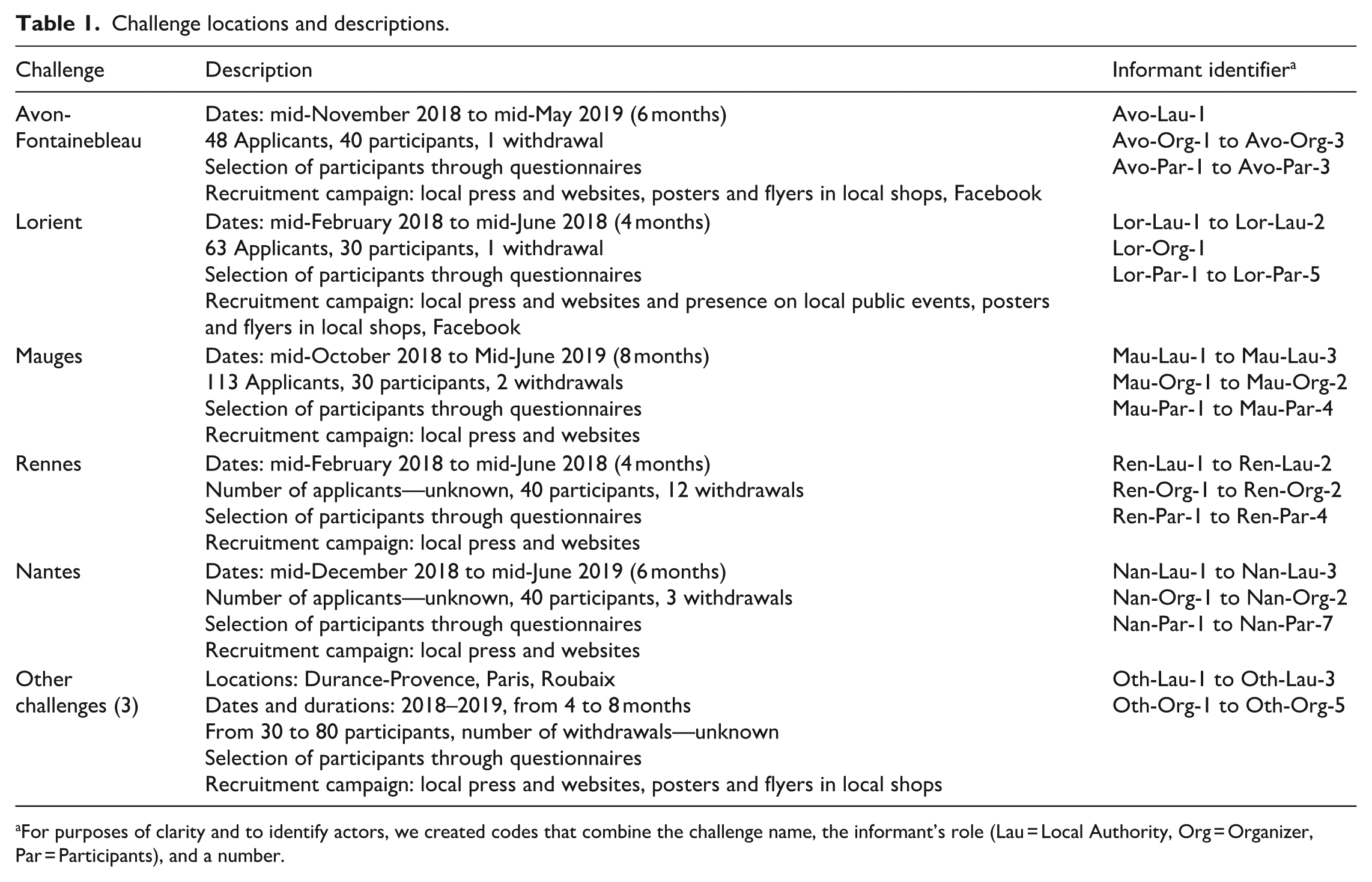
For purposes of clarity and to identify actors, we created codes that combine the challenge name, the informant’s role (Lau = Local Authority, Org = Organizer, Par = Participants), and a number.
Thus, the zero-waste challenges closely aligned with our study objectives. They encourage socially beneficial practices by providing potential adopters with diverse opportunities for interaction. These occur individually, as participants engage with new practices and activities during the challenges, and collectively, through group activities. Therefore, zero-waste challenges offer a promising case where the phenomenon of interest is clearly observable (Pettigrew, 1990).
Methods
Our research employed an abductive approach (Sætre and Van De Ven, 2021; Timmermans and Tavory, 2012; Vila-Henninger et al., 2024), which informed a process-oriented perspective (Langley, 1999). Consistent with other abductive research in our field (e.g., Sonpar et al., 2024), we started with a set of empirical “puzzles” and “surprises” (Sætre and Van De Ven, 2021: 687). These initiated an iterative movement between data and theory to organize empirical material through a “thematic analysis [. . .] engaging in our disciplinary, theoretical worlds” (Tavory and Timmermans, 2019: 533). We began by comparing anomalies in the data with the literature (Alvesson and Karreman, 2007), then confirmed these anomalies by converging them into theoretical themes that were subsequently assessed against the data (Timmermans and Tavory, 2012; Vila-Henninger et al., 2024).
Access and sample
We gained access to our research field through the first author’s participation in a series of workshops organized by the French Agency for Ecological Transition. These workshops convened both national experts in the implementation of waste management policies and representatives of local authorities selected either for their performance or for specific initiatives in municipal waste reduction observed in their respective territories. We were able to interview all the participants in these workshops. Zero-waste challenges were repeatedly discussed in our pilot interviews as a notable complement to the economic and usual social incentives to engage households in zero-waste practices. We were surprised by the importance that our informants attached to these challenges. Bearing in mind Eisenhardt’s invitation to “tak[e] advantage of serendipitous findings” (1989: 536), we decided to focus on how these challenges could drive practice adoption.
Hence, we started making observations and collecting secondary data on zero-waste challenges in general and on the challenges under study in particular. We also accessed local authority representatives, organizers, and participants directly involved in the challenges we investigated via snowball sampling (Biernacki and Waldorf, 1981). For five challenges, we conducted in-depth interviews with numerous local authority representatives, organizers, and participants. For the remaining three, we interviewed several local authority representatives and organizers, who provided valuable insights but declined to connect us with participants, fearing it might disrupt implementation. We present the details of all the data sources in Table 2. Beyond its size, this sample allowed us to go into the field with a “well-defined focus to collect specific types of data systematically” (Mintzberg, 1979: 585) and enabled cross-case comparison and triangulation to enhance the robustness of our findings (Eisenhardt, 1989).
Summary of data collection.
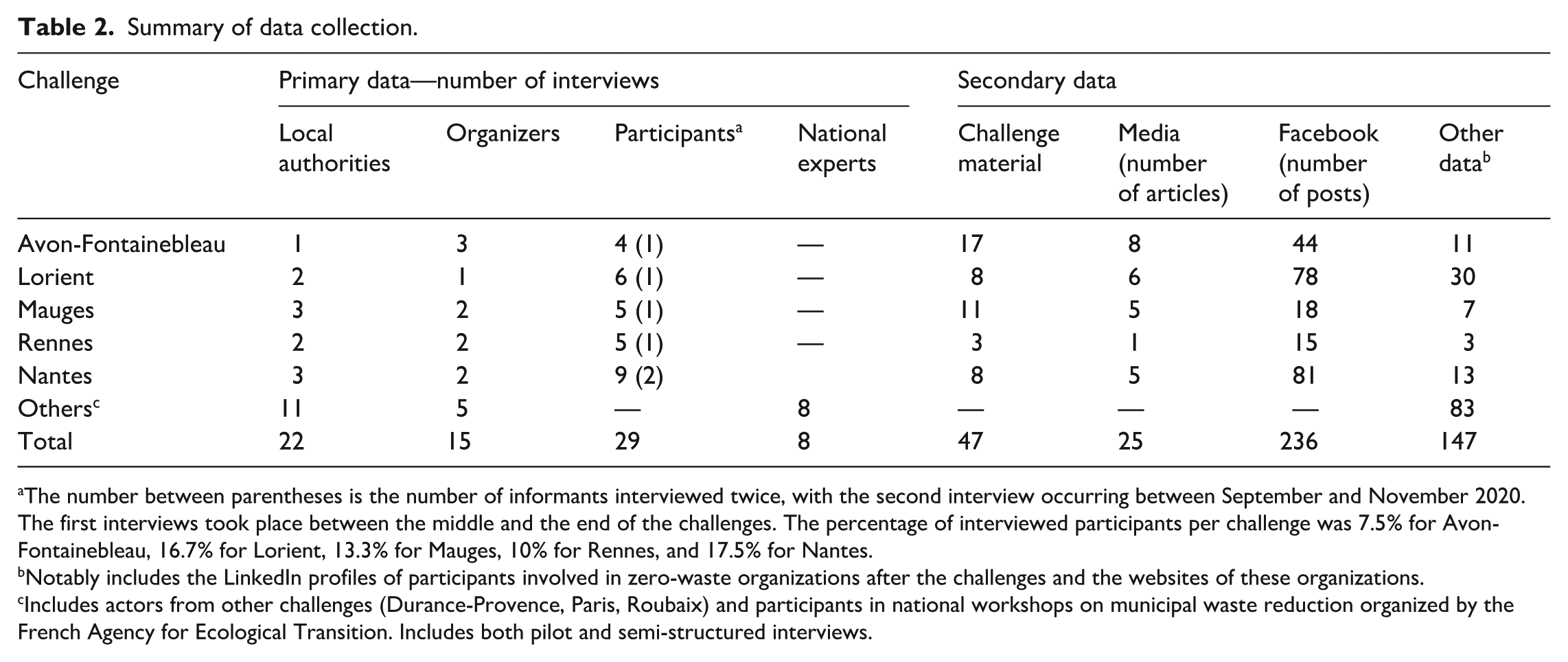
The number between parentheses is the number of informants interviewed twice, with the second interview occurring between September and November 2020. The first interviews took place between the middle and the end of the challenges. The percentage of interviewed participants per challenge was 7.5% for Avon-Fontainebleau, 16.7% for Lorient, 13.3% for Mauges, 10% for Rennes, and 17.5% for Nantes.
Notably includes the LinkedIn profiles of participants involved in zero-waste organizations after the challenges and the websites of these organizations.
Includes actors from other challenges (Durance-Provence, Paris, Roubaix) and participants in national workshops on municipal waste reduction organized by the French Agency for Ecological Transition. Includes both pilot and semi-structured interviews.
An abductive approach driving data collection
Our data collection process was driven by our abductive approach (Timmermans and Tavory, 2012). We moved back and forth between data collection and analysis to theoretical knowledge and the literature (Sonpar et al., 2024) while remaining attuned to unexpected patterns and empirical anomalies (Sætre and Van De Ven, 2021). This approach also led us to revisit different data sources as we theorized our findings (Dunne and Dougherty, 2016). We began with emerging themes from pilot interviews, then iterated between data collection, analysis, and theory to sharpen our constructs (Timmermans and Tavory, 2012), and concluded data collection when “incremental improvement to theory was minimal” (Eisenhardt, 1989: 545).
Initial research focus
Our initial interest was to better understand how individuals could adopt new practices, especially socially beneficial practices. Our literature review indicated the role of economic, social, and technical drivers of and obstacles to practice adoption. We deliberately refrained from emphasizing one set of drivers over another at this early stage and chose to integrate these themes in our pilot interviews.
Pilot interviews
To refine our research question, we conducted 16 pilot interviews to better understand how households could engage in zero-waste practices. Between March and November 2017, we interviewed eight prominent experts working on waste management policies at the national level. We also conducted interviews with eight representatives of local authorities who had taken part in municipal waste reduction workshops organized by the French Agency for Ecological Transition. This step allowed us to compare policymakers’ perspectives with those of local authorities responsible for implementation. These were purposely broad in scope. They touched on many topics, such as the financing schemes for new waste management policies; the mixed results of economic incentives promoting waste reduction among households; and the limits of traditional communication campaigns in inducing households to engage in waste sorting.
First anomalies and refining the research focus
Our first informants provided us with insights into the potential of zero-waste challenges in practice adoption. One local authority representative (Mau-Lau-1) claimed, “We’ve launched a recruitment campaign for a zero-waste challenge. And there’s a huge craze! We had planned for 25 households, we had 113 or 114 applications, and in the end, we took 30.” While previous work had established variance in engagement toward practice adoption (Gondo and Amis, 2013), challenge organizers reported durable and consistent change in behaviors across a wide range of participants. This initial surprise prompted iterative engagement between empirical anomalies, confirming those data points (Sætre & Van de Ven, 2021) and interpreting them theoretically (Tavory and Timmermans, 2019; Vila-Henninger et al., 2024).
Our pilot interviews also directed our attention to individual and social interactions likely to facilitate zero-waste adoption within the challenges. We revisited the gamification literature to better understand the types of interactions occurring in gamified settings (Koivisto and Hamari, 2019; Liu et al., 2017) and to further refine our interview guide accordingly. When comparing our data to this literature, we identified a second anomaly: The pace of learning in gamified contexts typically declines after an initial increase in engagement (Landers et al., 2015). Yet, recent research suggests gamification can have enduring effects on sustainability-related behaviors (Lim et al., 2025), though it remains unclear how these behaviors are sustained beyond the gamified context.
Further interviews and direct observations
We conducted 52 additional semi-structured interviews focusing more directly on the zero-waste challenges implemented in eight local communities and their aftermath (see Supplemental Appendices C and D). Among these interviews, 14 were with local authority actors directly involved in the challenges. This step enriched our understanding of their expectations and experiences. It also provided us with secondary data (e.g., recruitment and follow-up questionnaires), which helped corroborate and contrast the insights retrieved from our primary data. This clarified how communities of early adopters persisted after the challenges concluded and reinforced our identification of a core anomaly (Sætre & Van de Ven, 2021): participants’ learning continued beyond the game, supporting long-term behavioral change. We also conducted 15 interviews with challenge organizers. These shed light on the challenges’ objectives and proceedings and organizers’ perceptions of participants’ behaviors and interactions. These interviews provided an external view of what took place during the challenges and helped validate how gamification mitigated the typical barriers to practice adoption (Ansari et al., 2010).
To enrich our understanding of the interactions, we conducted an initial round of 23 individual interviews with challenge participants and collected 12 hours of in situ observational notes. This allowed us to gather data from diverse individuals, assess their participation, explore their unexpectedly high and sustained levels of engagement (Gondo and Amis, 2013), evaluate their adoption of the practices, and examine their social interactions.
Preliminary analysis
While collecting our data, we met every month to review and discuss our analytical notes and observations. This confrontation broadened the interpretative frame underlying our theorizing as we identified more anomalies, confirmed them, and compared them with the literature (Sætre & Van de Ven, 2021; Vila-Henninger et al., 2024). The data were also phase-coded (before, during, and after the challenges), and when relevant, we mitigated the risk of retrospective bias through triangulation with secondary data (e.g., recruitment questionnaires).
Second round of interviews with participants
We re-interviewed six participants from different zero-waste challenges to strengthen our analysis. These follow-up interviews took place 18–24 months after the initial round. This enabled us to examine how zero-waste practice adoption persisted even after the challenges had ended. We concluded this second round by collecting secondary data on participants’ career paths and their involvement with zero-waste organizations established during or after the challenges.
Analytical process through abductive reasoning
As part of our abductive approach, we engaged in iterative cycles of identifying anomalies or surprises, confirming them, and theorizing them (Sætre & Van de Ven, 2021). Some of the anomalies became apparent when contrasted with expectations from the practice adoption literature: For example, we were surprised to observe individuals persisting with a practice while being socially disapproved for it (Clemente and Roulet, 2015; Garnier et al., 2025). Other anomalies were identified by contrast with the gamification literature: While interest in the game is typically expected to decline over time, following an inverted U-shape (Landers et al., 2015), our participants remained engaged by continuing to apply the same principles beyond the game setting, thereby sustaining adoption of the practice.
While identifying and confirming anomalies, we iteratively engaged with the literature to build our descriptive codes and develop first-order categories. We drew on gamification research to identify the game elements at play in our context and examine their impact at both individual and collective levels. At the individual level, consistent with existing literature (Landers et al., 2015), we observed the psychological impact of gamified elements, such as reduced anxiety and strengthened participants’ expectancy that their adoption efforts would yield the desired outcomes. We then examined how these elements interacted with group-level social dynamics and sought to uncover the social mechanisms that ultimately enabled the long-term outcomes of gamification. We referred to a variety of works (e.g., Koivisto and Hamari, 2019; Liu et al., 2017) to capture the interactions between individual and collective dynamics in our data.
To refine our coding schemes and theoretical interpretations, we iteratively moved between inductive and deductive approaches (Sætre & Van de Ven, 2021; Timmermans and Tavory, 2012). We compared our respective themes and interpretations until we reached consensus (Supplemental Appendix B). As a result, the dynamics of practice adoption through zero-waste challenges became clearer, and consistent patterns emerged as we theorized the confirmed anomalies.
Next, we aggregated our first-order categories at a more abstract level through axial coding (Corbin and Strauss, 1990). In the first phase, we iteratively compared our emergent findings with literature on collective dynamics, behavioral change, and gamification. These bodies of literature helped us identify the factors that had previously hindered the adoption of zero-waste practices before the challenges—namely, social isolation, unfavorable norms, ambivalence, and a perceived lack of control over adoption (Ajzen et al., 2018; Conner and Sparks, 2002). We were surprised to observe that participants in the challenges were able to overcome the previously documented adoption barriers. We thus examined how gamification influenced these factors by fostering readiness and helping participants commit to adoption within the challenges, as they developed implementation intentions through participation in a newly formed group of adopters (Rafferty and Minbashian, 2019). Next, we linked these two second-order categories—Fostering Collective Readiness and Tailoring Gamified Adoption Plans—to what we identified as Affiliation: the social distancing and attraction effects conveyed by purposively driven interactions (Lewis et al., 2008). These steps highlighted how participants initiated the adoption of zero-waste practices through their affiliation with new groups of adopters formed around the gamified infrastructure.
In the second phase, we concentrated on how gamification-driven collective dynamics contributed to sustaining adoption. By proceeding iteratively from the literature on gamification systems (Liu et al., 2017) and works on collective dynamics (Drury and Reicher, 2005), we constructed the second-order categories: Regulating Continuous Engagement, Building Protective In-Group Cohesion, and Enabling Independent Adoption. Taking into account the functions covered by these categories, we grouped them into the theoretical category Insulation from Pushbacks. In so doing, we emphasized how these gamified interactions and dynamics supported adopters’ sustained efforts to experiment and learn despite the technical challenges of zero-waste practices, helped neutralize adverse external pressures, and set the stage for independent adoption once the challenges ended.
In the third phase, we identified how, somewhat unexpectedly, individuals remained driven by collective dynamics and continued to adhere to the practice after the zero-waste challenges had come to an end. Building on works on identification and identities (Hogg and Terry, 2000; Sonpar et al., 2024; Tajfel, 1978), we constructed two additional second-order categories: Crystallizing Social Bonds and Identifying with the Practice. Through these categories, we first captured how the end of the challenges fostered new durable group identities, which eventually drove the creation of new organizations and businesses dedicated to advancing zero-waste. Second, we accounted for how adopters began to construct a renewed self-conception shaped by their knowledge and months of consistent, day-to-day engagement in zero-waste practices as members of these groups. This new identity associated with both the collective and the practice, in turn, strengthened their commitment to zero waste and ultimately inspired them to become advocates for the movement. Finally, these categories were abstracted into the broader category Extension of the Gamified Experience, as we observed that lasting social settings derived from the collective dynamics of the zero-waste challenges enabled individuals to definitively make their own life choices and to advocate for alternative practices they believed can change society for the better.
Gamification and the adoption of zero-waste practices
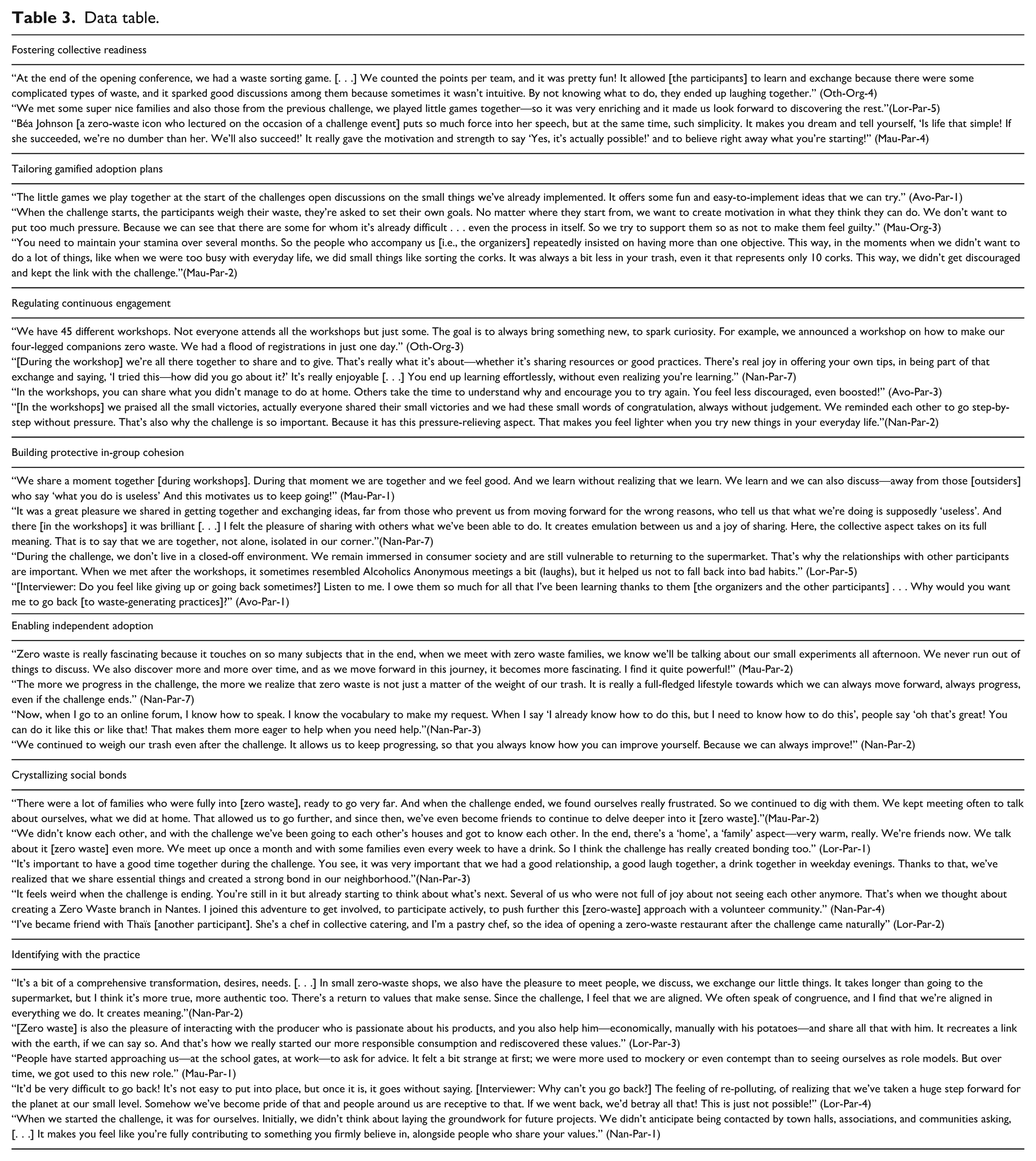
Our findings reveal how gamification fostered the long-term adoption of zero-waste practices through three social mechanisms: affiliation, insulation, and extension. Each mechanism shaped a distinct stage of the process: affiliation with the group of adopters (to initiate adoption), insulation from negative pushback (to sustain adoption), and extension of the gamified experience (to anchor adoption). Figure 1 outlines the model that we derived from our findings. Table 3 provides representative data for each of our coded themes.
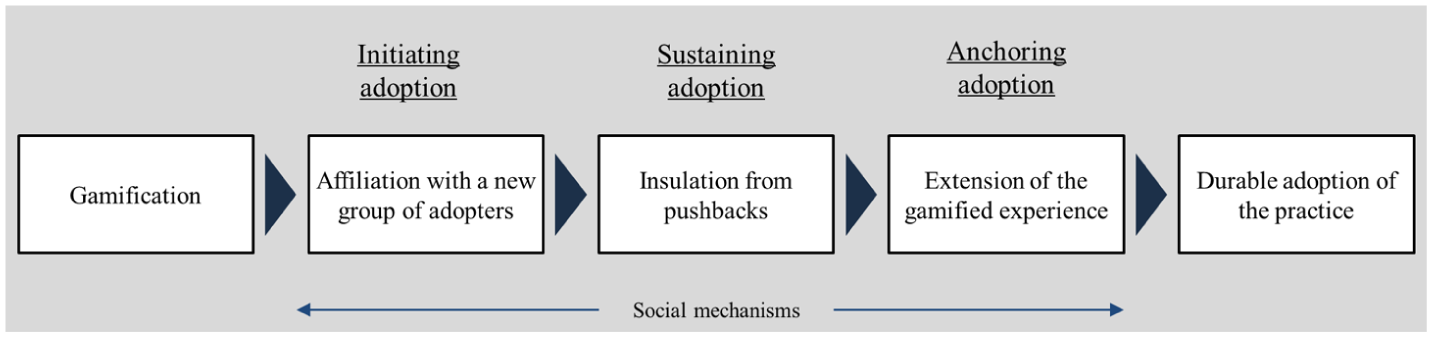
Gamification-driven social mechanisms prompting practice adoption.
Data table.
Initiating adoption through affiliation with a new group of adopters
Analysis of our data first showed that gamification initiated adoption through affiliation: the process by which individuals align with a new group of adopters. Affiliation emerged from two interrelated dynamics in the first phase of the challenges. Together, these dynamics cultivated an emerging community of early adopters while providing individuals with desirable and feasible pathways for action. In this way, affiliation bridged personal commitment and collective momentum. At the collective level, gamified activities transformed isolated sympathizers into a supportive group, building readiness for change. At the individual level, organizers built on early participant interactions to develop personalized gamified approaches that strengthened implementation intentions.
Fostering collective readiness
By readiness, we refer to participants’ preparedness and motivation to take concrete steps toward adoption as a group. Within the challenges, organizers selected participants for their readiness—they were inclined to engage, connected them through playful activities that built a sense of belonging and shared knowledge, and exposed them to experiences that heightened the appeal of zero-waste practices while discouraging waste-generating ones.
Fostering readiness was first a matter of selection. Organizers stated that they targeted participants who had an early interest in zero-waste practices and who needed support and coordination. According to them, these profiles were most likely to eagerly engage in the challenges and their social activities. This was corroborated by our analysis of participant interviews and the enrollment questionnaires. The participants previously had ambivalent attitudes toward zero waste—valuing both zero-waste practices and opposing practices (e.g., purchasing goods in plastic packaging from mass-market retail stores)—and had refrained from attempting adoption owing to adverse social pressure (e.g., the skepticism of their neighbors or parents toward zero waste) and perceived lack of control over adoption (e.g., difficulties finding where to bulk buy without packaging).
Specifically, the participants expressed initial tensions between their curiosity about zero waste, their guilt over what they perceived as personal overconsumption and wastefulness, and their “passion” for buying mass-packaged products in “temples of consumption.” Terms like “constraints,” “complicated,” and even “impossible” described their initial perception of adopting zero waste. Additionally, our interviewees shared their initial “loneliness” caused by disapproval from their direct social circle, even when considering the most basic zero-waste gesture, such as package sorting. One participant described the situation where she felt as if she was acting against all odds when attempting to shift her consumption habits in favor of zero-waste practices: It was too hard, too much pressure when you kept hearing, “What you do is useless; the planet is rotten anyway. You’re sacrificing yourself for nothing. Stop annoying us, and buy your stuff at the supermarket!” It makes you feel like giving up. (Mau-Par-3)
Readiness for adoption was then fostered by leveraging the gamified settings. These settings not only helped remove barriers related to social isolation but also cultivated a sense of belonging among participants. Early activities related to challenges, such as quizzes, role-playing games, and team challenges, spurred participants to interact and compete both individually and in groups. These activities established cooperative and harmonious relationships, which enabled participants to step out of their comfort zones and experiment with zero-waste practices without fear of embarrassment. One participant reflected on how this setting facilitated the rapid formation of connections centered on the collective acquisition of basic knowledge and skills about zero-waste practices: These little games let us get to know each other better right away without fear of exposing ourselves. For example, the quizzes showed how clueless we all were about zero waste, but it was better to laugh about it. We were so clueless that eventually, we weren’t even keeping score anymore! But it still taught us a few things, and that’s valuable. And above all, it made me realize that the people next to me were in the same situation, there for the same reasons as me. And that alone is motivating. (Avo-Par-2)
Moreover, gamified activities and related interactions increased participants’ attraction to zero-waste practices while distancing them from waste-generating habits. Conferences featuring prominent advocates of zero-waste practices, like Béa Johnson, exposed participants to narratives that heightened the appeal of the lifestyle associated with zero waste. Simultaneously, all the participants whom we interviewed reported that regularly weighing and reporting their individual waste output at the start of the challenges served as a “big wake-up call.” This, coupled with the “visual shock” that they collectively experienced during the visits to waste facilities (e.g., recycling centers), compelled them to change their behavior, subsequently motivating them to incorporate the knowledge and habits introduced during early challenge activities.
Thus, gamification first acted as a driver of readiness to change behavior. It enabled previously isolated sympathizers to become capable and committed to taking action as part of a group, where they developed a shared understanding of the practice and its implications, recognized the feasibility of its adoption, and felt connected with supportive like-minded people.
Tailoring gamified adoption plans
The initiation of individual adoption required a shift from mere interest to the active implementation of zero-waste practices. To achieve this shift, organizers mobilized gamification elements at the individual level. This involved, first, leveraging interpersonal exchanges within the gamified infrastructure and, second, tailoring the gamified mechanics to each participant.
First, through game and play activities, early interactions among participants spurred social interactions, making the practice accessible and desirable. Seeing the progress of more experienced participants inspired newcomers, while more advanced participants were motivated to push themselves further after they were “blown away by how quickly [the beginners] became involved” (Nan-Par-6). Early interpersonal exchanges also revealed new ways to engage with zero-waste practices. One participant (Nan-Par-1) reported convincingly how others fueled her sense of surprise regarding zero-waste practices: At the very beginning, I met somebody who made me realize I could replace my sanitary towels . . . I was far from suspecting it was possible; I’d never considered it before . . . I thought, “My God, it’s actually possible! It’s like a game!” Right after, I wondered, “Wait! What if I searched to see whether I could replace my aluminum foil? Yes! I can! I couldn’t believe it!” And I really took it as a game!
Second, organizers built on these early interpersonal exchanges to help each participant adopt a gamified approach tailored to their interests and capabilities. They applied gamification principles—such as self-set goals and a step-by-step approach—to alleviate the anxiety and fear of failure that accompanied the prospect of adopting zero-waste practices. Through this approach, reasonable goals could prevent initial enthusiasm from overwhelming participants and leading to dropout. Challenge activities were offered on an optional basis, tailored to participants’ personal preferences and perceived difficulty. Participant interviews indicated that this gave them a sense of autonomy and that the activities involved minimal risk. Echoing this point, organizers aimed to give participants flexibility in their involvement and control over the adoption process: There are some [participants], when they are confronted with changes, when they feel they might not make it, it puts a lot of pressure on them, and they might give up. So, we invite them to go at their own pace and find their entry points, [. . .] once they’ve started with a theme that interested them, they’ll gradually take an interest in others. (Oth-Org-2)
Thus, the application of gamified elements complemented group dynamics in initiating the individual adoption of zero-waste practices. By targeting participants individually, organizers mitigated typical barriers to adoption and effectively initiated engagement with the collective of adopters. The use of personalized goals, nurtured through participant interactions, facilitated the initial steps toward adoption and helped cultivate an emerging sense of belonging to the group.
Sustaining adoption through insulation from pushbacks
We observed that gamification sustained adoption through insulation, a mechanism that protected participants from loss of motivation through regulated interactions and from external disapproval through in-group cohesion. Insulation emerged during the second phase of the challenges, which featured workshops and collective events designed to maintain engagement. At the collective level, gamified interactions created strong bonds among participants, foregrounding their connections with fellow adopters and backgrounding hostile outsiders. At the individual level, this environment enabled participants to master demanding zero-waste practices despite technical difficulties, entrenched habits, and external criticism. Thus, through insulation, gamification sustained motivation and commitment, creating the foundations to maintain zero-waste practices independently over the long term.
Regulating continuous engagement
Gamification sustained participants’ engagement with regular social interactions around zero-waste practices. These interactions enabled the sharing of personal resources and practical support that reduced the complexity of adoption. They also regulated how gamification mechanics were experienced and interpreted, thereby reinforcing individual commitment and ensuring sustained motivation throughout the challenges.
Organizers strategically paced the social activities of the challenge to ensure ongoing excitement. They regularly organized workshops and events that gathered participants around novel themes (e.g., zero-waste Christmas or Easter) and objects (e.g., reusable beeswax wraps to replace cling film and aluminum foil), thereby continuously fostering discovery, curiosity, and engagement. In addition to the workshops, mini-games and auxiliary challenges were introduced to promote collaborative learning and autonomy and to strengthen social bonds. An organizer explained, Every week, I sent them a small thematic challenge, for example, “Trip to Japan.” They were invited to do tawashi, furoshiki [. . .]: they’re like small zero-waste workshops. There were kind of funny moments when they autonomously organized meetings with their teams outside the challenge. (Nan-Org-2)
The challenges’ infrastructure provided resources that reduced the financial barriers and effort required for experimentation, including appropriate materials and equipment (e.g., compost cans, washable diapers) and spaces reserved for hands-on experimentation with zero-waste practices. During workshops and events, organizers offered timely feedback and coaching. Individual goals were collectively discussed and sometimes revised to align each participant’s efforts with their actual capacity, thereby ensuring consistent, albeit sometimes minimal, participant involvement. This approach ensured that participants did not get discouraged and maintained their connection to the challenge.
These gamified settings also encouraged the sharing of personal resources within the group. Our interviews with both organizers and participants indicated that the interactions between participants involved exchanging practical advice, sharing experiences, solving problems collectively, and discussing personal issues. Further, participants borrowed and donated personal materials, further enhancing their potential to learn new techniques. This fulfilled individual needs, reduced the effort required for experimentation, and increased the likelihood of success. One participant recounted how her discussions with others provided the guidance necessary to overcome previous setbacks: I’d already tried to make my own jams to reuse my jars, but the stuff was too hard, super-sweet. And they [other participants] told me, “Yes, but you need lemon to stabilize it.” They helped me find solutions. Otherwise, you would tell yourself, “With whom [can I talk]? Well, nobody!” So, it really makes you feel less alone and share tips and tricks. Because zero waste is a new universe, so the workshop allows you to move forward. (Ren-Par-3)
Interactions among participants were also instrumental in regulating the motivational impact of gamified mechanics and objects (e.g., step-by-step flexible approach, performance charts, self-made zero-waste products). First, they proved highly valuable for maintaining individual motivation despite obstacles, dead ends, and the unlearning and relearning involved in adopting new practices. Participants repeatedly expressed how their interactions helped them put personal setbacks into perspective and persist in adoption efforts: The workshops also make it possible to “lighten up.” When we were stuck on something, we were told, “Don’t take it too seriously. Just move forward; you’ll come back to this later.” That’s what really helped me with this challenge: doing workshops, meeting people. It was really essential for me in my thought process. (Mau-Par-1)
Second, participant interactions amplified the motivation derived from personal successes. Participants shared how they “celebrated” together and congratulated each other on their “small victories” in adopting zero-waste solutions. This spurred collective emulation, which in turn reinforced commitment throughout the adoption process: Receiving the graphs with our quantity of waste was always a great moment! We were all so curious to see how much we were progressing! It was like a sports competition. We congratulated each other, we celebrated together, which made us look forward to playing the next game! (Nan-Par-3)
Thus, the gamified settings structured participant interactions, which played a central role in sustaining motivation for adopting zero-waste practices. By fostering resource-sharing, problem-solving, and mutual encouragement, these interactions helped participants overcome technical hurdles and maintain engagement. Importantly, they also contributed to adjusting and regulating the effects of gamified mechanics: they amplified positive tangible results and recurring rewards while buffering the impact of failure. In this way, adoption remained both engaging and adaptable to individual needs. Through these dynamics, gamification not only sustained motivation but also transformed individual efforts into a collectively supported adoption process.
Building protective in-group cohesion
The collective efforts encouraged by the gamified settings created strong social bonds among participants, which shielded them from an adverse social environment likely to deter adoption. Bonding and trust developed through the social activities of the challenges protected participants against hostility and harsh criticism from outsiders. Moreover, the mutual accountability formed through shared activities and adoption-related achievements prevented from reverting to old, non-zero-waste habits. This ultimately safeguarded adopters during a vulnerable phase in the adoption process when backsliding was most likely.
Analysis of participant interview data revealed that bonding consistently generated “reassurance” and enabled them to overcome criticism from outsiders who disapproved of zero-waste practices. Participants consistently emphasized that these interactions facilitated progress by neutralizing such unfavorable social pressures: We had this great group cohesion. We had such pleasure meeting up on Saturdays for workshops [. . .] So, the challenge stopped us from being isolated. Because it’s not easy to manage outsiders’ perceptions of what we’re doing. We can talk among ourselves, far from all these mocking stares and unpleasant remarks we receive from our social circle, including friends and family. So, the challenge allowed us to meet, laugh, move forward, and then exchange our little tips. (Nan-Par-6) All those moments we spend together during the workshops aren’t just about learning. In the end, what we actually learn is almost anecdotal. What really matters is the joy of being together and feeling understood in our approach. That’s what gives us strength . . . I mean, the resilience to keep going when we face criticism and mockery from people who look down on what we’re trying to do.(Lor-Par-1)
Furthermore, ties between participants fostered accountability, as gratitude and shared experiences strengthened commitment—not only to the practice but also to the group. Through social interactions, gamification reduced the likelihood of relapse by counterbalancing the ease of old habits. Participants convincingly illustrated how bonding was crucial in preventing participants from reverting to their old waste-generative consumption practices: Zero waste requires changing your habits. And when you’re all alone in your corner, it’s not easy not to go back to the supermarket. You have moments of weakness. And being with people who encourage and believe in you, when you think about it, it allows you not to fall back into your old habits [. . .] You feel grateful for what you’ve gained. And because we had a great time together, you don’t want to ruin it all [by giving up]! (Nan-Par-4)
In summary, organizers used gamification mechanics to buffer participants against demotivation and external pressures that might have derailed their adoption of zero-waste practices. The regularity and novelty of the activities in which participants engaged, along with structured, repeated interactions based on collective endeavors, fostered bonding. As a result, this gamified environment not only facilitated ongoing engagement—helping participants sustain momentum in their zero-waste endeavors through collective effort—but also fostered collective resilience against hostility, helping them master these practices. This insulating social mechanism worked in tandem with gamification elements designed to empower participants.
Enabling independent adoption
The zero-waste challenges equipped participants with the awareness and capabilities to continue to engage with the practice independently. Through social interactions and hands-on experiences, participants also assimilated skills, vocabulary, and problem-solving approaches, enabling them to adapt zero-waste practices to their own circumstances. As one participant explained, the capabilities gained and curiosity about the transformative potential of zero waste encouraged them to keep progressing once the challenge concluded: Now we have a lot of keys to rethink our consumption and continue to make progress. The challenge also opens our eyes to many aspects of our daily life that we can change, but even if it’s an intense experience, we can’t change everything over a few months. So, in the end, many of us were left with a feeling of incompleteness, but at the same time, it also drove us to keep moving forward. (Nan-Par-4)
As a result, the assimilation of zero-waste codes and gamification principles fostered a change in attitude. Participants identified improvements, sought community support, and believed they could achieve them by themselves: The challenge showed that with a little creativity, we can adapt standard solutions to our way of life [. . .] that we can do almost all our daily activities with what we have at hand, around us. So it makes us no longer dependent on what they [the consumption society] want to sell to us.(Lor-Par-3)
Consequently, the zero-waste challenges went beyond the transmission of specific skills and knowledge through dedicated workshops and events (e.g., zero-waste cooking). They set the stage for independent progress by fostering a deeper understanding of zero-waste potential and equipping participants to continuously adopt new aspects of the practice. Thus, after the challenges ended, participants who sought to expand their commitment could draw on the resources and social interactions gained during the challenge.
Anchoring adoption through the extension of the gamified experience
Interactions and commitments initiated during the challenges persisted beyond the gamified context. At the collective level, the gamified experience crystallized into durable social and organizational arrangements dedicated to advancing zero-waste practices. At the individual level, these new settings both enabled and were reinforced by full identification with the practice, fostering advocacy and anchoring zero-waste adoption over the long term. Thus, through the extension of the gamified experience, adoption persisted beyond the formal boundaries of the challenges.
Crystallizing social bonds
Crystallization occurred as the social bonds and dynamics formed during the challenges persisted beyond the gamified experience to form a durable community of adopters. Where such bonds failed to crystallize, adoption often faltered; pressures against adoption took over again and a number of participants dropped out—this is especially what we observed in the Rennes challenge. As one participant who did not maintain adoption claimed: “The problem is that, after the challenge, we didn’t keep in touch, and that’s a pity because everyday life quickly reclaims its grip in the absence of a community!” (Ren-Par-1) In such cases, zero-waste was perceived as too constraining in terms of time and cost; disincentives, therefore, prevailed: After the challenge [. . .] we didn’t necessarily continue to engage with the same things. We tried making our own homemade yogurt to limit packaging, for example, but yogurt makers are expensive, and it’s time-consuming to find second-hand ones. Also, it takes up a lot of room, so in the end, we simply continued buying our yogurts at the supermarket. (Ren-Par-2)
In contrast, when crystallization operated, participants remained connected, fostering new group identities and maintaining collective solutions to support zero-waste practices. These enduring interactions gave rise to both informal networks and formal initiatives, eventually leading to the creation of new organizations and businesses. As a result, a lasting social infrastructure emerged after the challenges concluded and proved essential to the durable adoption of zero-waste practices.
The crystallization process began with the social bonds formed during the challenges. Follow-up interviews revealed that participants remained connected afterward for both affective and practical reasons, cultivating a new group identity. Interviewees illustrated this outcome of their shared experience during the challenge: By repeatedly having this pleasure of being together, we realized we really shared the same values and aspired to the same lifestyle. So, we really became closer friends. Now, we meet to talk about our waste, how we consume, what we eat, why we eat this and not that, how we wash ourselves. These aren’t things we can talk about when we go for a drink with friends who didn’t take the challenge. (Nan-Par-1)
These groups maintained a collective dynamic to support zero-waste habits. Joint purchasing helped maintain the possibility of “buying large quantities [implying] less packaging than small individual packages” (Avo-Par-1). Participants collectively managed the “financial budgeting,” “time,” “efforts,” and “organization” required to implement zero-waste practices. Furthermore, the “consideration” and “respect” that participants developed with small local bulk sellers and farmers during the zero-waste challenges resulted in a lasting network of supporters, embedding new consumption patterns into daily life.
Furthermore, active zero-waste initiatives undertaken by former participants outside of and after the challenges led to the creation of ad hoc formal organizations dedicated to zero waste. Several participants described the establishment of a zero-waste association as an emotionally driven response to the conclusion of the challenge: At the end [of the challenge], we were all a little sad to leave each other. We had trouble with the idea that we’d need to continue our life alone on the path we had started together. So, we talked, and since we wanted to continue, we set up the association, precisely to maintain this link. (Mau-Par-2)
The establishment of new businesses dedicated to promoting zero-waste practices emerged from opportunities identified during these challenges. Some participants integrated their professional expertise and resources with the zero-waste approach to launch entrepreneurial projects. One participant (Nan-Par-3), who co-founded a consultancy on corporate waste management with another participant from the challenge, reported, I quit my job, and I created “Oasis Environment.” At first, I wanted to reduce waste in my former company. I worked on it, and I looked for consultancies or firms or associations to help me, but I didn’t find anything. [. . .] And I told myself, “Hey, maybe it’s worth doing something.” And that’s how “Oasis Environment” was born, with three co-founders, one of whom had been in the challenge with me.
In summary, the crystallization process shows how a time-limited gamified experience can lead to the durable adoption of practices as part of a collective, even after the gamified activities have concluded. The establishment of new zero-waste businesses and organizations, facilitated by the meetings and opportunities arising from these challenges, reinforced organizational crystallization. These new social settings were both enabled and reinforced by the individual-level adoption of zero-waste practices.
Identifying with the practice
These new social settings, which were established through the challenges, drove adopters’ identification to the community and practice: by practicing zero waste, adopters aligned themselves with a broader set of values and assumed informal roles as advocates and role models for zero-waste living. The loyalty to the community anchored zero-waste practices.
Zero waste became instrumental in experiencing congruence. Late interviews revealed how, beyond environmental matters, adopters began to embody a new set of “essential values,” as zero waste became even more important in their daily lives. This eventually prompted a comprehensive reassessment of their needs and a transformation of their “vision of life” to align it more closely with the rest of the early adopters’ group. Adopters explained how they gradually connected zero waste with values of human connection and solidarity, ultimately reassessing their own values: In the end, we realized that choosing local products solves a lot of problems. It reduces our garbage and sustains the people who live next door. We can go there with our children. It allows us to teach how all of [the fruit and vegetables] grow. Our quality of life improves. We discover our neighboring area in a completely different way. And then, over time, our needs shrink because we get back to simple values [that are], I’d say, down to earth. (Avo-Par-3)
Congruence between individual and collective identities manifested in different ways in our data. This congruence produced a sense of “lightness” or “moral cleanliness” that anchored the practice among adopters, also by strengthening their conviction in the face of external criticism. As one participant shared, When you achieve it and feel good about it, people can’t oppose it. You can’t stop someone who achieves this and feels good about this way of life. There really can’t be any arguments against it! (Lor-Par-1)
Adopters’ self-perceptions were significantly shaped by how others perceived them. Our respondents noted that they were approached for their zero-waste skills, considered “exemplary behaviors” by their family and close relations, and that they were recognized for their new status as zero-waste experts on social media. Some of them even led zero-waste initiatives at their workplaces. These successes “convert[ing]” others elicited pride in “being” zero waste and thus reinforced adoption: People around us are receptive to that [the adoption efforts of participants]. And if we went back, we’d betray all that! That’s just not possible! (Lor-Par-4)
This identification made adopters even more eager to share zero-waste practices—they became passionate advocates of zero waste. They consistently integrated and promoted zero-waste practices in every area of their social lives (e.g., workplaces, churches, their children’s schools, and associations with which they were involved).
Analysis of our late interviews revealed that the participants who deepened their commitment to zero waste often realigned their professional goals accordingly. They quit jobs that no longer resonated with them in favor of positions that promoted zero waste as a norm, emphasizing that “working with people sharing the same values [was] a driving force.” As one participant (Nan-Par-7), who left an IT consultancy to set up a “ressourcerie” (i.e., an organization to collect, repair, and resell second-hand products), explained, I felt comfortable with this lifestyle thanks to the challenge. Then, I wanted to pass it on to those around me through different paths. And after that, I strived to launch CSR initiatives at my former company to try to show that another way of life is possible. But it wasn’t enough. Eventually, I told myself, “This is it, there I am, totally committing myself [to zero waste]!”
In summary, we found that the zero-waste challenges anchored adoption through the creation of informal and formal organizations that fulfilled the identification needs of adopters. Within these new settings, participants who had previously engaged in the challenges continued deepening their adoption of zero-waste practices, leading to a reassessment of their personal values and overall life perspective. Zero waste became the cornerstone of a broader lifestyle change, where adoption went hand in hand with advocacy in both personal and professional life. Identification further reinforced the collective dynamics sustaining the adoption of zero-waste practices. As a result, the zero-waste challenges produced lasting outcomes that extended well beyond their time-limited design, sustaining adoption at both collective and individual levels.
How gamification drives collective dynamics of practice adoption
The gamified system of zero-waste challenges enabled early adopters to overcome the costs and effort involved in implementing challenging practices and to resist social pressures. Figure 1 depicts how gamification fostered collective dynamics contributing to each stage of the zero-waste adoption process. Below, we explain how the three phases informed the conceptualization of gamification’s core mechanisms in driving practice adoption.
First, our findings indicate that potential adopters can be identified by their sympathy toward zero-waste practices (Lindebaum and Jordan, 2014). Many individuals are sympathetic to these practices due to the alignment between personal and practice-related values. However, they lack the expertise and social support necessary to engage with them effectively. As previously highlighted, costs and effort represent the primary barriers to adoption in this context.
These potential adopters then enter the gamified system, which fosters affiliation with a social group of like-minded individuals (Hogg and Terry, 2000). The components of the gamified system, such as quizzes, team challenges, and role-playing games, enable these individuals to rapidly connect and collectively embrace the challenges associated with adoption. Although initially socially isolated in their attempts to engage with zero-waste practices (Clemente and Roulet, 2015), participants became integrated into a collective of adopters upon entering the gamified system. This collective environment enables them to gradually step out of their comfort zones and overcome cost and effort barriers by challenging themselves and drawing support from the group. Furthermore, the group helps early adopters develop readiness for adoption by steering them away from practices that conflict with the targeted adoption and by providing desirable options and the self-confidence needed to implement change.
Second, the collective support inherent within the gamified system enables participants to maintain their commitment to adoption. Each potential adopter is supported in setting their own goals and experimenting with different ways to engage with zero-waste practices. This, in turn, enhances the adopters’ degree of technical expertise, a crucial factor in adoption (Johnstone and Tan, 2015). By observing how others are adopting these practices within these gamified interactions, they further develop their know-how (cf. Terlaak and Gong, 2008). The learning cycles are insulated from social judgment, allowing participants to experiment without fear of failure or criticism. After gaining this experience, adopters feel empowered to continue progressing and experimenting by themselves after the collective gamified structure has ended.
Finally, our model explains what occurs after adopters have exited the gamified system. Based on our findings, we demonstrate that the outcomes of gamification effects persist beyond the structured duration of the gamification phase. New collective dynamics emerge as adopters reshape their social circles and establish organizations to deepen their engagement and facilitate the mainstreaming of zero-waste practices. In these new settings, further engagement in these practices both generates and results from a new social identity, achieved by aligning these practices with their broader personal values and positioning adopters as role models. This drives them to become individual advocates who promote these practices, thereby connecting with new potential adopters or adopters at the early stages of their adoption process.
Discussion and conclusion
In this study, we examined how gamification can drive the adoption of zero-waste practices through social and collective dynamics. We theorized how these dynamics helped potential adopters overcome normative pressures from nonadopters and the practical challenges involved in implementing new practices. Our key theoretical insight is that the social mechanisms fostered by gamification—affiliation with a new group of adopters, insulation from social disapproval, and the crystallization of new behaviors into a lasting social environment—progressively empower adopters to engage with zero-waste practices to such an extent that they no longer require collective support and ultimately provide that same support to future adopters.
Our study also demonstrates that gamification can have durable behavioral effects that extend beyond short-term engagement. The deliberate use of gamification to elicit behavioral change raises ethical concerns (Kim and Werbach, 2016; Landers, 2014), particularly as it benefits the orchestrator of the gamification—in our case, local authorities. While gamification can yield benefits for both initiators and participants, the legitimacy of this approach remains questionable (Landers, 2019): Under what conditions is it ethically justifiable to influence behavior through gamified mechanisms if the objective is to foster the adoption of a socially beneficial practice? Future research should explore the potential unintended consequences of such an approach.
Theoretical contributions
Contribution to the social innovation and practice adoption literature
Our study explores the adoption and diffusion of an important set of practices (waste reduction). The findings confirm that social change may be pushed forward by stakeholders at more of a macrolevel (e.g., regulatory agencies and local and national authorities) (Georgallis et al., 2019) while being powered and fed by collective individual-level engagement (van Wijk et al., 2019). Agentic efforts from the top can promote the adoption of social innovation; yet we also observed how individuals became practice advocates (Massa et al., 2017) and created their own organizational structures in both the profit and nonprofit sectors. However, in such a nascent field, promoting solutions to grand societal challenges often involves vulnerability and requires sustained institutional support to scale effectively (Georgallis et al., 2019). Beyond gamification, there are other means to make tasks more engaging (Liu et al., 2017), and further research could yield a more nuanced understanding of how collective dynamics shape individual motivation.
More specifically, the primary contribution of our work is to highlight collective support and dynamics interconnected through gamification as a central mechanism that accounts for the adoption of new practices. To shape this contribution, we departed from the traditional adoption and diffusion literature examining economic and social mechanisms as primary drivers (Kennedy and Fiss, 2009). Instead, we looked at how these mechanisms can become deterrents in the context of socially beneficial practices (Mena and Suddaby, 2016; Rimal and Real, 2005; York et al., 2018), and we explored how adopters can overcome such barriers by focusing on the early stages of adoption (Tolbert and Zucker, 1983). Thus, as its core contribution, our paper provides evidence that the collective dynamics enacted by gamified interactions protect early adopters from external disapproval and encourage them to persist and engage with zero-waste practices despite difficulties. Importantly, we unpack how gamification-driven collective dynamics empower individual adopters, thus bridging the gap between the social and individual mechanisms of adoption (Siebert et al., 2015; van Wijk et al., 2019).
Our work also highlights the importance of communities in practice adoption (cf. Ansari and Phillips, 2011). Our findings reveal how gamification can effectively foster and structure a community of adopters. We demonstrate that the practical and social difficulties associated with adoption can be overcome through the support offered by the collective. Specifically, we emphasize the insulating nature of being able to experiment within a group of similarly minded adopters. Early adopters experience a sense of safety and are free to learn through experimentation, trial and error, progressively improving their mastery of zero-waste practices. Such learning cycles, grounded in social support, enhance adopters’ self-confidence and sense of empowerment.
As a result, adopters become “evangelists” (Massa et al., 2017), providing support to other adopters within their social environments after having experienced the gamified system. In this way, we illustrate a recursive process through which individual engagement can transform wider social systems (Haugh et al., Forthcoming) via the mediation of gamification-driven social mechanisms (Cartel et al., 2019). By focusing on how motivational messages and collective support trigger individual engagement with a practice (Harmon et al., 2019), we explore how individuals become sensitized to the practice to the extent that they develop personalized routines that reinforce adoption (Dacin et al., 2010; Siebert et al., 2017).
Finally, our case documents how gamification supports the mutually reinforcing relationship between practice adoption and social identity (Hogg and Terry, 2000). It particularly resonates with the work by Sonpar et al. (2024) in demonstrating that social identity develops as individuals form bonds through shared practice. Specifically, gamification does not change core values but activates and channels values that participants already held but had not yet expressed.
This identification process begins with the temporary confines of the gamified environment, where early behavioral changes emerge through adopters’ attachments to new roles and groups. Subsequently, the social outcomes of the gamified experience move adopters toward a phase of deepened identification, during which the values underlying the practice become integrated into their self-concept, shaping how they understand both their own behaviors and those of others in relation to the practice. In our case, adopters developed a profound new identity through their extended engagement in zero-waste practices in the new social settings emerging from the zero-waste challenges. This, in turn, strengthened their commitment to zero waste and ultimately transformed them into advocates for the practice.
In this sense, we observed how gamification supports an identification process—first by distancing individuals from previously held meanings and values, then guiding them through transient identification, and ultimately leading them toward deep identification with new ones (Tajfel, 1978). Gamification helps make this process and that of practice adoption mutually reinforcing, enabling sympathizers of a new practice to fully embrace it and ultimately advocate for its further diffusion.
Contribution to gamification in organization theory
We also contribute to the emerging literature on gamification within organization theory (Cartel et al., 2019) and the role of entertainment as a key driver of organizational and social behavior (Woodcock and Johnson, 2018). In line with prior research, we show how gamification elements encourage individuals to engage in a practice, make it viable, and facilitate its diffusion, thus generating long-term individual-level impacts that remain unexplored in current gamification studies (e.g., Lim et al., 2025).
In line with the literature, at the individual level, we observed psychological impacts from realistic gamified action plans, the provision of information and feedback, experiential learning techniques, and recurring tangible rewards—such as charts and leaderboards—on initiating and sustaining behavioral change (Landers et al., 2015; Lim et al., 2025). We also extend existing knowledge by examining how these elements were activated collectively through participant interaction. While emerging research has linked the social dimensions of gamified interventions to their outcomes (e.g., Krath et al., 2021; Lim et al., 2025), our study complements this outcome-focused approach by showing how the underlying social mechanisms unfold and interrelate to generate more durable, long-term effects. The combination of the three mechanisms, affiliation, insulation, and extension, creates a distinctive form of collective engagement. Together, they support structural and community dynamics not previously identified in the gamification literature. Whereas prior work often points to an inverted U-shape in gamification effects over time, with engagement typically declining after an initial peak (e.g., Landers, 2014), we found that these three mechanisms sustain engagement. This effect is partly explained by the emergence of an ecosystem in which early adopters gradually become ambassadors, extending the practice beyond the confines of the gamified intervention.
Focusing on collective mechanisms, our case illustrates how practice adoption emerges as an interaction between actors’ engagement and broad framing strategies that articulate and legitimize the values underpinning the practice. We demonstrate how gamification-structured social interactions and motivational strategies align individuals’ behavior with organizational or societal values, thereby reinforcing practice adoption and sustainability. Importantly, we highlight how the gamified setting can be designed to support participants’ autonomous progress while maintaining a sense of group cohesion even beyond the conclusion of the gamified phase. The gamification literature has not yet demonstrated how gamified interventions durably close the attitude–behavior gap in sustainable environmental practices (e.g., Lim et al., 2025). By contrast, our findings show how this gap can be progressively bridged, offering a processual account that complements prior quantitative findings.
By following multiple challenges in different locations over extended periods, our study further documents the long-term effects of gamification and addresses the crucial need for longitudinal insights (Landers et al., 2015). While engagement often declines after participants exit a game, we show how gamification can generate enduring behavioral change, evidenced by participants’ long-term adherence to the practice. The core explanation lies in participants reuniting after the challenges as members of new collectives and organizations, characterized by a shared identity, enabling them to continue sharing knowledge and resources and enacting zero-waste practices.
From a practical perspective, we outline an innovative approach for public institutions and community leaders to promote practices with positive impacts on society and the environment. However, we also highlight the power dynamics and ethical challenges inherent in efforts to promote socially beneficial practices through gamification. Gamification can be a legitimate technique for fostering behavioral change (Landers, 2019), as demonstrated in our case with zero-waste practices, which are socially desirable. Nevertheless, even in such cases, orchestrators of gamification must justify the ethical legitimacy of their approach overall and regarding specific game components (Kim and Werbach, 2016).
Limitations and boundary conditions
The design of our study introduced certain limitations regarding its scope and the generalizability of its findings. In our case, gamification was pushed on people by authorities (Woodcock and Johnson, 2018) to reduce the cost of waste management and comply with European norms. This raises ethical questions about the purpose and implementation of gamification (Kim and Werbach, 2016), even in contexts where the intention is to achieve positive societal outcomes. Indeed, our focus was on practices with clear moral implications. The collective impetus is likely to be lower for the adoption of a more neutral practice (e.g., teamwork in Reay et al., 2013; texting in Ansari and Phillips, 2011; or total quality management in Kennedy and Fiss, 2009). Therefore, both the top-down implementation of gamification and the moral framing of the practice function as boundary conditions for our theory of collective dynamics as drivers of early adoption. Without these conditions, we could expect early adoption to be more difficult, as collective dynamics would not counterbalance the economic and social deterrents to the same degree.
Implications for practice
From a practical perspective, we show how public actors can innovatively promote high-impact practices that address societal and environmental challenges while strengthening the social fabric of local communities. Through gamification, social actors can generate collective dynamics with the potential to address social issues. These dynamics can, in turn, create economic opportunities for adopters and strengthen the emerging ecosystem surrounding social innovation.
Specifically, our findings identify four distinctive, interconnected levers through which gamification can promote innovative practices. First, interventions are more likely to gain traction when they engage individuals who already value the targeted practice but feel unable to adopt it because of social disapproval or technical constraints. Second, structuring the early phase of the gamified experience around playful, low-risk social gatherings helps lower emotional and social barriers; within this protective frame, participants feel less exposed and less afraid of “not knowing” or “getting it wrong.” Third, gamified settings can sustain engagement during more fragile phases: well-paced social activities and simple game elements can ritualize the recognition of progress, encourage the sharing of solutions, and normalize setbacks, helping individuals develop their skillsets. Finally, long-term engagement appears more likely when the gamified phase does not attempt to encompass all dimensions of the targeted practice. Providing a few meaningful entry points that spark curiosity, while leaving room for parallel, participant-led initiatives, generates momentum for independent engagement and equips participants with the capabilities and social ties that enable durable adoption beyond the intervention.
In this sense, gamification complements traditional approaches to sustainability transitions. Economic incentives, discourses (Cristofini, 2021), information campaigns, and technical training often treat individuals as isolated decision-makers, whereas gamified settings activate the social dynamics through which demanding practices become feasible, motivating, and collectively reinforced. However, there is a need to closely monitor the intentions and ethical implications of such gamified design (Kim and Werbach, 2016) and to promote transparency and agency for all stakeholders to ensure that gamification does not reinforce power imbalances. Waste management, for example, has important environmental implications. Zero-waste practices not only enable households to help preserve the environment but also serve as a passion, a professional activity, and an opportunity for many individuals to be part of a community of like-minded people. By fostering such engagement, gamification can play a pivotal role in driving sustainable practices that benefit both society and the environment.
Supplemental Material
sj-pdf-1-hum-10.1177_00187267261431565 – Supplemental material for Playing with trash: How gamification fostered the early adoption of zero-waste practices
Supplemental material, sj-pdf-1-hum-10.1177_00187267261431565 for Playing with trash: How gamification fostered the early adoption of zero-waste practices by Olivier Cristofini and Thomas Roulet in Human Relations
Footnotes
Acknowledgements
We are grateful for the support of editor Karan Sonpar and input by anonymous reviewers. The paper benefited from a huge amount of feedback along the way in various seminars at McGill, London Business School, Southampton, Glasgow, SKEMA, Edinburgh, ESSEC, NEOMA, and conference presentations at AIMS, EGOS, and AOM. Finally, we thank the CEFAG program (organized and funded by FNEGE) where we met.
Funding
The authors disclosed receipt of the following financial support for the research, authorship, and/or publication of this article: FNEGE (Fondation Nationale pour l’Enseignement de la Gestion des Entreprises).
AI usage declaration
The authors acknowledge that they have followed Human Relations’ AI policy. No AI was used for preparing the manuscript.

Supplemental material
Supplemental material for this article is available online.
References
Supplementary Material
Please find the following supplemental material available below.
For Open Access articles published under a Creative Commons License, all supplemental material carries the same license as the article it is associated with.
For non-Open Access articles published, all supplemental material carries a non-exclusive license, and permission requests for re-use of supplemental material or any part of supplemental material shall be sent directly to the copyright owner as specified in the copyright notice associated with the article.
