




Abstract
Integrating circularity in business strategy is difficult to achieve for companies as it requires impactful changes in core business processes. While research has focused on identifying key barriers, little is known about the organizational attributes that can assist businesses in integrating circularity in their strategies. The purpose of this study is to investigate the implications of organizational managers and network interactions for the integration of circularity in business strategy. Through using survey data from 627 SMEs (small- and medium-sized enterprises) in the Netherlands, this study shows that managers who interpret circularity as an opportunity can have a positive direct and indirect effect on the integration of circularity in a company’s strategy. The results furthermore highlight the importance of circular network interactions for the integration of circularity in business strategy. This article contributes to recent calls for more empirical research into the integration of circularity and offers relevant insights for companies aiming to integrate circularity.
Introduction
Researchers are increasingly focusing on the successful integration of circularity in business strategy, which can enable companies to contribute to the sustainable development of our planet (Bocken et al., 2017; Kirchherr et al., 2017; Urbinati et al., 2017). The circular economy has been defined as an economic system that replaces the “end-of-life” concept with reducing, reusing, recycling and recovering materials in production, distribution, and consumption processes (Kirchherr et al., 2017). Integrating circularity in a company’s strategy involves establishing a long-term vision, setting clear targets and assigning responsibilities for circularity (Liu & Bai, 2014; Pheifer, 2017). This can lead to multiple benefits including environmental benefits, such as a decrease in natural resource depletion, and social benefits, including the creation of employment (Geissdoerfer et al., 2018; Murray et al., 2017). A recent paper by the Ellen MacArthur Foundation (2019) shows for instance that the adoption of circularity could help reduce global emissions by 40% in 2050.
Research has highlighted that a fundamental shift in every aspect of how businesses are conducted is needed in order to successfully integrate circularity in business strategy (Bocken & Short, 2016; Urbinati et al., 2017). Transitioning toward a circular economy represents change that requires new ways of doing business in the long-term (Lieder & Rashid, 2016). It is a new way of thinking, focusing on value preservation, where materials from a discarded product maintain their original quality, and achieving growth without expending resources (Potting et al., 2017). Change in core business processes, such as the value proposition and forward supply chain activities, is thus needed in order to integrate circularity in business strategy (Urbinati et al., 2017). However, research has shown that making such impactful changes is difficult to achieve for many businesses (Bocken et al., 2017; Ormazabal et al., 2018; Pheifer, 2017). Ormazabal et al. (2018) found for example in a survey among 95 Spanish small- and medium-sized enterprises (SMEs), that the adoption of long-term strategic approaches toward circularity was limited. This is likely caused by the barriers companies face in the integration of circularity. These include cultural barriers, such as a hesitant company culture, regulatory barriers, including a lacking global consensus, technical barriers, for example, a need for new technologies, and market barriers, such as high upfront investment costs (Kirchherr et al., 2018; Rizos et al., 2016). These barriers may for instance hamper the development of circular products and services, prevent circular products from competing with their linear equivalents and complicate the adoption of recycled materials (Kirchherr et al., 2018).
Although researchers have increasingly focused on the barriers firms face in the integration of circularity (Kirchherr et al., 2018; Ormazabal et al., 2018; Rizos et al., 2016), little attention has been paid to the organizational attributes that can help companies successfully overcome these barriers. This is an important limitation, as the barriers combined can lead companies to only adopt circularity in the form of ad-on short-term practices, such as one-time waste reduction activities, and not integrate circularity in their strategies (Ormazabal et al., 2018; Pheifer, 2017; Stewart et al., 2018). This will in turn limit the shift of businesses toward value preservation and consequently also their ability to generate environmental, economic, and social benefits (Baumgartner & Ebner, 2010; Pheifer, 2017). Researchers have therefore attributed the limited progress in the integration of circularity in business strategy to the cultural, regulatory, market, and technical barriers faced by companies (e.g., Kirchherr et al., 2018; Pheifer, 2017; Rizos et al., 2016: Stewart et al., 2018).
Previous research has highlighted that organizational managers (e.g., Rizos et al., 2016; Ünal et al., 2018) and networks (e.g., Sousa-Zomer et al., 2018; Walls & Paquin, 2015) may be important for the adoption of circularity in businesses. It has for example been emphasized that managers willing to embrace the circular economy can aid the transition of corporations toward circularity (Ünal et al., 2018). Furthermore, research has shown that organizational networks are essential in order to close resource loops and keep them closed over time (Sousa-Zomer et al., 2018). It is however unclear how these two organizational attributes can enable companies to overcome the previously mentioned barriers and integrate circularity in their strategies. It has for instance been shown that managers are becoming increasingly positive about the circular economy, however it is unclear if and how this translates in the integration of circularity in business strategy (Liu & Bai, 2014; Pheifer, 2017; Rizos et al., 2016).
The purpose of this study is therefore to investigate the implications of organizational managers and circular network interactions for the integrating of circularity in business strategy. We contribute to the circular economy literature by showing how two organizational attributes, managerial interpretations of circularity and circular network interactions, can assist businesses (and SMEs in particular) in successfully integrating circularity in their strategies. Our findings highlighted that both of these attributes were positively related to the integration of circularity in an SME’s strategy. Furthermore, our results highlighted that an essential role for managers was to encourage circular network interactions, which could eventually lead to the integration of circularity in business strategy. However, our findings also showed that circular network interactions only partially mediated the relationship between managerial interpretations of circularity and the integration of circularity in a company’s strategy. This indicates that managerial interpretations were both directly and indirectly related to the integration of circularity in a company’s strategy. Finally, our results indicated that a manager’s level of holistic thinking did not strengthen the relationship between positive managerial interpretations of circularity and circular network interactions.
Literature and Hypotheses
The Circular Economy
The 4R framework of reduce, reuse, recycle, and recover is often adopted to describe the different circular economy principles that can be implemented by businesses (Kirchherr et al., 2017). Reduce refers to increasing efficiency in product manufacturing and usage by consuming fewer natural resources and materials. Reuse includes reusing discarded products which are still in good condition. Recycle addresses processing materials to obtain the same or lower quality. Finally, recover refers to the incineration of materials with energy recovery. Recently, extensions to the 4R framework have been made to include other circular principles as well, including refuse, rethink, repair, refurbish, remanufacture, and repurpose (Potting et al., 2017). These principles also fit with the cradle-to-cradle concept in which the focus is on designing products that, after their useful lives, become resources for new products (McDonough & Braungart, 2002). Successfully integrating circular principles in business strategy often requires changes in core business processes including (1) forward supply chain activities, (2) value propositions, (3) relationships with customers, and (4) flow of revenues (Urbinati et al., 2017). For example, integrating return schemes for the reuse of discarded products requires a change in technologies, policies, organizational culture, and the way businesses interact with their supply chain partners (enabling reverse logistics; Repo & Anttonen, 2017). Through making these changes, circularity can become a central part of the business instead of an optional extra (Potting et al., 2017; Urbinati et al., 2017).
The integration of circularity in business strategy may be difficult to achieve due to several barriers. Kirchherr et al. (2018) identified, through surveys and expert interviews among European businesses, multiple barriers which are faced by firms in the implementation of circularity (Table 1). These barriers pose an important obstacle to the integration of circularity, especially in the context of SMEs. First, cultural barriers, such as lacking consumer interests and a hesitant company culture, may hamper the development of circular products and services as they are often difficult to change (Kirchherr et al., 2018). Managing these cultural barriers is especially difficult for SMEs, as SMEs are often more dependent on their supply chain partners and experience more difficulties in addressing the mind-sets of consumers and partners (Luthra et al., 2017; Rizos et al., 2016). Second, market barriers, such as low prices for virgin materials, prevent circular products and services from competing with their linear equivalents (Mont et al., 2017). Furthermore, due to the large investments needed and limited funding available for circular business models, the first companies to implement circularity will likely lose money (Kirchherr et al., 2018). The severity of these market barriers is increased in the context of SMEs as SMEs are more sensitive to the additional costs resulting from circularity compared with large businesses (Rizos et al., 2016). Third, multiple regulatory barriers can hinder the integration of circularity as they may complicate the adoption of recycled materials and prevent the cascading of materials across international borders (Kirchherr et al., 2018; Pheifer, 2017). Large companies may be in a better position to influence and get around these regulations compared with SMEs due to their larger stake in the market and more extensive resource base (Rizos et al., 2016). Fourth, technical barriers, such as limited circular designs and few large-scale demonstration projects, may hinder the development of circular products and services as technological development is often slow (Kirchherr et al., 2018; Pheifer, 2017). These technical barriers may be difficult to manage for SMEs due to their limited technological know-how and dependence on available technologies in the market (Rizos et al., 2016).
Barriers Firms Face in the Implementation of Circular Principles.
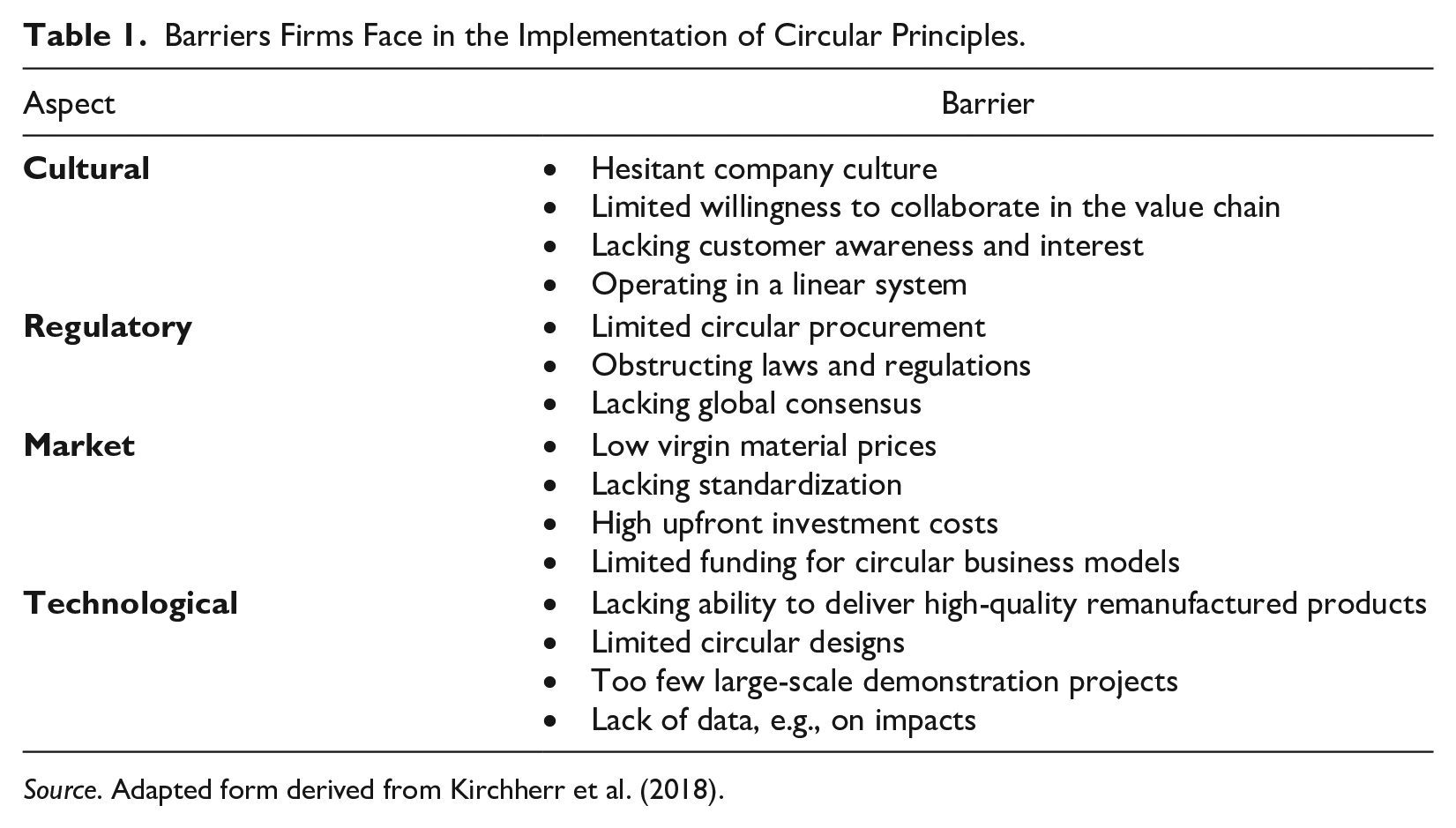
Source. Adapted form derived from Kirchherr et al. (2018).
The different barriers may lead business to implement circularity in the form of ad-on short-term practices, instead of integrating circularity in their strategies, as short-term practices do not require impactful changes in core business processes (Kirchherr et al., 2018; Pheifer, 2017). Pheifer (2017) found for instance that most companies included in his study had not integrated circularity in their strategy, mission, vision and key performance indicators. Kirchherr et al. (2018) identified that three cultural barriers, “lacking consumer interest and awareness,” “hesitant company culture,” and “operating in a linear system,” appeared as main barriers for the implementation of circularity in their study. These findings suggest that circularity may still be a niche discussion among sustainable development professionals, which does not automatically translate into the successful integration of circularity in business strategy. Kirchherr et al. (2018) also identified that the different cultural, market, regulatory, and technical barriers can reinforce each other. Low virgin material prices may for instance favor linear products, resulting in lacking customer interests in circular products, which can in turn lead to a hesitant company culture to develop such products.
Managerial Interpretations of Circularity
Researchers have started to explore the role of managers in the circular economy and reveal that managers can be important for the transition of businesses toward circularity (Rizos et al., 2016; Ünal et al., 2018). We draw on strategic issue interpretation literature to explore the impact managers can have on the integration of circularity in a company’s strategy. Strategic issue interpretation literature focuses on the processes that determine the events and information that managers pay attention to and those that they ignore (Dutton et al., 1983). These processes, especially within ambiguous and complex contexts, involve fitting information into categories for understanding and action taking (Gioia, 1986). Through using cognitive frames managers can reduce complexity and ambiguity by selectively organizing and interpreting signals from the organizational context (Dutton & Jackson, 1987). Two categories in which managers fit strategic issues in order to reduce ambiguity are “opportunities” and “threats” (Jackson & Dutton, 1988). Managers who interpret a strategic issue as a threat will emphasize its negative aspects and the potential loss for the organization resulting from the issue. On the other hand, managers interpreting a strategic issue as an opportunity will focus on its positive aspects and potential gains. It has been demonstrated that these managerial interpretations can have a significant impact on the strategic actions an organization takes and the environmental strategy it chooses (Barr & Glynn, 2004; Dutton & Jackson, 1987; Jackson & Dutton, 1988; Sharma, 2000; Thomas et al., 1993). For example, Sharma (2000) found that managers who interpret environmental issues as opportunities have a positive influence on the implementation of voluntary environmental strategies in their organizations.
The integration of circularity is a relatively new consideration for managers (Ghisellini et al., 2016; Kirchherr et al., 2018), who may face a great deal of ambiguity in understanding the concept and its implications. This is caused by the significant changes in production and consumption patterns needed for the successful integration of circularity including the development of new products, technologies, and policies (Kirchherr et al., 2017). Furthermore, complexity is increased as circularity often requires collaborations between multiple stakeholders who may have different perspectives on how closed materials loops can be best generated (Lazarevic & Valve, 2017). Given the high level of complexity and ambiguity involved in circularity, the treat and opportunity categorization of strategic issues is relevant. Managers may interpret circularity as a threat due to its complex and innovative nature, which requires impactful changes and may potentially result in losses (Urbinati et al., 2017). For example, if a company integrates circularity through remaining ownership of its products, potential losses may occur due to uncertain product returns in terms of quality, quantity, and timing (Shaharudin et al., 2017). On the other hand, managers may interpret circularity as an opportunity due to its potential gains such as reduced material costs, access to new markets and higher environmental gains (Bocken et al., 2018; Stewart et al., 2018). For example, Mugge et al. (2017) found that businesses can address new markets and customer groups through the manufacturing of refurbished mobile phones.
We propose that managers who interpret circularity as an opportunity may be able to positively influence the integration of circularity in their company’s strategy in two ways. First, building on the treat-rigidity hypothesis (Staw et al., 1981), we argue that managers who interpret circularity as a threat are likely to respond in domains over which there is greater organizational control in order to offset their negative perceptions. These managers are therefore unlikely to seek new and innovative solutions because these solutions can disrupt existing production and operating systems (Sharma, 2000; Thomas et al., 1993). Furthermore, managers who interpret circularity as a threat may be more likely to adopt a passive and defensive search approach due to their fear of negative outcomes (Nutt, 1984; Sharma, 2000). Engaging in an open search for new solutions is important for the integration of circularity in a company’s strategy as this requires radically new approaches where relying on existing policies and processes may not be sufficient (Bocken et al., 2018; Urbinati et al., 2017). We propose that managers who interpret circularity as an opportunity likely act in opposite ways compared with managers who interpret circularity as a threat. It has for instance been found that the categorization of issues as opportunities results in a more open search for solutions compared with the categorization of issues as threats (Nutt, 1984; Sharma, 2000). We therefore propose that managers who perceive circularity as an opportunity will be more likely to engage in an open search for new and innovative circular solutions which can assist them in developing an alternative vision and finding new ways to integrate circularity in their company’s strategy.
Second, building on the treat-rigidity hypothesis, we argue that managers who interpret circularity as a threat are more concerned about efficiency (Staw et al., 1981) and therefore focus attention on issues internal to the organization which can result in cost cutting and budget tightening (Thomas et al., 1993). The mobilization of action toward circularity, for instance the allocation of employees, time and resources to circular activities, is important for the establishment of clear targets and responsibilities for circularity (Pheifer, 2017; Urbinati et al., 2017). We propose that managers who interpret circularity as an opportunity likely act in opposite ways from managers who interpret circularity as a treat and are therefore more likely to mobilize action toward circularity which can assist them in integrating circularity in their company’s strategy. It has for instance been argued that managers who interpret circularity as an opportunity may be more likely to mobilize action because of their confidence in achieving positive outcomes (Dutton et al., 1983; Ginsberg, 1988). These insights lead to the following hypothesis:
Circular Network Interactions
Integrating circularity in business strategy likely requires increased interactions with different stakeholders due to the collective nature of the circular economy. The circular economy focuses on value preservation instead of value capture for the individual firm (Jonker et al., 2020). Value preservation is a collective value which can only be realized when all actors in a value chain collaborate to create various types of resource loops through recycling, conversion, and the substitution of materials (Jonker et al., 2020; Jonker & Faber, 2018). For example, in order for businesses to close resource loops, manufacturers need to adopt reusable materials and customers have to return products. The involvement of multiple different stakeholders, such as suppliers, manufacturers and customers, in interfirm networks is thus needed (Ghisellini et al., 2016). This means that businesses need to organize circularity at an interorganizational level instead of organizing circularity in an organization-centric environment (Jonker et al., 2020).
Literature on multistakeholder networks investigates how companies can increasingly collaborate in networks involving different stakeholders (Reypens et al., 2016; Roloff, 2008). Multistakeholder networks can involve actors from business, civil society, and governmental institutions, who come together in order to find a common approach to an issue that affects them all and that is too complex to be addressed effectively without collaboration (Roloff, 2008). Through interacting with each other, the involved stakeholders can grasp the complexity of the issue, learn about their interdependencies, and develop shared perspectives and collaborative strategies (Clarke & Fuller, 2010; Roloff, 2008; Warner, 2006). These collaborative strategies involve the joint determination of a vision and broad collective goals for addressing a given issue (Clarke & Fuller, 2010). Interacting with each other and formulating collaborative strategies first, can assist the involved stakeholders in specifying organizational-level actions and strategies related to the issue (Clarke & Fuller, 2010; Reypens et al., 2016). It enables companies to get new and innovative ideas for their individual strategies regarding the issue or identify how to put existing ideas into action through pooling and sharing resources with other stakeholders (Clarke & Fuller, 2010; Hardy et al., 2003). For example, Reypens et al. (2016) found that participation in a multistakeholder network allowed companies to develop company specific strategies related to the issues being explored as it broadened their vision, challenged their procedures, and identified new opportunities.
We propose that adopting a multistakeholder network approach is important for the integration of circularity in a company’s strategy, as circularity requires the collaboration of several stakeholders and is too complex to be handled by one actor alone (Ghisellini et al., 2016; Jonker et al., 2020). There are three key arguments that explain why firstly interacting in circular networks can assist companies in integrating circularity in their strategies. First, interacting with different stakeholders can assist companies in identifying how knowledge, resources, and responsibilities can be pooled and shared in order to close resource loops and keep them closed over time (Ghisellini et al., 2016; Hardy et al., 2003). This knowledge can enable companies to formulate and integrate company specific targets and responsibilities as it assists them in taking interdependencies into account that may not have been apparent before (Reypens et al., 2016).
Second, interacting with diverse stakeholders on the topic of circularity can enable firms to identify collaborative approaches for value preservation (Jonker & Faber, 2018). These collaborative approaches can in turn assist companies in determining and integrating a company specific vision, responsibilities, and targets necessary for value preservation (Clarke & Fuller, 2010). Without interacting with key stakeholders, firms may not be able to individually develop and integrate a long-term vision and targets necessary for achieving the collective goal of value preservation (Jonker et al., 2020). The case of Kalundborg, an industrial symbiosis network in Denmark including several private and public entities, highlights the importance of interacting with different stakeholders and establishing a collaborative approach. The different by-product exchange projects in Kalundborg sprung initially from social interactions among different stakeholders in which key challenges the organizations faced were discussed (Valentine, 2016). These interactions led to a collaborative approach focused on industrial symbiosis, which in turn laid ground for the formulation and integration of circular actions and strategies at the individual stakeholders, such as an oil refinery using steam from a local power plant (Jacobsen & Anderberg, 2005; Valentine, 2016).
Third, interacting with different stakeholders can assist companies in dealing with the barriers they face in the implementation of circularity. It can for instance help them address the linear mind-set of supply chain partners and increase the awareness and concerns of consumers for circularity (Jonker et al., 2020; Ormazabal et al., 2018; Östlin et al., 2008). For example, Jonker et al. (2020) highlight that companies can create support for circularity by involving the government, market and customers in formulating a collaborative approach, which can function as the basis for individual firm strategies. These insights lead to the following hypothesis:
Literature on multistakeholder networks suggests that the ability of managers to establish interactions and build trust with different stakeholders is highly important for the establishment of successful multistakeholder networks (Dentoni & Veldhuizen, 2012). We propose that organizational managers who interpret circularity as an opportunity are likely to be able to fulfill this role. First, these managers may be more likely to become involved in new interactions with different stakeholders on the topic of circularity. It has for instance been highlighted that managers who interpret strategic issues as opportunities are more likely to initiate actions directed at the external environment that might otherwise be perceived as too risky, such as interactions with new stakeholders (Dutton & Jackson, 1987; Thomas et al., 1993). In contrast, managers who interpret circularity as a threat may be less likely to engage in new interactions with stakeholders as they focus on taking internally directed actions (Dutton & Jackson, 1987; Staw et al., 1981). These internally directed actions can assist managers in dealing with their negative perceptions, as they perceive such actions to be associated with lower levels of risk compared with externally directed actions (Dutton & Jackson, 1987). Furthermore, perceptions of threats can intensify concerns about efficiency and in this way focus attention on issues and stakeholders internal to the organization (Thomas et al., 1993).
Second, managers with a positive interpretation of circularity may be more likely to build strong relationships and trust with their stakeholders on the topic of circularity. Engaging in early and positive interactions with stakeholders on the topic of circularity can for instance assist in building trust by highlighting future possibilities and opportunities (Quinn & Dalton, 2009). Furthermore, managers with a positive interpretation of circularity can inspire their stakeholders to get involved in circularity as well, leading to enlarged circular networks (Waligo et al., 2013). Managers who perceive circularity as a threat may instead highlight “doom and gloom” scenario’s which may neither inspire nor encourage the establishment of strong relationships on the topic of circularity (Quinn & Dalton, 2009). These insights lead to the following hypothesis:
In conclusion, we propose that managers who interpret circularity as an opportunity may be more likely to engage in an open search for innovative circular solutions and mobilize action toward circularity. This can assist these managers in the integration of circularity in their company’s strategy. However, an open search and the mobilization of action alone may not be sufficient for the integration of circularity in a company’s strategy due to the importance of stakeholder interactions and the establishment of collaborative approaches (Hypothesis 2). We therefore propose that the positive influence of managers on the integration of circularity may not only take place directly but also indirectly via their influence on circular network interactions. For example, a manager’s positive interpretation of circularity and open search for circular solutions may not only directly enable the development of an alternative vision and the integration of circularity in a company’s strategy. It may also lead to increased interactions with diverse stakeholders and the development of a collaborative approach, which can in turn assist the firm in developing an alternative vision and integrating firm-level targets and responsibilities for circularity. These insights lead to the following hypothesis:
Manager’s Holistic Thinking
Some managers who interpret circularity as an opportunity may be better able to encourage the development of circular network interactions compared with others. This is due to the fact that some managers will be better able to recognize the importance of network interactions for the integration of circularity (Zott & Amit, 2010). Holistic thinking has been argued to help individuals appreciate the interconnectedness of elements and understand the “bigger picture” including the relationships between objects (Monga & John, 2008). Holistic thinking has been defined as “an orientation to the context or field as a whole, including attention to relationships between a focal object and the field, and a preference for explaining and predicting events on the basis of such relationships” (Nisbett et al., 2001, p. 293). Holistic thinking has often been contrasted against analytic thinking which involves “the detachment of the object from its context and a tendency to focus on attributes of the object” (Nisbett et al., 2001, p. 293). This difference has for example been shown by Morris and Peng (1994), who showed participants pictures of fish moving in relation to each other. Analytic thinkers viewed the behavior of individual fish as being caused by internal factors such as health and size, whereas holistic thinkers viewed the behavior of the fish as being caused by contextual factors including the movements of the other fish. Most research has focused on comparing individuals from Westerns and Eastern cultures, where individuals from Western cultures tend to be analytic thinkers and individuals from Eastern cultures tend to be holistic thinkers (Choi et al., 2007). However, researchers are also increasingly exploring the variation within cultures and the effects of holistic thinking in a business context (e.g., Monga & John, 2008).
Within the circular economy, emphasis has been placed on the importance of holistic perspectives and approaches. This is due to the fact that circular principles operate in wider systems including different partners in interfirm networks (Ghisellini et al., 2016). Managers have been argued to play an important role in recognizing the embeddedness of circularity within this network which requires them to abandon isolated and individual choices (Zott & Amit, 2010). Following the previous insights, we argue that holistic thinking can assist managers in evaluating circularity at the network level and in recognizing interdependencies among different network partners. Therefore, we propose that managers with a positive interpretation of circularity that exhibit a high level of holistic thinking may be more likely to encourage circular network interactions. These managers may be more likely to engage in new interactions with network partners with the aim to establish long-term collaborative relationships as they recognize the importance of such relationships for the successful integration of circularity (Monga & John, 2008). Furthermore, these managers may be more likely to mobilize externally directed actions that help establish such relationships, such as the organization of networking events. In contrast, managers with a low level of holistic thinking may interact with network partners but likely focus on finding individual firm solutions, such as internal waste reduction programs. This will likely lead to one-time interactions with suppliers or knowledge institutions instead of long-term relationships with different stakeholders. These insights lead to the following hypothesis:
Figure 1 presents the research model of this study.
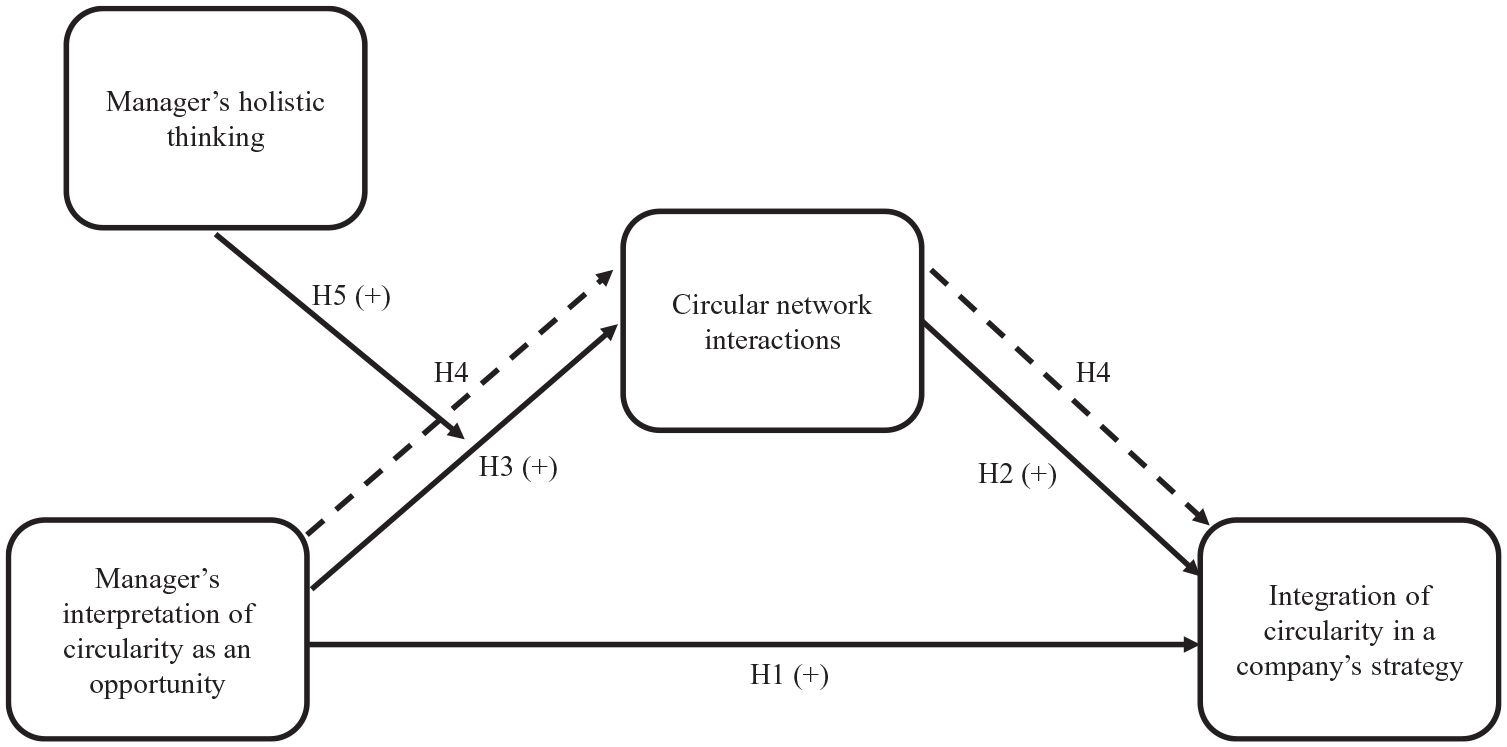
Research model.
Data and Method
Research Design
Primary data to test the hypotheses was collected in a questionnaire which was designed in four steps. First, the circular economy, strategic issue interpretation and network literature was reviewed to identify relevant measures and items. As limited measures on circular economy constructs were available in the scientific literature, a review of the practice literature was conducted as well including circular economy studies from research institutes such as the European Commission and the Ellen McArthur Foundation. Second, the questionnaire was developed following recommendations on survey design by Krosnick and Presser (2010) and Hinkin (1995). These included the use of simple syntax, relevant and clear scales, and an appropriate order of questions. Third, the questionnaire was translated from English to Dutch and the first version was tested in a panel of six managers and two circular economy scholars. Pretesting was conducted in order to minimize potential bias, to prevent measurement errors and to ensure that the questionnaire was understood by the target respondents (Podsakoff et al., 2003). Adjustments were made regarding the clarity and understandability of the questions. Fourth, the enhanced questionnaire was tested among 30 companies to verify the constructs and assess their validity and reliability.
Participants and Procedures
The population of this study included Dutch-owned SMEs (<500 employees; USITC, 2010). We focused on SMEs in this study as SMEs represent the majority of businesses in most European countries and contribute significantly to environmental problems, including 60% to 70% of industrial waste and pollution and 40% to 45% of all industrial air emissions (OECD, 2015; Tounés et al., 2019). Therefore, the adoption of circularity by SMEs is important and could lead to a significant reduction in global pollution and emissions (Ellen MacArthur Foundation, 2019; Ormazabal et al., 2018). However, SMEs are facing difficulties in the integration of circularity due to their relatively low level of financial resources and small resource base. This can cause barriers, such as high upfront investment costs, limited funding, operating in a linear system and the ability to deliver high-quality remanufactured products, to be more difficult to manage in the context of SMEs (Ormazabal et al., 2018; Rizos et al., 2016). Therefore, the context of SMEs is relevant for the objectives of this study.
A nonprobabilistic sampling strategy was adopted, reducing the sample to SMEs in Friesland, a northern province of the Netherlands with approximately 650,000 inhabitants. Respondents from the province were selected to ensure that the enterprises faced similar institutional environments regarding circularity. For this purpose, a random sample of 6,000 SMEs (from a total of approximately 20,000 SMEs in the province) from the province of Friesland was acquired. For each of the targeted companies, the manager of the firm was identified in order to personalize the invitation letter. Data were collected in cooperation with the Frisian province which was interested in collecting information on the uptake of circularity among SMEs in the region. A cover letter signed by the Frisian province was added in order to explain the dual purpose of the questionnaire to the respondents. This letter and the beginning of the questionnaire both included an explanation of the circular economy following the definition of the Ellen McArthur Foundation (The circular economy is an industrial economy that is restorative and regenerative by intention and design through reducing, reusing, recycling and recovering waste and increasing reusability in production and consumption). Data were collected between November and December 2018. Questionnaires were sent out to all corporations, followed by a reminder 4 weeks later. Only 24 questionnaires were not delivered, primarily due to unknown relocation or bankruptcy of the company (0.4%). In total, 783 firms responded to the questionnaire, with 40 responses unusable because the questionnaires were incomplete (>10% missing data), leaving 743 usable responses. This represents a 12.43% response rate with respect to the 5,976 questionnaires that were successfully distributed. We had to exclude multiple responses from our research because the main location of the company was outside of Friesland (2 cases), the company size was either too small (<2 employees, 80 cases) or too large (>500 employees, 4 cases), or the respondent was not the manager of the company (30 cases). This resulted in 627 usable responses. The average number of employees in the organizations was 23.29 (SD = 59.02), and the average organizational age was 45.14 years (SD = 42.04). The average age of the respondents was 52.36 years (SD = 9.78), and their average tenure was 22.74 years (SD = 12.85).
The early and late respondents in the survey were compared in order to estimate the potential for nonresponse bias. Adopting t tests, no significant differences in organizational size, age, the manager’s interpretation of circularity, circular network interactions, and the integration of circularity in the company’s strategy were found between early and late respondents. Several recommended procedural methods to reduce the risk of common method bias were adopted including: (1) ensuring anonymity, (2) decreasing the risk of social desirability bias, (3) carefully evaluating all survey items, and (4) distancing dependent and independent variables with a logical order from each other in the survey (Podsakoff et al., 2003). We aimed to decrease the risk of social desirability bias by ensuring the anonymity of the respondents and by assuring respondents that there were no right and wrong answers (Podsakoff et al., 2003). We additionally adopted the method described by Krosnick and Presser (2010) that attempts to save face for respondents by legitimating the less desirable option. We did this by specifying in the invitation letter and questionnaire that the integration of circularity can be difficult to achieve for SMEs and that we were interested in both positive and negative experiences in order to find ways to help SMEs with the integration of circularity. Single-respondent bias was further limited, as the survey addressed small organizations and targeted managers as respondents (Arend, 2014). Confirmatory factor analysis (CFA) was performed to investigate whether all survey items were loaded on a “common” method factor and to assess whether the data may have featured significant common variance. The CFA analysis yielded a poor model fit to the data, with χ2(252) = 6728.95, root mean square error of approximation (RMSEA) = 0.21, comparative fit index (CFI) = 0.43 and Tucker–Lewis index (TLI) = 0.37, suggesting that common method bias was unlikely to be a problem in the data.
Measures
Manager’s Interpretation of Circularity as an Opportunity
To measure the manager’s interpretation of circularity as an opportunity, an adapted version of the manager’s interpretation of corporate sustainability developed by Thomas et al. (1993) was adopted. We adapted the measure by replacing corporate sustainability with circularity. After the probe “To what extent do you . . . ” items included the following: (1) “perceive that benefits for my company will come from circularity,” (2) “label circularity as something positive for my company,” (3) “feel the future of my company will be better because of circularity,” (4) “label circularity as a potential gain for my company” (α = .93). Managers responded to these items on a 7-point Likert-type scale ranging from 1 (totally disagree) to 7 (totally agree).
Circular Network Interactions
Circular network interactions were measured using an adapted measure of intersubsidiary relationships by Hansen et al. (2005). This measure included two questions relating to the frequency of interactions with different subsidiaries and the strength of the relations between different subsidiaries. The measure was adapted to refer to the relationships between different network parties on the topic of circularity. The circular economy literature was reviewed in order to identify important parties in the implementation of circularity. These included the following: (1) suppliers, (2) consumers, (3) knowledge institutions, (4) network organizations, (5) colleague entrepreneurs, (6) competitors, and (7) the municipality (e.g., Ghisellini et al., 2016; Östlin et al., 2008). Managers were asked for each of these parties to identify: “How frequently does your organization interact with this party on the topic of circularity?” Managers responded to this question on a frequency scale ranging from 1 (never) until 5 (very frequently). Second, managers were asked to identify for each of the parties: “How close is the working relationship between your organization and this party on the topic of circularity?” Managers responded to this question on a 5-point Likert-type scale ranging from 1 (very distant) to 5 (very close).
For each party, we computed Spearman’s rho for the two questions relating to the frequency and strength of the relationships. Spearman’s rho is a nonparametric test that can be used to measure the strength of the association between two variables (where a value of 1 means a perfect positive correlation and a value of −1 a perfect negative correlation). The Spearman’s rho for all parties showed sufficient reliability (suppliers .70; consumers: .74; knowledge institutions .70; network organizations .73; colleague entrepreneurs .70; competitors .68 and the municipality .70). In line with Hansen et al. (2005), we computed the average of the two questions for all the parties and adopted these averages to create one measure for circular network interactions (α = .92).
Integration of Circularity in a Company’s Strategy
To measure the integration of circularity in the strategies of the companies a measure from the grey literature was adopted (VBDO, 2015). After the prompt “To what extent is circularity integrated in your company?” items included (1) “My company has integrated circularity into strategy.” (2) “My company has a long-term vision on circularity.” (3) “My company sets targets for circularity.” (4) “Progress against targets for circularity is clearly reported.” (5) “It is clear who is responsible for circularity.” (α = .93). Managers responded to these items on a 7-point Likert-type scale ranging from 1 (totally disagree) to 7 (totally agree).
Holistic Thinking
In order to measure the manager’s level of holistic thinking, a measure for the holistic thinking dimension locus of attention from Choi et al. (2007) was adopted. Following the prompt “To what extent do you agree with the following statements?” items included (1) “The whole, rather than its parts, should be considered in order to understand a phenomenon.” (2) “The whole is greater than the sum of its parts.” (3) “It is more important to pay attention to the whole context rather than the details” (4) “It is not possible to understand the parts without considering the whole picture.” (α = .86). Managers responded to these items on a 7-point Likert-type scale ranging from 1 (totally disagree) to 7 (totally agree).
Control Variables
Several control variables were included to control for alternative explanations of the relationships predicted by the hypotheses. First, the potential relationships between the age and tenure of the managers and organizational outcomes were controlled for (Hambrick & Mason, 1984). Second, this study controlled for several organizational attributes that may influence the integration of circularity in a company’s strategy including: organizational size, age, sector, market, and financial performance (Ormazabal et al., 2018; Rizos et al., 2016). Finally, we controlled for the network commitment of the organization, which may influence how likely it is that an organization seeks advice from its network in strategic decision making (Ulaga & Eggert, 2004). The information for the control variables was collected in the survey including organizational size (the natural logarithm of the number of employees), organization age (number of years operating), market (B2B; benchmark, B2C, both), and financial performance (average financial performance in the past 3 years, ranging from 1 (very low) to 5 (very high). Network commitment was measured using an adapted (referring to the whole network) measure by Ulaga and Eggert (2004). Following the prompt “To what extent do you agree or disagree with the following statements?” items included the following: (1) “We are very committed to the relationships with actors in our network.” (2) “The relationships with actors in our network are very important to our business.” (3) “We intend to maintain the relationships with actors in our network indefinitely.” (4) “The relationships with actors in our network deserve our business’ maximum effort to maintain” (α = .95). Mangers responded to these items on a 5-point Likert-type scale ranging from 1 (totally disagree) to 7 (totally agree).
Data Analysis
Both multiple regression analysis in StataSE 15 and conditional process analysis using the PROCESS macro in SPSS statistics 24 were adopted to test the hypotheses. Conditional process analysis has been adopted to study statistical models were the goal is to describe and understand the conditional nature of the mechanism or mechanisms by which a variable transmits its effect on another (Hayes, 2013). The SPSS macro PROCESS presented by Hayes (2013) allows for the estimation of indirect effects using bootstrapping procedures based on generating multiple random samples. Bootstrapping procedures have received increased attention as these test a model’s predictive validity, make no normality assumption, and provide stronger accuracy in confidence intervals (CI; Hayes, 2013). Conditional process analysis estimates the conditional indirect effects and generates bias-corrected 95% CIs for the indirect effect. This analysis has been employed by various studies recently published in journals in the fields of business and management (e.g., Lu et al., 2019).
Results
The descriptive and correlation statistics for the variables are presented in Table 2. Table 2 indicates that the integration of circularity in the company’s strategy had a positive association with both the manager’s interpretation of circularity and circular network interactions. The average for the manager’s interpretation of circularity was on the higher end (5.62 on a 7-point scale), whereas the average for circular network interactions (2.13 on a 5-point scale) and for the integration of circularity in the company’s strategy (3.75 on a 7-point scale) where on the lower end.
Descriptive Statistics and Correlation Matrix. a
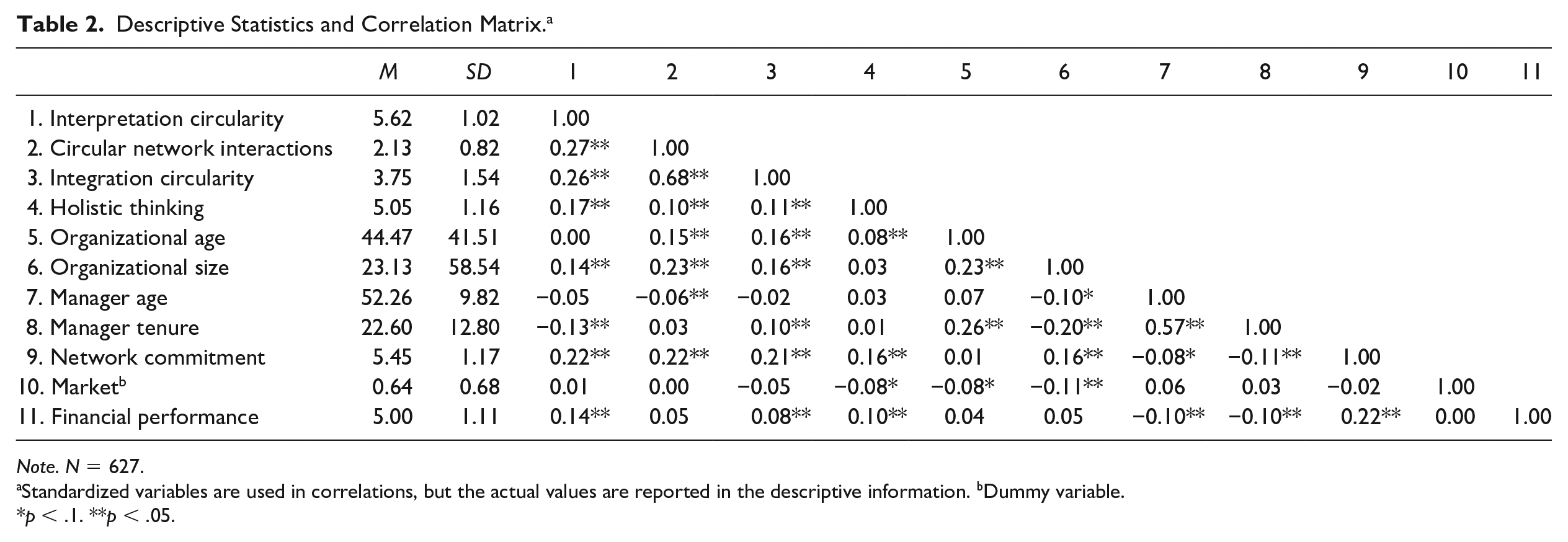
Note. N = 627.
Standardized variables are used in correlations, but the actual values are reported in the descriptive information. bDummy variable.
p < .1. **p < .05.
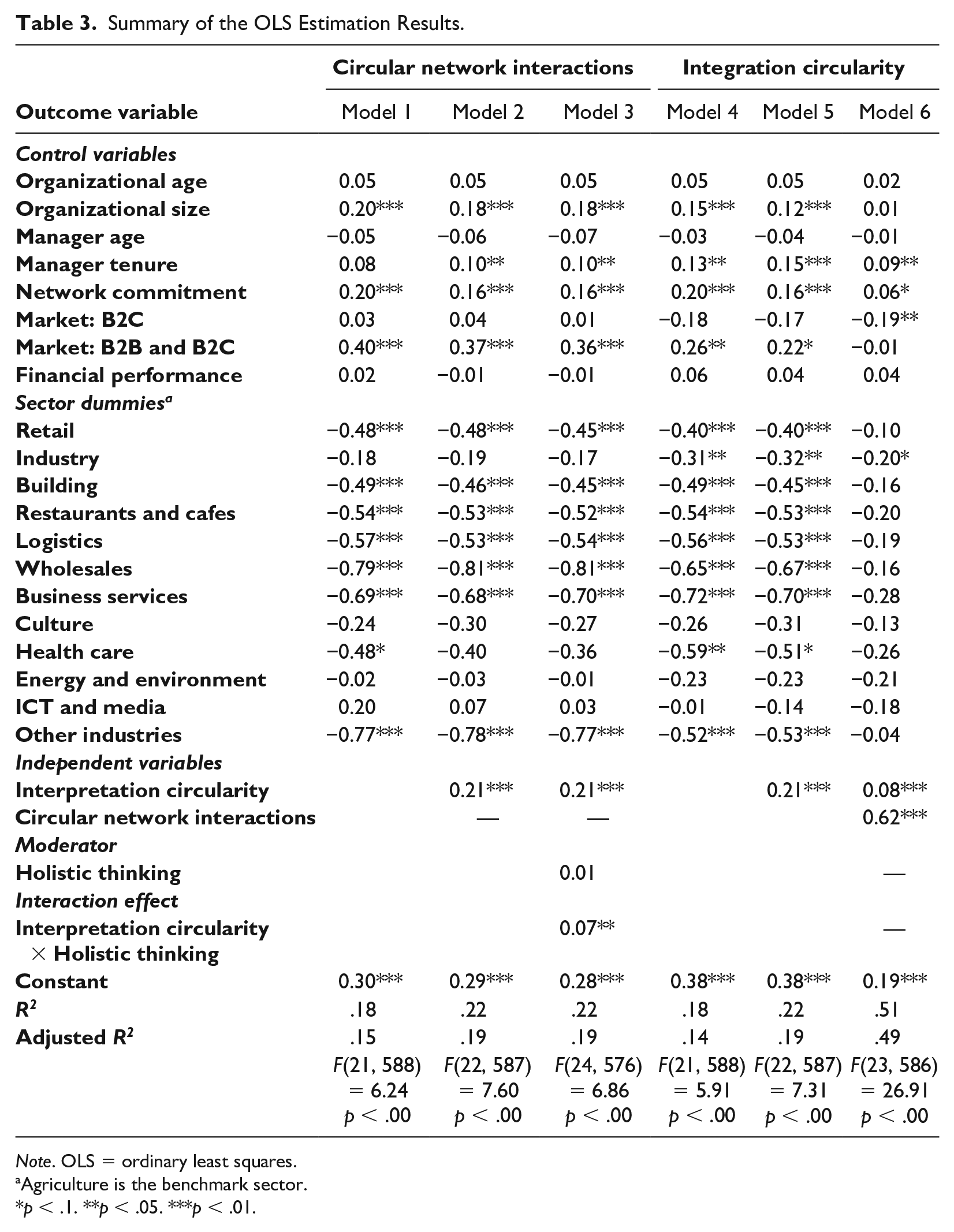
Hypotheses 1, 2, 3, and 5 were tested using an ordinary least squares (OLS) estimation approach in StataSE 15. Several models, with circular network interactions and the integration of circularity in the company’s strategy as outcome variables, were estimated using standardized variables. Robust standard errors were adopted in the models to control for nonnormality and heteroscedasticity. To test for a bias caused by collinearity among the variables, the variance inflation factors (VIF) were calculated for all models. The VIF values obtained ranged from 1.02 to 2.35. These values are below the cutoff point of 10 (Hair et al., 1998), indicating that there were no collinearity problems in the models. A summary of the multiple regression results is presented in Table 3 and Figure 2. Semipartial correlations for the main models are reported in Table 4. Hypothesis 4 was tested using the Process macro in SPSS statistics 24 by adopting a mediation model (Model 4; Hayes, 2013). The analysis employed 5,000 bootstrap samples and 95% CIs to obtain the estimates. A summary of the conditional process analysis results can be found in Table 5. A discussion of the main findings follows.
Summary of the OLS Estimation Results.
Note. OLS = ordinary least squares.
Agriculture is the benchmark sector.
p < .1. **p < .05. ***p < .01.
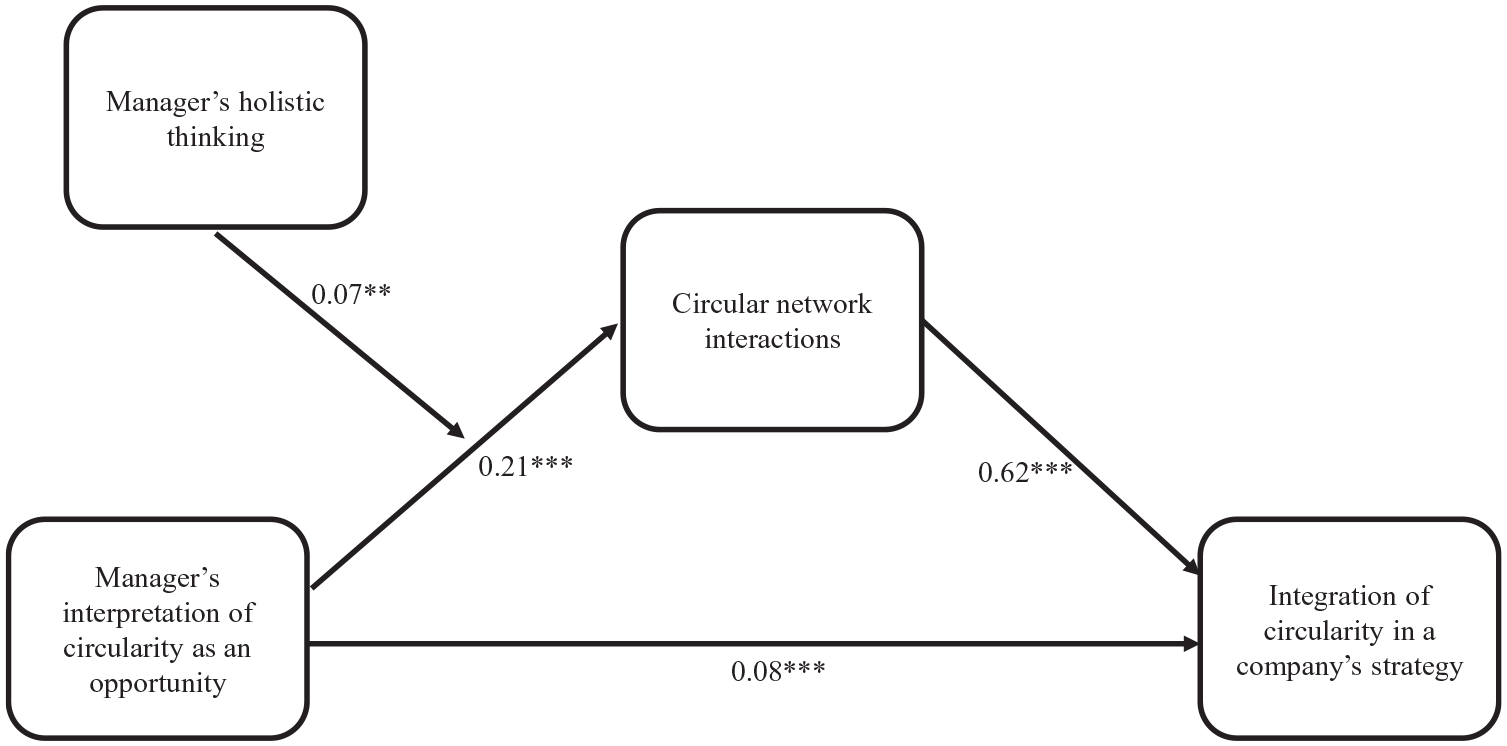
Summary of the study results.
Semipartial Correlations for Models 3 and 6. a
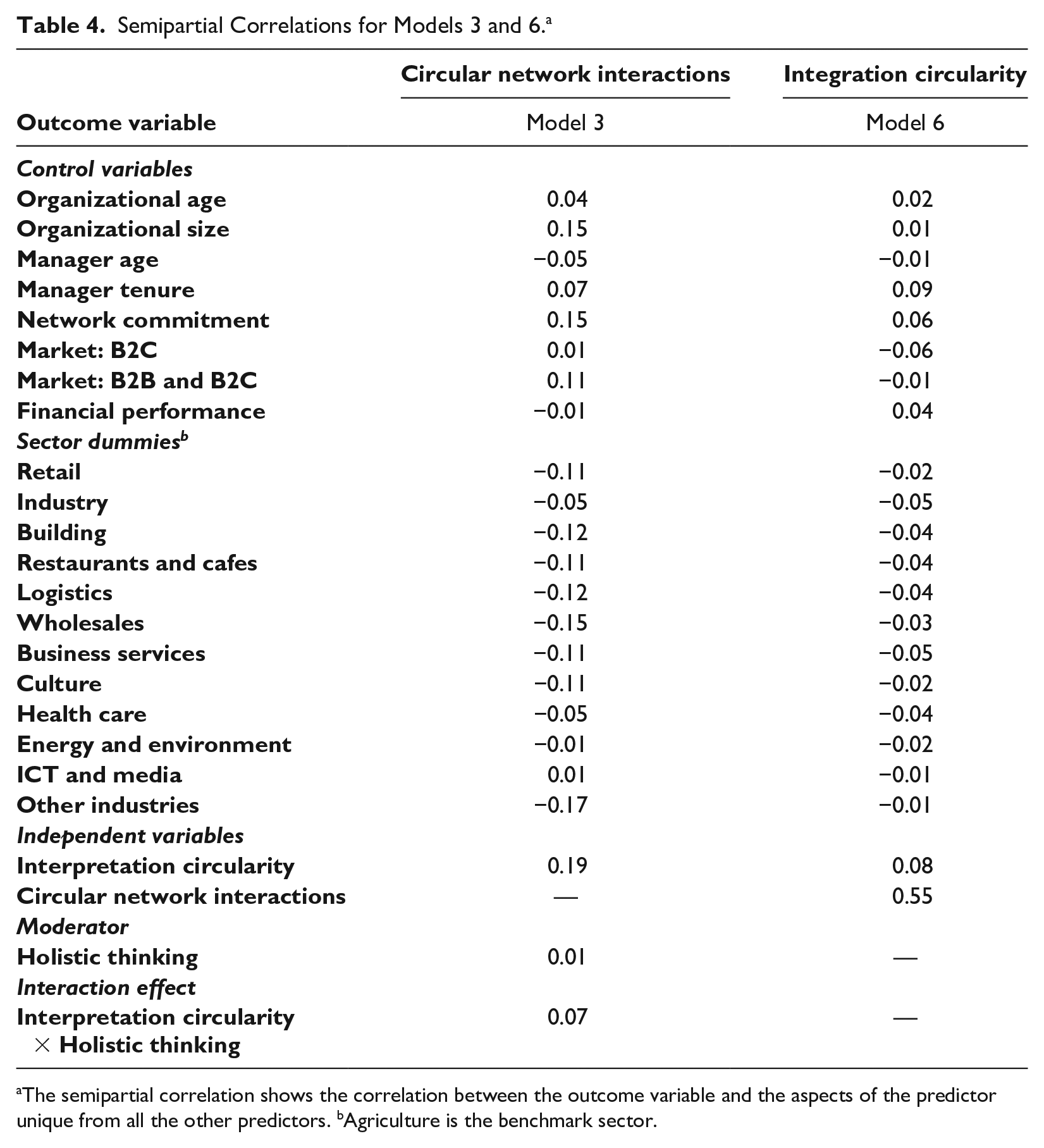
The semipartial correlation shows the correlation between the outcome variable and the aspects of the predictor unique from all the other predictors. bAgriculture is the benchmark sector.
Summary of the Conditional Process Analysis Results.
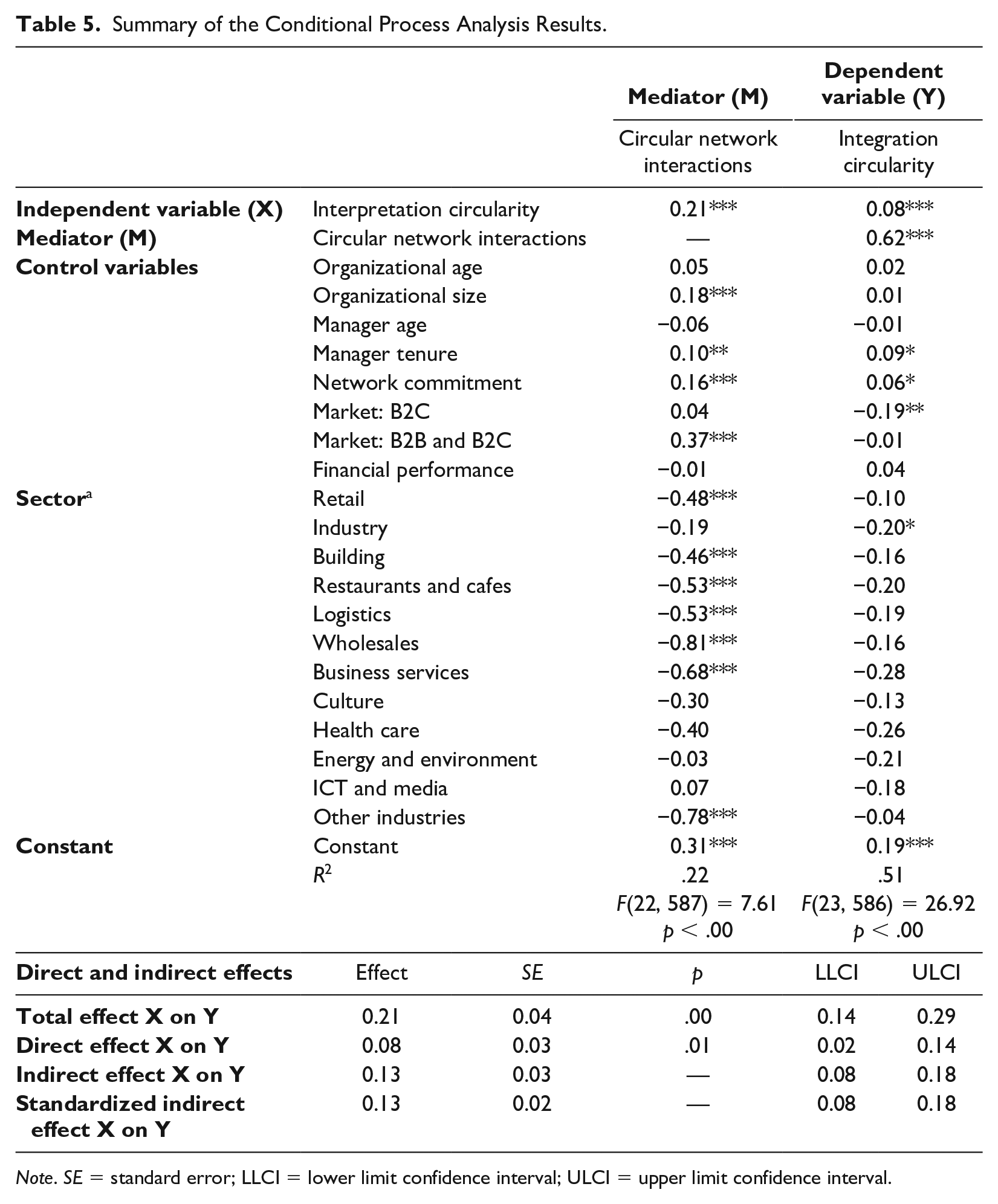
Note. SE = standard error; LLCI = lower limit confidence interval; ULCI = upper limit confidence interval.
Hypothesis 1 predicted that the manager’s interpretation of circularity as an opportunity positively relates to the integration of circularity in the company’s strategy. Figure 2 and Table 3 (Model 6) show that this hypothesis was supported—the estimated parameter coefficient from the manager’s interpretation of circularity as an opportunity to the integration of circularity in the company’s strategy was positive and significant (β = .08, p < .01).
Hypothesis 2 predicted that circular network interactions are positively related to the integration of circularity in a company’s strategy. Figure 2 and Table 3 (Model 6) show that this hypothesis was supported—the estimated parameter coefficient from circular network interactions to the integration of circularity in the company’s strategy was positive and significant (β = .62, p < .01).
Hypothesis 3 predicted that the manager’s interpretation of circularity as an opportunity positively relates to circular network interactions. Figure 2 and Table 3 (Model 2) show that this hypothesis was supported—the estimated parameter coefficient from the manager’s interpretation of circularity as an opportunity to circular network interactions was positive and significant (β = .21, p < .01).
Hypothesis 4 predicted that the relation between the manager’s interpretation of circularity as an opportunity and the integration of circularity in the company’s strategy is mediated by circular network interactions. The results of the mediation analysis (Table 5) show that the direct effect of the manager’s interpretation of circularity as an opportunity on the integration of circularity in a company’s strategy was positive and significant (β = .08, p < .01). Furthermore, the results show that the indirect effect of the manager’s interpretation of circularity as an opportunity via circular network interactions was also positive and significant (β = .13, 95% CI [0.08, 0.18]). In addition, to test the mediating effect of circular network interactions, we assessed the following conditions: (1) the independent variable relates to the mediator variable, (2) the independent variable relates to the dependent variable, (3) the mediator relates to the dependent variable, and (4) the independent variable must have no effect on the dependent variable when the mediator is held constant (full mediation) or become significantly smaller (partial mediation; Baron & Kenny, 1986). Our OLS estimation results (Table 3) showed that all conditions were satisfied, were the effect of the manager’s interpretation of circularity on the integration of circularity in the company’s strategy became smaller when the mediator, circular network interactions, was held constant (see Table 3, Models 5 and 6). These results indicate that the relation between the manager’s interpretation of circularity as an opportunity and the integration of circularity in the company’s strategy was partially mediated by circular network interactions.
Hypothesis 5 predicted that the relationship between the manager’s interpretation of circularity as an opportunity and circular network interactions is positively moderated by the manager’s holistic thinking. Figure 2 and Table 3 (Model 3) show that this hypothesis was supported—the estimated parameter coefficient for the interaction effect was positive and significant (β = .07, p < .05). However, Table 3 also shows that the effect was small and the inclusion of the interaction effect did not result in an improvement of the adjusted R2. Figure 3 depicts the effect of the manager’s interpretation of circularity on circular network interactions contingent on holistic thinking, based on the estimation results of Model 3 (Table 3). Figure 3 shows that the relationship between the manager’s interpretation of circularity and circular network interactions was positive for manager’s with low and high levels of holistic thinking. The slope is slightly steeper for managers with a high level of holistic thinking, compared with managers with a low level of holistic thinking, however the difference is minimal and the CIs of both slopes are overlapping. Therefore, we conclude that holistic thinking does not seem to have a meaningful effect on the relationship between the manager’s interpretation of circularity as an opportunity and circular network interactions.
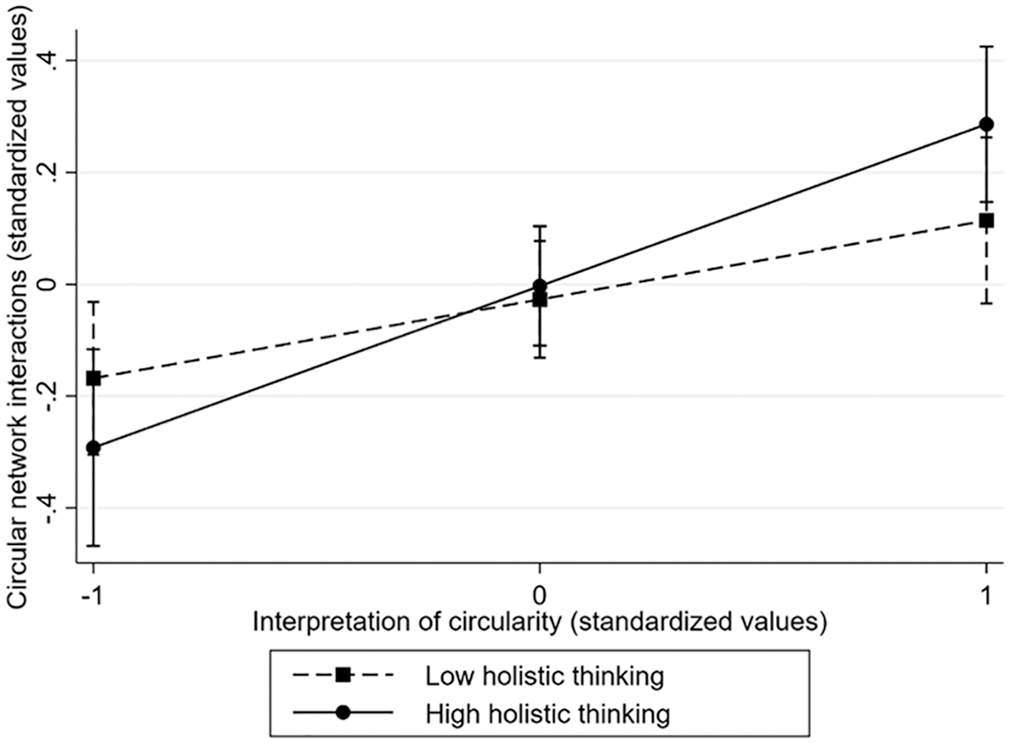
Effect of the interpretation of circularity as an opportunity on circular network interactions contingent on holistic thinking (including 95% confidence intervals).
Robustness Checks
Three additional analyses were performed to test for robustness. First, in order to control for common method bias by creating temporal separation between the independent and dependent variables (Podsakoff et al., 2003), the model was estimated adopting the integration of circularity in the company’s strategy measured six months after the initial questionnaire was sent out. We were only able to measure this variable for the respondents that indicated to be willing to participate in further research which corresponded to 250 respondents. A new questionnaire, including the questions for the integration of circularity in the company’s strategy, was sent out in April 2019, with a reminder sent 2 weeks later. Prior to the initial questionnaire distribution, the questionnaires were code numbered to match responses from the initial questionnaire with those of this additional questionnaire. Due to the code numbering, the respondents remained unidentified since all questionnaires were answered anonymously. In total, 62 companies responded to this questionnaire. The integration of circularity in the company’s strategy measured in this questionnaire highly correlated to the integration of circularity in the company’s strategy measured in the initial questionnaire (.68, p < .01). A model was estimated using an OLS estimation approach in StataSE 15, with the integration of circularity in the company’s strategy as the dependent variable and the manager’s interpretation of circularity and circular network interactions as independent variables. As the number of respondents was limited, only the control variables correlating with the dependent variable (organizational age, size, owner–manager tenure, network commitment, financial performance, and sector) were included. The results indicated that the relation from the manager’s interpretation of circularity as an opportunity to the integration of circularity in the company’s strategy was still positive and significant (β = .21, p < .05), as well as the relation from circular network interactions to the integration of circularity in the company’s strategy (β = .53, p < .01).
Second, we checked whether the items for circular network interactions and the integration of circularity in a company’s strategy all referred to the same underlying factor. This may explain the high correlation between the two variables (.68). For this purpose, we conducted a factor analysis using a varimax rotation. Two factors were extracted in the analysis (based on eigenvalue > 1), showing high factor loadings of the circular network interaction items on the first factor and high factor loadings of the integration of circularity items on the second factor (Table 6). These results indicate that the items for both variables did not refer to the same underlying factor.
Rotated Factor Matrix for the Items of Circular Network Interactions and the Integration of Circularity in a Company’s Strategy.
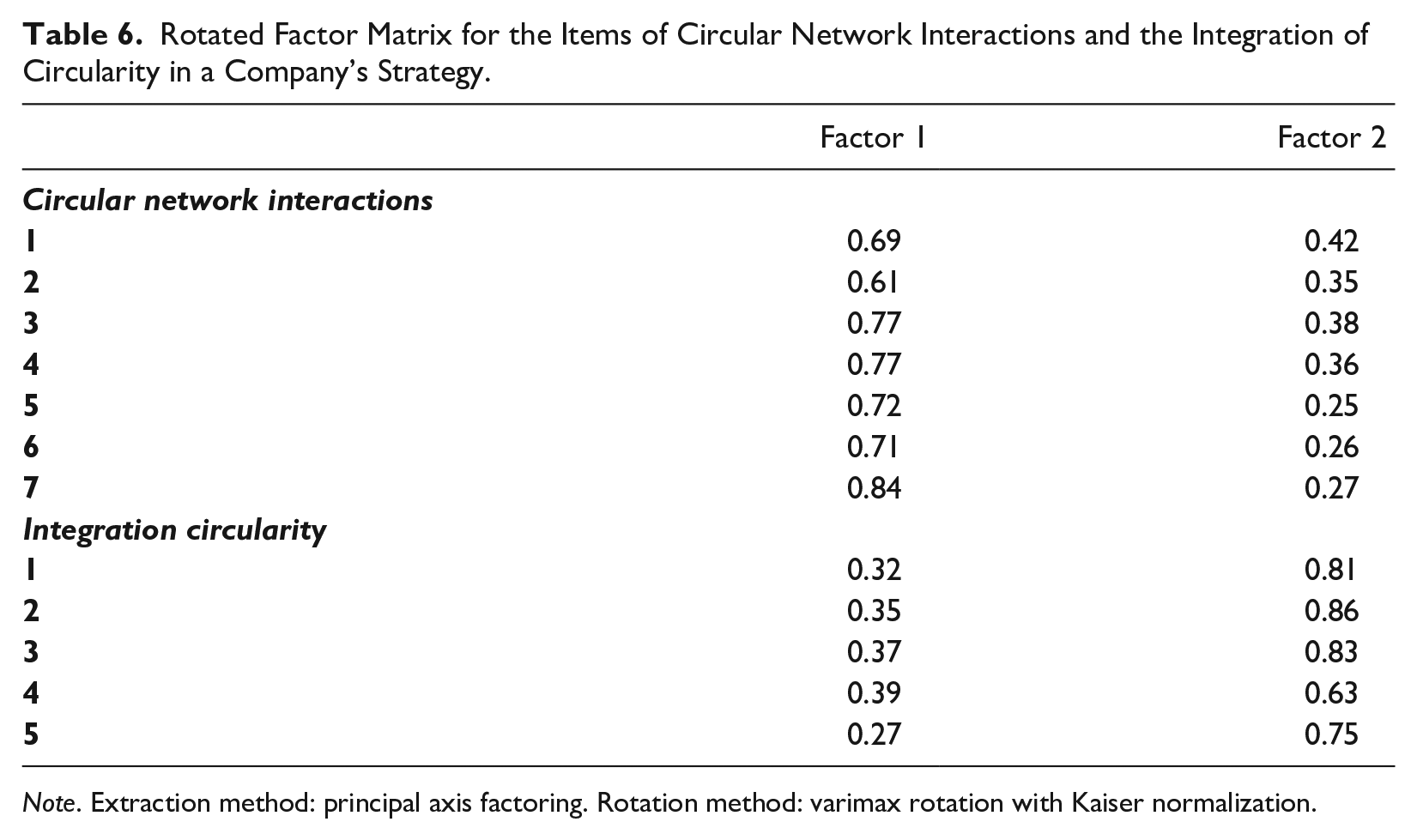
Note. Extraction method: principal axis factoring. Rotation method: varimax rotation with Kaiser normalization.
Third, we checked the relations between the interpretation of circularity as an opportunity and both circular network interactions and the integration of circularity in the company’s strategy for respondents that were not the manager of the company (n = 30). These respondents were employees of the respective companies with functions including: administrative employees, quality managers, environmental employees, and controllers. We expected that the relations would be weaker for these respondents compared with the relations for respondents that were the manager of the company. Two models were estimated using an OLS estimation approach in StataSE 15, with the respondent’s interpretation of circularity as the independent variable and the integration of circularity in the company’s strategy and circular network interactions as dependent variables. As the number of observations was limited, only the control variables correlating with the dependent variables (organizational age, size, owner–manager tenure, network commitment, financial performance, and sector) were included. The results indicated that the relation from the respondent’s interpretation of circularity as an opportunity to the integration of circularity in the company’s strategy was positive but insignificant (β = .16, p = .37), as well as the relation to circular network interactions (β = .23, p = .32). The results also showed that the relation from circular network interactions to the integration of circularity in the company’s strategy remained positive and significant (β = .54, p < .01).
Discussion
The importance of the integration of circularity in businesses is increasingly recognized by researchers and policy makers (Ormazabal et al., 2018). This study investigated the impact of managers and network interactions on the integration of circularity in business strategy. The results advance the debate about the integration of circularity in businesses in significant ways.
First, this article contributes to the growing body of research on the integration of circularity in businesses (e.g., Bocken et al., 2017; Kirchherr et al., 2017; Rizos et al., 2016). While many businesses are increasingly recognizing the opportunities circularity can bring, research has shown that the integration of circularity in corporate strategies is limited (Ormazabal et al., 2018; Pheifer, 2017). This study contributes to the literature by investigating the next step: using the existing knowledge on the barriers companies face in the integration of circularity (e.g., Kirchherr et al., 2018; Rizos et al., 2016), this study investigated the organizational attributes that can assist businesses in overcoming these barriers and integrating circularity in their strategies. By combining insights from the circular economy, strategic issue interpretation, and multistakeholder network literature, we contribute to the circular economy literature by showing that both organizational managers and network interactions can assist companies in integrating circularity in their strategies. Furthermore, this article contributes to the literature by providing empirical findings about the integration of circularity in a larger sample of firms. Most circular economy studies are small-N studies (<10 cases), while insights about what works on average are important to aid businesses in the integration of circularity (Kirchherr & van Santen, 2019). Our findings, based on a sample of SMEs in the Netherlands, are in line with previous research which shows that managers are becoming increasingly positive about the circular economy (Liu & Bai, 2014; Ormazabal et al., 2018). We contribute to this research, by conceptually building and empirically testing a model in a large sample of firms that offers insights in the organizational attributes that can assist firms in the integration of circularity.
Second, this research contributes to the literature on leadership and management in the circular economy. In line with previous research (e.g., Rizos et al., 2016; Ünal et al., 2018), our findings showed that organizational managers are important for the implementation of circularity in businesses. We advance this research by specifying and testing that the manager’s interpretation of circularity as an opportunity in particular can assist firms in integrating circularity in their strategies. In line with Sharma (2000), our study highlights the importance of the human dimension, and managerial interpretations in particular, in environmental strategies. This research also indicated a new application of strategic issue interpretation literature in explaining, next to the direct influence, also the indirect influence of organizational managers. Strategic issue interpretation literature has mostly been used to specify the direct influence of managers on internal processes such as environmental strategies and actions (Sharma, 2000; Thomas et al., 1993). However, this article also builds on the strategic issue interpretation literature to shed light on the indirect role of organizational managers, via their influence on circular network interactions. This also indicates a convergence between managerial and network research streams in the circular economy. Research has for instance emphasized the importance of organizational networks in the circular economy (Bocken et al., 2016; Ghisellini et al., 2016); however, it has not placed much emphasis on how organizational managers can function to facilitate these networks. Our results showed that managers with a positive interpretation of circularity could directly influence the integration of circularity in their company’s strategy. This finding indicates that the ability of these managers to engage in an open search for circular solutions and mobilize employees and resources for the execution of circular activities can in itself have a positive effect on the integration of circularity. However, our results highlighted that the manager’s ability to influence the integration of circularity in business strategy indirectly, via his or her influence on circular network interactions, was stronger. Our results thus highlight that an essential role for managers is to encourage the development of circular network interactions. This may enable managers to lead the way toward collaborative approaches and the successful integration of circularity in corporate strategy. Furthermore, our findings show that the manager’s level of holistic thinking may be a supporting factor in this process. However, the effect we found was small, which implies that the ability of managers to encourage circular network interactions is not highly dependent on their level of holistic thinking. Even managers with a low level of holistic thinking may be able to recognize the importance of network interactions due to the high level of dependence among supply chain partners in the circular economy (Ghisellini et al., 2016).
Third, this research contributes to the literature on circular networks and confirms previous research (e.g., Jonker et al., 2020; Zucchella & Previtali, 2018) by highlighting the important role of organizational networks in the circular economy. This study adds to the circular economy literature by combining insights from the circular economy and multistakeholder network literature and showing that interacting with different stakeholders in the network can assist organizations in integrating circularity in their strategies. Our findings highlight that integrating circularity in business strategy demands more than an organization-centric perspective. Instead, it is important to broaden the perspective to the level of the network and interact with network partners in order to establish collaborative approaches, which can in turn assist companies in specifying and integrating firm-level strategies, targets, and responsibilities. In doing so, this article bridges circular economy research focusing on the network level and research focusing on the organizational level. While research is increasingly paying attention to circular networks and network-level outcomes such as network-level learning and value creation (e.g., Baas & Huisingh, 2008; Jonker et al., 2020), limited emphasis has been placed on how these networks can assist firms in achieving circularity at the firm-level (Walls & Paquin, 2015). Our findings highlight that interacting with different stakeholders in the network can assist firms in integrating circularity in their strategies.
Managerial Implications
The results presented in this study offer guidelines for businesses which are aiming to integrate circularity in their strategies. First, given the relative newness of the circular economy concept, it is important that managers update their knowledge about the circular economy by engaging in knowledge-related events and workshops or hiring professionals for in-company workshops. This can help managers look past the challenges inherent in circularity, and view circularity as an opportunity, which can result in increased efficiency and new competitive advantages. Furthermore, it may be beneficial for managers to get more familiar with the circular principles that are already adopted in their organizations and the circular network interactions that are or may be established. To get started, managers thus need to develop a better understanding of the circular economy potential of their organizations.
Second, it is important for managers to realize the importance of collaboration for the integration of circularity in their company’s strategy. Increased interactions with different stakeholders in the network and the establishment of collaborative approaches can assist companies in managing barriers and successfully integrating circularity in their strategies. It is therefore highly important for managers to encourage the establishment of circular network interactions and interact on the topic of circularity with employees, customers, suppliers, knowledge institutions, and other stakeholders in order to establish collaborative approaches. A first step in this direction can be taken by exploring the network in which the company is situated (e.g., via the net-map method by Schiffer & Hauck, 2010). This method can help managers identify the position of the business in the value chain and wider environment, including for instance relevant legislations and cultural habits. This can assist managers in identifying interdependencies and finding new opportunities for circular network interactions. Managers can make use of existing relationships identified through the nep-map method to benefit from their existing knowledge-sharing routines. Furthermore, managers may identify the need to establish new relationships which can be achieved through using active networks and attending events such as conferences, communities of practice, and trade shows. Engaging in open conversations with potential partners can enable managers to come to both formal (e.g., financial, confidentiality) and informal (shared mission, collaborative goals) agreements.
Third, although our research concentrates on businesses, it goes without saying that the successful transformation toward a circular economy requires useful guidelines and policy instruments. One implication of our study is that policy makers should concentrate on the design and maintenance of circular networks including different organizations from multiple industries. Another implication is that, rather than highlighting barriers toward circularity and therefore, at least implicitly, portraying circularity as a threat, policy makers should support the interpretation of circularity as an opportunity and frame an interdisciplinary dialogue around the concept. Policy makers could do this by means of, for example, redesigning existing laws and regulations in order to consider waste as a meaningful production input and adapt to the current technological advancements. In this way, policy makers can assist managers in shifting their interpretation of circularity as a threat toward an interpretation of circularity as an opportunity. Furthermore, policy makers could support regional stakeholders such as educational institutes to design transdisciplinary and interdisciplinary programs that bring different stakeholders together.
Limitations and Future Research
There were several limitations within this study, which point to areas for future research. First, our research setting and data relates to SMEs in a particular province in the Netherlands. Using SMEs from one specific context enables us to control for unobserved heterogeneity due to, among others, cultural and institutional differences. Our study is among the first to present results from a large data set of SMEs and, in doing so, offer new and unique findings. Nonetheless, future research is needed to address the relationships in the context of larger firms as our data did not allow us to test the relationships in this context. Relationships, in particular between managerial interpretations and the integration of circularity, may be weaker in this context as managers of larger firms may have less influence over the allocation of resources and strategic decisions of the company (Augier & Teece, 2009). Furthermore, a replication of this study with data collected from companies from other countries and regions enables a cross-validation of the results and study the potential differences in national/regional transitions to a circular economy. Positive managerial interpretations may for instance be less influential in uncertainty-avoiding cultures, as even managers with a positive interpretation of circularity may not be willing to get involved in circularity due to its complex and ambiguous nature.
Second, this study was constrained by its time frame, which may have caused endogeneity. An important limitation that should be taken into account is the issue of reversed causality, especially with regard to the relationships between circular network interactions and the integration of circularity in a company’s strategy. We relied on strategic issue interpretation and multistakeholder network literature to support our hypotheses and added a robustness check in which we created temporal separation between the independent and dependent variable. Nonetheless, reverse causality may be an issue. Adopting longitudinal or panel data sets would enable researchers to address this issue and study more complex causalities among the concepts included in this research such as feedback mechanisms. For instance, a company’s integration of circularity in its strategy may lead other firms aiming to integrate circularity to reach out to the company, in turn leading to increased circular network interactions. We were not able to test for these feedback loops in our study and future research is therefore needed to assess these relationships. Furthermore, the use of longitudinal data would enable investigations into the process of transitioning toward circularity.
Third, despite our aims to control for social desirability and common method bias, our study might still include potential biases. For instance, the potential for social desirability bias may have been increased due to the involvement of the Frisian province which may have caused companies to put effort in showing themselves at their best. Therefore, our results should be interpreted with caution and future research is needed to verify the results.
Fourth, we only measured the manager’s interpretation of circularity as an opportunity in our study. Future research could investigate if, rather than interpreting circularity as an opportunity, organizational managers may interpret circularity as something else, for example, as a necessary requirement, and explore how this relates to the integration of circularity in a company’s strategy. The interpretation of circularity as a necessary requirement may for instance limit circular network interactions as it may lead managers to focus on quick fixes such as short-term practices, instead of formulating collaborative approaches in cooperation with multiple stakeholders. Future research can also address the effects of other managerial characteristics, such as openness or risk avoidance. These factors may influence the extent to which managers interpret circularity as an opportunity and are able to stimulate circular network interactions. While we did control for several managerial characteristics, omitted variable bias may have been an issue in our analysis. Therefore, future research is needed to verify our results.
Fifth, there may be overlap between the variables circular network interactions and the integration of circularity in a company’s strategy. While factor analysis showed that the items for these variables did not refer to the same underlying factor, our results should still be interpreted with caution. In case of dependence between the variables, the results we found regarding the relationship between circular network interactions and the integration of circularity may have been inflated. Our analysis also suggests that circular network interactions may overlap with the structure of the company, sector, or the market. Our study showed for instance a significant correlation between circular network interactions, organizational size (0.23), and market (B2B: 0.08, B2B&B2C: 0.12, B2C: −0.16). This finding highlights interesting directions for future research, which can explore the relation between the structure of a company, sector or market, and circular network interactions. It can for instance be interesting to investigate how establishing circular network interactions may be different for companies operating in a B2C market compared with companies operating in a B2B market. Furthermore, future research could adopt a finer measure of financial performance to explore the relations between financial performance, circular network interactions, and the integration of circularity in more detail.
Finally, although our study benefits from a large data set and fills research gaps in this direction, it could be complemented with insights derived from other research methods. The use of case studies would enable more detailed investigations in the integration of circularity in business strategy and potentially identify concepts or causalities that have not been addressed in this study. Similarly, the use of intervention research enables identifying whether and how managers with different personalities and value systems can be induced to change their interpretations of circularity. Furthermore, future research adopting case studies could investigate in more detail the specific roles of and interactions between the diverse stakeholders in circular networks. Finally, future studies could broaden the view of leadership, not only focusing on the manager of the organization but also including other forms of leadership.
Conclusion
This study addressed an important research topic in the recent circular economy literature on the integration of circularity in business strategy. While organizational managers are becoming increasingly positive about the circular economy, the integration of circularity in business strategy is still limited. This is an important issue as scaling up the circular economy from front-runners to the mainstream businesses can make a significant contribution to achieving climate neutrality by 2050 and decoupling economic growth from resource use, while ensuring long-term competitiveness (European Commission, 2020). However, this promise has been hard to fulfil as businesses face numerous barriers in the integration of circularity and limited approaches to mitigate these barriers have been identified. Further research is therefore needed in order to assist firms in finding ways to integrate circularity in their strategies and make the shift toward value preservation. Building on our findings, researchers may focus on investigating interactions among various stakeholders leading to the formulation of collaborative circular approaches, encouraging experimentation and interactions among businesses, governments, citizens, knowledge institutions, and civil society organizations. This may ultimately lead to the identification of successful circular strategies and thus ensure that the promises of the circular economy can be fulfilled.
Footnotes
Declaration of Conflicting Interests
The author(s) declared the following potential conflicts of interest with respect to the research, authorship, and/or publication of this article: Data for this research was collected in cooperation with the municipality of Friesland. The authors declare no further potential conflicts of interest with respect to the research, authorship and/or publication of this article.
Funding
The author(s) received no financial support for the research, authorship, and/or publication of this article.
