



Abstract
This study aims to understand how organizations within modern waste-management ecosystems pursue strategic change from a linear economy to a circular economy logic. This paper draws on complementary firm theory perspectives to examine the interplay of management practices that enable organizations in waste-management ecosystems to become circular by altering their identities, capabilities, power positions, and boundaries. Based on an in-depth study of organizations in one waste-management ecosystem in Finland, this study identifies several management practices associated with identity and capability-building, repositioning, and boundary decision-making that facilitate the green transition. This study enables managers to benchmark systemic transitions in established, conservative, and regulated organizations and ecosystems and highlights that the implications of strategic practices extend beyond focal companies.
“One man’s trash, that’s another man’s come-up”
Introduction
Several exogenous and endogenous forces drive organizations to change from linear (take-make-use-dispose paradigm) to circular-based business models and logics involving the reduce-refurbish-reuse-recycle-remove paradigm (Cohen & Kietzmann, 2014; Kirchherr et al., 2017; Velter et al., 2020; Wright & Nyberg, 2017). For example, legislation and directives (Peng et al., 2008) provide examples of exogenous drivers that compel organizations to behave more sustainably (e.g., the right-to-repair movement in the European Union [EU]) (Ranta et al., 2018; Stabler et al., 2024). In addition, general norms and social movements trigger sustainable transitions, as consumers may start to boycott firms that behave unsustainably (DiMaggio & Powell, 1983; Klein et al., 2004). On the other hand, adopting circularity principles enables organizations to save costs and gain efficiency benefits (Kirchherr et al., 2017), generate increased profit margins, engage with clients and learn from them, gain a better reputation among stakeholders in the market, and differentiate themselves from their key rivals (Clauss et al., 2019; Frishammar & Parida, 2019).
Transitioning from a linear business model to a circular model is far from a simple and straightforward process for any incumbent organization (Frishammar & Parida, 2019; Pucker, 2022). Established organizations confront organizational inertia that prevents the adoption of new, sustainable business models that require different mindsets, capabilities, cultures, routines, and business logic from multiple actors in the ecosystem (Bocken & Konietzko, 2022; Ranta et al., 2021). This transition has been studied from various theoretical perspectives in early circularity studies, such as identity change (Agyabeng-Mensah et al., 2021), transaction cost economics (Nygaard, 2022), resources/capabilities (van Eechoud & Ganzaroli, 2023), service ecosystems/service-dominant-logic (Fehrer et al., 2024), supply-chain management (Aarikka-Stenroos et al., 2022), and meta-organizations (Miller et al., 2025).
Nevertheless, we argue that our understanding of the circular economy (CE) would benefit from the simultaneous use of multiple lenses that address the multidimensional nature of a phenomenon that is complex, nascent, and relevant (Bjartmarz & Bocken, 2024; Santos & Eisenhardt, 2009). The CE can simultaneously include all these aspects (Corvellec et al., 2022). Therefore, understanding the interplay between different boundary theories (identity, capabilities, power, efficiency) enriches our holistic understanding of co-evolutionary boundary changes in systemic transitions, such as green transition, compared to using only a single lens (Santos & Eisenhardt, 2005). The simultaneous use of these lenses/theories is useful to shed light on actions and practices needed to mitigate tension between circular utopia and paralysis (Bocken et al., 2023). Utopic ambitions may drive firms to adopt circular principles, but discouragement arises if challenges emerge. Instead, paralysis may emerge from the fear of failure or the perception of high costs preventing firms from acting. The four approaches can assist to explain how boundary reconfigurations facilitate organizations to balance idealist ambitions with realistic incremental steps, creating a middle ground where neither utopia nor paralysis dominates.
The present study addresses the following research question: “How do firms within a waste-management ecosystem alter their identities, positions, capabilities, and boundaries to initiate an early transition toward a circular economy?” To address this question, we conducted an in-depth qualitative case study investigating organizations in Finland’s regional waste-management ecosystem and how they transition from linear to circular operational logic by adopting sustainability-enhancing strategic practices. The present study makes two main contributions to the CE literature. First, it identifies strategic practices that enable managers to create a circular ecosystem by altering its identity, capabilities, power, and boundaries. Second, the present study shows how practices related to identity, capabilities, power, and boundaries interplay and how their reinforcement drives strategic transformation. For managers attempting to pursue strategic change toward circularity logic, this study enables managers to benchmark the strategic practices required to manage systemic and strategic transformation within and between organizations in rapidly evolving ecosystems. Furthermore, this study addresses the call for navigating between circular utopia and paralysis (Bocken et al., 2023) by suggesting that forerunner organizations can play a pivotal role in breaking the paralysis by “keeping head in the clouds” yet simultaneously keeping “feet on the ground.”
The present paper is structured as follows: First, the introduction sets the motivation for the study’s relevance, illustrates the research gap, and positions the article. The second section presents the theoretical roots of the paper, namely, the CE and firm boundary theories (the identity, capability, power, and efficiency lenses). The third section presents the methodological choices of our in-depth, qualitative case study and provides an overview of the context of waste management and how it is aligned with circular principles. The fourth section discusses the key findings of the data. The final section focuses on shedding light on theoretical and managerial contributions, the study’s key limitations, and suggestions for future research.
Theoretical Background
CE and Sustainable Business Models
The CE has become a significant business trend in Western economies (Bocken et al., 2017; Ranta et al., 2018; Reim et al., 2018), as sustainability issues have become strategic for many executive boards (Ritala et al., 2018; Schillebeeckx et al., 2022; Wright & Nyberg, 2017), and governments worldwide have agreed to address climate change by fostering circularity principles, for example, to address sustainability requirements (e.g., Paris Agreement). Both national governments and supranational unions such as the EU have pushed the circularity trend forward by funding initiatives related to the extension of a product or raw material life cycle, hence disincentivizing the usage of virgin materials (Stabler et al., 2024). The key objective of this circular logic is to prevent the usage of virgin materials and the creation of waste. Another objective is to minimize waste and create additional value by repeatedly reusing materials. In practice, the CE involves sharing, leasing, reusing, repairing, refurbishing, and recycling existing materials and products as many times as possible (European Parliament, 2023). The CE manifests in the rise of businesses such as those related to rentals (e.g., equipment rentals, see Reinartz & Ulaga, 2008), the peer-to-peer sharing economy (e.g., Schibstedt, see Dreyer et al., 2017; Kraus et al., 2020), various services/solutions (e.g., outcome/performance-based solutions, see Keränen et al., 2021; Rondi et al., 2021), (digital) platforms (e.g., Siemens MindSphere/Insights Hub, see Blackburn et al., 2022; Eloranta & Turunen, 2015; Rohn et al., 2021), and products-as-a-service (e.g., mobility-as-a-service; see Stabler et al., 2024; Tukker & Tischner, 2006).
Circular business models (CBMs) refer to firms implementing circular activities to create, facilitate, deliver, and capture value sustainably in all economic, social, and environmental dimensions (Bressanelli et al., 2024; Frishammar & Parida, 2019; Geissdoerfer et al., 2020). As value propositions are central to any business model, CBMs emphasize the client’s perception of value differently than linear models (Clauss et al., 2019). When clients expect to buy outcomes/performance or availability instead of products/product features (see Korkeamäki et al., 2021; Vendrell-Herrero et al., 2022), an organization’s mechanisms and activities designed to create, deliver, and capture value change remarkably (Aarikka-Stenroos et al., 2022; Keränen et al., 2021; Töytäri et al., 2018). This often requires changes in a company’s business logic (Vargo & Lusch, 2004), identity (Töytäri et al., 2018), mind-set (Kowalkowski & Ulaga, 2017), processes (Huikkola et al., 2022a), capabilities (Ulaga & Reinartz, 2011), boundaries (Bjartmarz & Bocken, 2024; Fehrer et al., 2024; Frishammar & Parida, 2019; Parida & Jovanovic, 2022), and execution (Reim et al., 2021). As strategic change entails severe risks and rigidities for any incumbent organization, managers must consider a comprehensive organizational change perspective (Santos & Eisenhardt, 2009; Kohtamäki et al., 2019; Makkonen et al., 2022). Alternative approaches within organization theory provide a holistic theoretical framework to analyze systemic changes within and between ecosystem organizations.
Understanding Strategic Shifts Via Complementary Firm Theory Approaches
Understanding systemic and complex organizational changes benefits from using synergetic, complementary, and interdependent theoretical lenses to investigate how organizations reposition themselves within an ecosystem (Santos & Eisenhardt, 2005, 2009). Strategic repositioning requires a simultaneous change in identity (Who are we as an organization? and What kind of organization should we become?), position (Where are we? What business we are about to enter? and How do we compete?), capability (What do we possess and know? and How do we differentiate?), and efficiency logic (What activities should we do on our own? and Which activities should we outsource?) (Bigdeli et al., 2021; Salonen & Jaakkola, 2015). These four lenses are co-evolutionary and help organizations better understand the demarcation between an organization and its operating environment, mainly when studied longitudinally (Santos & Eisenhardt, 2005). The interplay of different theoretical lenses makes the dynamics between different strategic themes more explicit as organizations are shaped by internal decisions (e.g., investments, acquisitions, alliances, managerial attention, see Huikkola et al., 2020) and responses to external forces (e.g., competition, effects from other ecosystems, changes in institutional norms and individual behavior; see Stabler et al., 2024).
Organizational identity is theoretically rooted in the managerial cognition literature (Santos & Eisenhardt, 2005). Identity change refers to an organization’s DNA change and addresses fundamental questions regarding its existence, purpose, and meaning in the business world (Corley & Gioia, 2004). An organization’s identity addresses fundamental questions such as “Who are we as an organization?” “What kind of an organization are we?” and “Who do we want to be(come)?” As an organization’s identity is central, enduring, and distinctive (Albert & Whetten, 1985; Ravasi & Schultz, 2006), identity changes have been described as dynamic and socially constructed processes (Gioia & Patvardhan, 2012; Schein, 2010) that require both sense-making among organization members (Why is this relevant for us?) and sense-giving by the executives (What are our organizational targets and why?) (Gioia & Chittipeddi, 1991). The desired identity is often manifested via mission and vision statements (Vaara & Tienari, 2011). Top management typically drives identity changes to affect organization members’ collective mind-set and perceptions of the organization through stories and narratives (Huikkola et al., 2022b). Another way to foster identity and a mind-set change is the bottom-up approach—that is, developing capabilities that later shape the mind-set and even the entire identity of a firm (Töytäri et al., 2018). Identity change thus calls for managerial cognitive capabilities (Danneels, 2011; Helfat & Peteraf, 2015; Schilke et al., 2018) and the ability to create a shared understanding of the future vision and position among organization members. In the linear economy, incumbent firms typically hold an identity linked with a take-make-sell-dispose, product-oriented approach (Huikkola et al., 2020). Labels and artifacts become increasingly important when pursuing strategic change toward a CE (Bjartmarz & Bocken, 2024; Vaara & Tienari, 2011). For instance, the Finnish energy corporation Neste Oil Oyj left “Oil” out of its corporate and brand name when it moved toward renewable energy and a CE to manifest the firm’s willingness to pursue strategic change (however, Neste Oyj has faced severe criticism of its actions from different stakeholders).
Discussing an organization’s power position is theoretically rooted in the industrial organization (IO) paradigm (Porter, 1985). Repositioning follows the organization’s desired position and the associated mechanisms and actions required to achieve that position along its value network/ecosystem (Jacobides et al., 2018; Porter & Heppelmann, 2015). Firms can move backward (upstream—toward suppliers) or forward (downstream—toward customers) in their value systems (Kohtamäki et al., 2019). However, the emergence of (digital) platforms has changed and blurred the boundaries between different sectors (Bjartmarz & Bocken, 2024; Rajala et al., 2018; Vuori & Tushman, 2024). Consequently, organizations must constantly (re)consider their decisions on joining, creating, and leaving platforms in other parts of the ecosystem (Caputo et al., 2021; Eloranta & Turunen, 2015; Vuori & Tushman, 2024). Typically, firms try to maximize their power positions and mitigate competitive forces (Bäck & Kohtamäki, 2015), as the profitability level depends on the bargaining power of clients and suppliers (the lower, the better), the level of existing (direct) competition (the lower, the better), and the threat of new substitutes and rivals (indirect or future competition; the lower, the better) (Porter & Heppelmann, 2014). Hence, organizations must constantly evaluate their capability-enhancing actions (e.g., recruitments, acquisitions, alliances, and divestments; see Danneels, 2011) that facilitate movement toward their desired position. Simultaneously, managers must consider these actions’ far-reaching consequences (e.g., responses from existing and future clients and competitors, the entire ecosystem’s competitive position in turf wars; see Vuori & Tushman, 2024). Changing a linear business model to a circular model can change a firm’s key suppliers/partners, distribution channels, and clients (Bjartmarz & Bocken, 2024). This calls for the development of new capabilities in the organization.
A capability change indicates an organization’s exercise of its dynamic capabilities (Danneels, 2011; Eisenhardt & Martin, 2000). A capability evolution is supported by managers’ ability to observe, screen, and seize new business opportunities, for instance, opportunities created by customer preference, technology development, or legislation changes (Bocken & Konietzko, 2022; Ott & Eisenhardt, 2020; Teece, 2007). It also comprises the ability to modify capabilities to address surrounding exogenous changes, for example, the ability to (re)construct and acquire new capabilities, exploit existing resources for other uses, utilize external resources, or shed decaying resources (Danneels, 2011; Sirmon et al., 2007). Firms typically want to secure their future core assets by acquiring and possessing activities regarding them but are willing (or forced) to make resource trade-offs involving assets not considered strategic in the future (Huikkola et al., 2022b; Prange et al., 2018). When adopting CBMs, firms must develop new capabilities and unlearn old habits related to linear business logic. This capability alteration requires boundary changes from existing players and decisions regarding whom to collaborate with and how to collaborate (in-depth strategic alliances vs. price-focused market mechanisms).
Efficiency logic changes are rooted in transaction cost theory (Williamson, 2008) and address the following strategic questions (see Geyskens et al., 2006): What activities must we accomplish hierarchically in-house? What activities should be sourced from business markets via an arm’s length market/price mechanism? When and how should we engage in strategic alliances and partnerships? (Barney, 1999). The basic logic is to maximize future profits and minimize governance/transaction costs by constantly evaluating opportunity costs and the distribution of work both within and between organizations (Dyer, 1997). Organizations continuously consider with whom they cooperate and collaborate (see Nissen et al., 2014). Coopetition (collaboration with competitors; see Bouncken et al., 2018) is a strategy commonly adopted by organizations in a CE, as competitors need to work together when following “R principles” (reuse, repair, refurbish, remanufacture, recycle; see Aarikka-Stenroos et al., 2022; Kirchherr et al., 2017). In ecosystems, boundaries are continuously changing and blurring as sustainable (business model) innovations, digital/technological advancements, and (digital) platforms are accelerating the need for new ventures and collaboration models (Bjartmarz & Bocken, 2024; Kohtamäki et al., 2023; Ott & Eisenhardt, 2020; Rajala et al., 2018; Ritala et al., 2022; Vuori & Tushman, 2024). In summary, we utilize rich and in-depth qualitative single-case methods of organizations in waste-management ecosystems to address how firms within a waste-management ecosystem facilitate their early-stage transition toward a CE by changing their identities, positions, capabilities, and boundaries.
Methodology
Research Strategy and Case Context Description
We followed a qualitative, in-depth case study as our primary research strategy to understand how ecosystem organizations are shaped by the circularity movement (Eisenhardt, 2021). A qualitative methodology is appropriate when studying novel, complex societal and organizational changes such as systemic business transitions (Makkonen et al., 2022; Piekkari et al., 2010; Schildt, 2022) when the focal phenomenon is nascent and emerging (Eisenhardt, 2021). The CE and business models are relatively new phenomena, especially in large-scale business settings and among incumbent firms (Bocken & Konietzko, 2022; Frishammar & Parida, 2019; Rajala et al., 2018). Transformations toward more sustainable businesses entail challenges and rigidities, as the former can be profitable for many organizations and societies because of path dependency (Mittone et al., 2024). In addition, such change involves drawbacks because it remains unclear how to monetize these new (sustainable) businesses, whether clients are ready to pay a price premium for the latest offerings or even use them (Pretner et al., 2021), and how the several adverse side effects of relinquishing the old way of doing things can be addressed (e.g., layoffs, divestments, inefficiencies, organizational rigidities).
First, we analyzed four waste-management ecosystems in different geographical areas of Finland. These pilots were chosen because of their early strategic initiative toward CE at the beginning of a research project (early 2018). All the studied ecosystem organizations, such as waste treatment, waste incineration, waste logistics, and electricity companies, were exploring opportunities regarding the CE. However, as the CE was a novel phenomenon, organizations did not have a clear idea of the phenomenon or a clear strategic trajectory. Naturally, they had organizational targets and different strategic reasons (financial, strategic, and marketing advantages) behind this initiative, but it was clear to the organizations that they had to be emergent when going toward an unknown future.
In this pilot phase, we conducted interviews with 11 senior managers, such as the CEO, Senior Vice President, Business Director, Vice President of Business Area, and Business Development Manager, to better understand this circularity phenomenon in waste-management ecosystems and understand how circularity movements shape their business strategies and strategic practices. Then, we focused on analyzing one waste-management ecosystem in Finland to understand in-depth how circularity shapes organizations’ strategic logic and practices. Organizations in this ecosystem were selected for further study because of (a) the proximity and sufficient access to data (allowing us to conduct research more frugally) and (b) the appropriateness (organizations in this ecosystem were initially and strategically interested in developing circularity principles forward). This ecosystem was also considered a pioneer in developing biogas as the biogas production and utilization have been extensive. Europe’s second septic treatment plant was established in this region almost 35 years ago. Biogas was first utilized in waste-treatment internal processes, but in the middle of the 1990s, biogas was also utilized to heat different industrial halls. Moreover, the region has become famous for adopting sustainable practices among the first ones in Finland. The circularity rate has been high in history, and the region has been a pioneer in investing in new technologies such as incineration plants (the area is wealthy, there are considerable investments in green technologies, and new solutions are adopted among the first ones because of close geographical location to more advanced markets). This pioneering spirit encouraged us to study how resilient forerunner organizations navigate toward circularity logic under uncertainty.
Data Collection and Analysis
We conducted 12 semi-structured interviews with senior managers from central organizations in this waste-management ecosystem between the spring of 2018 and 2024. The roles of the interviewees were CEO (Waste Treatment/Waste Logistics/Waste Incineration), General Manager (Waste Incineration), Circular Economy Manager (Waste Treatment), and Circular Economy Project Manager (Regional Development Company). We interviewed the following organizations: a waste-treatment organization, a waste-incineration plant, a regional development company, a waste-logistics company, and an electricity company. In addition, we had other research projects with different Original Equipment Manufacturers (OEMs) and municipalities during that time. The research project started in 2017 and focused on understanding key principles regarding sharing/CE business models. The research project was funded by Business Finland (a public organization under the Finnish Ministry of Employment and the Economy aiming to attract trade, tourism, and foreign investment) and lasted 19 months. The research consortium comprised two Finnish research institutions and four private companies focused on advancing the understanding of the sharing/CE in a waste-management context.
After the project, we conducted more interview rounds. In addition, we had a deeper collaboration with key organizations in this particular waste-management ecosystem, and we invited multiple organizations to our master’s programs as case organizations (master students solved real-life strategic problems for them in our undergraduate courses). Some researchers also had strategy consultancy projects with the organizations. These activities provided us with an in-depth understanding of this waste-management ecosystem’s strategic initiatives and practices, as strategic documents were available for our research purposes, and it was easy to verify our findings with the respondents if needed. Table 1 describes the data used in our research.
Overview of the Data.

Our data analysis followed an abductive reasoning process (Dubois & Gadde, 2002). When we started the initial project in the summer of 2017, the CE was not yet a widely studied phenomenon among business scholars (Bjartmarz & Bocken, 2024; Frishammar & Parida, 2019). Through the aforementioned research project, we gained an initial understanding of the CE and the associated business models and practices as our research team worked closely with organizations in this field. Simultaneously, academic knowledge of the CE increased as the research project progressed. Furthermore, nonprofit organizations (e.g., foundations and think tanks such as Sitra) started to advance the CE as a phenomenon by publishing reports and providing grants to gain a deeper understanding of the phenomenon. The CE became a central research topic among business and technology researchers in Finland during the project timeframe.
After generating a sufficient understanding of the waste-management ecosystem case (Eisenhardt, 2021), we clustered the data into the following aggregate dimensions based on the themes identified from the data: (a) driving the CE forward, (b) building a circular identity, (c) altering capabilities to gain knowledge, (d) repositioning in the ecosystem, and (e) changing boundaries to obtain efficiency benefits. Figure 1 outlines the study’s key data structure.
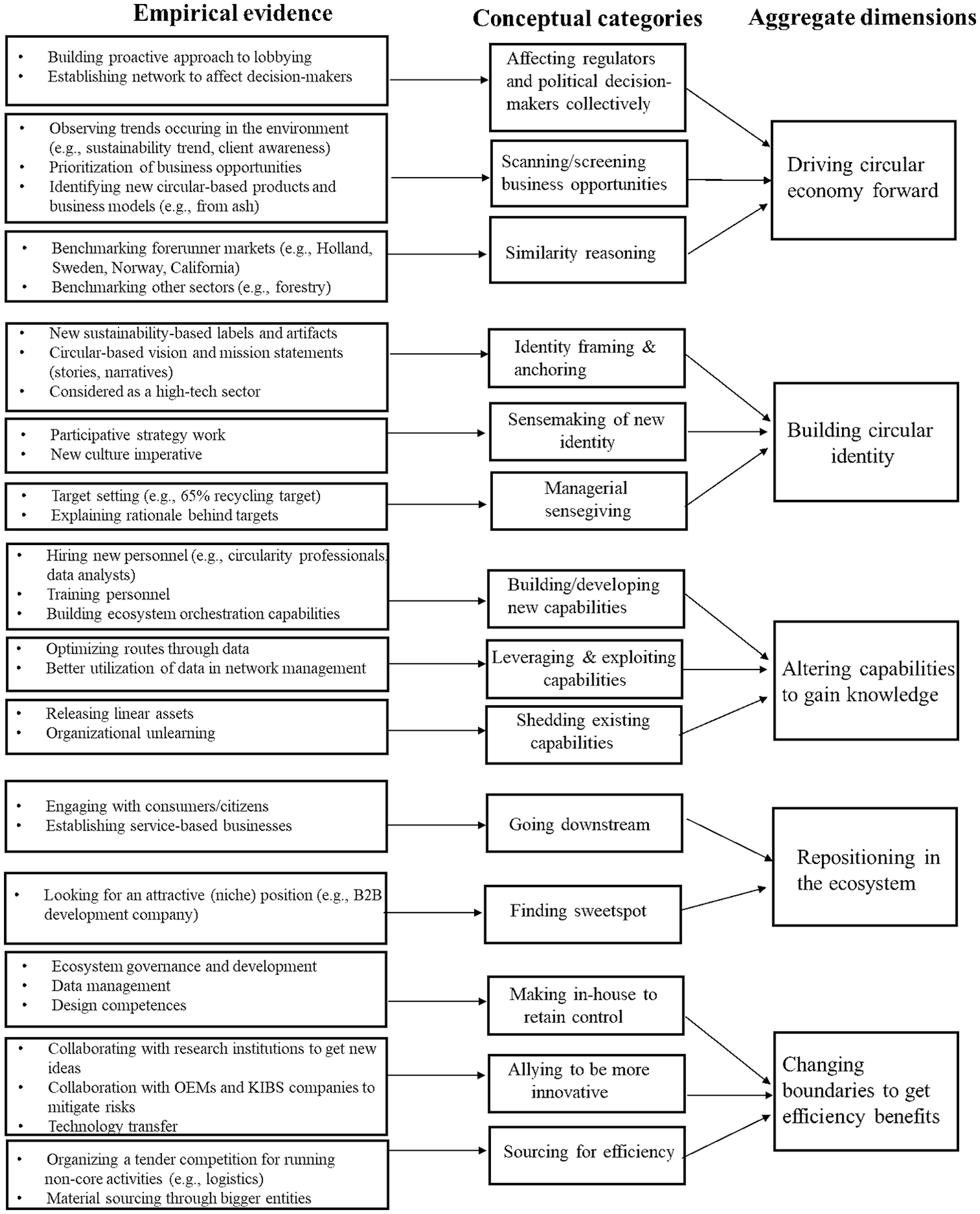
Data Structure.
Contextual Framing of Waste Management and the CE
Although waste management has been criticized for not ultimately fulfilling the principles of a CE (there should not be waste at all in our utopia, and waste management requires materials to produce energy and new products), waste management is an essential societal activity, as people want to live in a wasteless environment (waste has negative externalities in the form of pollution, smell nuisance, adverse visual effects, etc.). Waste can be utilized to produce energy and heat for citizens, but waste can also be reused in other products and materials. As waste management is typically considered an essential service in (developed) societies, political decision-making remarkably affects waste-management organizations. Hence, regulations (e.g., the EU’s landfill ban) and institutional norms (e.g., focus on sustainability issues, societal trends, and behavioral/attitudinal changes among citizens) impact the operations of waste-management organizations. Waste can be classified into organic, combustible, recyclable, and private company waste (e.g., concrete, construction, and dangerous/hazardous). According to the waste type, the waste is sent to a biogas plant (the primary process outcome is biogas or nutrients), a waste-incineration plant (the primary process outcome is district heat or electricity), or a materials recycling/sharing facility (the primary process outcome is recycled materials or shared products). The connection between the CE and waste management is depicted in Figure 2, which outlines how the CE and waste management are aligned. The focus of this study is on household waste. Hence, company waste is not within the scope of our study.
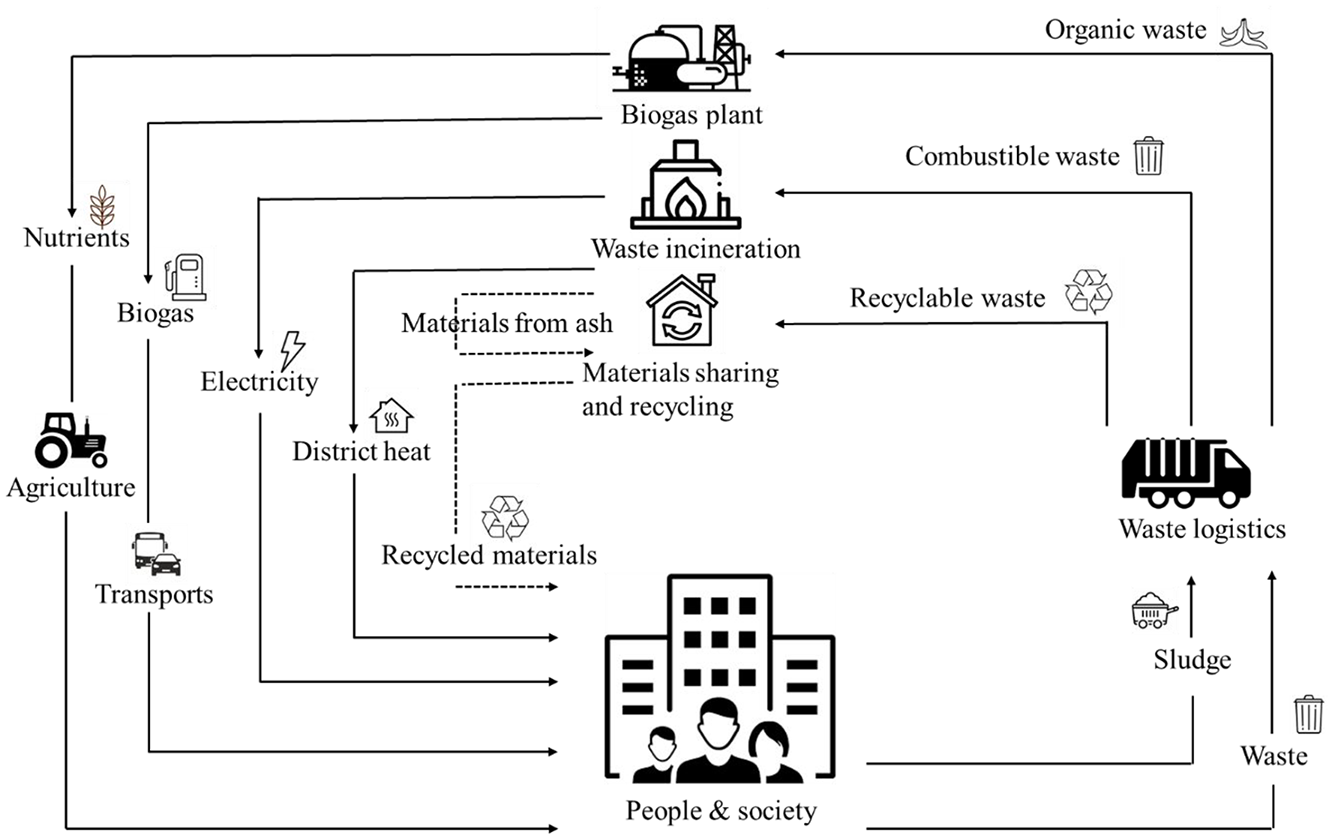
Alignment Between the Circular Economy and Waste Management in Finland (Adopted and Modified Based on Studied Organizations’ Reports and Interviews).
Findings
This chapter examines the transition from linear to CEs among the studied ecosystem organizations. This transition is explained through different strategic practices under different theoretical lenses. The first finding opens up strategic practices used to drive the CE forward, whereas the remaining findings shed light on strategic practices regarding identity-building, capability alteration, repositioning, and boundary decisions. After these findings, the interplay between different strategic practices is explained.
Driving the CE Forward
Organizations in the waste-management ecosystem must be aware of the embedded societal trends that may affect them. As the CE was an emerging theme when the studied organizations started their early journeys toward circularity, they attempted to systematically drive the CE forward by scanning changes occurring in the environment and affecting political decision-makers at different levels (supranational, national, and municipality levels). For example, the studied organizations constantly scanned exogenous changes, such as changes in other sectors, markets, or client’s needs and behavior. The following quote exemplifies that the studied organizations benchmarked totally different sectors, such as forestry, when developing their business models and operations: We should get the overall picture of where the waste comes from. How did the waste come up to us? Who put it into a trash can? Why did they put it into the wrong place initially? How could they recycle it better? If you consider forestry . . . And if you read a physical newspaper, you know exactly which batch it is from, where it comes from, and you may know the tree it has been made from. (General Manager/Waste Incineration)
As the organizations wanted to be forerunners in this sector, they continuously benchmark CBM organizations operating in the most advanced markets (e.g., the Netherlands, Scandinavia, California). Following how forerunner organizations in the most advanced markets worked enabled them to prepare and understand possible forthcoming changes: Well, the examples are from other European markets. The Netherlands is one, and Norway is another. They have made development work for decades. And also in California, [circular] business models have emerged from those markets. (General Manager/Waste Incineration)
The studied organizations possessed limited resources, so they prioritized the opportunities they had decided to seize. Understanding opportunity costs was considered eye-opening for engineering-oriented organizations: We had a budget and initial idea of what kind of circular activities we would do. Then, we understood the most impactful activities and focused on developing them. . .Understanding opportunity costs has been critical for us. (General Manager/Waste Incineration)
Naturally, organizations followed municipal, national, and supranational legislation changes. Instead of just following these coercive structures, executives were proactive in terms of affecting political decision-makers collectively, as the following quotes illustrate: This lobbying competence is enhanced. Our [lobbying] network needs to be strong (CEO/Waste Treatment). When we realized that the world is changing, we realized that we need to start to affect decision-makers more actively . . . The circular economy is still not established. Regulations are made in Europe, in Brussels . . . We have started to build that contact network with other European and international partners and get inside those forums (General Manager, Waste Incineration).
Organizations mentioned that people have realized that linear, fossil-based businesses benefit dictators worldwide, and many Western economies depend on them. People’s attitudes toward this reality changed, especially after the Russo-Ukrainian war in February 2022: Back then [2018–2019], it was not so clear that Europe was so highly dependent on dictatorships when it comes to hydrocarbons and coal. However, now we know. (General Manager, Waste Incineration)
To drive circularity forward, the studied organizations started to build networks to affect regulators and political decision-makers more (pro)actively. They also scanned and screened new business opportunities by following market trends and leading markets and benchmarked other sectors (e.g., forestry). They prioritized using resources to impact the most attractive part of the value chain and attempted to understand changing consumer behavior and attitudes.
The CE Shaping Identity
As the waste-management sector is highly regulated and associated with politics, the old identity of the ecosystem was described with unflattering words such as conservative and bureaucratic (this is somewhat unsurprising, as landfills have never been trendy). Waste management as a sector was also described as unattractive by job-seekers, career-changers, and larger audiences. Basic tasks have been given to specific organizations, and their responsibilities have become evident because of coercive structures. Because of this history and path dependency, the respondents described their old identities as follows: Previously, we were a waste management company. Well, if you look directly, this is what we [still] are. (CEO/Waste Treatment)
The studied organizations provide essential services that are highly regulated. In addition, the organizations can provide market-based services (a maximum of 10% of their revenues may come from private/company waste by 2029). This limitation was considered relatively rigid and was said to limit organizations’ ability to seek additional business opportunities and, thus, change their identities.
This 10% limit is quite low, and it is limiting what we can do. Even if it was reasonable to do so. (CEO/Waste Treatment)
As an identity change is far from a simple initiative and may cause ambiguity across boundaries, managers must pay special attention to labeling it. Typically, this identity change starts from the top management team’s mission and vision statements, speeches, and artifacts. During the investigated period, all the studied organizations and ecosystems shifted their expressed/public narratives toward circularity and more efficient ways of using and sharing resources. One executive stated that they needed to convince themselves before gaining credibility among other stakeholders by building a new organizational culture. This mutual sense-making of new identity and culture was seen as an essential way to understand what types of organizations they wanted to become: Well, the culture is changing. Now we see we have been too careful and said we are a waste collection company. We must dare say that if you do not trust yourself, how could anyone else trust you? During the last two years, this [culture] has clearly changed. (CEO/Waste Treatment)
Identity framing was utilized among companies to help people see an organization’s desired position and identity. This framing required continuous communication, as described by our interviewees: The perspective needs to be changed; we are no longer just a waste incineration plant but a material processor. We produce not just energy but also new materials. At the moment, we process metals, ashes, and minerals. We need to highlight in our communications that we are not just another hole of a pipe that produces energy. (GM/Waste Incineration)
To transform organizations into circular organizations, executives need to understand this change, explain why this change is meaningful, and identify future business targets. This sense-giving was manifested in a very concrete boundary target set by the organization (as a result of strategy work): The New Waste Act states that the recycling rate needs to be 65% by the year 2035. Our material recycling target is 65% by the year 2030. (Strategy document/Waste Treatment)
A participative and more open strategy effectively increased mutual understanding of the CE and facilitated new identity-building. In particular, successful CE projects have inspired confidence among personnel: We started to arrange workshops and discuss with our personnel what this future will mean to us and how we could contribute to it in the best possible way. . .These new, successful projects are exciting ways to take things forward and the best way to take these [circular] initiatives forward and attract interest [internally]. (General Manager/Waste Incineration)
This identity change takes even more time in the eyes of other stakeholders (e.g., citizens, media, suppliers, and clients). One respondent used the analogy of an iceberg to describe what people see and what is “beneath the water”: This iceberg is mostly under the water. What people [really] see is our recycling mall. (CEO/Waste Treatment)
Some respondents also wanted to highlight that waste management is anchored to a high-technology industry, as capital-intensive plants contain valuable and modern technology. They simultaneously highlighted the role and importance of sustainability alongside this technological aspect, which helped them, as a syndicate, to acquire new talent: This is comparable to the high-technology sector, and we have plenty of interesting job opportunities. We can even overtake them [pure technology companies] because of this sustainability aspect. (CEO/Waste Incineration)
In line with general societal development, not only has the waste-management sector become more appealing to the general public (e.g., undergraduates, job-seekers, career-changers), but influential people such as ministers and members of the Parliament have also begun paying particular attention to this sector, hence manifesting the broader identity change: This [interest] has changed. Lately, members of Parliament have stated their interest in visiting our plant [which did not happen 15–20 years ago]. (CEO/Waste Treatment)
In summary, identity change is a longitudinal process and cannot be forced. Public narratives such as vision and mission statements and continuous communication of circularity-related themes have shaped people’s minds within the ecosystem and society. Synchronized and aligned with general societal trends, new ecosystem identity-building actions have helped organizations in waste-management ecosystems to attract new talent and refresh their public image. Hence, active/continuous lobbying and the intentional use of sustainability-related narratives have helped organizations in waste-management ecosystems shape their identities, acquire new skills, build new capabilities (e.g., digitalization, platform building), and make sense of CBMs.
The CE’s Shaping Capabilities
A CE calls for capabilities different from those of a linear economy that follows take-make-sell-use-dispose principles. Capabilities will be altered at the individual, team, organization, sector, and societal levels when transitioning to a CE: The circular economy already impacts work tasks and competence needs and will continue to do so in the future. Jobs will be created and eliminated, and the content of most people’s work tasks will change as sectors move from a linear economy to a circular economy. (Degerman et al., 2022)
To create and build new capabilities needed in a CE, the studied organizations reported that they need to continuously hire new, competent people to manage and develop CE principles both within and between the organizations in the ecosystem: We need to be able to recruit the right people. (GM/Waste Incineration)
One respondent said that they continuously receive job applications from people working in the high-technology sector, enabling them to obtain highly valued technological competences: We get job applications all the time from the people working in the higher technology sector. (CEO/Waste Treatment)
CBMs utilize data to generate financial benefits. In the waste-management ecosystem, the collected data have been utilized to leverage existing capabilities by optimizing operations: We are optimizing our logistics all the time . . . We plan the routes so that they take the shortest route possible . . . We have different logistics software, and we can see where the trucks are in real-time and can continuously communicate with the drivers about their forthcoming tasks, etc. (CEO/Waste Treatment)
Network management was seen as a central capability for central waste-treatment organizations when moving toward a CE. Network orchestration was seen as a key competence to create more added value, as stated by the respondents: Chains will become longer [because of the circular economy]. The longer these chains become, the more added value can be generated. Also, the price of the end product will be higher. You cannot be professional in all of these. (CEO/Waste Treatment)
One interviewee highlighted that waste management is about knowledge management. Some companies described their capabilities as associated with network, material, and data management/business intelligence (BI) themes. However, sharing data between organizations was seen as problematic because different players wanted to secure their data assets: Knowledge in waste management is fragmented. Different players hold knowledge. We attempt to increase data sharing between the parties, but it is not easy because they consider data their business secret . . .We wish this ecosystem was more modern than other industrial ecosystems—there could be some synergy benefits. (GM, Waste Incineration) We should not be scared of sharing our knowledge with organizations outside of this network. (CEO, Waste Treatment)
The strategic transition to the CE logic requires making capability trade-offs. The interviewees emphasized the need to shed existing linear economy competences, unlearn old habits, and forget the old mind-set: I want to emphasize the role of rethinking—we should be able to reduce overpacking. We need to apply lean principles in a way that we reduce waste in all of our operations. (Project Manager/Circular Economy, Regional Development Company) We should not be too narrow-minded. We need to have a broader perspective in a circular economy. (CEO/Waste Treatment)
In summary, when transitioning to a CE, organizations in the waste-management ecosystem had to develop, build, and create new capabilities by hiring new, white-collar personnel (e.g., CE professionals, data analysts, software developers, etc.). Simultaneously, organizations need to exploit and leverage their existing knowledge—organizations focused on utilizing data to make their operations more (cost)effective through optimization. The studied organizations shed some of their linear assets and unlearned from their old routines and habits to master this transition successfully; developing broader mindsets and knowledge-sharing routines were seen as keen facilitators of this change.
The CE Shaping Power Position
Traditionally, entry barriers in the waste-management business are high because plant investments are significant, as one respondent in our pilot case noted: This business requires extensive financial resources because the waste incineration plants are expensive. That is why energy companies are traditionally strong in their balance sheets: district heating, electrical networks, and power plants are expensive. This industry requires plenty of capital. (Business Director/Waste Incineration/Pilot case)
CBMs, however, are decreasing entry barriers, at least in theory, because the logic is opposite to the traditional linear business model, which requires upfront research and development, manufacturing, and sales, as one interviewee clarified: In normal business, you have a business or product idea. You start developing that product, investing in it, and selling and marketing it. You have some production costs; you finance it somehow and then give the client some payment time. Eventually, you get some money back and try to repay the loans you have used for the investments. This [waste management] works in reverse: you immediately get money into your pocket, get the customer, and take the waste and say thanks. You do not need to take on any debt, conduct any R&D, or take risks. You get three years to think about how to get rid of that waste as cheaply as possible. (CEO/Waste Logistics)
The respondents proposed that as value chains become more fragmented during the transition toward circularity, this opens up opportunities for special actors in the ecosystem: If you have done something very special, you can have a sweet and nice niche position. (CEO/Waste Treatment)
Simultaneously, the respondents believed power would generally be more equally distributed within an ecosystem because of the transition to a linear economy. However, some system integrators and technology providers may become more powerful in the ecosystem, according to the respondents: This will be quite the opposite. In a circular economy, it [power] will not go to one player . . . The power will mostly disperse . . . They [system integrators/OEMs] may have a slightly more sunny place, but I do not think they will get too much power either. (CEO/Waste Treatment)
The studied ecosystem focused strongly on producing biogas. This specialization started decades ago and involves many different public and private organizations to become successful (e.g., public transportation utilizing biogas, OEMs utilizing biogas in their research activities and business operations, ferries utilizing biogas, suppliers providing organic waste to make biogas, etc.).
Our biogas ecosystem is beyond comparison. We cannot find anything similar in Finland or Europe. Not even in the world. (CEO/Waste Treatment) Even though our ferry is the most environmentally friendly in the world, our work to reduce its carbon footprint continues . . . We explore if it is financially feasible to expand our biogas utilization. (CEO/Cruise Line)
This movement closer to end customers has also led to the establishment of consumer services such as the provision of biogas or recycled materials. To reposition closer to end customers, the studied organizations established recycling centers, secondhand shops, and biogas stations to serve consumers better. Furthermore, the studied organizations innovated ways to motivate consumers to collect better and sort waste and recycle materials, as stated by the respondents: The starting point is that this requires us to make this sorting work better so that we can get raw materials into our process. (CEO/Waste Treatment).
The organizations were looking for sweet spots to reposition in an ecosystem. One organization framed itself as a B2B development company, hence focusing on taking the role of (green) development organization: We have positioned ourselves as a B2B development company. (GM/Waste Incineration)
In summary, regional monopoly positions are protected (depending on politicians’ decisions), and certain OEMs can benefit from being positioned in the ecosystem’s “sweet spot.” However, monopolies do not mean that there is no competition or pressure from key stakeholders (e.g., inhabitants and politicians). Based on our data, regulated organizations in ecosystems face pressure from indirect competition arising from (a) customer awareness of prices and (opportunity) costs (information availability), (b) comparable ecosystems’ performance (similar reasoning), and (c) substitutes (price anchoring). These forces drive efficiency and facilitate productivity. Productivity may increase because of the better distribution of work.
The CE Shaping Organizational Boundaries
The transition toward circularity affects organizations’ make-buy-or-ally decisions. In general, as illustrated earlier, the respondents explained that their organizations’ value chains become more fragmented and specialized with the transition from linearity to circularity, which increases collaboration within and between ecosystems. Synchronized with findings regarding capabilities, the organization members emphasized the need to control their core activities (e.g., design and planning, orchestration and logistics management) by possessing and developing these activities within their organizations and outsourcing noncentral activities (e.g., running logistics, collecting waste). Many key operators explained that they play the role of orchestrators in the ecosystems, as the following quote exemplifies: In addition to the organization’s success, the success of the entire network should be emphasized. (CEO/Waste Treatment)
Organizations within the ecosystems engage in strategic alliances with knowledge-intensive business service (KIBS) organizations and OEMs from unrelated fields to gain access to valuable competences (e.g., automation, artificial intelligence (AI), large language models (LLMs), and augmented reality (AR)), which are required in a CE: It might be that resources from our strong OEMs are not enough. We need the entire cluster to take this forward. (CEO/Waste Treatment)
All the interviewees mentioned that collaboration with universities, research institutions, and higher education organizations had become more critical because of the need to enhance know-how regarding circularity in the ecosystem: [Through collaboration with the university], we are interested in capturing and utilizing CO₂ from flue gas, decreasing emissions from logistics, and looking for innovative solutions to advance a circular economy. (CEO/Waste Incineration)
However, engaging in collaboration with both KIBS organizations and research institutions requires new types of capabilities and routines related to knowledge-sharing and collaboration: In these [research] projects, we have some protection for our knowledge. This knowledge is not distributed to everyone, but within the project, this knowledge is shared quite openly. (CEO/Waste Treatment)
One way to break the path dependency of the linear economy, generate innovations, and address the competency gap is to establish separate (profit-and-loss responsible) units that focus solely on developing circular business. These internal boundaries help organizations to focus on progressing circular business: In the future, we might establish a new company that starts to build a plant that is big enough [to advance certain circular business]. (CEO/Waste Logistics)
Naturally, some noncore activities, such as waste collection, are sourced through the utilization of price mechanisms to obtain efficiency benefits: We always organize a tender competition. Who pays the highest price gets the deal [raw material]. (CEO/Waste Logistics) New solutions are rather CAPEX intensive rather than OPEX intensive in this sector, so the decision to shop around with the providers becomes important in investments. On the other hand, some delivery contracts are longer. (GM, Waste Incineration)
Because of the movement toward a CE, boundary changes are inevitable. According to our data, value networks will become more dispersed. Ecosystems are also becoming more knowledge- and innovation-intensive, requiring existing players to gain new competences to manage and collaborate with them. The “arm’s length” governance mechanism, which uses price as a primary mechanism, has become less important and ineffective in managing certain knowledge-based, high-value activities, such as innovating from recycled materials. Hence, building social networks and increasing trust through communities and platforms require new capabilities and routines from orchestrators and other key players within the ecosystem. Ecosystems have started collaborating with other ecosystems to develop the capabilities needed in a CE. As new modern technologies such as AI, LLMs, AR, the Internet of Things (IoT), machine learning, robotics, and computer vision become more popular, organizations in waste-management ecosystems need to know how to utilize and apply these contemporary technologies better to make sense of the data.
Based on the collected data, we identified several management practices associated with different organizational theories (identity, power/repositioning, capabilities, boundaries/efficiency). The identified strategic practices related to identity-building were identity framing and anchoring (e.g., managerial narratives such as visioning, (re)labeling), mutual sense-making (e.g., mutual understanding, culture building), and managerial sense-giving (e.g., target setting, justification). The strategic practices related to power/repositioning were moving downstream (closer to the end customer) and finding a sweet spot (e.g., platform orchestrator). The strategic practices regarding capability development were building new capabilities (e.g., hiring new talent), leveraging existing capabilities (e.g., developing new offerings based on extant competences), and releasing capabilities (e.g., unlearning, divestments, layoffs). The strategic practices related to boundaries were decisions regarding making certain activities in-house, buying activities from markets, and allying with other knowledge-intensive organizations.
The shift toward a CE is systemic and complex. Hence, strategic practices are typically intertwined and executed simultaneously rather than sequentially. Table 2 illustrates the evolution in key ecosystem organizations’ identities, capabilities, power positions, and boundary decisions when trying to become circular and sustainable organizations.
Evolution of Key Organizations’ Identities, Capabilities, Positions, and Efficiency Logics to Become Circular and Sustainable Organizations.
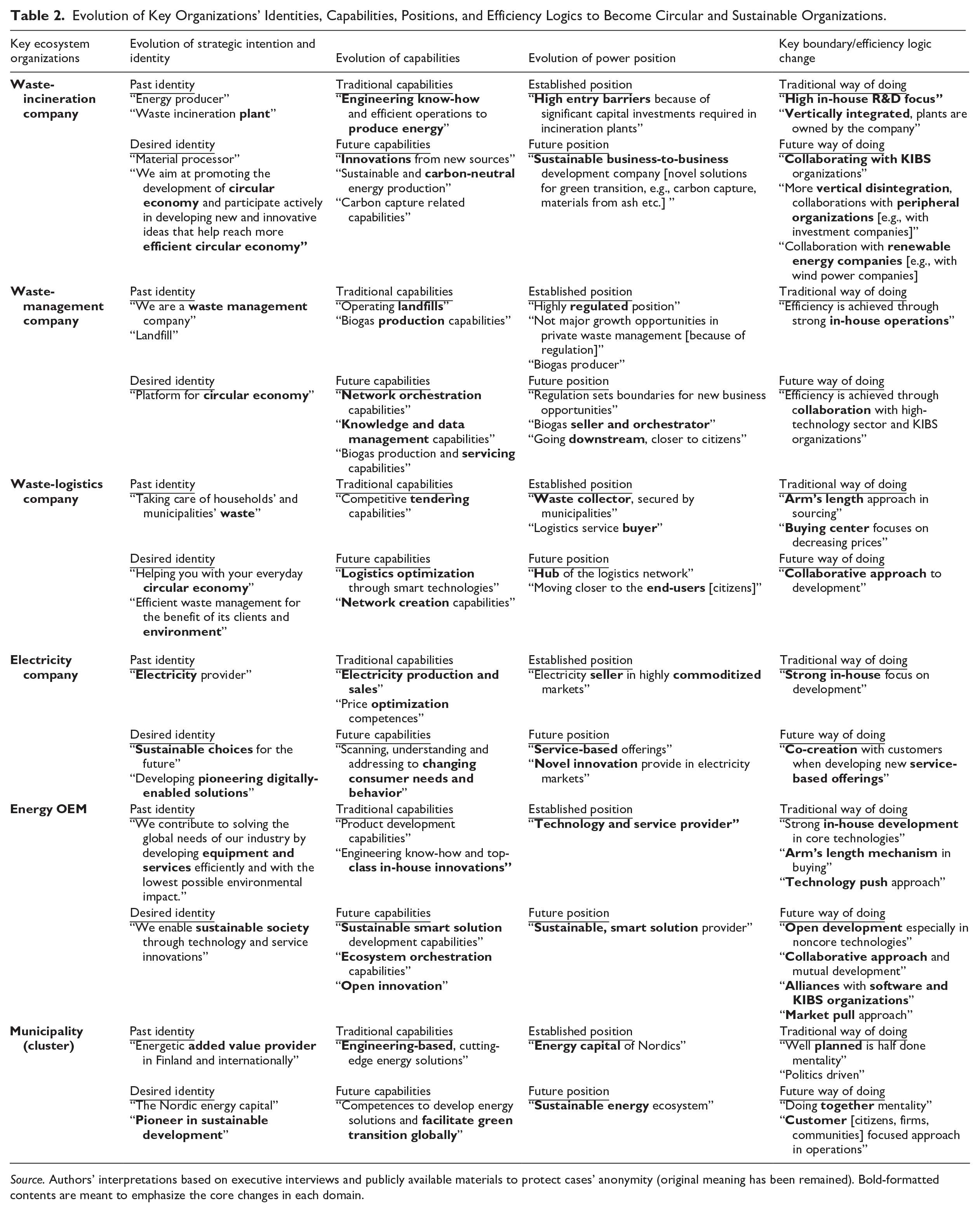
Source. Authors’ interpretations based on executive interviews and publicly available materials to protect cases’ anonymity (original meaning has been remained). Bold-formatted contents are meant to emphasize the core changes in each domain.
Discussion and Conclusion
The present study aimed to understand how incumbent organizations initiate the transition from a linear economy to a CE through different boundary theories and their interplay. By applying Santos and Eisenhardt’s (2005) organizational boundary framework to the ecosystem transition toward a CE, our findings provide a detailed account of how firms reconfigure their boundaries. The study findings show that organizations should build new circular identities through framing, anchoring, sense-making, and sense-giving practices. Second, organizations should reposition downstream, be closer to end clients, and try to find unique ecosystem sweet spots. Third, organizations should build new capabilities, especially in white-collar domains, leverage their existing data assets to achieve cost advantages and release their linear-focused assets and routines. Finally, organizations should attempt to maintain in-house network orchestration capabilities and access external capabilities to pursue innovations (especially with knowledge-intensive organizations). These boundary-shaping strategic practices interplay and managers must manage them in parallel to drive circularity forward.
Theoretical Contributions
The study’s contributions to the CE literature are twofold. First, it intends to show how a CE shapes organizations in ecosystems through changes in identity, capabilities, power position, and boundary decisions. Thus, the study extends the literature on the CE (Bocken et al., 2017; Nygaard, 2022) and CBMs (Bocken & Konietzko, 2022; Curtis & Mont, 2020; Frishammar & Parida, 2019; Rajala et al., 2018) by providing a complementary and holistic perspective on how systemic changes can be managed and executed in organizations and syndicates. Moreover, the study identifies key management practices under different theoretical disciplines that organizations adopt to drive circularity forward. Therefore, this study’s findings may enrich the debate on CE utopia and paralysis (Bocken et al., 2023) by examining these opposing dynamics in waste-management context (Rajala et al., 2018) when organizations shift their boundaries.
Concerning organizational identity, the study extends earlier discussions in the CE context (Agyabeng-Mensah et al., 2021). The transition is not straightforward but challenging and does not happen overnight. Embedding circularity into the organizational identity may enhance legitimacy. Nevertheless, it may involve utopic narratives and overly optimistic assumptions that lead to ambitious commitments that are challenging to implement, enhancing stakeholder expectations, and in turn, creating tensions when outcomes are not achieved. Alternatively, identity conflicts can drive paralysis after decades of operating with linear models, which can delay action. In addition, identity misalignments across ecosystem actors can lead to paralysis due to the lack of a shared vision. Therefore, shifting organizational identity and aligning identities within the ecosystem to foster a shared vision is key. Thus, this study contributes by identifying circularity-enhancing identity-building practices such as managerial narratives (new sustainability narratives, visioning, mission statements regarding circularity), (re)labeling (sustainability-enhancing artifacts), sense-making (mutually trying to understand what circularity means to our organization), and sense-giving (justifying the need for change and setting target regarding circularity). These identified strategic practices aimed to alter the organization’s identity are novel in the existing CE literature and circularity context. These are useful for executives to understand how to frame and anchor toward the desired identity and direction.
In addition, the study advances the earlier discussions of power position in a CE context (Eisenreich et al., 2022). A particular aspect of the power dynamics relates to power asymmetries and dependencies. In this sense, utopian views may assume a high degree of collaboration, idealizing partnerships or overlooking the goals of dominant players, which can lead to paralyzing resistance when other stakeholders prioritize linear models over circularity. Shifting power dynamics through collective governance mechanisms can empower less-powerful actors. In this context, the study identifies strategic practices related to seeking and gaining improved power positions, repositioning downstream, and understanding (in)direct competition in markets. Seeking and going toward a new power position before positions become established in circularity logic can help organizations gain a sustainable advantage over rivals (Porter & Heppelmann, 2014).
Capability-wise, the resources and capabilities needed for circular practices cannot be seamlessly acquired, often resulting in aspirational but not actionable plans. Instead, firms with limited resources are prone to overestimating their development or acquisition costs, preventing action, and creating paralyzing inertia. This study further illustrates capability-altering practices in the CE. It contributes to the discussion of dynamic capabilities in the CE (AL-Khatib, 2023; van Eechoud & Ganzaroli, 2023) by shedding light on strategic practices to build and acquire new capabilities (e.g., hiring capabilities regarding digitalization and data management), leverage existing capabilities (e.g., orchestrating the circular network, exploiting the usage of the extant data), and release noncore (linear-focused) organizational capabilities and routines (e.g., reducing landfills and facilitating organizational unlearning). By building these capabilities early on, firms can generate a competitive edge before circular-based resources become overly costly to acquire. Moreover, investing in capability-building through modular innovations and collaboration enables firms to adopt circular practices more gradually, whereas incremental capability-building through partnerships and experimentation can help overcome paralysis.
Finally, organizations may underestimate the complexity and the transaction costs associated with circularity. Otherwise, inaction may arise from the perception that the transaction costs of circularity are unaffordable, discouraging firms from acting. Our study also contributes to the discussion of boundaries in the CE (Bjartmarz & Bocken, 2024; Bressanelli et al., 2022; Frishammar & Parida, 2019; Nygaard, 2022) and scrutinizes make-buy-ally decisions made in waste-management ecosystems to facilitate the transition toward a CE. Even though the transaction costs may be high at the beginning of circular movement, they may remarkably decline over time as new practices such as standardization (Flynn & Hacking, 2019), modularization (Machado & Morioka, 2021), and the adoption of new technologies such as digital platforms (Rajala et al., 2018), AI (Lu & Serafeim, 2023), and AR (Porter & Heppelmann, 2017) help to decrease transaction costs.
As a second conceptual contribution, this study discusses intertwined management practices to manage systemic changes, such as linear organizations transitioning toward a CE (Bressanelli et al., 2022; Frishammar & Parida, 2019). Our findings advance our understanding of the interplay between strategic practices to manage co-evolutionary and holistic organizational transformation. While acknowledging the importance and value of scrutinizing the CE through a single lens (see, for instance, AL-Khatib, 2023; Nygaard, 2022) and the interplay of different theoretical lenses (Bäck & Kohtamäki, 2015; Bigdeli et al., 2021; Huikkola et al., 2020; Salonen & Jaakkola, 2015), our study suggests the relevance of reviewing the interplay between strategic practices aimed at changing organizational identities, capabilities, positions, and boundaries. This intertwined approach to managing the transition toward a CE is helpful, as systemic changes rarely follow sequential models (Ott & Eisenhardt, 2020) but are managed in parallel (Huikkola et al., 2022b).
The consistency and alignment between different strategic practices should be acknowledged. In a broader context, this study advances the attention-based view of strategy (Ocasio, 1997) by suggesting that, as managers’ time is considered a scarce resource (Barney, 1991), managing systemic changes calls for managerial attention and cognition (time, focus, resources) to several, ongoing and simultaneous changes taking place within and between organizations and ecosystems. This approach to circularity helps to show the connection between central organizational change themes and follow their interdependency. This interdependency of theoretical lenses and associated strategic practices shows the simultaneous actions required to push strategic initiatives forward and break path-dependencies.
Managerial Implications
For managers, our study provides benchmarking opportunities for how systemic changes are driven and managed by altering identity, capabilities, power position, and boundaries to avoid paralysis. Different theoretical lenses offer a holistic perspective to analyze strategically relevant themes and challenges.
When changing organizational identity, managers must consider questions such as “Who do we want to become?” or “Who are we as an organization?” Thus, managers must create a unified and common identity for focal companies and the whole ecosystem through managerial storytelling and narratives. Even though a new, desired identity may sound overly optimistic for key stakeholders first, a new identity can facilitate organizations’ recruitment, investment, and capability-building actions to avoid paralysis. Instead, when considering repositioning in the ecosystem, managers must consider questions such as “What markets should we be in?” and “What is the optimal position for us in the market?” Repositioning requires an analysis of activities that need to be performed in-house; in a CE, repositioning toward end clients becomes increasingly important, and building downstream capabilities needs managerial attention.
When changing capabilities, managers must consider questions such as “What capabilities do we need to build, acquire, leverage, and release to become circular organizations?” In this context, building new capabilities is associated with identity-building activities. In particular, the emergence of (digital) platforms and tools designed to create and make sense of data calls for new professionals (e.g., data analysts, software developers, and CE professionals) as well as new routines (e.g., related to innovating, knowledge-sharing, recruiting, and collaborating with other organizations).
When changing efficiency logic (boundaries), incumbents must address the following questions: “What circularity-enhancing activities do we need to make in-house, collaborate with other organizations, and source from the markets?” As boundaries become blurred and are altered, organizations must decide which activities should be insourced and outsourced and which activities should be conducted in collaboration with other (unrelated or competing) organizations and ecosystems. In particular, collaborations with knowledge-intensive organizations (e.g., research institutions, OEMs, and KIBS) become essential in the CE. To take advantage of external organizations’ know-how, waste-management organizations must acquire competencies regarding their utilization and management (e.g., hiring professionals who can manage research collaborations, engage with other external organizations, and affect political decision-makers). More extensive use of digital platforms and tools may decrease organizations’ long-term transaction costs. From this study, managers and policy-makers can learn that systemic transitions require effort and investments from focal companies and ecosystems; particular attention should be given to collective efforts such as proactive lobbying and promoting the ecosystem to a broader audience (politicians, students, professionals). Furthermore, organizations should pay attention to establishing collaborative learning forums that facilitate knowledge-sharing and mutual sense-making across organizations within and between ecosystems.
Limitations and Future Research Directions
As is the case with any research, this study is not without limitations. One key practical limitation is that waste-management organizations can only make limited contributions to the CE, especially when coordination with the entire value system is impossible. We hope our findings encourage other waste-management organizations to take a leap of faith toward circularity and move away from the traditional linear economy model by suggesting managerial practices related to identity and capability-building, repositioning, and make-buy-ally decisions. Another limitation of this study is that it focuses on how CE principles have been adopted in Finland’s highly regulated regional waste-management ecosystems. The studied ecosystem is still in its early transition stage, so the generalization of the findings should be made carefully. In the future, CE-related studies could be conducted in other geographical areas. The research community would benefit from studies focused on how CBM innovations occur not only in less-regulated (more market-driven) or differently regulated contexts but also in bottom-of-the-pyramid contexts, which may be less path-dependent and thus free from existing waste-management infrastructure.
Furthermore, future studies would benefit from research focusing on CBM innovation processes and how sustainable business models are innovated in practice within organizations. Future studies would benefit from adopting a sole theoretical lens and scrutinizing in-depth how (single) organizations alter their identities, capabilities, power positions, or boundaries when transitioning toward a CE, especially in a more mature stage of the circularity movement (when the loops are closing). Understanding microfoundations regarding managing systemic changes would provide valuable knowledge of the factors enabling or hindering strategic transformations in the micro-macro axis. Finally, future studies would benefit from using institutional theory to understand better how different coercive structures, institutional norms, and mimetic isomorphisms shape or are shaped by CBM innovations. Studying, for instance, how organizations try to affect political decision-makers in the forms of taxes (e.g., existing value-added tax in circular solutions may be questioned) and regulations related to CE could be worth studying as these institutional forces may remarkably hinder or promote circularity in societies.
Footnotes
Appendix A
Appendix B
Illustrations From Data.
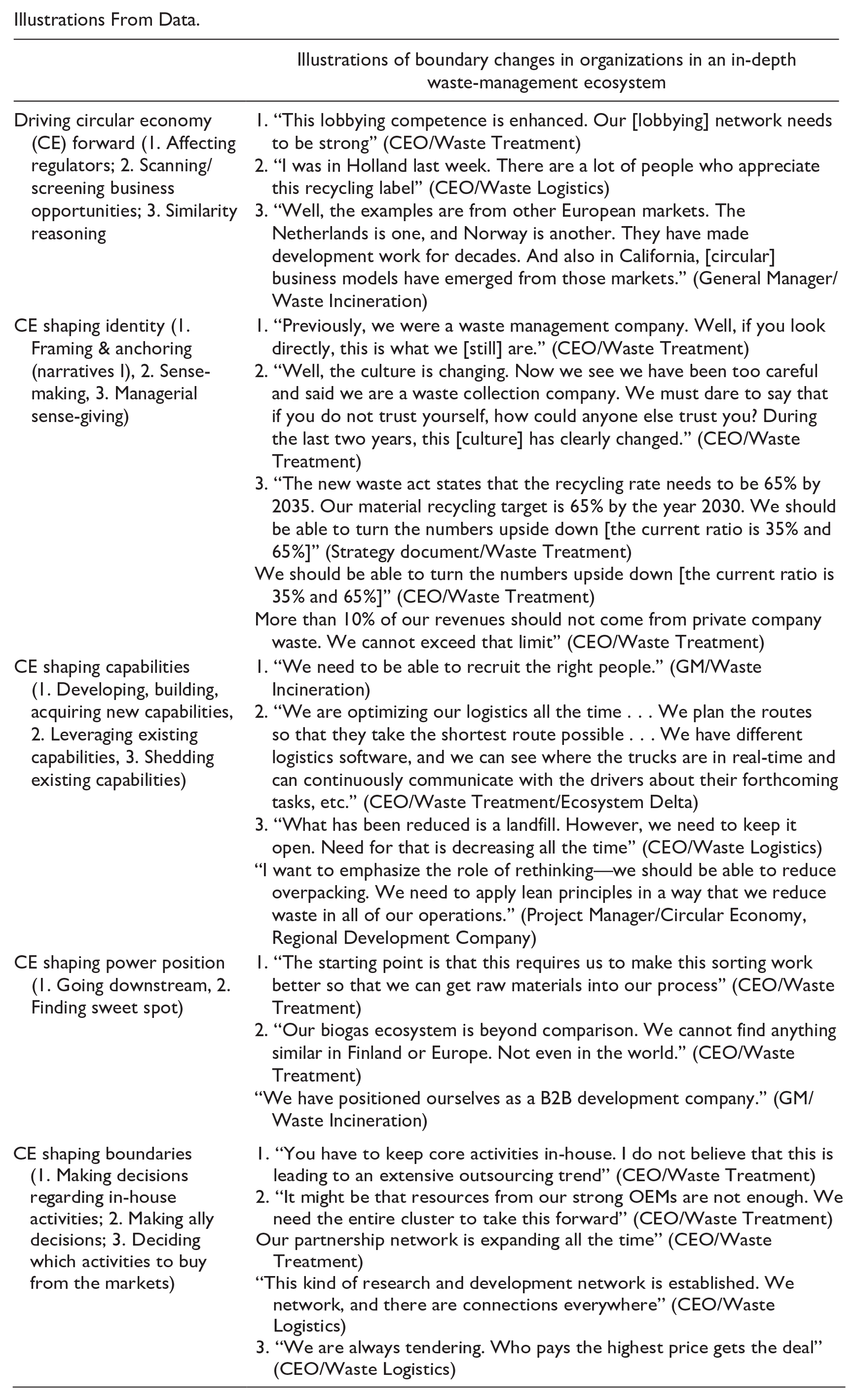
| Illustrations of boundary changes in organizations in an in-depth waste-management ecosystem | |
|---|---|
| Driving circular economy (CE) forward (1. Affecting regulators; 2. Scanning/screening business opportunities; 3. Similarity reasoning | 1. “This lobbying competence is enhanced. Our [lobbying] network needs to be strong” (CEO/Waste Treatment) 2. “I was in Holland last week. There are a lot of people who appreciate this recycling label” (CEO/Waste Logistics) 3. “Well, the examples are from other European markets. The Netherlands is one, and Norway is another. They have made development work for decades. And also in California, [circular] business models have emerged from those markets.” (General Manager/Waste Incineration) |
| CE shaping identity (1. Framing & anchoring (narratives I), 2. Sense-making, 3. Managerial sense-giving) | 1. “Previously, we were a waste management company. Well, if you look directly, this is what we [still] are.” (CEO/Waste Treatment) 2. “Well, the culture is changing. Now we see we have been too careful and said we are a waste collection company. We must dare to say that if you do not trust yourself, how could anyone else trust you? During the last two years, this [culture] has clearly changed.” (CEO/Waste Treatment) 3. “The new waste act states that the recycling rate needs to be 65% by 2035. Our material recycling target is 65% by the year 2030. We should be able to turn the numbers upside down [the current ratio is 35% and 65%]” (Strategy document/Waste Treatment) We should be able to turn the numbers upside down [the current ratio is 35% and 65%]” (CEO/Waste Treatment) More than 10% of our revenues should not come from private company waste. We cannot exceed that limit” (CEO/Waste Treatment) |
| CE shaping capabilities (1. Developing, building, acquiring new capabilities, 2. Leveraging existing capabilities, 3. Shedding existing capabilities) | 1. “We need to be able to recruit the right people.” (GM/Waste Incineration) 2. “We are optimizing our logistics all the time . . . We plan the routes so that they take the shortest route possible . . . We have different logistics software, and we can see where the trucks are in real-time and can continuously communicate with the drivers about their forthcoming tasks, etc.” (CEO/Waste Treatment/Ecosystem Delta) 3. “What has been reduced is a landfill. However, we need to keep it open. Need for that is decreasing all the time” (CEO/Waste Logistics) “I want to emphasize the role of rethinking—we should be able to reduce overpacking. We need to apply lean principles in a way that we reduce waste in all of our operations.” (Project Manager/Circular Economy, Regional Development Company) |
| CE shaping power position (1. Going downstream, 2. Finding sweet spot) | 1. “The starting point is that this requires us to make this sorting work better so that we can get raw materials into our process” (CEO/Waste Treatment) 2. “Our biogas ecosystem is beyond comparison. We cannot find anything similar in Finland or Europe. Not even in the world.” (CEO/Waste Treatment) “We have positioned ourselves as a B2B development company.” (GM/Waste Incineration) |
| CE shaping boundaries (1. Making decisions regarding in-house activities; 2. Making ally decisions; 3. Deciding which activities to buy from the markets) | 1. “You have to keep core activities in-house. I do not believe that this is leading to an extensive outsourcing trend” (CEO/Waste Treatment) 2. “It might be that resources from our strong OEMs are not enough. We need the entire cluster to take this forward” (CEO/Waste Treatment) Our partnership network is expanding all the time” (CEO/Waste Treatment) “This kind of research and development network is established. We network, and there are connections everywhere” (CEO/Waste Logistics) 3. “We are always tendering. Who pays the highest price gets the deal” (CEO/Waste Logistics) |
Appendix C
Declaration of Conflicting Interests
The author(s) declared no potential conflicts of interest with respect to the research, authorship, and/or publication of this article.
Funding
The author(s) disclosed receipt of the following financial support for the research, authorship, and/or publication of this article: This paper is a product of the SHARE (Industry sharing platform for boosting transition toward circular economy) research project. The financial support of the Business Finland (BF) and the organizations involved in the project is gratefully acknowledged. Tuomas Huikkola wants to acknowledge the Alliance for Socially-acceptable & Actionable Plants (ASAP) research project. The research was carried out with funding from the Research Council of Finland, funding decision number 366010. Rodrigo Rabetino wants to acknowledge the DigiBiogasHubs research project, co-funded by the European Union and the Regional Councils of Ostrobothnia, Central Ostrobothnia, and South Ostrobothnia.
