




Abstract
Financial stakeholders play a key role in facilitating the initiation and growth of new circular business models, as well as supporting substantial improvements in existing linear incumbent firms. To empirically investigate how financial stakeholders make sense and form investment practices around the circular economy (CE) as an emerging, novel category in the financial industry, we conducted 37 interviews across 31 asset management firms, using the sensemaking lens. We identify the key characteristics of asset managers’ (AMs) sensemaking processes that facilitate reducing uncertainty and ambiguity around CE investment risk and return, thus fostering investment practices that increase the CE’s viability as an investment category and facilitate a transition towards a CE. We provide recommendations for interventions that can support AMs’ sensemaking around the CE.
Introduction
The circular economy (CE) is an umbrella concept encompassing different but interrelated strategies for waste and resource management—such as prevention, redesign, reuse, remanufacturing, and recycling—that share the capacity to improve resource conservation, efficiency, and productivity (Blomsma & Brennan, 2017; Homrich et al., 2018). The transition to a circular economy (CE) can be viewed as part of sustainable development, as circular practices have the potential to deliver significant contributions towards economic, environmental, and social sustainability (Geissdoerfer et al., 2017; Murray et al., 2017). But for this potential to be realised, the CE needs to move beyond utopian paralysis—a mere utopian vision that cannot be operationalised and leads to a state of paralysis (Calisto Friant et al., 2020; Gümüsay & Reinecke, 2022). Instead, it needs to enable concrete shifts in established practices, and do so in a manner that does not create an incremental, reinforcing add-on to the existing linear economy (Clube & Tennant, 2020).
A fundamental requirement for this is the synergistic coordination and alignment between circular business models (CBMs) and other important stakeholder groups, such as customers, suppliers, public sector entities, and finance (Brown et al., 2021; Kanda et al., 2021; Parida et al., 2019; Patala et al., 2022). Among these, financial actors play a prominent role, as their ability to allocate financial capital towards the CE is crucial for creating new value networks and transitioning to new business practices (EMF, 2017, 2020). This can be done by financing the initiation, growth, and scaling of circular startups, as well as substantial improvements in existing, linear incumbent firms.
The importance of this financial allocation is underscored by the growing popularity of CE-focused investment vehicles and specialized sustainability financial instruments (EMF, 2020; UNEP Finance Initiative, 2020). These span a spectrum—from established resource-efficiency practices not previously labelled as circular to more novel and more transformative approaches, such as value chain financing (European Commission, 2019), systemic investing (Jay & Yau, 2023; Tews et al., 2025), and strategies for financing circular ecosystems (Boyd & Reardon, 2023). This growing diversification of offered and proposed investment strategies underscores the pivotal role of financial actors in both accelerating and shaping the transition to a circular economy.
However, despite growing recognition of the opportunities offered by the CE (EMF, 2020; Kirchherr et al., 2017; UNEP Finance Initiative, 2020), there is a lack of widespread financial support for starting and growing circular businesses, creating a barrier to their uptake and diffusion. As highlighted by Barrie et al. (2023), capital allocation towards the CE reaches only about 3% each year, signalling that it remains an emergent and peripheral category in the investment field. This raises a critical question: How does the CE become a viable category in the investment field?
New categories introduced into established fields often begin at the periphery, with their diffusion and persistence heavily influenced by actors through sensegiving and collective action (Ocasio et al., 2015). The inherent ambiguity and uncertainty of novel categories trigger sense-making processes that determine whether they will spread. Actors must interpret novel categories and work out what it means to enact them in practice (Dewulf & Biesbroek, 2018; Powell & Colyvas, 2008; Weick, 1995)—and how they relate to other already existing categories. Importantly, the viability of a category, characterised by balanced levels of coherence and distinctiveness, supports sensemaking and comprehension (Lo et al., 2020), which are essential for its adoption and spread within a field.
The enactment practices involved in sensemaking around a novel category will either depart from or adapt existing practices—in the case of a viable new category that takes root and diffuses throughout a field—or remain unchanged if the category is overshadowed by established ones and fails to take root. As such, sensemaking is a foundation for both change and inertia. However, at present, there is a lack of understanding of the underlying sensemaking processes leading to category viability. Consequently, also for the domain of finance, there is a lack of understanding of the sensemaking and enactment practices that could facilitate or hinder the CE category’s viability in the investment field.
Furthermore, the question is not only whether to invest in CE, but also whether it leads to significant transformations in the real economy and the degree to which financial institutions must adjust to enable this. For example, is the narrative they construct one in which CE is a minor adaptation of business-as-usual, driven by technical innovation, allowing finance to assess risks and opportunities as usual (Calisto Friant et al., 2020; Leipold et al., 2023)? Or is the collaboration to close loops seen as essential, requiring investment in entire value chains or ecosystems and a shift in how finance assesses risks and rewards (Boyd & Reardon, 2023)? Understanding how individuals in the finance industry construct the meaning of CE and the actions that follow reveals the micro-foundations of barriers and enablers to organisational and field-level change and how this, in turn, contributes to systemic or macro-level change.
To shed light on the processes influencing category viability, we applied the sensemaking lens to investigate the processes and practices underlying the CE category’s viability in the investment field. Specifically, we explored how asset managers (AMs) interpret the CE concept as a novel and peripheral category, and what, if any, changes in investment practices this results in. Through 37 interviews with AMs from diverse European countries—both those committed to CE investments and those who are not—we gained insights into how financial actors navigate the uncertainty and ambiguity of the CE category and take investment actions based on their understanding of its potential risks and rewards.
Our contribution is threefold. First, we advance the categories literature by identifying which forms of sensemaking support—and hinder—category viability (Lo et al., 2020). We suggest that utopian paralysis can emerge from persistent micro-level cognitive ambiguity and uncertainty around novel categories, such as the CE, hindering financial actors’ ability to adequately evaluate its risks and returns and to make the category viable in the investment field. Second, we contribute to the sustainable investing literature by uncovering the microfoundations that bridge desirable utopian futures and actual investment practices. By examining how AMs make sense of the novel CE category and translate it into concrete investment actions, we identify specific underlying cognitive processes that either perpetuate circular utopian paralysis or enable a sustainable CE transition through more transformative investor impact mechanisms (Heeb & Kölbel, 2020; Kölbel et al., 2020). Third, we contribute to the CE literature by demonstrating how the micro-level sensemaking processes of important stakeholders in CE—financial stakeholders—can either reinforce circular utopian paralysis and cause inertia or overcome it through more transformative operationalization and enactment. This builds upon existing research on macro-level CE narratives and discourses (e.g., Calisto Friant et al., 2020; Leipold et al., 2023), providing deeper insights into the underlying cognitive processes of CE transitions.
Furthermore, our findings provide a basis for designing interventions to steer the interpretation of the CE concept towards transformative outcomes, helping it evolve from a “utopian” concept to one that delivers on its transformative promise.
Background: Category Viability, Sensemaking and CE
In the following, we first examine what is already known about category viability and emergence, as well as the diffusion of a category into the mainstream of a field. Next, we link this to sensemaking processes by explaining how the emergence of new categories functions as a trigger for new sensemaking processes. Below, we focus on insights relevant for business and finance.
Why Novel Categories May or May Not Take Hold
Popularised in its current form by the Ellen MacArthur Foundation (EMF, 2013), the CE has since become recognised for its potential to advance sustainability and a green economy. However, in some fields, including financial markets, the CE remains “a relatively new topic for investors and the financial sector” (Barrie et al., 2023, p. 6). Efforts are still ongoing to define what it means for businesses to adopt diverse waste and resource management strategies under the CE umbrella and where such practices fit into other business practices and sustainability concepts (i.e., ESG, net-zero, green economy). As such, it can be said that CE represents a category that has yet to be fully understood. This presents a challenge, as it is not guaranteed that CE will persist, diffuse, or become mainstream (Blomsma & Brennan, 2017). Understanding how these processes unfold is crucial to determining whether and how to support and accelerate them, as well as how to shape them in line with transformative change.
Management and organisational scholars have provided valuable insights into how cognitive and socio-economic categories affect organisations and their stakeholders. For example, research studies have investigated the economically punitive and constraining effects of membership in specific market categories (e.g., Hsu, 2006; Zuckerman, 1999). External audiences (e.g., securities analysts) draw on existing, familiar categories (e.g., industry classification schemes), to make sense of and assign meaning to the objects in question (e.g., investee companies), which has implications for company share price valuations and investment decisions (see e.g., Zuckerman, 1999, 2000, 2004). This suggests one company may be valued higher than another simply because it differentiates itself by being associated with a more familiar category. Furthermore, once a category is established within a group, it can be hard to change due to ingrained cognitive and cultural expectations (Lounsbury & Rao, 2004). Established categories can also impede the diffusion of alternatives (Hsu, 2006).
Category emergence constitutes a major theme within category studies. New category formation can be triggered through, for example, shifts in technological or material innovation, unmet market or societal needs, cultural and intellectual movements, strategic firm-level actions, and the role of the media, experts, analysts or key innovators in shaping how new products or services are understood (e.g., Durand & Khaire, 2017; Fiol & Romanelli, 2012; Jones et al., 2012; Kennedy, 2008; Khaire & Wadhwani, 2010).
Categories change their status as the result of a dynamic process (Blader & Chen, 2011; Delmestri & Greenwood, 2016). While some categories successfully diffuse and become institutionalized (e.g., ESG), others may fail to take root (Navis et al., 2012) or have a relatively short lifespan (Boone et al., 2012). Lo et al. (2020) suggest that category viability is a key aspect of a category’s dynamism and can shape its future evolution and institutionalisation. Characterised by balanced levels of coherence and distinctiveness, viable categories can better facilitate people’s sensemaking and comprehension, which are critical to the category’s acceptance and diffusion among a field’s members.
For example, ESG investment can be said to be distinct from mainstream investment because it integrates environmental, social, and governance objectives into investment processes. Moreover, it can be said to be internally coherent as an investment category in the sense that it fits the risk-reward lens dominant in finance: it still promises financial returns, while at the same time reducing risks compared to not managing ESG aspects. Combined, this is what can be said to have made ESG viable and is likely to have supported its diffusion as an investment category.
However, not all new categories become viable: difficulties with placing a novel category—such as CE—in existing cognitive frameworks may lead actors to disregard or devalue it (Hsu, 2006; Navis & Glynn, 2011; Negro et al., 2011; Zuckerman, 1999). In this sense, a category’s viability can diminish, potentially leading to its short lifespan or marginal position if it is overshadowed by other well-established categories. For CE, such competing categories may be ESG or climate change.
While category emergence and subsequent diffusion is understood from a macro-perspective (whether and how categories diffuse into the mainstream)—the micro processes (the cognitive and enacted processes of how individuals make sense of categories) remain poorly understood. This largely stems from the category literature being roughly divided into macro and micro streams, which have limited connections between them (Vergne & Wry, 2014). While the micro-level of analysis is rooted in cognitive psychology and takes an agentic approach by emphasising the “ability of organisations to create categories and act upon that basis,” the macro-level, sociological view has “theorised categories as components of a firm’s external environment” (Vergne & Wry, 2014, p. 57) and has placed an “emphasis on the ability of external audiences to impose constraints or sanctions on category members (e.g., organisations)” (Verne & Wry, p. 62)—without linking or integration between the two streams.
We address this gap by examining how the micro-processes of category viability reveal how actors understand and respond to novel categories. We focus on sensemaking, which is crucial for assigning meaning to new categories and shaping their viability trajectory, thereby influencing their subsequent macro-level diffusion or stagnation (Lo et al., 2020).
Sensemaking as a Way to Open Up the Black-Box of Category Viability
Sensemaking is the process that helps to determine “what is going on” in the world—amid the novelty, ambiguity, uncertainty, and complexity that is inherent in it—and how to respond to this (Daft & Weick, 1984; Weick, 1993, 1995; Weick et al., 2005). It consists of ever-ongoing cycles of: (1) selecting, sorting, and assembling of relevant cues from the actor’s situational context through perceptual and world-view frames; (2) the continuous interpretation and reinterpretation of those cues to attach meaning to past and present cues; and (3) enactment, whereby meaning is given substance in the world through the matching action or inaction, depending on the meaning that was established. The next cycle then starts as the effects of the action or inaction of the previous cycle are being observed and become the next cue(s) to be interpreted—ad infinitum, see Figure 1. As such, sensemaking processes thus consist of several linked cycles of cue extraction, (re)interpretation, and enactment (Maitlis & Christianson, 2014).
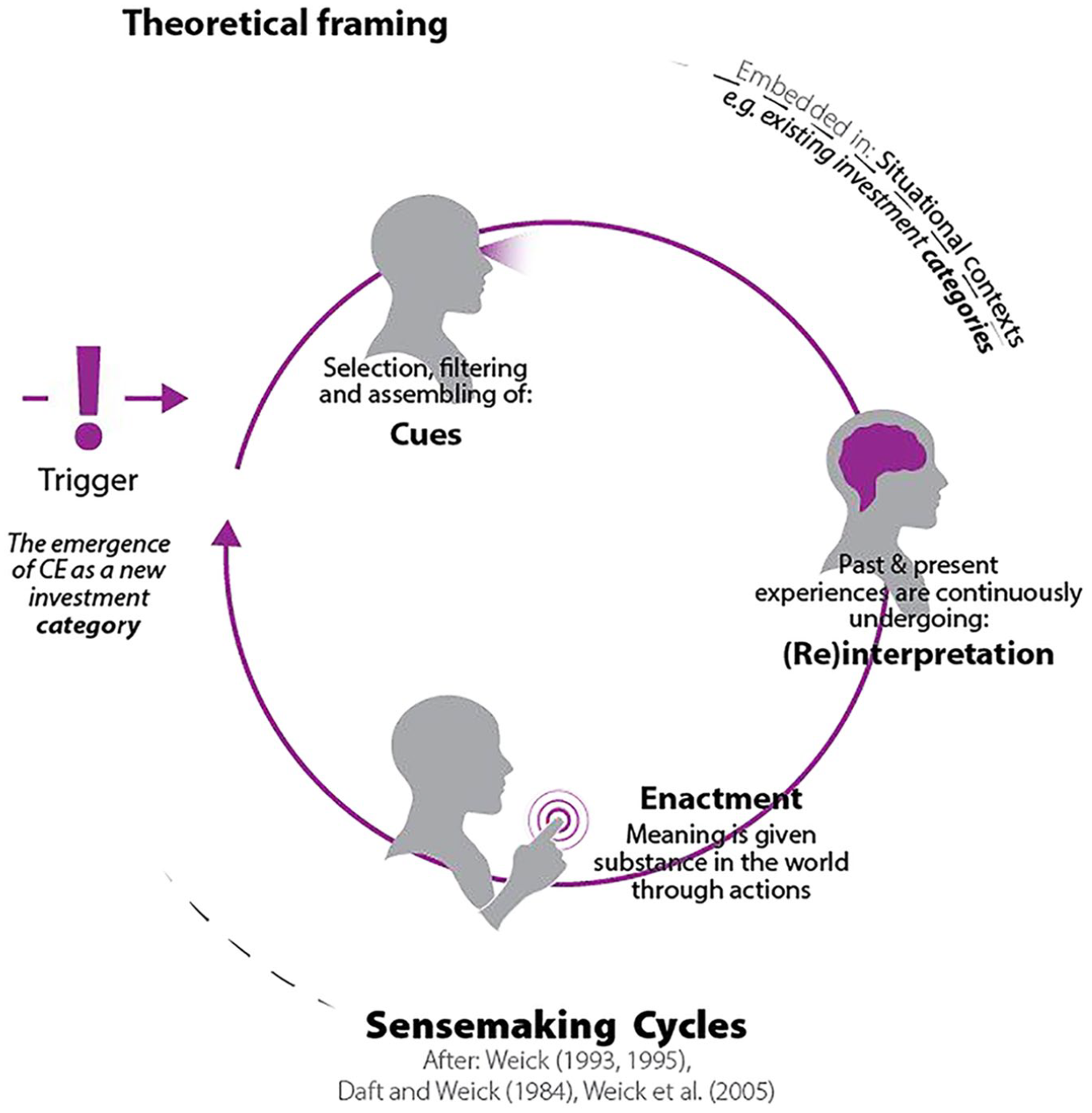
Schematic Depiction of How Sensemaking Processes Unfold.
Categories are an important part of sensemaking, as they, on the one hand, provide actors with cognitive frames to guide their sensemaking when they are well established (Weick, 1995). In these cases, categories help actors simplify their interpretation and enactment (Lounsbury & Rao, 2004). Novel categories, on the other hand, trigger (re)newed sensemaking cycles: redrawing the boundaries of what cues to pay attention to, bringing about new interpretations and new enacted practices (Durand & Khaire, 2017; Karpik, 2010). In doing so, new categories introduce new meanings. Therefore, sensemaking can be thought of as the micro-processes underpinning category viability.
This process can also alter the position and marginalise prior categories by diminishing the value of the objects, ideas, or practices associated with them (Lamont & Molnár, 2002). For instance, introducing the organic cotton category aims to elevate the value of fabrics produced based on sustainable practices over other non-organic fabric categories. In this sense, the organic cotton category does not merely represent a fabric type, but aims to alter how actors evaluate and value it relative to other categories.
When novel categories are first introduced, they can create ambiguity and uncertainty, making it difficult for actors to interpret and assign meaning to them (Glynn & Navis, 2013). There may be a period where actors try to establish what, exactly, the new category entails as well as if and what action needs to be taken. For example, in the case of CE, questions that may come up are: “What is going on here?” and “What’s next?” (Weick & Sutcliffe, 2015). Moreover, unfamiliar categories can be understood in different ways, leading to confusion and potential divergence within groups (Powell & Colyvas, 2008; Weick, 1993; Weick et al., 2005). For CE, which encompasses many waste and resource management strategies, many of which are also long-established industrial practices, the result is that different interpretations and narratives abound (e.g., Calisto Friant et al., 2020; Leipold et al., 2023). However, reducing such ambiguity and uncertainty is particularly important within finance, as it is a key aspect in determining the prospects of an investment (Baker & Filbeck, 2015; Hopkin, 2013; Marrison, 2002), and thus also the risks and rewards of investing in CE.
It is through the process of sensemaking that actors attempt to get past the ambiguity or uncertainty (equivocality) of new categories and, in doing so, collectively develop new organisational practices that help address or adapt to these novel concepts (Maitlis & Christianson, 2014). In other words, as they make sense of unfamiliar ideas, actors create new ways of working to incorporate them, thus putting this process at the heart of the change and innovation processes (Sandberg & Tsoukas, 2015). When this is successful and a category is found useful, it endures and becomes adopted into the mainstream; when it does not, it perishes (Blomsma & Brennan, 2017). Sensemaking thus shapes both the meaning and trajectory of a category.
For this reason, it is crucial to understand how actors interpret the CE category to explain its viability and potential diffusion in the investment field. As a category gains traction, it can trigger field-level structural changes and societal impact (Durand & Khaire, 2017; Karpik, 2010). However, the sense-making processes behind a novel category’s viability remain underexplored, particularly in competitive contexts where established categories, such as ESG and impact investment, already dominate.
To this end, this article draws on sensemaking theory to examine how asset managers (AMs) interpret and shape the viability of the CE category in the investment field. Specifically, it examines how AMs’ sense-making processes shape the development of investment practices that facilitate the transition from linear to circular business models. By unpacking these micro-processes, the study aims to offer new insights into the evolution and diffusion of novel categories and their broader implications for moving beyond utopian paralysis at the intersection of CE and sustainable finance.
Research Design
To understand how AMs make sense of the CE, we conducted a total of 37 semi-structured interviews across 31 financial asset management firms located in eight different Western European countries. Below, we outline our procedures for selecting interviewees, collecting data, and analyzing the data.
Sample Selection
Our study aims to understand why some AMs deliberately invest in CE while others do not. To explore the underlying sensemaking patterns, we purposively sampled two groups of AMs, whom we describe as general AMs and CE-specific AMs—having in common that they all work in highly institutionalised settings, and are thus heavily influenced by pre-existing categories. However, the former group consists of 18 AMs managing at least one ESG or sustainability-focused fund, which allowed us to examine how CE is regarded in a context where it is not yet well established; the latter comprised 19 AMs who specifically market and manage a dedicated CE fund, or who specifically distinguish the CE as a major pillar within their sustainable investment fund(s). We expected the second group to be highly knowledgeable about the CE topic. These two samples enable us to identify, compare, and contrast the sensemaking processes and investment practices that enhance category viability and potentially facilitate a transition to the CE in the investment field, compared to those that have minimal impact or provide no support for a CE transition. The first group was interviewed from May to July 2021, the second from February to April 2023.
Furthermore, the puzzle is not only why AMs invest in the CE or not, but whether those who deliberately choose to invest in the CE have the potential to drive substantial changes in the real economy towards a macro-level CE transition, and the extent to which AMs must adapt to support this. As part of our data analysis, explained in more detail below, we later reorganised our two “general/CE-specific” samples into two main groups based on the potential to drive a CE transformation: trailblazers, who reflect greater potential, and trackers, whose investment practices are deemed less transformative for the CE. Thus, the “general AM/CE-specific AM” groups, based on our interviewee selection and data collection, differ from the “tracker/trailblazer” groups, which emerged from our data analysis. As a result, five general AMs were classified as trailblazer and four CE-specific AMs as tracker. Ultimately, we maintained two balanced datasets for comparison: 20 trailblazers and 17 trackers. Table 1 provides an overview of the general/CE-specific and the subsequent trailblazer/tracker groupings.
Anonymised Table of Interviewees With Assigned Codes and Some Key Characteristics.
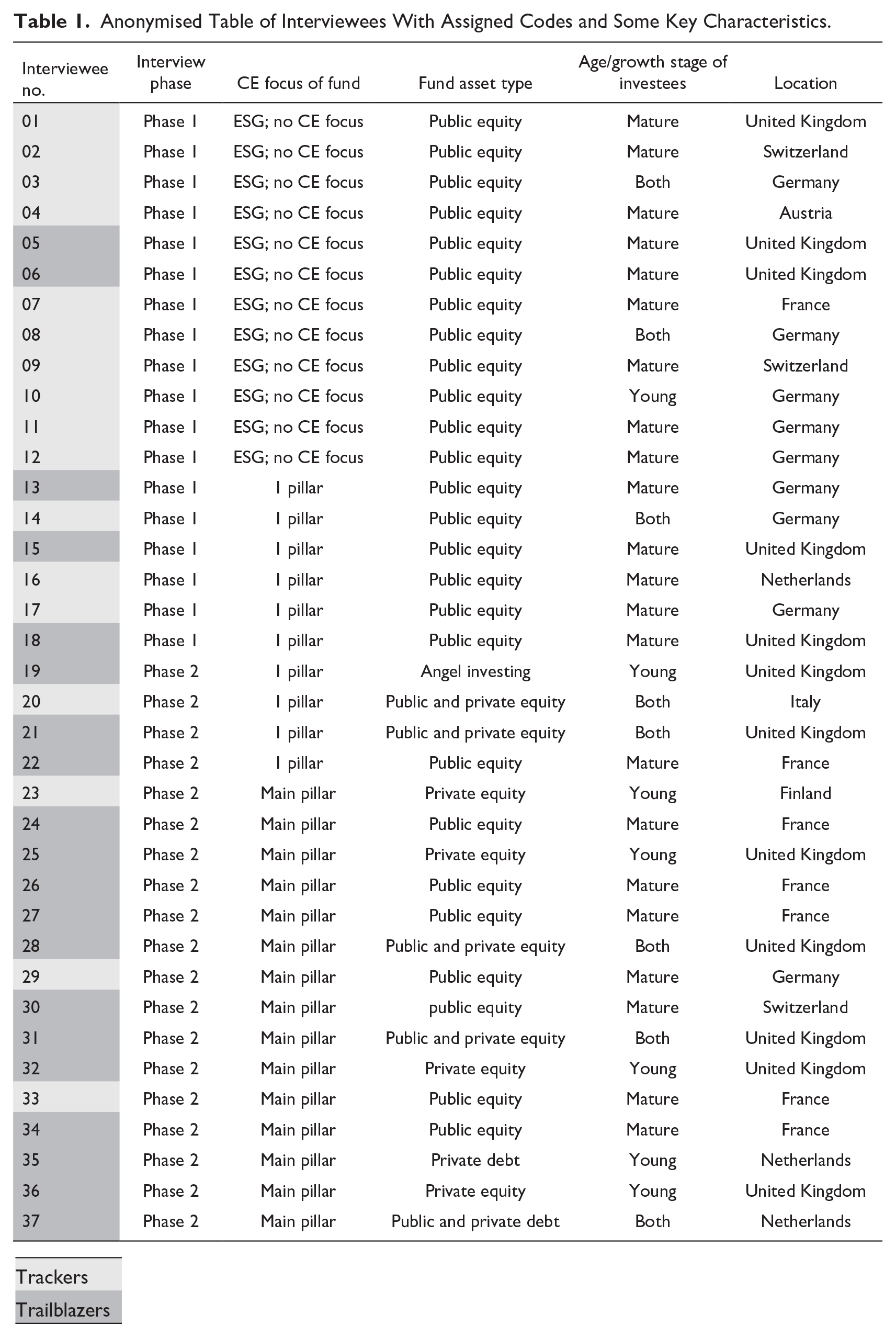
Both samples are deliberately diverse to explore how the financial industry can more broadly support the shift from a linear economy to a circular economy (CE). Financial instruments vary by business development phase: venture capital and private equity typically fund early-stage startups, while bank financing and public stock and bond market listings support larger, established businesses. Depending on their development phase and whether they are startups or corporate transition initiatives, CE businesses are likely to secure capital from different types of financial stakeholders. To capture this diversity, our samples include AMs focused on public capital markets (25 interviews), private markets (7 interviews), or both (5 interviews).
We interviewed AMs from firms located in eight Western European countries: the United Kingdom (12), Germany (9), France (7), the Netherlands (3), Switzerland (3), Italy (1), Austria (1), and Finland (1). We focused on advanced economies with high resource consumption and consumerism, and thus a strong need for circular solutions. Western Europe was chosen due to its active policy-making and public discourse surrounding the CE, such as the EU’s Action Plan on Financing a Circular Economy and the EU Taxonomy’s environmental objective related to a transition to a CE. As CE investing gains traction in Europe but financial support still remains relatively low, this context allows us to explore why this is the case. Table 1 provides an overview of the data sample and its key characteristics.
Data Collection
We selected interviewees using two databases suited for identifying general AMs and CE-specific AMs. For general AMs, we emailed about 250 AMs who were on a mailing list pertaining to funds seeking or holding the FNG Label, a type of ESG certification. For CE-specific AMs, we searched Refinitiv’s database using keywords like “circular,” “resource,” “waste,” “pollution,” and “impact” to identify funds focused on CE themes. We verified both the fund details (to confirm the CE focus) as well as the AM contact details through the AM firm’s website or LinkedIn, and then sent interview invitations via email or LinkedIn message.
Our interview guide, aligned with the standard risk-reward lens used in finance, focused on how AMs assess the value and risk of investing in the CE. For the sample of general AMs, questions aimed to gauge the relevance of CE within the broader ESG or sustainable finance context, their knowledge of CE, and how they make sense of its value and risk. For the sample of CE-specific AMs, the interview questions explored how they conceptualise and define the CE concept, the types of CE strategies or business models they invest in or exclude (and why), the opportunities and risks they perceive, and how they assess the performance of their circular investments. A copy of the interview guide for both AM samples is included in the Supplemental Appendix.
Additional data was collected in the form of publicly available AM firm documents, including website descriptions, fund documents such as prospectuses, key investor information documents (KIIDs), periodic reports, action plans, and position statements. During the interviews, we asked AMs to clarify or elaborate on the information from these sources.
Data Analysis
All interviews were recorded, transcribed verbatim, and then analysed using both inductive and deductive coding—see Tables A and B in the Supplemental Appendix for the respective coding schemes. First, we applied inductive coding for thematic analysis (Table A, Supplemental Appendix) to develop our theoretical model. This involved generating first-order semantic codes, which were descriptive and derived from interviewees’ own words, and second-order latent codes, which abstracted these into more implicit, conceptual meanings relevant to the research question (Terry et al., 2017). We focused on how AMs view the risks and rewards of investing in the CE (i.e., cues and interpretation), examining both their perceptions of value (e.g., benefits, opportunities, returns) and risks (e.g., barriers, drawbacks, costs), as well as how CE investments are implemented in practice (i.e., enactment). Through a process of thematic mapping (Terry et al., 2017), we clustered these codes into distinct patterns that reflect how AMs reduce their sense of uncertainty and ambiguity and create legitimacy around CE investing. We then iteratively discussed and refined the relationships between the emerging themes. This led to the identification of four third-order overarching themes—or distinct sensemaking patterns—that are common to all AMs: categorising, clarifying, validating, and prospecting.
We applied deductive coding (Table B, Supplemental Appendix) to identify three distinct themes related to AMs’ investment practices—innovating, engaging, and promoting—based on the “investor impact mechanisms” framework by Heeb and Kölbel (2020) and Kölbel et al. (2020). The goal was to evaluate which CE investment practices, as discussed by interviewees, have the potential to support transformative change in the real economy and thus enhance the viability of the CE investment category. These practices include (a) enabling sustainable companies to grow by providing new or flexible financial capital or non-financial support, and (b) improving unsustainable companies through active shareholder engagement or sending non-market signals that influence the public discourse by being vocal about investment decisions and why they were made. This analysis led to the classification of AMs into two groups: trackers, whose CE investment practices were judged to be limited, partial or non-transformative, and trailblazers, whose practices were deemed potentially transformative.
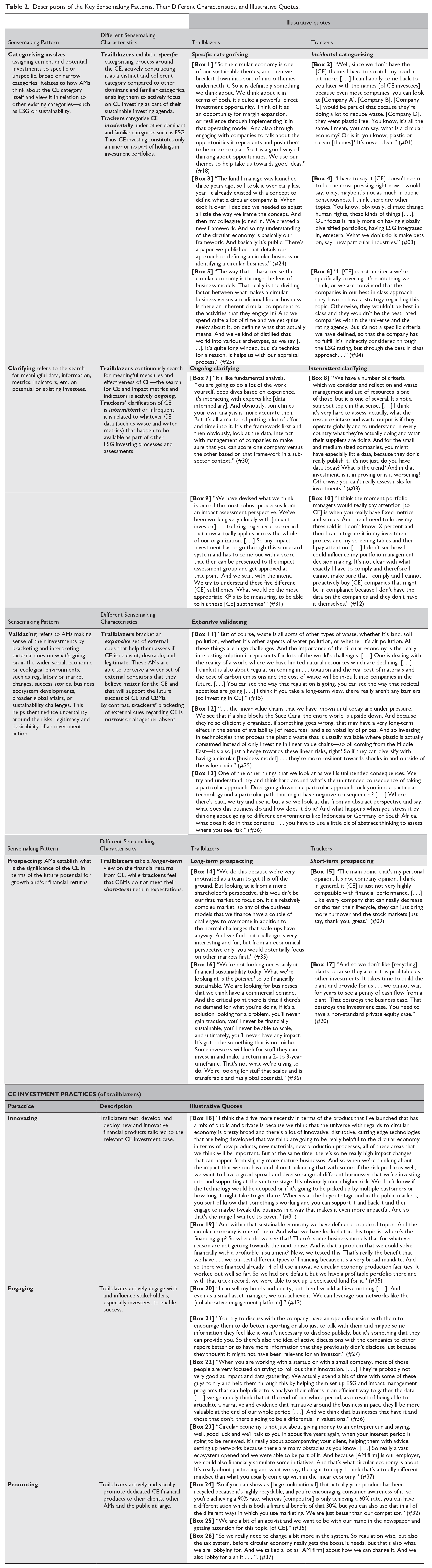
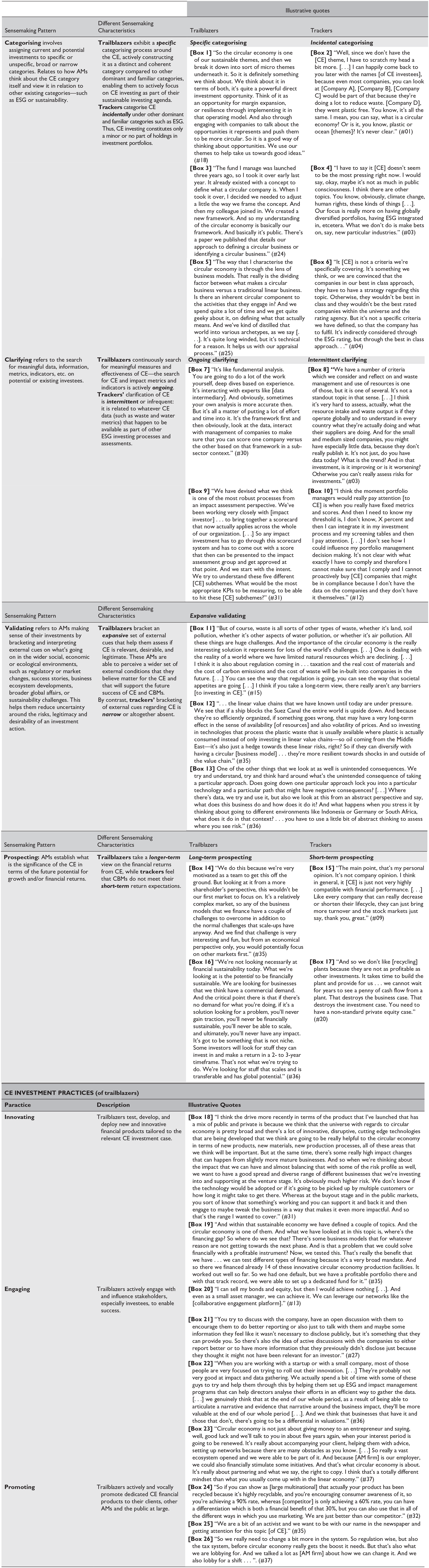
Through further iterative thematic mapping, we identified distinct qualitative characteristics that distinguish the sensemaking patterns of trackers and trailblazers, as well as their interrelationships. For example, whereas trackers’ categorising pattern is incidental and leads to a clarifying pattern that is more intermittent, trailblazers’ specific categorising supports an ongoing clarifying pattern. Table 2 provides descriptions of the key sensemaking patterns (themes), their different characteristics, and illustrative quotes.
Descriptions of the Key Sensemaking Patterns, Their Different Characteristics, and Illustrative Quotes.
Findings
We identified three key sensemaking patterns that AMs use to navigate the risks and rewards of sustainable investing: categorising, clarifying, and validating, which aim to reduce ambiguity and uncertainty; and prospecting, which aims to assess whether and how adequate risk-adjusted returns can be captured. While all AMs engage in these patterns—irrespective of whether they focus specifically on the CE topic or on other ESG or sustainability topics—their approaches to making sense of the CE are qualitatively different. These differences influence how uncertain, ambiguous or risky the novel CE category seems to them, which in turn shapes investment practices that either support or hinder the CE category’s viability and diffusion. From this, we distinguish two AM archetypes:
These two archetypes represent opposite ends of a spectrum regarding the potential to support category viability and an early-stage CE transition. While some AMs fully align with each archetype, others fall in between. However, we distinguish these archetypes to clearly highlight the sensemaking patterns and investment practices that either support or hinder the viability of the CE category and its potential to diffuse in the investment field.
Figure 2A depicts how trackers show incidental categorising, intermittent clarifying, narrow validating, and short-term prospecting of CE. These sensemaking efforts fail to reduce uncertainty and ambiguity about the risks and rewards of CE, leading to either no investment or investment practices that don’t support its viability. As a result, their approach hinders the potential for a transformative CE transition in the investment field.
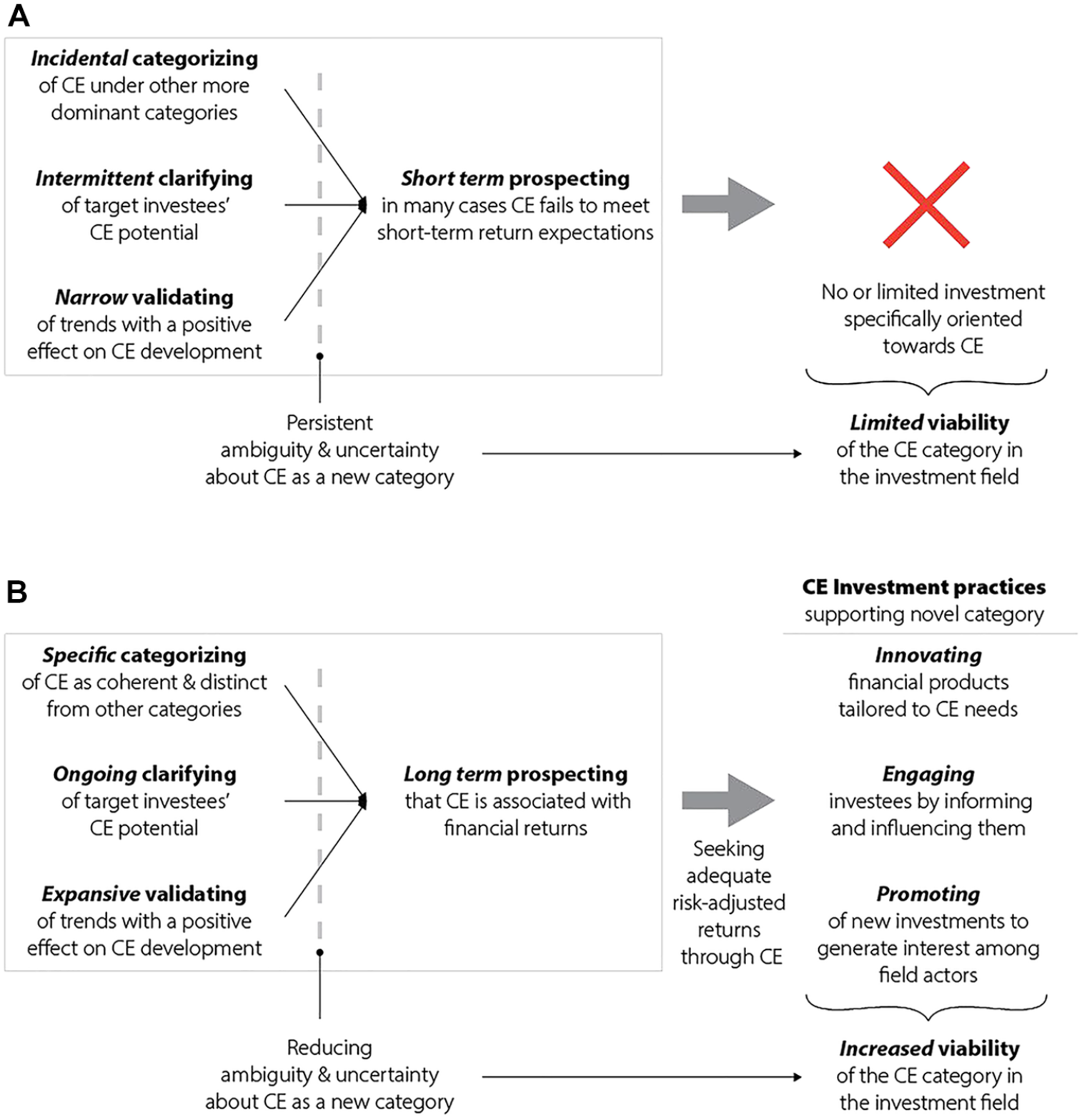
Sensemaking Patterns of Asset Managers: (A) Top: Trackers: Sensemaking Patterns and Investment Practices of AMs Who Limit the Viability of the CE Category in the Investment Field; (B) Bottom: Trailblazers: Sensemaking Patterns and Investment Practices of AMs Who Substantially Facilitate the Viability of the CE Category in the Investment Field.
In contrast, Figure 2B illustrates how trailblazers employ specific categorising, ongoing clarifying, expansive validating, and long-term prospecting strategies to mitigate uncertainty and ambiguity regarding the risks and rewards associated with the CE category. These sensemaking patterns appear much more intensive than those of the trackers, enabling this group to take action through three key CE investment practices—innovating, engaging, and promoting—that reinforce the CE category’s viability. These practices, in turn, strengthen the sensemaking patterns, further reducing uncertainty and ambiguity, and further boosting capital allocation to the CE.
In the following sections, we elaborate on each of the four sensemaking patterns and the three CE investment practices. Within each of these patterns, the bracketing of cues, (re)interpretation, and enactment take place. The four patterns exist in a recursive relationship: they are intertwined and reinforce each other. For each process, we compare the different characteristics of trailblazers and trackers and demonstrate how they influence AMs’ ability to reduce uncertainty about CE risks and rewards, thereby shaping their investment practices and, in turn, impacting the CE category’s viability and potential for transformative change in the investment field.
Categorising
Categorising involves assigning current and potential investments to specific or unspecific, broad or narrow categories. This pattern of bracketing cues, interpretation, and enactment captures how AMs view the CE category itself and how they view it in relation to other established, dominant categories, such as different industries (e.g., education, health care), product categories (e.g., consumer electronics, fashion), asset classes (e.g., equities, fixed-income bonds, real estate), market capitalisation (e.g., small-cap, mid-cap, and large-cap stocks), the 17 Sustainable Development Goals (SDGs), as well as ESG. The categorizing process describes how AMs select, filter, and assemble a complex array of cues associated with the CE, and whether this results in a category that is sufficiently coherent and distinct from existing categories.
Trackers take a relatively passive approach to the CE category, which appears incidentally under other familiar and dominant categories. These categories, such as market cap and ESG, tend to constrain trackers’ sensemaking of the CE category. First, trackers who focus only on large-cap stocks typically exclude small-cap CBMs or startups, which currently comprise the majority of CBMs. Second, trackers’ cues and interpretation as to what ESG investing actually means are shaped by external pressures from policymakers, investor clients, and the general public at large, as well as what kind of information is already provided by ESG rating agencies or other third-party data providers. These tend to prioritise other categories like carbon emissions, climate change, human rights, diversity, and corporate governance, rather than the CE (Table 2, Boxes 4 and 6; also interviewees # 01, 02, 07, 08, 09, 11). As a result, trackers tend to overlook the CE altogether (# 03, 04, 07, 08, 10, 11), unless they see it as relevant in a particular investment case pertaining to a familiar industry or product category with obvious resource- and waste-related risks, such as mining or plastic packaging (# 01, 02, 09, 12, 14, 17). In this manner, incidental categorising restricts trackers’ bracketing of cues around the CE, leading to interpretations that it is irrelevant, risky, or incompatible with their current investment model (Table 2, Box 4). As a result, CE investing (enactment) is secondary to other ESG investing activities, with CBMs and circular initiatives only incidentally included in trackers’ portfolios.
In contrast, the trailblazers exhibit specific categorising patterns around the CE, actively constructing it as a relevant category. They combine labels such as “circular,” “resources,” “waste,” “responsible,” “pollution,” and “impact” to describe their dedicated CE funds or distinct CE pillars within ESG funds. This allows them to give CE its own place within their sustainable investing agenda (see Table 1). They furthermore articulate specific definitions and descriptions of the CE and CBMs, and adapt conceptual CE frameworks to their own needs to define and identify “what’s circular” in their view (selection, filtering, and assembling of cues) and to guide their assessment of potential investments (interpretation). Common frameworks adapted include variations of: Ellen MacArthur Foundation’s (2019) “butterfly diagram” (interviewee # 13, 15, 28, 30, 34, 35); Accenture’s (2014) five circular business models 1 (# 28, 31, 34, 35); Achterberg et al.’s (2016) “value hill” (# 35, 37); and the Circular Economy Finance Guidelines (ABN et al., 2018) 2 (# 35, 37). This, for example, entails merging categories from these frameworks, such as “sharing platform” and “PSS,” into a single category named “circular use.” Alternatively, it can also involve omitting circular practices proposed by these frameworks where the AMs do not currently see investment opportunities. Furthermore, trailblazers use examples of prototypical firms that they believe are most representative of the specific CBM sub-categories (exemplars). These practices help trailblazers make CE their own and support the ongoing clarifying pattern (Table 2, Boxes 5, 7, and 9) (see below). Typically, however, these AMs see a broad range of circular strategies and business models as relevant, for which—in some cases—they even construct customised risk-return profiles associated with CE sub-categories (also see prospecting below).
In sum, whereas incidental categorising relies on habitual and passive sensemaking, specific categorising is a form of active sensemaking that allows the AM to recognise a broad range of CE investment opportunities and perceive them as valid. Trailblazers bracket a wider set of relevant cues around the CE, enabling more holistic investment appraisals (interpretations) and guiding capital allocation (enactment) toward a broader range of CBMs and initiatives (# 25, 28, 30, 31, 32, 34, 36). In addition, it helps AMs understand the CE category’s meaning and connection to other sustainability-related categories, such as climate, CO2 emissions, biodiversity, or the SDGs (# 13, 18, 21, 22, 24, 27, 28, 30, 31, 35, 36), by regarding CE simultaneously as a theme that cuts across these goals and a means to achieve them.
Clarifying
Clarifying refers to AMs’ particular sensemaking pattern whereby they search for meaningful data, metrics, and indicators about each firm’s characteristics and performance that they fund or consider funding. This pattern helps AMs seek information (cues), assess performance (interpretation), and enact financial resource allocation by shaping views on a firm’s future prospects in relation to risk and reward expectations. In essence, clarifying helps AMs navigate the ambiguity and uncertainty of specific investment opportunities and enables investment decisions.
Trackers intermittently clarify CE-related issues, relying heavily on external ESG ratings and data that often (at present) inadequately cover the CE theme. They rarely make sense of CE within their organisation, instead allowing others to define and assess it. This stems from their incidental categorising of CE as secondary to other sustainability categories, leading trackers to focus on non-CE-specific data. Consequently, CE clarification occurs only when CE-related cues appear within broader ESG data (Table 2, Boxes 8 and 10; also interviewee # 02, 04, 07, 08, 11). Combined, these sensemaking processes hinder their ability to identify, assess, and evaluate investees aligned with CE goals. As a result, they cannot invest, because they do not have—but also do not seek—the data. While they may inadvertently invest in CE, this is not a deliberate practice or pursuit.
In contrast, trailblazers take a different approach. First, they utilize the frameworks they have constructed (specific categorising) and link these to KPIs, for which they collect existing data about investees,either in the public domain or from existing databases. Second, they develop CE-specific assessment tools and methods and focus on data directly related to current or potential CE investees. This includes qualitative and quantitative metrics on sustainability, impact, circularity, and financial performance. This is done in different ways: through dedicated CE research roles or departments (# 25, 27, 28, 30, 31, 37), forming partnerships with CE-specific data providers to address gaps in current ESG data (# 21, 30, 32, 35, 36, 37), and engaging directly with investees (# 13, 21, 22, 24, 27, 30, 31, 32, 34, 35, 36, 37). See Table 2, Boxes 5, 7, and 9 for illustrative quotes.
Notably, many trailblazers also emphasise that the CE’s complexity and variability pertaining to interdependent industries, materials, and product systems make standardised, “one-size-fits-all” metrics ineffective (# 24, 25, 27, 28, 31, 32, 36), further highlighting the need for partnerships with specialist data intermediaries supplemented by internal research on their own investees. For example, the business model, industry, geography, product, materials, and so on are all details that can affect the assessment.
Guided by specific categorising, they target and shape data requirements to align with their focus (cues and interpretation). Next, they enact the clarifying pattern by first, taking what data they can easily get and second, by seeking out more detail through their actively constructed assessment approaches. In this manner, ongoing clarifying helps trailblazers reduce uncertainty and ambiguity about CE’s long-term risks, benefits, and impact on financial returns and sustainability. This furthermore supports long-term prospecting (see below), and thus strengthens the CE category, boosting its viability.
Validating
Through validating, our interviewees establish the legitimacy and desirability of their investments by bracketing and interpreting cues from past and future external events and broader economic, social, and ecological contexts. AMs’ interpretations are grounded in establishing and triangulating facts such as regulatory and market changes and broader global affairs that they perceive as having the potential to indirectly affect future investee performance. Thus, AMs connect the process of validating with prospecting by interpreting how external conditions and trends create barriers or opportunities for return potential.
Trackers tend to present a narrow or absent validating pattern around the CE. Influenced by their incidental categorising and intermittent clarifying patterns, this narrow approach prevents them from bracketing and interpreting cues pertaining to the complex external conditions and contexts, enabling or hindering different CBMs and circular initiatives. As a result, trackers struggle to reduce their sense of uncertainty and ambiguity around the broad array of potential CBMs and circular initiatives, as well as their ability to prospect for potential opportunities, resulting in no or only limited investment in the CE and hindering the viability of the CE category.
In contrast to the trackers, the trailblazers seek and interpret cues that are relevant for stimulating a broader future transition towards a CE, such as market and technological developments (# 18, 21, 22, 25, 28, 31, 32, 35, 36), consumer trends (# 15, 18, 19, 21, 25, 27, 34, 36), broader global affairs relating to the flow of resources (# 18, 30, 35), as well as how industry circular value chains and ecosystems are developing and how supportive they are (# 24, 25, 30, 32, 35, 36, 37). Further examples include past and current success stories of CBMs and circular initiatives (# 24, 25, 35), regulatory developments and the extent to which specific governments are supporting the CE through policy and public investment (# 15, 18, 21, 25, 27, 30, 31, 32, 35, 36, 37), as well as the significance of ecological and social sustainability trends relating to waste and resource management (# 13, 18, 19, 25, 28, 30, 31, 32, 36).
Therefore, the trailblazers can be said to make sense of CE through expansive validating, as they bracket a wide set of external cues that help them interpret the legitimacy and desirability of CE investments in broader socio-economic or socio-ecological contexts (Table 2, Boxes 11, 12, 13). Through expansive validating, they gain deeper insights into the barriers and enablers of circular solutions and what needs to be changed or supported in broader systems. By gaining visibility into risks and circularity gaps in linear value chains (Table 2, Box 12) and where the development of new CBMs or improvements in mature linear companies offer advantages (# 25, 30, 32, 34, 35, 36), they connect expansive validating with long-term prospecting, using these insights to uncover investment opportunities with long-term return potential.
The sensemaking patterns discussed so far have contributed to understanding the risks associated with investing in CE (or not) and an investment’s potential for success, thereby reducing uncertainty and ambiguity about risks and potential rewards. The next section, on the prospecting pattern, covers whether or not the CE is viable as an investment category and how adequate risk-adjusted returns can be captured.
Prospecting
In the prospecting pattern, the inputs from the preceding patterns—categorising, clarifying, and validating—come together for AMs to reach a judgement on whether CE is worthwhile to develop as a coherent and distinct investment category. The central question here:‘Is CE viable?’
Trackers approach this question from the perspective of whether or not it is compatible with their current investment approaches. This can be seen as problematic. For example, managing highly liquid public funds with quarterly time horizons or private funds with 3- to 5-year exit strategies creates pressure to deliver short-term returns. This can render CBMs and circular initiatives as financially unappealing due to high(er) upfront costs (e.g., building recycling plants or PSS systems) and delayed profitability (Table 2, Boxes 15 and 17; also interviewee # 01, 03, 14, 20).
This manner of prospecting is influenced by trackers’ preceding sensemaking patterns of incidental categorising, intermittent clarifying, and narrow validating, which create the conditions for an unfavourable view of CE. They limit the scope of cues around the CE to whatever is already most readily available—namely traditional “linear” financial indicators and risk assessments—which do not capture the long-term returns and long-term risk-mitigation effects of CBMs—making them appear financially unattractive compared to linear business models. Such a focus on short-term financial indicators leads trackers to perceive CE investments as risky, limiting their investment and hindering CE’s viability.
In contrast, trailblazers approach this question differently, viewing investment in CE as potentially viable, albeit not yet ready to “hit the ground running.” Their prior sensemaking—through specific categorising, ongoing clarifying, and expansive validating—enables a long-term, holistic view of CE, reducing uncertainty around the long-term returns from CBMs or circular initiatives, as well as their legitimacy and desirability. This allows trailblazers to feel more confident in investing in CE and form stronger investment convictions. For instance, expansive validating highlights long-term “linear risks” and demonstrates how circular solutions can benefit financially from structural trends in waste and resource management (Table 2, Box 12). It also helps AMs understand external future conditions that will enable CBMs or circular initiatives to gain market share from linear models and scale up regionally or globally (Table 2, Box 16; interviewee # 15, 19, 21, 25, 26, 31, 32, 35).
However, trailblazers acknowledge that action is needed to capture the CE opportunity. They adopt a long-term perspective, anticipating returns beyond quarterly or annual horizons, and are willing to accept lower short-term returns in exchange for greater long-term impact (Table 2, Boxes 14 and 16; also interviewees # 15, 21, 22, 25, 28, 32, 35). In addition to this, they also exercise agency through specific CE investment practices—innovating, engaging, and promoting (see below). This means that while they also recognize the challenges (cues and interpretation), they see possibilities for overcoming them by being proactive. Thus, through their enactment—being proactive and a willingness to adapt their investment practices—the viability of CE as an investment category is further enhanced, creating a virtuous loop.
CE Investment Practices of Trailblazers
A behaviour that trackers and trailblazers share is that they re-label and regroup current investees as “circular.” In this sense, having a CE category of investments does not always lead to new companies being invested in. However, in addition, the trailblazers have changed their organisational practices in the following way.
Innovating: Developing Financial Instruments for CE
Through the CE investment practice of innovating, trailblazers test, develop, and deploy new or innovative financial products tailored to the unique CE investment case.
First, our interviews reveal how trailblazers develop financial instruments that mitigate and manage the risks of large, capital intensive CE investments, thus helping to plug the common funding gaps which prevent CBMs from growing and maturing to commercial, profitable scale—and enabling them to attract bank and/or public equity finance later on (Table 2, Box 19). Second, our interviews reveal how trailblazers launch hybrid investment vehicles or multiple financial product lines that are able to access and invest in a combination of both innovative startup CBMs in the private markets as well as large, more traditional CBMs in the public capital markets (Table 2, Box 18; also interviewee #28).
These innovative practices are supported and facilitated by the sensemaking patterns of specific categorising, ongoing clarifying, and expansive validating, through which trailblazers bracket and interpret cues around a wide variety of new and innovative CBMs and CE solutions that are needed to facilitate circularity in different parts of industry value chains at different material/product life cycle stages—and develop an in-depth understanding of the unique reasons for their failure to attract investment. Because they also widen the bracketing and interpreting of cues to circular solutions encompassing both the growth of circular startups and the improvement of mature, “linear” companies, trailblazers actively aim to capture returns from CE by developing investment products that cover the full range of CBMs/CE solutions at different stages of business maturity that are needed to facilitate the CE transition. Furthermore, through long-term prospecting, trailblazers then actively aim to mitigate the unique risks and capture long-term value from CBMs and circular initiatives by designing financial vehicles and instruments that specifically address these financial barriers—significantly contributing to the CE category’s viability and the potential for transformative change.
Engaging: Non-Financial Strategic Support for Investees
Through the investment practice of engaging, trailblazers directly influence stakeholders, especially investees, to enable success. The sensemaking patterns of ongoing clarifying, expansive validating, and long-term prospecting foster engaging, while in turn, the practice of engaging supports and reinforces the sensemaking patterns. Below, we summarize the different forms of engagement among trailblazers, while highlighting the interconnections between engagement and the sense-making patterns.
Ongoing clarifying drives AMs to engage with investees, and the engaging practice in turn further supports ongoing clarifying. In the private markets, trailblazers believe that investees with strong governance and sustainability credentials are less risky and achieve higher valuations upon exit (e.g., Table 2, Box 22). This motivates them to closely engage and assist investee managers to develop know-how and internal capacity for ESG best practices, impact targets, measurement and reporting, embedding these routines into company culture from an early stage of company development (# 25, 32, 36, 37). In the public markets, ongoing clarifying also leads trailblazers to engage with investees to address data gaps, reduce ambiguity and uncertainty, and identify areas for improvement, refining the specific points for discussion on CE with investees’ top management teams (Table 2, Box 21; also interviewee # 13, 21, 22, 24, 30, 31, 34)—thus influencing investees at the strategic level. Through the interplay between ongoing clarifying and engaging, trailblazers ensure that CBMs are not only circular but also sustainable.
Through expansive validating and long-term prospecting, trailblazers in private markets seek to understand the broader business ecosystem around their investees and then actively engage with various stakeholders to mitigate risks and boost returns from circular investments. For example, they facilitate partnerships between CBM startups and linear incumbents, helping startups secure supply or purchasing commitments and enabling linear companies to adopt circular practices (#35). AMs also facilitate cooperation between CBMs and specialised consultants, lawyers, and financial experts on technological, legal, and insurance matters (# 35, 37). In addition, expansive validating drives trailblazers to sponsor multi-stakeholder, cross-sector networks and partnerships with governments, academics, NGOs, and other financial services entities, further strengthening the validating process (Table 2, Box 23). To support this, they implement internal changes, such as training relationship managers and hosting CE innovation workshops (#37).
Through expansive validating and long-term prospecting, trailblazers in public markets pinpoint the industries and value chains most likely to benefit from circularity, and actively engage with both potential and existing linear investees to influence improvements that they believe will mitigate risks and enhance long-term company value. These AMs are convinced that the greatest financial returns and sustainability impacts come from large, linear investees adopting CE strategies and CBMs, and that failure to meet circularity or sustainability targets creates reputational and financial risks for the AM firm (# 06, 13, 24, 27, 30). This leads to further active engagement with investees’ top management teams and ongoing clarifying of CE strategies, interim targets, and actual implementation (# 13, 21, 22, 24, 27, 34). For example, one smaller trailblazer initiated a collective engagement initiative via a joint platform with larger AMs to motivate the implementation of circular packaging solutions in a large consumer goods company. As more AMs engaged, the investee’s management committed to circularity targets and to developing initiatives for plastic waste reduction (Table 2, Box 20).
The engaging practice, in turn, enables long-term prospecting. By helping CBM startups to develop effective governance and impact measurement, influencing the stakeholder ecosystem around them, or persuading incumbent linear investees to improve, trailblazers seek higher valuations and returns by shaping the risk and reward conditions of their investments, and thereby substantially enhancing the viability of the CE category.
Promoting: External Communication
Through the practice of promoting, trailblazers promote their dedicated CE financial products to their clients, other AMs, and the public at large. As is the case with the investment practices of innovating and engaging, promoting is supported by the preceding sensemaking patterns.
Specific categorising helps trailblazers draw public attention to the CE category and why it is important to invest in it, such as through dedicated CE funds or a specific CE pillar within an ESG fund (e.g., Table 2, Box 25). Long-term prospecting enables them to publicly promote CE’s financial benefits and attract capital from a broader spectrum of investor clients (Table 2, Box 18), while ongoing clarifying helps trailblazers build a credible narrative around CE success stories and to promote them publicly (Table 2, Box 24). Expansive validating raises awareness among key stakeholders about how CE offers solutions to long-term structural trends and why CE is necessary because of these trends, highlighting what’s missing, and calling for action from policymakers, corporations, and investors to support CE (Table 2, Box 26). In this way, promoting supports the increased viability of the CE category in the investment field.
Discussion
To understand how CE can move beyond utopian paralysis and instead towards concrete shifts in established practices, we conducted 37 semi-structured interviews with asset managers (AMs), as one of the key stakeholders in the CE transition. Central to our work was the question: How does the CE become a viable category in the investment field? Based on our empirical analysis, we suggest that the evolution of CE as a category can become a source of real change rather than maintaining an incremental and add-on status to the existing linear economy (Clube & Tennant, 2020). Our approach was guided by category studies and sensemaking, examining the micro-process through which the viability of CE as an investment category is constructed or fails to be constructed, amid other existing categories such as ESG and impact investing.
We confirmed that AMs face significant ambiguity and uncertainty when dealing with the CE as a novel category. This is further complicated by the evolving and inconsistent landscape of definitions, frameworks, and taxonomies that often lack coherence and sufficient granularity for CE investing (Dewick et al., 2020).
However, we also found that AMs span a spectrum with regard to how they confront this, with the two archetypes of trackers and trailblazers occupying the opposing ends. Our theoretical model, depicted in Figure 2, explains how these different positions are reached by identifying three sensemaking patterns aimed at reducing ambiguity and uncertainty around CE—categorising, clarifying, and validating—and one that seeks adequate risk-adjusted returns—prospecting. The different positions are reached by approaching these four sensemaking patterns in qualitatively different ways.
AMs’ qualitatively different micro-level sensemaking patterns can contribute to either reinforcing or overcoming the macro-level phenomena of circular utopian paralysis. For example, trackers reinforce utopian paralysis through the sensemaking patterns of incidental categorising, intermittent clarifying, narrow validating, and short-term prospecting. Their overreliance on other dominant categories and failure to construct the CE as a sufficiently distinct and coherent—and therefore viable category (Lo et al., 2020)—means that trackers maintain a persistent sense of ambiguity and uncertainty, and perceive inadequate risk-adjusted returns from CE investing. In contrast, trailblazers actively work to resolve the gap between utopian visions and concrete actions through the sensemaking patterns of specific categorising, ongoing clarifying, expansive validating, and long-term prospecting. Trailblazers move beyond utopian paralysis by actively reconfiguring and expanding their sensemaking around the CE category, allowing them to develop new interpretations and to experiment with viable investment practices that have the potential to facilitate a CE transition in the investment field. Thus, through the categories and sensemaking lenses, we offer important theoretical insights into the micro-foundational sources of circular utopian paralysis—and how it is either perpetuated or overcome.
The two AM archetypes situated along a spectrum of transformation implies mobility along its axis, ideally moving towards “real utopias”—that is, “utopian” because they articulate new future visions and alternatives, and simultaneously “real” because they are grounded in the possibilities of present-day realities (Gümüsay & Reinecke, 2022). While we acknowledge that trailblazers are starting on a path towards real utopia, none of them fully represent even more transformative CE investment theories and practices that transcend traditional finance and whose implementation is still emergent, such as value chain financing (European Commission, 2019), systemic investing (Jay & Yau, 2023; Tews et al., 2025), and the financing of entire circular ecosystems (Boyd & Reardon, 2023). This implies that there is a third group—which we label transformers—who are even more progressive than our trailblazers. Thus, in the following, we highlight what support or interventions could contribute to moving each of the two sensemaking archetypes further along this spectrum, as well as towards more transformative practices that we did not see evidence of in our sample. We regard the following recommendations as areas for further work and future research.
Recommendation 1: From Incidental to Specific Categorising, and Beyond
An important aspect that distinguishes trailblazers from trackers is that they see CE as both a cross-cutting category and a means to achieve a range of sustainability, impact, and financial objectives. To help trackers see this also, it may be helpful to provide education as well as case studies and lighthouse examples that demonstrate how circular strategies resolve business challenges and deliver on a range of objectives, such as profitability, resilience, cost savings, innovation, and sustainability—while making sure that an explicit link is made to other already existing categories and labels commonly used in finance. This could be done by including CE examples in existing training and curricula for finance as well as adapting and elaborating the current databases of CE-focused case study examples with information relevant for the financial industry.
Such real-world examples and case studies could also demonstrate how existing linear businesses have incorporated significant circular elements. In this way, circular strategies are connected to familiar linear practices in a manner that demonstrates their compatibility and how steps towards the CE can be taken. One example is the classic case of Ricoh, a producer of copiers that has successfully added a remanufacturing arm to its operations as a way to regain and maintain competitiveness across different market segments (Hopkinson et al., 2018).
While an argument can also be made to develop and widely adopt shared definitions and frameworks—such as the ISO standard for CE and the EU Taxonomy which includes a CE objective—it is also important to be mindful of the usefulness of deliberate ambiguity. This enables AMs to make CE “their own,” facilitating adaptability and linking with existing categories in different ways, thus preserving the more innovative behaviours of the trailblazers. If a definition of CE is too prescriptive and an AM disagrees with it or cannot adapt it to their own context, the CE concept may be dismissed altogether (Dewick et al., 2020).
Another behaviour that we observed that could be leveraged is that of creating exemplars. A service could be provided that examines the various existing investment products and portfolios of trackers, identifying investees that are already part of the CE. Such a mapping could provide a first step towards creating a new CE fund. As a next step for trailblazers, such a mapping could explore whether their CE fund has connections with other investment products or portfolios. For example, a recycler that is part of a CE fund could be linked to a producer of plastic packaging that is currently assigned to another fund to explore how these firms can be linked, creating both a market for the recycler and managing a potential risk for the packaging producer.
Recommendation 2: From Intermittent to Ongoing Clarifying, and Beyond
While efforts are underway to generate more data on the waste and resource management practices of businesses as part of various policy initiatives, and anticipating that this data will eventually become available through databases that AMs commonly use (such as Bloomberg), it will also take many years for these efforts to bear fruit. In the meantime, it may be helpful to provide more insight into the processes, methods, and tools that trailblazers apply to both finding and working with existing CE-specific data. Case study descriptions that focus on the process of creating these—as opposed to the specific, often proprietary assessment methods that result from it—could help trackers to understand what next steps they could take. For example, they could conduct experimental data pilots, where they engage with one or a small set of investees to understand what and how data needs to be generated.
In the medium term, it would be helpful to develop modular sets of CE-specific metrics for the financial industry, which take into account relevant details of a business model, industry, geography, product, specific resource, material, and so on—all details that can affect the assessment. Such a set could provide, while not a complete solution, at least a lower-threshold entry point for trackers to adapt to their own needs.
In turn, these short- and medium-term efforts could be used as input into larger and long-term standardisation efforts that facilitate linking of circular strategies within and across sectors and different life cycle phases in line with the concept of circular configurations—for example, how value chains can best be linked so that sets of circular strategies become cooperative and synergistic instead of competing with each other (Blomsma & Brennan, 2017).
Recommendation 3: From Narrow to Expansive Validation, and Beyond
To a degree, all AMs consider broader and long-term trends (such as policy and technology) to assess whether an investment is worthwhile. The inclusion of waste and resources in this is not uncommon. However, the expansive validating of trailblazers allows them to assign a much greater significance to developments that affect waste and resources. This raises a question, could the reverse also be true: where the current validating process of trackers is redesigned such that it becomes a trigger for sensemaking around waste and resource management—leading to a greater awareness of CE? For example, by connecting trends and risks such as resource scarcity, export restrictions, and price volatility, a theme such as reliable access to rare earths can gain greater significance, which can shift perception to the importance of the longevity of equipment, reuse of components, and recycling of materials. Such a small change could have a potentially big effect.
A further next step, for both trackers and trailblazers, is to take into account different types of structural waste in their validating, that is, the seen and unseen types of waste that occur between processes and stakeholders (Blomsma, 2018). An example is the company Riversimple, which provides mobility-as-a-service and is on a mission to demonstrate that cars are needlessly heavy and thus inefficient. By redesigning for radical efficiency (up to 3x more efficient) and applying longevity and refurbishment strategies, they can deploy resources much more competitively (Blomsma et al., 2023). Eliminating this taken-for-granted waste is, for Riversimple, a source of value creation. Such a shift in how waste is perceived could also open up new solution spaces for AMs and other types of financial stakeholders.
Recommendation 4: From Short-Term to Long-Term Prospecting, and Beyond
Real-world examples and case studies to support the prospecting pattern should also be provided on the AMs themselves. These case studies should focus on the developmental trajectories of their CE funds and thus provide trackers with a roadmap of what changes they could make. For example, what set of relatively simple steps can be taken to include CE as a focus area? And what would the next steps be? Think of the creation of a ladder, continuum, or maturity model. Providing such pathways may make the effort appear more manageable, showing the viable steps that trackers could take and supporting a willingness to change.
Last but not least, although trailblazers aim to actively influence the stakeholder ecosystem around their investees—typically through non-financial means—portfolio investments are always undertaken separately in individual companies, rather than holistically in entire circular value chains or ecosystems. Thus, while systemic investing (Jay & Yau, 2023; Tews et al., 2025) and strategies for the financing of entire circular ecosystems has been proposed (Boyd & Reardon, 2023), these practices were not seen in our interview sample—nor any ambitions or inclinations to explore this. However, given that no firm can become circular on its own, shared initiatives, collaboration, and new infrastructure have to be created; such financial instruments hold significant potential. Thus, a next step for trailblazers could be to consider innovative mechanisms for governing and financing entire circular ecosystems in a way that aligns stakeholder interests, decreases risk, and leads to greater gains for all firms in the ecosystem in the long term (Boyd & Reardon, 2023)—and to find ways to experiment with such practices.
Conclusion
Accelerating the transition to a sustainable economy requires substantial financial capital to support businesses at the forefront of change (Davis, 2009). Our research contributes to scholarly discussions on how the transition from a linear economy to a CE unfolds in the investment field (Barrie et al., 2023; Dewick et al., 2020; Fallahi et al., 2022; Toxopeus et al., 2021). Understanding the micro-level sensemaking dynamics of the CE transition (Kuhlmann et al., 2023) is essential for fostering change at the macro-level (Haack et al., 2020), as they reveal how decision-makers navigate and implement novel categories, such as the CE. By drawing on the sensemaking perspective (Weick, 1995), we unpack how AMs interpret and enact the CE as a novel category (Durand & Khaire, 2017; Korhonen et al., 2018), shedding light on the micro-processes through which it takes root in the early stages of development in the investment field, and how these micro-processes shape bottom-up transitions in a field with other established but related categories (Bertassini et al., 2021; Kuhlmann et al., 2023; Vergne & Wry, 2014).
Our theoretical model (Figure 2) shows the sensemaking micro-processes through which AMs navigate the ambiguity and uncertainty associated with the novel CE category (Balogun & Johnson, 2004; Glynn & Navis, 2013; Weick, 1995), which is a key mechanism that enables the evaluation of potential risk-adjusted returns and the ability to take concrete investment actions. This aligns with calls to bridge the gap between utopian futures and practical, actionable steps that can create meaningful societal transformation (Gümüsay & Reinecke, 2022). Grounded in the real-world context of asset management, our empirical evidence highlights the sensemaking processes that financial actors employ to increase the viability of CE as an investment category, fostering investment practices that reflect practical yet transformative changes required to overcome utopian paralysis and help turn the CE vision into reality. In the following sections, we highlight how our findings contribute to the domains of category studies, sustainable investing, and CE narratives, providing theoretical insights into the sources of utopian paralysis and how it could be addressed.
Category Studies
We contribute to category studies by highlighting which forms of sensemaking promote category viability and which ones do not (Lo et al., 2020) in fields dominated by established categories (Zuckerman, 1999). Through sensemaking patterns of specific categorising, ongoing clarifying, expansive validating, and long-term prospecting, trailblazers work to construct the CE as a coherent and distinct category (Lo et al., 2020), enabling them to distinguish the novel CE category from established but related categories, such as ESG, and to make it viable for investment purposes. Trackers, on the other hand, did not distinguish the CE as a distinct category, instead treating it as a subset of the broader ESG framework.
This reflects how related categories can influence sensemaking processes, as actors often rely on established categories to make sense of novel ones (Vergne & Wry, 2014). This interplay between novel and established categories highlights how the presence of mature categories can shape and sometimes impede the adoption of emerging categories by blurring their boundaries, diluting their distinctiveness, and reducing their coherence (Lo et al., 2020; Zuckerman, 1999). As a result, actors may unintentionally limit their ability to grasp a novel category’s distinct value proposition (Vergne & Wry, 2014). While our findings support the view that coherence and distinctiveness are essential for category viability (Lo et al., 2020), we elaborate on this by demonstrating how sensemaking processes can either enable or undermine actors’ ability to distinguish the value of novel categories from familiar, related ones. From this, we suggest that utopian paralysis can arise from persistent micro-level cognitive ambiguity and uncertainty surrounding a novel category, which impedes actors’ ability to properly assess its risks and rewards, thus preventing the category from becoming viable within a particular field.
Furthermore, our model shows that, through the prospecting pattern, the viability of the CE as an investment category is closely tied to how AMs perceive its financial prospects, aligning with prior research indicating that financial performance is vital to the legitimacy of novel categories in investment fields (Baker & Filbeck, 2015; Crifo et al., 2019). Intense sensemaking helps AMs deepen their understanding of whether the CE can deliver such returns (Tapaninaho & Heikkinen, 2022), leading them to establish whether the CE is a financially viable category before taking action to further secure its viability.
Sustainable Investing
We contribute to the sustainable investing literature by providing empirical insights into the micro-foundations that connect idealised utopian futures with real-world investment practices. Our theoretical model shows the mechanism through which sensemaking processes around CE as a novel investment category can prompt financial actors to form investment practices—innovating financial products, engaging with stakeholders extensively, and promoting new investments publicly—that serve as the foundation for more transformative and impactful investment portfolios. By exploring how AMs interpret the novel CE category and translate it into tangible enactment, we uncover how key sensemaking micro-processes can either sustain utopian paralysis or facilitate a sustainable CE transition through more transformative investor impact mechanisms (Heeb & Kölbel, 2020; Kölbel et al., 2020).
As a novel category, the CE lacks clear prescriptions on how financial actors can adapt and integrate it into their investment practices (Dewick et al., 2020). Translating the CE into concrete actions requires intense sensemaking to move from confusion to comprehension (Sandberg & Tsoukas, 2015). Our model highlights the recursive relationship between sensemaking patterns and investment practice formation that advances the CE’s viability (Lo et al., 2020). Trailblazers’ intense sensemaking patterns help them transition from initial sensemaking around the CE category’s viability to creating precise, actionable roadmaps for investment that further support its viability. As AMs implement and adjust their practices, they further refine their understanding of the CE as a viable investment category. This aligns with prior research on the importance of the iterative interplay between sensemaking and action (Maitlis & Christianson, 2014; Weick, 1995). Furthermore, while sensemaking helps actors to enact a novel category, it is through the establishment of concrete practices that they make it meaningful to others (Arjaliès & Bansal, 2018; Wegener et al., 2024)—thus increasing the CE category’s viability and broader adoption in the investment field.
CE Narratives
We contribute to the literature on CE narratives and discourses (e.g., Calisto Friant et al., 2020; Leipold et al., 2023), by unpacking how certain interpretations of CE come into being. Our micro-level analysis of cognitive processes and enactment complements existing macro-level analyses of CE narratives and discourses, developing a more complete multi-level understanding of how CE transitions unfold. By contrasting and comparing two groups of AMs—trackers and trailblazers—we provide insight into which sensemaking patterns lead to the CE concept being largely overlooked and which ones lead to more transformative interpretations. With this, and our recommendations for further work, we have contributed to making CE truly transformative.
Our findings have significant implications for both research and practice that can help to shift the CE concept from an abstract utopian ideal to an enacted reality. For researchers, we demonstrate the value of micro-foundational approaches in understanding sustainability transitions, suggesting that future work should further examine the interplay between cognitive processes, organisational- and field-level category emergence, and macro-level systemic transitions. For practice and policy, we identify specific cognitive interventions to move beyond a state of circular utopia and overcome transition paralysis. As Karl Weick (1995) already pointed out, small changes in how people frame the world can produce large-scale transformations.
Supplemental Material
sj-docx-1-oae-10.1177_10860266251342567 – Supplemental material for The Micro-Processes of Transitioning to a Circular Economy Through Capital Allocation: A Case of the Investment Field
Supplemental material, sj-docx-1-oae-10.1177_10860266251342567 for The Micro-Processes of Transitioning to a Circular Economy Through Capital Allocation: A Case of the Investment Field by Julia Anne Gross, Fenna Blomsma, Ibrat Djabbarov and Timo Busch in Organization & Environment
Footnotes
Declaration of Conflicting Interests
The author(s) declared no potential conflicts of interest with respect to the research, authorship, and/or publication of this article.
Funding
The author(s) received no financial support for the research, authorship, and/or publication of this article.

Supplemental Material
Supplemental material for this article is available online.
Notes
Author Biographies
References
Supplementary Material
Please find the following supplemental material available below.
For Open Access articles published under a Creative Commons License, all supplemental material carries the same license as the article it is associated with.
For non-Open Access articles published, all supplemental material carries a non-exclusive license, and permission requests for re-use of supplemental material or any part of supplemental material shall be sent directly to the copyright owner as specified in the copyright notice associated with the article.
