




Abstract
Circular economy (CE) is both contesting the status quo and a contested idea, for which many competing understandings and implementations exist. And yet, analyses of the role of social conflicts and pluralism are rare in the CE literature, overly focused on convergence and cooperation. To address this research gap, we draw on Mouffe’s “agonistic pluralism” political theory. Empirically, the study focuses on the interplay between different groups of actors in shaping the right to repair (R2R) policy debate in the European Union (EU) context. Deploying a process method consisting of secondary data and semistructured interviews, our analysis shows that productive conflicts between the R2R campaign and manufacturers did foster mutual learning, unlikely convergences, and a more pluralist European repair ecosystem. We call this dynamic “agonistic circularity.” We highlight the limits of both “harmonious” and “antagonistic” circularity, outlining a pluralist integrative model of CE politics.
Keywords
Introduction
In a decade, the notion of circular economy (CE) has moved up the European policy agenda, from being a niche concept to being recognised by the European Union (EU) as an “irreversible, global mega trend” (COM 2019/190, p. 10). Indeed, the CE has become an essential part of fundamental EU strategies such as the European Green Deal and Clean Industrial Deal (EU Commission, 2019, 2023). Drawing on Kirchherr et al. (2017, p. 224–225) CE can be broadly defined as “an economic system that is based on business models which replace the ‘end-of-life’ concept with reducing, alternatively reusing, recycling and recovering materials in production/distribution and consumption processes.” It is linked to socio-environmental sustainability, balancing the needs of current and future generations, and operating at the micro, meso, and macro levels of the economy. However, different actors propose different conceptualisations of CE, depending on their socio-economic perspectives and interests, leading to conflicting visions of circular futures (Bauwens et al., 2020; Calisto Friant et al., 2020; Ziegler et al., 2023). This consideration draws attention to the need to better conceptualise the role of conflicts and pluralism in the CE.
We argue that conflicts and contestation are integral elements of CE dynamics in at least two ways. In essence, CE represents a contestation of the dominance of unsustainable linear economic models, that is, “take-make-dispose,” often focusing on the design of closed-looped material flows to eliminate or reduce waste. As such it “entails a radical redesign of how the economy is run, not to minimize social and environmental harms but to create a new, circular model of socio-ecological relations that are essentially regenerative and redistributive” (Corvellec et al., 2020). Furthermore, CE definition and forms of implementation are themselves still very much contested (Corvellec et al., 2022; Kirchher et al., 2023; Korhonen et al., 2018). However, traditionally, there has been little discussion of the role of conflict and contestation in the development of the CE. Conventional CE often focuses on the importance of “win–win” and market-centred collaboration across all groups of actors, driven by governments and large businesses (e.g., Ghisellini et al., 2016; Kaipainen & Aarikka-Stenroos, 2022) and tends to overlook social conflicts and tensions, seen only as barriers to effective CE innovation (Korhonen et al., 2018). As noted by Ziegler et al. (2023), the dominant conception “presents the transition toward a CE as a politically neutral, technology-driven process of efficiency improvement and expansion of green markets” (p. 1). In recent years, this “harmonious” approach to CE has been increasingly challenged for being depoliticised and unrealistic, imposing a narrow technocentric and business-driven CE agenda (Corvellec et al., 2020, 2022; Dagilienė & Varaniūtė, 2023; Giampietro & Funtowicz, 2020; Valenzuela & Böhm, 2017). An important contribution of this literature has been to underline that CE is not one “thing” (Valenzuela & Böhm, 2017), but there is a variety of alternative visions of a circular future (Bauwens et al., 2020; Calisto Friant et al., 2020). However, to date, there is a dearth of systematic research specifying whether and how such visions can co-exist in a pluralist CE. In contrast to dominant views of CE, a number of critical scholars have also advanced a “political turn” in CE studies, underlining the importance of politics, conflicts, and “antagonistic” bottom-up initiatives (Genovese & Pansera, 2021; Lloveras et al., 2024; Niskanen et al., 2020; Pansera et al., 2021). This approach tends to conceptualise current EU policies as a way to deflect attention from more radical sustainability solutions (Giampietro & Funtowicz, 2020; Pinyol Alberich et al., 2023). Instead, they promote an alternative view of CE based on principles of sufficiency, de-growth, radical democracy, and localised systems of exchange (Genovese & Pansera, 2021; Pansera et al., 2024; Ziegler et al., 2023). As a result, the literature appears increasingly polarised between two distant positions, market-based “harmonious” and grassroots “antagonistic” perspectives on the politics of CE.
To contribute to this emergent literature on the role of conflicts and pluralism in the strategic development of CE, our study empirically investigates the development of “Right to Repair” (R2R) in the EU. Repair is a key strategy for CE (N. M. P. Bocken et al., 2016) and R2R can be defined as a specific set of legislative proposals but also as a broader movement or campaign, aimed at helping the transition away from a linear economic order (Niskanen & McLaren, 2023; Svensson-Hoglund et al., 2023). This bottom-up nature of R2R makes it an ideal setting to study social conflicts in the CE. It is also a particularly topical area of research due to a recent EU legislation passed in 2024, hailed by Justice Commissioner Didier Reynders, as “the last piece of the puzzle to make right to repair reality” (Reynders, 2023) but contested by many as not ambitious enough (Right to Repair Europe, 2024). Our question is: How does the R2R campaign interact with other groups of actors to shape the R2R policy debate in the EU context, and how do practices and meaning of R2R shift in this process?
In addressing this question, our analysis draws on the political theory of “agonistic pluralism,” developed by political theorist Chantal Mouffe (1999, 2000, 2013, 2014). Similarly to other agonistic perspectives, this theory provides a framework that embraces conflict as essential to a vibrant society. However, it distinctively emphasises the need for transforming antagonistic conflict into democratic agonism, defined as a form of productive confrontation where different groups can engage in an open contest of ideas and values. Drawing on Mouffe’s theoretical framework, we advance the concept of “agonistic circularity” as a middle ground between polarised ideals of “harmonious” and “antagonistic” circularity. We argue that both harmonious and antagonistic perspectives tend to impose one “right idea” of what CE ought to be, limiting or excluding pluralism in their visions of circular futures. We found that the confrontation between the R2R campaign and manufacturers evolved through three phases: “politicisation,” “democratisation,” and “institutionalisation” of R2R. This is marked by two major shifts: from initial antagonism to agonism, fostering mutual learning and generating pluralism and unlikely convergences between different actors. And from voluntary R2R to legislation, marking an ongoing attempt to institutionalise R2R. Theorising our results, we propose a more general model where agonistic CE can be positioned on a continuum between harmonious and antagonistic CE. Thus, we understand the agonistic politics of CE as an extended process of political contestation and accommodation where conflict and collaboration are contingent rather than default options. Beyond academic debates, our agonistic CE perspective may well hold value for policymakers, business managers, and activists as society attempts to develop alternative pluralistic and democratic models to organise the relationships between different groups of actors within emergent circular ecosystems.
The remainder of this article presents the literature on the politics of CE and our theoretical framing (section 2), the case of R2R and process method adopted in our research (section 3), our analysis of the findings (section 4), and discussion of the results and concluding remarks (section 5).
Background Literature and Theory
Conflicts and Pluralism in the CE
Inherent in the idea of CE there is a contestation of the traditional business and economic models of linear economic growth, based on a “make, take and dispose” model. As noted by Murray et al. (2017), this radical opposition is evident in the conceptualisation of CE as “an antonym of a linear economy.” However, many authors have noticed that, rather paradoxically, CE debates have overlooked conflicts, trade-offs, and problems of leaving the linear economy (Corvellec et al., 2022; Völker et al., 2020). Instead, much of the literature on CE tends to focus on “win–win,” market-centred, and collaborative initiatives (Aguilar-Hernandez et al., 2021; Geissdoerfer et al., 2017). Promoted by influential institutional entrepreneurs such as the Ellen MacArthur Foundation (EMF), CE has historically emerged as a “unified narrative,” taking stock of diverse pre-existing concepts (Borello et al., 2020, p. 3) and rapidly gaining momentum across corporate and political leaders (e.g., Fitch-Roy et al., 2019; Ghisellini et al., 2016; Kaipainen & Aarikka-Stenroos, 2022). CE literature often underlines the need for greater collaboration across industry, governments, and universities, seen as the key precondition and primary driver of CE innovations (Aarikka-Stenroos et al., 2021; Blackburn et al., 2023; Kaipainen & Aarikka-Stenroos, 2022; Kanda et al., 2021; Konietzko et al., 2020; Ranta et al., 2018). There is often an emphasis that the adoption of circular practices, such as repair, reuse, repurpose, and recycle, cannot be scaled up without a collaborative effort (N. Bocken & Ritala, 2021; Kuhlmann et al., 2023; Ranta et al., 2021).
There is also a body of research that contradicts this optimistic, collaborative ideal of “harmonious CE,” highlighting competition between different groups of actors, as well as trade-offs, and barriers. For instance, there are tensions in terms of competition within CE strategies, such as recycling and reuse (Dalhammar et al., 2021; Richter et al., 2023), or even competition within one circular strategy, for example, between original equipment manufacturers (OEMs) and other actors (Hansen & Revellio, 2020). For example, Daddi et al. (2019) and Dagilienė and Varaniūtė (2023) note that while firms may express a commitment to sustainability, the pressures of market competition and shareholder expectations can force them to prioritise cost-cutting and efficiency over broader environmental goals. The literature also highlights barriers, trade-offs and misalignments that require fundamental changes in product design, supply chains, and customer engagement (Geissdoerfer et al., 2018; Kirchherr et al., 2018; Linder & Williander, 2017).
More critical scholars have outlined a more radical critique of the dominant approach to CE defined as a politically neutral, technology-driven from of “ecomodernism” (Corvellec et al., 2022; Genovese and Pansera, 2021; Ziegler et al., 2023) that represents a “narrowing down of latent possibilities in the systems thinking that underpins the CE” (Corvellec et al., 2020, p. 97). According to this view, extant CE policies and practices tend to exclude issues of equity and inclusion, labour practices, working conditions, power asymmetries, as well as political and economic constraints (Aguilar-Hernandez et al., 2021; Corvellec et al., 2022; Velis, 2018; Ziegler et al., 2023). Niskanen and McLaren (2023) note that an “unresolved contradiction lies at the core of the mainstream narrative on CE: i.e., that economic gains can be secured, and true sustainability can be achieved, without achieving any systemic political, social, and economic change” (p. 1696).
Several studies have scrutinised conceptualisations of the CE for being depoliticised, unrealistic, and uncontroversial (Corvellec et al., 2022; Dagilienė & Varaniūtė, 2023; Giampietro & Funtowicz, 2020; Gregson et al., 2015; Hobson & Lynch, 2016; Niskanen et al., 2020). A fundamental contribution of this critical literature has been to reassert that CE is a contested umbrella concept (Korhonen et al., 2018). Besides the dominant ecomodernist and market-based CE discourse, there are many different actors proposing different visions and discourses of CE, depending on their socio-economic perspectives and interests (Bauwens et al., 2020; Calisto Friant et al., 2020). For instance, Calisto Friant et al. (2020) shed light on four possible circular futures: technocentric CE, reformist circular society, transformational circular society, and fortress CE. This typology is based on two criteria, the degree of optimism about the ecological impact of technological innovation and the extent to which CE takes into account broader socio-ecological issues. Also, Bauwens et al. (2020) outline four scenarios for circular futures: circular modernism, peer-to-peer circularity, bottom-up sufficiency, and planned circularity. This is based on the level of technological innovations and the level of (de)centralised governance. Overall, this strand of research underscores the “plural, multiple, diverse” nature of CE (Pascucci, 2021, p. 318; see also, e.g., Bauwens et al., 2020; Kirchherr et al., 2017, 2023). It has the merit of highlighting that CE is embedded in democratic and participatory processes of governance that require giving and asking for reasons for how production and consumption are to be rethought and shared (Ziegler et al., 2023). This debate about decision-making and resource allocation reveals the coexistence of multiple alternatives beyond the dominant market-based and technocentric approach to CE (Bauwens et al., 2020; Ziegler et al., 2023). However, there is still limited discussion about the relationship between different CE visions and discourses, and the extent to which they can co-exist.
Building on these critiques of extant CE debates, a number of authors have advanced a “political turn” in CE studies (Genovese & Pansera, 2021; Lloveras et al., 2024; Pinyol Alberich et al., 2023; Valenzuela & Böhm, 2017; Völker et al., 2020). Beyond the extant focus on competition and conflicting interests as mere barriers to advance efficient circular business and innovation (e.g., Kirchherr et al., 2018), they draw attention to the centrality of broader societal conflicts and antagonistic relations (Lloveras et al., 2024; Pansera et al., 2021). This strand of literature often promotes a dichotomous representation of the politics of CE as a choice between the dominant technocratic ecomodernist idea of CE and an alternative bottom-up organisation of CE based on sufficiency, deeper democracy, and localised systems of exchange (Bauwens et al., 2020; Genovese & Pansera, 2021; Lloveras et al., 2024; Pansera et al., 2024; Pinyol Alberich et al., 2023). Their critique is thought-provoking and provides important insights about hegemonic and counter-hegemonic dynamics at play in the CE. However, the proposed alternative model of a just transition to the CE that “can re-appropriate and reshape the CE discourse” (Pansera et al., 2021, p. 747) remains rather ill-defined and idealised. Furthermore, the polarised view of the politics of CE appears too simplistic compared to the existence of multiple CE definitions and forms of implementation (Bauwens et al., 2020; Calisto Friant et al., 2020; Kirchher et al., 2023; Pascucci, 2021).
As noted by N. Bocken et al. (2023), at this point in time, the CE literature and public debate appear to be increasingly polarised between circular paralysis and utopian dreams of a circular future. We agree with the critiques of depoliticised ecomodernist CE and aim for more balanced, realistic, and comprehensive conceptualisations that entail not only collaborative networks but also contestation, trade-offs, and tensions between different groups of actors. However, we also reject the antagonistic conclusion that, in the face of structural power asymmetries, only a grassroots antagonistic vision of CE can achieve meaningful change. Instead, in the following section, we draw on the work of Mouffe (1999, 2013) to highlight the possibility of a more pluralist and “agonistic” political theory of CE that constitutes a “middle ground” between idealised harmonious and antagonistic perspectives.
Theoretical Framing: Insights from Agonistic Pluralism
Responding to calls for broadening the conceptualisation of the CE (Snihur & Bocken, 2022) and for a better understanding of how CE can work in reality (N. Bocken et al., 2023; Kirchher et al., 2023), we contribute to the emergent debate on the politics of CE by building on Mouffe’s (1999, 2000, 2013, 2014) agonistic pluralism. For the scope of this study, we decided to draw on Mouffe’s (1999, 2000, 2013, 2014) version of agonistic political theory, for several reasons. First of all, the decision has emerged inductively as we went through our data analysis on the development of R2R and we saw instances that neither fitted the more collaborative “harmonious” CE nor radical antagonism. At this point, moving back-and-forth between data and theories of conflict, we found that agonistic pluralism provides a robust and more comprehensive explanatory framework for our data. While all agonistic theorists underline the inevitability of conflicts and even their positive role in society (see Tambakaki, 2014; Wenman, 2003), Mouffe more distinctively “democratises such conflicts—by insisting on their transformation to agons,” meaning contestations—not conflicts (Tambakaki, 2014, p. 5). To this end Mouffe’s defining contribution to the politics of CE is to identify the constructive work of democratic pluralism in the transformation of political conflict in forms of engagement and democratic contestation. Finally, agonistic pluralism has been very influential not only in political theory (Dryzek & Niemeyer, 2006; Glover, 2012) but also in organisation studies (e.g., Dawkins, 2015; Dillard & Roslender, 2011; Parker & Parker, 2017). However, to our knowledge, it has never been applied to the study of CE (while, as mentioned, there is an emergent literature on antagonistic positions in CE, that is, Lloveras et al., 2024).
In the space of this section, it is impossible to do justice to the vast debate on this political philosophy (for a critical overview see, for example, Dryzek & Niemeyer, 2006; Glover, 2012; Tambakaki, 2014; Wenman, 2003). For the scope of this study, we single out and briefly discuss three main themes in Mouffe’s work—agonism/antagonism, passion, and counter-hegemonic politics—and we highlight their significance in the current debate about the politics of CE.
Agonism/antagonism—According to Mouffe, agonism is the mobilisation of contesting interpretations of democratic projects and discourses that citizens identify with. On the contrary, antagonism is an ontological dimension, ever present, and inescapable. The co-existence of these two dimensions and the definition of democratic pluralism’s central task as the transformation of antagonism into agonism defines Mouffe’s theory. This conception of conflict departs from deliberative democracy’s focus on the convergence of different actors towards one universal common ground, defined as “natural” and “normal” (Habermas, 1996; Rawls, 1997). This emphasis on cooperation as the norm and on conflict as exception underpins also the dominant market-based CE ecomodernist agenda (Pinyol Alberich et al., 2023) and, more broadly, most of the literature on political corporate social responsibility (PCSR) (Dawkins, 2015; Scherer & Palazzo, 2007). Mouffe shares with other agonistic social theorists the assumption that conflict—antagonism—is the natural and normal condition in all human society. Thus, frequent appeals to consensus among all groups of actors and under-scrutinised notions of public interest and common good are viewed as subtle strategies for silencing struggle and papering over deep disagreement (Glover, 2012). The difference with other agonistic theories is that agonistic pluralism assigns to democratic pluralism the specific task “to structure and utilize discord rather than reduce or eliminate it” (Dawkins, 2015, p. 1). Here Mouffe makes an important distinction between “the political,” which is the ontological dimension of antagonism inherent in human relations, and “politics.” Politics is seen as “the assemblages of practices, discourses, and institutions which seek to establish a certain order and organise human coexistence in conditions that are always potentially conflictual” (Mouffe, 2000, p. 101). Moving from the political to democratic politics entails turning conflicts between mutually excluding positions into a confrontation between actors who hold profoundly different values and goals but recognise the legitimacy of the other’s party. Here lies the key difference between antagonism and democratic agonism, which is relevant also in the emergent literature on the politics of CE (Genovese & Pansera, 2021; Lloveras et al., 2024; Pansera et al., 2024). Antagonistic positions represent for Mouffe a form of contestation as withdrawal from, a form of “exit” from politics into the political dimension. Agonistic pluralism, instead, advocates contestation as engagement with politics. On this ground, Mouffe (2013) maintains that “a central task of democratic politics is to provide the institutions which will permit conflicts to take an ‘agonistic’ form, where the opponents are not enemies but adversaries among whom exists a conflictual consensus.” (p. 7). This brings us to the second tenet of Mouffe’s work that we here single out: passion, seen as defining and driving democratic politics.
Passion—Mouffe repeatedly emphasised the importance of recuperating passions, often suppressed by overly rationalistic and universalistic accounts of politics (Mihai, 2014; Mouffe, 2013; Tambakaki, 2014). Instead, she argues that the transformation of inescapable antagonism into democratic agonism entails not to repress but to “tame” passions. Following Lacan, she understands passions as anchors of collective identifications and as motivational forces (for a comprehensive account and critique of “passion” in Mouffe’s work see Mihai, 2014). Agonistic pluralism insists on passion’s Janus face, through its associative and dissociative effects. On one hand, it is through passion that political identities become constituted. Crucially, passion here is neither personal nor expendable, rather it constitutes the “collective” and “necessary” “grounds for democratic practices” (Tambakaki, 2014, p. 6). By shaping common systems of reference, passion constructs “we/they” identifications that constitute collectivities and unite citizenries. Thus, passion infuses commitment into democracy in the form of contestation but also carves out alternatives to the status quo. On the other hand, Mouffe also underlines that untamed passion can threaten agonistic democracy. In fact, the repression of passions and attempts to eliminate them trigger dangerous forms of “we/them” antagonistic conflicts. Thus, she argues for the construction of democratic outlets for the expression and pluralisation of passions that ultimately avoids that passion is a single antagonistic confrontation where no agonistic debate is possible. In relation to the politics of CE debate, little has been written to date on the role of collective passions and emotions in fostering circularity besides some research on how emotions explain eco-friendly consumer purchase decisions (e.g., Chao & Yu, 2023), overlooking their organisational and political dimensions. For the scope of this study, it is clear that grassroots movements, such as the R2R campaign, cannot be understood without grasping how collective identities are created through the mobilisation of affects and emotions.
Hegemony and counter-hegemony—Drawing on Gramsci (2007), Mouffe recognises the “hegemonic” nature of every kind of social order, envisaging society as the product of a series of practices whose aim is to establish order in a context of contingency. She defines “hegemonic practices” as “the practices of articulation through which a given order is created and the meaning of social institutions is fixed” (Mouffe, 2013, p. 12). Thus, hegemony does not simply disappear, it is replaced by another hegemony, a counter-hegemony. How this process happens and its relation with agonistic democratic pluralism has to do with what Mouffe often refers to as the “double movement of disarticulation/re-articulation” of mainstream modes of thought. Disarticulation refers to the moment of contesting a given social order, often presented as “natural” and sedimented as “common sense” by the establishment. Then, re-articulation captures the moment of politicisation, when passion transforms discontent and, often, disaffection into mobilisations around opposing political discourses. In agonistic pluralism, disarticulation exposes and challenges power asymmetries and forms of injustice and subordination. By doing so, it ensures that democratic politics remains open, plural and dynamic. According to Mouffe, counter-hegemonic democratic politics entails the emergence of moments of unity out of “we/they” identifications, re-articulating a variety of demands into collective claims that challenge existing power constellations. This conceptualisation can be particularly relevant in the context of CE politics. While the unifying goal of CE initiatives is to upset conformity to the dominant linear and wasteful economic model, there is a multiplicity of alternative visions of the CE future (Bauwens et al., 2020; Calisto Friant et al., 2020). Mouffe’s conceptualisation of counter-hegemonic democratic politics can help to advance this debate by shifting the emphasis from what the CE future ought to be to how a certain CE future (instead of another) can be (co)constructed.
Methods
Case: Repair and the Politics of Right to Repair
The R2R policy debate is a suitable and interesting case for us to study the politics of CE because of the prominence of repair practices and policies, considered as integral to prolonging product lifetimes and slowing resource loops (N. M. P. Bocken et al., 2016). It is also a topical area of research due to the relevance it has acquired in European policy and public debate (Perzanowski, 2021, 2022). Repair studies is emerging as a field in its own right (Graziano & Trogal, 2019), and there are many studies documenting the role of repair in the CE, and in particular drivers and barriers to repair (Niskanen & McLaren, 2023; Richter et al., 2023; Svensson-Hoglund et al., 2021, 2023). In their literature and policy review of different barriers to repair from the consumer perspective, Svensson-Hoglund et al. (2023) summarise many of these existing studies, categorising the barriers as fundamental (e.g., product design, access to spare parts, manuals and other “necessities” of repair), competitive (e.g., expense, lack of convenience, etc.) and barriers in terms of consumption norms and consumer attitudes that favour new and novel.
R2R constitutes an ideal setting for researching social conflicts in the CE. Although some studies approach R2R more as a policy development, others focus on grassroots community repair (see, e.g., Bradley & Persson, 2022; Niskanen et al., 2021; van der Velden, 2021), with some link to lifestyle (Graziano & Trogal, 2017) and degrowth (see, e.g., Hickel, 2020; Lloveras et al., 2024) movements. R2R campaigns in the U.S. focussed on consumer rights and ownership in the early 2000s, demanding access to parts, tools, and information, with the first legislation targeting the automotive industry (Svensson-Hoglund et al., 2023). By contrast, the focus on repair in the EU began more with an emphasis on waste prevention. For example, in 2004, an EU Parliament resolution called for “a system of accredited re-use and repair centres” (EU Parliament, 2004). The R2R campaign in the EU began gaining traction, aligning with the development of the broader Circular Economy Action Plan (CEAP) launched by the EU Commission in 2015. In July 2017, the EU Parliament proposed a number of measures related to promoting product repairability. Along with this, European organisations representing community repair groups, social economy actors, and independent repairers and some repair related businesses formed the Right to Repair coalition Europe in 2019. They continued cooperating and advocating for more focus on repair in ecodesign requirements, a register of independent repairers and a repairability index for EU consumers (Right to Repair Europe, 2019). The formal incorporation of repairability into EU policies started with the Ecodesign Directive revisions in 2019, which mandated repairability requirements for specific products like washing machines and refrigerators, coming into effect in 2021 (Spinaci, 2023). In March 2023, the EU Commission introduced a proposal to establish a new “right to repair” for consumers and by May 2024, the Right to Repair Directive was approved, which aims to make repair more accessible, affordable, and faster for consumers (EU Commission, 2024). Since then, R2R campaigns have also developed towards questioning overconsumption (Imarhiagbe, 2022), and manufacturing practices towards unrepairable and less-durable products (Perzanowski, 2022). Questions of individual freedoms (Svensson-Hoglund et al., 2023) and (in)justices and societal problems are also part of current debates (Érdi & Szvetelszky, 2022; Ozturkcan, 2023). Different groups of actors, such as consumers, independent repairers, and OEMs have a diversity of (sometimes conflicting) interests in the R2R (Svensson-Hoglund et al., 2021). There is also diverse perspectives within actor groups, for example, there are mission-driven manufacturers leading the industry and well ahead of regulatory requirements with repairable products (e.g., Fairphone, among others) while other manufacturers have other priorities and would be pushed by R2R policies (Perzanowski, 2022). Other studies also highlight tensions between manufacturers and independent repairers, for example, in a study of the aftermarket for consumer electronics that argued that advances in digitalisation in product development also enabled manufacturers’ control of the aftermarket over independent repairers (Recker et al., 2024). Studies of spare part harvesting and reuse also showed that manufacturers may seek to limit access to spare parts through recycling contracts and control of e-waste flows (Dalhammar et al., 2021; Richter et al., 2023). Hansen and Revellio (2020) also explore how different repair-related actors strategically position themselves in circular value creation architecture, which can include manufacturers when they can capture a “strategic,” or future-oriented economic value, and that these actors often then seek to control spare parts access, information flows, and aftermarkets.
Research Design
In designing our exploratory research we decided to focus on what Svensson-Hoglund et al. (2021, 2023) identify as meso-level actors in a repair system. While Svensson-Hoglund et al. (2023) examine the repair process from the viewpoint of the individual, their findings suggest that the consumers’ decision to repair is strongly influenced by meso-level system dynamics within the repair market. This includes key groups of actors with different interests in repair, such as producers and OEMs, professional or independent repairers, nongovernmental organisations (NGOs), and policymakers, as well as macro-level factors, such as economics, politics, and ideology (see Figure 1). The authors also highlight that there are questions of power and control of the repair market between different groups of actors such as the manufacturers, independent repairers, and nonprofessional repairers. While the different roles and tensions in repair value chains have also been explored in other studies (see, e.g., Hansen & Revellio, 2020; Recker et al., 2024), there is less emphasis on the different roles in the development of demands for R2R and related policies. This interest in the development of social struggles for R2R has guided our data collection (e.g., selection of interviewees). Thus, we focused on how these meso-level actors interact within the EU R2R policy debate, aiming at capturing the formation of strategic alliances and conflictual relationships.
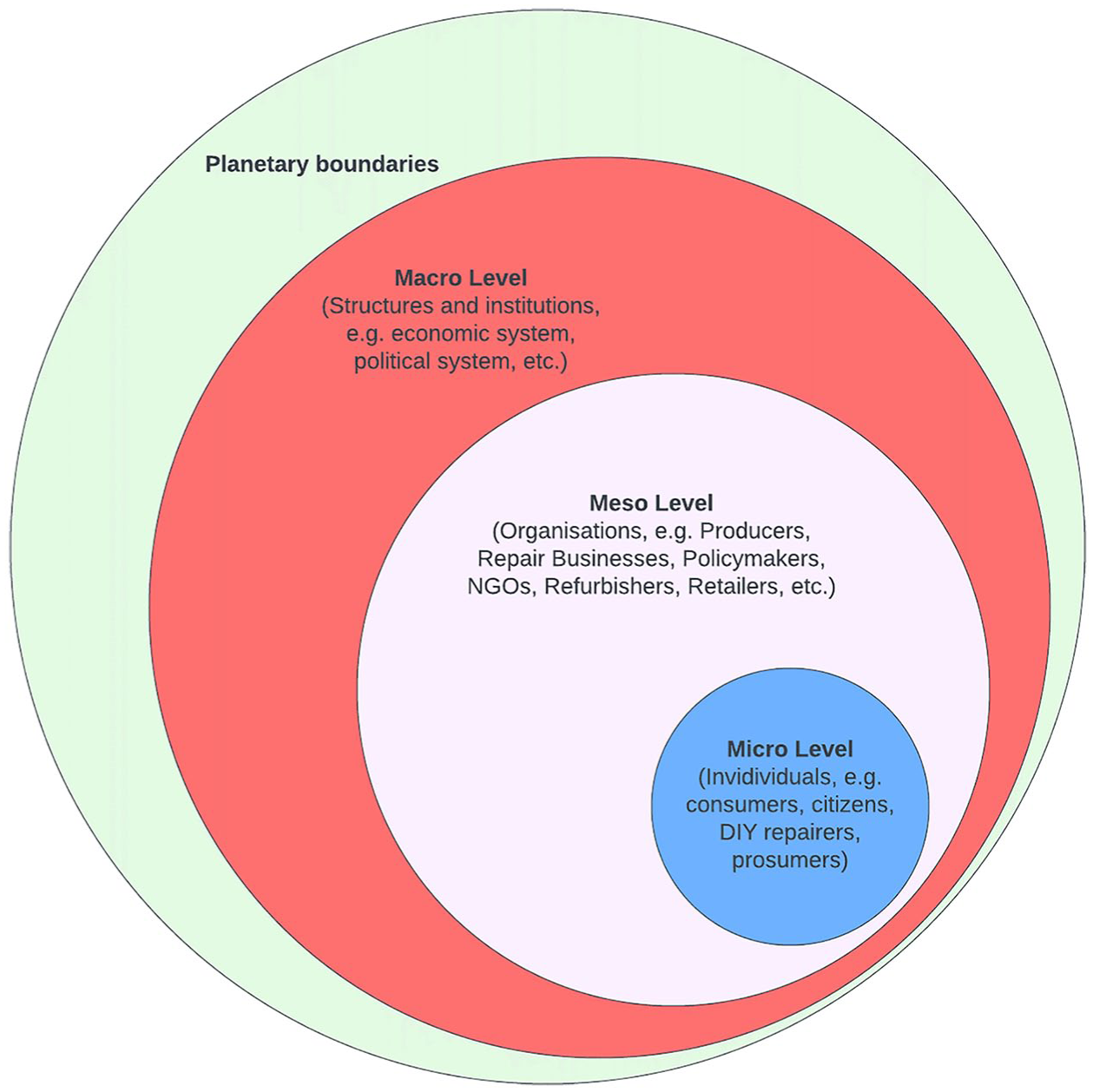
Expanded Repair System Actors, based on Svensson-Hoglund et al. (2021, 2023).
To empirically investigate the social struggles that shaped the recent development of R2R policies in the EU context and the roles of key groups of actors, we adopted a “process theory” perspective (Langley, 1999; Pierson, 2004). This research methodology pays particular attention to time ordering of the contributory events as a way of capturing the key factors that explain the role of different actors in shaping policy and regulatory changes. Through process coding of data (Saldaña, 2009), we were able to explore the causal chain that led to the emergence of the R2R campaign in the EU, demanding for universal R2R (see Beach & Pedersen, 2019), and culminating in a legislative proposal “Sustainable Consumption of Goods—Promoting Repair and Reuse” in 2022 in the EU (our case—see below). In an inductive process, our exploratory analysis emerged from the iteration between data, literature, and emerging theory (Gioia et al., 2012). In particular, we found that the work of Chantalle Mouffe on “agonistic pluralism” (Mouffe, 1999, 2000, 2013, 2014) provided an enlightening theoretical lens for our analysis of the empirical data.
Data Collection and Analysis
As illustrated by Table 1 above, our data are drawn from two main sources:
Overview of Data Sources.
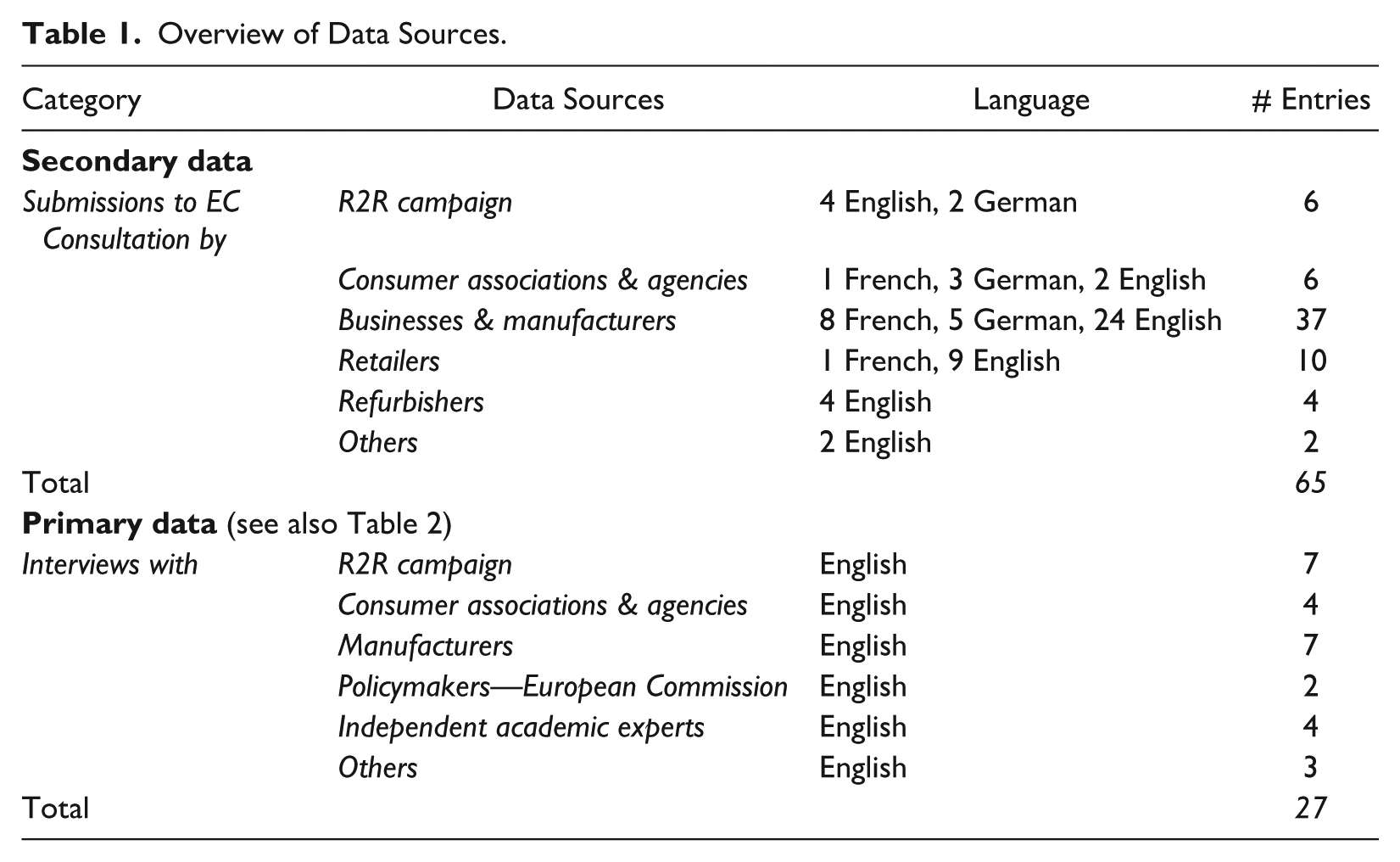
A systematic analysis of publicly available responses to the European Commission’s legislative proposal entitled “Sustainable Consumption of Goods—Promoting Repair and Reuse.” Following the call for evidence published by the European Commission on their website, the feedback and public consultation period remained open between 11 January and 5 April 2022. The call for evidence was framed as part of the new consumer agenda, and the CEAP, and aimed to gather feedback of relevant actors on the existence and extent of the problem, as well as the likely impacts of different policy interventions. All the responses are publicly available as part of the legislative process within the dedicated webpage of the European Commission. 1 We decided to focus on this public consultation because of its relevance and timeliness. While we recognise that demands for R2R are intersecting with more than one directive and regulation, this consultation received an exceptionally high public attention. This is illustrated by the number of feedback submissions (n=325), including direct participation from EU citizens, compared to low two-digits numbers of submissions on any other repair-related initiative proposed by the European Commission. Thus, it constitutes a suitable entry point and allows us to map the positions of key meso-level actors involved in the EU R2R policy debate. Furthermore, it provided a snapshot of their respective views. To select our secondary database, we decided to include in our analysis the submissions that met the following criteria: (a) relevant to the topic (some documents were generic comments on a variety of issues); (b) coming from organisations at the meso-level (and, thus, excluding individuals); (c) clearly expressed and supported with arguments, examples, or references to further studies; and (d) written in English, Spanish, Italian, German, or French in line with our language capacities, as we understand that translations could alter the nuances and arguments offered by the participants and complicate the data analysis. Our final database contains 65 relevant submissions.
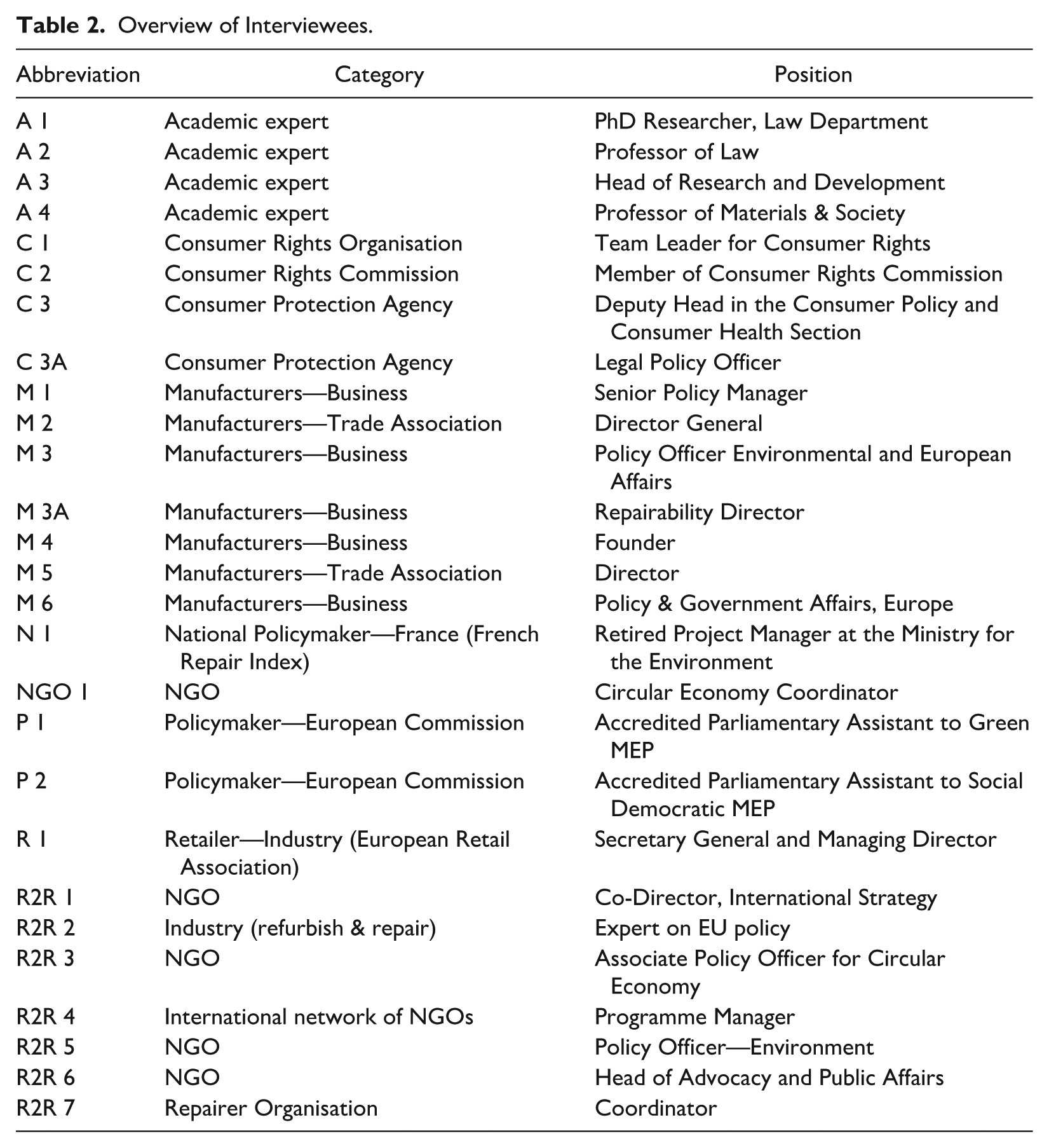
A total of 25 semistructured interviews with 27 representatives of key actors (see Table 2 for a list of interviewees). We reached out to 49 meso-level organisations identified through the mapping exercise (1). In addition, we reached out to key EU and national policymakers, as well as independent experts and academics, to enhance our understanding of the EU repair system. Unfortunately, only some of the actors that we contacted accepted our request for an interview. Thus, we used “snowball sampling” (Lincoln & Guba, 1985) to add new contacts, by asking each interviewee to recommend another suitable interviewee on the basis of their acknowledged expertise. Through this process, we ensured that our final list of interviewees provides sufficient data and a balanced exploratory account of all the key groups of actors active at the meso-level (Crouch & McKenzie, 2006). All the interviews were conducted in English, either in-person or online (via Zoom or Microsoft Teams), between March and August 2023. They were systematically recorded with the consent of the interviewees, transcribed via Microsoft Word, checked, and semi-anonymised. The interviewees were asked about, for example, their conceptualisation and rationale of “right to repair,” as well as for whom this is most important; how the R2R campaign has changed; what is the role of different actors in the development of the R2R (e.g., who is pushing back and who is the strongest advocate); what is justice in regard to R2R; and so on (see Appendix 1 for the interview guide). These questions allowed us to obtain a better understanding of the evolution of the social struggles for R2R over time in the EU context. In particular, they offered invaluable insights into the strategic alliances and conflictual relationships between different groups of actors that could not be grasped from the analysis of the submissions to the EU public consultation, see point (1).
Overview of Interviewees.
The texts from both the responses to the EU public consultation and transcription of the 25 interviews were coded manually, according to an inductive approach. Drawing from the mass of raw data, we have as a starting point the ground assumption that “people constructing their organisational realities are knowledgeable agents” (Gioia et al., 2012, p. 17) and that participants understand the dynamic relationships, conflicts, and possible trade-offs between the different groups of actors. Hence, our efforts to keep their voices at the first stage of data analysis and cluster the evidence into first-order concepts with coherent meanings, making use of the informant-centric terms and codes, for example, “frustration,” “success of the R2R campaign,” “open market,” “obligation to repair,” “alignments,” “symbiotic relationship,” “consumers’ behaviour and attitude,” and so on. Following that, and in line with the process coding approach (Saldaña, 2009), data (and, more specifically, looking at our first-order concepts) were ordered chronologically, paying particular attention to major changes in the way R2R was framed in the policy discourse and to the activity and strategic decisions of different groups of actors involved in shaping the policy debate. Here we identified major structural changes in this development of R2R: from antagonism to agonistic pluralism, from voluntary practices to a wave of R2R legislative initiatives. Within these structural changes, our analysis includes six second-order themes: antagonism and the politicisation of collective discontent; disarticulation and re-articulation of the repair ecosystem; the agonistic relationship between the R2R campaign and manufacturers; pluralism in the EU politics of R2R; a wave of R2R policies in the EU, and; the risks of “harmonious circularity.” Finally, we aggregated these second-order themes into aggregate dimensions, using “temporal bracketing” (Langley, 1999) to make sense of different phases in the broad historical development of R2R in Europe. We identified three phases characterised by the “politicisation”; “democratisation”; and “institutionalisation” of R2R in Europe.
To promote inter-coder reliability, authors coded and categorised the data independently. We arrived at similar categories, but also encountered differences, for instance on the role of consumer associations and the support of manufacturers to R2R policies in Europe. This conversation forced us to be clearer about the discursive strategies and ambiguities that characterise some actors and how they interrelate and co-evolve within the repair system. Please see Figure 2 below for our data structure.
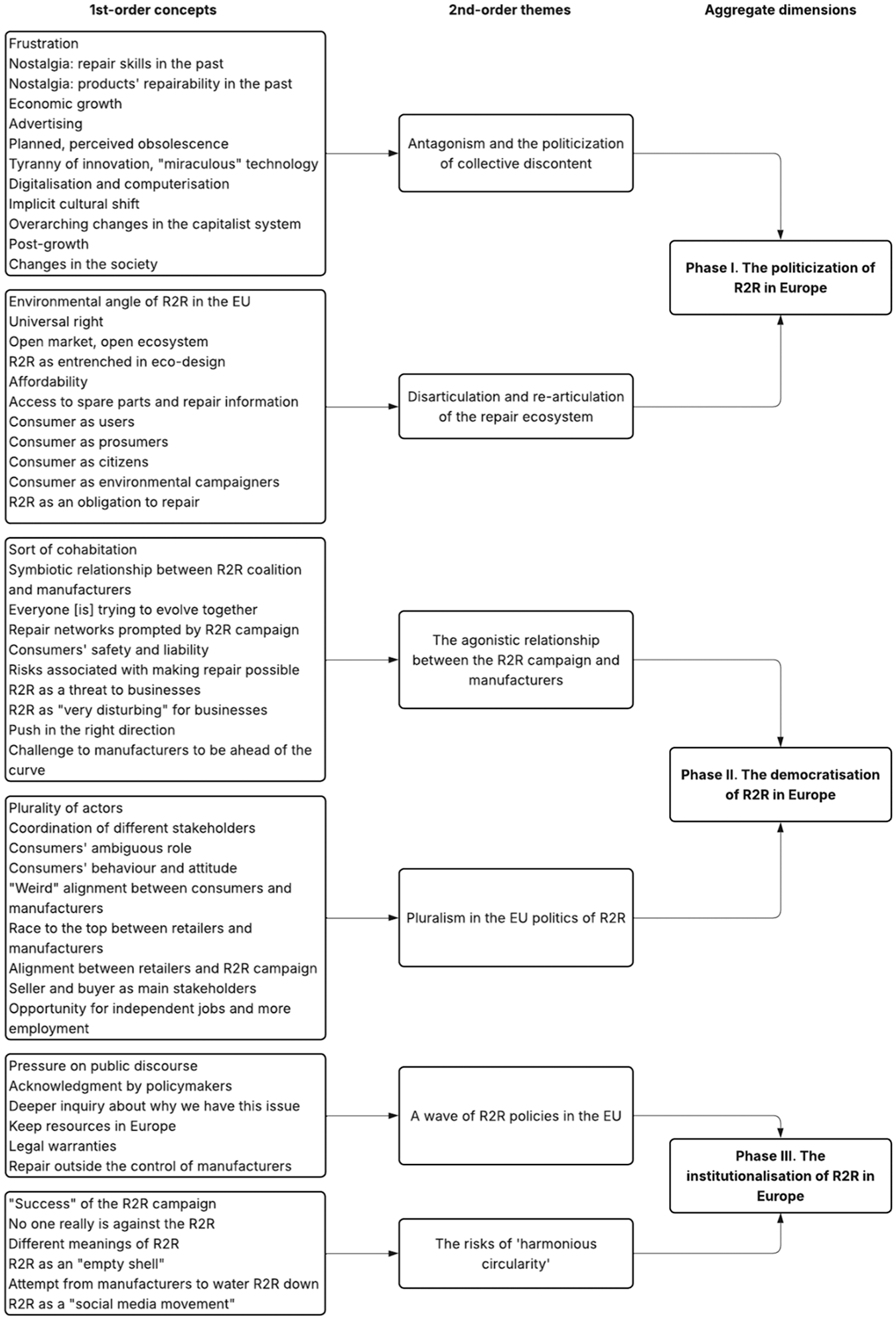
Data Structure.
We acknowledge that our data sources intrinsically capture a snapshot of participants’ viewpoints. To develop a dynamic, processual account of the recent history of R2R from these relatively static sources, our interview questions were specifically designed to elicit retrospective accounts. In addition, as detailed in our research design and data analysis, we employed chronological ordering and process coding of data (Saldaña, 2009), alongside temporal bracketing (Langley, 1999) to identify shifts and delineate the phases mentioned. While we acknowledge potential limitations, such as retrospective bias in participants’ recollection of the events, we aimed to mitigate this by triangulating insights across multiple interviews and documented positions in the EU consultation. Thus, our processual account represents a grounded reconstruction, based on the available evidence, of the developmental trajectory of the recent R2R policy debate in the EU context.
Findings
Summary
Based on the thematic analysis of our data, we clustered the findings into three temporal phases in the evolution of R2R in the EU context, illustrated in Figure 3. Phase I is the initial phase of antagonistic politicisation of R2R, in which emotions of discontent are mobilised to challenge conventional understandings and practices. Phase II is characterised by the agonistic democratisation of R2R, driven by a gradual shift towards a more symbiotic engagement between the R2R campaign and manufacturers. The extraordinary success of the R2R campaign led to a second major shift from voluntary R2R to legislation. We have defined Phase III as the institutionalisation of R2R, because this ongoing phase shifts the locus of the agon within political institutions and around the definition of R2R policies. During this latest phase we see the risk that R2R pluralism is silenced in favour of harmonious, “win–win” policies that deny differences and disagreements. Please see Appendix 2 for a supplementary table with illustrative quotes for each of these phases.
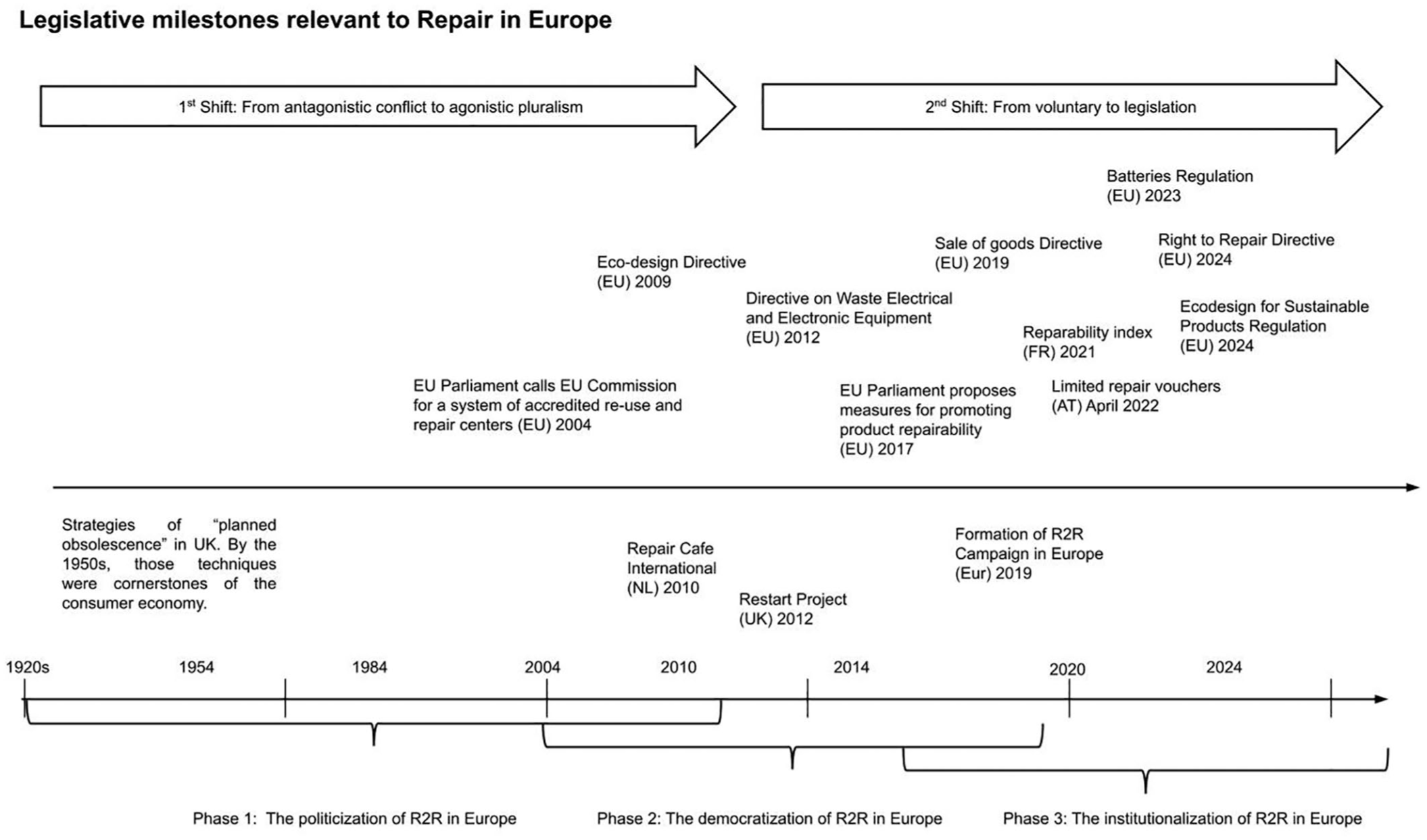
Right to Repair Milestones.
Phase I. The Politicisation of R2R in Europe
Antagonism and the Politicisation of Collective Discontent
Asking about the historical origins of R2R in Europe, the most striking element that emerges from our interviews is the distance from the ideal CE model of collaboration. What we found instead is that the vast appeal of demands for R2R was driven by emotional reactions driven by discontent with conventional business practices which came in waves starting with the concepts of planned obsolescence in the 1920s. Our interviews with representatives of the R2R campaign often refer to values and emotions: nostalgic feelings, frustration, perceived injustice, and discomfort with the status quo. Such emotions can be seen as generative and constructive, to an extent in which they create political identities politicising “us/them” differences between ordinary citizens and large manufacturers.
For instance, several interviewees refer to nostalgic feelings towards a past when the repairability of products and sustainable consumption was the norm, “nobody questioned their right to repair, and everything could be repaired” (Interview, C-2). This changed in the 60s as the following interviewee noted:
Somewhere in the 1960s, people got the idea that they could have new stuff all of the time, and some companies really marketed in that sense. (. . .) That’s where this philosophy of consumerism started. 30 years prior, if you had said that you were putting your couch on the street just because you liked a new one, everyone would have thought you were insane. (Interview, R2R-2)
While many interviewees mention collective past-oriented feelings of nostalgia for something lost, there are also novel circumstances and motivations mobilising demands for R2R. We noticed the emergence of the R2R campaign is explained through an emotional language of perceived injustice, indignation, and discomfort. This seems to be also a strategy aiming at creating strong and broad support from the general public to face a clear opponent. The “enemy” to fight is identified in business unsustainable and mischievous practices, for example, “the devil’s triangle” referring to economic growth, advertisement, and obsolescence, or the “tyranny of innovation” practised by the manufacturers, in which “we are innovating ourselves into the grave” (Interview, R2R-2).
This mix of emotions was described by an interviewed academic in the following terms:
You had an expectation that you could repair [the product] and this has just been eroded. (. . .) This has been an implicit cultural shift, which never sat well with lots of people. (. . .) We slept-walked into it and the environmental movement suddenly brought it out into the open in the early 21st-century. This is the moment, I would say, where the R2R becomes this valuable thing that we have lost. We lost our souls for this miraculous technology, (. . .) and the R2R is our fight back. (Interview, A-4)
The foundation and rise of local Repair Cafés in the 2010s in the Netherlands and their popularity throughout Europe in the last decade also manifest this fight back of uniting and supporting each other in trying to repair items as well as social, communal bonds. Within the European context, our interviews show that a main feature of the R2R campaign, for many of the actors involved, is not only better repairing per se but also the promotion of a wholly alternative social and political project. This entails “a post-growth type of economy, where the whole mentality would be different” (Interview, R2R-2), as a means to tackle major socio-ecological challenges, such as climate change (e.g., P-2).
The Disarticulation and Re-articulation of the Repair Ecosystem
We found that the frustration expressed through the R2R campaign towards the lack of effective and affordable repair solutions fuelled a disarticulation/re-articulation of conventional way of thinking. Taken-for-granted ideas and practices are questioned and re-framed in the pursuit of a more open and sustainable EU repair ecosystem, for example, reframing consumers as ‘right-holders’; identifying the responsibility of manufacturers for the perceived injury.
Despite the diversity of actors involved in the R2R campaign, from our data emerges a remarkably consistent and unifying plead for a “universal right to repair” (R2R-1, R2R-2, R2R-4, R2R-5 R2R-6), and “opening up the market” (R2R-3), or “open ecosystem” (R2R-2, R2R-7), “entrenched in eco-design” (R2R-1, R2R-2, R2R-3, R2R-4, R2R5, R2R-6, R2R-7), characterised by “affordability” (R2R-2, R2R-3, R2R-7) and “access” to spare parts and information (R2R-3, R2R-7).
This deep re-articulation of repair is well summarised by one of our interviewees in the following terms: We plead for what we call a universal R2R, which means that it should not only be possible, but it should be easy, affordable, mainstream, for everyone to get their products [repaired]. This means an open ecosystem. So, it means that not only a manufacturer or their authorised representative can repair their products, but also independent repairers, non-profit repair initiatives, such as Repair Cafés, and also consumers or citizens rather should be able to repair their products themselves. It also means access to spare parts at reasonable prices. It means access to information. It also obviously starts with products that are designed to be able to be repaired. (Interview, R2R-2)
Our data suggest that the R2R campaign tends to disarticulate the conventional discourse on consumers, understood only as individualistic actors driven by economic rational motivations, by politicising their identity as right-holders. In stark contrast with the dominant market-based and depoliticised view of a consumerist society, they decide to engage them also as “users” or “prosumers” (R2R-2, R2R-4), and above all as “citizens” (R2R-2), and increasingly as activists. This discursive strategy helped to build a large support and mobilisation around R2R, based also but not only on environmental issues. It also leverages users’ dissatisfaction with the lack of affordable options to repair their products. This organisational work of engagement with and re-articulation of conventional thoughts and practices is well explained by one of our interviewees: The word “consumer” it’s over. Like “consumerism,” it cannot coexist with sustainability. And, if we want people to be anything other than a disposer and a polluter, we have to give them a new word for how they are operating in society. And “citizen” is the word that we use. (Interview, A-4)
Instead of the conventional representation of repair as a matter of consumer’s choice, the R2R campaign blamed monopolistic manufacturers for failing to respect rights to repair and, thus, drew attention to their “obligation to repair” (R2R-4 and C-3a). This discursive re-articulation re-defines and shifts the blame for the failures of the repair field from individual consumers to large companies. The latter are blamed for reducing the accessibility of affordable alternatives through anti-repair business practices while also elevating the passive consumer to a more active role. As noted by a representative of the R2R campaign this entails engagement with manufacturers:
We have to change this culture of throwaway [. . .] this has to pass by change of culture. But for that, we have to change the manufacturers first. (Interview, R2R-6)
Phase II. The Democratisation of R2R in Europe
The Agonistic Relationship Between the R2R Campaign and Manufacturers
Considering the evolution of R2R in the EU context, we were surprised to see that the relationship between the R2R campaign and manufacturers can be defined as more agonistic (“friendly enemies”) than purely antagonistic. There is mutual recognition of their irreducible differences but also a degree of symbiosis that does not emerge from the literature on antagonistic R2R (e.g., Lloveras et al., 2024). Based on our interviews, we consider agonism as key for mutual learning and a greater openness to understand the other party’s positions.
Undoubtedly, there is a conflictual relationship between the R2R campaign and manufacturers and demands from advocates of R2R are pushed back by manufacturers, “because it threatens their business model” (Interview, R2R-2). As summarised by a policymaker: They [manufacturers] really do not want to open up the repair market. They really do not want to give their spare parts to individuals to hold up. Even the two years of legal guarantee if anyone repairs them. They also don’t want to offer repair services themselves, [. . .] So there are, of course, big tech lobbyists and the industry [against it]. [. . .], basically, the question will be how much burden we put on the producers. And that, of course, the industry and the lobbyists are against. (Interview, P-1)
However, as in a typical agonistic relationship, we found that the confrontation between the R2R campaign and manufacturers is characterised both by an explicit divergence of interests and objectives, and by the mutual recognition of their respective views and roles. One of the interviewees from the R2R coalition effectively describes it as “really a sort of cohabitation” where companies like Apple are “our best enemy” (Interview, R2R-2). A similar picture emerges from some of the interviews with the manufacturers’ association that defines this relationship as symbiotic. They recognise the role of the R2R campaign in pushing their members to promote a more effective repair ecosystem, in which the aim is to “keep the energy and keep everyone trying to evolve together” (Interview, A-3). This point is also confirmed by other industry representatives: I hope they are learning from us as well. I would say it is symbiotic. I mean, who pushed who is another question. As I said, our members have had repair networks in place for decades as well. I think [the R2R campaign] has been democratising repair and breaking open some of those repair networks. This has probably been prompted by some of these campaigns. And some of these things, like Repair Cafés, etc., probably have given our members that push in the right direction. (Interview, M-1)
We found that the pressure exerted by the R2R campaign pushed manufacturers to adopt new internal repair and sustainable design practices (Interview, M-3 and M-3a). For instance, an industry representative told us that “we see now increasingly the possibility to repair, where manufacturers are putting out repair manuals, the ability to buy spare parts, and tools as well” (Interview, M-1). This agonistic dynamic has had very concrete consequences as illustrated by the paradoxical case of Apple. Widely recognised as one of the fiercest opponents of the creation of an open repair ecosystem for its products. Only due to iFixit, users have access to almost 100% coverage of free and open-source repair manuals for Apple products (see, e.g., Interview, R2R-2). This more symbiotic relationship is also well illustrated by the following excerpt from a manufacturers’ interview: It is through discussions about the “right to repair,” about durability, that we are really using this to challenge ourselves as to how we can be ahead of the curve. Not just in terms of competition, but to make sure we can make it as easy for the consumer as possible, which ultimately should make it as environmentally friendly [as possible] at the same time. (Interview, M-3a)
Not only the agonistic engagement with the R2R campaign has contributed to gradually change established manufacturers “from within,” but our interviewees also mentioned the emergence of progressive, mission-driven manufacturers, such as Fairphone (Interview, A-4) that are effectively “part of the R2R campaign as well” (Interview R2R-4).
Pluralism in the EU Politics of R2R
Our data analysis suggests that the popularity of the R2R campaign had a major role in shaping the politics of R2R. The R2R campaign regularly emphasises this popular support in its communication with policymakers and other actors. One can read, for instance, that “8 in 10 Europeans agree that manufacturers should be required to make it easier to repair digital devices” (Right to Repair Europe, 2020), a statistic taken from Eurobarometer (EU Commission, 2020b). This evidences the success of the R2R coalition but also the importance of popular support in its campaign. This broad support allowed R2R to be framed as a democratic right that citizens expected and demanded. It also created pressure on manufacturers—as well as politicians—to accept and drive changes. Significantly, even some manufacturers’ representatives that we interviewed acknowledge the frustrations of consumers fuelling the popular support, as illustrated in the following excerpt:
I think the way that products are put together has evolved over time and it might have been easier to repair products yourself in the past. (. . .) There is a perception that maybe the devices do not last as long as they did, and there are frustrations there. (Interview, M-1)
The success of the R2R campaign led to a more plural and diverse coalition of actors supportive of repair policies and practices, where motivations “are rather different, depending on who they represent” (Interview, R2R-4). Instead of the dichotomous and antagonistic confrontation that emerges from prior research (Genovese & Pansera, 2021; Lloveras et al., 2024), from our study of the EU politics of R2R emerges as a more complex and pluralistic field, characterised by conflicts as well as opportunities for “unlikely” coalitions and strategic alignments. Beyond the “usual suspects” that can be identified with the grassroots demand for R2R—for example, “independent repairers, professional or non-professional and DIY-repairers, [Repair] Cafés, environmental organisations” (Interview, R2R-4)—there is a plurality of actors, such as progressive manufacturers, retailers, refurbishers, and consumers that have diverse interests and positions.
In particular, it emerges from several interviews that the role of consumers and consumer associations is rather ambiguous. On one hand, consumers are widely portrayed as the main beneficiaries of R2R policies (e.g., R2R-3, C-3a, P-1 and P-2), and further:
[R2R] is most important for consumers, obviously, because they would like to have their products repaired and keep them longer. It can save them a lot of money as well, apart from the environmental considerations, it can be also very beneficial for them economically. (Interview, C-1)
On the other hand, we found that consumer associations offer only conditional support to the R2R campaign. As pointed out by a consumer association’s representative, while they support R2R and the coalition, the measures the R2R campaign is proposing “are not always exactly the same as the ones we try to advocate for” (Interview, C-1; also in C-3A). These differences in priorities led one member of the R2R campaign to define consumer organisations’ role as “ambiguous”:
The consumer organisations sometimes also play an ambiguous role, because some of them seem to want to defend that consumerism. Although there is a growing awareness of the need for sustainable consumption, often their focus still seems to be on getting consumers as many products as possible for as little money as possible. (. . .) In a way, they are aligned with the manufacturers in that they both seem to be locked into a model of overproduction or overconsumption. (Interview, R2R-2)
In the EU policy debate about R2R, the attitude of consumers is then used by the representatives of manufacturers as an alibi to shift the blame away, pointing to a generalised behavioural and cultural issue that is outside their control, as illustrated in the following excerpt:
That has to do with the consumer attitude, with respect to repair, so the behavioural aspect. That is really important. And the legislation cannot solve it, because that’s behaviour, that’s us. (Interview, M-2)
Furthermore, according to our data, retailers are another group of actors that does not fit easily in a dichotomous view of R2R politics. Our interviews with the retailers’ association reveals their interest in repairing as a promising business and additional source of revenues (Interview, R-1). Quite interestingly, in the EU policy debate, retailers are increasingly seen as one of the players in the repair ecosystem, particularly due to their close relationship with customers and their liability for the product within the legal warranty period (Interviews, C-3b and R2R-3). In their own words, retailers perceive their new protagonism in the repair ecosystem as “a challenge or a race to the top between retailers and manufacturers” (Interview, R-1). As illustrated by the following excerpt, they understand their positions are not aligned with the manufacturers, which currently hold a position close to monopoly on the repair market:
More and more we see that between retailers, producers, suppliers, positions are not always on the same side. Of course, they are business partners, but when we are arriving at a certain development of the market, there are positions which maybe are not exactly the same. How is the situation right now? The whole game of repairability is in the hands of manufacturers. (Interview, R-1)
As noted by a policymaker, retailers “have a similar asymmetric power situation vis-a-vis big manufacturers, like consumers do as well” (Interview, P-2), which contextualises this misalignment in their positions. For the same reason, in our interview, the retailer association positioned themselves closer to the R2R campaign, in terms of enabling an open repair ecosystem, despite still not seeing themselves as “activists,” as illustrated below: We actually met with the representatives of the R2R campaign [. . .] and there were common points. So, it’s exactly what we already mentioned: enabling repair out of the control of manufacturers, to actually create the conditions [to repair]. Although obviously they are very on the activism part, so whenever you talk to them about economical consideration, sometimes that’s where we don’t align too much. (Interview, R-1)
Another example of the diversity of motivations and pluralism that characterises demands for R2R in the EU is represented by the growing interest in refurbishing and, as such, unlocking the “huge potential of many, very sustainable jobs to be created in this market” (Interview, R2R-7). This can further open and expand the repair ecosystem and create or enhance new business opportunities, such as independent repairers, and professional refurbishers, enabling local growth. As mentioned, there is a particular interest in these jobs being localised in Europe, and this certainly is the case for the refurbishment sector (see, e.g., Interview, R2R-7). In addition, refurbishers have a strong interest in agonistic engagement with manufacturers because their whole business model rely on further changes in the manufacturers’ practices, as illustrated in the following excerpt:
For us, the right to repair is actually design. It’s all entrenched in eco design, because as refurbishers, we only operate in the middle of the value chain. We have no control over what the original manufacturers and the producers are doing with the design and manufacturing of the device. (. . .) And so, if we do not have the ability to repair in the first place, then our business model cannot stand anymore. (Interview, R2R- 5)
Phase III. The Institutionalisation of R2R in Europe
A Wave of R2R Policies and Legislation
Due to a widely perceived frustration with the lack of effective and affordable repair solutions and the ability of the R2R campaign to create wide public and political support for R2R reforms, this issue has quickly moved up in the EU policy agenda. Around the mid-2010, in Europe, this resulted in a wave of R2R policy and legislative initiatives (see section 2.3; see Figure 3). Our interviews evidence how the mobilisation driven by the R2R campaign has created unprecedented interest by law-makers at different levels (i.e., local, national, and EU-level) in fostering a more effective repair ecosystem. This is acknowledged by all our interviewees, including business representatives, as illustrated below:
Well, I would say that the public discourse has been provoked in principle by organisations like iFixit. How has that changed over time? I think there has been the acknowledgement by policymakers that there is some justification to the principles raised by those complaints, on behalf of frustrated consumers. So, I think it is the acknowledgement of policymakers and then the deeper inquiry about why we have this issue. (Interview, M-5)
Our interviews with policymakers suggest that the R2R campaign has been successful in pitching the creation of a more effective repair ecosystem as an opportunity, for example, to create local jobs (Interview, P-1; see also, e.g., R2R-6 and R2R-7). Furthermore, our interviewees see repairing as a way to maintain strategic resources longer within Europe. For instance: For Europe, to be the global leader of circularity also reduces risks related, for example, to resources like gold, silver or copper. Rare elements, which are in the majority of cases, not available to extract within the European continent. [This allows] to keep it in Europe and optimise supply chains, reintegrating these resources and elements into the production which is still based in Europe. (Interview, M-4)
The consensus on the need to strengthen the repair ecosystem led to a momentum for more systemic and consequential legislative reforms at the EU level (Interview, P-2) but also at national and regional levels. For instance, our interviewees acknowledge the significance of the Repairability Index adopted in France in 2021 (see, e.g., Interview, A-1, A-3, R2R-1, R2R-7, N-1, M-1, M-2, M-3 and M-3a), defined as “very disturbing” for manufacturers (Interview, N-1). They also highlighted the emergence of different repair funds or vouchers schemes in Austria and France (see, e.g., Interview, R2R-1; M-4; and R2R-6) and regional initiatives, for example, Thüringen and Sachsen in Germany (e.g., Interview, P-2 and M-4). As noted by a representative of the R2R campaign: I think, thanks to our work, we have a lot of pressure [i.e. on the French government] on this subject, because the repair fund was something pushed by our NGO first and it’s the same for the Index. So, we are not alone in this fight obviously. But, I think, mobilisation is the thing that changes the system. (Interview, R2R-6)
The Risks of “Harmonious Circularity”
From the analysis of this latest phase in the development of R2R in Europe, we found particularly surprising the emphasis of several manufacturers on their support for R2R at the EU policy level. This emerges from the submissions to the EU public consultation on R2R (e.g., Bosch, Confederation of Danish Industry, Decathlon, Electrolux, IKEA, U2P, Swappie) as well as from several interviews (e.g., M-1, M-3A). As a policymaker puts it, “because the campaign was so successful, there is no one really against the right to repair” (Interview, P-1). For instance, a manufacturers’ representative told us:
Any industry sector would be for it and not against it. Maybe some will be more vocal, some will be less vocal. But I’m not sure that you would really have industry sectors against this. (Interview, M-3)
While this support might seem to mark the triumph of the R2R campaign and a pre-condition for the emergence of collaborative circular repair ecosystems, our data suggest a more careful assessment. In particular, the interviews with R2R campaigners highlight how this wide support represents a “double-edged sword” for the R2R campaign because it risks cancelling all the different meanings and divergent interpretations of R2R. Our interviews with manufacturers show they often support a narrow conception of R2R as an end in itself (Interviews, M-1 and M-3). For example, b
We are not against the concept. It’s just making sure that repairs are done in a safe and efficient manner. (Interview, M-1)
This apparent consensus (i.e., “no one is against,” Interview M-3A) risks damaging both the R2R campaign and the adoption of ambitious R2R policies because it gives the wrong impression that the objectives of the campaign had been achieved. As acknowledged by a representative of the R2R campaign: It became a big thing in 2019, when the European Commission itself used the term “right to repair,” when it presented the eco-design legislation on white goods, and so, in essence, kind of spun out of control. . . Because, on the one hand, it endorses it, so it is a big victory for us. Everyone agrees that we need the “right to repair.” But we all have different meanings and different perspectives on where it comes from. But it has also grown in acceptability across political boundaries. And, yet, it does not turn into very quick, applicable policies, because of the powers at play. (Interview, R2R-1)
This is echoed also by a political representative of the EU Parliament: The question will be which actors try to water it down, to what extent, while keeping the headline that we have a “right to repair . . .” Everyone wants it, but they probably just want to have an empty shell called “right to repair.” (Interview, P-1)
As manufacturers tend to highlight their support for R2R, contestation and pluralism are sidelined in favour of a “harmonious CE” approach in which much of the disagreements are denied. The risk is that R2R becomes an “empty signifier” (Valenzuela & Böhm, 2017), instrumentally used to give the impression of radical changes while mostly reproducing existing power dynamics and unsustainable practices. This risk is mentioned also by the academics that we have interviewed, which refer to the broad support from the manufacturers as “greenwashing” (see, e.g., Interview, A-2):
In a way, the very success of the R2R movement, its appeal in catching people’s attention and imagination, is also its downfall. Because it is so easily appropriated and hijacked by the very people that have made it a problem to begin with. (Interview, A-1)
The market-based, “win–win” discursive strategy adopted by the manufacturers’ association and largely embraced by the EU representatives is hiding conflicts and impeding the different parties to keep learning from their confrontation and differences. A more realistic assessment of the current situation would suggest that the struggle for R2R is ongoing and still at an early stage. As summarised by an industry representative:
I think there has been a huge evolution, but at the same time, it is quite clear we are still at the early stages, especially when it comes to consumer behaviour and making sure that a mixture of what we can do as manufacturers as well as what legislators can do really incentivises a real cultural change. (Interview, M-3A)
This stands in stark contrast to the approach from the EU Commission, framing the latest initiative as a last aspect (the “last piece of the puzzle,” as mentioned) of the R2R within the EU legislative process.
Discussion and Conclusions
This study responds to calls for a better understanding of how CE works in reality (N. Bocken et al., 2023; Kirchher et al., 2023) and contributes to the emergent literature on conflict and pluralism in the politics of the CE, increasingly polarised between dominant market-based ecomodernism and grassroots antagonism (Bauwens et al., 2020; Pansera et al., 2021; Valenzuela & Böhm, 2017; Ziegler et al., 2023). We set out by outlining an intriguing paradox. CE is both contesting the status quo and a contested idea. Yet, as noted earlier, analyses of the role of social conflicts and pluralism are rare in the CE literature (Corvellec et al., 2020, 2022), which is overly focused on win-win convergence and cooperation (e.g., N. Bocken & Ritala, 2021; Kuhlmann et al., 2023). We believe that a better understanding of conflicts and contestation as integral elements of CE dynamics is needed.
To unpack this conundrum, we have empirically investigated the politics of R2R in the European context. We identify three phases characterised by the ‘politicisation’; “democratisation” and “institutionalisation” of R2R. Through Mouffe’s theoretical lens (see section 2.2), we understand politicisation as a fundamental step for upsetting conformism to unsustainable practices by mobilising political identities around “us/them” antagonistic conflicts and divides. In our case, we see the formation of the R2R campaign in radical opposition to manufacturers, who are blamed for reducing the accessibility of affordable alternatives through anti-repair business practices. According to our analysis, the shift to the second phase marks a transformation of the R2R movement from antagonism to agonism, moving from the political to democratic politics and ultimately fostering pluralism and democratisation in the repair field. R2R demands progressively evolves into a more complex engagement of multiple groups of actors, including also retailers, consumer associations, refurbishers, progressive manufacturers, and so on. We argue that this is triggered by a change in the relationship between the R2R campaign and manufacturers: from antagonistic conflict to agonistic engagement. This entails mutual recognition of their irreducible differences but also a degree of symbiosis. Ultimately, their agon—the material reality of the products to be repaired—is also what they have in common and fosters mutual engagement. Finally, the extraordinary popularity and success of the R2R campaign led to another shift in the politics of R2R that we have defined as institutionalisation of R2R. This ongoing phase shifts the locus of the agon within political institutions and around the definition of R2R policies. Within this institutional setting, despite the broader aims of many actors behind the R2R campaign, the EU policy debate is dominated by a market-based and ecomodernist understanding of CE (Pinyol Alberich et al., 2023). Our findings reveal that, in this context, the support for the R2R campaign by mainstream policymakers and mainstream businesses might represent a “double-edged-sword.” It constitutes a subtle strategy for silencing dissensus and papering over deep disagreements (Glover, 2012) in favour of a narrow hegemonic conception of R2R. The latter would be satisfied with reforms on access to repair manuals, spare parts and economic incentives, only to name a few examples, instead of transformative changes, challenging established practices and values (e.g., about ownership, production, consumption). Therefore, any institutionalised compromise is unlikely to represent a stable endpoint. Dissatisfaction with its inherent limitations could itself become the emotional catalyst for a renewed iteration of politicisation and democratic contestation, as actors seek to challenge this narrowed R2R framing in the legislation and push the agenda further.
Our study provides three important contributions to the extant literature of political CE. First, drawing on the “agonistic pluralism” political theory developed by Mouffe’s (1999, 2000, 2013, 2014), we make an overall theoretical contribution by outlining a comprehensive, integrative model of CE politics articulated into three interplaying dynamics that we christened “harmonious,” ‘antagonistic,’ and “agonistic” circularity. Second, we contribute to the academic and public debate on alternative and contested visions of CE future (Bauwens et al., 2020; Calisto Friant et al., 2020; Ziegler et al., 2023) by arguing that alternative understandings of CE are not mutually exclusive. Indeed, pluralism and confrontation can lead to productive tensions, mutual learning, and ultimately to the greater development of CE policies and practices. Finally, we contribute to extant policy debates on the implementation of CE. By introducing agonistic CE, we draw attention to the relationship between CE, democracy and pluralism (Dawkins, 2015; Mäkinen and Kourula, 2012). In particular, our conceptualisation underscores the importance of passion in maintaining agonistic openness and engagement.
An Integrative Framework: Antagonistic, Harmonious, and Agonistic Circularity
Drawing on our analysis and informed by Mouffe’s theoretical framing, we outline an integrative model of conflict and pluralism in the CE, articulated into three interplaying dynamics: antagonistic, agonistic, and harmonious circularity. Rather than understanding the dominant emphasis on collaboration and consensus (e.g., Kaipainen & Aarikka-Stenroos, 2022) in isolation from radical contestation (e.g., Lloveras et al., 2024), we conceive them as positioned on a continuum. Here agonistic dynamics can be conceptualised as a “middle ground” in the politics of CE, bridging opposite tensions and ultimately resulting in greater diversity and democratic pluralism. Our model is illustrated in Figure 4.
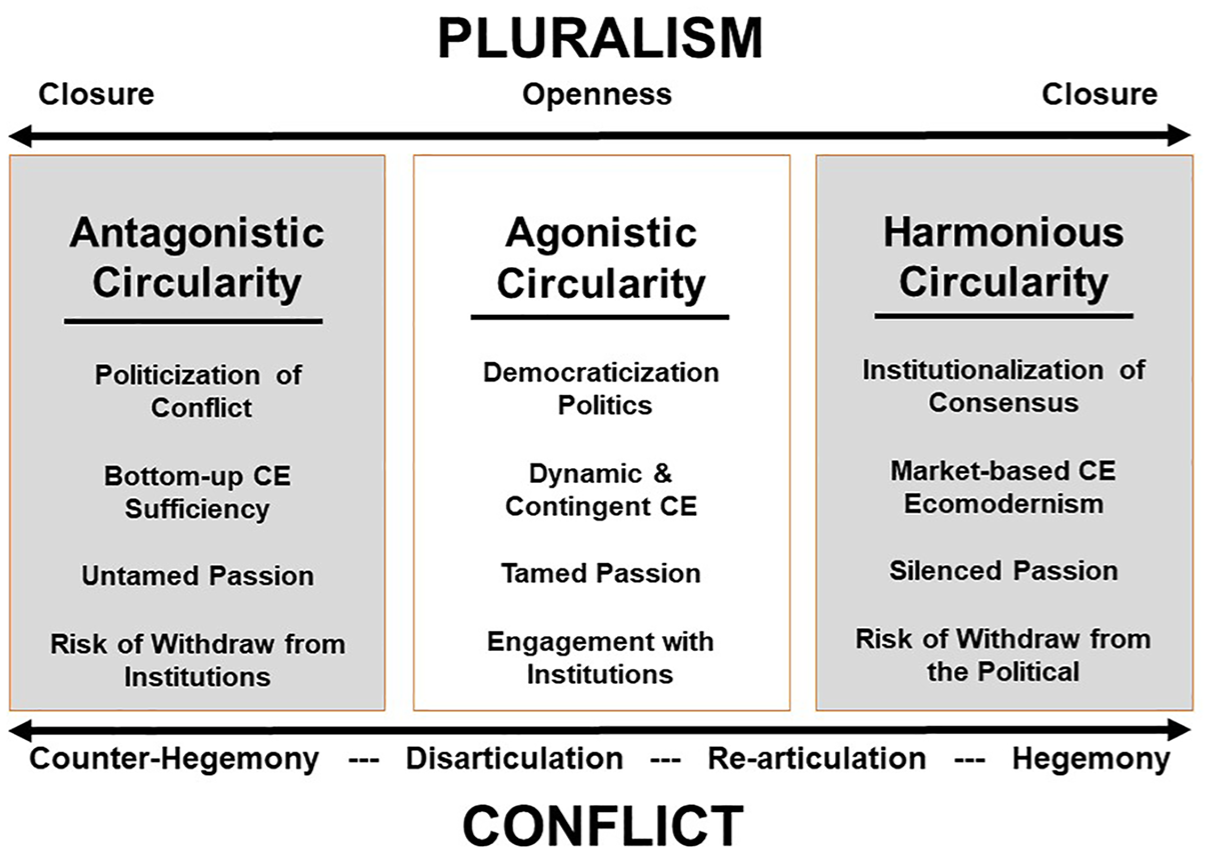
An Integrative Model of Conflict and Pluralism in the Circular Economy.
To secure mainstream institutional support, harmonious circularity has promoted a narrow and uncontroversial version of CE, where systemic injustice and power asymmetries are overlooked. It acknowledges pluralism (i.e., the existence of a variety of actors expressing different interests in the CE), but because of its focus on market-based, technocentric collaborations, it tends to silence passion in favour of economic rational decision-making. Overall, it represents an (attempt to) withdraw from Mouffe’s dimension of the political (2013), ultimately risking to be perceived as a “distant dream” (Panwar & Niesten, 2022) expressed by corporate and institutional élites (Giampietro & Funtowicz, 2020).
On the contrary, antagonistic circularity originates from the ontological dimension of political conflicts (Mouffe, 2013), thus it emphasises the need for radical dissensus, in opposition to the dominant vision of “harmonious CE,” perceived with as a co-opted form of CE, hegemonised by the dominant business and political actors (Genovese & Pansera, 2021; Lloveras et al., 2024; Pinyol Alberich et al., 2023). Antagonistic CE tends to promote a bottom-up organisation of CE, based on sufficiency, deeper democracy, and localised systems of exchange (Bauwens et al., 2020; Genovese & Pansera, 2021; Pansera et al., 2024). It fuels and it is fuelled by strong collective passion and emotions, drawing attention to questions of injustice and inequality, typically overlooked by harmonious CE (Genovese & Pansera, 2021). In our study of R2R, we have seen an antagonistic dynamic at work in politicising the collective discontent towards the lack of effective and affordable repair practices. Finally, antagonistic CE tends to withdraw from institutions, seen as dominated by hegemonic forces, retreating into “small-scale production within self-sufficient local communities” (Bauwens et al., 2020, p. 6).
Finally, we conceptualise agonistic circularity as a distinct democratising dynamic, fostering openness in the politics of CE. It bridges the unifying dynamics of harmonious CE with the inescapability of conflict; and balances the mobilisation and disarticulation of dissensus with collective re-articulations that encourage democratic renewal. In particular, this is illustrated in our findings by the definition of R2R given by the R2R campaign as “open” and “universal,” thus balancing pluralism with unity. Because of this hybrid nature, agonistic CE does not offer a predefined and singular vision of the CE. CE becomes more contingent, depending on the interplay between a multitude of actors. Similarly to antagonistic CE, confrontation fuels agonistic dynamics. However, it is a moderate, tamed form of strife. We argue that this kind of agonistic confrontation can foster opportunities for mutual learning, innovation, and co-evolution. In our case, this is illustrated by the symbiotic engagement between the R2R campaign and manufacturers. The two groups of actors represent radically different worldviews, interests, and demands. Yet, they have co-evolved symbiotically, continuously learning from each other. On one hand, this is illustrated by manufacturers’ acknowledgement that the R2R campaign has ultimately pushed them “in the right direction” to invest more in repairability and refurbished products. On the other hand, it has also forced the R2R campaign to find more realistic and ever-better solutions to increase repairability in an ongoing struggle to keep pace with new, more complex, products. In this endless confrontation, their agonistic relationship is constantly anchored to the material reality of the products to be repaired. Thus, we conceptualise agonistic circularity as always adjusting and rather unpredictable. This also reveals the unstable and paradoxical nature of agonism. On one hand, it is driven by contestation and discontent that can generate momentum (e.g., the wide and popular support for R2R). Yet, by doing so, it is always exposed to risks of possible hegemonic co-optation (e.g., attempts to capture the R2R concept).
Pluralism in the Politics of CE and the Benefits of Agonistic Dynamics
We contribute to the academic and public debate on alternative and contested visions of CE future (Bauwens et al., 2020; Calisto Friant et al., 2020; Ziegler et al., 2023) by contending that alternative understandings of CE are not mutually exclusive. Current perspectives, focused on either “harmonious” or “antagonistic” CE, risk negating democratic pluralism (Mouffe, 2013), by trying to impose the idea of CE as “one thing” (Valenzuela & Böhm, 2017).
This is evident in the tendency of depoliticised “harmonious” perspectives to limit or silence dissensus by featuring CE mainly as a consensual win–win policy, thus restricting “the focus only to conflict-free solutions and strategies” (Corvellec et al., 2022, p. 422). Earlier studies of repair already highlighted that often dominant narratives were not challenged and subaltern views were sidelined (Corvellec et al., 2020, 2022; Niskanen & McLaren, 2023; Pansera et al., 2021; Yalçın et al., 2025). In our empirical analysis, this emerges when manufacturers start to express their support for R2R policies, denying disagreements and thus cancelling different meanings and divergent understandings of R2R. We conceive this as a hegemonic discursive strategy (Howarth et al., 2000), adopted by manufacturers with the support of policymakers to resist transformative changes by giving the wrong impression that the fight for R2R is over.
While the current literature on the politics of CE insists particularly on the risks that alternatives to ecomodernist, win-win solutions are silenced (Corvellec et al., 2020, 2022; Pansera et al., 2021; Yalçın et al., 2025), we argue that also antagonistic circularity tends to deny collaboration, dialogue and engagement with alternative visions, seen as mutually exclusive (Genovese & Pansera, 2021; Lloveras et al., 2024; Pinyol Alberich et al., 2023; Pansera et al., 2024). As such, it manifests a tendency to deny pluralism and impose one idea of CE closing the possibility to diverse alternatives. Here our analysis differs from the work of Lloveras et al. (2024) on the politics of repair. While their study provides excellent insights on hegemonic and counter-hegemonic struggles in the repair field, it tends to assume that, in the face of structural power asymmetries, the only meaningful approach to CE is represented by a bottom-up organisation of CE based on sufficiency, deeper democracy, and localised systems of exchange (Bauwens et al., 2020; Genovese & Pansera, 2021; Lloveras et al., 2024; Pansera et al., 2024; Pinyol Alberich et al., 2023). Thus, it tends to exclude other views, restricting the CE field to a binary choice. It also assumes that only one (their) version of CE is representing the “just transition to CE” (Genovese & Pansera, 2021; Pansera et al., 2024) and thus a real breakthrough. For instance, they deliberately ignore the possibility of what Böhm et al. (2023) call “activism from within,” that is, the idea that CE innovations and pressure to change unsustainable organisational routines and cultures can be incubated endogenously by corporate actors. Here, our critique builds on Mouffe’s arguments against the strategy of “withdrawal from institutions” (Mouffe, 2013, p. 52) to criticise this closure towards democratic politics and engagement with alternative views. Mouffe has often demonstrated her scepticism towards antagonistic movements (e.g., the Occupy movement) aimed at replacing the neoliberal hegemonic order without confronting its institutions. For instance, she maintains that “it is not enough to organise new forms of existence of the common, outside the dominant capitalist structures, as if the latter would progressively ebb away without any confrontation” (2013, p. 115–116).
Instead, we found that the R2R campaign constituted a “threat” to manufacturers’ hegemony precisely because of their broad consensus and direct engagement with manufacturers and other actors to change conventional practices. Our data suggest that the broad interest and popular support for R2R was built by agonistically engaging with different rationales for R2R and values (e.g., from economic libertarianism to socio-ecological activism) (Mäkinen & Kourula, 2012). This led to building a diverse coalition for R2R Europe in 2019 with more than 180 different organisations from 30 countries (Repair, n.d.), rather than adopting only one narrower vision. Because we understand the importance of conflict, we think that progress cannot be achieved by retreating from politics and disengaging with corporate activities (Parker and Parker, 2017). In this respect, we argue that agonistic circularity dynamics play a critical role in assuring that CE remain “plural” (see, e.g., Pascucci, 2021), always acknowledging the inevitability of conflicts as well as the need for “democratic politics [. . .] to provide the institutions which will permit conflicts to take an ‘agonistic’ form” (Mouffe, 2013, p. 7).
Agonism and the Importance of Passion for Democratic CE Politics
Finally, our analysis also contributes to extant policy debates by drawing attention to the importance of reflecting on democratic pluralism in the transition to CE (Calisto Friant et al., 2020). To date, the CE literature has dedicated limited attention to the question of democracy and pluralism. However, recently there have been various calls for furthering research in this area (Böhm et al., 2023; Monciardini et al., 2023; Ziegler et al., 2023). For instance, Bauwens and colleagues (2020) question whether CE should be decentralised and democratic or take a top-down centralised approach. Böhm et al. (2023) suggest that “a circular society should not be understood as a unified people.” Monciardini et al. (2023) point out that promoting greater democratic participation in CE activities, including business decision-making, is critical to implement truly sustainable—just and inclusive—circular strategies.
We go beyond prior analyses by identifying democratisation as a desirable way of organising CE politics. As illustrated by our study, this entails extended and symbiotic forms of dynamic engagement between adversaries (manufacturers and the R2R campaign), involving radical disagreements but also mutual recognition of their respective views and roles. Capturing this agonistic dynamic relationship, one of the R2R campaigners refers to manufacturers as “our best enemy.” We argue that agonistic confrontation can foster opportunities for mutual learning, innovation, and co-evolution that are excluded under win-win collaboration as well as antagonistic conflicts. In this endless confrontation, their agon—struggle—is “concretised” (Tambakaki, 2014): constantly anchored to the material reality of the products to be repaired. Our exploratory findings may hold value for policymakers and business managers about the benefits of fostering exchanges of ideas and agonistic engagement with radically different actors, including organised civil society.
Crucially, democratic pluralism entails “to structure and utilize discord rather than reduce or eliminate it” (Dawkins, 2015, p. 1). Thus, our study draws attention to the role of collective emotions in driving progress towards a more open and pluralistic repair ecosystem. In our study, R2R demands were initially driven by emotions of discontent (e.g., discomfort and frustration for the lack of affordable reparability options; nostalgic feelings towards a time in which repairing was easier; indignation with anti-repair business practices), ultimately driving the rise of the R2R campaign in Europe. To some extent, the rise of the R2R campaign builds on what Niskanen et al. (2021) refer to as the “retro-topian notion of repair”—a nostalgic narrative that longs for an utopian past, in which a “trope of forgone skilled (often) male laborers (often fathers) could repair anything” (p. 9). We believe that our findings could encourage a reconsideration of emotions in the policy debate on the strategic development of CE. Our analysis illustrates the importance of feelings and emotions as collective motivational forces, mobilising ordinary citizens against large manufacturers. Ultimately, tamed emotions can be crucial for democratic politics when they turn discontent and disaffection into public mobilisations around opposing political discourses. This is when a variety of demands turn into claims that challenge existing power constellations, driving the disarticulation and re-articulation of conventional unsustainable practices and thoughts. Our findings are in line with Mouffe’s emphasis on the power of what she refers to as “passion” in “creating collective forms of identification around democratic objectives” (Mouffe, 2013, p. 17). For instance, we have seen how the R2R campaign has been able to mobilise consumers and re-articulate their identity as right-holders, thus shifting the responsibility on manufacturers for the lack of affordable and effective repair solutions.
Scope Conditions, Future Research, and Policy Implications
Although our study focused on R2R and the EU repair ecosystem, our theoretical framework has broader implications for other areas of the CE and in the role-played by social conflicts. We expect that our theoretical model and the idea of “agonistic circularity” play out in other ecosystems where more circular and sustainable business models have evolved over time. Future studies could elaborate on these dynamics in different empirical contexts to examine similarities and differences and advance explanations for this variation. Of course, the R2R campaign and EU repair ecosystem are associated with a specific set of actors—including a relatively large number of environmentally conscious consumers and active civil society organisations—and pluralistic democratic institutions. This focus only on the EU context constitutes a clear limitation of this study. Non-EU actors are also important for future research expanding our understanding of the dynamics and actors in repair systems (see Krebs & Weber, 2021). We also encourage future research to expand beyond our exploratory focus, limited to the meso-level. There is a need for a multi-level understanding of system dynamics, not only by further exploring the interplay between the R2R campaign and manufacturers at different levels, but also by exploring linkages with individual micro-dynamics (Kuhlmann et al., 2023). Our focus on the actors directly involved in the public consultation called by the European Commission constitutes another clear limitation of this study. For instance, researchers could further investigate the key role-played by mission-driven manufacturers in the politics of repair across different levels of governance (Amend et al., 2022; Hansen & Revellio, 2020).
Our exploratory study could also stimulate future research on democratic pluralism in the CE and, more broadly, in corporate sustainability debates (Mäkinen & Kourula, 2012). This includes research on pluralism within antagonistic movements. As noted by Calisto Friant et al. (2020), “it is key to establish a democratic and deliberative governance system for a CE to ensure that everyone is involved in its construction and that its benefits reach the most vulnerable” (p. 6). Echoing the work of authors such as Martínez-Alier et al. (2010), we highlight the importance of mobilising rights-holders in response to perceived social and ecological injustice and public discomfort towards unsustainable corporate and business practices. Acknowledging the importance of passion and building on various conceptualisations and theories of justice (e.g., environmental, restorative, distributive, generative, regenerative), we encourage researchers to build on our exploratory study and question: what is (in)justice in the CE? On what grounds is it envisioned and represented in the policy debate? What does it look and feel like in practice?
Also, we invite future research to investigate whether and how social movements’ engagement with mission-driven manufacturers (e.g., Fairphone) can drive innovation in circular product design or remanufacturing and refurbishment. And to explore whether CE movements can force more mainstream business organisations to rethink their long-term strategic plans in the face of external pressures and “ activism from within” (Böhm et al., 2023; Ho et al., 2022). More broadly, there are many partly overlapping or even competing theories that can be deployed to shed light on the politics of CE, which were not explored in this study (see, e.g., Geels & Verhees, 2011; Lloveras et al., 2024; Martínez-Alier et al., 2010; Recker et al., 2024). For example, the MultiLevel Perspective (MLP) takes a system approach to including politics and policies in a more broad analysis of socio-technical system transitions (Geels & Verhees, 2011). Martínez-Alier et al. (2010) also have a broad approach in examining the traction of the de-growth concept in challenging the dominant sustainable development paradigm. Lloveras et al. (2024) apply radical democracy to the case of R2R that highlights antagonism in particular. Finally, Recker et al. (2024) conduct a dialectic process analysis to examine how manufacturers exert control on digital product aftermarkets, with implications for the relative power between manufacturers and independent repairers. How power is exercised in a CE has also been studied, in particular how the resistance of powerful incumbents impedes policy outcomes (Yalçın et al., 2025). We then encourage research that expands on these other theoretical frameworks, contrasting or integrating them with ideas of antagonistic, agonistic, and harmonious circular dynamics.
Beyond the academic debate, we hope that our study highlights the practical significance of democratic discourse, civil society engagement and cross-sector collaboration in shaping CE politics and practices in Europe. By examining the evolution of the R2R movement, we demonstrate how NGOs, grassroots campaigns, policymakers, and segments of the business and retail sector as well as the public have contributed to reconfiguring the repair landscape—not only by envisioning more sustainable futures but by actively shaping them. In terms of policy implications, our findings challenge the dominant market-based and technocentric “win–win” account of what is an effective CE policy (Corvellec et al., 2022). Instead, we show that real-world CE practices are shaped by contestation, and characterised by tensions, trade-offs, and competing interests. The R2R movement exemplifies how pluralistic coalitions can emerge, negotiate, and contest meanings, revealing the importance of maintaining political space for disagreement and democratic engagement. For policymakers, this means recognising that effective CE policy cannot be reduced to technical standards or economic incentives alone, even though they are both important. It requires ongoing engagement with diverse actors, including those who may hold conflicting views. For social movements, our study underscores the importance of remaining politically engaged and resisting the temptation to retreat into niche sufficiency models. The emotional resonance of repair—rooted in frustration, care, and hope—has proven powerful in mobilising public support and should not be underestimated as a driver of systemic change.
Ultimately, this paper contributes to public debates by offering a more grounded and nuanced understanding of how sustainable CE transitions can unfold in practice. It invites both policymakers and practitioners to embrace complexity, foster inclusive dialogue, and remain attentive to the democratic processes that underpin meaningful and lasting change.
Supplemental Material
sj-docx-1-oae-10.1177_10860266251364566 – Supplemental material for “Our Best Enemy”: Right to Repair and the Politics of Agonistic Circularity
Supplemental material, sj-docx-1-oae-10.1177_10860266251364566 for “Our Best Enemy”: Right to Repair and the Politics of Agonistic Circularity by David Monciardini, Philipp Montenegro, Lívia Regina Batista-Pritchard and Jessika L. Richter in Organization & Environment
Supplemental Material
sj-docx-2-oae-10.1177_10860266251364566 – Supplemental material for “Our Best Enemy”: Right to Repair and the Politics of Agonistic Circularity
Supplemental material, sj-docx-2-oae-10.1177_10860266251364566 for “Our Best Enemy”: Right to Repair and the Politics of Agonistic Circularity by David Monciardini, Philipp Montenegro, Lívia Regina Batista-Pritchard and Jessika L. Richter in Organization & Environment
Footnotes
Declaration of Conflicting Interests
The author(s) declared no potential conflicts of interest with respect to the research, authorship, and/or publication of this article.
Funding
The authors disclosed receipt of the following financial support for the research, authorship, and/or publication of this article: The authors received financial support for the research by the Europe Network Fund of the University of Exeter and the University of Lund as part of the collaborative project JustCE (LEX) – Just Circular Economy (Lund + Exeter).

Supplemental Material
Supplemental material for this article is available online.
Notes
Author Biographies
References
Supplementary Material
Please find the following supplemental material available below.
For Open Access articles published under a Creative Commons License, all supplemental material carries the same license as the article it is associated with.
For non-Open Access articles published, all supplemental material carries a non-exclusive license, and permission requests for re-use of supplemental material or any part of supplemental material shall be sent directly to the copyright owner as specified in the copyright notice associated with the article.
