




Abstract
Research shows that people search for balance in their moral (e.g., environmentally friendly) behaviors such that they feel licensed to behave less morally after a previous moral act (licensing) and cleanse previous morally questionable behaviors by subsequently behaving more morally (cleansing). This article investigates whether this balancing may extend to close others, but not to nonclose others, and tests vicarious licensing and cleansing in the environmental domain. Study 1 showed that vicarious licensing effects are more likely when a close other displayed environmentally friendly (vs. neutral) behavior. Study 2 showed that environmental vicarious licensing effects are more likely for close than nonclose others. Studies 3 and 4 suggested that vicarious licensing effects, but not vicarious cleansing effects are more likely for close (vs. nonclose) others. Finally, a meta-analysis showed that overall these studies provide evidence for vicarious licensing effects, but not for vicarious cleansing effects in the environmental domain.
Research shows that people search for balance in their moral behaviors (e.g., environmentally friendly behaviors) such that they feel licensed to behave less morally after a previous moral act (i.e., licensing effect) and cleanse previous morally questionable behaviors by subsequently behaving morally (i.e., cleansing effect; Monin & Miller, 2001; Sachdeva, Iliev, & Medin, 2009; Tetlock, Kristel, Elson, Green, & Lerner, 2000). In the present research, it is investigated whether people extend this moral balancing to incorporate not only their own moral behaviors but also the behaviors of close others. To illustrate, one may think of those who feel licensed to buy a less environmentally friendly product after their close friend has made a donation to Greenpeace, or those who meticulously separate their garbage after their spouse bought a new car with poor fuel economy.
Literature suggests that considerable self–other overlap may occur when people feel close to another person (Aron, Aron, Tudor, & Nelson, 1991), and that the actions of close others may be perceived to some extent as actions of themselves (Goldstein & Cialdini, 2007). In other words, people incorporate the behaviors of close others into their own self-concepts. Based on this reasoning, it is posited that moral behaviors of close others may lead to vicarious licensing effects, and that the morally questionable behaviors of close others might lead to vicarious cleansing effects in the environmental domain. In this article, it is hypothesized that the strength of these effects depends on the degree of interpersonal closeness: When people are close to another person they are more likely to vicariously balance each other’s moral behaviors than when they are not close. In the remainder of the article, we will elaborate on the theoretical background for this proposition and report four studies and a meta-analysis testing this proposition in the context of environmentally friendly behaviors. Support is found for vicarious licensing effects, but not for vicarious cleansing effects.
Moral Licensing and Cleansing Effects
In general, people want to see themselves as moral. They do, however, permit themselves morally questionable behavior from time to time (e.g., lying, engaging in less environmentally friendly behavior, cheating; Mazar, Amir, & Ariely, 2008). Research suggests that such morally questionable behaviors are more likely when people first behaved in a moral way. Prior engagement in a moral act may provide people with a justification for less moral behaviors at a later point in time (e.g., Khan & Dhar, 2006; Mazar & Zhong, 2010; Merritt, Effron, & Monin, 2010; Monin & Miller, 2001; Sachdeva et al., 2009). By behaving in a moral way, people establish their morality, which makes them less reluctant to behave in a morally questionable manner. In other words, it allows people to behave less morally, but at the same time maintain their moral self-view (Khan & Dhar, 2006; Miller & Effron, 2010; Monin & Miller, 2001). In line with this reasoning, previous studies have, for example, shown that people who just purchased environmentally friendly products may subsequently be more likely to cheat (Mazar & Zhong, 2010), and that people who save water may increase their electricity consumption (Tiefenbeck, Staake, Roth, & Sachs, 2013).
Such balancing of moral behaviors can also occur the other way around, driving people to behave more morally after engaging in a less moral act, a so-called moral cleansing effect (e.g., Jordan, Mullen, & Murnighan, 2011; Sachdeva et al., 2009; Tetlock, Kristel, Elson, Green, & Lerner, 2000; Zhong, Liljenquist, & Daylian, 2009). For example, undermining one’s moral self-regard by recalling general morally questionable behaviors performed in the past leads to more moral behaviors in the present (Jordan et al., 2011; Sachdeva et al., 2009). In sum, previous research has suggested that people balance their morally laudable and morally questionable behaviors to maintain a consistent moral self-view. In this article, this notion is extended by proposing that people not only take their own moral behaviors into account when striving for moral balance but may also take into account the moral behaviors of close others.
Inclusion of Others in the Moral Self
Whereas people may experience a connection with nonclose others such as colleagues or acquaintances, they may actually experience a sense of “oneness” with close others such as partners or relatives (Cialdini, Brown, Lewis, Luce, & Neuberg, 1997). Aron and Aron (1986) have argued that people’s sense of self can be expanded to include others, which is especially the case when it concerns close others (see also Aron et al., 1991). In close relationships, the other person is perceived as part of the self, and the other’s attributes, behaviors, and characteristics are integrated in the self (e.g., Aron et al., 1991).
Research has, for example, shown that the self and close others may be incorporated in the same cognitive category (Hogg & Turner, 1987), such that people treat close others as if they are oneself (Aron et al., 1991). Accordingly, people memorize words associated with the self to the same extent as words associated with close others, and (monetary) resources of close others are perceived to be the resources of oneself (Aron et al., 1991). Such highly overlapping mental construal may lead to vicariously experiencing depletion (Ackerman, Goldstein, Shapiro, & Bargh, 2009) and emotions (e.g., Davis, 1994; Welten, Zeelenberg, & Breugelmans, 2012). It may make people see themselves as possessing the same traits as close others (e.g., Davis, Conklin, Smith, & Luce, 1996) and even actions of close others may be perceived as the actions of oneself (Goldstein & Cialdini, 2007). For example, when hearing a close other agreeing to help another person, people see themselves as more helpful and altruistic as well through the vicarious self-perception mechanism (Goldstein & Cialdini, 2007). Thus, when people feel close to another person, they may act as if aspects and behaviors of this close other are in part also their own (Aron, Aron, & Smollan, 1992; Aron et al., 1991; Goldstein & Cialdini, 2007).
Vicarious Licensing and Vicarious Cleansing
We expect similar effects for moral behaviors of close others, and, therefore, hypothesize that the moral behaviors of close others affect people’s own moral balance. If this is true, the moral behavior of a close other could heighten the likelihood that people subsequently engage in less moral behavior. This effect may be referred to as vicarious moral licensing (cf. Kouchaki, 2011). In contrast, if a close other behaves in a morally questionable manner, people may be subsequently more likely to behave relatively morally. We call this vicarious moral cleansing. This pattern of effects should depend on the degree of self–other overlap and would, therefore, not be found with nonclose others.
This proposition has not been studied systematically; however, one study in the domain of racism provides initial support. Specifically, Kouchaki (2011) showed that participants were less likely to rate a Latino as suitable for an ambitious, but stereotypical White job, when people of the same subject pool had previously included this same Latino in their list of preferred applicants in a hiring decision task. This suggests that people may feel licensed to behave in a racist way when their in-group behaves in a nonracist way in a similar context. There are, however, some differences between our study and that of Kouchaki (2011). Therefore, our article adds to the literature in the following ways: First of all, the present research will study vicarious licensing and cleansing through close others in the moral domain of environmentally friendly behavior, because understanding the factors that influence people’s environmentally friendly behaviors is a first step in inducing long-lasting environmentally friendly behaviors (Bratanova, Loughnan, & Gatersleben, 2012; Schmuck & Schultz, 2002). When and how others may affect one’s own environmentally friendly behaviors not only are relevant for gaining knowledge about vicarious moral licensing and cleansing but also provide important information about the dynamics of environmentally friendly behavior, and may as such have important societal implications. Second, the current research tests the hypothesis looking at a dyadic context, rather than in an in-group context. Third, the current research also investigates vicarious cleansing effects rather than only vicarious licensing. To our knowledge, this is the first study investigating vicarious cleansing effects. It is important to investigate these effects, because it is not unlikely that moral balancing is asymmetrical: Whereas vicarious licensing effects imply that people can lower their efforts to behave in a moral way after their friends have behaved in a moral way, vicarious cleansing would imply engaging in an additional effort to compensate the morally questionable behavior of others.
Overview of Studies
A series of studies was conducted to test the hypothesis that people show vicarious moral balancing effects and to examine the role of a close (vs. nonclose) relationship with the other. Study 1 tested whether people feel licensed to behave in a less environmentally friendly way after a close other behaved in a more environmentally friendly way. Study 2 tested whether people are more likely to feel vicariously licensed when it concerns a close (vs. nonclose) other. Studies 3 and 4 tested both types of vicarious moral balancing (i.e., licensing and cleansing), and investigated whether these effects occur with close others but not with nonclose others. Moreover, in Study 4, environmental self-identity was taken into account as covariate. Finally, a meta-analysis was conducted to examine vicarious licensing and vicarious cleansing effects across the four different studies.
Study 1
Method
Participants and design
Seventy-one participants (M = 34.18 years, SDage = 12.00 years, 70.4% female) completed our study on Amazon’s Mechanical Turk (MTurk) in exchange for a monetary reward. Only people living in the United States were invited to participate in the study. The participants were randomly assigned to one of two conditions (purchase: environmentally friendly vs. conventional) of a between-subjects design.
Procedure
First, we asked participants to think about a close other (e.g., their best friend or partner; Aron et al., 1991) and to think about how they complement each other. Hereafter, they were asked to write down the first name of this close other. After writing down the name of this person, participants read a scenario regarding the person they kept in mind. We programmed the scenario such that the name of the person they kept in mind [name] appeared in the scenario. In the conventional purchase condition, participants read that [name] was going to buy a new refrigerator and that [name]’s eyes were set on two refrigerators with the same capacity and the same price. [Name] decided to choose the one that fitted the design of his or her kitchen. In the environmentally friendly purchase condition, participants read that [name] was going to buy a new refrigerator and that [name]’s eyes were set on two refrigerators with the same capacity and the same price, however, one was more energy efficient than the other. [Name] decided to buy the energy-efficient refrigerator as it was better for the environment.
Manipulation check
To check whether the participants read the relevant details of the scenario, we asked participants why [name] decided to buy the refrigerator with an open-ended question as a manipulation check. Eight participants gave nonsensical reasons (e.g., “because he wanted”) and were excluded for analyses. Please note that inclusion of these participants would have resulted in nearly identical, but slightly stronger, effects (results available on request). Furthermore, participants were given the opportunity to comment on the study. None of the participants commented negatively on the realism or credibility of the imagined scenario.
Dependent measure
Participants were subsequently asked to complete a questionnaire regarding their environmentally friendly behavioral intentions. Intentions were measured by the Minton and Rose (1997) Behavioral Intentions Scale with six items such as “I would be willing to make personal sacrifices for the sake of slowing down pollution even though the immediate results may not seem significant” and “I would be willing to pay more each month for electricity if it meant cleaner air” rated on a scale from 1 (completely disagree) to 7 (completely agree), Cronbach’s α = .91 (M = 4.88, SD = 1.34).
Results and Discussion
As expected, an independent samples t test showed that when a close other purchased an environmentally friendly refrigerator, participants subsequently reported lower environmentally friendly intentions (M = 4.54, SD = 1.36) than when a close other purchased a conventional refrigerator (M = 5.17, SD = 1.29), t(61) = −2.08, p = .041, ηp2 = .066. These results are in line with the reasoning that people have lower environmentally friendly intentions after a close other behaves in an environmentally friendly way. This provides initial support for the hypothesis that people are likely to show vicarious moral balancing with close others. Study 2 extends Study 1 by testing whether people are more likely to feel vicariously licensed when it concerns a close other rather than a nonclose other.
Study 2
Method
Participants and design
Sixty-two students (Mage = 22.61 years, SDage = 2.99 years, 32.3% female) participated voluntarily in the study and were randomly assigned to one of the conditions (closeness: close, nonclose) of a between-subjects design.
Procedure
Participants were approached in several restaurants of a Dutch university and asked to participate in a paper-and-pencil study. We used an unrelated task paradigm (Higgins, Rholes, & Jones, 1977), in which participants completed two tasks: The first task was called “empathy in relationships,” the second was called “economic decision making.” First, participants read that there are different kinds of relationships. Sometimes, people feel close to each other and as such feel like a united whole, for example, best friends. In other cases, people know each other well but do not feel very close to each other and feel more like separate individuals, for example, fellow students. In the close condition, they were asked to imagine somebody being close to them such as a best friend. To visualize this closeness, participants were provided with a figure based on Aron and colleagues (1992), in which closeness was pictured by means of two overlapping circles. In the nonclose condition, they were asked to imagine somebody they know and who is nonclose to them, such as a fellow student. This closeness was visualized by two nonoverlapping circles. Then, participants wrote down the name of the person.
Next, the study continued explaining that the researchers were interested in studying empathy in relationships. Therefore, they were asked to read an environmentally friendly behavior scenario describing how the person they kept in mind separated waste such as bottles, cans, and paper. To keep up the “empathy study” cover story, participants were then asked bogus questions concerning the scenario. First, we measured how much trouble they had with imagining the person they kept in mind performing all the behaviors by asking two questions: How difficult was it to understand the scenario? (M = 1.77, SD = 0.99) and How difficult was it to put yourself in your fellow student’s shoes? on a scale from 1 (not difficult at all) to 7 (very difficult; M = 2.73, SD = 1.35). Second, we measured how much work they thought the behaviors were by asking the following questions: How much effort did it take your fellow student to recycle? on a scale from 1 (not a lot of effort at all) to 7 (a lot of effort; M = 4.81, SD = 1.30) and How many minutes did it take your fellow student to conduct these activities? (M = 62.34, SD = 46.61).
Dependent measure
Hereafter, participants completed an environmentally friendly behavior task disguised as an economic decision-making task (i.e., the second ostensibly unrelated study). In this task, they were confronted with a dilemma in which they had to choose between the environment and money. We used the scenario of Sachdeva et al. (2009), in which participants were told that they are managing a manufacturing plant that pollutes the air via smokestacks. To prevent the release of pollutants, they could run filters at monetary costs. The more often the filters would run, the better for the environment, but also the higher the financial costs. The participants learned that under pressure from environmental lobbyists and at the risk of a new law prescribing running the filters 100% at all times, all manufacturing plants agreed with the lobbyists to run the filters 60% of the time. Participants could choose to run filters for any 10% interval between 0% and 100%, with each incremental step costing €0.2 million (M = 62.46, SD = 16.50). A higher percentage, thus, means not only a more expensive but also a more environmentally friendly choice.
Results and Discussion
The percentage of time that the participants chose to run the filters was used as the dependent variable in an independent samples t test. As expected, participants chose to run the filters for a lower percentage of the time after imagining that their close other behaved in an environmentally friendly way (M = 58.06, SD = 18.15) than after imagining that their nonclose other behaved in an environmentally friendly way (M = 67.00, SD = 13.43), t(59) = 2.18, p = .033, ηp2 = .075. The results, thus, show that environmentally friendly behavior of a close other compared with a nonclose other leads to less environmentally friendly behavior. People are, thus, more likely to show vicarious moral licensing effects when it concerns a close rather than a nonclose other.
Study 3
Study 3 tested both sides of the hypothesis, that is, people are more likely to show vicarious licensing as well as cleansing effects when it concerns a close other than when it concerns a nonclose other. Furthermore, the emphasis in this study is on the other’s morally laudable (vs. morally questionable) behavior rather than on the other’s more (or less) environmentally friendly behavior and how this affects one’s environmentally friendly behaviors. Research on licensing shows that even contemplating one’s morality may lead to licensing effects (Jordan et al., 2011; Sachdeva et al., 2009), so we wanted to test whether vicarious licensing and cleansing effects concerning environmentally friendly behaviors also occur when contemplating the morality of a close (vs. nonclose) other. By looking at a conceptually related manipulation rather than directly manipulating environmentally friendly behaviors, it can be tested whether vicarious balancing may also occur across domains, just like the moral balancing effect within one person (e.g., Mazar & Zhong, 2010).
Method
Participants and design
Ninety-two people (Mage = 24.80 years, SDage = 8.73 years, 63.0% female) were randomly assigned to one of the conditions of a 2 (closeness: close, nonclose) × 2 (words: morally laudable, morally questionable) between-subjects design.
Procedure
Participants were sampled in two ways. First, potential participants (mostly students) were approached in several campus restaurants and the library of a Dutch university (N = 63, Mage = 20.71 years, SDage = 2.52 years, 63.5% female). In addition, we emailed potential Dutch participants (mostly nonstudents) to invite them to participate in our study, making use of a convenience sample (N = 29, Mage = 33.69 years, SDage = 10.68 years, 62.1% female). Similar to Study 2, an unrelated tasks paradigm was used (Higgins et al., 1977). In the close conditions, participants were asked to keep someone in mind who is close to them, for example, their best friend or partner. To strengthen the manipulation, they were asked to think about their similarities for a while and to write down the name of the person they kept in mind (thinking of similarities is a common way to induce a sense of oneness; Cialdini et al., 1997). In the nonclose conditions, participants were asked to keep someone in mind who they know, but is not too close to them, for example a fellow student, colleague, or acquaintance. They were asked to think about their dissimilarities for a while and to write down the name of this person. Subsequently, following Sachdeva et al. (2009), participants saw six words and were asked to apply those to the person they kept in mind. In the morally laudable conditions, these were words such as honest, compassionate, and helpful; in the morally questionable conditions, these were words such as dishonest, selfish, and unhelpful.
Dependent measure
Environmentally friendly behavior was measured using an organic food–shopping task (Meijers & Rutjens, 2014). Previous research has shown that consumers associate organic products with caring for the environment. Moreover, people who value the environment are more likely to choose organic products (Sparks & Shepherd, 1992; Thøgersen & Ölander, 2003). Therefore, environmentally friendly consumer behavior was operationalized by measuring the number of organic food items that participants chose. Participants were asked to imagine that they were grocery shopping, and looked at eight sets of three products of existing brands that are available in the supermarket (e.g., custard, pasta, olive oil). In each set, participants had to choose a product out of the three available options. One of the options was always organic (e.g., one organic olive oil bottle and two conventional olive oil bottles). We summed the number of organic product participants chose so the scale ranges from 0 (none of the products chosen is organic) to 8 (all the products chosen are organic), M = 2.12, SD = 2.27.
Results and Discussion
In line with the hypothesis, a 2 × 2 ANOVA showed a marginal significant interaction between closeness and morality, F(1, 87) = 4.79, p = .031, ηp2 = .052, see Figure 1. There were no main effects of closeness, F(1, 87) = 0.02, p = .902, or morality, F(1, 87) = 0.10, p = .753. To interpret the interaction, we compared the means with simple main effects tests. First, the close versus nonclose conditions were compared. This showed a nonsignificant difference, such that participants did not choose fewer organic products when they thought of a morally laudable close other (M = 1.64, SD = 1.79) than when they thought of a morally laudable nonclose other (M = 2.73, SD = 2.60), F(1, 87) = 2.59, p = .111. Furthermore, participants who thought of a morally questionable close other did not choose more organic products (M = 2.52, SD = 2.10) than when they thought of a morally questionable nonclose other (M = 1.55, SD = 2.42), F(1, 87) = 2.20, p = .141. Next, the morally laudable versus morally questionable conditions were compared. This showed a nonsignificant difference, such that participants who thought of a morally laudable close other did not choose fewer organic products (M = 1.64, SD = 1.79) than participants who thought of a morally questionable close other (M = 2.52, SD = 2.10), F(1, 87) = 1.81, p = .182. Furthermore, participants chose marginally more organic products when they thought of a morally laudable nonclose other (M = 2.73, SD = 2.60) than when they thought of a morally questionable nonclose other (M = 1.55, SD = 2.42), F(1, 87) = 3.04, p = .086.
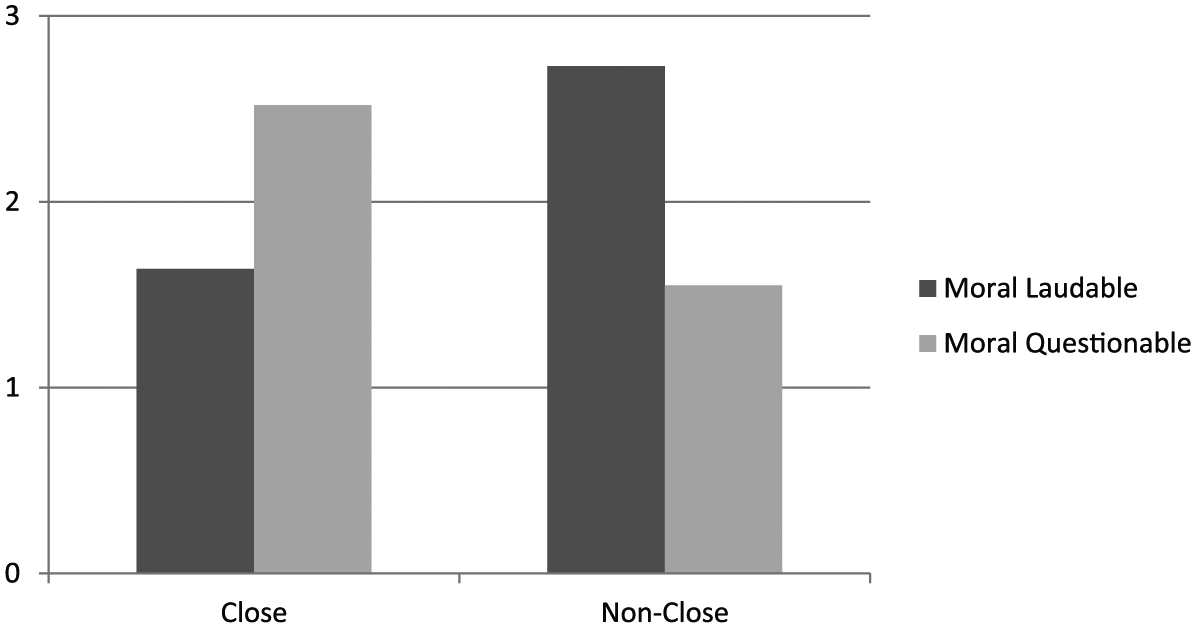
The number of organic products (0-8) that participants chose in Study 3 as a function of thinking about a morally laudable (vs. morally questionable) close (vs. nonclose) other.
In sum, these results show an interaction between closeness and morality of the other person on organic choices. Although the pattern of results replicates Studies 1 and 2, supporting vicarious licensing effects, these differences are statistically nonsignificant. It is possible that floor effects (i.e., participants only chose a limited number of organic products) and the sample size lowered the strengths of the results. To further test our logic, we, therefore, aimed to conceptually replicate the interaction between closeness and moral behavior in Study 4.
Study 4
Study 4 again tested whether people balance the moral behaviors of close others such that they are likely to show vicarious licensing and cleansing effects when it concerns a close other, whereas they will be less likely do so when it concerns a nonclose other. Furthermore, as a large body of research shows that environmental intentions and behaviors are largely influenced by people’s environmental self-identity (e.g., Gatersleben, Steg, & Vlek, 2002; Sparks & Shepherd, 1992; Van der Werff, Steg, & Keizer, 2014; Whitmarsh & O’Neill, 2010), we decided to take environmental self-identity into account as a covariate. Especially important in this consideration is that research has shown that environmental self-identity is an important factor when studying licensing effects in the environmental domain (Meijers, Verlegh, Noordewier, & Smit, 2015).
Method
Participants and design
Two hundred participants completed our study in exchange for course credit or a monetary incentive (Mage = 23.03 years, SDage = 5.79 years—six missing, 72.1% female, 24.9% male, 1.0% gender neutral—four missing). They were randomly assigned to one of the conditions of a 2 (closeness: close, nonclose) × 2 (behavior: environmentally friendly, less environmentally friendly) between-subjects design.
Procedure
Participants were sampled in two ways via the subject pool of a Dutch university. They were either invited to come over to the lab to complete a number of studies, which this study was part of, or they completed the study session online. Similar to Study 2 and Study 3, we used an unrelated tasks paradigm (Higgins et al., 1977). Participants were told they were going to participate in a study concerning relationships. In the close conditions, participants spent 2 minutes writing down how they are similar to the people surrounding them (thinking of similarities is a common way to induce a sense of oneness; Cialdini et al., 1997). Then, they were asked to keep someone in mind who is close to them, for example, their best friend and were asked to write down the name of the person. In the nonclose conditions, participants spent 2 minutes writing down how they are dissimilar to the people surrounding them. Then, they were asked to keep someone in mind who they know, but is not too close to them, for example a fellow student, and were asked to write down the name of this person.
After writing down the name of the person they kept in mind, participants read a scenario regarding the person they kept in mind. Similar to Study 1, we programmed the scenario such that the name of the person the participants kept in mind [name] appeared in the scenario. In the environmentally friendly conditions, participants read that [name] had a lot of waste at home that needed to be separated and brought to the garbage collection point due to a party. The scenario described how [name] separated the plastic from the paper, the biodegradable waste, and the glass bottles and brought them all to the garbage collection point where [name] disposed of the types of waste in the designated bins. In the less environmentally friendly conditions, participants read that [name] had a lot of waste at home that needed to be separated and brought to the garbage collection point due to a party. The scenario described how [name] did not feel like separating the different types of waste and threw them all in one big bag. Then, [name] walked to the garbage collection point and saw that the residual waste bin was full and disposed of the big bag containing all kinds of waste in the biodegradable waste bin.
Manipulation checks
To check whether the participants read the relevant details of the scenario, we asked participants what [name] did in the scenario with an open-ended question as a manipulation check. Nine participants were unable to report correctly what was in the scenario (e.g., “Oscar wanted to become friends with a person who does not like him”) or stated that the scenario was highly unlikely (e.g., “Karin supposedly behaved in an environmentally unfriendly way, but this does not make sense”). These participants were excluded for analyses. Inclusion of these participants resulted in a similar pattern of results (results available on request). Furthermore, to check whether our manipulations were successful, we asked participants how close they were with [name] on a scale from 1 (not close at all) to 7 (very close), M = 4.37, SD = 2.54, and to what extent [name] displayed environmentally friendly behavior on a scale from 1 (not at all) to 7 (very much), M = 4.04, SD = 2.62.
Dependent measure
Next, participants were asked to complete the questionnaire regarding environmentally friendly behavioral intentions. Intentions were measured using the same six items as in Study 1 (based on Minton & Rose, 1997; Cronbach’s α = .86; M = 3.95, SD = 1.36). Hereafter, participants continued to participate in a number of unrelated studies concerning advertising of other faculty members who served as fillers between our study and the environmental self-identity measure.
Covariate
After these unrelated studies, we measured environmental self-identity with three items such as “Acting environmentally friendly is an important part of who I am,” on a scale from 1 (completely disagree) to 7 (completely agree), Cronbach’s α = .91, (M = 4.16, SD = 1.41; Van der Werff et al., 2014). Finally, participants were thanked for their participation and fully debriefed.
Results and Discussion
Manipulation checks
First, we checked whether our manipulation of closeness was successful. A 2 (closeness: close, nonclose) × 2 (behavior: environmentally friendly, less environmentally friendly) ANOVA with closeness judgments as the dependent variable showed a main effect of closeness, F(1, 187) = 1,330.02, p < .001, ηp2 = .88. As expected, participants in the close conditions felt closer to the person they kept in mind (M = 6.66, SD = 0.57) than did participants in the noncloseness condition (M = 1.90, SD = 1.15). 1
Next, we checked whether our manipulation of environmentally friendly behavior was successful by conducting a 2 (closeness: close, nonclose) × 2 (behavior: environmentally friendly, less environmentally friendly) ANOVA with environmentally friendly behavior judgments as the dependent variable. The ANOVA showed a main effect of environmental friendliness, F(1, 187) = 858.18, p < .001, ηp2 = .82. As expected, participants in the environmentally friendly conditions thought that the person they kept in mind behaved in a more environmentally friendly way (M = 6.39, SD = 1.10) than did participants in the less environmentally friendly conditions (M = 1.67, SD = 1.18). 2
Main analyses
A 2 (closeness: close, nonclose) × 2 (behavior: environmentally friendly, less environmentally friendly) ANOVA with environmentally friendly behavioral intentions as the dependent variable showed no interaction or main effects: interaction between closeness and environmentally friendly behavior, F(1, 187) = 2.06, p = .153, ηp2 = .011; main effects of closeness, F(1, 187) = 0.41, p = .524 and environmental behavior, F(1, 187) = 1.04, p = .310. For means, see Table 1.
Environmentally Friendly Intentions as a Function of Closeness and Environmentally Friendly Behavior in Study 4 on a Scale From 1 (Completely Disagree) to 7 (Completely Agree).
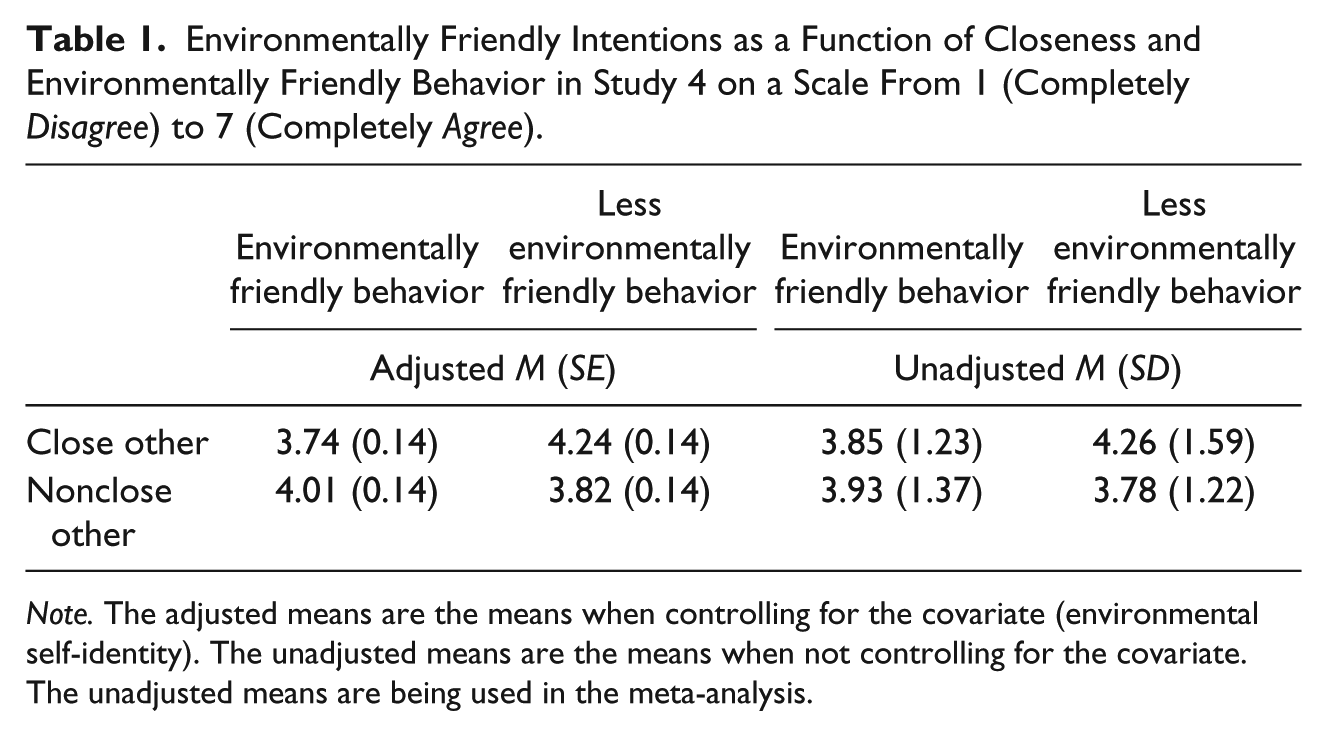
Note. The adjusted means are the means when controlling for the covariate (environmental self-identity). The unadjusted means are the means when not controlling for the covariate. The unadjusted means are being used in the meta-analysis.
Next, the influence of environmental self-identity was controlled for. As expected, environmental self-identity was correlated with the dependent variable (r = .69, p < .001). Because environmental self-identity met the assumptions for taking it into account as a covariate (e.g., linearity, homogeneity of regression slopes, no multicollinearity; Pallant, 2001), we controlled for it as intended. In line with the hypothesis, a 2 (closeness: close, nonclose) × 2 (behavior: environmentally friendly, less environmentally friendly) ANCOVA with environmental self-identity as a covariate and environmentally friendly behavioral intentions as the dependent variable showed an interaction between closeness and environmentally friendly behavior, F(1, 186) = 6.01, p = .015, ηp2 = .031. There were no main effects of closeness, F(1, 186) = 1.17, p = .281, or environmental behavior, F(1, 186) = 0.28, p = .596.
To interpret the interaction, we compared the means with simple main effects tests while controlling for environmental self-identity (hence the adjusted Ms and SEs reported here, but see Table 1 for the unadjusted Ms and SDs). First, the close versus nonclose conditions were compared. The simple main effects showed that when participants thought of a close other being environmentally friendly, they reported lower environmentally friendly behavioral intentions (M = 3.74, SE = 0.14) than when they thought of a nonclose other being environmentally friendly (M = 4.24, SE = 0.14), F(1, 186) = 6.27, p = .013. Unexpectedly, when participants thought of a close other behaving in a less environmentally friendly manner, they did not report more environmentally friendly behavioral intentions (M = 4.01, SE = 0.14), than when they thought of a nonclose other behaving in a less environmentally friendly manner (M = 3.82, SE = 0.14), F(1, 186) = 0.94, p = .334.
Second, the environmentally friendly versus less environmentally friendly conditions were compared. The simple main effects showed, against expectations, that when participants thought of a close other behaving in an environmentally friendly manner, they did not report lower environmentally friendly behavioral intentions (M = 3.74, SE = 0.14) than when they thought of a close other behaving in a less environmentally friendly manner (M = 4.01, SE = 0.14), F(1, 186) = 1.91, p = .169. Finally, when participants thought of a nonclose other behaving in an environmentally friendly manner, they reported higher environmentally friendly behavioral intentions (M = 4.24, SE = 0.14) than when they thought of a nonclose other behaving in a less environmentally friendly manner (M = 3.82, SE = 0.14), F(1, 186) = 4.29, p = .040 (see Table 1 and Figure 2).
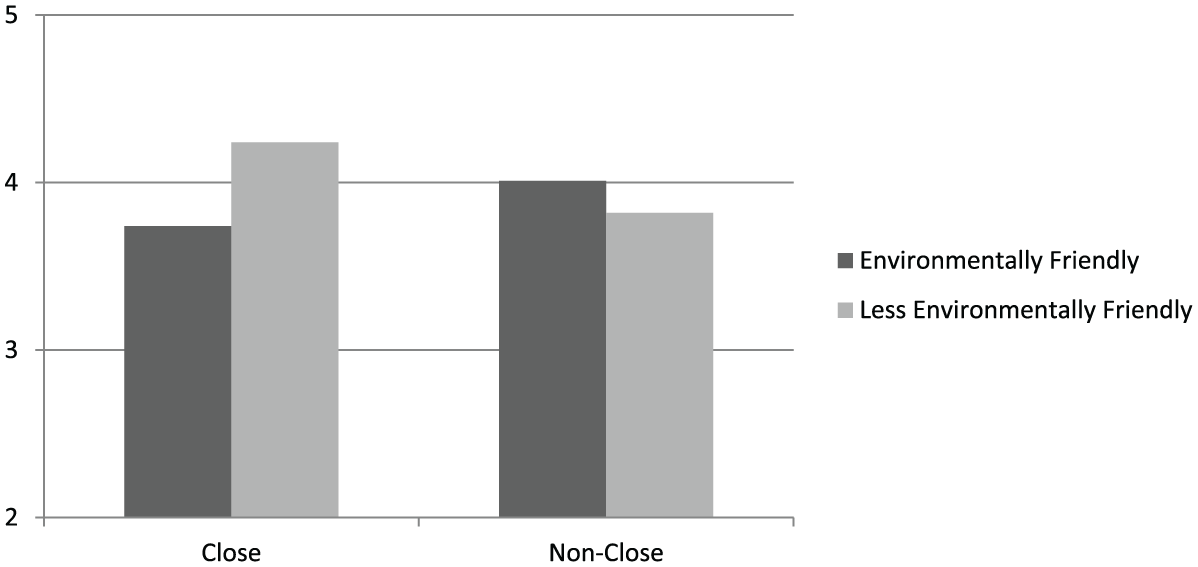
Environmentally friendly intentions (1-7) as a function of closeness and environmentally friendly behavior performed by the other, controlled for environmental self-identity, in Study 4.
Taken together, these results show some support for vicarious licensing, but some results were, unexpectedly, nonsignificant. Similar to Study 3, there was no support for vicarious cleansing. Furthermore, we find that thinking of a nonclose other who behaved in an environmentally friendly way results in more environmentally friendly behavioral intentions. This point will be revisited in the “General Discussion” section. Finally, the interaction effect only emerged when taking environmental self-identity into account as a covariate. Previous research showed that environmental self-identity is a major predictor of environmentally friendly attitudes, intentions, and behaviors (Gatersleben et al., 2002; Sparks & Shepherd, 1992; Van der Werff et al., 2014; Whitmarsh & O’Neill, 2010). When such a strong predictor is added to a statistical model as a covariate, the statistical power for finding a significant between-group difference increases because the within-group variance decreases. Hence, the fact that the interaction effect only emerged in the model with self-identity included could be explained as the result of an increase in statistical power. A recent quasi-experimental field study similarly found that the licensing effect in the environmental domain was only observed when controlling for environmental self-identity (Meijers et al., 2015).
Meta-Analysis
Studies 1 to 4 show some support for the prediction that people take the moral behaviors of close others into account regarding their own moral behavior. To investigate whether there is evidence for vicarious licensing and cleansing effects, a meta-analysis was conducted. Using a meta-analysis is a common way to increase statistical power (Cohn & Becker, 2003), allowing us to investigate more accurately whether there is indeed evidence for vicarious licensing and cleansing effects or whether the hypothesis has to be rejected. Random-effects models were used as the effect sizes may vary from study to study, due to—among others—differences between the manipulations of various studies. Following Borenstein, Hedges, Higgins, and Rothstein (2009), Cohen’s d was used as an index for effect size.
Results and Discussion
First, vicarious licensing with close others was tested, that is, whether people are more likely to feel licensed when a close other behaved morally than when a close other did not behave morally. To this end, Studies 1, 3, and 4 were included. In Study 1, the control condition consisted of neutral behavior, whereas in Studies 3 and 4, the control condition consisted of less moral behavior (e.g., less environmentally friendly behavior). We decided to look at these simultaneously, as a meta-analysis concerning the moral licensing effect showed that effect size is not influenced by the type of control condition (neutral or less moral; Blanken, van de Ven, & Zeelenberg, 2015). The meta-analysis showed a small-to-moderate significant mean effect size of d = −0.43, SE = 0.21, confidence interval (CI) = [–0.83, –0.02], p = .039. This indicates that people are more likely to feel licensed when a close other behaved in an environmentally friendly way than when a close other behaved in a less environmentally friendly way. Note that this difference was not statistically significant in Studies 3 and 4, but pooling the data leads to an increase in power that provides a more accurate estimate of the effect size, and renders the effect significant.
Next, to test whether people are more likely to feel licensed when a close other rather than a nonclose other behaved morally, a meta-analysis including the Studies 2, 3, and 4 was conducted. As expected, the meta-analysis showed a significant vicarious moral licensing effect across the studies and produced a small-to-moderate mean effect size of d = −0.43, SE = 0.19, CI = [–0.80, –0.06], p = .022. Based on the current studies, there, thus, seems to be a vicarious licensing effect and this effect seems to be dependent on people’s closeness: People are more likely to feel licensed when a close other than a nonclose other behaved in an environmentally friendly way.
Finally, to test whether people are more likely to cleanse a close other’s less moral behavior than a nonclose other’s less moral behavior (i.e., vicarious cleansing effect), a meta-analysis including Studies 3 and 4 was conducted. The meta-analysis showed no support for a vicarious cleansing effect, with a nonsignificant small mean effect size of d = 0.24, SE = 0.20, CI = [–0.15, 0.62], p = .230. This suggests that people may use close others’ environmentally friendly behavior to license their own less environmentally friendly behaviors, but people do not cleanse close others’ less environmentally friendly behavior by performing environmentally friendly behaviors themselves.
General Discussion
It was hypothesized that people balance close others’ more and less environmentally friendly behaviors when striving for moral balance, because of the self–other overlap in close relationships. In four studies, support was found for one side of this prediction (vicarious licensing), but not for the other (vicarious cleansing).
Vicarious Licensing, but Not Cleansing
The current findings contribute to previous research in several ways. First of all, they add to the literature on licensing by showing that people feel licensed to behave in a less environmentally friendly way not only after they previously behaved morally themselves but also after a close other previously behaved morally. This is in line with research showing that others may be included in the self and may affect one’s moral self-view (e.g., Aron et al., 1991; Kouchaki, 2011).
The current findings also add to the literature on moral cleansing by showing that, at least in the current setting, people do not seem to be motivated to cleanse close others’ morally questionable behavior. Concerning close others, there, thus, seems to be an interpersonal moral balancing effect, but only when this allows people to behave in a less environmentally friendly way. Having to cleanse a close other’s behavior by behaving in a more environmentally friendly way is costly in terms of money, time, and/or effort. Whereas vicarious cleansing may, thus, be primarily perceived as a burden, vicarious licensing is tempting as it provides people with a justification to behave less morally. Another explanation for the absence of vicarious cleansing could be that within the imagined scenarios, people may have felt that it would have been socially awkward to be seen to be “picking up” after others (i.e., compensating for the morally questionable behavior of a close friend or family member). In addition, Minson and Monin (2011) more recently suggested that overly moral behavior is often frowned upon, which may create an additional hurdle for such vicarious cleansing behavior. Furthermore, it could be that participants were less worried about appearing environmentally unfriendly because of the less environmentally friendly behavior of the other person. This may have resulted in feeling excused from behaving in an (extra) environmentally friendly way. Finally, participants might have found other ways to cognitively resolve the need to compensate for the less moral behavior of the close other, for example, via cognitive dissonance reduction strategies. Future research could investigate what factors play a role in (the absence of) vicarious cleansing effects.
This absence of vicarious cleansing seems to be in line with the body of research documenting people’s tendency to be self-serving (Finch & Cialdini, 1989; Gino & Galinsky, 2012; Hastorf & Cantril, 1954; Kunda, 1987; Sanitioso, Kunda, & Fong, 1990). People tend to retrieve and present information in such a way that it helps them to justify their behaviors and see themselves in a positive light. For example, when people feel conflicted about their environmental behaviors, they think of previous environmentally friendly behaviors to make themselves feel better (Hope, Jones, Webb, Watson, & Kaklamanou, 2017). The research on self-servingness may explain why people show vicarious licensing effects; that is, because of the moral behaviors of close others, they may feel licensed to behave in a more morally questionable manner while being able to see these transgressions in a more positive light due to the moral behaviors of close others.
Similarly, research shows that when people are confronted with morally questionable behaviors of close others, they soften their views of these morally questionable behaviors. Research has shown, for example, that feeling close to a person who behaves in a morally questionable way makes people perceive those morally questionable behaviors as less unethical (Gino & Galinsky, 2012). In sum, people seem to be able to construe information in such a way that is most beneficial for themselves, which may explain the absence of vicarious cleansing effects: Because people might construe the morally questionable behavior of close others as less immoral, people are less likely to feel the need to cleanse their close other’s morally questionable behaviors.
Sustained Environmentally Friendly Behaviors
The current research also adds to research showing that people are not always consistent when it comes to their environmentally friendly behaviors across situations and time (e.g., Hope et al., 2017; Meijers, Noordewier, & Avramova, 2013; Nilsson, Bergquist, & Schultz, 2017; Truelove, Carrico, Weber, Raimi, & Vandenbergh, 2014). That is, on one hand, research shows that one’s environmentally friendly behavior in one domain may positively spill over into another domain. For example, people who are likely to drive in a fuel-efficient manner are more likely to reduce meat consumption (Van der Werff et al., 2014). On the other hand, there is also research showing the opposite, such that one’s environmentally friendly behaviors in one domain may negatively spill over into another domain. For example, people who decrease their water consumption may subsequently increase their electricity consumption (Tiefenbeck et al., 2013). Our research adds to these findings by showing that the environmentally friendly behaviors of a close other may also lead to less environmentally friendly behaviors of the self. For future research, it is important to investigate what factors instigate positive and negative spillover effects (within and across people) to foster sustained environmentally friendly behaviors. Research so far suggests that environmental self-identity may play an important role in stimulating sustained environmentally friendly behaviors (Meijers et al., 2013; Truelove et al., 2014), which might explain why environmental self-identity played such a big role in Study 4.
What exactly drives the environmental vicarious licensing effect is not clear yet. Similar to inconsistent environmental behavior within one person, there may be a number of explanations. Within the licensing literature, two different mechanisms have been proposed: moral credentials and moral credits (Merritt et al., 2010). When it concerns moral credentials, people’s “good deeds” change the meaning of their subsequent morally questionable behaviors and these subsequent morally questionable behaviors might be seen as less immoral (Monin & Miller, 2001). In contrast, when it concerns moral credits, people might feel entitled to behave less morally after a good deed (Jordan et al., 2011; Sachdeva et al., 2009). Moreover, recent research shows that people might strike an environmental balance by endorsing compensatory green beliefs (Hope et al., 2017; Kaklamanou, Jones, Webb, & Walker, 2015). That is, people may hold beliefs that recycling may compensate for driving a car (Kaklamanou et al., 2015). By extension, we could argue that recycling behaviors of close others may make up for driving a car, as such instigating licensing effects. Future research could investigate which of these processes (or maybe multiple processes) underlie the vicarious licensing effects within the environmental domain.
Vicarious Balancing Versus Social Norms
The current findings that the environmentally friendly and moral behavior of close others may actually lead to less environmentally friendly behaviors of the self appear to contrast with the results of research on social norms. This research has shown that others’ behaviors guide an individual’s own behaviors because they communicate a certain norm (e.g., Cialdini, 2003; Cialdini, Reno, & Kallgren, 1990; Schultz, Nolan, Cialdini, Goldstein, & Griskevicius, 2007). For example, individuals are more likely to behave in an environmentally friendly way and reuse their bath towels in hotels if other guests also do so (Goldstein, Cialdini, & Griskevicius, 2008). The behavior of others defines the social norm and provides individuals with social proof on how to behave, thus leading them to behave in a similar manner. Particularly, when individuals feel similar or close to others, they are likely to follow the behavior of those others (e.g., Johnston & White, 2003; Louis, Davies, Smith, & Terry, 2007). At first glance, these results regarding social norms appear to contradict our results; however, there are some differences that explain these apparently opposing results.
First, studies on social norms often examine the effect of an individual’s behaviors on identical behaviors of others, for example, how low energy use by neighbors leads to a lower energy use of the self (Schultz et al., 2007). Research shows that the effect of norms diminishes once the norm-setting behavior and the behavior following this norm become more distant. Therefore, an antilittering norm leads to less littering, but recycling or energy-saving norms are less likely to lead to less littering (Cialdini et al., 1990). The current studies, investigated how moral behaviors may lead to less environmentally friendly behaviors or how one type of environmentally friendly behavior influences other types of environmentally friendly behaviors. These behaviors are, thus, less conceptually close, which might be an explanation of why we observe vicarious licensing rather than social norm effects. Second, when emphasizing similarity or closeness in social norm experiments, researchers generally focus on what we would term nonclose others (rather than close others). So, individuals may be more likely to reuse their towels when they resemble the other hotel guests more (e.g., they both stayed in the same room; Goldstein et al., 2008). However, this situation is unlikely to create an overlapping feeling of oneness and self–other overlap, which drives the vicarious licensing effect. When comparing the results of social norm studies (in which closeness is similar to our operationalization of nonclose others) with the current results regarding nonclose others, they in fact appear to be consistent rather than opposing. Specifically, the findings in Studies 3 and 4 suggested that contemplating nonclose others may be more likely to instigate social norm rather than balancing effects. It, thus, seems to be the case that people balance others’ behavior when there is a large degree of self–other overlap (i.e., a close other in our studies) but show social norm effects when there is less self–other overlap (i.e., a nonclose other in our studies). This suggests that for future research, it is important to make a distinction in how close a “close other” is, as relative closeness may instigate social norm effects, but more extreme closeness may instigate vicarious licensing effects. Furthermore, it could be interesting to investigate whether being part of the same household affects the results. It could be that the closeness effect is strengthened when, for example, environmentally friendly appliances or food are acquired via shared (financial) resources, as in that case, both vicarious and self-licensing may play a role.
Limitations, Alternative Explanations, and Future Research
There are a number of limitations that need to be taken into account when drawing conclusions from our studies. The current studies mainly make use of scenarios, which may be less realistic. For future research, it is advisable to include a perceived realism check to probe the realism of the scenarios. In the open-ended questions affiliated with the current studies, very few people explicitly questioned the realism of the scenarios (four participants in Study 2) and all participants indicated they were able to “put themselves into the shoes” of the people in the scenarios. Taken together, it seems that the scenarios were quite realistic.
Next to using scenarios to manipulate the independent variables, we measured intentions instead of actual behavior, which might affect the generalizability to everyday moral behavior. Most research on moral licensing, however, uses scenarios, recall, or vignettes in a lab or online setting (e.g., Jordan et al., 2011; Khan & Dhar, 2006; Mazar & Zhong, 2010; Monin & Miller, 2001; Sachdeva et al., 2009). Importantly, effects found in these studies are comparable with the results of research focused on actual behavior (Hofmann, Wisneski, Brandt, & Skitka, 2014; Meijers et al., 2015; Tiefenbeck et al., 2013). In line with this, a recent meta-analysis on the licensing effect shows that the effects found on hypothetical behavior (e.g., intentions) and actual behavior are similar (Blanken et al., 2015).
An additional alternative explanation for the current findings could be assimilation and contrast effects (Schwartz & Bless, 1992). 3 When participants read about the environmentally friendly or moral behaviors of close others, they might feel that they cannot live up to this, which could subsequently lead participants to behave in a less environmentally friendly way (i.e., contrast effect). On the contrary, nonclose others may be more likely to be used as a normative standard, because they are less familiar (i.e., assimilation effect; see also Dijksterhuis, Spears, & Lépinasse, 2001). Other research suggests, however, that assimilation effects are actually more likely than contrast effects when the closeness between two people is emphasized and when they feel connected (Suls, Martin, & Wheeler, 2002), as is the case with the close other. To disentangle the exact underlying mechanism of the current findings, a future think-aloud study could provide interesting insights (see, for example, Hope et al., 2017).
The current research is the first to systematically study vicarious balancing effects in dyadic situations, and investigate the role of interpersonal closeness in these effects. To some extent, our results parallel the findings of Kouchaki (2011), who studied how people might behave in a more racist way because a participant of the same subject pool (i.e., same in-group) has behaved in a nonracist way. Her results suggest that, next to interpersonal closeness, vicarious licensing effects might also be induced by shared in-group membership. Future research might examine other bases for vicarious licensing effects.
We are not aware of previous research examining the possibility of vicarious cleansing effects. In two studies, however, we did not find any support for it. Of course, this lack of effect may be due to the context (environmentally friendly behavior), but it may also be that the motivational force that is needed to morally balance the behavior of others is simply not strong enough to engage in the additional effort that is needed to compensate the less environmentally friendly behavior of others. Furthermore, we found an asymmetry in evidence for vicarious cleansing and vicarious licensing in the environmental domain, so it would be interesting to see whether this asymmetry replicates in other domains (for more research on asymmetry in morality, see Gino & Galinsky, 2012). Finally, it is important to replicate the current findings with different (large) samples, methods, across countries, and with different manipulations and measures to test the robustness of the findings.
Footnotes
Acknowledgements
We would like to thank the editor in chief Dr. Ann Devlin, senior associate editor Dr. Kelly Fielding, and three anonymous reviewers for the constructive feedback they have provided.
Declaration of Conflicting Interests
The author(s) declared no potential conflicts of interest with respect to the research, authorship, and/or publication of this article.
Funding
The author(s) received no financial support for the research, authorship, and/or publication of this article.