



Abstract
It is a common assumption to believe that encouraging pro environmental behavior (PEB) in one domain would lead to increased PEB in other domains (best-case scenario) or just be restricted to the initial targeted domain (worst-case scenario). Evidence from a rapidly growing literature on moral licensing suggests that interventions targeting behavioral change could lead to an even worse scenario, with individuals starting to underperform in one domain, as a compensation for their good performance in other domains. We propose to study the dynamic of PEBs when individuals are exposed to a specific nudge (priming) via an original experiment designed to capture actual behavior. We found that priming could increase PEB, but does not thwart moral licensing. Primed individuals end up doing worse than non-primed individual under a moral licensing condition. A more comprehensive view of the mechanisms underlying behavioral change is essential to support sustainable policies.
In the last several years policy makers have engaged in a range of behavior change initiatives aimed at increasing pro environmental behavior (PEB). Information campaigns, as well as economic incentives and nudges of various types (normative messaging, default option, reminders, etc.), have been used to encourage the adoption of more sustainable practices across a range of areas (recycling, energy saving, healthier food habits, organ donation), with mixed results (for a review of international evidence see Allcott, 2011; Al-Ubaydli & Lee, 2011; Southerton et al., 2011; Viscusi et al., 2011). Evaluations of the effectiveness of these initiatives are fraught with many complex issues, the most prominent of which is that most initiatives evaluate the direct impact that results from the specific initiative adopted (say reduced household emissions from energy saving), without addressing the effect that the initiative may inadvertently have on other behaviors (Gilg et al., 2005).
Recent research on pro-environmental behaviors reveals the importance of considering behavioral spillovers, that is, the effects an initial intervention may have on subsequent behaviors not directly targeted by it (Poortinga et al., 2013). Negative spillovers (i.e., when an increase in one PEB is associated to a decrease in another unrelated PEB) could be harmful to participants if neglected as they could cancel the benefit associated with the initial intervention. While those negative spillovers tend to be associated with the so called rebound effect (i.e., expected economic gains from a new technology are offset by a change in behavior, such as, replacing one conventional light bulb with two LED light bulbs), we focus in this work on a less considered type of spillover affecting moral behavior, “Moral licensing”; suggesting a high level of complexity in the way individuals make decisions over time. “Moral licensing,” the idea that people may off-set their virtuous deeds by feeling entitled to behave more self-indulgently afterward, offers new perspective to approach PEB and the global impact of policies (Blanken et al., 2015; Galizzi & Whitmarsh, 2019; Khan & Dhar, 2006; Mazar & Zhong, 2010; Mullen & Monin, 2016). In light of this theory, an internal balancing mechanism between good and bad deeds prevents individuals from reaching their long-term goals. Moral licensing has been applied to health (smokers taking vitamin pills smoke more cigarettes; Chiou et al., 2011) or even driving habits (Prius hybrid drivers are more likely to break crosswalk laws, get into accidents, and receive fines; Woodyard, 2009) but little is known about moral licensing implications within the environmental domain in real life settings (Clot et al., 2016). This present paper proposes to investigate the potential for “green licensing.” 1 A better understanding of how individual behavior interferes with environmental long-term goals and to what extent moral licensing may harm environmental policies seems crucial in helping to design effective policies: the goal is to reduce carbon footprints overall, and thus any negative spillovers must be “planned in.”
Our work relies on an experiment designed to study moral licensing in the environmental domain by observing actual behavior. We designed and conducted a between-subjects experiment with one control and two treatments that tested the impact of exposure to environmental information (priming via green product rating) on the opportunity to actually do good for the environment in two sequential tasks (signing a petition and recycling).
Background
The implicit expectation of behavior change initiatives is that once an individual has become more conscious in one domain, this will spread to a whole range of other choices. This rests on two assumptions: (1) that having more information about issues and caring about them encourages more action, and (2) aside from practical resource constraints (essentially time and various forms of capital, including human capital) there is no upper limit to the amount of “good” actions that individuals are willing to undertake. However, experimental evidence from behavioral economics suggests a more complex picture given that, whilst individuals care about the effect of their actions on others (social preferences or prosocial behavior), they also experience self-control problems (moral licensing) (Blanken et al., 2015; Khan & Dhar, 2006; Mazar & Zhong, 2010; Mullen & Monin, 2016).
For instance, the mixed results of carbon-offset programs constitute a good example that could find its roots in moral licensing. Major organizations engaged in releasing carbon off-sets, such as Responsible Travel, Yahoo, or the United States House of Representatives have stopped their activity because “Offsets are distracting people from making more significant behavioural changes, such as flying less” (Rosenthal, 2009). Seventy percent of people in the UK believe that air travel has a significant impact on climate change (British social attitudes survey, 2009), but only 26% would try not flying in the next 12 months (88% would be willing to reduce the energy used at home). While an increasing portion of people acknowledge that flying is a major source of carbon emission, which goes against their environmental values, very few are ready to change their habits in line with their green ideals. Relying on 202 individual interviews about sustainable lifestyle, Barr et al. (2011) highlighted this contradiction within individual lifestyle. Their findings reveal that people having the greener habits at home were also those flying the most. People further argue that they deserved such flying as a reward for their green efforts. This is a concrete example of paradox linked to moral licensing that may seriously affect the efficiency of pro-environmental initiatives.
Moral licensing questions the sustainability of isolated measures targeting one specific domain (e.g., waste management, water use, energy consumption, purchase of local or organic food) in achieving a successful path to greener lifestyles at an aggregated level. The idea that people may off-set their effort in one domain by feeling entitled to behave more indulgently subsequently through moral licensing is emerging rapidly (see Blanken et al., 2015 for a meta study and Mullen & Monin, 2016 for a comprehensive review). Looking at driving habits, a study shows that Prius hybrid drivers are more likely to break crosswalk laws, get into accidents, and receive fines than drivers from conventional cars (Norton, 2012). In the environmental domain, voluntary commitment to carbon reduction (i.e., buying carbon offsets) could promote the use of polluting transportation such as airplanes (Khan et al., 2010). Other studies have shown that environmental commitment (i.e., buying green products or committing to a conservation program) could alter subsequent behavior by decreasing moral attitude but also easing moral transgression (Clot et al., 2014; Mazar & Zhong, 2010).
The mechanism that leads people to behave consistently or even increase their good behaviors in repeated events (positive spillovers) rather than off-setting them (negative spillovers) remains an open question. The literature brings evidence that both positive and negative spillovers (but also no spillovers at all) exists, which underlines the need to look more closely at the factors and conditions associated to those spillovers.
In a comprehensive interdisciplinary literature review, Truelove et al. (2014) highlight three moderators that may play a significant role in spillovers: (1) the decision-mode (whether people’s decisions are calculation vs affect based), (2) the causal attribution (external or internal), and (3) the characteristics of the sequential behaviors (in terms of similarity and difficulty). Consolidating existing work on spillovers, Maki et al. (2019) run a metanalysis compiling 25 experimental or quasi-experimental studies manipulating spillovers across PEBs, and found positive spillovers on the intention to perform a subsequent PEB but negative spillovers when it comes to actual behavior. In a more conceptual paper based on a review of the literature, Nilsson et al. (2017) propose a distinction over behavioral, temporal, and contextual spillovers, discussing theories underlying positive spillovers (cognitive dissonance, self-perception, and action-based learning) as well as those theories underpinning negative spillovers (moral licensing and rebound effect). They additionally discuss possible moderators at the task level (similarity) as well as at the personality level (personal preference for consistency) and finally report the determining role played by self-identity.
Overall, one dimension that brings together a majority of scholars is the way in which the PEB is initiated that is the origin of the motivation that is external versus internal. External sources of motivation, such as regulations or financial rewards may crowd out intrinsic motivation and further translate into negative spillovers. In contrast, when the source of motivation is internal, the PEB is linked to the individual’s self-identity and crowds-in intrinsic motivation, and thus positive spillovers, are more likely to arise (Clot et al., 2016; Lacasse, 2016; Nilsson et al., 2017; Thøgersen & Crompton, 2009; Truelove et al., 2014).
Nudges are becoming a popular tool to promote virtuous behavior by influencing socially relevant decisions in desirable ways at a relatively low cost, for example, to increase pro-environmental choices or pro-social behavior in general. Such nudges seem promising and extraordinarily successful when evaluating their impact on the targeted behaviors in isolation. In the context of spillovers, the role played by nudges may be ambiguous as they could subtly comfort people already doing well, but they could also be particularly influential in driving individuals to start acting in a new way. A few papers have investigated the interactions between nudges and behavioral spillovers. Sintov et al. (2017) found that nudging with cognitive accessibility impact spillovers through an initial relatively difficult behavior (composting) while normative messaging does not. Lacasse (2019) investigated the impact of purposefully adopting a new PEB and found that associating a nudge to the adoption of a new PEB (i.e., tracking that behavior via messaging) had small, indirect positive spillover effects on one type of individual PEB (purchasing local or organic produce) and on political attitude (policy support). Capraro et al. (2019) demonstrated via running sequential charity games on AMT that moral nudges (asking subjects to self-report “what they think is the morally right thing to do”) led to positive spillovers. This work further supports that positive spillovers spread across contexts. Finally, the findings of D’Adda et al. (2017) demonstrate that push measures (i.e., rebates and minimum donation rule) are more effective than nudges (i.e., defaults and social information) in promoting fairness over time and positive spillovers.
We propose in this work to investigate the role played by a specific nudge known as priming in PEBs spillovers. The priming effect lies in the assumption that behavior can be influenced by subtle related cues. For example, Fitzsimons et al. (2008) demonstrated that exposure to the Apple logo increased creativity. Similarly, Mazar and Zhong (2010) provided experimental evidence that exposure to green products increase ethical behavior in a subsequent task. However, their experiments have also shown that the purchase of green products has opposite effects and can license asocial and unethical behavior. More specifically, Mazar and Zhong (2010) found that people buying products from a green store are acting less altruistically than people only exposed to a green store, but they are also more likely to cheat. There are two concomitant explanations for this outcome. First, it could be that one situation enable ones to earn moral credit (in the case of buying green products, an individual clearly signal their virtuous deed) while the other situation (being primed) does not lead to earning any moral credit.
More specifically, our aim is to test the lasting effect of priming by observing how primed people behave in two subsequent tasks. As discussed earlier, we hypothesize that priming will successfully drive individuals’ behavior in the desirable way in the first task, but because they have earnt moral credit in this first task, moral licensing will drive less ethical behavior in the second task. Because priming aims at influencing individuals in an unconscious way, we posit that it is closer to an externally driven change, and that it will lead to negative spillovers in a subsequent PEB. Our hypotheses are summarized below.
H1: Primed individuals are more likely to perform an initial PEB than non-primed individuals.
H2: Primed individuals having earnt moral credit via a first PEB will be more subject to moral licensing (negative spillovers) in a second PEB than primed individuals who haven’t had the opportunity to earn moral credit via a first PEB.
Our contribution is twofold. First we expand the literature on nudges’ spillovers by exploring the impact of priming on two sequential tasks. Second, we develop an original experimental protocol involving “real” tasks (signing a petition and recycling) which enables us to observe actual behavior (more likely to generate negative spillovers as in Maki et al., 2019) in a context free of economic incentives. The absence of economic compensation allows us to disentangle moral licensing from the rebound effect as the two concurrent theories at the origin of negative spillovers (Nilsson et al., 2017). The experimental methodology is further discussed in the following section.
Experimental Design and Procedure
Participants and Method
The experiment took place at the University of Reading in the UK during spring 2016. We ran two sessions following the exact same protocol. Eighty-five undergraduates in total from the economic department (with an average age of 19.5 years and 31.4% female 2 ) participated in this between-subjects experiment as part of their lecture. They were randomly assigned to one out of three conditions. Data was collected using both tablets and papers.
Design
The experimental design (see Table 1) is a modified version of Mazar and Zhong (2010) and involves a product rating task and two PEBs (PEB_1: signing a petition and PEB_2: recycling). The product rating task could take two forms. The first version, with a majority of green products, was designed to prime participants to act in an environmentally friendly way, while there was a majority of conventional products in the second version, which constitutes our control group. PEB_1 (signing a petition) represents the licensing task while PEB 2 (recycling) is our outcome variable. Our experimental design is thus made of three groups: (1) one “Control” (conventional product rating task: no priming) and two treatments, (2) “Priming” (green product rating), and (3) “Priming + Licensing” (green product rating and licensing task, PEB_1).
Experimental Design.
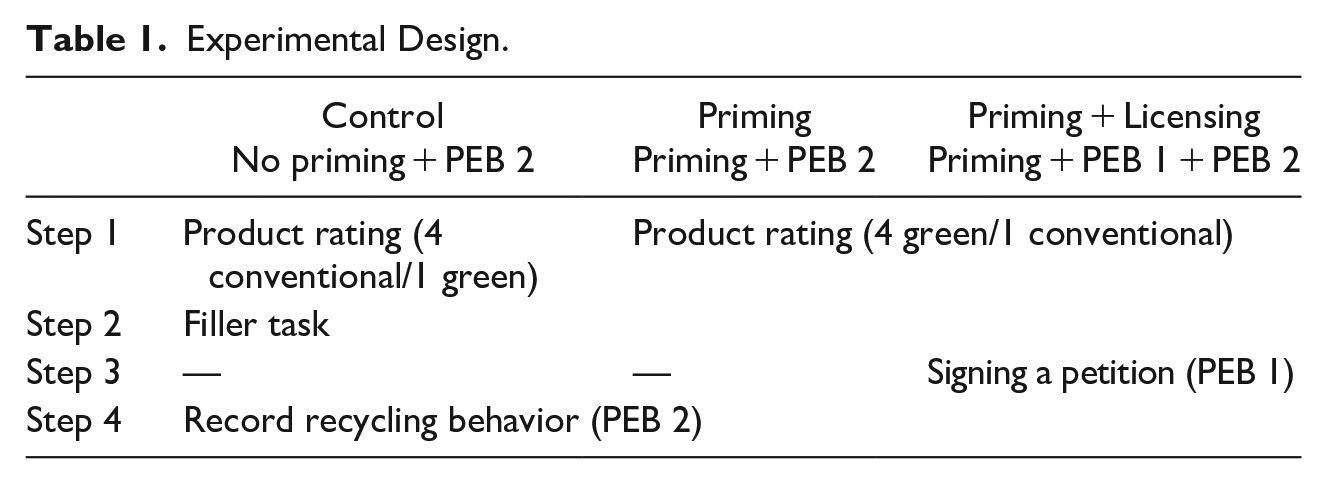
More specifically, in Step 1, participants had to rate products on two criteria: (1) the design of the packaging and (2) the informativeness of the description. In “Control” (the non- primed group), participants were exposed to a list with a majority of conventional products (four conventional products, one green product). In “Priming” and “Priming + Licensing,” participants were primed through exposure to a list containing a majority of green products (four green products, one conventional product). To minimize the possibility that participants notice a link with the subsequent part of the experiment, an additional filler task (consisting of rating a sweet) was introduced after the product rating task, Step 2.
The licensing task (i.e., signing a petition) is introduced at Step 3, for “Priming + Licensing” only, and involved having the option to sign a petition (to tell US congress to support the Paris Climate Agreement 3 ). Signing a petition in this experiment aimed at giving participants the option to engage in small token forms of support for an environmental cause (Kristofferson et al., 2014). In prior experimental works, moral credit tasks have taken the form of either declarative statements or economic games with monetary consequences. The petition is an interesting way to earn moral credit in the context of a moral licensing experiment as it enables individuals to perform a real good deed, while clearly disentangling the moral aspect of a good deed to its monetary consequences. This further facilitates interpretation as it enables us to isolate moral licensing from other possible interpretation such as the rebound effect.
Our outcome variable PEB_2 was monitored for all three groups, at Step 4. The outcome variable is measured through recycling behavior, or whether papers administered for the experiment are placed in the general waste bin or the recycle bin. The instructions made clear to participants that papers (the instructions sheet and a smaller envelope with the sweet, both enclosed in a larger envelope) should be placed in bins while leaving the room. The following sentence “Please, do not forget to take all the papers with you and throw them in the bin when you leave the room!” was mentioned both in the paper and in the online instructions (see Supplemental Appendix 2 4 ). Each paper linked to the survey was numbered, so we could record participant’s recycling behavior by checking bins after the experiment.
In sum, our experimental design involves four steps. This first step (product rating task) comprised three groups, as summarized in Table 1: “Control,” exposed to conventional products, “Priming,” exposed to green products, “Priming + Licensing,” also exposed to green products. In a second step, all participants took part in the filler task. Only participants in “Priming + Licensing” undertook Step 3, the licensing task (PEB_1). Step 4 (PEB_2) consisted of recording individual recycling behavior.
Procedure
Before participants entered the room, both the tablet and a big envelop (containing the instructions) were placed on tables, making sure to keep enough space between students for privacy purposes. As participants entered the room, they were asked to sit in front of a tablet. They were told that they would participate in a survey for research, which would consist in rating products on a list that would be made available on the tablets and that they would have a break at the end of the activity before the lecture started again. Additional details on the instructions and the experimental design are available in the Appendices.
Results
We collected 85 observations well balanced among the three groups (29 in Control, 28 in Priming, and 28 in Priming + Licensing). We categorize the recycling outcome into three categories: (1) used the recycle bin, (2) used the general waste bin, (3) did not use a bin (some individuals just left the papers behind them when leaving the classroom).
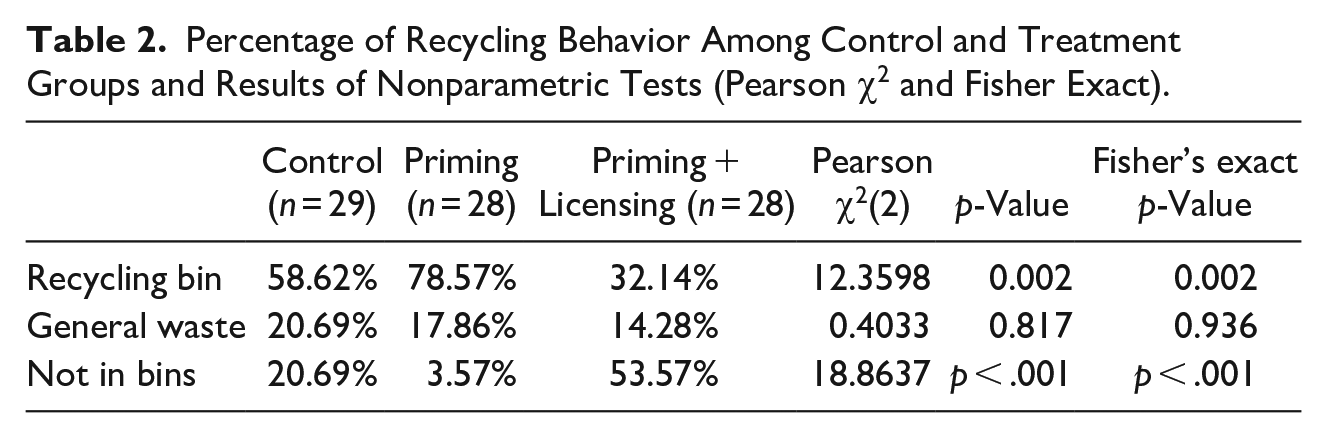
Our main findings are summarized below. In Table 2, we present the percentage of recycling behavior among our three sub-groups along with two different nonparametric tests (Fisher exact test and Pearson χ2 5).
Percentage of Recycling Behavior Among Control and Treatment Groups and Results of Nonparametric Tests (Pearson χ2 and Fisher Exact).
Result 1
Priming tends to increase green behavior. Participants in the priming treatment were more likely to use the recycle bin than participants in the control group (+19.95 points, Fisher exact test = 0.091, Cohen’s d = −0.43). They were also less likely to litter the classroom by leaving their paper behind (−17.12 points, Fisher exact test = 0.056, Cohen’s d = 0.53).
Result 2
The licensing task dampens the effect of priming and leads to a significant decrease in green behavior. Overall, participants in the Priming + Licensing treatment used the recycling bin significantly less than participants in the control group (−26.48 points, Fisher exact test = 0.040, Cohen’s d = 0.54) as well as the participants in the Priming treatment alone (−46.43 points, Fisher exact test = 0.001, Cohen’s d = 1.03). They were also significantly more likely to litter by not using bins than the control group (32.88 points, Fisher exact test = 0.010, Cohen’s d = −0.71) as well as than the primed group (50 points, Fisher exact test <0.001, Cohen’s d = −1.3).
Figure 1 compares the distribution of participant’s behavior between treatments and control, illustrating Results 1 and 2.
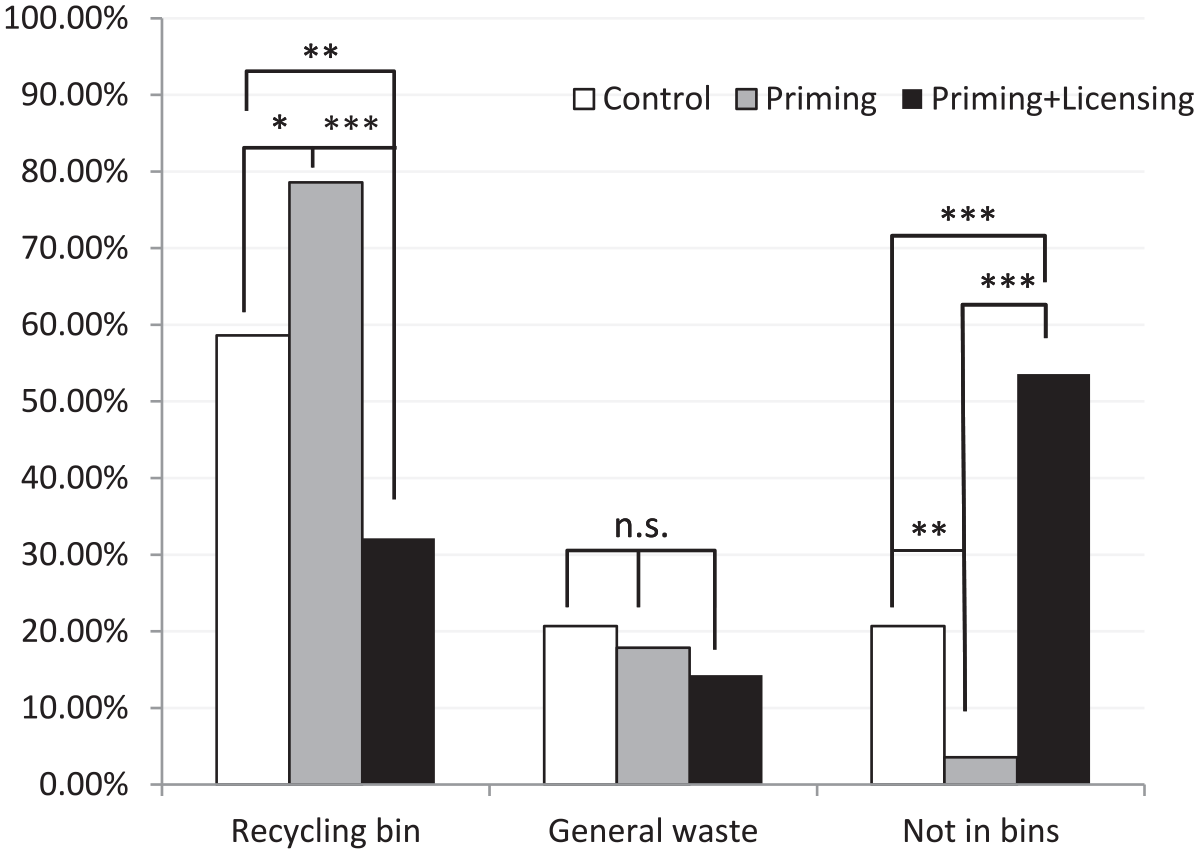
Distribution of behavior toward waste between control and treatment groups.
Within “Priming + Licensing,” we could track down 50% of participants who signed the petition. 6 The following paragraphs refine the analysis based on this observation.
Result 3
Participants who effectively signed the petition were much less likely to use the recycle bin than both the control group (−37.19 points, Fisher exact test = 0.022, Cohen’s d = 0.85) and the primed group (−57.14 points, Fisher exact test < 0.001, Cohen’s d = 1.45). They were also far more likely to not use bins than the control group (+34.45 points, Fisher exact test = 0.017, Cohen’s d = −0.94) as well as more likely than the primed group (+53.57, Fisher exact test < 0.001, Cohen’s d = −1.76).
Result 4
Participants for which we could not verify the signature reflect similar patterns than those who signed it though the effect is less pronounced. They were less likely to use the recycle bin than both the control group (−15.76 points, Fisher exact test = 0.434. Cohen’s d = 0.17) and the primed group (−35.71 points, Fisher exact test = 0.026, Cohen’s d = 0.63). They were also more likely to not use bins than the control group (+29.31 points, Fisher exact test = 0.056, Cohen’s d = −0.47) as well as than the primed group (+46.43, Fisher exact test = 0.001, Cohen’s d = −1.19).
Finally, we run an ordered probit (Table 3) with behavior toward waste as a dependent variable (1 = recycle bin; 2 = general waste; 3 = non-use of bins) as a robustness check of the impact of priming and licensing. We controlled for group fixed effects 7 as well as sensitivity to green products (an indicator we built based on the product’s rating survey capturing the difference between green and standard products’ ratings). The probit estimates confirm previous results and highlights the statistically significant and positive role of priming on recycling behavior along with the negative effect of the licensing task dampening the priming effect and worsening recycling behavior.
Ordered Probit Estimates—Dependent Variable: Recycling Behavior (1 = Recycle Bin; 2 = General Waste; 3 = Non-Use of Bins).
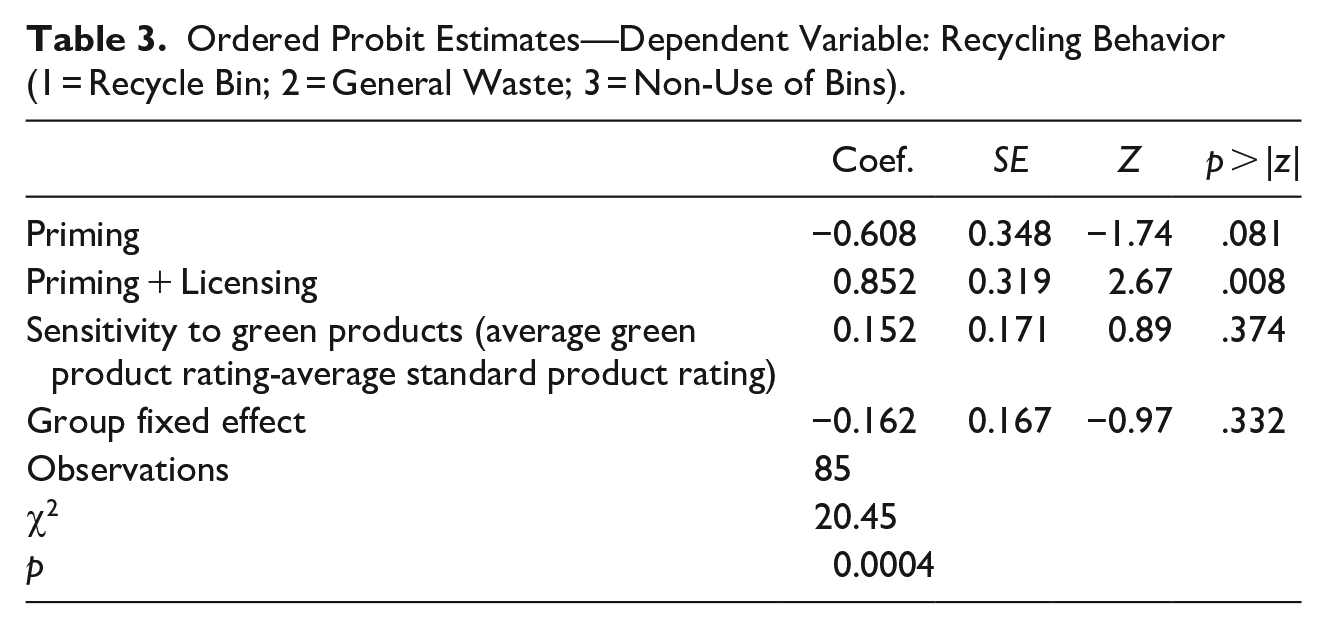
Overall, results from this experiment suggest that behavioral priming has a positive effect on the immediate behavior, but it is not robust to moral licensing and could generate negative spillovers. The nature of the interaction with social and moral value in this particular context does not enable to promote consistency.
Conclusions
Our findings suggest that the relationship between information and green behavior is not straightforward. Priming (or one-shot exposure to environmental information) leads to higher environmentally friendly behavior in the directly associated task, but is not robust to licensing. We extend the literature on priming showing a positive effect on the immediate task (as in Mazar & Zhong, 2010), although the priming effect may not persist over time. As soon as the opportunity to perform an environmentally friendly good deed arises, the effect of priming disappears and gives way to licensing.
Those findings underline the importance of alternative tools to promote environmentally friendly behavior while calling for extreme care when using priming techniques, as they may not prevent counterproductive effects. In light of prior works on nudge’s spillovers, it suggests that all nudges should not be treated the same and that spillovers may greatly vary among the different type of nudges.
Firstly, the origin of the motivation is a key element. Earlier research found that external sources of motivation (often referred as regulations or financial rewards) are more likely to generate negative spillovers contrary to internal source of motivation (Clot et al., 2016; Lacasse, 2016; Nilsson et al., 2017; Thøgersen & Crompton, 2009; Truelove et al., 2014). Nudging, and more specifically priming, may not necessarily be associated with intrinsic motivation but may be assimilated to an external motivator, thus susceptible to generate negative spillovers, as we find in this work. A more nuanced approach of the mechanism behind nudges and how it interacts with motivation seems crucial in order to better apprehend subsequent spillovers. Noteworthy, this research also underlines the potential role of moral licensing in the occurrence of negative spillovers when PEB are considered over the long run. Past research has mostly reported the presence of positive spillovers versus no spillovers in response to nudges (Capraro et al., 2019; D’Adda et al., 2017; Lacasse, 2019; Sintov et al., 2017). We find that an even worse scenario might occur, that is the rise of negative spillovers due to moral licensing.
We developed an original protocol which enables to control for factors that are likely to influence the characteristics of spillovers. We test priming’s spillovers in a context where treatments involve “real” tasks rather than artificial ones (recycling), with participants not knowing this would be part of the research, limiting the potential influence of an experimenter demand effect, known for influencing individual’s behavior (Zizzo, 2010). An additional originality of our design is to involve non-monetary tasks, so we are able to disentangle moral licensing from the other well studied rebound effect. Although those two effects may occur concomitantly, it is important to ascertain the respective impact of moral licensing in potentially mitigating PEB’s spillovers. At the same time, our design still benefits from a controlled environment, facilitating impact measurement.
The main limitation of this work is its sample size, which does not enable to offer a clear-cut conclusion on the impact of priming on PEBs spillovers. It rather aims at opening the debate by focusing on an understudied nudge. At the same time, it comforts earlier works on PEBs spillovers, showing that impact needs to be assessed over a less restrictive time frame (and not just on the variable of interest) as spillovers, both positive and negative may be at play. Another limit stands in the fact we could not track all signatures in PEB_1 due to voluntarily leaving participants the anonymity option. Altogether, the significance of results holds, but it would have been interesting to isolate people who may have refused to sign the petition and whether moral cleansing takes place in the subsequent task.
Further research is required to assess the contrasting impact of different types of nudges over the long run and not just on one given behavior. Some nudges may be particularly efficient to achieve one goal, while being more prone to off settings than other nudges in subsequent PEBs. As things stand, policies to encourage more pro-environmental behavior need to confront the possibility that a priori effective solutions could also backfire.
Supplemental Material
sj-docx-1-eab-10.1177_00139165211060524 – Supplemental material for Once Good, Always Good? Testing Nudge’s Spillovers on Pro Environmental Behavior
Supplemental material, sj-docx-1-eab-10.1177_00139165211060524 for Once Good, Always Good? Testing Nudge’s Spillovers on Pro Environmental Behavior by Sophie Clot, Marina Della Giusta and Sarah Jewell in Environment and Behavior
Footnotes
Declaration of Conflicting Interests
The author(s) declared no potential conflicts of interest with respect to the research, authorship, and/or publication of this article.
Funding
The author(s) received no financial support for the research, authorship, and/or publication of this article.

Supplemental Material
Supplemental material for this article is available online.
Notes
Author Biographies
References
Supplementary Material
Please find the following supplemental material available below.
For Open Access articles published under a Creative Commons License, all supplemental material carries the same license as the article it is associated with.
For non-Open Access articles published, all supplemental material carries a non-exclusive license, and permission requests for re-use of supplemental material or any part of supplemental material shall be sent directly to the copyright owner as specified in the copyright notice associated with the article.
