



Abstract
The gap between theory and practice during initial teacher training has been an enduring topic of research due to its impact on teacher-readiness. Given the COVID-19 pandemic campus closures threatening to widen the gap, this research was a timely intervention aimed at connecting pre-service teachers to their professional network. Specifically, the project brought together pre-service drama teachers and in-service drama teachers (identified as positive mentors and practitioners) in two 90 minute online forums, to explore pedagogical perspectives and understandings. Semi-structured focus-group and individual interviews were held with 21 pre-service drama teachers. Data revealed that the lived experience shared by drama teachers assisted pre-service teachers translate theory into practice supporting the learning of their pedagogical craft, both instructionally and behaviourally. Furthermore, this collaboration appeared to enhance motivation, build connection to the drama education community and inspire pre-service students during a personally and professionally challenging time in their initial teacher training.
Keywords
Introduction
Synergy between theory and practice and from different sources is integral to the training of quality teachers. Investigating ways of creating closer links to schools is essential to understanding teacher education program coherence (Canrinus et al., 2017).
Drama education in schools, both curricular and non-curricular, provides a platform for enriching and transformational learning experiences to take place (Caldwell & Vaughan, 2012; Gray, 2016). For example, the propensity to develop self-confidence through drama is well recognised in the research (Bryce et al., 2004; Hunter, 2005) as is the opportunity to develop empathy (Catterall et al., 2012; Cremin, 2014; O’Mara, 2004) and heightened capabilities in planning and perseverance (Bryce et al., 2004). Saunders (2019) states, ‘Drama is a highly collaborative discipline and pedagogy as participants work together to make meaning (in process-based work) or develop performance (in discipline-based work)’ (p. 45). Learning through drama is embodied and collaborative (Kempe, 2012) and often requires students to step out of their comfort zone to take risks (Bryce et al., 2004). For drama teachers to be successful in delivering engaging learning experiences, they must possess high-level pedagogy and an ability to develop relationships of trust with their students (Gray & Lambert, 2019; Kempe, 2012).
Drama teachers also have additional challenges to navigate as their discipline is often under-resourced in terms of facilities and technologies (Garvis & Pendergast, 2010; Lorenza, 2021; Thorkelsdóttir, 2020) and has a considerable extra-curricular component that is time-intensive and stressful (Gray & Lowe, 2019; Thorkelsdóttir, 2020). Particularly significant to this research is the complexity of teaching in an open space with limited resources and working with challenging students who do not wish to engage in drama lessons (Anderson & Donelan, 2009; Lambert et al., 2016; Lorenza, 2021). Therefore, the effective training of drama teachers who are prepared for the myriad of responsibilities they will manage and challenges they will face is essential.
However, research identifies concerns with initial teacher education programs and their effectiveness in preparing classroom-ready teachers. Studies consistently highlight a lack of cohesion between on-campus theory and classroom practice, revealing initial teacher education to be outdated (Graça et al., 2021; Leite, Ribeiro, Leite, & Uliana, 2018), irrelevant and insular (Casaschi, 2018; Darling-Hammond, 2013; Ingvarson et al., 2014). Recent reviews of initial teacher education emphasise the need for in-service teachers as key participants (Australian Institute for Teaching and School Leadership [AITSL], 2015; Next Steps: Report of the Quality Initial Teacher Education Review, 2022) and greater collaboration between universities and schools (Ingvarson et al., 2014; TEMAG, 2014) to better connect theory to practice.
The conceptual terrain
Professional experience and quality mentoring
Learning to teach is complex and mentoring is central to this endeavour. Pre-service teachers benefit considerably by establishing relationships with quality mentors who are part of the teaching community with acute understanding of the challenges faced in the classroom (Hargreaves & Fullan, 2000; Harrison et al., 2005; Mackie, 2020). Mentors assist pre-service teachers translate theory (university-based learning) to practice (professional experience) by providing knowledge of their classroom context including professional duties, individual student needs, effective classroom management and pedagogy (Hashweh, 2013; Knoblauch & Woolfolk Hoy, 2008). This knowledge is grounded in their immediate personal and professional experience (Clarke et al., 2013).
In addition to professional support, mentor teachers may provide emotional support (Hall et al., 2008; Williams & Soares, 2002). Indeed, Gray (2016) and Gray et al. (2018) revealed that pre-service drama teachers highly valued a mentor who was able to offer personal support and role model best practice while nurturing their professional development. Contemporary mentoring practice features collaboration (rather than more traditional power/powerless relationships that hinder development) in order to improve pedagogical practice and address key issues such as social justice and equality (Hargreaves, 2000). Researchers have advocated for consistent and quality mentoring opportunities for pre-service teachers to learn their pedagogical craft so as to better support their induction into the profession (Becher & Orland-Barak, 2018; Mackie, 2020). While school-based mentors do not view themselves as teacher educators (Livingston, 2014), their influence on their mentees is profound. Becher and Orland-Barak (2018) found that mentors’ beliefs and tensions around subject matter as well as unique contextual factors were integral to their knowledge base as mentors: Such tensions can, on one hand, yield frustration and create incongruence between different ideas about teaching. On the other hand, however, these tensions can create potential opportunities for more informed mentoring practices (such as in the case of theatre, where the low status of theatre in schools drove the mentor to engage STs [student teachers] in critical dialogue around school politics and teacher agency (p. 487).
Consequently, the case for providing pre-service drama teachers with quality and multiple mentoring opportunities to acquire and translate pedagogical content knowledge from theory into practice is strong.
Pedagogical craft
Learning to teach high quality drama education that can bring far reaching benefits to students’ personal, social and academic outcomes involves pre-service teachers developing highly complex drama pedagogy (Dunn & Stinson, 2011; Kempe, 2012; Wright, 2015). Teachers need to be both instructionally intelligent (understanding the depth and breadth of their curriculum area and able to effectively manipulate this to assist all students to learn), and behaviourally intelligent (knowing their students and how to manage them and their emotions) (Darling-Hammond et al., 2020; Egeberg & McConney, 2018; Egeberg et al., 2020).
Researchers agree that developing drama pedagogy is indeed complex (McCammon et al., 1997; Pascoe & Sallis, 2012; Wright & Gerber, 2004). For example, the nuances of delivering high quality drama experiences requires the teacher to have intuition, an innate understanding of the student group and an ability to foster a sense of safety and community so that students are supported to take risks and engage in individual and collective discovery (Gray et al., 2018; Mreiwed et al., 2017). Teachers must use their voice and body confidently within an open space and model performance skills and techniques (Wales, 2009). Of particular importance is the teachers’ capacity to develop group cohesiveness and mutual respect so that students learn to work productively in group tasks (Mandell & Wolf, 2003). It is these trusting relationships (Kempe, 2012), and ability to foster a positive class dynamic and sense of togetherness (Neelands, 2009) that is key to success in the drama space.
Hence, it is vital that beginning drama teachers are assisted in their passage from student of drama to teacher of drama by mentors who understand drama pedagogy, its unique challenges (Gray et al., 2018), as well as effective ways of translating this theory into practice.
This research reports on a project that set out to bridge theory and practice by bringing together pre-service drama teachers and in-service drama teachers (identified as positive practitioners and mentors) to explore pedagogical perspectives and understandings. Through two 90-minute online forums, 33 pre-service drama teachers were able to engage with five in-service drama teachers from different schools and sectors. This was particularly timely given the increased disconnection pre-service students experienced during campus closures posed by the COVID-19 pandemic and the resulting move from face-to-face workshops to online learning. Through focus-group and individual interviews with 21 of the pre-service drama teachers, we gain insight into their developing understandings of pedagogy. In doing so, we discuss the importance of connecting theory to practice through sound, intelligent advice from practising teachers so that pre-service teachers are supported in learning their pedagogical craft, both instructionally and behaviourally. As this research revealed, the additional outcomes of this collaboration was its capacity to inspire, motivate and connect pre-service teachers to the drama education community. Therefore, researchers propose a more regular and collective approach to mentoring that is in addition to pre-service teachers’ structured professional experience.
Methodology
Key researchers in the field of drama education have advocated for further research into the initial teacher training of drama teachers (Anderson, 2002; 2003; Schonmann & Kempe, 2010). This research responds to this recommendation by specifically focusing on pre-service drama teachers and their developing understandings and perspectives of effective pedagogy. We chose a constructivist epistemology, a meaning-making theory, to frame this research, emphasising that the development of new ideas and thinking requires active engagement on the part of the learner (Dinham et al., 2021; McCauley et al., 2018; Sharma & Sharma, 2021). Individuals create and construct new meanings through the interaction of what they already know and believe and the ideas with which they come into contact (Boghossion, 2006).
Participants
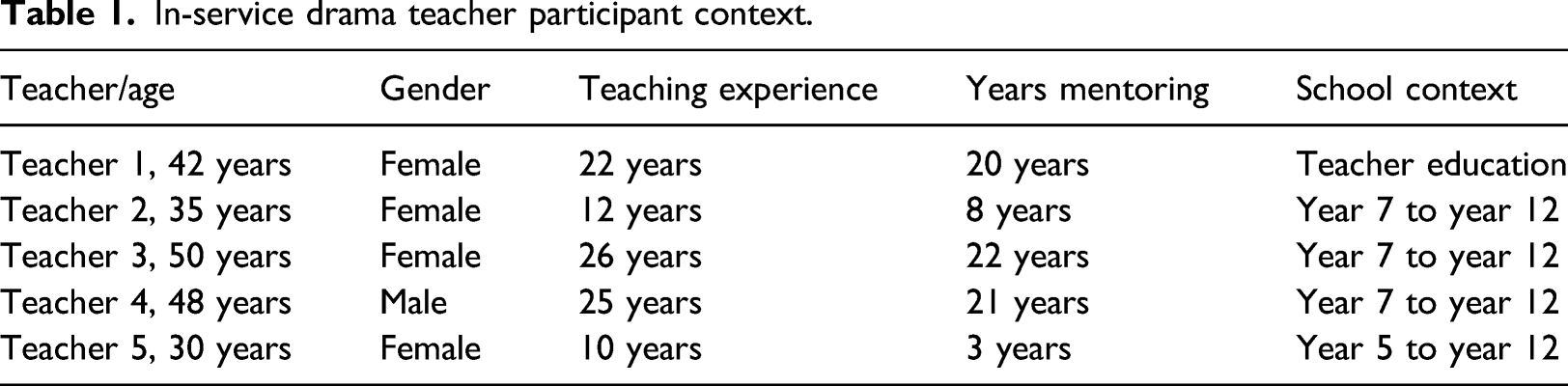
When selecting in-service drama teachers as participants for this research, we used predetermined criterion of importance termed ‘criterion-based sampling’ (Patton, 1990), as well as reputational-case selection (LeCompte et al., 1993). Patton (1990) posits, ‘The point of criterion sampling is to be sure to understand cases that are likely to be information-rich because they may reveal major system weaknesses that become targets of opportunity for program or system improvement’ (p. 177). In terms of reputational-case selection, drama teacher participants were nominated by knowledgeable professionals in their field so as to harness expert and professional judgements on subjectivities, to minimise possibilities of bias and favouritism (LeCompte et al., 1993).
Thus, the selection measures we applied were: 1) drama teachers had substantial experience mentoring pre-service drama teachers during professional experience; 2) drama teachers were recognised by their professional network and pre-service teachers returning from professional experience as displaying pedagogical competence as identified in research on quality drama teaching (for example, Gray & Lambert, 2019; Neelands, 2009; Wright & Gerber, 2004).
In-service drama teacher participant context.
Thirty-three pre-service drama teachers in their second or third year of a Bachelor of Education degree participated in this collaboration exercise with in-service drama teachers. Twenty-one pre-service drama teacher participants agreed to an interview and provided input into this research – 12 pre-service teachers participated in online focus-group interviews and nine participants chose to email their responses to interview prompts. Of the 21 pre-service drama teacher participants, 16 identified as female and five as male. Thirteen participants were in their second year and eight were in their third year of study.
Procedures
Ethics approval was granted for collection of feedback in the form of interviews with the pre-service teacher participants. At the conclusion of the online collaboration exercise, we emailed all pre-service teachers to invite them to participate in an interview. While face-to-face semi-structured focus-group interviews were planned, given the pandemic and campus closures, data was instead collected through online focus-group interviews and follow-up focus questions (via email) for participants to respond directly to researchers.
Guiding questions included
1) What are you most looking forward to when teaching drama? 2) What concerns/worries do you have about teaching drama? 3) What take home message/s resonated with you from the collaboration?
The interviews were recorded, transcribed and analysed using NVivo (2018) software and according to procedures developed by Miles et al., (2014). Researchers allocated a number to each participant to protect their identity and interrogated the data for key themes, ideas and descriptors. These were then grouped to form categories of generalised information and were repeated for the remaining interviews and electronic responses. Four significant themes were revealed: 1) connecting theory to practice; 2) motivation and inspiration; 3) relationships and boundaries; and 4) being authentic. These will now be discussed in turn.
Findings
Connecting theory to practice
The quality advice and diverse real-life experiences shared by the in-service drama teachers were highly valued by the pre-service participants. While there were different perspectives offered by the teachers reflective of the range in socio-economic school contexts and individual teaching styles, there were also commonalities that emphasised essential drama pedagogy addressed during university-based learning. A respondent stated ‘It was amazing to hear the different techniques we learn about here [university-based] from drama teachers out in schools. They were all from really different schools too.’ Another respondent similarly recalled ‘They were all so different yet put their students’ emotional and physical safety first.’
Respondents valued how authentically teachers spoke about teaching drama and hearing how they delivered best practice and/or made mistakes was deemed beneficial. One respondent explained, these teachers were honest and did not pretend they had all the answers. We discuss [at university] the need to be flexible but to hear these teachers say that some days nothing works, and they have to go with the flow was so good.
The connection of theory to practice was widely discussed in focus groups. University-based units were validated when teachers reinforced concepts the respondents had learned in their studies. A respondent stated ‘We learn in our textbooks to respond to low-key misbehaviours quickly, to negotiate rules with the kids early in the term and to actually hear from these drama teachers that they do this and it works was so reassuring.’ Another respondent similarly explained ‘We talk about safety in drama. It was good to hear this was a priority for EVERY drama teacher. A drama teacher needs to join in games which can be risky but helps create physical and emotional safety.’
Respondents agreed that it would take time and perseverance to hone classroom management strategies in order to keep up the momentum and positive atmosphere of the lesson. One respondent believed that ‘Low-key strategies are an art! Having a consistent signal before delivering an instruction such as FOCUS, FREEZE, EYES ON ME was important and had to be long, because the drama classroom is loud.’ For another respondent, learning a strategy to check in with students and their mental wellbeing at the beginning of the lesson was vital. She said, ‘I really appreciated the idea of allowing time at the beginning [of class] for students to rate how they’re feeling on a scale from one to ten. Checking in and assessing their mental wellbeing in a private way.’
Respondents found the teachers tips for effectively managing classes and overhearing banter between teachers helpful and inspiring.
Motivation and inspiration
This project was implemented during campus closures due to the COVID-19 pandemic, when pre-service teachers had moved from regular face-to-face workshops focusing on teaching and learning drama to an online platform. Respondents noted that online learning had raised issues such as reduced interaction, isolation and poor motivation. Therefore, the timing of this project must be noted, as for some respondents, the collaboration was inspirational and lifted their motivation for studying and teaching. A respondent encapsulated this when she said, ‘My spirits are lifted and I’m back in the game. It’s so hard keeping focused on my studies when I’m behind a screen.’
Other respondents, regardless of the current changes to their studies, spoke of this interaction during the forum as ‘the most valuable and inspiring work we’ve done at uni.’ The effect of this collaboration on pre-service teachers’ motivation was an unexpected outcome. One respondent captured this when he said ‘I found today’s lesson inspiring and the most informative in all my years of study. I have been completely drawn into this amazing teaching area. Such inspiring teachers and incredible advice from those we met today.’
Furthermore, the real-life stories offered by in-service teachers provided respondents with an exciting glimpse of their future. Pre-service drama teachers appreciated the positive perspectives in-service teachers shared, which helped to settle some concerns they had about professional experience and beginning teaching. One respondent said, ‘I was feeling so nervous about classroom management on prac [professional experience]. But hearing from these drama teachers got me excited. They didn’t dwell on the doom and gloom. They spoke about positive ways they work with kids.’ Indeed, working with students and the importance of building strong and professional relationships was widely discussed in focus groups.
Relationships and boundaries
Respondents identified that all drama teachers emphasised the importance of building relationships and developing clear boundaries with their students in the drama space. It was evident that this shared ideology validated respondents developing understanding of creating a safe space through respectful relationships and boundaries. This was encapsulated by a respondent who said, ‘…call students out on misbehaviour as what they’re doing is disrespectful. Being respectful towards each other in the drama space is vital.’ Respondents noted that this proactive approach to classroom management, in which the teachers highlighted the importance of positive leadership, furthered their understanding of how a safe drama space was constructed. Another respondent stated, ‘My favourite quote was, “Be queen bee and everyone else will fall into place”. It’s about letting all the kids know that you have their back and you will not let anyone bully them.’
A common message from in-service drama teachers was the importance of creating limits when forming relationships with students. The need for emotional, physical and behavioural limitations was widely discussed in the follow-up focus groups, with respondents drawing on the experiences of in-service teachers who differentiated between relationships and friendships. A respondent recalled, ‘It was good to hear from these drama teachers that you need to develop boundaries and that they are your students not your friend.’ Another respondent explained, ‘It’s important to build strong relationships with your students, however, you need to remind yourself that you’re their teacher not their best mate.’
Pre-service teachers were encouraged by the importance placed on fun, as the drama teachers shared personal insights into the way fun, positive environments helped to foster relationships. One respondent said, ‘I felt reassured that having fun and enjoying the kids is so important.’ Another respondent recalled the role of the teacher in modelling these positive attributes, stating, ‘Be kind and smile. If you want to be there, then so does everybody else.’
Creating fun and trusting relationships was a clear message for all respondents. This notion was encapsulated by a respondent who stated, “Making the drama space safe includes getting in there yourself, being silly if you need to and have fun with the students. Being willing to let your guard down will encourage the students to do the same.”
It was evident that respondents found merit in the commonality of these real-life stories, in which the in-service drama teachers emphasised the importance of forming respectful relationships and boundaries with students.
Being authentic
Authenticity in practice is an important part of fostering a healthy classroom culture for both students and teachers. Through the shared experiences, authenticity was identified as a key factor in developing truthful experiences and relationships of trust. One respondent said, ‘You need to be authentic. The students will pick up if you aren’t being authentic.’ Another respondent recalled that, ‘The kids have to know that you’re human. You make mistakes. These teachers seemed to be open and approachable and had positive relationships with their students.’
The in-service drama teachers in the forum highlighted the importance of showing one’s authentic self when teaching in a creative and personalised environment. When reflecting on the human experience of teaching drama in subsequent focus-group interviews, respondents further discussed the interplay between authenticity, relationships and the classroom environment. A respondent explained
Each of the in-service teachers demonstrated an effective classroom management approach that embodied both their personality and teaching style, hence validating the notion that authenticity in practice is an important part of one’s pedagogical craft. One respondent recalled, ‘It’s important to be adaptable and create an approach to teaching that is suitable to who you are and your personality.’ Similarly, another respondent explained, ‘Use your personality. Don't try and copy what other teachers have used or learnt. Be yourself. Be authentic.’
The diverse range of in-service teachers selected for the research appeared to reassure participants that they could remain authentic and truthful to whom they were when developing their own pedagogical practice. This was reflected by a respondent who stated
This collaboration between in-service drama teachers and pre-service teachers not only assisted pre-service teachers to develop key pedagogical perspectives and understandings but also connected them to their wider drama education network, which was both motivating and inspiring.
Discussion
This research adds to the literature affirming the importance of cohesion between theory and practice in order to support and consolidate pre-service teachers’ pedagogical content knowledge (Canrinus et al., 2017; McCammon et al., 1997). Further, it supports the role of expert teacher-mentors in this process, who, through the sharing of lived experiences, offer insight into the broad responsibilities of teaching drama while reinforcing key pedagogies acquired during university-based learning (Anderson et al., 2009; Gray, 2016; Hrncir, 2007). These key pedagogies highlight the dynamic and complex nature of drama teaching recognised in earlier research (McCammon et al., 1997; Pascoe & Sallis, 2012; Wright & Gerber, 2004).
Pre-service drama teacher respondents appreciated the opportunity to focus primarily on drama teaching pedagogy rather than teaching generally as often depicted in teacher education texts (McCammon et al., 1997; Pascoe & Sallis, 2012). For example, working effectively in an open space with students actively and noisily participating in workshops requires nuanced pedagogical skills well recognised in drama education research (Gray, 2016; Wales, 2009; Wright & Gerber, 2004). What these expert teachers were able to do was extrapolate the generic skills into the drama domain using stories and advice.
Notable in our findings were the emphasis in-service teachers placed on the highly collaborative nature of the discipline and the importance of building quality professional relationships identified by both in-service teachers and respondents. Both aspects have been identified in earlier research (Kempe, 2012; Saunders, 2019). It is these relationships, with clear boundaries, that pre-service and expert teachers believed were essential to good practice and as Mandell and Wolf (2003) and Neelands (2009) purport, essential to creating a safe space for students. Further, fostering a space where students feel supported by their teacher who is a strong leader and who has their back as opposed acting as their friend was a clear message and similarly documented by Kempe (2012).
Like other university students, the pre-service teachers in our study reported that online learning created issues with reduced interaction, isolation and poor motivation (Martin, 2020; Tertiary Education Quality and Standards Agency, 2021). For practical degrees (like in the performing arts) these issues may be heightened. However, respondents indicated that the collaborative exercise and the opportunities to share in the experiences of the mentor teachers helped reinspire them.
Key to building a supportive and safe space for students is being authentic. Respondents understood authenticity transpired through their personality and being themselves. This was heightened by being honest and humble when making mistakes and integral to building relationships of trust. Indeed, notions of safety, both physical and emotional, are deemed an important characteristic of a positive drama classroom environment (Gray, 2016; Mreiwed et al., 2017). Respondents were reassured that all of the expert teacher-mentors shared this perspective, across the different contexts in which they worked. They particularly valued hearing practical strategies and tips for checking in on their students’ mental wellbeing at the beginning of the class.
Respondents understood that classroom management techniques were an art and would require time to develop. For example, the ability to be flexible, respond to low-key misbehaviours quickly and efficiently so as to keep up the momentum of the lesson as well as negotiating rules to ensure safety and a positive class atmosphere. The importance of a clear and lengthy signal to begin, due to the noise level of students actively participating in a large open space, was also valued. It is interesting that while participants noted the arduous demands of teaching drama previously documented by researchers (Gray, 2016; Gray & Lowe, 2019; Lambert et al., 2016), they admired the positivity with which drama teachers spoke about their work. It is perhaps this positivity that both inspired and motivated the pre-service teachers.
We acknowledge the lack of time in schools with quality mentors is problematic for pre-service drama teachers (Pascoe & Sallis, 2012; Warren, 1992). This research highlights that connecting with professional networks at key opportunities within teacher training can be of mutual benefit (Thorkelsdóttir, 2020). For pre-service teachers, the opportunity to see these expert teachers against their drama space backdrop whilst hearing stories and astute advice was clearly valuable. Indeed, forming strong collegial networks has been found to be integral to drama teachers’ wellbeing, stress management and resilience to stay in the drama teaching profession (Thorkelsdóttir, 2020). However, the experience of participating in an online forum enabled time-poor drama teachers an opportunity to share perspectives about best practice with minimal disruption and additional pressure on their teaching commitments. This recognised these teachers as experts in their field which, as teachers noted following the forum, was a rewarding accolade to achieve. Given the isolation many drama teachers experience in schools, gaining recognition and appreciation for their work and expertise is important and, as Thorkelsdóttir (2020) asserts, instrumental to retention and job satisfaction.
The interplay between quality mentoring from expert teachers and creating classroom-ready teachers is critical given the stressful, arduous nature of teaching drama (Gray et al., 2018; Lambert et al., 2016). The lived experience and wise advice shared by these teachers provided helpful information about the complexities of teaching drama and supporting synergies between theory and practice. Pre-service teachers felt motivated, inspired and connected to their profession after hearing stories of the real-life experience of in-service drama teachers, particularly when these stories highlighted the taken-for granted assumptions of good drama teaching.
The current study expands on drama teaching literature by showing the power of expert drama teachers reinforcing key learning acquired at university. It shows that while we are all ‘zoomed out’, the opportunity to zoom teachers into our classroom was a powerful and motivating addition to our unit on teaching drama. It clearly extrapolates what we know effective teachers do to create and maintain quality learning environments (Egeberg & McConney, 2018; Egeberg et al., 2020) into the drama classroom through the lived experience of expert drama teachers who illustrate how theory works in practice.
Conclusion
High teacher attrition, particularly among beginning teachers, is a confronting reality for education systems world-wide. For drama teachers, managing a challenging curricular and non-curricular workload, without support from administration, can result in high levels of stress and teacher burnout. Adding to this stress are the impacts of the COVID-19 pandemic on teaching and learning such as the rapid (seemingly overnight) transition to an online platform not conducive to the practical aesthetics of teaching drama. Therefore, maintaining strong collegial networks amongst drama educators and supporting beginning drama teachers in their induction to the profession is imperative.
This collaboration between in-service and pre-service drama teachers is one such support. Through providing stakeholders with a platform to connect and learn from one another we have observed enhanced integration between theory and practice. We have also witnessed drama teachers acknowledged and valued, offering inspiration and motivation to the next generation of drama teachers grappling with their own teacher identities. Experiences like this, amidst challenging and uncertain times, reinforce the value of connection and ongoing dialogue within our community. Cultivating this connection must certainly be a priority for initial teacher training programs.
Footnotes
Declaration of Conflicting Interests
The author(s) declared no potential conflicts of interest with respect to the research, authorship, and/or publication of this article.
Funding
The author(s) received no financial support for the research, authorship, and/or publication of this article.
