




Abstract
Background
The proportion of poor metabolizers (PMs) of cytochrome P450 (CYP) 2C19 is much higher in the Japanese population than in European populations. Cycling probe technology (CPT) is a simple signal amplification technique for targeting specific DNA sequences. CPT utilizes a chimeric DNA-RNA-DNA probe that is cleaved by the enzyme ribonuclease (RNase H). In this study, using CPT, we aimed to detect the CYP2C19 gene polymorphism from noninvasive samples to determine extensive metabolizers (EMs) and PMs of CYP2C19.
Methods
DNA samples were extracted from hair, buccal mucosa, and blood cells. Primers and cycling probes were designed specifically for region G636A for exon 4 and G681A for exon 5, reported to be gene polymorphisms of CYP2C19.
Results
DNA extracted from hair follicle cells and buccal epithelial cells was the same as that collected from invasive blood sampling. The genotype of CYP2C19 was successfully identified as either EM or PM in 71 samples, producing identical results to those for the TaqMan method, except in three samples.
Conclusions
We successfully detected the two gene polymorphisms of CYP2C19 from noninvasive samples using a simple DNA extraction method and CPT.
Introduction
The function of cytochrome P450 (CYP) enzymes varies by enzyme species, but many are involved in drug metabolism. Genetic mutations are known to occur in CYP2C19 and in CYP2C9, 1 and as a result, drug metabolizing capacity is markedly lowered in poor metabolizers (PMs), leading to increases in blood concentration and the occurrence of side effects. 2 Ethnic differences exist, and a higher frequency of CYP2C19 1 (PM genotype, 11.7–25.7%) has been reported in Asian populations compared with other populations.
CYP2C19 mutations at positions 681 and 636 are expressed as type 2 (*2) and type 3 (*3), respectively, and wild type is expressed as type 1 (*1). 3 Among the single nucleotide polymorphisms (SNPs) that lead to decreases in CYP2C19 enzyme activity, the mutations found in the Japanese population are mostly *2 and *3. 1
SNP analysis employs various techniques including the invader, 4 DNA microarray (DNA chip), 5 and TaqMan. 6 Aside from these, cycling probe technology (CPT) 7 is a newly developed fluorescence detection method that allows for specific detection of single base differences by using chimeric probes consisting of RNA and DNA, together with the DNA-RNA hybrid cleaving ribonuclease (RNase H). We report here an alternative detection method for SNPs in CYP2C19 by utilizing CPT with noninvasive samples.
Methods and materials
Subjects
The study was conducted following approval by the Ethics Committee of Tokyo University of Pharmacy and Life Sciences and in accordance with the Declaration of Helsinki. From 74 subjects who provided informed consent, buccal mucosal cells were collected for DNA extraction, and peripheral blood and hair were collected from 15 consenting volunteers each.
DNA extraction
DNA extraction was carried out using a simple extraction method that permits sole addition of the solution DNA zol Direct (Cosmo Bio, Tokyo, Japan). First, a simple and general DNA extraction method was compared with conventional methods where 5 mL of heparinized peripheral blood, three scratches of buccal mucosal cells, and one strand of hair were collected for DNA extraction. DNA was extracted from blood using Dr. GenTLE® (from whole blood) (Takara Bio, Shiga, Japan), from buccal mucosal cells using the ZR Genomic DNA Kit (Zymo Research, CA, USA), and from hair using Isohair (Nippon Gene, Tokyo, Japan), respectively.
Genotyping
For CPT, samples were prepared with a CyleavePCR Core Kit (Takara Bio). The TaqMan probe method (TaqMan Drug Metabolism Genotyping Assays C_259867_70 for CYP2C19*2; C_27861809_10 for CYP2C19*3, Applied Biosystems) was applied as a control.
Primers, cycling probes, and PCR condition used in CYP2C19 SNP analysis.
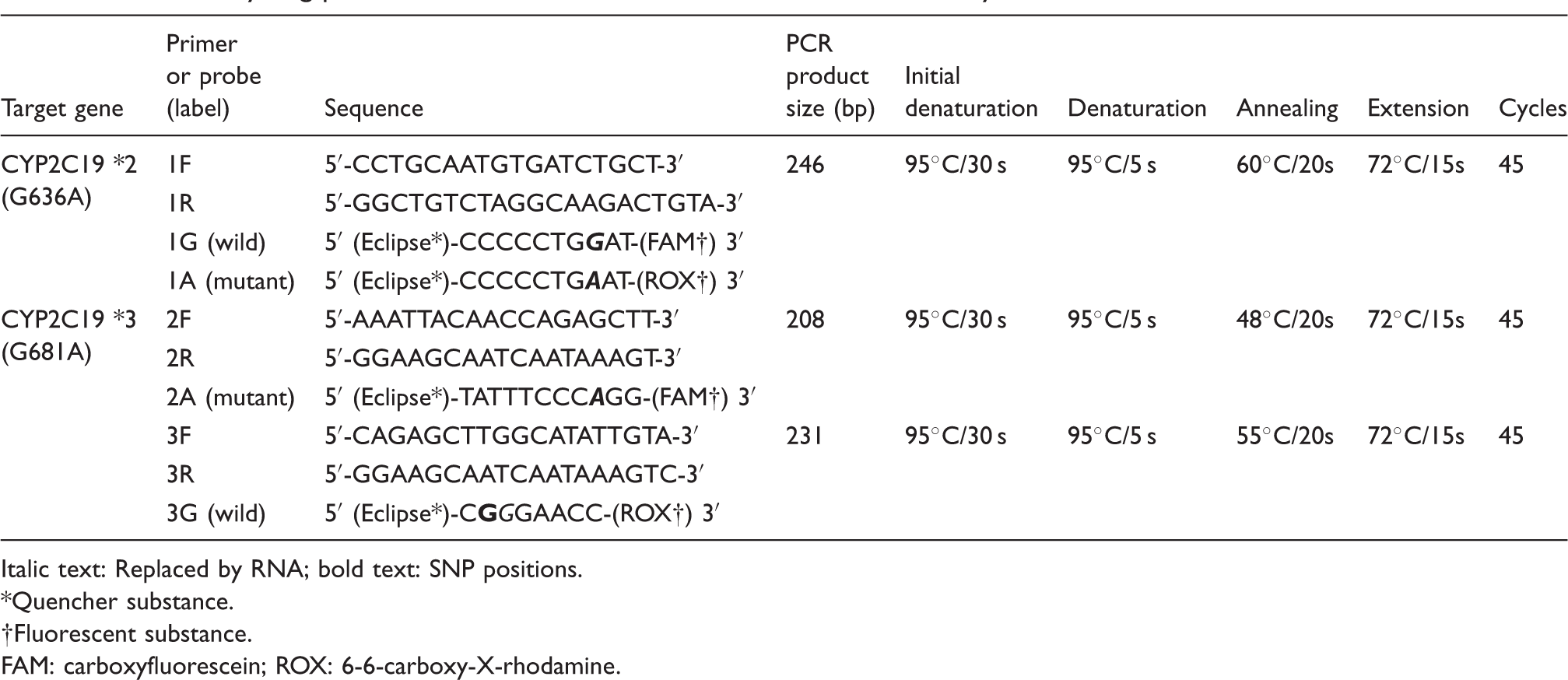
Italic text: Replaced by RNA; bold text: SNP positions.
Quencher substance.
Fluorescent substance.
FAM: carboxyfluorescein; ROX: 6-6-carboxy-X-rhodamine.
DNA sequence analysis
Three mismatched samples were amplified and sequenced by Greiner Bio-One co., Ltd (Japan) using the 3F and 3R primers.
Data analysis
Hardy–Weinberg equilibrium was determined by comparing genotype frequency with the expected values by using a Chi-squared test.
Results and discussion
For the 74 healthy subjects (41 men and 33 women, aged 21–83 years), SNP genotyping analysis was conducted for positions 636 and 681. Identical results were obtained from the following samples: template DNA, buccal mucosa, hair, and peripheral blood, and genotypes became apparent from genetic mutations in these two positions from all subjects. The amount of DNA (15.6 ± 11.3 µg, n = 74) from the buccal mucosa obtained by simple extraction was higher than that obtained by the conventional method (1.3 ± 1.3 µg, n = 41). The amount of DNA from hair was 4.2 ± 11.3 µg (n = 14) by simple extraction and 21.8 ± 2.7 µg (n = 42) by the conventional method. The amount of DNA from blood was 1.9 ± 2.0 µg (n = 4) by simple extraction and 2.6 ± 4.1 µg (n = 10) by the conventional method. Among them, samples from 71 subjects were compatible with the commercial TaqMan probe method; however, samples from three subjects were mismatched with the 3G probe. Sequencing revealed that the RNA position replaced by the 3G probe was not the SNP position. Detection limits were 4.2 ng for the 2A probe/2F and 2R primer set and 2.1 ng for the 1A probe/1F and 1R, 1G probe/1F and 1R, and 3G probe/3F and 3R primer sets. Of the 74 subjects, 23 were *1/*1 type, 24 were *1/*2 type, 5 were *1/*3 type, 13 were *2/*2 type, and 9 were *2/*3 type. Overall, 52 (70.3%) were extensive metabolizers and 22 (29.7%) were PMs, which is in almost agreed with the reported rate of PMs in the Japanese population (15.2–25.7%). 1 Genotype and allele frequency satisfied the Hardy–Weinberg equilibrium model.
Conclusions
We successfully detected the two gene polymorphisms of CYP2C19 from noninvasive samples using a simple DNA extraction method and CPT. The results are summarized as follows: The amount of DNA from the buccal mucosa was slightly higher than in other studies, and buccal mucosal cell samples could be extracted easily and noninvasively, thereby reducing the burden on patients. The three samples mismatched by the 3G probe were determined by DNA sequence analysis to be the *2/*2 type. The false-positive reaction at the 3G probe was brought about by CPT. In other words, sequencing revealed that the 3G probe was difficult to design without using a palindromic sequence. Furthermore, CPT measurement requires three experiments because of the different annealing temperature. Nevertheless, CPT was capable of detecting the SNP regions.
Footnotes
Acknowledgements
We would like to thank Mami Hashimoto for providing experimental assistance.
Declaration of conflicting interests
None declared.
Funding
Grant-in-Aid for Scientific Research of Japan (20890244).
Ethical approval
The study was approved by the Ethics Committee of Tokyo University of Pharmacy and Life Sciences (#09-11).
Guarantor
SY.
Contributorship
SN, NK, YT, and SY researched the literature, conceived the study, and performed data analysis. SS and SO handled ethical approval, patient recruitment, and data analysis. SN wrote the first draft of the manuscript. NK performed additional experiments (sample analysis and sequencing). All authors reviewed and edited the manuscript and approved the final version.