






Abstract
Patients with severe primary headache may benefit from consultation with headache specialists, but doctor attendance rates in Japan are very low. More headache patients might consult headache specialists if these specialists were more widely recognized by the public. To determine what information prompted patients to seek consultation with a headache specialist, we questioned 256 primary headache patients about the source of the helpful information concerning consultation with headache specialists. From 191 patients, a total of 235 responses to the questionnaire were obtained. The most common response was ‘websites’ (33.2%), followed by ‘professionals’ (23.8%), ‘acquaintances’ (20.9%), ‘print media’ (6.8%) and ‘TV/radio’ (3.4%). Patients who indicated websites showed the most severe pain and highest impact of headache, and accounted for 52.4% of those with cluster headaches. Development of websites concerning headache specialists would seem likely to increase doctor attendance rates for patients with primary headache.
Introduction
Headaches may have a wide range of impact on the lives of patients (1). In a report issued by the World Health Organization, migraine was ranked number 12 among women and number 19 in the overall population for degree of handicap (2). Cluster headaches, although periodic in most cases, have a considerable impact on social functions, quality of life and use of healthcare (3).
Some individuals who would benefit from treatment for migraine may consult doctors about their headaches. Headache consultation rates in the UK from 1992 to 2000 were 6.4/100 patients/year among women and 2.5/100 patients/year among men (4). Sixty-eight percent of female and 57% of male migraine patients reported having ever consulted a doctor for headache (5). In another study, 54% of subjects with migraine and 31% of subjects with non-migraine headaches reported having visited physicians once or more for their headaches in the year prior to the questionnaire (6). Doctor attendance rates in Japan are very low, and 69.4% of Japanese patients with migraine have never consulted a physician for headache (7).
The aim of this study was to clarify helpful information concerning consultation with headache specialists. Some headache patients said they did not know where to consult a physician until they learned about headache specialists. The existence of headache specialists might not be generally known. More headache patients might consult headache specialists if such specialists were more commonly recognized. For this reason, we believe that clarifying what helpful information prompts patients to seek consultation with headache specialists is likely to prove beneficial.
Subjects and methods
Subjects
Demographic characteristics of the study population

Questionnaire design
The questionnaire comprised 15 items: age at onset; frequency of attacks; duration of attacks; site of pain; type of pain; character of pain (throbbing, dull, etc.); severity of pain; aggravation of pain; accessory symptoms; impact of headache; previous examination; previous treatment; current treatments; wishes for treatment; and the source of helpful information prompting patients to seek consultation with a headache specialist. The question about the source of helpful information was a multiple-choice question, with the following options: ‘professional’, ‘acquaintance’, ‘print media’, ‘TV/radio’, ‘websites’ and ‘others’.
Statistical analysis
Sources of helpful information were analysed for age, gender, type of headache, severity of headache, and impact of headache. The type of headache was classified into four groups: migraine, tension-type headache, combined migraine and tension-type headache, or cluster headache. Severity of pain was evaluated by visual analogue scale (VAS). Impact of headache was scored using the Japanese version of the short-form headache impact test (HIT-6) (9).
StatView version 5.0 for Windows software (SAS Institute, Cary, NC, USA) was used for statistical analysis. Comparisons between two samples were made using the χ2 test, Kruskal–Wallis test and Mann–Whitney U-test, whenever applicable. Values of P < 0.05 were considered statistically significant.
Results
Prevalence of helpful information concerning consultation with headache specialists
The question about the source of helpful information concerning consultation with a headache specialist yielded 235 responses: websites, 78 responses (33.2%); professionals, 56 (23.8%); acquaintances, 49 (20.9%); print media, 16 (6.8%); and TV/radio, eight (3.4%).
Age, gender and helpful information concerning consultation with headache specialists
Characteristics of helpful information concerning consultation with headache specialists
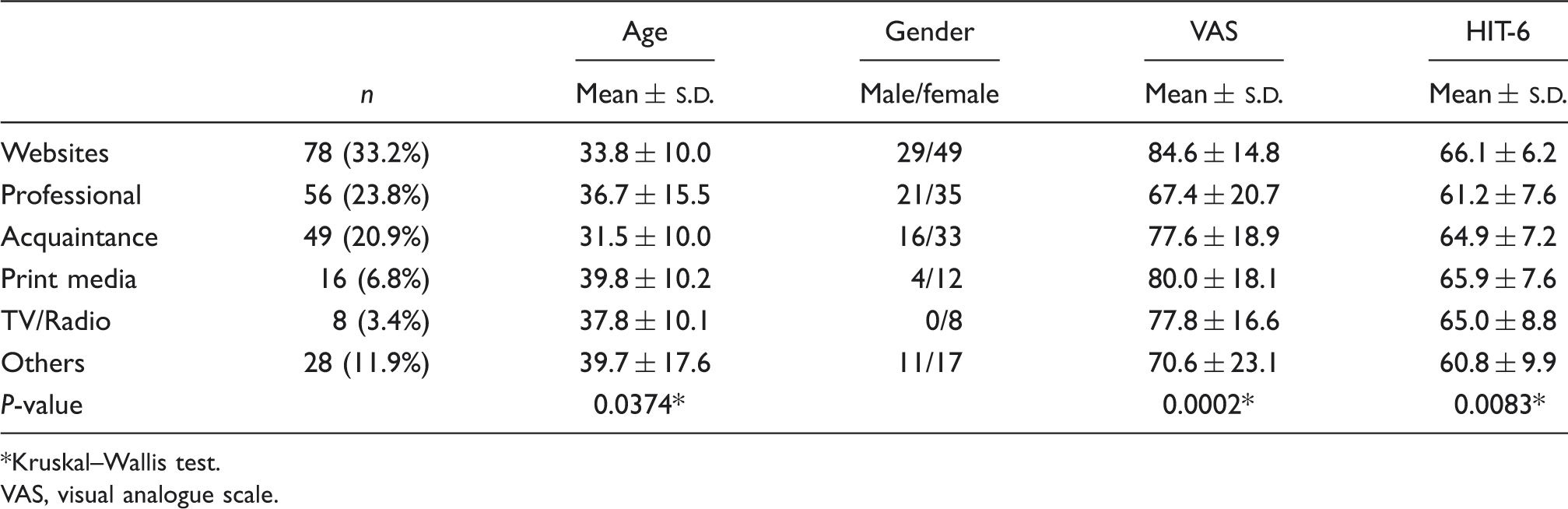
Kruskal–Wallis test.
VAS, visual analogue scale.
Type of headache and helpful information concerning consultation with headache specialists
Prevalence of different sources of helpful information differed significantly by the type of headache (Fig. 1). Websites were helpful for 11 of 21 patients (52.4%) with cluster headache, 10 of 24 patients (41.7%) with combined migraine and tension-type headache, 48 of 148 patients (32.4%) with migraine, and nine of 42 patients (21.4%) with tension-type headache. Professionals were helpful for 14 of 42 patients (33.3%) with tension-type headache, seven of 24 patients (29.2%) with combined migraine and tension-type headache, 33 of 148 patients (22.3%) with migraine, and only two of 21 patients (9.5%) with cluster headache.
Type of headache and helpful information concerning consultation with headache specialists. Prevalence of helpful information differed significantly according to headache type (P = 0.014; χ2 test). Websites accounted for 11 of 21 patients (52.4%) of cluster headache patients.
VAS, HIT-6 and helpful information concerning consultation with headache specialists
Significant differences were seen in VAS and HIT-6 scores according to the sources of helpful information (Table 2). Websites were associated with the highest scores for VAS and HIT-6.
No significant differences in frequency of attacks, duration of attacks, site of pain, type of pain, character of pain, aggravation of pain, accessory symptoms, previous examination, previous treatment, current treatments, or wishes for treatment were identified.
Discussion
This study identified websites as the most helpful sources of information to prompt patients to consult with headache specialists. In Japan, the proportion of subscribers to fixed broadband is the third highest in the world (10). Internet users in Japan reached 88.11 million, with a 69.0% diffusion rate (relative to population) in 2005 (11). The internet usage rate for individuals was > 90% for people aged 13–49 years (11). The highest prevalence of migraine in Japan was among women in their 30s and men in their 20s (7), and 87% of patients who replied to the questionnaire were 13–49 years old. Websites are thus probably the most popular and useful tool for gathering information among these age groups. The reason that the youngest group indicated acquaintances as the source of information may be that acquaintances are the easiest and most common resource to prompt the first consultation with a headache specialist. The TV/radio source showed a small response number. Although these media are generally thought to have a major influence on information, they can not offer specific information on which specialists to consult. Specific information might be necessary to prompt patients to seek consultation.
Severity and impact of each headache type

TTH, tension-type headache; VAS, visual analogue scale.
Many patients with probable medication overuse for headaches in Japan overuse combination analgesics, most of which are over-the-counter analgesics (16). Medication overuse for headaches is a growing problem in Japanese clinical practice (17), but the number of headache specialists is also growing. If patients with poorly controlled primary headaches could be provided with more information about headache specialists, abuse of combination analgesics might decrease.
Websites may represent a most helpful tool to provide headache patients with information on consulting with headache specialists. Moreover, the internet is now more commonly accessed from a cellular phone than a PC in Japan (11). The development of websites concerning headache specialists, particularly websites accessible by cellular phone, may therefore increase doctor attendance rates for primary headache.