





Abstract
Introduction:
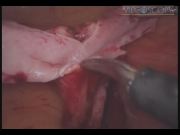
Conventional treatment of obstructive megaureter entails disconnection proximal to the pathological segment, tailoring of the dismembered ureter, and ureteric reimplantation through incisional approach. Laparoscopic tailoring and intracorporeal suturing for management of obstructive megaureter is evolving.1 All the published citations till date have mentioned the exercise in uniltaeral affections. We present a video demonstration of simultaneous bilateral tailoring, reimplantation, and nonrefluxing ureteric reimplantation. The video spans over 7 minutes and 33 seconds. To our knowledge, this is the first report of simultaneous bilateral laparoscopic tailoring and intracorporeal suturing with reimplantation.
Methods:
Fourteen-year-old boy presented with recurrent episodes of flank pain and urinary infection. Renal profile was normal. Imaging was suggestive of bilateral obstructive megaureter. He consented for laparoscopic approach for reconstruction. Cystoscopy was performed initially, followed by insertion of a perurethral catheter. Thereafter, in a steep Trendelenberg decubitus utilizing four ports laparoscopic exercise was carried out. Each ureter was identified at the level of pelvic brim and dissected upto the pathological segment preserving the periureteral adventitia. Ureters were dismembered and tailored. Intracorporeal suturing was performed, and ureteral stents were inserted in an antegrade fashion. This was followed by adequate mobilization of bladder, ensuring tension-free ureterovesical anastomosis. After constructing ureteroneocystostomies, bilateral antireflux construction was carried out following the Lich Gregoir principle.
Results and Discussion:
Postoperative recovery was uneventful. Drain and catheter was removed on second and fifth postoperative days, respectively. He was discharged on the third day. Ureteral stents were removed at 6 weeks postprocedure. Repeat imaging was performed at 3 months and revealed satisfactory drainage pattern with decrease in upper-tract dilatation. Voiding cystourethrogram demonstrated no evidence of reflux. Satisfactory reconstruction of obstructive megaureters demands tapering of the lower 4–5 cm of the atonic ureter. Although both plication and excisional tailoring have been advocated to achieve this goal, excisional tailoring is favored by most operators especially if the ureteral diameter exceeds 1.75 cm.2 Tailoring via laparoscopic approach is technically challenging and practiced in limited centers worldwide. Some authors advocate extracorporeal suturing of the tapered ureter to enable satisfactory reconstruction,3 but if the operator is conversant with laparoscopic exercise, intracorporeal suturing can be conveniently accomplished. Bilateral simultaneous laparoscopic tailoring and reimplantation has not been hitherto reported. Familiarity with pelvic anatomy, dexterity in handling laparoscopic instruments, and proficiency in laparoscopic suturing are key issues to achieve a satisfactory outcome.
No competing financial interests exist.
Runtime of video: 7 mins 33 secs


Keywords
Get full access to this article
View all access options for this article.
References
Supplementary Material
Please find the following supplemental material available below.
For Open Access articles published under a Creative Commons License, all supplemental material carries the same license as the article it is associated with.
For non-Open Access articles published, all supplemental material carries a non-exclusive license, and permission requests for re-use of supplemental material or any part of supplemental material shall be sent directly to the copyright owner as specified in the copyright notice associated with the article.
