





Abstract
Introduction:
Colovesical fistula may result from iatrogenic insults, benign pathologies like diverticulitis, or Crohn's disease and secondary to malignant etiologies. The commonest presentation is pneumaturia, fecaluria, or recurrent urinary infection. The established practices for management of colovesical fistula are resection/repair of the fistula with proximal bowel diversion and delayed restoration of bowel continuity or single-stage primary reconstruction. Traditionally, these have been performed via incisional approach. 1 We present a video on minimally invasive approach of primary reconstruction of colovesical fistula.
Methods:
Patient was evaluated in detail with presenting complaints, clinical survey, and blood profile. Imaging included ultrasonography, magnetic resonance urogram, and colonoscopy. Cystoscopy was performed followed by definitive repair through minimally invasive approach. Operative and postoperative parameters were recorded. Patient was evaluated postprocedure at regular intervals.
Results and Discussion:
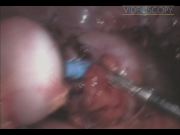
Preoperative evaluation revealed a colovesical fistula secondary to rupture of sigmoid diverticula. Patient underwent disconnection of fistula segment, partial cystectomy, and colo-colic anastomosis. Dense adhesions were encountered in view of diverticulitis. As the cystectomy margin was sufficiently distant from both ureteric orifices, no additional ureteric catheter or stents were employed. The proximal bowel was occluded by linear stapler. The pathological colonic segement was resected. Colonic continuity was re-established using circular stapler. The entire procedure was performed through laparoscopic approach. The operation duration was 165 min and blood loss was 100 mL. The patient recovered uneventfully in the postoperative period. He was ambulatory on the first postoperative day and tolerated orals by the third postoperative day. He was sent home on sixth postoperative day. At 11 months' follow-up, the patient was clinically stable with no symptom recurrence. He also revealed normal voiding and bowel habits. Single-stage definitive repair of enterovesical fistula secondary to benign pathologies requires removal of the pathological segment and satisfactory rehabilitation of the gastrointestinal and urinary systems. In the presence of diverticulitis, this exercise is demanding with a high risk of iatrogenic complications. With the advancements in the field of minimally invasive surgery, even such complex reconstructions may be attempted via this approach. Till date, these procedures have been performed in limited centers worldwide. 2 Although this procedure has been reported with a high conversion rate, 3 in this case it was completed. The key advantages are single-stage definitive management with excellent morbidity profile. As a result of minimally invasive approach, the risk of postoperative intestinal paresis is also reduced. The operator needs to be proficient in laparoscopic exercises and familiar with the laparoscopic pelvic anatomy. The outcome after such complex reconstruction is also satisfactory.
No competing financial interests exist.
Runtime of video: 6 mins 13 secs


Get full access to this article
View all access options for this article.
References
Supplementary Material
Please find the following supplemental material available below.
For Open Access articles published under a Creative Commons License, all supplemental material carries the same license as the article it is associated with.
For non-Open Access articles published, all supplemental material carries a non-exclusive license, and permission requests for re-use of supplemental material or any part of supplemental material shall be sent directly to the copyright owner as specified in the copyright notice associated with the article.
