





Abstract
Introduction:
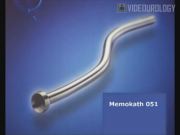
We present our technique and unique case of sequentially inserting two Memokath 051 ureteric stents in one ureter as a single-step procedure, aiming to treat an extensive stricture in a young patient.
Materials and Methods:
We treated a 32-year-old female patient who suffered from postradiation treatment bilateral ureteric stricture. A 10-cm Memokath stent was inserted on the right side 4 months previously. On the left, the measured stricture length encompassed the whole ureter, measuring at 22 cm. The longest commercially available Memokath 051 ueretric stent is 20 cm long. Therefore, we decided to use two of the commercially available lengths that would be suitable in a sequential manner.
Results and Conclusions:
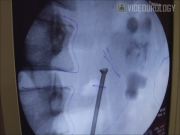
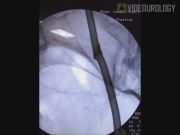
The procedure typically begins with cystoscopy and a retrograde study of the involved ureter. 1,2 The appropriate position and patency of the right Memokath stent is controlled. Following the removal of the left Double J stent, stricture length is performed by a retrograde study and the use of a dual lumen ureteric catheter. Two measurements are performed as standard. We decided to insert a 15-cm-long stent proximally as a first step, followed by a 10-cm-long stent for the remainder of the ureter. A crucial step in the procedure is the accurate marking of the position of the pelviureteric junction as well as the ureteric orifice, as success depends upon bridging of the stent at these two points in cases of total length strictures. 3 The first stent, measuring 15 cm, is advanced up to the pelviureteric junction inside the introducer, which is gradually withdrawn while injecting 50°C–60°C hot water to expand the metal alloy. Following successful insertion of the proximal stent, an additional measurement of the remaining stricture was performed, resulting in a 7-cm residual segment. The second stent, measuring 10 cm, is inserted in a similar fashion, with the proximal end now touching the distal end of the proximal stent. Initial efforts to expand the stent led to incomplete deployment. Complete expansion of the proximal tip of the second stent was achieved by selective catheterization with a 6F ureteric catheter of the stent and injection of hot water in situ. A final retrograde study demonstrated the patency of the stents with no contrast extravasation as well as complete drainage afterward. 4 The patient was discharged on the same day and remains asymptomatic and without complications at the 3-month follow-up.
The authors have no conflicts of interest to disclose.
Runtime of video: 6 mins 11 secs
Keywords
Get full access to this article
View all access options for this article.