





Abstract
Introduction and Objective:
Megaureter (MGU) is a disease including variable anomalies. It may be caused by either a primary cause or secondary to specific pathologic origin. The cause of primary obstructive MGU typically is an aperistaltic juxtavesical segment 2 or 3 cm long that is unable to propagate urine at acceptable rates of flow. The result of lower ureteral obstruction can lead to renal failure due to silent obstruction of the ureter and can be complicated by potential loss of renal function. We present a video demonstration of three-dimensional (3D) laparoscopic management of primary obstructive megaureter.
Materials and Methods:
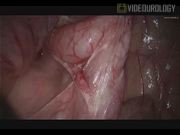
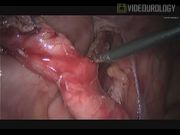
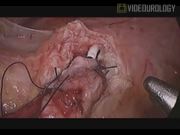
Case 1: A 7-year-old male with h/o right dull loin pain and recurrent urinary-tract infection (UTI) on and off for 1 year. Imaging protocol included ultrasound (USG), micturating cystourethrogram, and MRI, which revealed grossly dilated tortuous ureter with obstruction at the right vesicouretral junction (VUJ). Laparoscopic tailored reimplantation was performed. Three ports were used. Right dilated ureter was dissected up to the VUJ. The lower ureter was tailored into a smooth tapered segment with 3-0 vicryl sutures. A Double-J stent was inserted retrograde and the ureter reimplanted after creating a bladder trough. Case 2: A 32-year-old female with h/o left loin pain and recurrent UTI with fever since 2 years. Imaging revealed left moderate hydronephrosis with lower ureteric obstructive segment. Laparoscopic reimplantation was performed over the Double-J stent after creating a bladder trough as an antireflux procedure.
Results:
The operative and postoperative details were recorded as follows. A total of 16 cases were treated by the laparoscopic approach. The mean operative time was 130 minutes. The blood loss was ∼150 mL. Orals was started on the first day and drain removal on the second day. The patients were discharged on the third postoperative day. The catheter was retained for 2 weeks. The Double-J stent was retained for 6 weeks. Follow-up USG was performed at 6 months.
Conclusion:
The proximal ureteral segments regain tone once they are unobstructed. Extended stent drainage after reimplantation decompresses the system. Minimally invasive management of primary obstructive megaureter is feasible and easier with a 3D laparoscopic approach especially the suturing part. Laparoscopic management has the advantages of early ambulation, rapid convalescence, and shorter hospital stay, with equivalent functional outcomes compared with open surgery.
No competing financial interests exist.
Runtime of video: 7 mins 38 secs
Keywords
Get full access to this article
View all access options for this article.