





Abstract
Introduction and Objective:
Suprapubic catheterization (SPC) provides bladder drainage when urethral access is either not possible or not advisable. 1 Once the SPC tract gets matured, access to the bladder for catheter change or any intervention becomes easier. However, when the tract is not yet mature and we need an antegrade access to bladder for urgent intervention like clot evacuation and/or change of malfunctioning catheter, there is always a risk of tract loss. To overcome this complexity, we have developed a novel technique called catheter-controlled dilatation (CCD) of suprapubic tract for antegrade bladder access using the same, but recently made, suprapubic tract. Running time of the video is 4 minutes 55 seconds.
Materials and Methods:
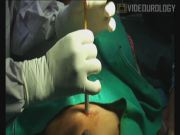
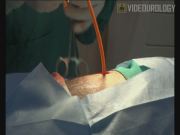
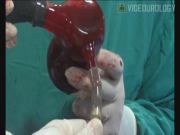
A total of five cases that underwent SPC within last 48 hours needed to have second intervention on emergency basis, and there was no scope for urethral access. Initial two cases required clot evacuation, while in later three, the same technique was employed for change of blocked catheter. After ensuring that preplaced Foley catheter balloon is filled with 10–15 mL of water, a transfixation suture is taken through its drainage channel and tied to occlude the balloon channel. The catheter is cut 1 cm above tied suture. Now, slide the Alken metallic dilator of suitable size over the catheter slowly till one gets the feel of Foley balloon. Dilate the tract by passing serial Alken dilators in a telescoping fashion. After dilating to maximum, pass the Amplatz sheath of corresponding size and remove all the Alken dilators. Cut the Foley catheter below the transfixed suture to deflate the balloon and remove the catheter to get an access to bladder through the Amplatz sheath for any intervention.
Discussion:
CCD is a useful technique with many advantages: (1) it is simple and does not require any additional expertise; (2) the technique is safe, and there is no risk of injury to posterior bladder wall due to inadvertent over-advancement of dilators, as the Foley balloon serves as protective cushion ahead of dilator tip while dilating the tract; (3) urinary bladder remains distended throughout procedure, as catheter remain occluded, this further protects from injury; (4) no fluoroscopy or ultrasonography is required; (5) no additional cost of consumable is added; (6) a wide direct access to the bladder can be obtained that is particularly useful in evacuating blood clots; (7) the technique is useful not only for immature suprapubic tract but also in stabilized tract to achieve above advantages; (8) it obviates need of transurethral cystoscopic visualization during tract dilation. Hence, it is useful when urethra is pathological (traumatized, stricture) or smaller-size cystoscopes are not available for pediatric cases.
Results and Conclusions:
Till date, we have successfully used this technique in five patients. The described technique of CCD is useful in retaining and dilating the previously made immature suprapubic tract without adding any complication or cost.
All authors have made a significant contribution to the findings and methods in the article. All authors have read and approved the final draft. The authors have no direct or indirect financial or commercial incentive associated with publishing the article. The work has not already been published and has not been submitted simultaneously to any other journal. There is no conflict of interest.
Runtime of video: 5 mins
Keywords
Get full access to this article
View all access options for this article.