





Abstract
Abstract
Introduction:
Pancreatic insulinomas are rare pancreatic neuroendocrine neoplasms. Most insulinomas are benign and can be safely enucleated. Traditionally these tumors undergo open resections with large incisions. Here we describe a robotic hybrid minimally invasive enucleation of an 8 mm nonexophitic insulinoma in the anterior body of the pancreas.
Materials and Methods:
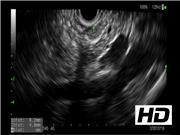
A 49-year-old female presented with a 6-month history of intermittent whole-body numbness and associated confusion that improved with oral intake. Overnight fasting revealed a low glucose (37 mg/dL), high proinsulin (10.2 pmol/L), normal insulin (3.2 µU/mL), normal C-peptide (1.2 ng/mL), and high β-hydroxybutyrate (0.49 mmol/L). Endoscopic ultrasonography revealed a single 8 mm mass in the anterior body of the pancreas. Fine needle aspiration was nondiagnostic. CT angiography of the abdomen showed a hyperenhancing mass in the pancreatic body with no evidence of liver metastases. Surgical options were reviewed with the patient and she preferred a minimally invasive approach. She was brought to the operating room for a robotic hybrid transperitoneal pancreatic enucleation.
Results:
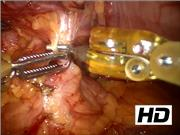
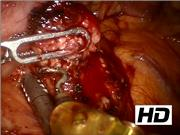
The abdomen was entered using a 10 mm Optiview trocar to the left of the umbilicus. Upon entry into the abdomen, there was no evidence of metastatic disease. The following subsequent ports were placed: a 10 mm assistant port left supraumbilical, three 8 mm robotic ports subcostal, and a 5 mm assistant port right infraumbilical. The lesser sac was entered by dividing the gastrocolic omentum. A robotic arm was used to elevate and retract the stomach upward and the pancreas was exposed. Robotic arm-assisted ultrasonography of the pancreas was performed by scanning the anterior surface of the pancreas across its entire length. This revealed the single 8 mm mass in the anterior midbody that was separated from the main pancreatic duct posteriorly by a 3–4 mm plane. The robotic hook was used to core out the mass using electrocautery in a circumferential manner with a small margin. Once the mass was removed, pancreatic surface bleeding was controlled easily with electrocautery and Surgicel®. A Jackson–Pratt drain was left anterior to the pancreas. Total operative time was 108 minutes. The patient had no further hypoglycemic episodes and was discharged on postoperative day 1. The drain was removed on postoperative day 5. Final pathology report was consistent with a low-grade neuroendocrine tumor. The patient remains well without return of hypoglycemic episodes 2 years after operative resection.
Conclusions:
Enucleation of small nonexophitic low-grade pancreatic neuroendocrine tumors through a hybrid robotic minimally invasive approach is feasible and can be considered as a surgical option in well selected patients.
There was no dedicated funding source used in the creation of this case report.
No competing financial interests exist.
Runtime of video: 5 mins 43 secs
Keywords
Get full access to this article
View all access options for this article.