






Abstract
Advances in diabetes technologies such as continuous glucose monitoring (CGM) have provided significant opportunities to improve glycemic and quality-of-life outcomes for people with type 1 diabetes (T1D). The ambulatory glucose profile and the introduction of glucose thresholds helped a lot to identify patterns, which was the first step toward improving hyper-and hypoglycemia management. Despite these innovations, the relentless burden of day-to-day T1D management continues to be a challenge for individuals and their families. In particular, hypoglycemia remains a significant cause of morbidity and mortality, as well as a barrier to achieving optimal glycemia, contributing to anxiety, fear, worry, and distress. Algorithm developments have led to CGM device-based thresholds and predictive alarms to warn individuals of impending hypoglycemia. More recent developments with artificial intelligence technology now allow for forecasting glucose trends and values over longer time frames, thereby aiding therapy decision-making. In this article, we focus on hypoglycemia and summarize recent developments in glucose prediction from CGM devices. While not intended to be a comprehensive review, we provide an update, highlight anticipated developments, and speculate on potential pitfalls and the potential value from medical, psychosocial, and lived experience perspective.
Keywords
Introduction
Recent advances in diabetes technologies have offered significant advantages in diabetes care and management. For example, hybrid closed-loop systems have become the standard of care in type 1 diabetes (T1D) and can offer significant benefits. 1 Nevertheless, access to insulin pumps and the need to be attached to multiple devices impose challenges to their widespread use. With widening uptake of continuous glucose monitoring (CGM), it is anticipated that multiple daily injections (MDI) with CGM will remain the main approach for diabetes management in developed countries in the years to come. 2
For this large population, which includes a growing number of people living with type 2 diabetes (T2D), the development and access to advanced CGM technology will be essential and could ultimately reduce the burden of diabetes and empower users in their efforts to achieve better glycemic outcomes.
The use of CGM has expanded significantly in recent years. Nevertheless, in those treated with intensive insulin therapy, severe hypoglycemia, fear of hypoglycemia (FOH), and burden of care are still major problems, which together contribute to persistent suboptimal glycemic control. 3 Indeed, recent data highlight that the majority of people with T1D (∼80%) do not achieve a glycated hemoglobin level <7%. 4 One major contributing factor is FOH, which may lead the individual to reduce or delay recommended insulin doses, take unnecessary bedtime snacks, and/or avoid physical activity. In most cases, this is an effective means for avoiding low glucose readings but leaves the individual exposed to longer periods of hyperglycemia.5–20 This situation is further compounded by impaired awareness of hypoglycemia (IAH), which leads to higher risks of prolonged and severe episodes of hypoglycemia as well as greater FOH. Not surprisingly, IAH, which affects 18%–25% of people with T1D, is also significantly associated with depression, anxiety, and diabetes distress. 21
Limitations of Current CGM Approaches
Real-time CGM has led to benefits in glycemic improvements and quality of life in people with diabetes (PWD). The advent of CGM allowed for developing quantitative and qualitative characterizations of diurnal glycemia, including the ambulatory glucose profile, which have helped with identification of glycemic patterns and hypo- and hyperglycemic issues and guiding successful interventions to stabilize glucose levels. It has also contributed to a small to moderate reduction in FOH in adults with T1D, with recent evidence indicating that this is independent of any reduction in hypoglycemia frequency. 22 However, the ongoing daily burden from day-to-day decision-making and management activities continues to be a barrier to optimal self-management and adds to the negative psychological impact. 23 While technologies such as CGM have offered significant benefits in decision-making, their use has also added to the personal burden. Continuous attachment to devices and the ongoing need for close attention to minute-to-minute-data—due to the limitations of forecasting glucose in longer horizons, as well as occasional lapses in accuracy—may lead to the seeming need for even greater vigilance as well as the potential for alarm fatigue and concerns regarding device inaccuracies and failures.24,25 Trend arrows, which are provided by most existing CGM systems, may inadvertently contribute to this CGM-associated burden. As they only reflect past glucose trends, users constantly need to be engaging with mental arithmetic to estimate future glucose values. In addition, the interpretation of the trend arrow’s direction and meaning can be challenging and may trigger confusion, underreactions, or overreactions.26–29 Thus, vigilant decision-making remains critical to enable optimal dosing and behavioral strategies, with FOH being an additional emotional burden.
Furthermore, current CGM systems’ threshold alerts may inadvertently promote a rather reactive style of diabetes management. Users may feel trapped into a constant “firefighting” mode as they may feel the pressure to react immediately to out-of-range glucose trends and values. This may be associated with aggravation when alarms become annoying to self or to others, especially when in social settings. 30 Of note, CGM alarms can have a lag time due to their measuring principle, which users may not factor in to their decision-making and can add thereby a further degree of uncertainty and worry. 31 Finally, a lack of integration with dosing advisors, pens, and other wearables also limits the potential benefits on decision burden that can be derived from a connected ecosystem. 32
In short, toward the promotion of more proactive diabetes management and less burden on the user, it is time for something better than mere trend arrows. By harnessing the power of advanced glucose prediction technology, future CGM features should be able to allow for a more safe, effective, and rewarding diabetes experience. This will involve contextual data beyond mere glucose streams from the CGM device that should be integrated automatically from wearables, connected pens, and advanced bolus calculators (Fig. 1).
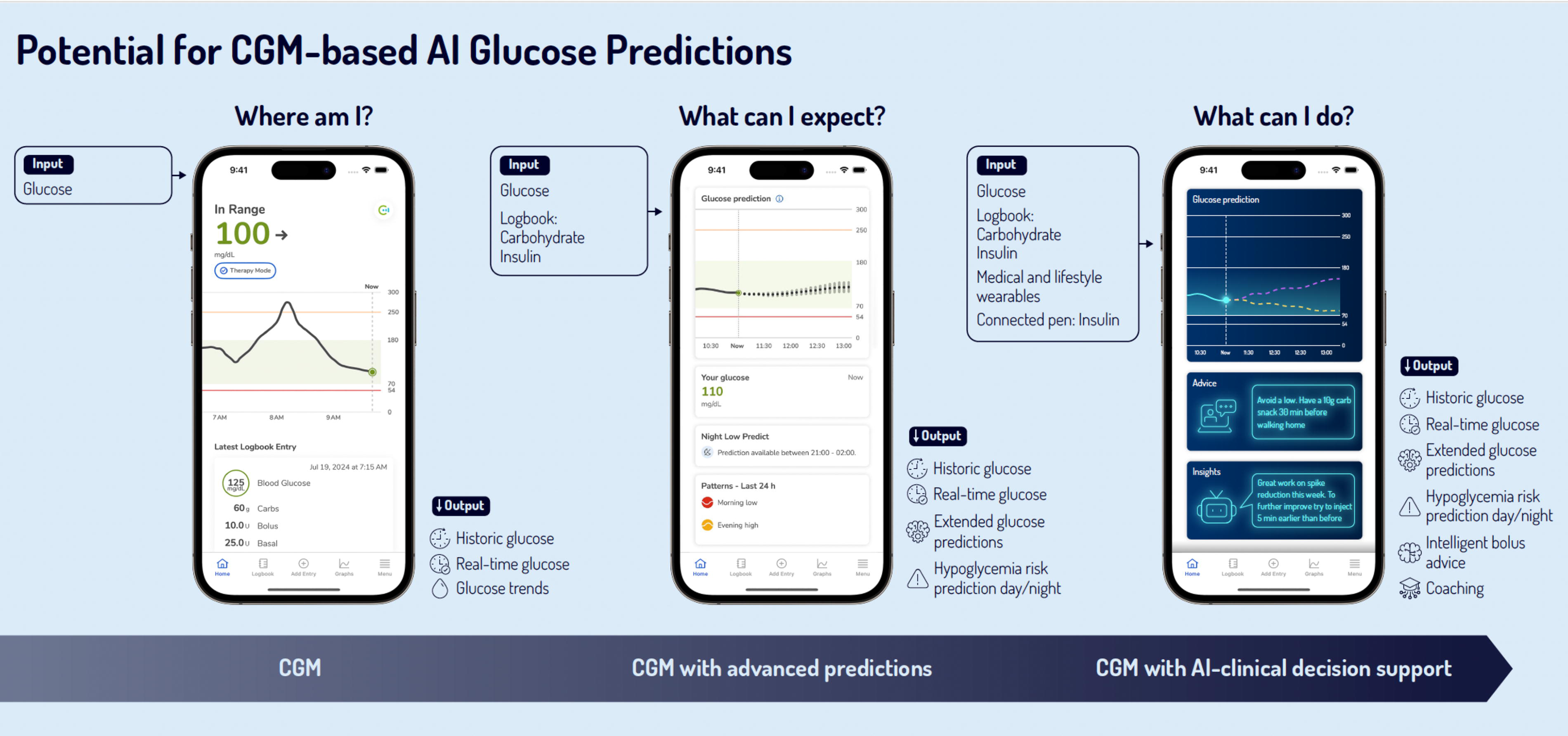
Potential for artificial intelligence (AI)-supported glucose predictions with continuous glucose monitoring (CGM): With AI-supported insights, CGM may empower users to shift from a reactive to a proactive approach. Furthermore, with ongoing device integration, these decision support tools have the potential to offer enhanced advice and insights that may improve overall care and well-being.
Glucose Prediction Technology: Early Experiences
User-driven open-source approaches have demonstrated potential opportunities for improving diabetes technologies, such as predictions and visualizations of CGM-derived values that were introduced in 2013.33,34 They enable users to visualize their glucose trajectory, possible eventual levels, and offer hypoglycemia prediction.33–35 Although they are not yet approved by regulatory bodies, their popularity has been highlighted with international consensus statements advocating their use. 36 Meanwhile, commercial providers have brought further CGM advancement with predictions for low glucose. For example, the feature “Urgent Low Soon,” initially introduced by Dexcom, demonstrated significant reductions in severe hypoglycemia.37–39 There has been further development with the introduction of the delayed first high alert, aiming at avoidance of overreactions and insulin-stacking by users. 40 Taken together, these proactive functionalities might allow users to make smarter therapy decisions, reducing unwanted low glucose excursions, and easing alarm burden.
AI-Informed Advanced Glucose Predictions
Although current diabetes technology enables users to take action in a more informed and timely manner, these decisions remain largely reactive—dependent on the vigilance of users and the ability to respond to potential problems urgently—and thus may not help to solve identified issues effectively. Moreover, CGM systems have not fully released individuals from the burden of nocturnal hypoglycemia, which can significantly impact sleep quality, daily functioning as well as mood, energy levels, and productivity. 9 Overall, these limitations often lead to significant frustrations, including FOH and higher levels of diabetes distress, since CGM users may now find themselves working harder to address worrisome glycemic events yet still resulting in problematic outcomes, ongoing frustrations and worries, and disturbed sleep.41,42
In the age of AI, users will expect more intelligent CGM systems in terms of prediction capabilities, which could become a uniquely valuable personal tool. This means that users would receive more actionable glucose projections, which could reduce the need to be constantly alert to changing glucose levels around the clock. And such advances are on the horizon. A first tool with AI-enabled advanced glucose prediction technology has recently entered the market.
a
This new CGM system provides three AI-enabled glucose prediction features based on a set of fixed parameters, including recent CGM measurements, bolus insulin-on-board estimates, and unabsorbed carbohydrate estimates:43,44
A customizable 30-min low glucose prediction notifies users in case of a high risk for low glucose within the next 30 min. Its glucose threshold values for low glucose can be set individually in the range of 60–100 mg/dL. A continuous 2-h glucose forecast feature visualizes glucose estimates graphically. An adjustable 7-h prediction of the risk of nocturnal hypoglycemia (<70 mg/dL; <3.9 mmol/L) notifies users prior to bedtime, if the risk is elevated. The feature includes a traffic-light visualization, which provides an intuitive indication of the risk. In addition, it supports PWD with information how they can reduce the chance of a hypoglycemic event or prepare for it.
Hence, this technology provides predictions for glucose levels over a longer-term time window than current solutions. As long as predictions are accurate and trust in the system with prediction technology is maintained, AI-powered predictions may heighten users’ confidence in making appropriate adjustments that may contribute to better glycemic outcomes. We suspect that these predictive functions could be of great value to users as they have the potential to improve both glycemic and patient-reported outcomes.43,45
Further empowerment of users through enhanced clinical decision support building on AI-powered predictions could lead to even stronger effect on outcomes and reduced disease associated burden. A prerequisite for this would be the collection of comprehensive contextual data on quantitative and qualitative food intake, insulin dosing, activity, weight, and more. Instead of tedious data entry and allowing for a high reliability, availability and accuracy this data would be provided by connected devices (Fig. 1). Additionally, a ketone-level prediction could be a powerful tool to enable people with T1D to prevent a critical rise of ketones. 46 Not least, an extension of the prediction horizon for up to a week might help individuals to adjust their glucose management for longer intervals well in advance, improving the safety and well-being. 47 Further improvements in prediction quality and acceptance could potentially be leveraged by introducing self-learning algorithms to provide an even stronger individualization to needs of users.
Potential Value of AI-Powered CGM
Potential impact on hypoglycemia
Perhaps the most important value of AI-powered CGM prediction is to provide better and longer-range forecasts for users which can help them to take early (and less disruptive) corrective actions rather than the need to wait for last-minute (and often quite disruptive) decision-making. While we await clinical studies to test the potential of this initial class of advanced glucose prediction technologies, first data demonstrate that active use of advanced glucose prediction results in a clinically meaningful reduction of time in hypoglycemia. 48 We anticipate appropriate use could lead to reduction in hypoglycemia and FOH. This should be a primary focus for such technologies as it could lead to positive behavior changes that may improve glycemic outcomes and help to alleviate diabetes distress as well. We encourage industry to work with potential users to identify which predictions would be of greatest value to them and aid in the reduction of their burden. Although avoidance of severe hypoglycemia is a primary concern for health care professionals (HCPs), preventing even mild hypoglycemia can be quite important to users as it can interrupt meaningful activities. 49 Hence, future focus with AI-assisted predictions needs to be on reducing interruptions and enabling meaningful alarms to allow a more worry-free diabetes experience. Indeed, a recently published survey highlighted that people with T1D and T2D rated the prediction of hypoglycemia as the most important reason for choosing a CGM device. 50 Furthermore, in silico data demonstrated a reduction of low glucose alarm rate using prediction. 48
Potential impact on nighttime hypoglycemia and sleep quality
By allowing users to better recognize and respond to hypoglycemia risk, especially before going to sleep, we hypothesize that AI-powered CGM solutions will enhance sleep quality. This is because users will now be aware of any potential risk of hypoglycemia before going to bed and be able to take preventive action, thus leading to greater comfort and confidence that they can be safe at night. 10 A reduction in nighttime hypoglycemia means fewer low-glucose alarms, which should contribute to fewer sleep interruptions for the user and potentially the partner and/or family. As a consequence, a reduction in needed treatment (especially overtreatment) for hypoglycemia is also likely, leading to a long-term positive impact on glycemic outcomes. These suggestions are in line with the expectations voiced by adults with T1D in a recent survey examining their thoughts on how longer-term glucose prediction might affect them. 10 Furthermore, in silico testing of nocturnal risk prediction applying a simple behavioral model has demonstrated significant improvements in nocturnal time below range as well as the probability and duration of nighttime hypoglycemia.45,48,51
Potential impact on perceived diabetes burden
AI-powered CGM should also bring considerable psychosocial benefits for most users. Feeling more confident that they will likely be safe from critical glucose levels (during the day as well during sleep), users may be able to reduce the moment-to-moment vigilance associated with diabetes management, which may in turn reduce fatigue and overall cognitive load. We can also envision how AI-powered CGM may reduce psychological stress linked to social situations. For example, when users receive a push notification that their glucose level could drop precipitously in the next 30 min, they may have the chance to take timely, proactive countermeasures to stay in the target range rather than needing to deal with a potential emergency during meetings, social events, or critical appointments. 45 This may also be valuable in reducing unwanted CGM alarms during social situations, which are often linked to diabetes stigma. 25 Overall, we might expect AI-powered CGM to help the user to feel more in control of diabetes, thus contributing to reduced diabetes distress and greater overall well-being. This expectation is in line with the results of the survey among PWD conducted by Ehrmann et al. 10
AI-powered CGM could be particularly beneficial for users that do not use automated insulin delivery (AID) systems due to personal choice, cost, or unavailability. They are much more dependent on their own actions to manage glycemia and prevent hypoglycemia, especially overnight. For this group, access to accurate longer-term glucose predictions may be of even greater value than to AID users.
Potential impact on HCPs
We also suspect that AI-powered CGM may positively impact HCPs if robust data to support the accuracy of these predictor systems are available. If trust and confidence from AI-powered CGM systems are gained, then HCPs may become comfortable with more intensive treatment recommendations. Especially if the system can reliably offer a more advanced safety net for their patients. Furthermore, future AI-supported CGM technologies with integrated dose calculators may enable users to carry out prediction-based titration regularly themselves. For this, HCPs will need data to reinforce confidence in the accuracy of these predictive systems and then offer education to train and support users regarding how they can use AI-powered CGM best.
Potential impact in T2D
Despite important differences in pathophysiology, individuals with T2D on intensive insulin regimens can share similar burdens (e.g., FOH) and needs as people living with T1D. 52 However, they may have only very limited access to AID systems and reimbursement is often not provided. 53 AI-powered CGM may help to better address educational needs regarding dosing adjustments as well as addressing burdens and challenges to reach glycemic targets. Further product development and studies in this group are urgently needed.
Limitations
It is self-evident that AI-enabled CGM systems highly depend on the quality and accuracy of their input data. Therefore, it is important to standardize both the criteria for CGM performance and regulatory requirements. This will, in turn, allow for more reliable and accurate glucose data while ensuring a high quality of advanced glucose predictions. Ultimately, standardization would reduce the risk of misleading predictive information. Hence, the following aspects need to be considered: There is a difference between CE marking in Europe, regulations in other markets such as the United States, and a true quality standard for CGM devices including measurements in the hypoglycemic range. 54 In addition, a standardized study design for CGM regulatory approval is still missing. In particular, there is a lack of requirements for the distribution of comparator measurements to evaluate CGM performance, which prevents comparability of CGM studies. However, harmonization efforts regarding an international ISO standard for CGM evaluation accuracy are under way. 55 In this context, Mathieu et al. suggested an “eCGM” compliance status as a short-time measure, which represents a minimum set of requirements for clinical testing and performance metrics for CGM systems. In other words, the eCGM status would mean that a CGM system has undergone a certification process beyond the requirement for European CE marking. 56
Currently, the concept of advanced glucose prediction faces a number of challenges. First, clinical studies and real-world data are now needed to confirm these proposed benefits and understand impact on behavior change, device-related burden, and key markers of quality of life. Novel ways of data collection such as ecological momentary assessment and sleep quality analysis can provide further insights. Second, further developments in technology with user-informed co-design and passive data integration from multiple sources to enhance AI-powered glucose predictions are urgently needed. Furthermore, the algorithms of advanced glucose predictions use CGM data alongside manually logged insulin and carbohydrates. By provision of these data, the performance and accuracy of the predictive algorithms can be improved. 43 Given the variability in logging data in the real world, the unavailability of these data might impact the validity of the visualized predictions. However, in a recent analysis, a lack of carbohydrate and insulin has been evaluated, and the performance drop was below 2%. 57 Automatic input of real-time insulin dose data from connected pens could mitigate the burden of manual logging while increasing the predictive performance. Trust in glucose predictions might lead to behavior change in terms of setup of threshold alarms and lead to critical situations in the case of false negative predictions.
Conclusions
In this article, we explored how AI-assisted CGM may pave a more powerful and effective way to view glucose data. While trend arrows provide valuable direction, they are often difficult for users to interpret easily and effectively. In contrast, we envision how the ability to better predict glucose values over time will grant the opportunity for users to address problems proactively rather than being limited to a reactive, firefighting mode, which has demonstrated to reduce diabetes distress. 10 Further product development and studies are needed to confirm the potential opportunities and benefits for AI-powered CGM. Effective co-design with both PWD and HCPs will be of central importance to ensure that the requirements from all perspectives are met.