




Abstract
The loss of a limb is a traumatic and far-reaching event and often represents a struggle for survival, psychosocial adaptation and re-defining of self. In this case study presentation, a patient's relationship with disability is explored by means of a comprehensive model in understanding and assessing the trauma journey. The value of projective techniques and narrative therapy will be highlighted in the process of re-defining self. It is hoped that professionals working with patients with limb loss will be able to intervene constructively and engage in taking-it-back practices.
Keywords
Introduction
The conversations I had with King 1 , a bilateral transfemoral amputee, had a profound effect on my work practices as a psychologist involved in a multi-disciplinary rehabilitation team. King visited his prosthetist for a regular fitting when the effect of disability on his experiences of life was raised. Seeing that he was distraught and depressed, King's prosthetist felt that he could benefit from consulting with a psychologist. King told me his story.
History of relationship with disability
King, a 19-year-old black male, led a full, childlike life when his life took a change at the age of eight. He was playing with some friends in his neighbor's garden when a car lost control, smashed through the fence and in the process a huge rock crushed both his legs. A bilateral transfemoral amputation followed during his hospitalization. Two years later, at the age of 10, King received his first prosthetic legs after being bound to a wheelchair. However, the effect of disability on King's life was very unhelpful. During our initial conversations, King told me that disability had such a profound effect on his self-esteem, that it convinced him that he would not be able to walk without having to use crutches. It also robbed him from his ability to play soccer and to do things for himself. Disability tried to convince King that he was inferior and that he would not be able to attend the same school as his peers.
However, at the age of 16, King was referred to another prosthetist who fitted him with new prosthetic legs and encouraged him to stand up against disability and to let go of his ‘emotional crutches’. This experience opened up a narrative space in King's life that allowed him to discover an alternative relationship with disability. King moved to a new school where he felt less compelled to live within the boundaries of what is expected from a disabled person. He discovered an interest in drama, acting and singing in the school choir.
Although the effect of disability in King's life was becoming less intrusive, he still encountered feelings of frustration and a fear of rejection, in particular by his female counterparts. Disability's tactics was to convince King that girls are not interested in him because of his disability. This in turn affected his interpersonal relationships, losing his temper easily and feeling disrespected by others.
Objectives
In supporting King to create stories of identity that would assist him in breaking from the influence of the problems he was facing, one of my first objectives was to separate his identity from the problem for which he was seeking assistance. Narrative therapy was used to explore King's relationship with disability and to reduce the influence of problems on his life. Kohl's (1984) model was selected to assess and analyze the rehabilitation process and expression art therapy was used as a projection technique in the therapeutic journey.
Intervention and methods
This section intends to provide a brief introduction and clarification of the underlying philosophy of narrative therapy and elucidate on the assessment tools employed throughout the rehabilitation process.
Narrative therapy
As a therapist, working from a narrative therapy approach, I seek to be respectful, non-blaming and to view people as the experts of their own lives. Morgan (2000) states that narrative therapy ‘views problems as separate from people and assumes people have many skills, competencies, beliefs, values, commitments and abilities that will assist them to reduce the influence of problems in their lives' (p. 2). Externalization is the foundation from which therapeutic conversations are built and requires a particular shift in the use of language (White and Epston 1990). The phrasing of disability as a noun, as opposed to an adjective or verb, gives it an identity and shifts the conversation from an internalized conversation to an externalized one. So instead of King describing himself as ‘being disabled’, the therapist explores his relationship with disability and investigates the problem's tricks, tactics, ways of operating and motives in King's life. Engaging in externalizing conversations can be helpful for many reasons: It opens a narrative space for people to work cooperatively to revise the relationship with the problem; the problem appears to be less fixed and less restricting when spoken of in externalizing ways; it disempowers the effects of labeling, diagnosing and pathologizing; and it enables the development of an alternative story (Morgan 2000). The opening up of a narrative space allowed King to realize that there are many new options and possibilities available to him, which allowed us to choose where to go on our therapeutic journey and what to leave behind (Nooney 2002).
Kohl's (1984) comprehensive rehabilitation model
In King's journey across the bridge of rehabilitation and restoration, there are significant psychosocial issues and functional tasks that may require mastery. Kohl (1984) developed a comprehensive model in understanding and assessing the trauma journey. The holistic model of rehabilitation focuses on ten psychosocial issues to be mastered to facilitate appropriate interventions by staff from various professions on the multi-disciplinary rehabilitation team. The goal of the treatment program is to provide each person with the functional and emotional skills and knowledge that will enable him/her to state their own self-definitions and reasons for continued life. The 10 psychosocial issues include a struggle for survival, ideations of death, thought disturbances, phantom sensations, mourning, and quest for meaning of injury, role relationships, body image, intimacy and vocational options. Table I provides a summary of the process of psychosocial adaptation to traumatic limb loss during the passage through three phases of the rehabilitation process. Kohl (1984) coined the phases as the acute, prosthetic training and post training phases.
Process of psychosocial adaptation to traumatic limb loss (Kohl 1984, p. 114).
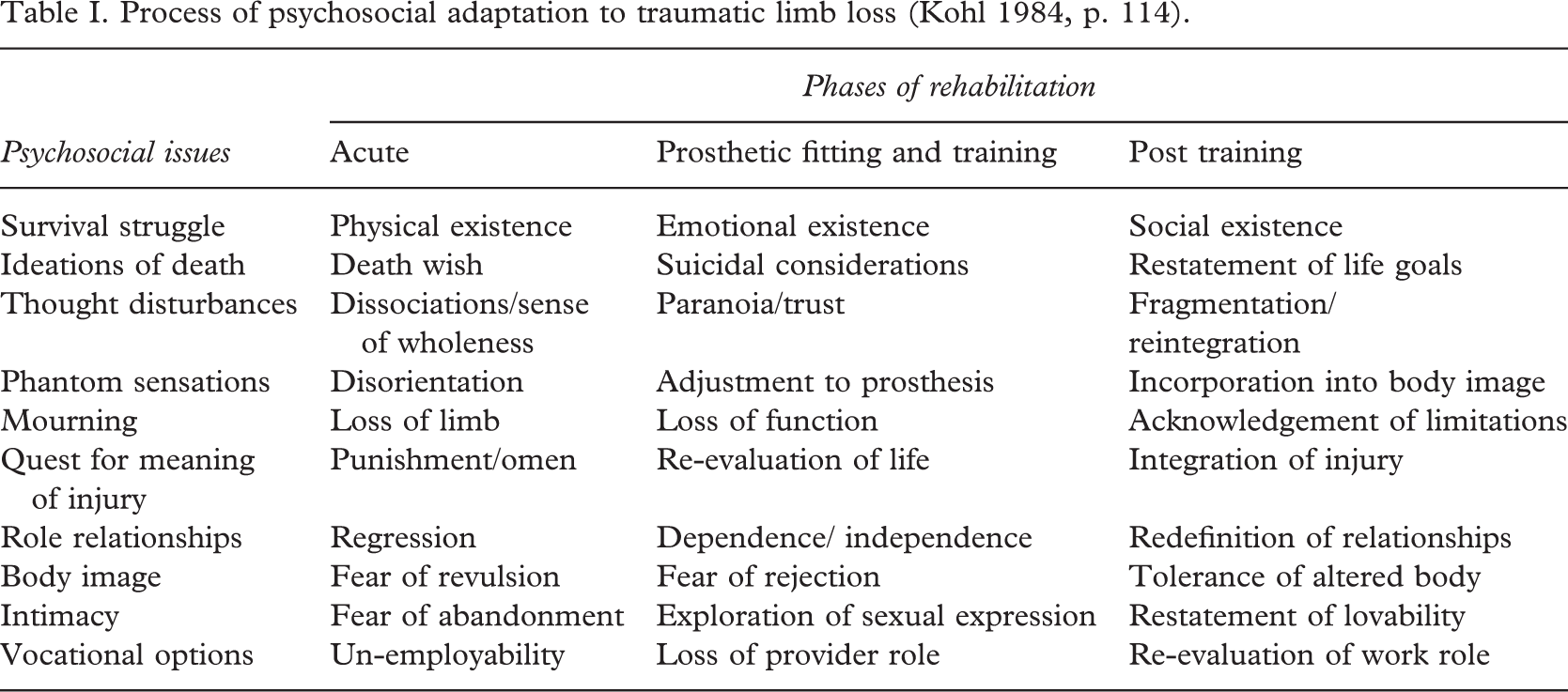
The psychosocial issues of quest for meaning of injury, body image, intimacy and vocational options were collaboratively identified during our therapeutic conversations as areas that needed special attention on the journey of rehabilitation and emotional healing.
Expressive art therapy as projective technique
Employing expressive art therapy as projective techniques can provide alternative means of expression and allow the unique ‘voices’ of young persons to be heard in therapy. It was especially helpful in my conversations with King who had to speak English during our consultation sessions, as opposed to his mother tongue, Sotho. It also assisted in my work where differences existed between us in terms of family style and cultural expression (www.narrativeapproaches.com).
Projective techniques originally developed out of Freud's work on personality and paranoia and is based on the hypothesis that ‘people will reveal in their responses to projective techniques, the things they would otherwise be unwilling to admit or unable to admit (because they are not fully conscious or are totally unconscious of that aspect of their personality) about themselves’ (Boddy 2007, p. 49). I asked King to create a self-collage by using any material on hand (see Figure 1). The advantages of using visual stimuli of a collage are that it stimulates right-brain activation which bypasses more rational evaluation procedures. Probing of what the images mean to the client and why those images were chosen stimulates conscious narratives to evolve about otherwise inaccessible responses (Boddy 2007). Johnson and Sullivan-Marx (2006) summarize the advantages of art therapy as follows: Art therapy can help facilitate communication, manage emotions, and provide an opportunity for life review. It can offer social connection and provides choices and control. It can bring about improved mental and physical health and offers a vehicle for nonverbal assessment. Perhaps most important, art therapy makes it possible for the staff and the family to see the client through the lens of their own life story and gain a glimpse into the core person, to see beyond their limitations to the strengths and beauty (p. 316).
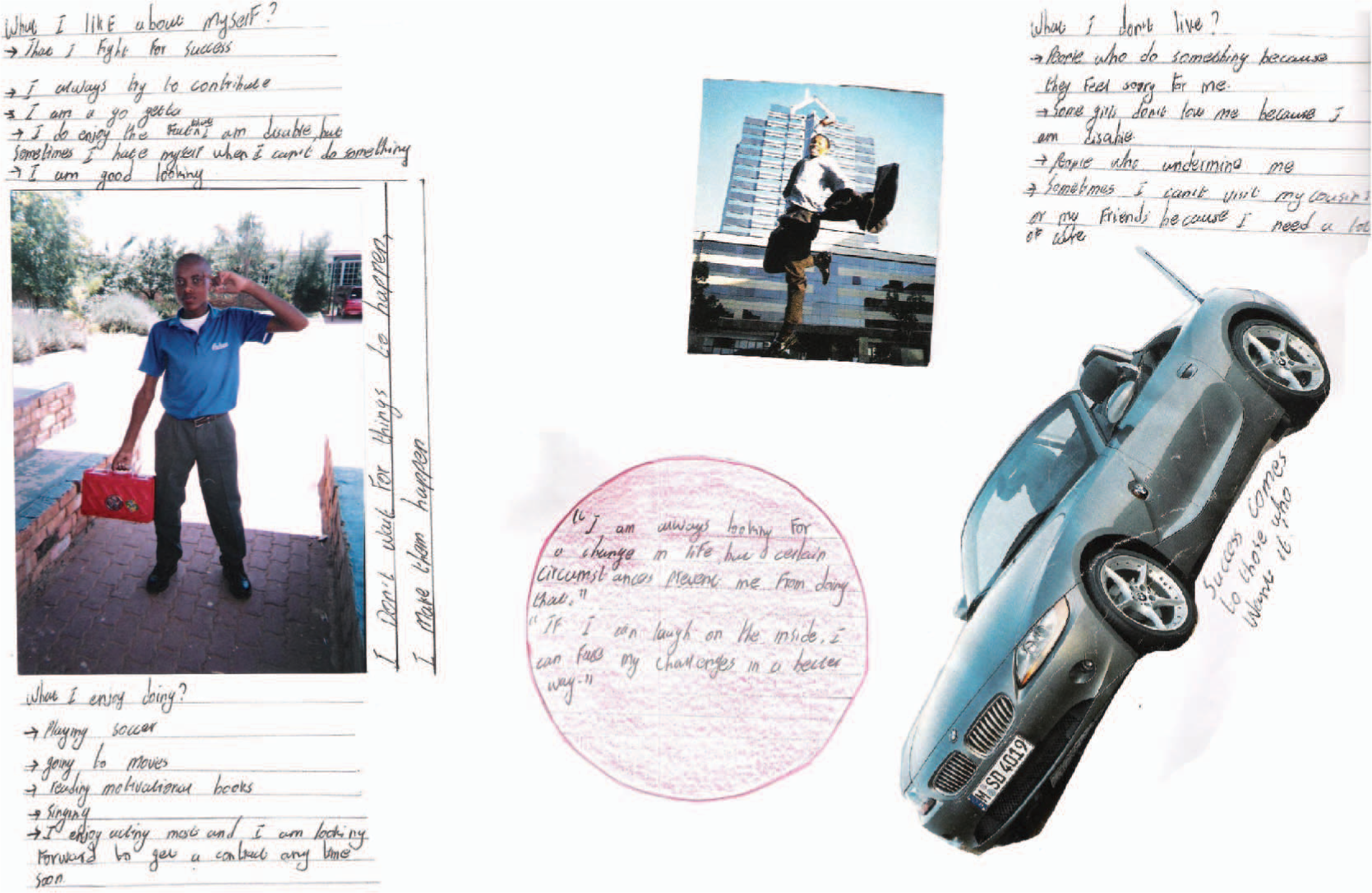
Self-collage.
Furthermore, an unstructured family drawing or genogram was used to invite King to make meaning of his own expressions and to explore his position within his family structure. The genogram is a tool that can be used to visually document dynamics of family relationships and to explore inter-generational patterns of behavior. The genogram also has value in aiding diagnostic, therapeutic and preventive care decisions (Watts and Shrader 1998). I adapted the construction of the genogram by replacing the symbols commonly used with a more unstructured approach. King was invited to sculpt his family by using metaphorical symbols of nature to represent each person's position within the family. Furthermore, he had to use one word to describe each person and use arrows to indicate ‘who is looking at whom in the family’ (see Figure 2). The very process of drawing and sculpting King's relationship with disability and his position within his family evoked a visceral sense of the problem located outside of him and is congruent with the practice of externalization commonly used in narrative therapy.
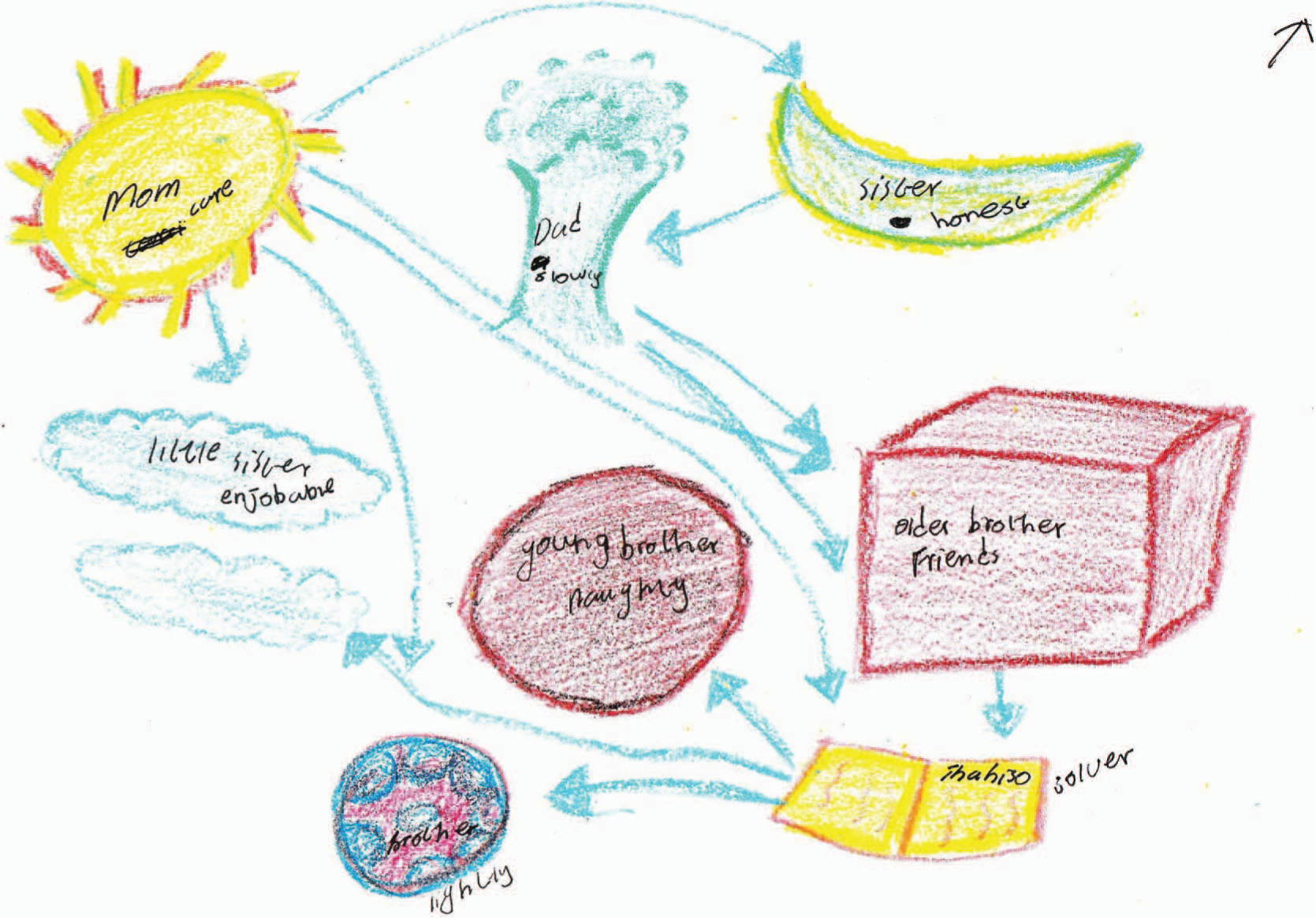
Family drawing or genogram.
Other instruments used
In addressing King's need to explore different vocational options, as identified as a psychosocial issue in Kohl's (1984) model of rehabilitation, I used psychometric assessment tools in determining King's special abilities, interest and personality traits and matching these results with possible career choices. The South African Vocational Interest Inventory (SAVII) was employed to measure occupational interests, dividing it into six fields, namely Practical Realistic (P), Scientific Investigative (W), Artistic (A), Social Service (S), Business and Management (B) and Clerical Administrative (K). These fields correspond to Holland's (1973) six personality types and describe job-related activities. The SAVII is particularly well-suited for career guidance, since its theoretical structure enables information about the individual to be linked directly to information about the world-of-work (Langley 1990).
In assessing King's reasoning ability, the General Reasoning Test Battery (GRT2) was used to measure general verbal reasoning, general numerical reasoning and general abstract reasoning. The instrument is particularly useful in providing a comprehensive assessment of mental ability and to indicate whether applicants can benefit from further training and development. Reliability studies on the GRT2 revealed a coefficient alpha of ranging between 0.78 and 0.86 on the subtests for South African vocational clients. Validity studies on the GRT2 supports the contention that the General Reasoning Ability Test gives an indication of a respondent's ability to learn, by correlating highly with tests on numerical ability and learning potential (www.psytech.co.za).
The Jung Type Indicator (JTI) is a reliable, non-ipsative personality measure based on Jung's typology. This questionnaire measures people's thinking style and the way they deal with information and is particularly useful for counseling, guidance and examining how people will interact in group settings. Reliability studies revealed that the Jung Type Indicator is within acceptable limits, even for Black respondents, ranging between 0.78 and 0.86. Developers of the instrument noted that correlations with other measures support the construct validity of the JTI quite convincingly (www.psytech.co.za).
Results and discussion
Kohl's (1984) model for the analysis of the rehabilitation process after traumatic limb loss and the use of expressive arts therapy as projective techniques accompanied us on the therapeutic journey and directed us towards the discovery of alternative stories. During our conversations, we realized that King was confronted with ‘making sense’ out of his situation and his relationship with disability. According to Kohl (1984), in the process of re-evaluation of life ‘an examination of one's life is made, which evolves into a balance sheet of right and wrong deeds that serves as a basis of determining future goals’ (p. 127). Successful resolution of this psychosocial issue leads to ‘the reattachment to life's meaning with a positive sense of self-worth and a potential for fulfillment’ (Kohl 1984, p. 127).
In the process of re-defining himself, King had to resolve the psychosocial issue of body image. Shontz (1974) refers to the unique situation of persons with limb loss of having three body images: one with prostheses, one without it, and the pre-injury intact body. During our therapeutic conversations we explored King's ability to fuse his emotional, cognitive and physical selves in accepting himself, as opposed to the internalization of a negative body image.
The psychosocial crisis of intimacy is also described by the psychologist, Erik Erickson (1968) who refers to the developmental stage that King finds himself in during adolescence and young adulthood as the task of achieving ego identity and avoiding role confusion. As a young adult in grade 11, King has to establish a social identity, career identity and a sexual identity. It is in particular his fear of rejection by an intimate partner that might result into isolation. This area needed special attention in our therapeutic conversations. In this context, intimacy refers to the ability to be close to others, as a lover, friend, and as a participant in society. Principles of narrative therapy proved to be successful in exploring discourses relating to what attracts him to the opposite sex and his ideas of ‘healthy intimate relationships’.
Kohl's (1984) comprehensive model was also helpful in determining King's need to explore different vocational options and career opportunities. Utilizing the South African Vocational Interest Inventory (SAVII), the Jung Type Indicator (JTI) and the General Reasoning Test Battery (GRT2) matched King's abilities, interests and personality traits with careers in performing arts, such as drama and acting.
Morgan (2000) suggests that ‘as narrative therapists listen to the stories brought to therapy, they will hear of events that fit with the problem story and events that seem to contradict or stand outside of that dominant story’ (p. 51). During the activity of the self-collage, King identified a number of self-descriptions that stand outside the dominant story of disability. He re-connected with his inner drive to fight for success, to be a go-getter, and could acknowledge that he is handsome and can be attractive to the opposite sex, regardless of his disability. He even discovered that disability brought certain rewards in his life, because he gets more opportunities and financial rewards as opposed to his family members. King recognized the opportunity to get involved in a community acting group as a special privilege due to his disability. He was also financially rewarded by receiving a government sponsored disability grant. King noticed his special talents and interests in drama, singing and reading motivational books. He created a special motto to live by: ‘if I can laugh on the inside, I can face my challenges in a better way’. Reflecting on his need for acceptance and fear of rejection, he realized that he doesn't have to like everyone he meets, just as they don't have to make him their best friend.
Facilitating a conversation regarding the unstructured family drawing or genogram invited King to explore and reflect on his position within his family structure. He discovered that he has a lot of aspirations and dreams, but that these are not shared by all his family members. He also discovered his special position in the family as peacemaker and the desire of his family to be ‘a family with dignity’. During the therapeutic process, I took a stance of curiosity rather than offering an expert opinion as therapist on King's artistic productions. Encouraging King to expand on the creation of preferred meanings through narrative and reflection assisted him in connecting with his siblings who share his values of ambition, dedication and optimism. He valued his special position in the family as a peacemaker and someone who can come up with great ideas to solve problems. The exercise also assisted him in developing his creative skills and thoughts.
Conclusion
King donated his enabling story for his life to others who have a relationship with disability and believing it to be useful. The opportunity to perform and enact our life stories before an audience has transformative power and is congruent with Bruner's (1986) argument that ‘texts must be performed to be experienced, and what is constitutive is in the production’ (p. 7). It is intriguing to think about the practices that assisted King to reclaim and reconstruct an enabling story for his life. The practice of externalizing conversations in narrative therapy assisted King to separate himself from disability and opened up possibilities to describe himself from a new, non problem-saturated perspective. Kohl's (1984) comprehensive rehabilitation model provided a framework to assess psychosocial issues that were not resolved yet and that needed special attention during the therapeutic intervention. Employing expressive art therapy as projective techniques assisted King to express himself in alternative ways and opened up creative discoveries and possibilities for change. King was also guided in making an informed career decision through the use of psychometric instruments that matched his specific abilities, interests and personality traits with appropriate careers. I encourage prosthetists and psychologists to take the unique outcomes that have been derived from this case study back to their practices and to engage in explorations of alternative relationships with disability.
King's story provides an alternative to the story of disability and loss. I believe that King will continue to participate in the constructions of a preferred way of knowing himself and of developing his special knowledge and wisdom to live a richly enabling life. The special opportunity that he recently received to be involved in an acting group is an affirmation that he is still to achieve great things in his life, fit for a King!
Footnotes
1. Pseudonym for purpose of confidentiality.