



Abstract
The ability to objectively measure an amputee's walking activity over prolonged periods can provide clinicians with a useful means of evaluating their patients' outcomes. The present study aimed to validate the temporospatial data output from a commercially available ambulatory activity monitor (PAM, Össur) fitted to trans-tibial and trans-femoral amputees, against data that was simultaneously captured from a three dimensional motion analysis system (Qualisys Medical AB, Gothenburg, Sweden). Results indicate that the PAM monitor provides accurate measures of temporospatial aspects of amputee gait for walking speeds above 0.75 m/s.
Introduction
Physical activity has been demonstrated as beneficial in lowering the risk of chronic diseases and as having significant positive health benefits (Argiropoulou et al. 2004; Schneider et al. 2003). It is identified as a primary determinant of quality of life and is subsequently considered to be one of the major goals of rehabilitation (Culhane et al. 1995). The feasibility of accurately determining levels of patients' walking activity has improved substantially with the introduction of sophisticated long-term ambulatory activity monitors (Table I). Such monitors are capable of continuously logging various temporospatial gait parameters for periods of days to months. The most commonly utilized motion detection mechanism within commercially available walking activity monitors are two or three-dimensional accelerometers.
Commercially available, long-term, activity monitors.
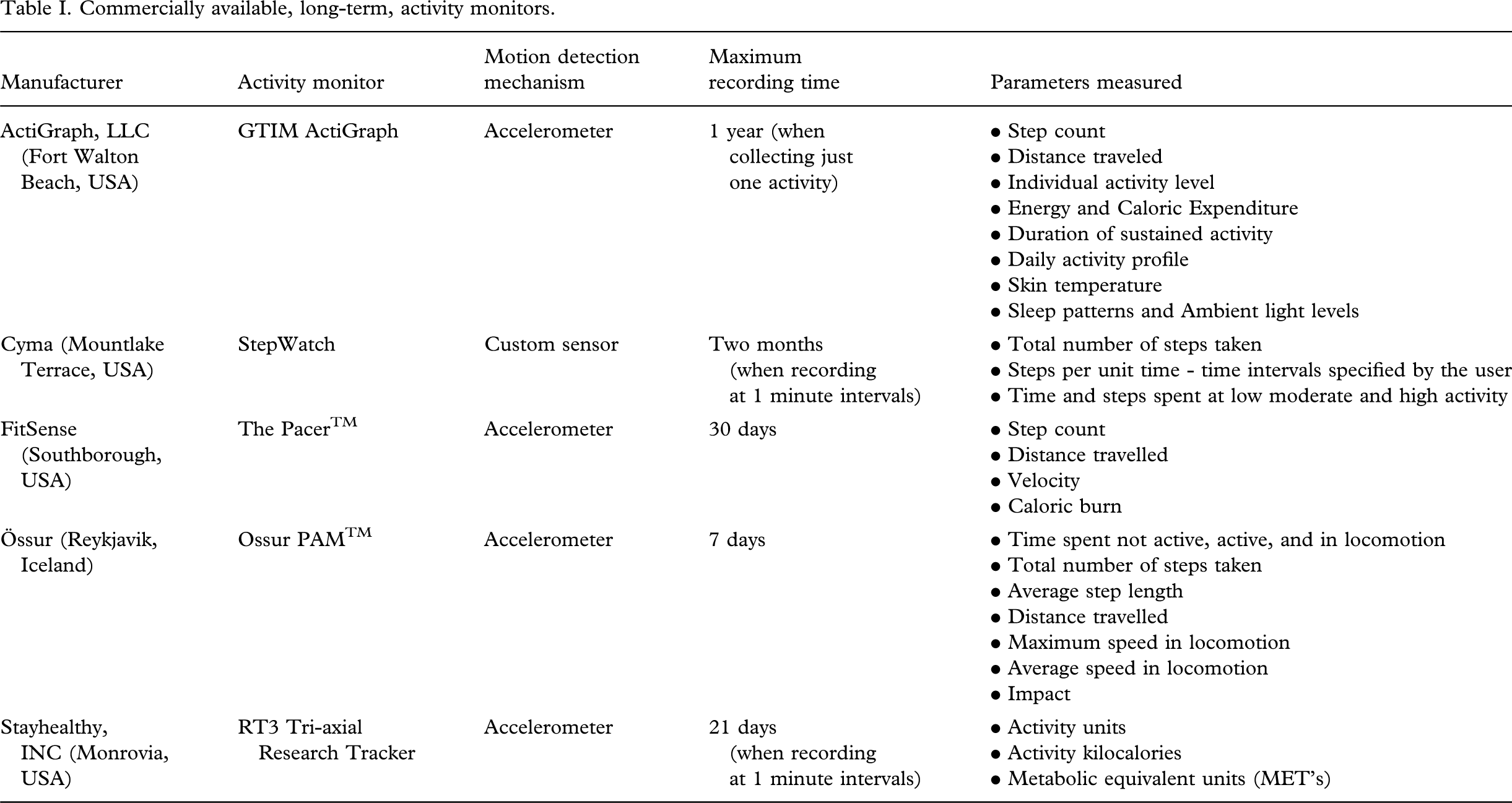
There have been a number of studies that have assessed the validity of different ambulatory activity monitors by comparing their data output against alternate measures. Studies have included comparisons of activity monitor generated data to pedometers (Macko et al. 2002; Shepherd et al. 1999), comparisons with the number of steps counted by an observer (Resnick et al. 2001; Hartsell et al. 2002) and the recorded speed of treadmill walking (Schultz et al. 2002). Results to date indicate that activity monitors generate less overall error when compared to pedometers (Shepherd et al. 1999; Macko et al. 2002), correlate highly with steps that were simultaneously counted by an observer (Coleman et al. 1999; Resnick et al. 2001; Hartsell et al. 2002) and correlate highly with measures of walking speed that are simultaneously recorded on a treadmill (Schultz et al. 2002). The accuracy of the StepWatch device (Cyma, Mountlake Terrace, WA) has been reported in numerous publications and has been successfully used to measure different styles of gait (Resnick et al. 2001; Silva et al. 2002; Macko et al. 2002).
Given that so little is currently known of the walking activities and gait characteristics of amputee subjects outside of the artificial laboratory environment, activity monitors have great potential for use in this population. A valid and reliable walking activity monitor can provide valuable information to those involved in amputee care through the provision of objective information regarding patient activity levels after different surgical, prosthetic or therapeutic interventions. Monitors can also provide useful information regarding the maintenance of temporospatial gait characteristics outside the constraints of the laboratory environment. Little evidence currently exists to demonstrate that gait characteristics of amputees are maintained when patients enter an unconstrained free-living environment and are no longer under the watchful and judgemental eyes of clinicians.
The Patient Activity Monitor (PAM) (Össur, Reykjavik, Iceland) is a recent addition to commercially available walking activity monitors and is specifically targeted towards evaluation of amputee gait patterns. The monitor is a small unit (85 mm×38 mm×32 mm) that is attached to the anterior surface of the leg, 20 cm from the ground. The unit weights 50 grams and is capable of capturing continuous data for a one week period. Stride characteristics are determined from an algorithm that processes data from one biaxial accelerometer and one uniaxial accelerometer (Bussmann et al. 2004). Select outputs from PAM have previously been described as valid for the evaluation of activity in a trans-tibial amputee population. Results have demonstrated a strong agreement between PAM data and manual measures of step count and walking speed measured on a treadmill (Bussmann et al. 2004). To date the accuracy of step length measurements recorded by the PAM have not been investigated. Neither has the ability of the PAM to accurately detect temporospatial gait parameters in a trans-femoral amputee population. Given that the typical gait pattern of a trans-femoral amputee is characterised by reduced angular motion of the tibial segment, precisely where the PAM device is positioned, it is important to establish if the algorithm employed by PAM to detect when a step is taken is equally valid for both trans-tibial and trans-femoral amputees. The aim of the present study was therefore to compare recordings of select gait parameters in both trans-tibial and trans-femoral amputees using the Össur Patient Activity Monitor and to evaluate the output against data captured using three-dimensional motion analysis.
Method
Subjects
Ten trans-tibial and twelve trans-femoral amputees were recruited for the study from the Jönköping University volunteer patient register. Amputees were selected on the basis that they were currently using a prosthesis for daily activities and were capable of walking unaided for a five minute period without a pause. All subjects were required to provide informed written consent before participating in the study and were informed that they may withdraw their participation at any time. All protocols were approved by the regional ethics board in Linköping, Sweden, prior to commencement of the study.
Testing protocol
Before testing, the Patient Activity Monitor (PAM) was fitted to the subjects' prosthetic side according to the manufacturer's instructions. In addition, a single retro-reflective marker was placed on the toe-box of the patients' left and right shoes. These markers were subsequently tracked in three-dimensional space using a six camera computerised motion analysis system (Qualisys Medical AB, Gothenburg, Sweden). Computerised motion analysis systems have been reported as having the ability to measure temporal and spatial gait parameters with high levels of validity and reliability (Barker et al. 2005).
Subjects were requested to walk on a treadmill for three five-minute periods at self-selected slow, medium and fast walking velocities. Participants were permitted to rest for as long as necessary between trials. Walking velocities were determined by the subject prior to testing. Testing for each walking velocity was randomised across patients.
For each walking trial, data was simultaneously collected from the PAM and from the Qualysis three-dimensional motion analysis system. In addition to the computerised motion analysis system, an investigator used a hand tally counter to record the total number of steps taken. After each of the walking trials, data from the PAM was recorded and the unit was cleared for the next walking trial. Motion analysis files were saved in a file folder for subsequent analysis.
Data analysis
Three-dimensional motion analysis files were analysed using Visual 3D motion analysis software (C-motion, Inc.). Specific values were generated for the total number of steps, average walking velocity and average step length. Pearson's correlation coefficients were calculated to compare the strength of the relationship between data collected from the three-dimensional motion analysis system against the PAM outputs for the same variables. Data was analysed using SPSS software (SPSS for Windows, Rel. 13.0.1. 2004. Chicago: SPSS Inc.). To visualise the relationship between variables, Bland-Altman plots were used. With the Bland-Altman plot, the relationship between the measurement error and the true value can be evaluated (Bland and Altman 1986). The method also serves to evaluate if the measures are normally distributed by using a 95% confidence interval.
Results
General
The authors tested 22 participants who had a mean age of 50 years (Median = 51). The sample included 12 subjects with trans-femoral amputation and 10 with trans-tibial amputation. The mean latency since amputation was 22 years (Median = 20; SD = 16). Each patient was measured walking at their self-selected slow, medium and fast walking velocities.
On nine occasions the PAM failed to register data. This occurred at the self-selected slow walking velocity in 5 of the cases. Each of the trials in which PAM failed to register data was removed from the data analysis. One further trial (subject 2 at self-selected fast walking velocity) was also removed from analysis due to a marker tracking failure related to the motion analysis system. After removal of unsuccessful trials a total of 56 trials were available for analysis.
Step count
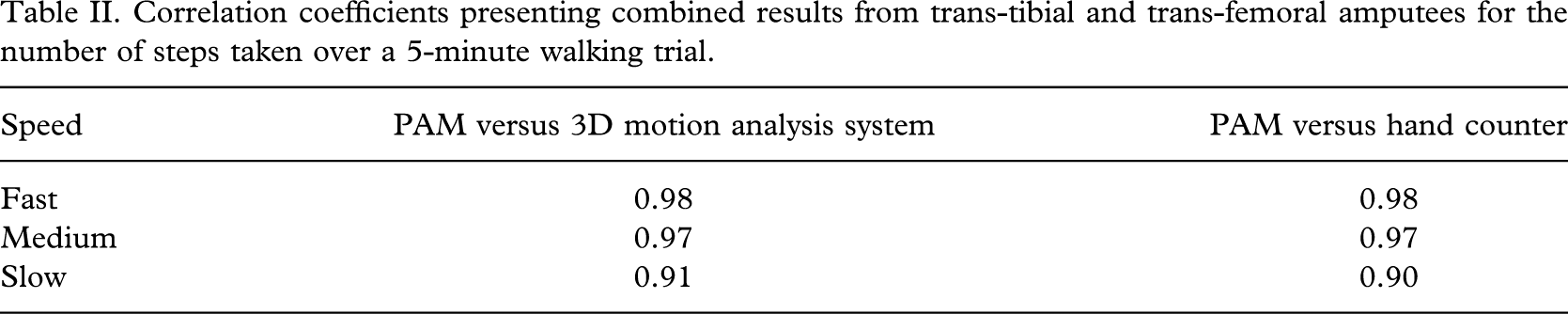
A scatter plot depicting the total step count as calculated by the PAM and the Qualisys motion analysis systems for trans-tibial and trans-femoral amputees is presented in Figure 1A. The correlation between values obtained using the PAM and those obtained from the hand count and the Qualisys motion analysis system were investigated using Pearson's correlation coefficient. Results are summarized in Table II and show very high correlation between step count, as recorded by PAM, and that which was recorded by the Qualysis motion analysis system and the hand counter. Results indicated no difference in the correlation coefficients when comparing trans-tibial (r = 0.97) and trans-femoral amputees (r = 0.98). Figure 1B depicts the agreement of the PAM and Qualisys methods by using a Bland-Altman plot. The difference between the two measurements was plotted versus the averages of the two measurements. The closer the points are to the horizontal axis the better the agreement. Inspection of the plot indicates that the PAM is measuring high most of the time and that the spread of the data is increased at lower average step counts. The average difference between the two methods was −10.9 with a standard deviation of 16.1. The Bland-Altman limits of agreement were −43.1 to 21.3 steps suggesting that over a five minute walking period one could expect the PAM to record between 43 steps less to 21 steps more than the Qualisys system.
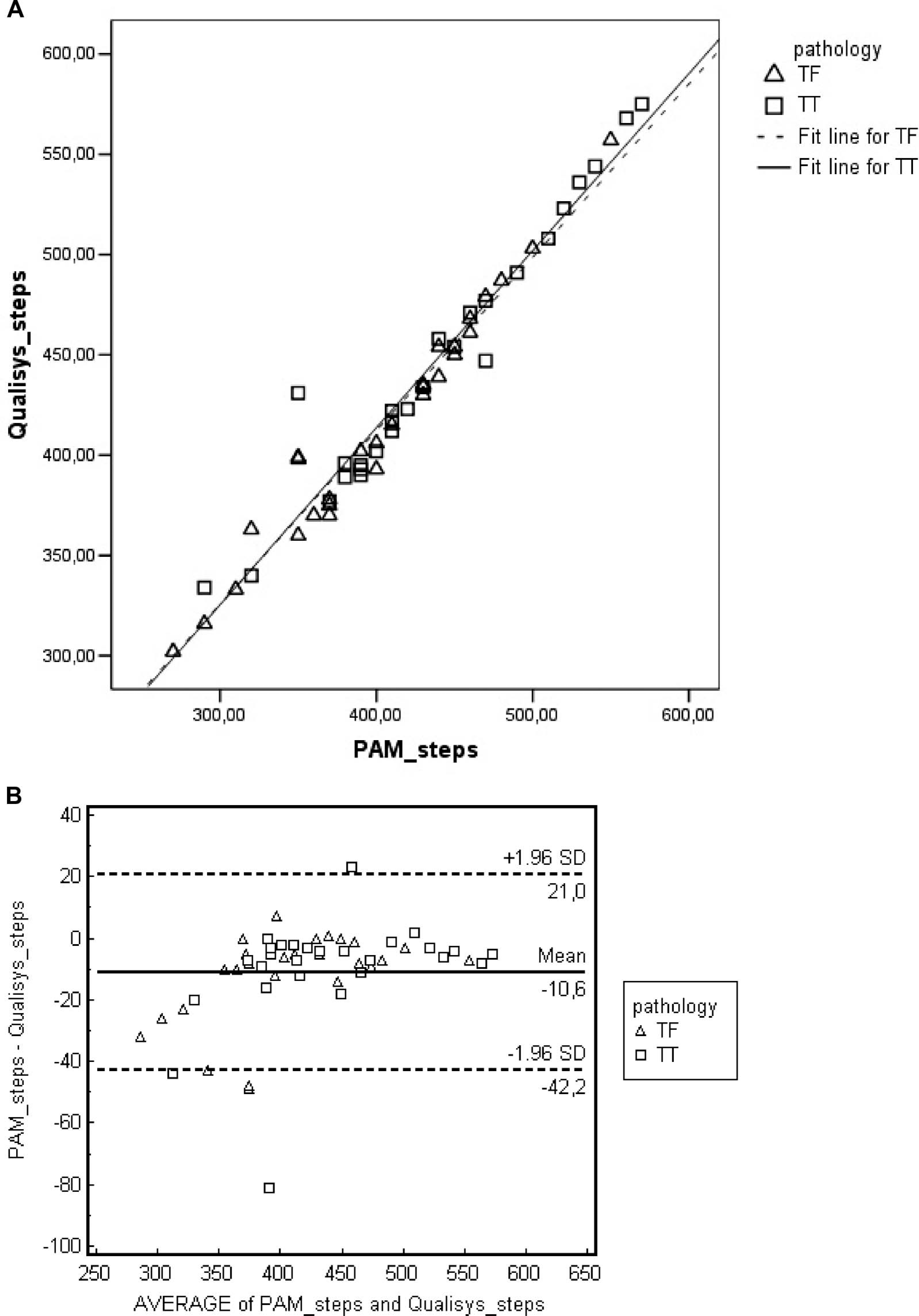
(A) Scatter plot of the number of steps as calculated by PAM versus the number of steps as calculated using the Qualisys motion analysis system; (B) Bland-Altman plot depicting the error scores (PAM-Qualisys). The solid line represents the mean difference and the dashed line represents the 95% confidence interval.
Correlation coefficients presenting combined results from trans-tibial and trans-femoral amputees for the number of steps taken over a 5-minute walking trial.
Walking velocity
The correlation between average walking velocity as recorded by PAM and that which was recorded by the Qualysis motion analysis system was calculated for slow (r = 0.95), medium (r = 0.99) and fast (r = 0.98) walking velocities (Figure 2A). Results indicate a very strong correlation between both methods of determining walking velocity. Again, no difference in correlation coefficient was noted when comparing overall correlation coefficients between trans-femoral and trans-tibial amputees. Correlation coefficients for trans-femoral and trans-tibial amputees were 0.98 and 0.99, respectively. Bland-Altman plots for walking velocity are presented in Figure 2B. The average difference between the two methods was −0.01 with a standard deviation of 0.05. The Bland-Altman limits of agreement were −0.11 to 0.09.
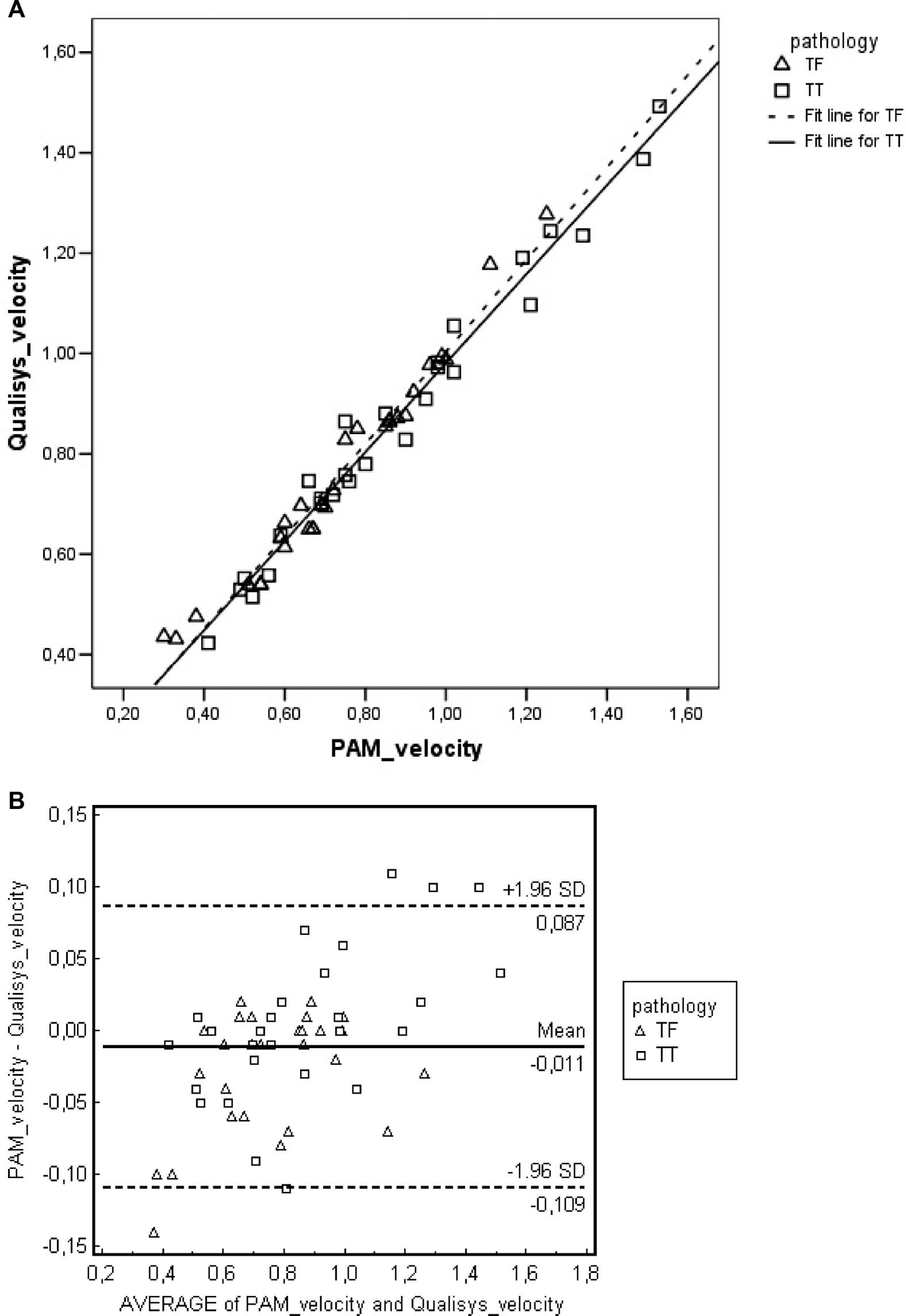
(A) Scatter plot of walking velocity as calculated by PAM versus velocity calculated using the Qualisys motion analysis system; (B) Bland-Altman plot depicting the error scores (PAM-Qualisys). The solid line represents the mean difference and the dashed line represents the 95% confidence interval.
Step length
A scatter plot of step length data is depicted in Figure 3A. Correlation coefficients were very high between the two data collection methods for fast (r = 0.95) and medium (r = 0.95) walking velocities. At the self-selected slow walking velocity, correlation was moderate (r = 0.77). Amputation level appeared to have a slight influence on the ability of the PAM to accurately record measures of step length. Trans-femoral amputees recorded correlation coefficients of 0.93, 0.95 and 0.36 for fast, medium and slow walking velocities respectively while trans-tibial amputees recorded correlation coefficients of 0.98, 0.99 and 0.93. Bland-Altman plots (Figure 3B) indicate that PAM recorded lower values than the Qualisys system when step length was shorter and higher values when step length was longer. The mean average difference was 0.03 (SD 0.05). Bland-Altman limits of agreement were −0.07 to 0.14.
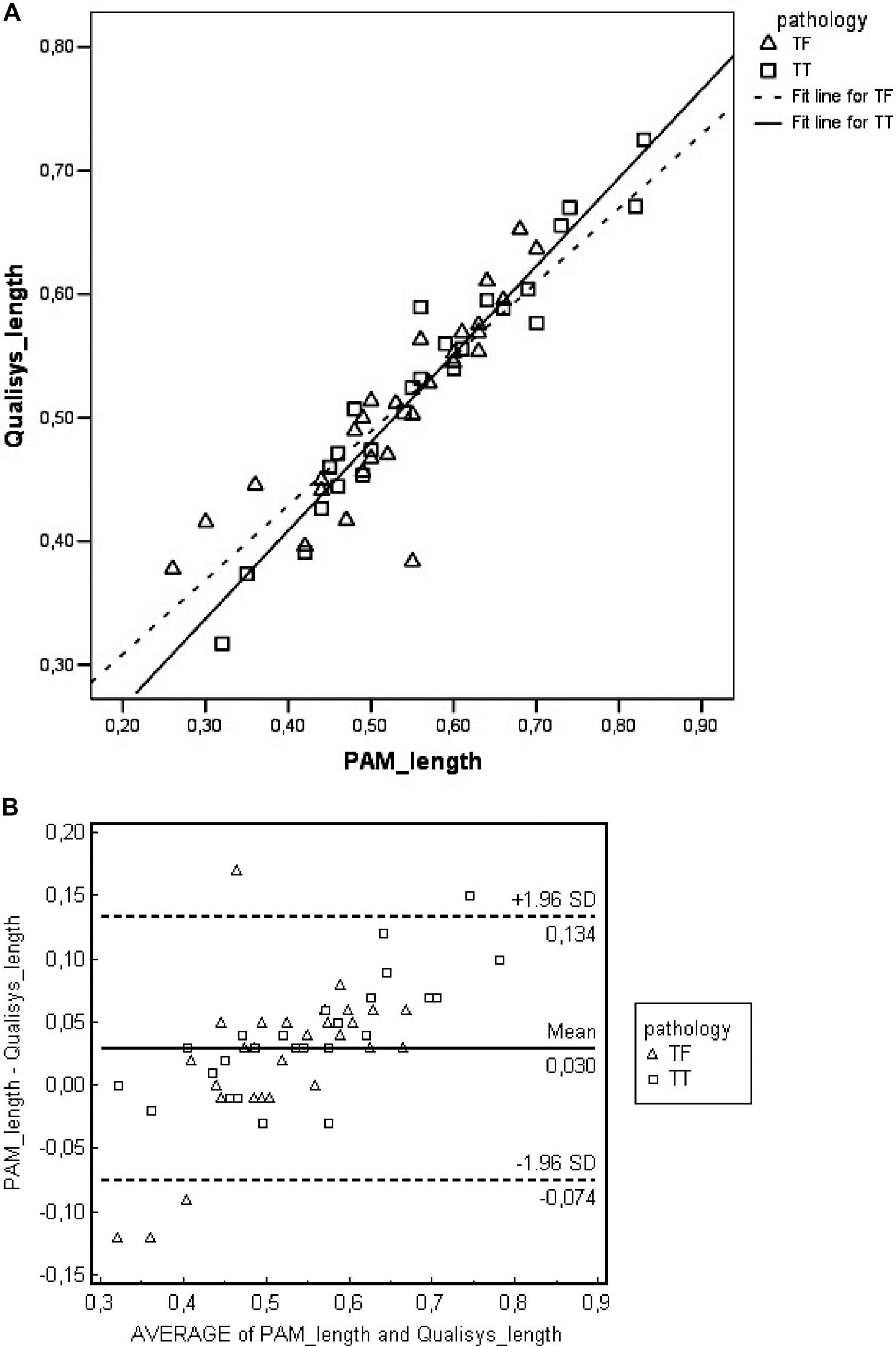
(A) Scatter plot of step length as calculated by PAM versus step length calculated using the Qualisys motion analysis system; (B) Bland-Altman plot depicting the error scores (PAM-Qualisys). The solid line represents the mean difference and the dashed line represents the 95% confidence interval.
Discussion
The present study indicates that the PAM is an acceptable method for measuring walking activity in both trans-tibial and trans-femoral amputees ambulating on a level treadmill. Very high average correlations were achieved when comparing data related to step count, walking velocity and step length between the PAM and a three-dimensional motion analysis system. Some evidence is presented to suggest that the PAM becomes less reliable at slower walking velocities, particularly in the case of trans-femoral amputees. This can be illustrated by analysing the cases in which PAM failed to register any data. Of the nine occasions that PAM failed to register data, five occurred at the self-selected slow walking velocity of five subjects (subjects 2, 4, 5, 6 and 14) while the remaining four cases are accounted for by the fact that no PAM data was registered from any of the walking trials (slow, medium and fast) for two subjects (subjects 4 and 14). Of the five subjects in whom problems were experienced collecting data from PAM, four were trans-femoral amputees while only one was a trans-tibial amputee.
Further evidence that PAM is less reliable at slow walking velocities can be suggested from the correlation coefficients calculated for each of the variables measured. In all cases, the correlation coefficients calculated for self-selected slow walking velocity were lower than those calculated for medium and fast walking. This was particularly the case for measures of step length in trans-femoral amputees.
Results from the present study have significant implications for the use of PAM during the early phases of rehabilitation. During this time an amputee's gait is typically characterized by a reduced step length, reduced walking velocity and a reduced total number of steps taken over a defined period of time. It is clear from the Bland-Altman plots presented in this paper that PAM has a tendency to record an underestimation of each of these variables when they are at their lower range and to overestimate them when they are at the upper range.
It must be recognized that the average self-selected slow walking velocity (0.59 m/s) in this study was lower than the manufactures' recommended minimum of 0.75 m/s. Nevertheless caution should be exercized when considering using the device on amputees who walk at slower velocities. Patients' self-selected walking speeds were lower in the present study than those recorded for trans-tibial amputees walking on level ground by Bussmann et al. (2004). This may be attributed to the fact the self-selected speeds in the present study were determined as subjects walked on a treadmill. It has been demonstrated that accommodation to treadmill walking can be particularly difficult and may not appropriately simulate over-ground walking (Wass et al. 2004). Results are however consistent between both studies in suggesting that PAM was highly accurate in detecting measures of stride count and walking speed.
The findings of this study are encouraging but it is important to consider limitations of the study design. Firstly the investigation was performed on a treadmill with subjects walking on a level surface. It is subsequently not possible to generalize results to naturalistic conditions that amputees would normally be subject to. This includes walking on uneven terrain, slopes and stairs. Clearly the ability of the device to accurately record activity over varying terrain conditions is necessary. These issues have been addressed in part by Bussmann et al. (2004).
A number of variables reported by PAM were not investigated in this study. These include values for the PAM index, idle time, active time, locomotion time, impact (mean peak axial acceleration) and top speed. Further investigation is necessary to determine the validity of these measures if they are to be routinely adopted as outcome measures in the management of amputees.
Finally, it should be recognized that the calculation of step length data from PAM is calculated by dividing stride length by a factor of two. This assumes that the patient is walking symmetrically. One must recognise that, particularly in the case of amputee subjects, this is unlikely to be the case (Nolan 2003).
Conclusion
The PAM has been demonstrated as a promising tool for measuring specific gait parameters in both trans-tibial and trans-femoral amputees. Caution should be exercized when considering using the device on subjects who walk at slower velocities.