






Abstract
Sferics are low frequency, low intensity electromagnetic pulses radiating from distant meteorological events and other yet unknown sources. It has been hypothesized that sferics are part of the purported sensitivity to weather changes reported by headache sufferers. We tested this proposal. Patients (migraine and/or tension headache) enrolled in a randomized clinical trial gave daily headache data (intensity, frequency, duration of headache) for at least 18 weeks. Concurrently, a sferics measurement station in the vicinity of the patients recorded frequency and intensity of sferics. Usable headache data from 21 patients and the corresponding sferics series were subjected to time series analysis applying ARIMA models and then cross-correlated. We found significant and consistent cross-correlations of moderate size at lag 0 in one patient between ARIMA-filtered headache intensity and frequency (r = 0.18) and amplitude of sferics (r = 0.20). We conclude that in an unselected sample of headache patients some may indeed be susceptible to the low intensity type of electromagnetic radiation exemplified by sferics pulses. This phenomenon warrants further scrutiny.
Introduction
Sensitivity to meteorological changes is reported by 30–78% of headache patients (1–3). Recent reports have drawn attention to the electromagnetic consequences of the meteorological processes, the so called ‘atmospherics’ or ‘sferics’ (3–9). Sferics are electromagnetic impulses of very short duration (500 μs) and low intensity (below some 100 nT). They are of very low frequency (VLF range, 1–100 kHz) and exhibit an frequency maximum around 10 kHz. It is only partially clear what meteorological situations are causal for sferics. They are generated by electric discharges, mainly during thunderstorms (lightning) and similar meteorological situations in the atmosphere.
Sferics show an extremely long range and, due to ionospheric reflection, may travel thousands of kilometres around the earth. For this reason local numbers of sferics pulses may be substantial even in the absence of regional thunderstorm conditions. The magnetic component of sferics penetrates into buildings and into the human body; under any practical circumstances shielding is virtually impossible. For this reason interaction with human cells or membranes does occur though the involved field energy is exceedingly small. At any location sferics pulses arrive from all directions, depending on where most prominent thunderstorm conditions develop. Many different sources contribute to the total local intensity, therefore one observes large daily and seasonal variations.
It has been hypothesized that in patients with headaches it could be sferics which are the relevant triggering factor (4, 5). The basic idea behind this could be that of an evolutionary relic. For our ancestors it could have been of immense evolutionary advantage to be able to tell in advance when bad weather or thunderstorms were approaching. Thus, the meteorological sensitivity of headache patients might be a fossilized sensitivity of those patients to atmospheric electric changes, which once was useful, but now is of only marginal importance. It is important to note that a possible influence of the non-ionizing radiation must be strictly non-thermal because the transmitted pulse-energy is many orders of magnitude too low to induce thermal effects.
Several authors have hypothesized that it is the electromagnetic change which goes together with weather changes that affect headache patients. Two most recent experimental studies could show some support for this hypothesis (3, 9). In the first study artificial sferics simulating medium-distance thunderstorms were produced (the apparatus is described in 10) and the influence of the these sferics was tested on the alpha band of the EEG in the parietal and occipital area of the brain of volunteers. While healthy volunteers did not show any EEG abnormalities, some changes could be observed in 32 women with self-reported weather-sensitive headaches. The alpha band showed changes in 10 of 30 locations, and the beta band in four of 24 comparisons. The effects are rather weak but they give a hint that sferics may influence the EEG.
There are many other earlier reports of the influence of sferics on diseases (6–8, 11). Both the data basis and the measurement apparatus for sferics in these studies, however, were far from perfect. A recent literature survey may be found in Schienle et al. (1998) (12). In an impressive number of the referenced articles the authors claim correlations between sferics and effects in human subjects, animals and various cells. The amount of reported information supports the assumption that sferics are biologically effective though causal connections have not yet been identified.
Thus, the review of the literature suggests in particular that there might be a possibility for electromagnetic impulses in triggering of headaches. We set out to test this hypothesis by correlating measurements of time series of sferics impulses with daily headache data gathered in the context of a clinical trial.
Methods
The headache data were collected in the framework of a randomized controlled trial of homeopathy in chronic headaches reported elsewhere (13). Briefly, 98 patients were randomized to either receive classical individualized homeopathic medication or placebo for 12 weeks after having noted their daily occurrence of headache in a headache diary for 6 weeks. Thus, for all these patients at least 18 weeks of daily headache data were available, for most of them even more, since the baseline was usually longer than 6 weeks, as was the treatment period. Moreover, 19 patients had taken the opportunity of receiving free treatment for giving more data. These patients had provided data for a 1-year period. In the headache diary patients noted occurrence, intensity and duration of headaches on a daily basis, usually in the evening. We utilized the data of those 21 patients whose recording of headache data fell into the period of normal working order of the sferics station and was long enough to meaningfully calculate time-series analysis (i.e. more than 100 data points). All of the patients had either migraine or chronic tension-type headaches and most of them had both. The median frequency of headaches was three times per week and the self-reported median duration was more than 8 h headache per day. Patients had been headache sufferers for 23 years on average. Thus, the sample is representative of headache patients as seen in many intervention trials for migraine or headaches.
The sferics data were collected by the sferics measurement station operated by the Physics Department of the University of Munich (14). This station had started its routine measurement just after the clinical trial had started in the vicinity of Munich. This measurement station records number, amplitude and frequency distribution of sferics arriving in the Munich area. Since these sferics were representative for the locations where the patients lived during the study and the data had been measured continuously it could be utilized after it had been aggregated and brought into a format compatible with the daily measurement of headaches. This was achieved by summing or averaging the sferics impulses of one 24-h cycle from 24.00 to 24.00. Thus, for each day we had the sum of sferics impulses and the mean sferics intensity. The measurement of sferics was available for the entire period during which the 21 patients had been treated within the headache study. Thus, the following analysis comprises the data of 21 patients correlated with intensity and frequency of sferics.
Statistics
All statistical calculations were run with Statistica (version 5 for Windows). We used ARIMA-analysis in order to reduce dependencies in the time series (15–22). Since time series are very often correlated, these autocorrelations or dependencies of a time series with itself tend to inflate correlations with other series. ARIMA-modelling can be used to filter out these autocorrelative dependencies. Ideally, the residual time series are then uncorrelated and can be used for cross-correlations. We used intensity of headaches of 21 subjects as a continuous variable. For ARIMA-analysis the single time series were inspected for significant autocorrelations or moving average processes by identifying appropriate ARIMA models. The models were then applied to the single time series, and thus the dependency filtered out of the data. The filtered residual time series were then used for cross-correlations with sferics data. In case there were dependencies also in the sferics series, the ARIMA-analysis was also applied to this time series. In cross-correlations two time series are correlated, whereby one series is being lagged by 1, 2, or more days. Thus, the number of negative lags means the number of days a time series is being shifted. A significant cross-correlation with lag 1 can be interpreted as one series being correlated to the other series after one unit (in this case 1 day), while a significant cross-correlation at lag 0 would indicate a significant simultaneous correlation. Since sferics travel with the speed of light we would expect either unlagged correlations or correlations with lag 1 at the most.
Results
For 11 of the 21 subjects headache intensity and sferics were uncorrelated. There were neither correlations between time lagged series of headache intensity and number of sferics, nor between headache intensity and sferics amplitude. In four more subjects we saw correlations with positive lag, which means that headache preceded the sferics. The lags were found between lag 1 and lag 6, that is to say there were up to 6 days time lag between sferics and headaches. Since for theoretical reasons it is not plausible to suppose that headaches precede the occurrence of sferics we did not regard these results as meaningful. In six other subjects we found significant correlations between a negative lag of sferics and headache intensity. Table 1 gives the magnitude of significant cross-correlations as well as the lags in brackets.
Significant correlations between number and amplitude of sferics and headache intensity with negative lag; all time series filtered by ARIMA-analysis

Results of cross-correlations are given for filtered and unfiltered sferics series. Series of headache intensity are always filtered, if dependencies were identified. nd = no dependencies in this sferics series.
It is immediately obvious that the correlations of the filtered time series cross-correlations are rather weak and that the lags are usually substantially negative. With three of the six subjects there are also significant correlations at 1 or more positive lags. Here we suspect that the significant correlations in the series cross-correlations are a result of residual dependencies that were not filtered out completely by the ARIMA-analysis. Although this analysis ideally filters out autocorrelations of the time series, this process is never perfect, because theoretical models rarely fit the empirical data exactly. Instead, the process of finding an appropriate model is in most cases a compromise between fitting a significant model and fitting a model with as few parameters as possible. Thus, in practice although a significant ARIMA-model can be identified which models the time series reasonably well, some residual correlations may still remain in the time series, which are apt to inflate correlations or lead to artificial cross-correlations. Therefore, theoretical reasoning has to be used as well in order to understand the results.
There is one subject (#129 in Table 1) who shows consistent effects across amplitude and number of sferics, and shows these correlations at lag 0, which means that sferics and headaches occur fairly simultaneously. Data of these cross-correlations are shown in Figs 1 and 2.
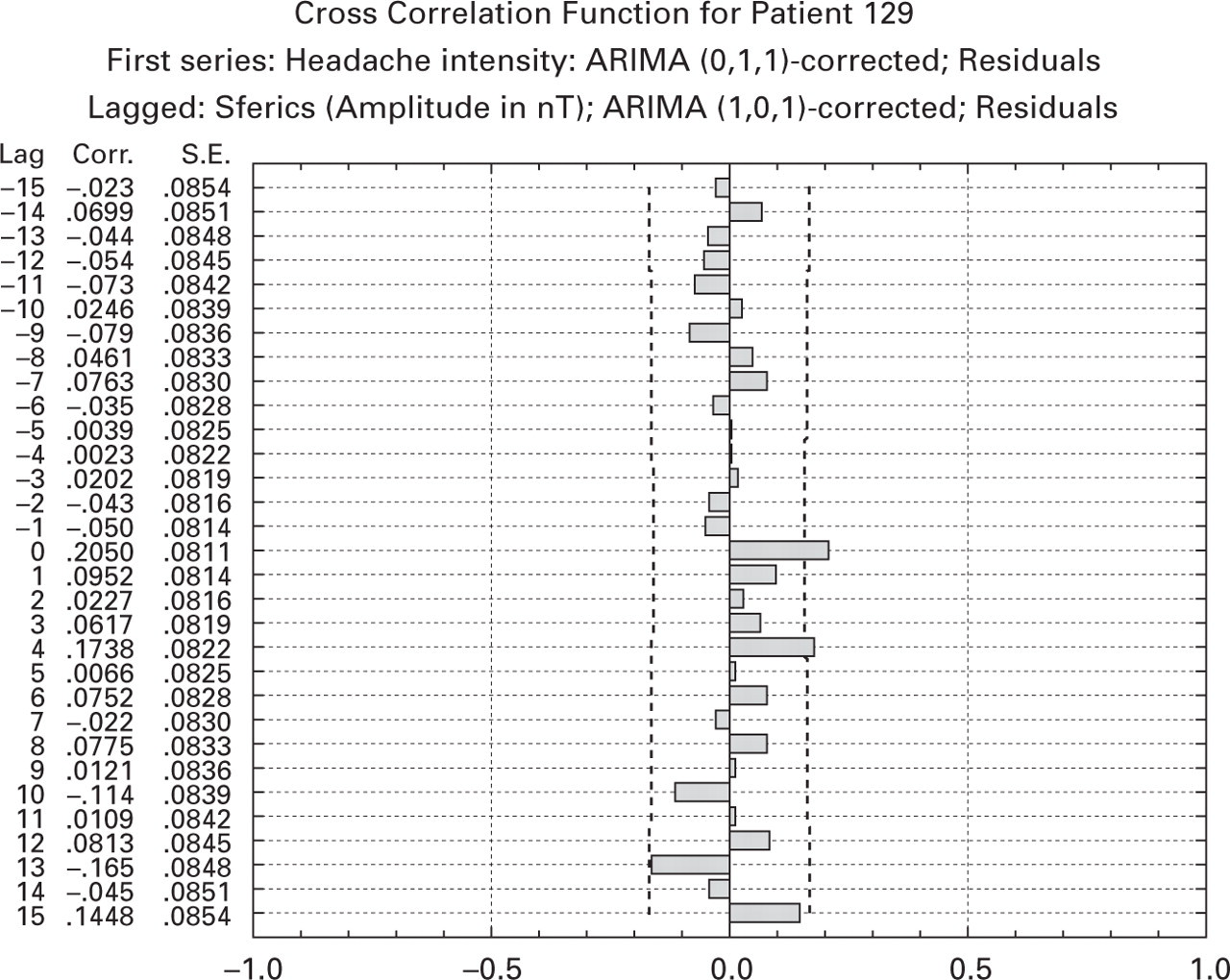
Cross-correlation between residual series of headache intensity and sferics amplitude in patient 129 significant at lag 0. Lag = number of days sferics data are being lagged behind (negative sign) or forward of headache data; Corr. = numerical value of correlation coefficient at that lag;

Cross-correlation between residual series of headache duration and sferics number in patient 129 at lag 0. Lag = number of days sferics data are being lagged behind (negative sign) or forward of headache data; Corr. = numerical value of correlation coefficient at that lag;
For subject 114 the time lag is very large, in subject 141 the time lag is inconsistent for intensity and amplitude of sferics. Correlations for the remaining subjects are also positive, albeit with a large lag. Subject 174 was the only one with a negative correlation, which is counterintuitive. Thus, only subject 129 showed not only a significant cross-correlation but also a consistent pattern. We also calculated cross-correlations of amplitude and number of sferics with headache duration as the second continuous variable. There is one more significant correlation (r = 0.301). The correlation can only be seen between frequency of sferics and headache duration.
Thus, a conservative estimate is that one out of 21 patients, or roughly 5% (standard error 4.65, 95% confidence interval 0–13.8%) are subject to possible influences of low frequency and low intensity electromagnetic impulses as represented by sferics.
Discussion
We report a secondary analysis of data collected within the framework of a controlled clinical trial, and the initial data of a sferics measurement station. The measurement of the headache parameters certainly fulfils the criteria of state of the art headache measurement, i.e. the data were collected daily, frequency, intensity and duration of headaches was monitored and measurement was continued for a rather long baseline period and over 12 weeks of treatment at least. Nevertheless, the data had not been collected with respect to a later correlation with sferics data. This idea only occurred to us after we had learned of the simultaneous operation of the sferics measurement station in Munich. Thus, the study is rather ad-hoc. This certainly is a limiting factor. The sferics station on the other hand has been built as a state of the art measurement device. It is sufficiently sensitive and sufficiently stable.
Although we used data from the initial period of the project, it was not data from calibration measurement, but routine measurement data. The only shortcoming of this measurement was that it does not comprise frequency bands, but only intensity and amplitude data.
Against this methodological background it is worthwhile noting that one out of 21 subjects shows a clear-cut and interpretable cross-correlation pattern between the occurrence of headaches and the occurrence of sferics. In this patient we can see both significant correlations of a moderate size and a correlation between all sferics parameters and all headache parameters. This significant correlation at lag 0 points to the fact that sferics and headaches occur rather simultaneously.
Sferics are meteorological events that happen at large distances and travel at the speed of light. Thus, if sferics are indeed meaningful, we would expect a correlation at lag 0 or lag 1 at the most. This happens in one out of 21 of the time series studied. Although there are a couple of other significant correlations, we tend to dismiss these correlations as artifactual for theoretical and practical reasons. The theoretical reasons are that these significant correlations occur at large lags, which do not seem to be meaningful, and that there is no consistent pattern in the correlations. That is to say they either occur only with one of the parameters, they are negative or they are even positive, which would mean that headaches are precursors of sferics, which is not plausible. The pragmatic reasons are that we can never exclude residual dependencies in time series data, that is, autocorrelations which tend to inflate correlations or lead to false positive correlations (see Statistics). Although we exacted great care in removing dependencies from the data by applying ARIMA-analysis, it is known that this analysis is never perfect (23). It involves an iterative process of model identification and testing, with the aim to explain dependencies with the most parsimonious model. The conflict between parsimony and residual dependency, avoiding over-parametrization, may leave some dependency or seasonal trends untouched, such that ARIMA-analysis is not a perfect tool. Thus, residual dependencies might have remained in the data and inflated correlations. Therefore we are adopting a conservative attitude and would like to interpret only those correlations which are meaningful, consistent and make sense theoretically.
We tried to not fit overly complex models to the data. We mostly identified auto-regressive or moving-average processes of the first order. Thus, the models fitted to the data are not complex, and thus no overestimation of parameters should have occurred. The fact that still so many significant but theoretically not meaningful correlations occur points to the fact that time series analysis is not perfect in filtering dependencies out of time series data. However, by applying the criteria of consistency and meaningful lag it is easy to identify those time series which cannot be squared with the sferics data.
We decided retrospectively to study the influence of sferics on headache occurrence, when all data were already taken. Therefore we had no measure of weather sensitivity either as self-report or as a validated measure, since we had not thought of that in the first place. Had we worked with subjects who self-reportedly are weather-sensitive, we could have received a higher percentage of significant correlations. Thus, our data seem to us a fairly robust estimate of the importance of sferics sensitivity in headache patients. One out of 21 patients is likely to be sensitive to those electromagnetic impulses. Due to the small sample size the confidence interval is rather large (0–13.8%) and we cannot exclude that our findings are due to chance fluctuation. However, the number of susceptible patients might also be considerably higher than 5%. Considering our conservative approach of only interpreting meaningful correlations, of reducing artifactual correlations by time-series filtering, and of applying the criterion of consistency, it is unlikely that this robust correlation is just a chance finding. One should bear in mind that cross-correlational analysis is a single case approach, and the power of the correlational analysis is given by the number of time points which are used to calculate the cross-correlation. These were large in our case and well above 140. Thus, the standard errors used to estimate the significances of the correlations were rather small and power for the single case analysis was strong. The findings of the significant cross-correlations as such can hardly be debated. What remains an open question is the precise epidemiological quantification of the incidence. This would have to be researched in a larger sample. Our question was rather a question of whether there is a cross-correlation between sferics and headaches at all. The answer is that in some patients indeed there is such a correlation. Precisely in how many patients is difficult to answer with our data set: anything between 0% and 13.6% of patients might be the true proportion.
If we look at the amount of electromagnetic radiation brought into the environment by various electric devices, such as mobile phones, computers or other everyday applications, it might be of clinical importance that some headache patients could potentially be sensitive to these electromagnetic radiations. At least our data warrant a further exploration of the field, which should be more specific. Headache data should be taken more frequently so as to allow for a more fine-grained correlation between meteorological events and headache, patients should be potentially sensitive, and sample sizes larger.
Apart from that it could be interesting to look for specific frequency bands. Other research has shown that living organisms are usually only susceptible to electromagnetic radiation within a very narrow window of frequency bands (24, 25). We could not discriminate between bands with our measuring device. It would be worthwhile to do this in future studies.
Thus, we are confident to conclude that electromagnetic sensitivity to sferics might be an important factor at least in some headache patients and might be even more important for so called ‘weather-sensitive patients’. This certainly warrants further investigation.
Footnotes
Acknowledgements
The study reported here was sponsored by the Robert-Bosch-Foundation. The sferics measurement equipment and the evaluation of the sferics data were funded by the Institut für Grenzgebiete der Psychologie (IGPP), Freiburg. The authors are grateful to Mr Gerl for compiling the sferics data.