




Background and Purpose
Microglial function is a double edged sword. Under normal circumstances, it supplies neurons with trophic factors, contributes to the rearrangement of neural connections and plasticity of normal brain tissue. But after stroke, microglia are activated and may potentiate ischemic injury. Blood-brain barrier (BBB) disruption can complicate stroke due to edema and hemorrhage. Minocycline is a semisynthetic second-generation tetracycline known to inhibit microglial activation. In this study, we examined the influence of microglia on blood brain barrier (BBB) components and whether this could be reversed by minocycline treatment.
Methods
In vitro, neocortical astrocytes (G), endothelial cells (E) and microglia (M) were isolated from postnatal Swiss Webster mice. Primary EG or EGM mixed cultures were prepared. Cultures were subjected to oxygen & glucose deprivation followed by reperfusion. In vivo, 28 C57BL/6J male mice (25∼30 grams) were subjected to 1.5 h middle cerebral artery occlusion followed by 22.5 h reperfusion. Mice were treated with minocycline (Mi) (n=16) or vehicle (n=12).
Results
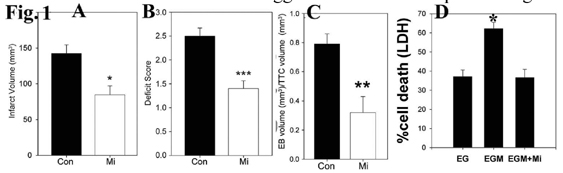
When microglia were added to cocultures, cell death nearly doubled compared to cocultures lacking microglia (*P<0. 01). The increase in cell death in the presence of microglia could be reversed by minocycline (*P<0.05) (Fig 1D). Infarct volume (Figure 1A, *P<0.01), Evans blue extravasation (Figure 1C, **P<0.001) and neurological deficit scores (***P<0.001, Figure 1B) decreased significantly in the minocycline treated mice compared with the vehicle treated group. Minocycline also prevented the occurrence of gross cerebral hemorrhage (P<0.05). Fewer microglia and MHC Class II positive cells were found within the penumbra in minocycline treated mice (P<0.001, P<0.05, respectively).
Conclusions
Minocycline can reduce BBB disruption and decrease injury to BBB components after ischemia by inhibiting microglial function and activation. This suggests a novel therapeutic target for stroke treatment.