






Abstract
Objective
The purpose of this study was to determine the effects of different inspired oxygen fractions (Fi
Methods
Eight physically active subjects (aged 33.62 ± 4.07 years; height, 1.77 ± 0.05 m; weight, 74.38 ± 6.86 kg) completed a Bosco jump test, consisting of a series of 15-second “all-out” jumps with 3 minutes of recovery, performed in a normoxia condition (N [Fi
Results
The average power outputs throughout the entire sets were similar between N (3187 ± 46) and MH (3184 ± 15; P > .05), but slightly greater with HH (3285 ± 43) compared with N (P < .05). Values for lactate during N (7.5 ± 3.0), MH (7.7 ± 4.0), and HH (7.9 ± 3.0; P > .05), and for creatine kinase (values before, 69.8 ± 15; and 24 hours after in N [79.4 ± 15.60], MH [85.2 ± 26.7], and HH [84.3 ± 47.2]; P > .05) were similar for all conditions. Only during exercise in hypoxia were moderate and severe hypoxemia induced as the sets increased and Fi
Conclusions
Jumping power output was not negatively affected by mild or high hypoxia in comparison with normoxia during an anaerobic workout despite having higher hypoxemia and a greater perception of exertion.
Keywords
Introduction
Explosive-strength (ES) training is a common type of strength training used in sport to improve particularly the specific neural adaptations of muscles. 1 Testing ES performance has also been used traditionally as an indicator of improved neuromuscular characteristics and anaerobic performance. 1 Explosive strength can be determined by measuring the power output generated during consecutive jumps, according to the well-established Bosco test for anaerobic performance. 2
Physical responses of athletes to hypoxia have been extensively studied, but the way in which hypoxia may improve aerobic or anaerobic performance remains inconclusive.
3
Although exercise in hypoxia has been shown to be associated with a reduction in maximal oxygen uptake (V
However, few reports have addressed decreases in maximal power output during anaerobic exercises under hypoxia to 12% FiO2. 6 Indeed, some studies have recently reinforced this idea, showing significantly higher anaerobic performance after short programs (eg, 12 sessions over 4 weeks) in a regimen of anaerobic exercise when compared with equal sea level training.7,8 Under this premise, it could be hypothesized that a workout program combining ES training with hypoxia, which would increase the training stimulus for anaerobic metabolism, 3 would lead to greater performance improvement than exercising at the same intensity in normoxia. One prerequisite, however, would be that during such training regimens (anaerobic training), the same absolute work intensity can be maintained in hypoxia as in normoxia.
The present study sought to investigate whether differing levels of inspired Fi
Methods
Participants
Eight physically active men (aged 33.6 ± 4.1 years; height, 1.77 ± 0.05 m; body mass, 74.4 ± 6.9 kg) who were nonsmokers and unfamiliar with these workout methods participated in the study. They were informed about the aims of the study, possible risks, and side effects. The study was carried out in accordance with the ethical standards laid down in the 2008 Declaration of Helsinki, and it was approved by the Bioethics Committee of the University of Innsbruck.
Experimental Design
A series of 6 consecutive jumps, lasting for 15 seconds with an intervening rest period of 3 minutes, was performed under different Fi
Subjects were advised not to consume any kind of food or drink during the 90-minute period before the test. They were not allowed to perform any physical activity 24 hours before the first session or during the study. The duration of the 3-session test under the different experimental conditions did not exceed 35 minutes. Sessions were performed in a random order at the same time of day, separated by at least 72 hours. Participants were unaware of the simulated altitude at which they exercised. Before each test, subjects performed the same warm-up protocol consisting of 10 minutes of running at 65% of the maximal individual heart rate and stretching for 5 more minutes. During the exercise tests, all subjects wore the same model of shoe (Adidas weightlifting training). Furthermore, a modified CR10 Borg fatigue scale was used as a sensitive method to measure the perceived exertion and fatigue of the subjects immediately after completion of the workout and again at 24 hours afterward. The Borg fatigue scale is a category-ratio scale for most subjective magnitudes that can be used to measure perceived exertion and pain.
Procedures
A hypoxicator (b-cat HA6500M, Tien, the Netherlands) was used to produce simulated altitude conditions by control of oxygen content. Hypoxia was applied by face mask, and the degree of hypoxia was controlled with Draeger MultiWarn II (Sd 8313300, Lübeck, Germany). Fingertip capillary blood samples were obtained from each subject only 4 minutes after finishing the exercise to determine blood lactate concentrations (Biosen C-Line, EFK Diagnostik, Frankfurt, Germany). At 24 hours before and after the training sessions, creatine kinase (CK) activity was determined (Refloton Sprint, Boehringer, Mannheim, Germany), providing a basal value (24 hours before) and a measurement of the state of muscle tissue damage after the workout.
9
A force platform device (type 9865 C, Kistler, Wien, Austria) with MLD 3.2 software (Sp Sport Mukel-Leistungs-Diagnose 3.2, Wien, Austria) was used to analyze the maximal and average power generated during the jump tests. The ES performance was expressed in watts (W). During the 30 seconds immediately after each set, the arterial oxygen saturation (Sa
Statistical Analysis
Data analyses were performed by means of the statistical software Sigmaplot (version 11, SYSTAT Software, San Jose, CA). After testing for normal distribution (Shapiro-Wilk), paired Student’s t tests were used to compare values of CK, lactate, Borg fatigue scale, and Sa
Results
Creatine Kinase, Lactate, and Arterial Oxygen Saturation Values
Neither the CK values at 24 hours after exercise (N, 79.4 ± 15.6 U/L; MH, 85.1 ± 26.6 U/L; and HH, 84.2 ± 47.1 U/L; P > .05) nor the maximal lactate concentration at the completion of each workout (N, 7.5 ± 3.0 mmol/L; MH, 7.6 ± 4.0 mmol/L; and HH, 7.9 ± 2.9 mmol/L; P > .05) differed among hypoxia and normoxia conditions in comparison with CK prevalues (69.8 ± 15). Disregarding the hypoxia level, Sa
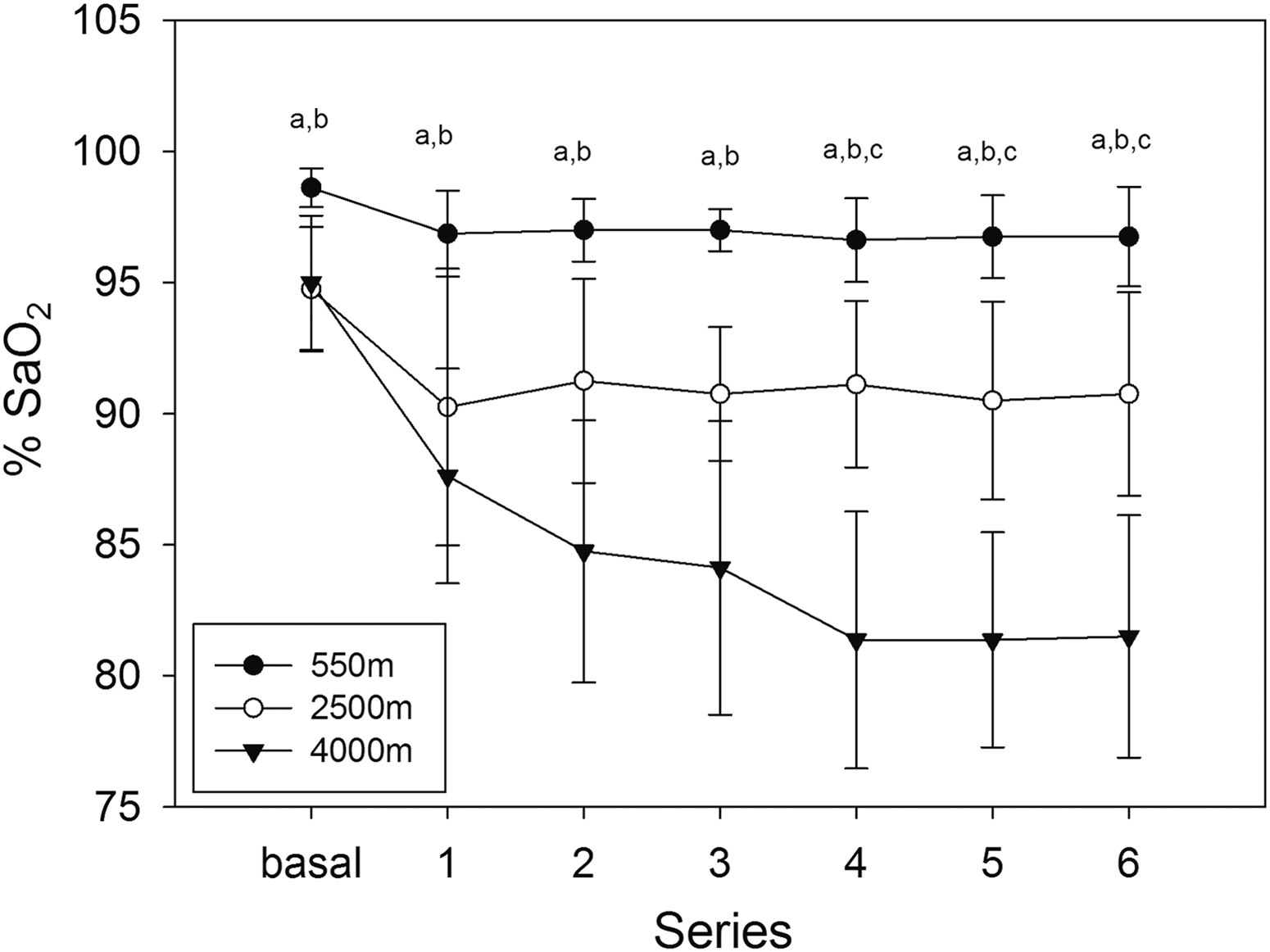
Oxygen saturation (Sa
Exercise-Related MEASUREMENTS
The average power generated during the entire workout (6 sets) indicates the mean power generated for each subject in each set and did not statistically differ when comparing N and MH (3187 ± 46 W vs 3184 ± 15 W; P = .82). However, differences in mean power output were found between N and HH (3187 ± 46 W vs 3285 ± 43 W; P < .001). The average power output at the different conditions for the 6 sets of each test is shown in Figure 2. The peak power reached in each set calculated individually shows that the maximal power generated for each subject in each set did not differ among the 3 conditions. The average of the peak power generated during the 6 sets was similar for N (3196 ± 761.4 W), MH (3228 ± 704 W), and HH (3306 ± 735.7 W). At the same time, as can be seen in Figure 3, no significant differences were detected among the first set and the last set of the exercise test under all conditions. Of note, the values selected from the modified Borg fatigue scale showed statistically significant differences only when the HH level was compared with N (N, 7.1 ± 1.9; MH, 8.1 ± 1.4; and HH, 8.9 ± 2.1; P < .05).
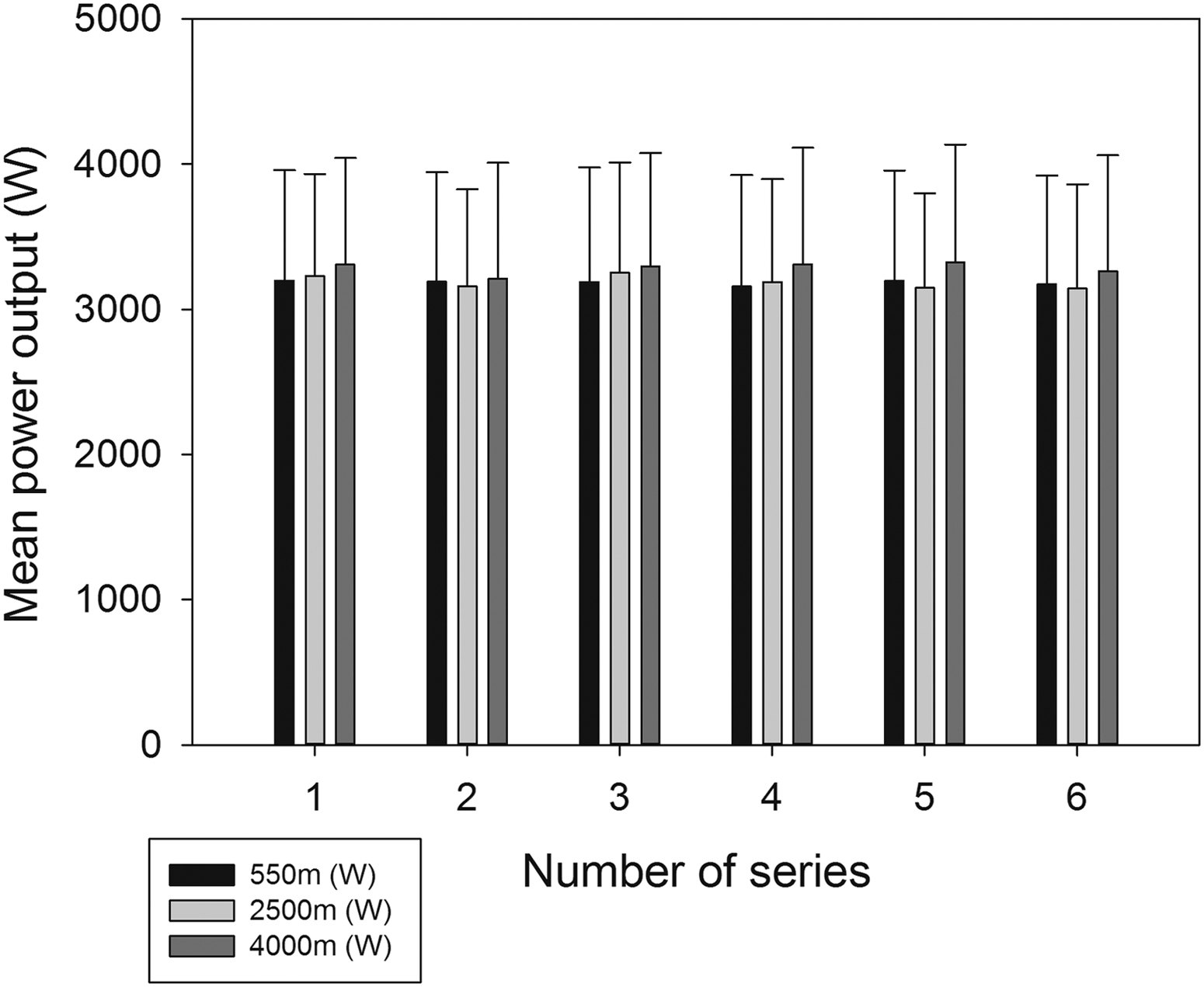
Average power output in watts (W) during each of 6 sets under different conditions: normoxia; simulated moderate altitude (16.5% Fi
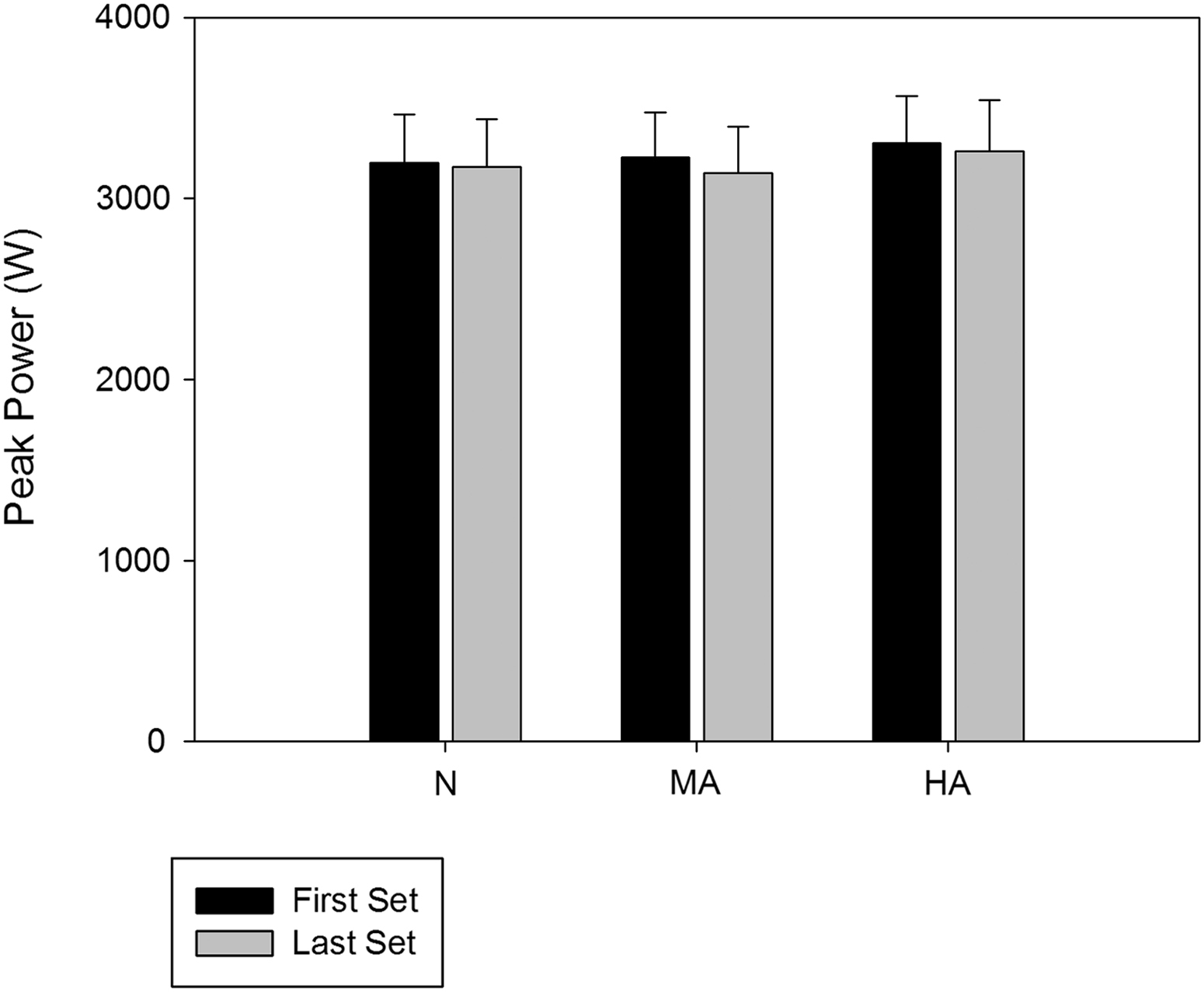
Average peak power in watts (W) performed by subjects during first set (black bars) and last set (gray bars) under different normobaric conditions: normoxia (N); simulated moderate altitude (MA [16.5% Fi
Discussion
The main finding of this study was that neither mild hypoxia nor high hypoxia negatively affected the capacity to generate anaerobic power output during sets of consecutive jumps in comparison with normoxia. However, subjects exercising in hypoxia reached a greater hypoxemia and perceived exertion as Fi
Subjects were able to maintain both average and peak power output during exercise in hypoxia throughout the sets (Figures 2 and 3). These results confirm and extend the observations of previous studies applying anaerobic exercise in hypoxic conditions (Wingate test,4,5 running,
10
jumping,
7
and repeated sprint performance6,8). The efficiency of training in hypoxia should make it possible to maintain the same absolute workload as during exercise in normoxia. All-out exercises in hypoxia conditions largely demand anaerobic energy sources to compensate for the reduction in aerobic ATP production to maintain exercise intensity. Apparently, the reduction in aerobic ATP production during anaerobic exercises in hypoxia is largely compensated through the anaerobic metabolism to maintain the exercise intensity. Thus, Friedmann et al
10
reported significant decreases in
Previous studies have speculated that a reduction in the oxygen availability during high-intensity intermittent exercise in hypoxia results in a higher accumulation of blood lactate
4
due to the greater participation of anaerobic metabolism. In our study, however, after maximal effort at different Fi
Another notable finding of this study was that, despite the significant declines observed in Sa
It could be speculated that in already well trained athletes, who require a specific, supramaximal exercise stimulus, the addition of hypoxia to an anaerobic exercise regimen could lead to muscular and metabolic stimulus that cannot be attained with training alone. This issue has been recently investigated through short programs of high-intensity intermittent training in hypoxia showing a greater anaerobic performance in comparison with the same protocol performed in normoxia.7,8
Conclusion
The present study showed that average and peak power output during ES training was not negatively affected by different hypoxia levels, but it did slightly increase at high hypoxia. Performing such a training regimen could improve the adaptations of anaerobic metabolism, as has recently been reported. Additionally, it may be speculated that lower training volumes could be enough to obtain similar adaptations when compared with training in normoxia. However, further studies are needed to confirm these conclusions.
As for practical applications, many sports demand high anaerobic power outputs, and improving this capacity is highly desirable for these athletes. Therefore, this type of training could be helpful for already well trained athletes to increase their training stimulus, and consequently, their training adaptation.