






Abstract
Hunter-game animal conflicts are occasionally reported from various parts of the world. This case series comprises all 7 game animal attacks on hunters reported to the Croatian Hunting Association over a period of 13 years (1999–2011), covering the entire Croatian territorial area. Seasonally, attacks occurred most frequently in the winter time, when the hunting season is at its peak. The most common attacking animal, representing 5 of 7 cases (71.4%), was the wild boar, and the majority of the attacks happened in the morning. All of our victims were male, with an average age of 51 years (range 26 to 69 years). Six victims sustained a bite wound or wounds and 1 was rammed by the animal. Almost all of our patients (5 of 7, with one unknown) recovered completely and without significant complications.
Introduction
The interaction between humans in general and wild animals has increased in recent times all over the world, mainly because of the geographic overlap of natural and traditional animal habitats with the increasing and spreading human population. Attacks on humans by game animals causing injuries are not uncommon in rural and forested areas, and there are also numerous reports of human fatalities in such encounters. 1 –11 Wild animal injuries inflicted on humans are mostly to soft tissues and organs. The injury mechanisms may include biting, tearing, cutting, penetrating, and crushing; these injuries may be further combined with falls caused by tackling or simply very intense animal forces causing blunt trauma.12,13
Croatia is a part of the Balkan Peninsula and thus a part of the Mediterranean basin, one of the world’s 25 biodiversity hotspots, 14 inhabited by several potentially dangerous game animals. Hunting in Croatia has throughout history been traditionally very important and remains ubiquitous. Hunters are at the greatest risk of being attacked by game animals as they usually have more contact with them than the rest of the population. 15 The aim of this study was to investigate the patterns of game animal attacks and injuries on hunters over a 13-year period.
Methods
The study was carried out over the entire Croatian territory, which is located between 46°33' and 42°23' northern latitude and 13°30' and 19°27' eastern longitude, with a total surface area of 56,542 km2 and a population size of 4,290,612. 16 We analyzed a total of 7 cases of game animal attacks on hunters over the 13-year period (1999–2011) that were reported to the Croatian Hunting Association (CHA). The data were collected from hunting records, a useful tool for evaluating trends in game animal impact, 17 with great precision and covering the whole country. We also reviewed medical records that were filed together with the insurance claims to the CHA. Verification of all animals attack in the study with regard to the game species and the injury status was carried out by government officials from the CHA. For each case, we extracted the following information: 1) species of the game animal, 2) date and time of the attack, 3) the geographic location of the attack, 4) the type of injury, 5) treatment, and (6) medical outcome.
Results
During the study period, hunting conditions have not changed but the number of hunters has slightly increased (Figure). The attacking animals were a wild boar (Sus scrofa) in 5 cases (71.4%), a brown bear (Ursus arctos arctos) in 1 case (14.3%), and a roe deer (Capreolus capreolus) in 1 case (14.3%). Seasonally, attacks occurred most often in the winter months (71.4% in November), when hunting season is at its peak. All victims were male; they ranged in age at the time of attack from 26 to 69 years, with an average of 51 years (Table). Six of the 7 men were hunters who were attacked during the hunt, and 1 was a gamekeeper attacked during his tour of the hunting ground.
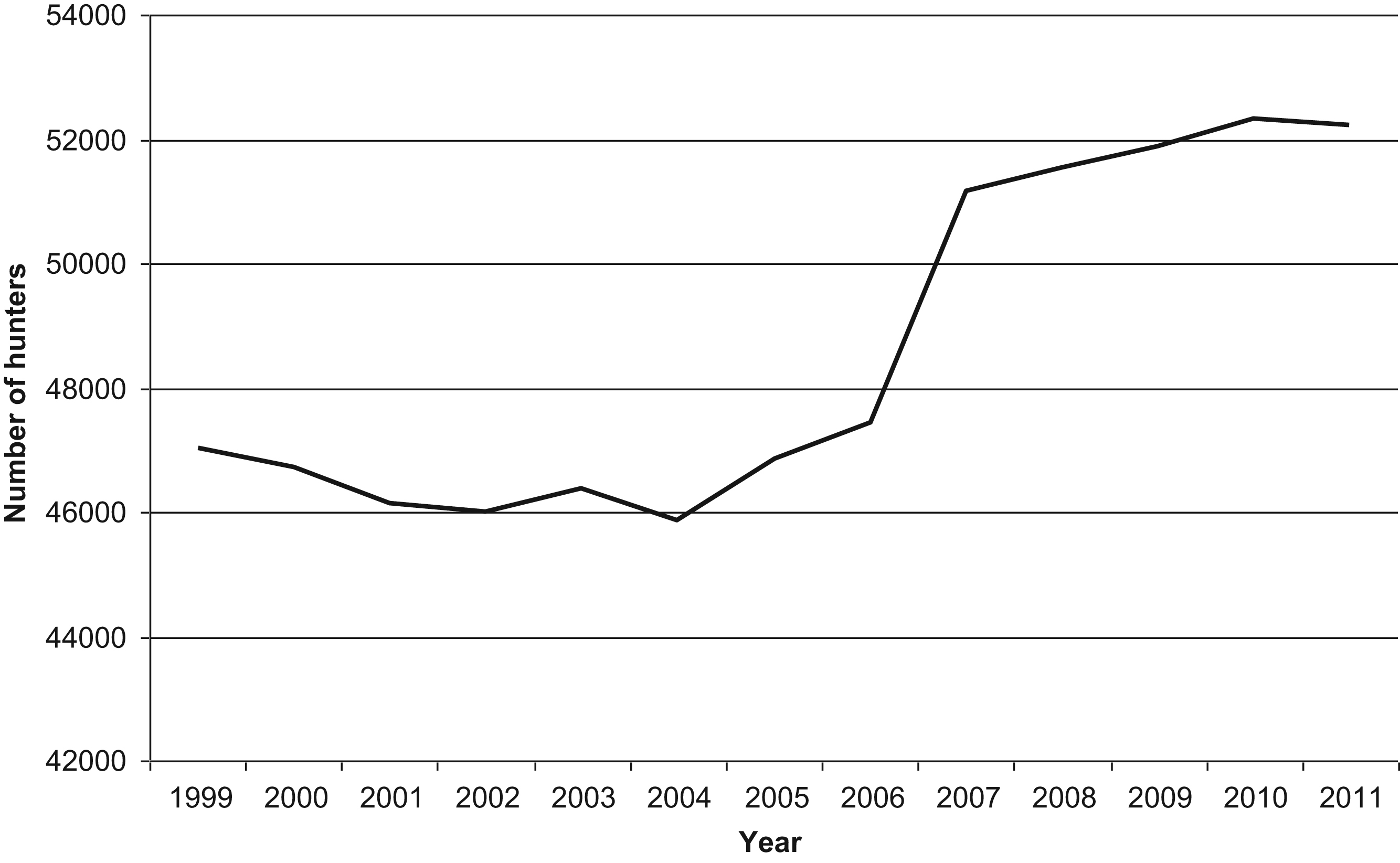
Number of hunters in Croatia over the 13-year period (1999–2011).
Details of all game animal attacks
Case Presentations
CASE 1
A 26-year-old hunter was rammed by a running roe deer buck on the front side of his right thigh during a drive hunt (“driving” or “drive hunt” is a type of organized group hunt where a group of hunters, often with hunting dogs, are herding or chasing animals in a particular direction, usually toward another group of hunters who then shoot the animals; it is a widespread type of hunting in this part of Europe, mainly used for hunting wild boars) on November 13, 2005, at approximately 11:30
CASE 2
A 40-year-old hunter was attacked by a wild boar during a drive hunt on November 3, 2007, at approximately 10:00
CASE 3
A 69-year-old hunter was attacked by a brown bear while stalking a roe deer on September 28, 2009, around 7:15
CASE 4
A 63-year-old hunter was attacked by a wounded wild boar during a drive hunt on November 1, 2009, at 10:00
CASE 5
A 51-year-old hunter was attacked by a wild boar during a drive hunt on November 14, 2010, at approximately 9:30
CASE 6
A 62-year-old hunter was attacked by a wild boar during a drive hunt on November 15, 2010, around 8:30
CASE 7
A 46-year-old gamekeeper was attacked by a wild boar during a tour of the hunting grounds on March 1, 2011, at approximately 11:15
Discussion
Wild boars, the most common attacking animals in our study (5 of 7 attacks [71.4%]), have a typical attack pattern that results in a localized pattern of injuries on humans. They first charge and bite, often from behind, resulting in injuries to the lower extremities; and if the assault continues and the victim is knocked to the ground, more dangerous and severe secondary lesions may occur in any anatomic location depending on the relative position of the victim and attacking animal. 18 These secondary injuries, which can be very serious or even fatal,4,7 were not present in our series.
Nearly all of our 7 injured hunters recovered completely and without significant complications. All who sought medical attention received timely emergency and surgical treatment as well as immediate vaccination (tetanus toxoid booster, rabies post-exposure prophylaxis) and single or dual antibiotic therapy, as recommended by some authors.18,19 The ultimate outcomes of animal-inflicted injuries can be affected by the timely application of initial first aid and resuscitation. In Croatia, first aid education is not part of the mandatory education course for hunters, unlike in other European countries; we propose that this be incorporated into the obligatory education curriculum for hunters and gamekeepers in Croatia to improve field treatment and on-scene management of animal inflicted injuries.
Most superficial injuries with minimal depth of penetration can be managed with simple wound care by local practitioners. Deeper or more severe injuries that may require surgical exploration should be transferred to a hospital environment where this is available. Deep penetrating injuries, which have higher risk for developing infections, and severe life-threatening injuries demand a multidisciplinary hospital approach including surgeons, microbiologists, neurologists, and rehabilitation medicine specialists to achieve the best recovery possible with good cosmetic and functional results. Of course, there are many more variables that need to be taken into consideration besides just the depth of penetration, so a thorough examination of the injury and the patient’s complete health state as well as the animal species and the individual animal (if it is caught or killed) must be conducted. The wound must be cleaned, followed by debridement, and then by a thorough wound exploration to seek out all potential injuries to anatomical structures (muscles, tendons, blood vessels, and nerves). 20 A high-risk patient with comorbidities will require a more thorough evaluation and potentially more aggressive treatment than that needed for an otherwise healthy person.
The use of prophylactic antibiotic treatment of wild animal bites is based on experience gained from treating domestic animal bites, 21 but most experts recommend their use for high-risk cases, especially when primary closure of the wound is performed. 18 ,19,22 The choice of antibiotics for treating animal bite wounds should be based on considering all potential pathologic microbial agents present in the animal's oral cavity and the victim’s skin. However, there are few data available about oral flora of some wild animals. It is reasonable to assume that wild boar oral flora may be similar to that of domestic pigs, and therefore may include Staphylococcus spp, Streptococcus spp (including S sanguis, S suis, and S milleri), diphtheroids, Pasteurella multocida and other Pasteurella spp, Mycoplasma, Haemophilus influenzae, Actinobacillus suis, Flavobacterium group IIb–like organisms, Bacteroides fragilis, and other anerobic gram-negative bacilli. 23 –26 Amoxicillin plus clavulanic acid or a combination of ciprofloxacin with co-amoxiclav is recommended for the prophylactic treatment of pig bites.24,25 For extremely high risk cases, intravenous benzylpenicillin, fluoxacillin, and metronidazole, together with ciprofloxacin orally are advocated. 25
Primary closure of animal bites leads to faster wound healing, shorter recovery time, and better aesthetic outcome, but may increase potential risk for wound infection. Proper selection of primary versus delayed closure should take into consideration the relative risk, including characteristics of the wound itself as well as the time passed from wounding to treatment, the injured person's health state, and potential infective microorganisms that can be found in the attacking animal’s oral cavity.
As evident in our second case and fourth through seventh cases, in which our victims had penetrating injuries inflicted by a wild boar, the surgeons opted for primary closure where sutures were necessary and antibiotic therapy for 7 to 10 days, unlike the recommended prophylactic therapy for 3 to 5 days. A longer duration of antibiotics as a treatment dose was chosen over prophylactic doses because the risk of infection in primarily closed animal wounds is greater than in those allowed to heal by secondary intention. Because none of our victims had infections after primary closure combined with immediate therapeutic antibiotic therapy and had fast recovery with great cosmetic and functional outcome, we would suggest further research into this treatment protocol as a potentially widely accepted treatment strategy.
After a retrospective review of game animal attacks on hunters during a 13-year period in Croatia, we can conclude that these occurrences are rare and suggest that, in this respect, hunting in Croatia is safe compared with hunting in some other countries, such as Kashmir, where 203 animal attacks occurred during a 3-year period (2005–2007); 2 Alberta, Canada, where there were 42 reported fatal and serious injuries to humans by bears over a 38-year period (1960–1998); 9 British Columbia, Canada, with 72 reported fatal and serious injuries over a 37-year period (1960–1997); 10 Tanzania, where 871 lion attacks were registered during a 15-year period (1990–2005); 11 South Africa, where 7 tourists were killed by wild mammals during a 10-year period (1988–1997); 6 and in the United States, North Carolina reported 92 deaths in the 17-year period from 1972 to 1989. 3 In our series, there were no fatalities, and the game attacks resulted mostly in soft tissue injuries, from which most of the victims recovered completely. Game animals do not generally pose a threat to humans in Croatia, but hunters should be aware of the possibility of attacks, especially during the busy hunting season between November and January.