






Abstract
Attacks on humans by wild boar (Sus scrofa) are occasionally reported in rural areas of Turkey. While fatalities are rare, individuals may sustain significiant soft tissue trauma. Lower extremity lacerations of up to 10 cm in length and 4 cm deep were seen in the 3 cases reviewed. Injuries to the upper abdomen and chest occured in one case. Attacks frequently occur in forested areas covered by dense brushwood, and their incidence is increased during the rutting season. In contrast to other large, feral animal attacks, injuries sustained from wild boar typically are limited to the lower extremities. This case series examines 3 attacks by wild boar in rural Turkey.
Introduction
The boar is a feral pig similar in appearance to the domestic pig except that the lower jaw has 2 canine teeth protruding outward and upward like tusks; these teeth are used for fighting. The wild boar is an animal widely found in forests and maquis areas in Turkey. Agricultural land, pathways, and animal pastures near such areas are locations in which humans encounter wild boars and may be subject to attack.
The wild boar of Europe is labeled Sus scrofa; various subspecies have been identified. Sus scrofa scrofa may be found anywhere in North Africa, Europe, and Asia; Sus scrofa ussuricus inhabits North Asia and Japan; Sus scrofa cristatus inhabits the Asia Minor Peninsula, India, and the Far East; and Sus scrofa taiwanus inhabits Taiwan.
European adult males can weigh up to 200 kg and have both upper and lower tusks; females do have smaller teeth but lack the large canine incisor tusks and are considerably smaller than males, although they can still weigh up to 120 kg. 1 The animals are usually nocturnal, foraging from dusk until dawn, but with resting periods during both night and day, since hunters are most active during the day. They eat almost anything they come across, including nuts, berries, carrion, roots, tubers, refuse, insects, small reptiles, bird eggs, and even young deer and lambs.2,3
Wild boar have excellent hearing and sense of smell, but poor eyesight. Boars shy away from human contact and are not dangerous to humans, provided they are left alone. When provoked, they are known to attack ferociously and repeatedly with their sharp tusks. 2
Case 1
A 46-year-old female patient presented to the emergency department following a wild boar attack, which she sustained at 10:30
Case 2
A 47-year-old male patient presented to the emergency department following a wild boar attack sustained at 11:00
Case 3
A 35-year-old male patient presented to the emergency department following a wild boar attack at 9:00
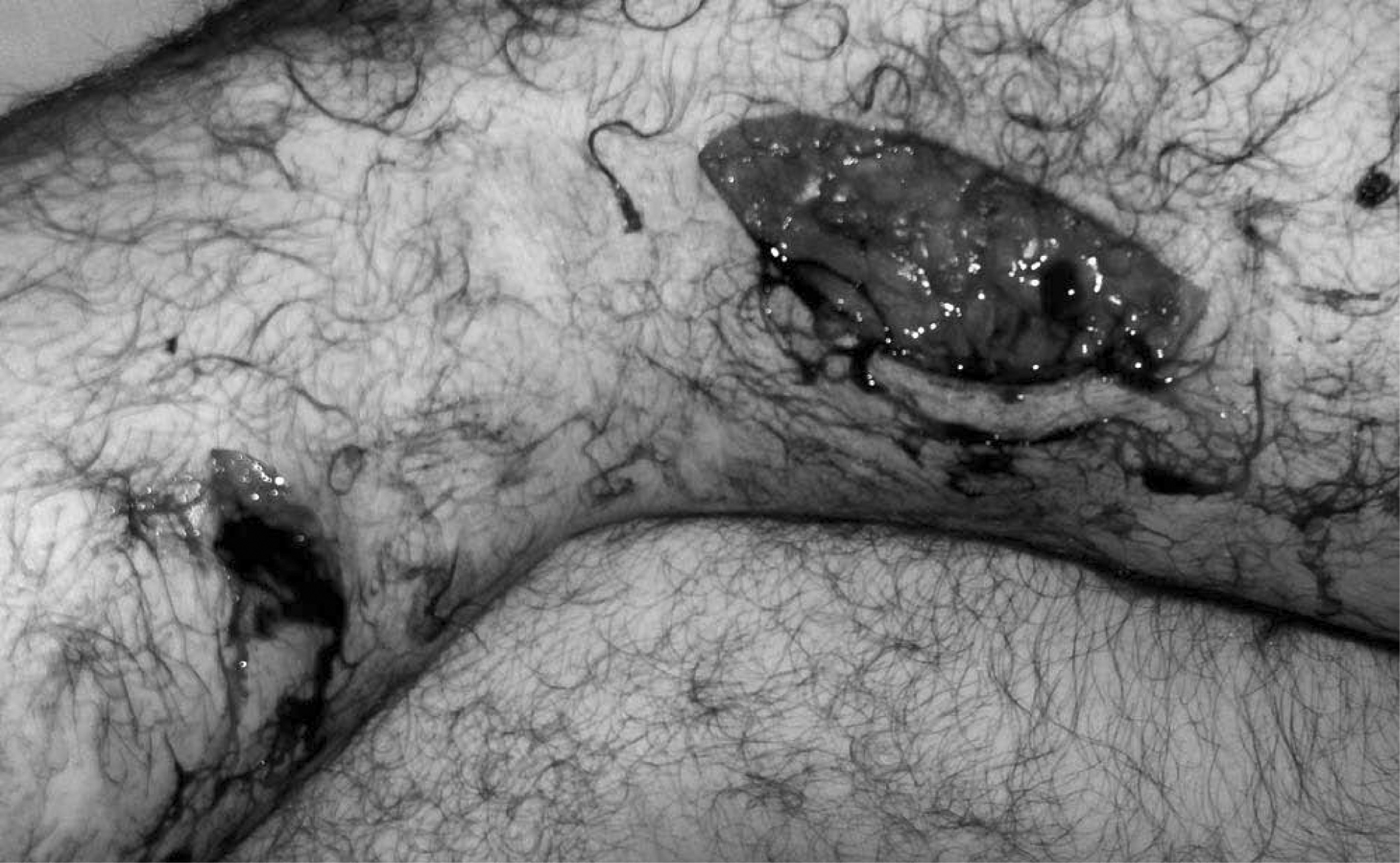
The photograph shows a 10-cm skin and subcutaneous tissue laceration on the posterior of the right distal thigh and a 4-cm laceration on the right proximal lower leg
Discussion
Injuries resulting from wild boar attacks generally occur in the lower extremities and lower-abdomen region. This pattern is related to the height of the animal. Following the initial assault the animal generally turns and attacks repeatedly. This results in victims frequently having more than one injury site. In our cases the injuries primarily occurred below the epigastrium. In one case there was a wound in the anterior wall of the thorax. The victim in this case stated that he had suffered a second attack after falling onto some bushes. Although the injuries in our cases were generally restricted to the skin and subcutaneous tissue, organ injuries and injuries penetrating the abdomen have been reported. 4
Wound cleaning, debridement, and tetanus prophylaxis are recommended after wild animal attacks. Most wild mammals can become infected with rabies. So, every suspected wild mammalian bite patient should be considered for rabies vaccination.5,6 Antimicrobial treatment should be administered for all bite wounds, with the exception of wounds in those patients who present 72 hours or more after injury with no clinical signs of infection. Antimicrobial therapy for bite wounds is not usually prophylactic but rather represents a therapeutic intervention. Antibiotics chosen for prophylaxis or treatment should be based on bacteriology. The role of prophylactic antimicrobial therapy in bite wounds is uncertain. However, because these wounds are usually contaminated with potential pathogens, it is advisable to treat with antibiotics all patients having deep bites, including puncture wounds, facial bites, and any wound over tendons or bones. 6
Organisms recovered from domestic pig bite infections include Staphylococcus species, Streptococcus species (including S. milleri, S. sanguis, and S. suis), diphtheroides, Pasteurella multocida and other Pasteurella species, Haemophilus influenzae, Actinobacillus suis, Flavobacterium IIb–like organisms, Bacteroides fragilis, and other anaerobic gram-negative bacilli. 7
Some bite lacerations can be safely and cosmetically primarily sutured. If closure is desirable for cosmetic or functional reasons, a skilled practitioner should perform this procedure under optimum conditions. Delayed primary closure is a technique that has been used successfully in contaminated wounds and should be considered in the management of bite injuries. 8 Patients in our cases were sutured following irrigation.
Wild boars live in groups called sounders. These sounders typically contain around 20 animals, although groups of over 50 have been seen. A typical sounder contains 2 or 3 sows and their offspring. Adult males are not part of the sounder outside of the autumnal breeding season and are usually found alone. 1 In our cases attacks generally took place in the form of assaults by 1 animal from within the sounder.
Attacks generally take place during the rutting season between November and January. All 3 of the attacks in our cases took place in January. Attacks generally occur in agricultural land bordering forests or maquis land or on pathways running through such areas. The attacks in our cases occurred on agricultural land bordering forests and during wood-cutting episodes in forests. Attacks have been reported in Turkey while victims were grazing sheep in forests, during film production in forests, while victims were traveling to another village, and while victims were traveling from one house to another within a village. 9 –12 Hunters have also been attacked by injured wild boars. The reduction in the size of forest areas and the consequent shrinking of the animals’ habitats have inevitably led to the situation in which a greater number of wild boars are encountering human beings.
There were no fatalities in our cases; the attacks resulted in soft tissue injuries. However, cases ending in death have occurred in Turkey. 10 In conclusion, although wild boars are known to be animals that do not generally pose a threat to human beings, people working on agricultural land bordering forests in regions known to be inhabited by wild boar herds need to be made aware of the possibility of wild boar attacks in the mating season between November and January.